Showing posts with label Cinema 2006. Show all posts

Friday, May 25, 2007

Cinema 2006: Old Joy


One of the defining "problems" of cinema is representation. Rarely can an image merely exist. Documentary or fiction, all movies in some form or another adhere to a narrative structure, therefore any image of that movie is constructed and positioned in relation to that narrative framework. The nature of that structure may differ, but since cinema is itself a culmination and extension of various art forms, narrative media and technologies, it has been positioned in a narrative spectrum from which it cannot escape.

While Deleuze may have been overly simplistic in labeling Italian Neo-realism as the liberating movement in cinema, his summation generally holds up insofar that many films of the neo-realism variety were explicitly reflexive of classical styles and refused to adhere to a connect-the-dots mode of film language that the early days of cinema necessarily offered. While much of American cinema moved along that same plane of film language (keep in mind that I'm writing in generalities so as to avoid a dissertation here), neo-realism films created gaps in films language, turned the system of signification that the moving image had become upside down and explored narrative possibilities from a standpoint of subtlty and abstraction. It was still reliant upon those very classical traditions in order to deviate from them, but they opened up what Deleuze calls the time-image, an image free from representation despite being made possible through its properties. The time-image may or may not more stringently adhere to classical narrative structures, styles, and traditions, but the key is that it expands upon them and confounds the comfortable familiarity of their cliches. The time-image does not allow the spectator to see less than the image, but rather enables her to see the whole image, in so doing moving beyond mere representation. This notion best surmises Deleuze's claim that cinema is another world altogether, not a symbolic representation of one.

Kelly Reichardt's Old Joy seems to me an extension of the essence of neo-realism. From a narrative standpoint, it is straightforward, chronicling the overnight camping trip of two old friends. Structurally, Old Joy exhibits simplicity, starting with Mark (Daniel London) receiving a call from his friend, Kurt (William Oldham), inviting him to meet up and hike through the woods of Oregon. Although this short description encompasses the extent of the introduction from the standpoint of plot, the film announces itself as one of real images (despite their apparent lack of stylization) and subtly stated emotions from its opening shot (a bird sitting on the roof of Mark's house). The actors' faces envelope the frames; Mark and his pregnant wife share few words in the film's opening scenes, but in the camera's intimate observation of both of them, the spectator can explore the same ambiguity transpiring between the characters. Nothing is really stated. We don't uncover any plot points other than is made visible in the compositions. Instead, we have an emotionally complex visual design through what appears to be simplicity.

I am spending so much time on this opening sequence because it establishes an atmosphere that permeates the film, setting up the viewer's knowledge of Mark and his wife before incorporating Kurt into the narrative. From a representational standpoint, we can gather what we know about Mark and Kurt based on the images and the dialogue, but this film is not about easily compartmentalized feelings and actions. It's about the feelings underneath the memory.

When the two meet up and begin their trip, the film enables the viewer to immerse herself in the lives of these individuals through the sublimity of the "ordinary" images. The images in fact are far from ordinary and capture every small detail of Kurt and Mark's relationship - from joking at the gas station, uncomfortable pauses when they scramble for things to talk about, shooting cans with beebee guns, and conversing about their lives over the past 20 years in short sentences, carefully phrasing their thoughts do to their own uncertainties about themselves and each other. All the while, the emotions conjured by the images is both hard to pinpoint, yet overwhelming in their nostalgia. The spectator knows nothing about these people outside these few days it follows them. We only know the extent of their relationship based on their own insider accounts of old memories. But this coupled with the observant nature of the film's images - whether it's panning the tree tops or lingering on facial expressions - result in a joyously bittersweet experience of reminiscing and enjoying the transient beauty of an old friendship. The backdrop of the densely wooded forrest only further emphasizes the isolation of such feeling and memory, and the film's contrast of these men and the woods they walk in builds the perfect atmosphere in which to set this nostalgic journey.

In its gentle simplicity and seemingly straightforward observations of these characters on two days of their lives, Old Joy builds a relationship between spectator and image brimming with ambiguity and nuanced emotion, mirroring the relationship between Mark and Kurt. Tensions are abound, and as much as we would like to easily categorize the aspects of the relationship and the feelings emerging from it, such simplicity is not ever possible within the seemingly simple relationship. The main struggle within the spectator/image relationship is (in general terms) the confusion over obervation and identification. Both infer a greater idea of representation, as if the viewer's observation of these characters triggers one's own experiences, thus we have identification through observation. Are we the characters or are we watching and identifying them? Further, what does it mean to "identify" with a character at all? Questions such as these are immensely difficult to answer, even if one has unlimited time and space to do so. They concern the greater relations between individual and cultures and narrative/cinema. With regards to narrative, cinema does separate itself in its visual nature. The purpose of narrative is to form a representation, but the very idea of seeing and hearing an action existing in its own place and time seems to conflict with this notion.

Old Joy exemplifies this relationship between spectator and image. And this comes through in dynamic of the characters and the deeply intimate portrait presented by Reichardt that both lets us into their minds, yet keeps us at a firm distance, as if to remind that every moment and every aspect of lived experience is subject to perception and interpretation. That tension defines Kurt and Mark's relationship as it does the cinema/spectator duality. While it ultimately introduces so many questions in its presentation of this narrative and these characters, what underlies the images and narrative structure is an examination and reflection on the very idea of experience and nostalgia. The images then serve to reflect the ambiguities and abstraction shared between two people whose experiences cannot be surmised by the language between them, but intead by the memory and feeling of such experiences.

Old Joy's sublime images and simple presentation of narrative exhibit a beauty about cinema (as a medium) that no amount of critical rumination can capture. Mark and Kurt's relationship - all its struggles, misunderstandings, and beauties - is not suggested through (or represented by) the images, but rather exists in the images themselves and our perceptions and interpretations of them. That is cinema, and that is the human sociocultural experience.

Tuesday, February 13, 2007

Cinema 2006: Cinematic Magical Realism


Grappling with both the necessity and absurdity of narrative, Pan's Labyrinth may very well be the standout film of 2006. Its backdrop—fascist Spain—is not so much a setting as it an an integral element of the story. Director Guillermo Del Toro's camera closely observes the experience of Ofelia, a young girl incapable of comprehending the horror around her but nonetheless possesses an intuitive understanding of the dehumanization that permeates her life and country. She flees into a world of imagination under the instruction of the mysterious faun, who tells Ofelia that she must perform a series of tasks so that she may claim her throne as princess of a fantasy world.

Pan's Labyrinth lures you in with its fantasy underpinnings and establishes a constrast with war-time reality. Del Toro carefully constructs each frame with care, marrying sound and image together to form a beautiful world of magical realism. His images allow the spectator fully into the childlike perspective of Ofelia, positioning you to hope that each imaginative adventure serves as a sufficient escape from the brutality of her step father, who also constructs his own reality based on fascist ideology. His reality, however, infests the social structures of the time, and, thus, he wields unmistakable power and influence over the people around him. Del Toro is so commanding of both the narrative and aesthetic, which is essential given the film's focus on the function of narrative in the interpretation of our perceptions of the world. Imagination is absurd in many ways, but it is wholly essential to grappling with experience. A stunning sequence near the beginning involving Ofelia talking to her unborn brother in her mother's womb illustrates this well, incorporates sublime, fantastical images in a free-flowing yet succinct manner. The images coupled with Javier Navarrete's ethereal, lullabye-esque music represent one of the film's key scenes.

Allegorical parallels abound, but Pan's Labyrinth is restrained in its presentation of details, capturing both magic and horror in equal amounts while balancing the story between a character based war drama and a fairy tale. Where most stories would take this setting at face value, Del Toro makes it a more prominent element of the story than the imaginative world into which Ofelia flees. He is very sparing in how he incorporates the fantasty aspects, and he is also treats them with darkness. Ofelia's world is not happy-go-lucky by any stretch; it is a strong reflection of how Ofelia views and participates in the reality of her own life. As the narrative progresses and we are exposed to the brutal reality of Ofelia's life, it is easy to understand her imaginative impulses as more than a trivial distraction from the goings on of the dehumanization around her. But Del Toro knows full well what he's doing and allows the proceedings to culminate in a climax so poignantly hopeful and bittersweet. It isn't until the film is over that you can really put together the pieces and discover what Del Toro is after, and yet the ultimate meaning is open to interpretation.

The similaraties and contrasts between the two worlds serve as an inquiry into not just national and personal ideology, but the reality of experience. Our experience with the world outside is mediated by the circumstances of our personal upbringing and exposure to social policy. Del Toro evokes this by building a brilliant narrative within these two worlds and never quite allowing the spectator to entirely be inside one without the other. Moreover, this simple contrast reveals itself to be much more complex than we might initially anticipate. In the end, no amount of praising metaphors or adjectives can contain just how beautifully simple yet dizzyingly complex Pan's Labyrinth is. It is a masterpiece.

Tuesday, February 6, 2007

Cinema 2006: Narrative and Visuality

I recently came across this interview from last month with Alfonso Cuaron about Children of Men:

"What I hate is when cinema is hostage of narrative...

Let cinema breathe, in which narrative is an element of the cinematic experience, but it's [just] an element, as acting is an element, cinematography is an element. Music and decors, those are elements. But right now? Cinema becomes just about seeing illustrated stories as opposed to engaging audiences in an experience in which you don't explain much....

The principle of cinema is that you are looking at that screen. A lot of reviewers nowadays, they fall into that vice: they want stories. They want explanations, they want exposition and they want political postures. Why does cinema have to be a medium for making political statements as opposed to presenting facts, presenting elements and then you making your own conclusions -- even if they are elusive? There's nothing more beautiful than elusiveness in cinema."


Cuaron voices a rare and essential perspective about cinema as a visual medium. Too often, critics and filmmakers fail to engage these properties of cinema and, in so doing, miss out on the treasures that it can offer. I wish more members of the film and film criticism community understood that which they study with the same knowledge that Cuaron possesses.

Too many film goers, makers, and critics are focused on plot, exposition, and structure. While it may be true that some films are good precisely because how they incorporate plot elements, they are just elements in a larger picture. Great cinema is about the interaction of all of these elements, and there is no set way of achieving that. The components of each film interact differently depending on how each aspect is constructed and positioned. But cinematic greatness is achieved when every frame breathes with life as a result of such an interaction. Cuaron understands this, and his last three films are testimony to that understanding. Children of Men, Harry Potter and the Prisoner of Azkaban, and Y Tu Mama Tambien all feature meticulously crafted images capable of revealing subtleties in various aspects of the storytelling, which for each film is quite different.

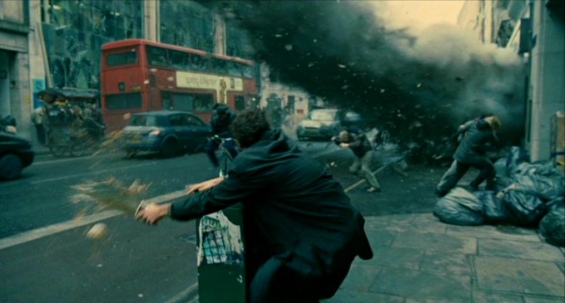
Children of Men fascinates me because it confounds the lines between real and symbolic. Cuaron frames his near-future Britain with an approach featuring many long-take and hand-held shots, which creates a sense of authenticity. He creates a dismal-looking future defined by violence, atrocities, and fear, in which society has crumbled from within because women are infertile. Cuaron never bothers to provide reasons for the infertility, and he doesn't need to. That isn't what the film is about.

In the opening moments of the film, the images are just as focused on the world in which the characters inhabit as on the characters themselves. Furthermore, the film plunges you into its world without much exposition or explanation, which, as Cuaron explains, are almost irrelevant. He is interested in exploring how human beings exist in social spheres, and how they interact institutionally under extreme circumstances. And his observances of violence, death, and imprisonment are startling because the world he has created is oddly familiar, not only in terms of how it was constructed, but what is constructed. The comparisons are at times blunt. Cuaron wants to evoke feelings and thoughts that constitute how we currently relate to and interact with our visual culture and the outside world.

However, by not revealing particular details about the plot with exposition and scienctific explanation, Cuaron contrasts the very real feeling of the film with an allegorical subtext brimming with ambiguity. The focus of Clive Owen's central character, Theo, is ensuring that a miraculously pregnant woman and her baby reach The Human Project, a symbol of hope in the deteriorating world around them. The structure of the film itself performs a highwire act, balancing familiar chase story conventions and motifs while summarily rejecting them by integrating them into the social world that the characters inhabit. The "chase" motifs that inspire Cuaron's action sequences are not so much plot devices as revealing moments of the story and character.

Therefore, the film seems to exist unto itself, as if Cuaron is merely observing this world. The viewer is positioned not to question what occurs within the structure of the plot; a plot which reveals itself to be a symbolic journey simulataneously representing hope and dread. In a conventional sense, the film is about Theo's character arc, but the storytelling stretches far beyond its topical concerns. Theo's story resonates more effectively because of the manner in which Cuaron makes the plot relevant to the style of the storytelling, not the sole means by which the story achieves its weight. The interaction between the characters' mission (the plot) and the world of which they are apart (the social setting) meld seamlessly, yielding moments of pure mastery in the film's climax, in which all of the film's visual styles interact so effectively with the social environment they have created. Amongst the anarchy of gunfire and explosions that eventually unleashes, the sight and sound of a crying baby juxtaposed with images of war and destruction is profound moment of both hope and defeat.

Children of Men conveys conveys its themes in a way respectful to viewer, intwining many ideas and feelings into what could have been a somewhat conventional chase story. Instead, Cuaron's perspective of this world and the need to tell its story in relation to the characters' journey results in a visceral, emotional, and cerebral cinematic experience. Somehow, Cuaron melds these moods and feelings together into a piece of cinema that is beautifully... elusive.

[Note: I originally posted this review on 1/20/07, prior to the current format for my Cinema 2006 series. I've removed that post and posted it here among my other selections. For those who have seen this post before, my apologies. For those that haven't, and I'm sure there are many, this disclaimer doesn't hold any meaning. My mislead quest for perfectionism continues...]

Cinema 2006: Representing Royalty


The Queen (Stephen Frears)

In just a few weeks, Helen Mirren will be awarded an Oscar for her portrayal of Queen Elizabeth II in Stephen Frears' masterful film, The Queen. As Kristin Thompson has pointed out over at her and David Bordwell's blog, actors have a much greater likelihood of winning awards if they portray actual people. When the Oscars aren't awarding actors for most acting (which they refer to as "best" acting), they award actors for their portrayals of renowned historical and contemporary figures. For example, the previous two best Actor winners were Jamie Foxx and Philip Seymour Hoffman for their respective portrayals of Ray Charles and Truman Capote. But I have always felt that portraying a real person as opposed to a fictitious character conditions the viewer to rely on his or her own understanding of the person rather than the actor's creation of that character. Jamie Foxx excellently mimicked Ray Charles in Taylor Hackford's 2004 biopic-by-numbers, Ray, but I'm not sure his performance was as amazing as it was hailed. I think somebody who has never seen or heard of Ray Charles may have interpretted his performance differently and perhaps with less enthusiasm than someone familiar with Charles.

This brings up many issues if expectation and anticipation. It's both easier and harder to play a character with whom so many viewers are already familiar: easy because the actor can mimic that person, thus relying viewers plugging in the gaps with their own knowledge of the person, and hard since creating a character beyond mimicking is incredibly difficult due to those very expectations. Even with peformances that are nuanced, they can often be seen as a mimicking act. The best of actors can somehow tap into the consciousness and expectations of viewers while simultaneously and subtly building a real character existing unto itself, independent of preconceptions. Philip Seymour Hoffman achieved this in his portrayal of Truman Capote. But I should also note that performances are not solely dependent on the actors portrayal of a character. No element of a film stands independent of the other components that make up the film; each detail has a context and achieves its effect based on its interaction with these other elements. A film is elevated to greatness when all of these details flow together and improve upon each other. Hoffman had the benefit of not just a great screenplay but a director that was able to use this character as a springboard for exploring many abstract concepts and narrative threads. That film fixated itself within a space and time so vividly and operated fluidly on various levels that it's hard to be aware of just how great it is on first viewing for the reason that it so absorbs you in this character and the world. The point of emphasis in mentioning Capote is that no performance is in a vacuum. It both determines and is determined by the surrounding elements of a film, even in performance-driven films like this.

Now, moving on to a discussion of The Queen, it is impossible to convey the beauty of this film without mentioning Helen Mirren's staggering performance. Director Stephen Frears focuses his film on the week surrounding Princess Diana's death, a week that many of us remember so well. In a sense, he handicapped himself in dealing with something that was such a huge focus of media attention and one of the great media events of the last century. He further put himself at a disadvantage (from a viewer expectation standpoint) by constructing a narrative that conditions the viewer to identify with the one person who was most reviled through the proceedings. And Frears has made a film that not only both shatters and comments on viewer expectations based on media representation, but also makes a profound statement about public perception of any subject as filtered through the media.

Helen Mirren's performance is quietly heartbreaking. It is the result of an actor's amazing technique as well as a director's understanding of the above issues of media and how it shapes ideology. In its depiction of the reserved queen, the film is an intimate account of an individual forced to act within that spectrum, forced to relegate herself to a media image for public consumption, in so doing realizing that the idea of her figure is all that others will see and all that she has become. Mirren and Frears channel these concepts through the media whirlwind of events surrounding the death of Dianna as well as through the contrast of worlds and ideas of members of the British government. The film also focuses on recently elected prime minister Tony Blair (Michael Sheen), who struggles to get through to the queen when she refuses to bow to the people's demands of making an appearance or showing any remorse. Blair is more in tune with how to function within the media realm and how government must cooperate with media outlets in order to have a relationship with "the people." The film's contrast of ideology and communication within the two sects of government - the stagnant old-fashioned ideals of royalty versus the modernized, tie-wearing media soldiers of the "new" Britain - gives the film and its characters so much life, and it does so primarily in its intimate portrayal of a broken woman and how she relates to the people around her depending in their positions. Beyond the ideology and modernization issues that the film tackles, on a more personal level, the film is about appearances and perception. We as spectators have a very intimate perspective of the proceedings as they are seen through the views of different participants. It doesn't do anything stylistically extraordinary and it doesn't judge its characters, all of whom seem to withhold judgements of the the individuals with whom they interact until they are in the presence of others. Through it all, Frears' camera simply observes. The film shows confidence in its story and characters in presenting presents its narrative in a simple manner.

There is a moment somewhere in the middle of the film in which the queen, separated from everyone and everything around her, is somewhere in the hills of her massive estate. No family members, no phone calls or cameras, no portraits of her or previous royality hanging on walls. And in this moment she sees the stag that several characters had been hunting through the film. It looks right back at her and she smiles. Knowing that someone may be nearby to try to shoot it, she encourages it to run away, although it doesn't understand. It's a brief, passing moment, seemingly without any relation to the events of the plot. But in that moment, all of the film's concepts and feelings come together in a series of images of fleeting hope. Blink and it will be gone, and that is precisely what happens. Short-lived as it is, that exchange of images resonates back through what we have seen and what lies ahead in the film. For that one moment in time, there are no barriers to prevent understanding or decide perception. The whole film is in that one moment; the loneliness, the joy, and the bittersweet realization that in just a few seconds it will be over.

Monday, February 5, 2007

Cinema 2006: Redefining Cinematic Space

In defending her reasoning for naming Miami Vice as one of the year's best films, New York Times film critic Manohla Dargis cites the film's exploration of cinematic space. I agree with Dargis completely, and would argue that Michael Mann uses the digital medium to breathe life into the fairly simple cops-and-drugs story. Mann constructs beautiful images and sounds to create cinematic space dripping with moods and atmosphere which seeps into every area of the storytelling. In doing so, he explores the depths of his characters more fully with an atmosphere that is both seductive and brimming with danger. The structure and dialogue of this film are nothing extraordinary, at least viewed in relation to similar films of the genre. But Mann proves that how ever well-treaded or generic a plot may be, there are always different ways both stylistic and structural of executing it visually.

For instance, there is a very straightforward exchange between two characters on a speedboat midway through the picture that is charged with an eroticism only brought to life through the interaction of the elements within the moving images. Actions that would be processed without much conscious thought in a different film are here fascinating, whether it's in how the wind blows their hair or causes their clothes to ripple. The whole film is made up of these moments, and seeing them within a familiar narrative structure makes it even more interesting and original, as opposed to if it wasn't steeped in genre tradition. But Mann's juxtaposition of the new and the familiar results in a visual and auditory experience of pure intoxication that is both real and dream-like.

Valuing style over substance (forgive the cliche, but it's useful in this context), the film blends familiar narrative norms with new images, allowing the viewer to see and feel the story in a completely new way, despite being grounded in very conventional traditions. Mann not only redefines cinematic space with this film, but he also redefines the presentation sexuality, violence, gender, identification, and representation within a familiar narrative framework, thus reimagining the possibility of visual storytelling.

Wednesday, January 31, 2007

Cinema 2006: Responsibility and Redemption


L'Enfant (The Child) (Jean-Pierre Dardenne and Luc Dardenne)

While watching the Dardenne brothers' latest film, I was reminded of Vittorio De Sica's Ladri di Biciclette (The Bicycle Thief) (1948). Like the Italian Neo-Realism masterpiece, this film tells a very intimate story one boy (or child), Bruno. However, instead of falling victim to the unfortunate events, this film depicts this character (played by Jeremie Renier) as the catalyst of actions that hurt himself, and more importantly, his girlfriend and child. In this film, the camera observes him and those around him so closely that as he makes mistake after mistake, what likely begins as passing judgement on Bruno evolves to sadness as we see the results of his actions and unwillingness to change.

Adopting a more organic approach to depicting Bruno, which includes hand-held camera work and very long takes, the Dardennes familiarize viewers with the nuance of this character, as if allowing them to peer right into his soul. But despite filling the story and images with heavy symbolism, the directors aren't overt when it comes to messages. Instead, their camera looks upon Bruno lovingly, as a parent would of a child who continues making mistakes. At the same time, as close as the camera gets to the boy's relationship with his girlfriend and following his every day actions, it never feels instrusive, and as the story evolves, its manner of capturing his action does as well.

While the film embodies many of the characteristics of a morality tale, it doesn't feel nearly as staged or preachy. As the story reaches its conclusion, we see the slightest bit of change in the boy's eyes as he attempts to take responsibility, but the story doesn't have Bruno becoming a different person or succeeding in the end. Rather, it shows him taking a step, which means much more because of how the camera has observed and depicted him as the film reaches its final heartbreaking and redemptive scene.

L'Enfant could have very easily been a fluffy inspirational redemption story, but, even though the story progresses along such a line of plotting, the film is more genuine because of how it follows Bruno so intimately while avoiding the invitation for the viewer to pass moral judgement. By subtly inviting the viewer to contemplate issues of responsibility and the consequences of what may seem to be simple but potentially very destructive decisions through the (real and symbolic) actions of Bruno, the Dardennes elevate the story beyond a phony morality tale that instructs its viewers how to think and feel.

L'Enfant is a close study of a person who makes wrong choices and slowly inches his way towards understanding his own motivations and how he hurts those around him. The Dardennes simple trick is in creating a narrative that (unlike other narratives) positions viewers not to be judging voyeurs, but to empathize with person who makes bad decisions. That empathy results from stylistic choices, true, but it really arises from the viewer's acknowledgement that every person makes wrong decisions. Every father may not abandon his son or mistreat his loved ones on the scale that Bruno does, but seeing his story depicted so honestly taps into all the little things people do to arrive at the same destination that Bruno does.

Monday, January 29, 2007

Cinema 2006: An Intimate War Picture


I should first note that I have not yet seen Flags of Our Fathers (though I will be doing so in February, when it is released on DVD). Most of the critical perspectives I have encountered concerning this film have approached it in relation to Flags, which is why it's pertinent to mention. More to the point, this film is a powerfully cerebral and emotional examination of organized violence that frames national ideology through the prism of the feelings of soldiers on the front line approaching their doom. It depicts the battle of Iwo Jima from the perspective of the outnumbered and nearly hopeless Japanese soldiers charged with the task of defending the island. One of the film's great strengths is that it communicates so much thought and emotion through very traditional storytelling and cinematic styles, i.e. flashbacks, voiceover letter writing, but what separates the presence of such devices in this film is that they contain subtleties that are largely unexplored in many other films, in particular war cinema. The film chronicles the feelings of various characters from all levels of the military - from the commanding General (excellently portrayed by Ken Watanabe) to a lowly infantry member - through the letters they write and the memories they recall while writing them.

The film is an intimate study of several characters attempting to uphold the ideals of country and honor but are most loyal to their wives and children. Eastwood also examines war from a greater humanist perspective, offering a subtle exploration of personal and national perspective while at the same time capturing the notion of how the institution of military and its ideals allows one to filter his or her perception of violence and the perception of the "other," or the enemy, and an understanding of country and honor. The vivid images of soldiers taking their own lives will live with me forever, and while they are capable of conjuring so much emotion, Eastwood's subtle exploration of perception and identity and how they relate to organized warfare is powerful and cerebral.

But Eastwood never slams you over the head with messages. The beauty of the film is its simplicity. Its themes may seem broad since they are the focus of many war narratives, but Eastwood's honest and contemplative narrative exposes many of those stories for how superficially they attempt to understand such issues. He is more interested in observing the inner feelings and behavior of those engaged in war than simply manipulating characters as narratives devices for pushing an anti-war messaged story. His film is far deeper and more knowing than that. His narrative devices only work because of sublimity with which he imbues the images of death and how soldiers react to it. It goes without saying that the performances strike a resonant chord within the world that the shadowy images have created.

Throughout his career, Clint Eastwood has attempted to grapple with mortality through many different storytelling styles and images. With each story he tells, he provides a uniquely different perspective on not just the ability to take another person's life, but the feeling of powerlessness your own is stripped from you, which is the focus of this film. All of the memories, thoughts, insights, and feelings of each man that dies in the name of some greater ideal is terminated as he becomes just another body amongst bodies. Every time a man is killed and his life drains away, Eastwood forces you to take notice where other films have not. He is not merely throwing you into the lion's den and making you feel the viscera of battle; he wants to understand the feeling underneath it, whether that be fear or exhiliration. He doesn't push any ideas on the spectator. His brilliantly focused story is instead interested in inquring into how a human being grapples with facing his or her own mortality as well as the worth of national ideals and ideas such as honor.

Cinema 2006: Descending Into Darkness


Neil Marhshall's horror masterpiece The Descent is an homage to the narrative style of classic horror films from the 70's and 80's. For viewers who think that horror cinema has something to offer beyond blood and guts, seeing this film is a nostalgic experience. Marshall's stylistic influences are many, from George A. Romero to James Cameron, but what makes this film so significant to the horror cannon is that it doesn't treat its characters as card board cutouts meant for devouring. Focusing on woman named Sarah as she struggles to deal with a monumental tragedy, the plot involves her and several friends spelunking through caves underneath the Appalacian mountains. What happens within the caves reflects the fear, rage, and guilt felt by Sarah, representing a physical and mental descent into darkness. But Marshall refuses to make the mistakes M. Night Shyamalan's committed with Signs, in making the actual plot too heavy on symbolism and lacking in any real feeling in the process. Marshall's images are capable of representing or symbolizing many things (For more on this, check out Jim Emerson's excellent imagery analysis of The Descent), but he cares very much for the characters and doesn't let the imagery overtake the immediate emotions of the story.

This film brilliantly guides the spectator on descent into physical and mental darkness, and there is surprising ambiguity as to the "meaning" of the plot beyond its thriller core. Marshall instead makes the film a journey just as much for the spectator, building moods and and relationships between characters, luring the spectator in before unleashing an experience so physically and mentally frightening that the darkness and brutality of the last act seems to take on a resonance of its own. But it works because of Marshall's careful construction of the film's characters, moods, images, and themes, which together culminate in an inescapable nightmare of dread and darkness.


The Descent borrows its scare tactics and storytelling techniquies liberally from the horror classics of the past, but Marshall gives them freshness because he has a story to tell and isn't interested in replicating those influences. He lively incorporates them into a carefully constructed narrative framework that is rarely seen in the horror genre these days. To me, this film is Marshall's cinematic argument to remind viewers that horror not only can still be scary good fun, but that it is capable of much more as storytelling. Plunging the spectator into the primal depths of the mind and soul, The Descent is one of the finest pieces of horror cinema in years.


Note: I have seen both the American theatrical cut and the original British cut and recommend the latter, which is available in a director's cut DVD format. The only difference in the two cuts is in how the film ends, with the American release bowing to a more generic shock ending and the British cut offering thematic closure and ambiguity while remaining consistent with the narrative threads and style. Despite exemplifying much of what is currently wrong with horror cinema, the American theatrical cut makes for interesting contrast, consideration, and discussion about the conventions of the genre in relation to the original cut. From that perspective, I recommend seeing both. But if you're choosing between the two, make sure it's the director's cut.

Friday, January 26, 2007

Recapping the Cinematic Year

In framing this introduction to my assessment on the year in movies, I'd like to address the now cliche observations that many critics apparently reflect upon at the end of each year. I find that negativity often pervades many top ten lists. Critics routinely provide commentaries about the sorry state of filmmaking seemingly unaware that they emulate (in the form of film criticism) the very faults for which they attack mainstream filmmaking. These commentaries rarely contribute much to the discussion of cinema and are highly selective in what they discuss. As Gilles Deleuze says (as anybody who has ever seen Andy Horbal's blog is aware), "the cinema is always as perfect as it can be."

Though I am fundamentally in opposition to upholding a test-like assessment of cinematic offerings in a given year, I find it relevant to point out particular films that I feel significantly contributed to the medium in some way. This is a broad characterization, but there is no way to fully encompass the capabilities that cinema posseses. Cinema creates meaning in various ways through the relationship of the image and the viewer. What transpires within that relationship is a limitless exploration of feeling through perception and interpretation of moving images, which is why I find it frustrating that so many critics bemoan about the death of cinema. Real analyists and lovers of cinema are instead quite aware that cinema is about endless possibility; it is a complex beast which can be engaged, perceived, and interpreted in an endless number of ways. Cinema is alive and well, and it will continue to be as these possibilities are continually analyzed, reconstructed, re-positioned, and made visible in new ways.

Upcoming is a short list of films that I think significantly contribute to the discussion of cinema. Since I haven't had much of a chance to review each film individually, it is somewhat unfair (not to mention daunting) to devote just one post to all of these films. If I were to do that, I would by limiting the extent to which I could write about each of these films. Therefore, each film will gets its own post, and the content of each post will vary. Some of these reviews will be short, others will be longer. But the element of each film I plan to discuss least is plot. I'm going to assume that readers have either seen the films under discussion or are familiar enough with them to know what each film is about topically. I will inevitably mention characters and plot elements, but I find detailed descriptions of such aspects to be moreorless pointless and very limiting.

The range of narrative and stylistic content of these films varies immensely because each film embodies different elements of the cinematic experience. The one unifying element of each of these movies is that they were all released (in the United States) in 2006. But another thing these films share in common is that - from my perspective - they all showcase the provocative nature of the art form we know as movies.