Showing posts with label Film Criticism. Show all posts

Monday, January 21, 2013

Looking for a silver lining: January capsule reviews


Silver Linings Playbook
“Reckless” is not usually how I would describe a movie, but Silver Linings Playbook is such an egregious misfire that no other characterization would be appropriate. That’s not to say that David O. Russell's film, which has all the moves of a tired romantic comedy, doesn’t have some satisfying features. These include strong turns from Jennifer Lawrence and Robert DeNiro and an evocative rendering of the blue-collar outskirts of Philadelphia. But a handful of good performances and skillful visual grammar cannot overcome the unsettling reality that Silver Linings Playbook unforgivably trivializes a sensitive and difficult subject—mental illness—with silly plot contrivances and a dubious underlying message about blind faith. *½

Beasts of the Southern Wild
Benh Zeitlin’s Beasts of the Southern Wild takes you to a flood-prone locale outside New Orleans called The Bathtub, where a young girl named Hushpuppy sets off on an odyssey. Despite its problematic tendency to ennoble the girl and other members of this community with penetrating insights into the mysteries of life, Beasts nonetheless authors a rich portrait of a world far removed from the social and commercial restraints of modern society. Moreover, the film’s most distinctive trait is that it seamlessly melds a gritty brand of realism with sweeping emotional gusts and fantastical visions of folk legend that come to play a major role in Hushpuppy’s coming of age. ***

Looper
Looper has everything a good science fiction film should offer, including a new spin on an old concept (time travel), a bold depiction of the future, and most importantly a character-centric story. The plot is too detailed to recount here, suffice to say that director Rian Johnson approaches it only as an extension character, an emphasis that deepens the film's many bursts of intense violence. Bruce Willis and Joseph Gordon-Levitt are both in fine form (playing, respectively, an older and younger version of the same man), but this is Johnson’s show, from the crisp writing to the distinctly understated visuals. Not every beat is successful, but Looper’s moving treatise on grief and remorse approaches greatness. ***½

The Deep Blue Sea
The Deep Blue Sea has an unbound emotional core, and yet it is defined by its reserve. Director Terence Davies adapts this play as if it were for the stage, giving us only a handful of characters and locations in telling this tale of a woman whose infidelities in post-World War II England magnify her deeper sadness. A stirring opening with sumptuous music and color set the tone for what becomes a somewhat muted and yet atmospheric work. The supporting characters are rendered too thinly for such challenging material, but the film is elevated by Rachel Weisz, who has no easy task in transmitting the suffering of a suicidal woman. Her restrained portrayal of transient hope and lingering depression is stunning. *** 

Friday, January 11, 2013

Critical Distance: The Hobbit: An Unexpected Journey

The critical response to The Hobbit: An Unexpected Journey, the first part in Peter Jackson's new film trilogy based on J.R.R. Tolkien's novel The Hobbit, or There and Back Again, suggests that it's bloated and deficient of the propulsive energy that typified the Lord of the Rings films. The likely cause of dissatisfaction stems from Jackson's approach toward adapting the book. Whereas Jackson and his writing team condensed each volume of Tolkien's Lord of the Rings trilogy into its own film, with The Hobbit they've opted to adapt a considerably more straightforward narrative into three films. Thus, An Unexpected Journey only represents a small portion of the book. Critics have seized on this and critiqued the nearly three-hour film for being padded and flabby. While not necessarily untrue, these charges have fueled an abundance of banal commentaries bereft of any real insight into or about the movie. What's most discouraging about this is that An Unexpected Journey, though certainly vulnerable to criticism, is a more layered film than we've been led to believe.

Wednesday, December 12, 2012

Moments out of Middle-Earth


Critics appear to be down on The Hobbit: An Unexpected Journey. That Peter Jackson opted to shoot his Hobbit movies at a higher frame rate and also announced a late decision to split two films into three might have something to do the film's early reception. Or it might simply be that The Hobbit fails to live up to the momentous Lord of the Rings trilogy. Although only nine years have passed since The Return of the King was released, both the critical and popular perspectives toward the trilogy appear to have steadily grown more positive. How this will affect Peter Jackson’s return to Middle Earth with The Hobbit trilogy remains to be seen.
In the mean time, I've gone back to The Lord of the Rings trilogy with a slightly fresh perspective. My goal was to look at these films from the inside out. Inspired by Richard T. Jameson and Kathleey Murphy’s annual “Moments out of Time” film retrospective series, I've picked 10 moments from the movies that magnify their great relevance. My article just went up over at The House Next Door. Please take note, these are not my "Top Ten" scenes out of the films. As I note in the introduction, the 10 scenes I've selected “illustrate a slightly different shade of the films’ fluid realization of a complex visual, thematic, and emotional spectrum.” Head on over and have a look, and feel free to weigh in with your own picks. 

Thursday, November 29, 2012

Pixar's identity crisis


When Cars 2 came out last year, the general attitude it was greeted with from audiences and critics alike verged on relief. After an uncommonly long streak of good (and often great) movies, the mighty Pixar had created a stinker. More than that, it was stinker from the hand of Pixar’s own leader John Lasseter. Though not a box office bomb and nary a complete misfire, Cars 2 lacked creative spirit and was deservedly deemed a failure. But given the good will that Pixar has built up over the last 15 years, and add in the fact that the property itself wasn’t all that inspiring to start with (given that Cars was the studio’s weakest effort before the sequel), many viewers were willing to give the studio a pass.
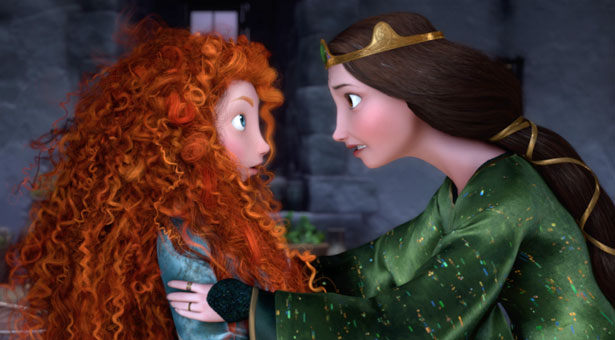
            Fast forward to this year. With the Cars 2 debacle in the proverbial rear view mirror, Pixar seemed poised to return to form with a new original story following its previous two sequel releases (the other being the universally praised—and justly so—Toy Story 3 in 2010). The film is Brave. While it fronts some of the standard elements of traditional Disney fare—character from royalty, fairy tale story elements, etc.—Brave also bears several unique distinctions in the Pixar canon. One of these is a rich period setting among the gray countryside of old Scotland. For all the studio has accomplished in digital vistas and beautifully rendered landscapes, nature had been mostly non-existent until now. One of Brave’s best assets is how well it captures the look and feel of a dense wilderness of rocks and trees.
More important than the quality of the animation, however, is the film’s focus on women. Brave tells the story of a rebellious princess named Merida (Kelly Macdonald) and her mother (Emma Thompson). The two are at odds over how Merida should carry herself as the kingdom’s next queen. While Merida would rather be riding on horseback through the forest, bull’s-eyeing targets with arrows along the way, her mother wishes that the red-haired rebel carried herself instead as a proper woman and fulfill her duties as future queen. Brave traces the trajectory of the tumultuous relationship between Merida and her mother, with other characters— such as the Billy Connolly-voiced king and Merida’s three devilish little brothers—serving as comic relief. But like many Pixar movies, Brave has a solemn core. Separating it from other Pixar works is the plot twist it serves up midway through. I won’t spoil it here; suffice to say that it significantly shifts the film’s tone and direction. The result is uneven, but Brave recovers enough to gain some momentum toward a modestly satisfying finale.
Taken on its own, Brave is enjoyable enough. But that’s where I have a problem. “Enjoyable enough” isn’t enough. More pointedly, Brave hews closer to the kind of modern animated movie to which Pixar has long been the alternative. It lacks an intangible sense of patience and timing that so many other works in the studio’s past have achieved so effortlessly. Both comedically and dramatically, the film is too eager to please. Nonetheless, directors Mark Andrews and Brenda Chapman ostensibly strive for a sublime effect but fall very short of that goal.
Before I go further, I should admit that judging Brave against other Pixar films is a slippery slope. After all, it would be unfair to expect every film from the studio to have the nuance of Ratatouille, the wonderment of Up, the forbearance of Wall-E, or the emotional roundedness of Monsters, Inc. And yet, to pay no heed to that heritage is unrealistic, particularly when a film bearing the studio’s name comes across so ordinary. Perhaps if I had seen Brave without any knowledge of its origins, I would have been more willing to recommend it. But that’s not really the point, nor is that scenario desirable. We bring so much with us when we watch movies, from our own implicit grasp of visual and narrative conventions, to our knowledge and expectations regarding certain acting and filmmaking talent. And lest we forget, we also bring our own individual life experiences and immediate feelings of the moment.
To critique a work based on the expectations promised by the names involved is not an entirely invalid way to come at a movie. Art demands that we take it in and respond to it, and for every viewer and critic, our judgments are formed based on what we bring to each movie and how we respond to the different elements in motion. So apart from what's in the movie, we're also dealing with elements outside it. (As Martin Scorsese imparts, "Cinema is a matter of what's in the frame, and what's out.") The critic’s job is to weigh these initial responses and contextual factors against a deeper knowledge of movies, storytelling, and various other things that inform our responses to movies.
But let me get back to Pixar, because I think what I’ve been wrestling with in my response to the Brave is the concept of legacy, or, specifically, how we respond to movies based on the legacies attached to them and those who make them. In the case of Brave, I knew little about the movie, so my frame of reference was based on the studio’s track record. Although different filmmakers have contributed to the Pixar catalogue, there are key similarities between the films that have since become associated with the studio's work in a more general sense. Pixar earned its untouchable reputation by making understated yet expressive films that also happened to be commercially slick and “family-safe.” As technology and entertainment increasingly demand our attention and time but not our minds and imaginations, Pixar has stood as a beacon of hope.
Which brings me back to Brave. If for no other reason, Brave merits a place in the Pixar canon for breaking important new ground with its focus on female characters. It is also an entertaining movie for the most part. But the fact that it fails to take hold in any deeper way (despite promising elements and a studio pedigree) underscores a potentially more troubling reality as Pixar is concerned. While Cars 2 showed the studio in pure cash-in mode, Brave is a different sort of effort; one in which the filmmakers are striving for a greatness that Pixar films so routinely achieve. And while Brave may be a better movie than Cars 2, it is arguably a greater disappointment. It suggests that Pixar may have reached a point where it is comfortable; where its imaginative forces have become enmeshed with financial interests of its parent company Disney. Art and commerce have always been strange bedfellows, but the work of Pixar has proven that the combination can yield visionary results. If Brave is any indication, the problem Pixar faces going forward is how it will come to terms with its own legacy of greatness while still always pressing forward into new creative domains.


Saturday, August 11, 2012

If I Had a Sight & Sound Film Ballot

For film critics, Top Ten lists are a fact of life. Yet, despite frequent complaints that Top Tens are a bore to compose at the end of each year, the British Film Institute’s Sight & Sound poll is one of those rare lists to which most critics would love to be asked to contribute. It’s the Top Ten. The lists themselves tend to represent each critic’s best effort to express the knowledge and creativity that the invitation supposes. You can imagine the arduousness, then, of limiting one’s selections of the greatest movies of all time to just ten entries.
Given that my role in the larger critical dialogue is minute as compared to those participating in this year’s Sight & Sound poll, I took to the challenge of a personal Top Ten more in the spirit of fun than soul-searching. Indeed, I’ve spent a good deal of time thinking about all of the below films in various capacities and stages of my life. Some meant more to me years ago than they do now, while others have lingered in my thoughts and memories beyond what seemed like an ordinary experience of watching them. Some are predictable, others perhaps naïve. But they each played an important part in my own development as a film lover, a writer, and a person.
So while individual Top Ten lists represent an opportunity for us all to showcase our film knowledge, I see them more as a reflection of who we are as people. They are all unique, interesting, and flawed, both in concept and execution, which also makes them less significant than their epic design would suggest. That’s why I have opted for simplicity in deciding on the films for my list. While a certain amount of self-reflection is essential, some things are better felt than pondered. The following list is no doubt an expression of my personal tastes and knowledge about film and perhaps even a statement about how I approach life. Then again, it is also a fairly arbitrary ordering of 10 films that mean a great deal to me.

Click here to see my list of Top Ten Films of All Time at Slant Magazine's blog The House Next Door.

Monday, July 9, 2012

A brief (belated) reflection on Andrew Sarris

Film has lost too many legends of late. In the last several weeks, we have seen the deaths of Nora Ephron, Andy Griffith, and Ernest Borgnine, all of whose work had a lasting effect on the Movies (or TV, in Griffith's case). But for film writers and critics, a more personal loss was felt with the death of Andrew Sarris, champion of auteur theory and all-around titan of American film criticism for the last 50 years. At the time the news broke, I was so moved by the bevy of remembrances and beautifully-written tributes that I could hardly find the words myself. Having digested it all, I still feel at a loss for words, suffice to say that although he will best be remembered for his involvement in Cahiers du Cinema and his brief riff with Pauline Kael (which was barely that, as Jim Emerson documents), Sarris's work will remain important to me for a very different reason.
Sarris eschewed the journalistic/academic binary that began to emerge in the 1960's and 1970's, when film studies became more accepted at colleges and universities and journalistic criticism more resembled a buyer's guide. Overly simplistic, perhaps, but this schism was and continues to affect how criticism is approached and practiced. Sarris, though, was never quite comfortable in either mold. That is to say, he was very comfortable in both venues but rejected the ideological simplicity of their respective purposes. This was a staple of his compact writing about films and directors. He recognized the different ways to see movies—as art, as commercial property, etc.—and came at them with insights that blended various sensibilities. Many writers have also noted that Sarris also famously changed his mind about movies and was willing to re-evaluate them. That he fluidly and cogently addressed this in his writing gave it an evenly personal and knowledgeable aura. He made me want to know about movies, but he also made me want to experience them and feel them.
No matter the circuit, the best criticism should be penetrating, informed, and personal. To engage in a bit of playful wordplay, criticism should rest somewhere be analysis and poetry. It's not an easy balance to strike, but Sarris straddled this line so convincingly and, consequently, inspired so much great criticism. His death is a matter of great sadness for those who love and practice criticism. And it is a reminder that in an age of ubiquitous digital exchange—in which opinion seems to trump knowledge, and in which serious media reporters interrogate film critics as if the occupation is without meaning or merit—perceptive criticism is needed now more than ever. And all those who (thankfully) practice it have Sarris to thank.

Thursday, May 24, 2012

A bit of permanence

In 2008, Scott Balcerzak and Jason Sperb, co-editors of the book, Cinephilia in the Age of Digital Reproduction, Vol. 1, invited me to join their panel at the Society of Cinema and Media Studies annual meeting. It was a moment of true happenstance, given that the meeting was held in my home city of Philadelphia. I graciously accepted the offer and focused my presentation on the contributions of internet writing to film criticism and cinephilia, particularly how it might redefine and collapse the space between the two. (Back then, my writing approach was more polemical, reflected by the longer posts.) The presentation went about as well as it could have, when you take into account that I'm a nervous wreck of a public speaker. I was more impressed by the uniquely focused presentations by the other panelists. Afterwards, Jason and Scott asked if I would be interested in contributing something for their planned second volume of the Cinephilia book series. Again, I accepted with equal feelings of excitement and trepidation.
Four years later, I am pleased to report that the outcome of that conversation has taken shape in the form of Cinephilia in the Age of Digital Reproduction, Vol. 2. The book aims to illuminate the larger historical and global contexts of the changes in technology and film spectatorship in recent years. My contribution is a chapter entitled "Revisioning Critical Space in the Digital Age." It represents an attempt to synthesize elements of my 2008 SCMS presentation with some writings that I've done here at The Cinematic Art. In retrospect, I wish I had given more time and energy to the product. But, having said that, I am generally pleased with the piece. It is not the definitive argument for my platform but its very publication may represent an important step in realizing the broader perspective of a kind of "critical cinephilia" that it outlines. It's also worth noting that it is an incredibly dated essay. I suppose that's the nature of the beast when it comes to academic publishing, but I cannot help but note the irony of an essay about the shifting state of media relations and film viewership that in some ways is already obsolete.
Limitations notwithstanding, the article is a standing reminder of what is possible in the digital age. On a personal level, I feel a deep sense of satisfaction that my small contribution to the still-growing network of film writing in the digital sphere has secured a bit of analogic permanence in print. When I started this blog five years ago, I had no inclination that it would result in a presentation at an academic conference and a chapter in a prominent book series in film studies. I am profoundly grateful to Jason and Scott for taking notice of The Cinematic Art—flaws and all (and there are many)—and seeing its potential. Moreover, I am thankful to them for providing me the opportunity to stand amongst scholars and argue the value of this format as an intermediary to criticism and cinephilia.

Cinephilia in the Age of Digital Reproduction: Film, Pleasure and Digital Culture, Vol. 2 is available now through Columbia University Press and can also be purchased via Amazon.

Wednesday, May 2, 2012

Gaining some 'Critical Distance'


At the start of the year, I announced I would be reviving The Cinematic Art and re-appropriating its content to suit my current interests and capacities. Four months in, I am generally pleased with the results. What started as the posting of simple, short capsules has evolved into the regular (and still brief) reviewing of movies and shows. While the format has limitations, it has also helped me understand and address my own limitations as a writer. If you've read this blog before, you know that I take to criticism with a high degree of reflexivity. Although I don't inject this into my writing these days, I am always wrestling with it and trying to improve my writing and approach with each review.

Another benefit of the recent writing I've been doing has been my rediscovery of long-form criticism. It started when I saw The Artist in February. I drafted a short review, but found myself reading more and reflecting on it. I returned to my capsule review and started adding to it. Eventually I molded it into a grander piece that was posted over at Slant Magazine's blog, The House Next Door. I had a similar recent experience with Mission: Impossible—Ghost Protocol, which I began writing as short review but gradually developed it into a longer polemic. Both essays don the "Critical Distance" tag, a name that suits my long-form critical approach and also reflect my own film-viewing limitations. (I often do not see new movies until DVD release). "Critical Distance" covers both of these angles and more broadly represents my approach to come at a film from the perspective of having absorbed the hype and attacking it with a new set set of eyes. I already have a few ideas for movies to explore future Critical Distance pieces (e.g., Prometheus, The Dark Knight Rises), but it's equally important to allow these essays to naturally develop from my reaction to something. (That I often am seeing films and shows well after their initial run adds to this approach). I realize that there isn't much need for a series like "Critical Distance." As David Hudson recently noted over at his new spot, KeyFrame Daily, "never has the mediasphere been noisier, nor have attention spans been shorter." Movies, even mega-commercial releases, have a brief moment in the sun on release, but are quickly chewed up and digested to make room for the next discussion of the moment. That goes for criticism, too. And that's why I like the idea of an essay series that runs against this trend. For the very same reason, I don't expect these article to resound much within the bigger conversation about a given movie. But it is my hope that they contribute a fresher perspective to works that have had their moment and are worth considering in a new light.

As I move forward with the Critical Distance pieces, I hope to put as much effort into the regular reviewing I've undertaken in recent months. Given that I am not a critic by profession, I am usually about six months behind the rest of the circuit with viewing/reviewing. This is an occasionally frustrating reality, but it also reminds me (as the Critical Distance series evidences) that there are other ways of spotlighting critical discussion than what constitutes the current moment. Nevertheless, I plan to have one foot firmly implanted in the new-to-DVD/streaming front and will also review select films in theaters. (On queue: A review of The Avengers, and perhaps also a Critical Distance piece on the same subjects at the end of May.) But as I am now winding down my engagement of 2011 movie fare, my review base will broaden in coming weeks and months, as I return to watching older films and television shows more regularly. This represents a relatively new direction in my reviewing habits, one that I am looking forward to carving out.

Tuesday, February 28, 2012

What we can learn from this year's Best Picture winner

Sometimes it's hard to separate a movie from the hype. Anyone who's followed the nauseating Oscar prognostication over the last several months knew full well that Harvey Weinstein's Michel Hazanavicius's The Artist would win the Best Picture crown on Sunday's telecast of the Academy Awards. Nonetheless, given its preordained victory, the critical dialogue about the film has become predictably antipathetic. As Scott Tobias observed recently, the political machine attached to frontrunners and winners often distorts our vision of them and renders reasonable discourse a challenge. Truth be told, these days the Oscar badge doesn't hold much weight. The reason for this, Tobias concludes, is that Best Picture winners represent consensus over excellence. Oscar winners reflect more on the film industry's own image of itself than the artistic significance of film.

Click here to read the full article at The House Next Door.

Wednesday, September 7, 2011

On chaos and classicism

I know I'm behind on the ever-growing discussion of chaos cinema, but this is a topic worth expanding, as it has already in so many directions. It started with Matthias Stork's video essay at IndieWire's Press Play. The two videos encase a movement in commercial filmmaking over the past two decades, in which a sense of spatial unity has been displaced by a deliberately less coherent (and sometimes incoherent) aesthetic. Shaky camerawork and quick-cut editing are the base markers of chaos cinema, but lighting, film speed, and zoom are also exploited in the distortion of the "clear" image.

Stork notes that film scholar David Bordwell has already identified this trend and given it a name: intensified continuity. Bordwell has argued that many of these techniques ultimately service a classical agenda but in modified manner. Given that viewers have grown so accustomed to classical techniques of cinematography and editing, the idea is that they can fill in the blanks when a particular sequence removes some of visual clarity. This technique can serve a variety of purposes. In the classic narrative sense, it can mirror a character's disoriented state or it can signal the chaotic environment of war or panic. But Stork looks at this trend as usurping traditional concepts of visual cohesiveness and becoming a new base aesthetic of popular cinema (and action films in particular). He propels Bordwell's notion beyond a matter film aesthetics and addresses the implications of this increasingly prevalent aesthetic.

Stork explains:

"In many post-millennial releases, we're not just seeing an intensification of classical technique, but a perversion. Contemporary blockbusters, particularly action movies, trade visual intelligibility for sensory overload. The result is film style marked by excess, exaggeration, and overindulgence: Chaos cinema."

And Stork doesn't stop there. He adds that chaos cinema is "a never-ending crescendo of flare and spectacle," as well as "an audiovisual war zone." As for the "art" of chaos cinema, Stork notes, "the only art here is the art of confusion." Stork dishes these charges during a montage of film clips from various contemporary action films, including Quantum of Solace, The Bourne Ultimatum, The Dark Knight, Domino, Battle: Los Angeles, and others.

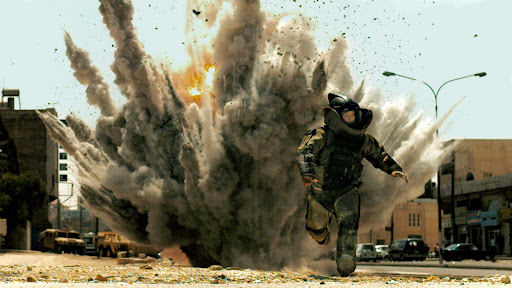
Given the inflammatory nature of the charges, Stork's essay provoked wide-ranging response. Ian Grey, also of Press Play, mounted a bold defense of chaos cinema by going on the offensive. In it, he targets Stork's ostensibly pro-classical tone, which (although Stork never explicitly endorses it) seems to inform his nearly wholesale dismissal of chaos cinema. (Stork briefly addresses the possibility of chaos cinema to achieve something more than empty spectacle with his analysis of The Hurt Locker, but not without noting that the exception proves the rule.)

Says Grey:

"It’s depressing that the ultra-conservative pro-classicists will not even consider that there might be something valuable occurring through these “chaos” films, planting the seeds of a new movement and establishing a new, valid way of seeing things for a new generation."

Grey's impassioned rebuttal highlights the glaring flaw of many accounts of chaos aesthetics, which is to focus almost exclusively on the mechanics of the film image in service of a more rigid ideological agenda. The notion that chaos cinema matters —no matter your opinion of its worth— tends to be glossed over by those launching assaults on it. While Stork briefly mentions music video aesthetics and shortened attention spans in attempt to explain the origins of chaos cinema, he fails to make a convincing connection between chaos cinema and the broader cultural tendencies and transactions on which the broad basis of his argument rests.

For my part, several of Stork's points seemed dead-on. I have always been partial to clarity and geography. Nevertheless I was uncomfortable with the ease of which he dismisses the majority of chaos cinema for not upholding a certain tacit vision of cinema long perpetrated by classical auteurs and formalist critics. Grey hits on this point effectively, but in doing so he makes sweeping generalizations that somewhat diminish the impact of his mostly well-argued response. He observes:

"It’s already a tired remark but it’s no less true: in the pulsing sensorium of multimedia, the sit-down, stand-alone feature film becomes kind of quaint, unless somebody does something to jack it into the world as it is now. And that’s what “chaos cinema” aims to accomplish. The style that many of you hate is probably the only thing (aside from that other thing you probably hate, 3D) persuading people to endure an increasingly god-awful cinematic experience."

Grey goes on to provide an anecdote of sitting through 35 minutes of commercials at a screening in New York to illustrate that viewers today are tired of old models and seek a more strongly visceral response to cinema, which now has to compete with various other modes of aesthetic pleasure in order to stay relevant. This notion warrants more exploration, for sure, but Grey's attempt to connect a movement in film form to something outside the isolation of film analysis is badly needed in film criticism. Too often it is filtered through the same "form/content" lens that it seems to have little relevance. Nevertheless, as part of the pro-chaos/anti-classical argument, Grey's remarks about generation politics leaves his argument vulnerable to criticism, as evidenced by Steven Boone's recent piece over at Big Media Vandalism calling out Grey and other defenders of chaos cinema. Boone concisely streamlines the evolution of our media technologies and senses as a means of explaining how chaos cinema was given to rise. Here's an excerpt (though I encourage you to head over and read the whole piece at least once, if not several times):

"The kids didn't create--or ask for--Chaos Cinema, no more than little Johnny asked for the neighborhood pusher to move onto his block and offer him some new sneakers. Kids just want to escape boredom. They want to feel alive. Chaos Cinema came along at a time when young people and adults alike had learned to expect instant gratification from their DVD players and cable boxes. The kind of spontaneous montage I created as a child couch potato of the '80s, armed only with a cable dial and a slothful VCR, acquired exponentially greater firepower by the late '90s, with thousands of satellite channels and the random-access of DVD chapter stops to draw from.

Concurrently, AVID (and later, Final Cut Pro) non-linear editing systems gave professional film editors the same freedom to make instant selections from their pools of footage.

Meanwhile, the Internet went from a convenient tool for interpersonal and business correspondence to a direct telecommunication and commerce channel. This quickened the pace of everything. Once digital video became widely accessible, it was even easier to feed the beast, 24/7. Finally, cheap portable media devices and Internet screens of varying diminution reduced the amount of information we could be expected to retain in a single image, lending shots the quality of flash cards. Car. Man. Smile. Pile of shit.

In the movie business, this quickening became an opportunity: Storytelling in mainstream movies would get faster and more furious with each year of the last decade, in the style of product upgrades. Let's think of the movies in the aughts as Dell desktops. Each new movie packed more RAM (more footage to draw from, and from a wider variety of camera angles), faster processors (editing that obeys fight-or-flight impulses like a channel surfer) and bigger hard drives (more screen time devoted to densely-packed expository dialogue, like Wikipedia clippings in an undergrad's netbook). Except that, unlike computers, these increasingly tricked-out flicks narrowed our selection of applications (visual styles) to ones with cluttered, user-unfriendly interfaces. This phenomenon was sold as a sign of the times by Ho'wood's de facto publicity outlets and happily/resignedly indulged by consumers who came to think of movies as perishable items. Slurp, burp, next."


Boone's piece is a grand statement against contemporary editing techniques and other staples of chaos cinema. These permeate hyper-masculinized action fare, like Battle: Los Angeles and The Expendables, but also and perhaps more importantly the work of popular cinema's new batch of auteurs, notably Christopher Nolan. Boone's takedown is a good companion piece to Stork's video essays, which were more focused on demonstrating and denouncing chaos cinema. It provides a convincing cultural and ideological context for arguments against chaos cinema. Perhaps most significant about Boone's argument is how it explodes the simple notion of form and content as somehow being internal to filmmaking or film viewing. While Boone stands in support of Stork, the overarching principle I pull from his essay is that how we watch, interpret, and derive enjoyment from cinema is a complex negotiation of innumerable processes both inside and outside of a frame. His narrative of the media state is both beautiful and horrifying to me. No matter how hard we try, we cannot anticipate or even begin to understand the extent to which our minds and brains are being rewired and projected through the increasing number and capacity of transaction in our current media age.

In light of Steven Boone's staggering reflection on the state of affairs in contemporary film standards, I see a number of ways in which the dialogue can continue, grow, and give us more insights into film images and how they continue to hold relevance. With respect to the notion of chaos cinema, I would spin the discussion by first considering that both Stork and Grey have legitimate points to make about the state of the movies. Their opposition may be more the result of ideological and rhetorical posturing than truly repelling concepts. There is more than a kernel of wisdom (as Steven Boone elaborates) to Stork's underlying argument that chaos cinema both reflects and informs a larger cultural movement that is quite honestly concerning. This deserves to be explored as chaos cinema becomes more pervasive in contemporary filmmaking techniques.

While Stork outlines the broad parameters of chaos cinema, we should first try to understand what chaos cinema actually is and how it operates. Stork provides an excellent start (particularly with his analysis of sound), but I am wary of accounts with an established negative outlook of this new aesthetic. While I would not directly refute anything Stork concludes, there are a number of opportunities to explore how and why a destabilized image is significant. Ian Grey broaches this issue with his assault on classical cinema, but this likely stemmed more from Stork's reflexively pro-classical tone. Nevertheless his observations on the beauties of chaos (such as his unashamed love of Resident Evil: Extinction) represent a solid foundation for a pro-chaos approach.

In light of these differing sensibilities toward contemporary visual styles, it might be interesting to look at how classicism and chaos cinema can be melded together. Instead of merely only looking at the work of leading practitioners of chaos cinema such as Paul Greengrass, I might suggest we have a look at films that are more classically influenced but have been inevitably shaped by the increased presence of chaos cinema in film today. Jim Emerson recently did something like this with his response to Stork's video essay (and in countless other pieces over the years, particularly his entries on The Dark Knight). He looks at Philip Noyce's Salt as an example of how the elements of chaos cinema can be assembled in a way that has intelligibility while still conveying the velocity of chaos aesthetics.

Another film that fits this billing is Steven Spielberg's Minority Report. I thought of the film when I read Ian Grey's essay, in which he uses the it as an example of how classicism can bring down an otherwise good film. Grey notes the frustrating extent to which each composition is precisely assembled and positioned. Indeed, Minority Report is largely consistent with Spielberg's self-described geographical aesthetic, but a closer look reveals a strange interplay of classical form and destabilized images typical of chaos cinema. For example, in the film's lone extended action set piece, Spielberg's camera is noticeably more frenetic and busy than in most other action sequences in his catalog. From the jetpack chase in the alley to the car manufacturing plant, the camera is imprecise in its ability to frame the details of the chase and yet there is clarity in how all of the shots and images connect. For example, in the second portion of the chase, John Anderton (Tom Cruise) encounters his pursuer, Danny Witwer (Colin Farrell) on the street outside the manufacturing plant and the two race to the building.


The foot chase is executed with a single hand-held shot, but when we cut inside the sterile hallways of the factory, Anderton is shown from a distance in a stable shot down a long, white hallway. He sprints past the camera, which shakes when he runs past it.


While all of the action until this point is discernible, Spielberg keeps the proceedings off balance with gritty camerawork that counterbalances the cleanly mechanical atmosphere of the factory.


A few bursts of light distort some of the images and even in longer shots the camera never stays still.


As the chase continues, Anderton and Witwer find themselves facing one another on a mobile platform maneuvering above the ground.


Here Spielberg incorporates an even stronger chaos sensibility by jumping between extreme shaky closeups and wide angle shots, which seem to compliment and clarify each other.


When the two plummet off of the platform, notice how the shifting camera denies us a feel of gravity, as the two barrel sideways through the air at the camera (but really down into a car under construction). When we cut to another angle, the transition is both seamless (due to the spatial economy) and jarring (due to the pronounced velocity from the shaky camera work and chaos touches).


This set piece is thoroughly Spielbergian in that we can clearly see what's happening from shot to shot, but it is also a subtly distinctive sequence for how it incorporates several characteristics of the chaos style. In my view, Minority Report exhibits a hyper-classical aesthetic that is difficult to situate within the chaos/classical mold emerging in critical dialogues. What's interesting to me is how this shaky-cam aesthetic joins with the classical stylings of the film's sleek visual palette. It is classical chaos.

In my next entry, I will demonstrate a few more examples of how the principles of chaos cinema have been incorporated in other recent popular films. Specifically, I hope to examine how these elements can alter and/or enhance the effect of classical style in some cases, or establish a brand new aesthetic and emotional spectrum in one particular case of genre filmmaking.

In the mean time, I open the forum to you: Are there any other movies that blend the line between chaos and classicism?

Wednesday, August 3, 2011

Up and running again

In a conversation about three months ago with a few close friends over the final Harry Potter film, we mutually decided to embark on a long project. We would convene once a week to watch the seven previous entries in the Potter film series in succession until the release of Deathly Hallows Part 2. We are all fans of the books and movies in various capacities, though I am probably in the minority for aligning more with the movies than the books. I've read maybe half of the novels and reasonably enjoyed them, but my interest was more with the movies. In attempting to articulate my positions on the films —like, for instance, why Prisoner of Azkaban, is the most evocative entry and a great film in its own right— I found myself thinking more about them and the surprisingly affecting mosaic they form. Perhaps realizing that very little serious reflection had been committed to these films, I had idea to write a series of essays. I don't know when exactly it came to me. Nor did I give it much thought. I just began penning reflections on the first film a day or two after watching it.

Turns out that a two-year-plus hiatus from writing about movies left me with a good deal of rust. But thanks to Keith Uhlich, who helped me gain clarity of the project and find a confident voice, I authored eight articles over roughly six weeks. They were posted at The House Next Door in the week following the release of Deathly Hallows Part 2. The series represents my first writing on movies in well over two years. I say, "on movies" because I do a fair amount of writing in my day job as an editor for a monthly medical magazine. Between this, completing my graduate school thesis (which took in excess of one year), and various other personal ventures from home projects to fatherhood in that span, I found little time to update this here blog. As the distance widened from my last update, my desire to return to film writing —even in a more limited capacity— was waning. I've attempted to keep up to speed with movies, still seeing roughly 50 to 60 theatrical releases in a given calendar year. (As usual, I've seen some very good ones and a few great ones. As for 2010, put me among the crop of critics who found The Social Network the only real masterpiece from last year.) I have been content to watch, feel, and reflect without the strain and effort of translating those feelings and reflections into text. To keep slightly abreast of the goings on of film criticism, I would rely on Roger Ebert, Manohla Dargis, and a handful of other critics whose work I have made part of my regular weekly reading for years now.

I never expected to return to this blog. But the unforeseen chain of events that has led to my Potter series has reinvigorated my interest in thinking critically about cinema of many stylings and rejoining this online community again. I should note that I have never had any delusions about the greater significance of this site. As I observed in my last published piece, back in March of 2009, my aim for the site was "to explore the interconnections of film, criticism, and cinephilia in an open forum." However flawed, I feel that in some ways The Cinematic Art achieved that despite my readership never achieving great heights. But as much as I've enjoyed lending my own small voice to the critical discussion, the real joy of it was exploring the work of so many others who are passionate about cinema and writing. In the spirit of the late Manny Farber, Andy Horbal once referred to the ever-expanding plane of film commentary on the web as a kind of "termite criticism." And after years of removal from the film blogging circuit and returning to discover it is as vibrant as ever, I feel that Andy's terming for it is spot-on and very relevant. We are a unique collection of voices. The flaws in our writing and logic are often openly on display, but so is the immediacy of our insights and perspectives. With styles ranging from scholarly prose to fanboy cinephilia (sometimes at the same time!), and everything in between, online film writers are slowly molding new pathways in the discussion of cinema; one that straddles the established structures but that also collapses them. Yes, the old pillars of journalistic and academic criticism will remain the authority on film canon and the officially sanctioned discourse about cinema for a long time to come. But I remain of the belief that a digital discussion of cinema is ubiquitous and can potentially guide dialogues that allow us new ways of engaging cinema, criticism, and cinephilia, by melding them all together. It will not usurp other modalities, but rather deepens the scope of criticism to encompass wider perspectives, styles, and reflections.

It seems that many new technologies and social platforms remove much of the spontaneity from life and our interactions with people, films, and various other things we engage regularly. But they also provide critical potential to harness the nuances and peculiarities of our individual experiences and project them into text and images. That is partly why cinema is so special and maybe why so many of us actively take part in this great experiment of termite criticism and cinephilia. For my part, I am happy to have rediscovered the desire for writing and film, which I hope in some capacity to channel into prose here on this site. In the past I've probably engaged in too much reflexivity for my own good. Going forward, I will try less to provide commentaries about the relationships of cinema, criticism, and cinephilia and focus more on doing my part to create it. I don't know where it will take me just yet. I have a few larger ideas in mind (such as a long-gestating Werner Herzog project that will hopefully unfold in coming weeks and months), but my general attitude is to write about things that mean something to me, to not engage in too much reflexive rumination, and to simply write. Whether it amounts to anything useful in the broader critical dialogue is not for me to decide. It will certainly not have the polish of many published forms of criticism. And there is obviously no guarantee that it will have consistency and structure (as evidenced by my long hiatus from writing). However, the broader canvas it affords me to perform the commentaries I wish will hopefully make it worthwhile. And one thing for sure is that mine will just be one voice amongst many that make this platform so enjoyable to participate in, both as a writer and reader.

Tuesday, March 24, 2009

Critical (re-)evaluation

I started The Cinematic Art with a desire to explore the interconnections of film, criticism, and cinephilia in an open forum. Among my predominant concerns was and still is the question of blogging as a relevant practice in cinephilia and a vehicle for film criticism, but a criticism of a different making. I wanted this site to be an experiment in criticism; a rumination on cinema, grounded in theory, vested cinephilia and personal narrativizing. Its style and content emerged from academic and journalistic tropes of film criticism, but I also sought to subvert and confound them, fold them in to each other, and explore new capabilities for engaging images.

Alas, I was weighed down by the scale of my ambitions.

This post brings an end to my longest drought since I started The Cinematic Art and caps off a disappointing year in the site's development. In my brief sabbatical, I had plenty of time to think about this blog and blogging as a practice. I've come to accept that this site will probably never operate in the capacity that I would like. The offerings here mostly consist of half-formed thoughts, occasional sloppy writing, and a startling lack of focus — all things that don't help to legitimize my cause of giving blogging a good name. My prolonged absence from updating the site with new content does not help my argument either.

Having said all that, I remain stubbornly convinced that there are new paths to forge and that this writing form grants me and so many others the possibility to discover them. The bigger question is if this gradual realization resonates beyond the constraining dialogue about digital technologies and comprehension of their properties.

Sobered with the reality that I cannot realize the ambitious vision I once held for the site, I now recognize the need to re-frame my expectations and goals, and I need to reposition my approach toward understanding what I and so many others are doing here in digital space.

The film blogging circuit is a community of voices from all across the spectrum of cinephilia and criticism. This isn't news to most writers and readers familiar with blogging, but this simple fact is the nonetheless the base of a more complex inquiry into and about critical modalities of film criticism. Digital media seem to allow us an understanding of the process of making and seeing film, but they also allow us to harness critical tools and engage criticism at a different level. The difficulty will be in using and comprehending these media as we gradually learn the tools they provide us to do just that. This form cannot simply assimilate the properties of other media and culminate in a Grand Form of writing or criticism. Many questions remain regarding how these media are used and the implications for their use, among other things.

Some more sophisticated members of the film community would scoff at the notion of blog authors as critics. In public and critical discourse, blogging still largely connotes blind opining and empty commentating. Some have argued that it is relevant only to those who perform it. But how can we dispute who is or is not a critic when we are at a moment in which film criticism has been problematized in so many ways? That criticism lacks a well-defined identity is largely due to a growing digital mediascape wherein the meanings of journalism and filmmaking are constantly in flux. Still more, it's not necessarily a negative thing. Both filmmaking and criticism are at an uneasy place. Their respective practitioners are adjusting to new conditions in which the professional seems to be quickly meeting the non-professional.

For those of the mindset that there is an very specific framework for practicing of criticism, the idea of non-professional individuals practicing the "craft" of something built on expertise and experience is central to the collapse of that very craft. But is it not possible to gain expertise and knowledge outside the annals of professional film criticism? If films (and art in general) are supposed to celebrate the diversity of peoples and cultures through images and narrative, why must film criticism remain such a stagnant practice where homogeneous frameworks empower a particular narrative about what films are, how they function, and which are deemed worthy to be recognized in the canon of film history?

I am not asking these questions to tear down professional film criticism, but to propose a new approach to its position and practice. For years, we've heard some critics sensationally talk about the death of movies or the death of criticism; not a majority, mind you, but a vocal minority. What they were really saying is that their limited idea of what film or criticism should be was diminishing. And when you look around at faltering arts and entertainment sections, it's obvious that professional avenues of film criticism are suffering. To suggest that digital media (e.g., blogging) are to blame for film criticism and print journalism faltering simplifies the issue to pinning blame for an event that is without blame. Digital media are prominent and relevant; this much we know. But we do not quite know how to situate them in commercial terms.

Here on this blog, I come to you unfiltered by the institutional limitations that structure professional criticism. This is an advantage and a disadvantage. All writers bring a part of themselves to their writing, but those of us who do this unprofessionally are on naked display. In other words, we're writing about what we feel is worth writing about. It can be more personal, more probing. The problem for those who do it is often an overall lack the skills, resources, and/or time to launch the kind of inquiry that those in the paid ranks are granted. And yet, in the commercial world, writers are often constrained to such a large extent, so as to remain commercially viable. This is where bloggers come in. The best bloggers are good writers and are informed on their subject matters, but they also have a talent to key into a dialogue, and they do it in a variety of fashions. There is no formula for this. It's almost an intuitive sense that some writers possess for just the right level of articulation (or lack there of) to expand on an existing dialogue or kickstart another. We can do more than just fill the space between, but can create that space — a function that is essentially inherent in the form.

A plurality of voices can and should open new avenues of engaging images and perspectives, and shed light on old ones. Criticism therefore should not be limited to a particular inquiry or based on presupposed means and conditions. Both academic and journalistic criticism explore films in different ways, but they are not opposite ends of a film criticism line. We don't necessarily need to search in between to locate new molds of criticism. Possibilities exist in a number of manifestations, not the least of which is the crucial relationship between criticism and cinephilia.

I would contend that we will never truly have the ability to describe or consciously project the purpose or relevance of moving images, or narrative, for that matter. The anomaly of film criticism is that while it should focus very much on the films themselves — images, sounds, perspectives — it is not about those things at all. A film is made up of cuts, colors, figures, lights, sounds, etc. It is a machine with so many moving parts; parts that function together to form an aesthetic unity beyond the function of these individual elements. While close analysis is required for film criticism to exist at all, the critic ultimately is examining a phenomenon that is not on "film." The film is merely the line through which many other threads pass. The critic should penetrate those depths and swim in them, not unlock meaning or extract value. Criticism helps viewers, filmmakers, and critics to understand the process of seeing images, making sense of them, and grasping their significance.

If I may offer a more positive approach to the issue of "the death of film criticism", I would argue that film criticism is always happening, much in the same vein that film or cinema is happening. It may just a matter of how much we open our eyes to it. Cinema will continue to grow and thrive as an industrial art. Images exist and are produced and reproduced ubiquitously. The same is true of film criticism. It's not only happening in recognized forums, such as newspapers, magazines, and publicized websites. It's in conversations, on personal blogs, comment sections, and elsewhere. In this respect, criticism mirrors the cinema in that it cannot be quantified or set to a definition, as much as we may try. It will always have a professional face, but if that is the only view we allow ourselves to have then it wouldn't be able to grow. More important is to examine how it is harnessed and expressed, and under what conditions.