Tuesday, March 6, 2012

Hugo

It’s refreshing to see Martin Scorsese try his hand at more whimsical material. The famed auteur is renowned for orchestrating sprawling crime sagas and dark fantasies centered on troubled individuals, but Hugo represents a shift in tone and outlook from these and even his more uncharacteristic works. It is dense in narrative but airy in mood. Its fairy tale leanings are clear in the opening shot, which flies through the snowy streets of Paris and into a great clock within a train station. It then maneuvers through smoke and gears without any sense of gravity, following the young title character as he navigates the clock’s endless innards. This is the first of many sequences showing off the endless possibilities of the medium. Aided by Howard Shore's lavish score, Scorsese employs a flood of traditional and contemporary special effects in an effort to fashion an ethereal atmosphere to the train station where many of the main set pieces take place. In fact, the film works best when it is wandering about this world, spinning enchantments with small, but charming character vignettes.
Where Hugo somewhat loses its footing—perversely enough—is with its gradual gaining of narrative direction. Somehow, it fuses Hugo Cabret’s tragic backstory with that of an old man’s who he meets in the station. The crotchety fellow, played by Ben Kingsley, turns out to be George Méliès, a pioneer of cinema who directed such classics as A Trip to the Moon and then later fell into depression when the world lost interest in his movies. How the screenplay converges these disparate back-stories is a bit of a muddle. Nevertheless, the boy eventually brings about the redemption of Méliès in what ultimately amounts to be a love letter to the movies. Once the message about film preservation is revealed in the later passages, so too, it seems, is Scorsese’s inspiration for making the film. Having said that, Scorsese does more to validate the magic of the movies elsewhere throughout the film than with his late focus on Méliès. The old filmmaker’s story isn't a glaring problem, however I found it emotionally distant as compared to the earlier focus on the boy and the other station dwellers. This is one of the many anomalies that make Hugo so difficult to characterize.
Perhaps because I became wrapped up in its web of optimism and filmmaking bravado, I was less bothered by Hugo's inherent problems. I knew when I was watching it there was something distinct about its strange mix of sensibilities and thematic core that would keep me returning to it. Although the explicit message about film preservation doesn’t quite work in context, its underlying ideas and attitudes about art are beautifully realized and reflected in the movement of the storytelling. Thereupon, Hugo is a poignant ode to the great works of art that influence minds old and young alike, those that are with us for generations and those that slip through their maker’s fingers. (Martin Scorsese, 2011) ***½

Friday, March 2, 2012

Star Wars—Episode IV: A New Hope*

After the chaotic orgy of noise and color committed by the prequel episodes, the original Star Wars beams ever stronger with clarity and purpose. It is a self-contained marvel that suggests a larger universe more than showing it. Whether this is symptomatic of the technological limitations of the time or the studio pressures George Lucas faced is hard to say. Nevertheless, Star Wars exhibits a real love of the composition. The famous opening shot is a prime example, with a pan down to a planet before two ships roar into the frame from above. Cutting to the reverse angle to show the ships racing toward us then provides a sense of scale to the proceedings both physically and narratively. These two shots are all we need. This visual elegance is expressed throughout the film, as when R2-D2 finds himself inside the bowels of a giant vessel maneuvering across the sand dunes: the camera moves slowly across the metallic junk and gradually gains focus of R2 amid the clutter. It may not have a “wow” factor but it has atmosphere and patience. These kinds of shots may explain in part why the environments of the film resonate in our minds. Lucas patiently establishes each locale and lets the world envelop you, depicting vast detail while always moving the plot along. This film has such a strong sense of place that even certain settings—such as the interior of the Millennium Falcon, the seedy cantina, and space itself—become characters.
In a variety of critical accounts of Star Wars, much has been made of how expertly George Lucas fused together a host of mythological and epic archetypes and set them in motion in galaxies far away. It’s all true. But of equal significance to the story is the storytelling, which ultimately accounts for why this film has endeared itself to audiences and burrowed into our conscious and unconscious minds for more than three decades. No doubt, its images of spaceships dashing through the mechanistic canyon of the Death Star’s surface represent some of the most visionary moments in film history. But we should also take notice of the understated simplicity with which this film moves and unfolds, even in the quiet moments.
Although the greatest achievement of the six-film series belongs to The Empire Strikes Back, the original film is the purest and the leanest. More than any other entry in the saga, Star Wars stands independent of the commercial empire it later signified and operates fully on its own, an emblem of economical storytelling and a sprawling spectacle that would become one of cinema’s greatest treasures. (George Lucas, 1977/1997/2004) ****


* To remain consistent with the approach I’ve established (to watch these films as Lucas intended from Episode I through Episode VI), I am obliged to officially cite this film by its revised title. Although the original 1977 cut would be my preference as a film lover and fan of the original trilogy, in the interest of this project at hand I am watching the more current 2004 DVD editions.**

** Believe it or not, I don’t have much of a problem with the tricked out special editions. Lucasfilm did eventually release the theatrical cuts of the original trilogy (barring one small change to the title card of Star Wars). Although I wish he and his team had done so with more care, Lucas is off the hook as far as I’m concerned. I actually enjoy the fact that there are many versions of these films; at the very least, it’s an intriguing filmmaking experiment.

Tuesday, February 28, 2012

What we can learn from this year's Best Picture winner

Sometimes it's hard to separate a movie from the hype. Anyone who's followed the nauseating Oscar prognostication over the last several months knew full well that Harvey Weinstein's Michel Hazanavicius's The Artist would win the Best Picture crown on Sunday's telecast of the Academy Awards. Nonetheless, given its preordained victory, the critical dialogue about the film has become predictably antipathetic. As Scott Tobias observed recently, the political machine attached to frontrunners and winners often distorts our vision of them and renders reasonable discourse a challenge. Truth be told, these days the Oscar badge doesn't hold much weight. The reason for this, Tobias concludes, is that Best Picture winners represent consensus over excellence. Oscar winners reflect more on the film industry's own image of itself than the artistic significance of film.

Click here to read the full article at The House Next Door.

Friday, February 24, 2012

Star Wars—Episode III: Revenge of the Sith

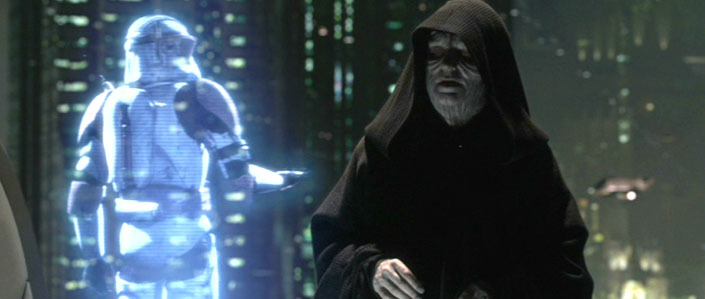
“Execute Order 66.” For Star Wars fans, these words recall the pivotal moment in Episode III when countless Jedi Knights are slaughtered, and the tides of the Force shift seismically. But to this film lover and modest fan of George Lucas’ opus, they represent the moment when the problematic prequel trilogy finally came to life. What follows is a gripping montage of surprising emotional breadth that no other Star Wars film has achieved. Bound together by mournful choral music, the scene depicts various worlds across the galaxy where troops are turning on and exterminating their leaders in the midst of battle. It is bared, visceral filmmaking, and it demonstrates why I find the prequel movies too endearing and interesting to dismiss. Certainly, Lucas deserves every shred of criticism he has received for shoddy storytelling throughout the films, which includes but is not limited to flat dialogue and convoluted plotting. Revenge of the Sith notably contains a similar dose of these flaws. And yet, to its maker’s credit, it crystallizes a compelling story arc with sincerity and vision. To be sure, Episode III is best remembered for its portrayal of Anakin Skywalker’s descent into darkness. However, for all the fuss about the emergence of Darth Vader, Sith belongs to the shadowy emperor (Ian McDiarmid), who subtly preys on every weakness of the political system to gain unfettered power. When he outstretches his hands and basks in rousing applause after announcing the birth of the Empire, the effect is chilling. It’s the kind of moment that caused me to realize through all the hyper-activity of the prequel films—and this entry in particular, with its non-stop jump-cutting, sword-waving, and noise—that George Lucas really has something to say. It may not be terribly profound and I wish he delivered it with more clarity, confidence, and skill, but it has real weight. Revenge of the Sith may be a hot mess of the visually poetic and the plain bad, but this saga-completing entry is elevated beyond its weaknesses by the scale its ambition. (George Lucas, 2005) ***

Tuesday, February 21, 2012

Another Earth

Another Earth imagines a scenario in which an Earth-like planet appears in the skies above our planet. A mirror-Earth, if you like. In newcomer Mike Cahill’s ambitious film, the philosophical implications of a parallel universe serve as a backdrop for an examination of remorse, regret, and identity. Although traveling to "Earth 2" is a main plot point, the film avoids space travel and other sci-fi conventions. It instead tells a more focused story of a young woman whose costly mistake racks her with guilt. The plot circulates around her attempt to make amends with a man that’s lost his family as a result of her action. Despite the conventional character drama (which necessitates that she doesn't tell him the truth until late in the movie), actors Brit Marling and William Mapother work well with the material and find chemistry in protracted periods of silence. Interspersed throughout the proceedings are clips of radio and TV commentary from scientists ruminating on questions of existence and choice. These sequences are augmented by numerous beautiful shots of Earth 2 hanging over the characters. Certainly, the film’s most memorable element is its visual design, which juxtaposes a hand-held style of realism with such simple, fantastical images. But Another Earth is too heavy with allegory to make the most of its unique disposition as a character study and thinkpiece. Accordingly, despite its potential, this “indie sci-fi” experiment somewhat falls short of achieving a distinct vision. (Mike Cahill, 2011) **½

Friday, February 17, 2012

Star Wars—Episode II: Attack of the Clones

Attack of the Clones ventures into new territory for a Star Wars film. Where The Phantom Menace was light, innocent, and regal, this middle episode of the prequel trilogy is brooding and dark. Its noir-ish mystery plot is fairly uncharacteristic of George Lucas’ established narrative approach and a welcome shift in tone. Clones features some exotic locales and set pieces that feel fresh and alive. For instance, after a sensational chase through Coruscant, the film takes us to the city-planet's Blade Runner-esque street level, a seedy place cocooned from the sterile rooftops occupied by Jedi and politicians. But in spite of these energetic flashes in storytelling, Lucas again fails epically at creating a real moment between characters. More pointedly, his struggles with dialogue are especially evident in this entry, which sees young love bloom between Anakin Skywalker and Padme Amidala. Here we see that Lucas’ problem with dialogue is not just a matter of stiff writing, but also with delivery that lacks any sense of rhythm. I suppose Lucas can fall back on how the players in his young lover’s tale don’t know how to be in love (which in part explains their awkwardness), but that doesn’t let him off the hook for his unshakeable propensity for explicitly stating or visualizing every idea he wants to convey. This is the main problem with the prequel films. Since we're taken carefully taken from Point A to Point B with painfully direct methods, the films become incapable of suggesting, observing, or expressing anything beyond their pixilated panoramas and consonant-free dialogue. (Next week I'll discuss how Lucas finally finds his voice and offers more successful attempts at visual poeticism with Episode III.) As for Clones, we are only afforded brief glimpses of the lucid storytelling and simple, powerful images that marked the original films. In particular, one stirring vision of lumbering spaceships riding to the horizon of war amid orange skies captures more feeling than anything before it in the prequel movies. While not making up for Episode II’s flaws, these images fleetingly realize the potential of a marriage between digital technology and narrative. Unfortunately, they also illustrate the missed opportunities of these films. (George Lucas, 2002) **½

Wednesday, February 15, 2012

Drive

Drive is a jolt of aesthetic pleasure the likes of which I can’t recall since Michael Mann’s Miami Vice. Like Vice, it breaks free from the confines of plot and turns what might have been a straightforward genre picture into a wholly original and evocative vision. Some critics have noted that Drive feels like an updated version of Taxi Driver, as both films are about an isolated driver (played in Drive by Ryan Gosling) who carries out a violent fantasy to save a woman. Others have observed that it channels 80s pop cinema (particularly Risky Business), with its sprawling pink title lettering and 80s-infused synth tunes. Both are true, but the list of the film’s thematic and stylistic influences runs much deeper. Drive is a pastiche of disparate styles and genres, gleaning outmoded cinematic dressings and repurposing them onto a splashy canvas of mood and color. Director Nicolas Winding Refn’s precise, sumptuous compositions coupled with a hypnotic soundtrack imbue the proceedings with a dreamy atmosphere that contrasts well with the guarded emotions of the characters. As the performances go, Albert Brooks stands out as a producer-turned-mobster who dispenses with his enemies with casual ease. His portrayal of controlled psychosis is frightening and masterful, and it is one of Drive’s many lyrical touches. (Nicolas Winding Refn, 2011) ***½

Monday, February 13, 2012

The Help

“No one had ever asked what it feel like to be me.” These are the words of Aibileen Clark, a black maid—brought to vivid life by Viola Davis—whose painful story provides the basis of The Help. If only it had the courage to tell her story, this movie might have been remarkable. Instead, despite several soulful performances, The Help is Hallmark-style comfort food. Set in a small Mississippi town in the pre-Civil Rights ‘60s, the film introduces a slew of characters and plotlines coalescing around central themes of racial injustice. I had a hard time following names (except Aibileen), so please bear with me as I try to make sense of the various subplots. First, you have the young white girl (Emma Stone) who decides to interview Aibileen and other maids for a book she's hoping to have published. Her story is complicated by a strained relationship with her insecure mom (Allison Janney), who lacks the backbone to stand up for what is right. Meanwhile, an unrelenting racist bitch (Bryce Dallas Howard) will stop at nothing to stand in the young white girl’s way from telling the maids’ stories. On the other side of town resides a sweet white girl (Jessica Chastain) wants to fit in with other white girls but finds connecting with her maid (Octavia Spencer) much easier. I’m sure there are a few I am forgetting, but you get the idea.
Writer-director Tate Taylor ostensibly wants each of these stories to illuminate a different shade of a larger, more significant patchwork narrative. But none of these threads resound as deeply as Aibileen’s and those of the other maids. There is a deeply moving scene late in the film that illustrates the film’s misguided focus and failed potential. After struggling to find maids to go on record for the book, Stone’s character walks into Aibeleen’s house and finds it full of women wanting tell their stories. It has a raw power that resonates within the context of the previous scenes and also as a broader statement of courage. But the moment is fleeting, since the movie then depicts the telling of the stories in a blink-and-you'll-miss-it montage, presumably in effort to push on to resolutions for the other plotlines.
I initially had reservations toward The Help taking a painful story and turning into inspirational fluff. But come to think of it, I would have settled for inspirational fluff if it were actually about Aibileen. Alas, merely telling us that certain stories need to be told is not enough. You have to tell the story. Only then can we know what it feels like to be Aibeleen or any other of the maids whose stories are glossed over by The Help. (Tate Taylor, 2011) *½

Friday, February 10, 2012

Star Wars—Episode I: The Phantom Menace

I was 16 years old when The Phantom Menace was released. And for the previous 10 years I had watched the three Star Wars films with what some would call an unhealthy regularity. When I saw Episode I for the first time, I didn't mind or even notice many of its problems. I left the film exhilarated by the visions I had seen: dangerous encounters with underwater leviathans; a maze of Venetian streets and pathways; a machine army marching in perfect unison; an entire planet covered in cityscapes. More than a decade later, I am pleasantly surprised by how well many of these images hold up. And I would still argue that the three-way light saber battle at the end of the film is one of the high points of the entire series. Having said that, George Lucas’ failure to meet the most basic criteria of competent filmmaking makes The Phantom Menace feel like an amateur film at times, proving every bit as grating as its reputation suggests. Lucas has become infamous for bad dialogue since the prequels, but this was also a trait of the original Star Wars and can quite honestly add to the fun of storytelling. Where the film really suffers is with its schematic narrative, poorly staged and edited scenes, and a misguided sense of humor that veers on embarrassing. In addition, Lucas' drawing of the young Anakin Skywalker—most notably his accidental late-film heroics—is so wrongheaded that one has to wonder whether Lucas had been questioned at any point as the movie was being made. Unfortunately these flaws are so pronounced that they overshadow what the film gets right. For instance, Liam Neeson is convincing as a calmly defiant Jedi and the villain Darth Maul has a palpable screen presence. I also love the frenzy of the opening scenes and how they move from location to location without allowing much time to take in what's happening. Then there are also the smaller pleasures like the background activity to the marketplace scenes on the desert planet, which very much capture the spirit and detail-oriented sense of the original films. But, in whole, The Phantom Menace is glaringly disjointed. I still maintain that its qualities are overlooked, but Lucas' startling ineptitude with some elements of filmmaking/storytelling craft make it a hard film to defend. (George Lucas, 1999) **½

Six Fridays of Star Wars

As if we don't have enough Star Wars in our lives, I've begun work on a rather epic essay series on George Lucas' six-film opus. In light of how saturated pop culture and criticism has become with Star Wars for nearly 35 years, my goal is to offer a slightly different and perhaps fresher perspective on one of cinema's most visible works. Thus, I am currently in the midst of re-watching all of the films. I don't foresee completing this project for a few months, but in the mean time I'll be posting short reflections on each film for the next six weeks, starting today with The Phantom Menace. Keep in mind these reviews are brief critical perspectives and will likely bear little relation to how I am approaching the series in terms of the larger project. Enjoy!

Update—Below are links to my reviews for each of the six films:

Star Wars—Episode I: The Phantom Menace

Star Wars—Episode II: Attack of the Clones

Star Wars—Episode III: Revenge of the Sith

Star Wars—Episode IV: A New Hope

Star Wars—Episode V: The Empire Strikes Back

Star Wars—Episode VI: Return of the Jedi

Wednesday, February 8, 2012

The Artist

It’s easy to see why the pseudo-silent film, The Artist has emerged as this year’s darling in the Best Picture race. Its nostalgia for cinema’s yesteryear is emblematic of an increasingly visible trend in Hollywood lore to romanticize the analog days. But The Artist sets itself apart from other works pining for the past because it is built entirely on a gimmick. Playing to broad traditions and styles of 20’s cinema, screenwriter and director Michel Hazanavicius tries to embody Hollywood’s golden age while lamenting the inevitable progress of technology. That’s about as far as it goes regarding thematic depth. The film’s real showcase is how skillfully it manipulates and presents film form. In this regard, Hazanavicius serves up a few particularly inventive visual tricks and every so often teases us with moments of compositional beauty. But the story's focus on the tragedy of a silent star's fall from prominence and how the guilt-stricken Vamp revives him is askew. So unless I am missing deeper significance of the mimicry and layers of meta-ness, The Artist amounts to little more than a stylistic exercise, albeit a modestly enjoyable one. Even so, Hazanavicius’ emphasis on style and simple storytelling is not what dogs The Artist. That it is a copy and a gimmick bears little relation to the deeper truth that this film lacks a soul. (Michel Hazanavicius, 2011) **

[Note: I'm currently penning a longer essay that looks at the film in a different critical context.]