 Werner Herzog is a man of eclectic interests. His recent films have explored everything from Antarctica to death row. But as any loyal Herzog fan is aware, subject matter is only of topical concern to the filmmaker. His investigations into the lives of seemingly off-the-map individuals often tap into life’s deeper questions and abstractions; and yet he often remains befuddled by the both the simplicity and the wonderment of existence. Perhaps no place is better suited to Herzog's unpretentious stylings than one within the earth that few eyes have seen. Cave of Forgotten Dreams follows Herzog into a cave in France housing some of the oldest artistic representations in history, preserved for some 30,000 years. Sprawled across its rolling walls are renderings of men and beasts, stories frozen in time. It’s the stuff tailor-made for Herzog’s enlightened narration and trademark tangents. Watching the small team of filmmakers and scientists navigate the caverns is a breathtaking sight, but it is dwarfed by the stirring visions carved onto rock. Despite the limiting filming conditions, Herzog’s camera beautifully maneuvers the cave’s surreal surfaces, from the fossilized bones on the ground to the theater on the walls. These would surely make for compelling interludes in any film. But authored by Herzog, they become encounters with stories and people from a distant life. (Werner Herzog, 2011) ***½
Monday, January 30, 2012
Cave of Forgotten Dreams
Werner Herzog is a man of eclectic interests. His recent films have explored everything from Antarctica to death row. But as any loyal Herzog fan is aware, subject matter is only of topical concern to the filmmaker. His investigations into the lives of seemingly off-the-map individuals often tap into life’s deeper questions and abstractions; and yet he often remains befuddled by the both the simplicity and the wonderment of existence. Perhaps no place is better suited to Herzog's unpretentious stylings than one within the earth that few eyes have seen. Cave of Forgotten Dreams follows Herzog into a cave in France housing some of the oldest artistic representations in history, preserved for some 30,000 years. Sprawled across its rolling walls are renderings of men and beasts, stories frozen in time. It’s the stuff tailor-made for Herzog’s enlightened narration and trademark tangents. Watching the small team of filmmakers and scientists navigate the caverns is a breathtaking sight, but it is dwarfed by the stirring visions carved onto rock. Despite the limiting filming conditions, Herzog’s camera beautifully maneuvers the cave’s surreal surfaces, from the fossilized bones on the ground to the theater on the walls. These would surely make for compelling interludes in any film. But authored by Herzog, they become encounters with stories and people from a distant life. (Werner Herzog, 2011) ***½


Friday, January 27, 2012
Win Win
 I resisted seeing Win Win for several months on account of its indie-pastiche marketing design. As a friend of mine pointed out, it was made to look like a Wes Anderson film, evidenced by the poster's bold yellow title text, symmetrical composition, and characters directly facing the camera.* The real tragedy of this is that a Fox Searchlight felt it had to sell the film to a niche audience to secure viewership, when in reality it faintly resembled the poster/DVD cover and should have wide appeal. It is life-affirming without being formulaic, hilarious without resorting to hackneyed stereotypes, and full of sharp observances without lecturing. As we have come to expect from Paul Giamatti, his performance is one of quiet subtlety. Few actors can pull off the challenges Giamatti meets in portraying a man hewing ethical lines in his struggle to make ends meet. Win Win doesn't just belong to Giamatti, but also to Amy Ryan, Jeffrey Tambor, Bobby Cannavale, and Alex Shaffer, each of whose performances contribute in making the dialogue and comedy—and the film as a whole—come alive. However, Win Win isn’t without flaw. David Edelstein sums up my criticisms far more succinctly and elegantly than I, expressing a wish that director Tom McCarthy would open and free up his frames and maybe hold shots longer. But these are minor complaints in the scope of what he achieves with this, his third feature. Perhaps most unique about McCarthy’s budding directorial voice is how skillfully in each of his three films he orchestrates a rich assembly of characters and performances in service of simple, but wholly genuine story told with nuance. (Tom McCarthy, 2011) ***
* I don't dislike the Wes Anderson aesthetic. Nevertheless, it has become tired and often itself a cliché akin to the very contemporary tropes Anderson ostensibly is out to undermine.
Monday, January 23, 2012
Rise of the Planet of the Apes

Thursday, January 19, 2012
Beginners
 Father-son stories represent a common thread in American cinema. A son either seeks his father’s acceptance or can be the source of his redemption. Beginners grazes these conventions but adds a new wrinkle to the narrative. Ewan McGregor plays a thirty-something artist whose father (Christopher Plummer, in a likely Oscar-winning performance) reveals that that he is gay. Much of the film is told in flashback, cutting between McGregor’s memories of his father's final years and his budding relationship with a French actress (played by the luminous Melanie Laurent). Per the title, this is a movie about learning who you are. But it is even more so about how identity is discovered, molded, and altered by and through relationships. It possesses the right amount of indie charm in telling a story of people longing to connect. Aided by strong performances, Beginners is by turns sorrowful and joyous, and one of more delightful movies released last year. (Mike Mills, 2011) ***½
Monday, January 16, 2012
Moneyball
 Moneyball deserves a lot of praise, and not just because it makes the business of a billion-dollar game so compelling. Steven Zaillian and Aaron Sorkin have received a big chunk of the credit for their efficient writing and crisp dialogue. But we mustn’t forget director Bennett Miller, whose cool command of the players and fluid dissemination of the many moving parts results in a real, visceral movie. My only complaint about such deft handling of complex material is that the film doesn’t quite dig to the heart of why the numbers and statistics are so important. Some of its finest interludes involve mathematics; unfortunately they are short-lived and undercooked as a result. Nevertheless this is smooth filmmaking. And at the center is Brad Pitt, who has never carried a movie on his shoulders as he does here. It’s not just that he owns the film from start to finish, but that he does it with a layered, subtle performance. His character exudes confidence when he’s wheeling and dealing, but in moments of quiet (see the opening and closing moments of the film) his eyes tell you everything. (Bennett Miller, 2011) ***
Sunday, January 15, 2012
Cowboys & Aliens
 Jon Favreau’s film caught a lot of flak from critics—in part—for taking itself too seriously. On the contrary, one of the redeeming aspects of this otherwise forgettable genre mash-up is how it dons a straight face as it dishes out ludicrous servings of pulp. When you consider Cowboys & Aliens as both a brilliant title for a movie and as a moniker for the limitless possibilities of colliding sci-fi and western tropes, the movie itself is something of a disappointment. Yet as a modest tribute to these traditions it has enough appeal to get by. The story veers on the brink of oblivion and/or inconsequence at nearly every turn, but Daniel Craig’s portrait of an amnesia-suffering cowboy badass (the best kind of badass, of course) anchors the campy proceedings and keeps the film on course. Harrison Ford contributes his customary scowl, which this time comes packaged along with a Searchers-inspired racist redemption subplot. In whole, Cowboys & Aliens is a complete throwaway, but one I enjoyed as such. As an absurd genre exercise, in some ways this film reminded me of Frank Marshall’s Congo. And that is probably the highest compliment I can pay it. (Jon Favreau, 2011) **
Friday, January 13, 2012
The Hangover: Part II
 At one time I was content with the notion of a carbon-copy sequel. Take Home Alone, for example. At nine years old, I was perfectly happy to see Kevin McCallister romp through the streets of New York as opposed to suburban Chicago in a film that was otherwise the same as its predecessor. The Hangover: Part II is essentially Todd Phillips’ Home Alone 2; except Daniel Stern and Joe Pesci’s shtick is much more bearable than watching Zach Galifianakis desperately try to rekindle the laughs he elicited from audiences with the original. I tried with this film—I really did—but it was no use. Props go to Phillips for the atmosphere and the look, but everything that seemed to work about the first first go-round falls flat here. This left me to wonder whether Phillips has any inkling as to what made the first movie work so well. Sure, we loved the Wolf Pack, but the individual comedy bits weren’t what set The Hangover apart from other comedies. There was a novelty to its brashness that gave it an enduring quality, and Part II all too well articulates this. (Todd Phillips, 2011) *½
Thursday, January 12, 2012
New directions
 In comings days and weeks this blog will undergo some changes regarding its content. Given the difficulty I've had with posting frequency, I am adopting a new approach that should keep my writing and posting more in-line and consistent.
 The capsule review.
I have avoided short write-ups for some time, mostly because it isn't a terribly exciting model for film writing. But I have recently concluded that for too long this has been my excuse to simply not write. And given the current state of the site, I'll take any writing to no writing at all. Moreover, while good capsule reviews are something of a rarity, this is less a statement about the form than it is a reflection of the difficulty of penning concise, interesting accounts of a film. Some of the best writing I have read recently has been of this variety, and it is about time I start pressing myself to explore it. Short and concise have not exactly been trademarks of my writing o'er these last five years of The Cinematic Art. So, in truth, I take this as a challenge. All news films I see in the theater or at home will receive a short review—probably no more than 200 to 250 words. I may pepper in some reviews of older films, though these will be less frequent.
It is my hope that I still find the time and energy to write commentary pieces on film criticism or a certain trend in film. These pieces tend to represent my preference for writing in this format. But they also require more time and inspiration than I have had lately. Nonetheless, I hope to still chime in to the larger discussion of this great circuit of film writing on the web, even if my contributions are not regular. In the mean time, for the foreseeable future, the capsule review will become this blog's identity.
From a personal viewpoint, I find that I am happier when I write. It is a daunting, often frustrating act for me. It always seems impossible. I write for my day-job in a very different format, and while the task at hand is different the challenge remains the same. Going from blank page to something useful and maybe even interesting is always a source of stress. However, the process is where real discovery happens. Writing helps me to better understand my response to a given movie, or a particular moment within a movie; a shot, a line of dialogue, an edit, etc. Movies are made up of so many things and criticism is a way not only to try to understand how movies work, but more importantly how movies (and art in general) can provoke our innermost states and burrow into our conscious and unconscious minds. For me, writing offers the ability to understand, hone, and develop those thoughts and feelings; which is why I am making a concerted effort to regain some direction for the site.
As always, thanks for reading and I invite your feedback.
Thursday, December 22, 2011
The Adventures of Tintin
 The negative criticisms I have read about The Adventures of Tintin —that it's dramatically shallow and that it's all surface, etc.— don't resonate much with me. While these observations may be true, that doesn't detract from the movie. It's supposed to be dramatically shallow. To borrow Keith Uhlich's phrase, "But what surface!" This a straight-up adventure yarn, cut to the bone. While this kind of fare may not hold the interest of more serious film types, I lament for their sake. Cinema, apart from offering an array of avenues into the deepest of human feeling and experience, also gives us simpler pleasures, such as a childlike exhilaration of motion. Steven Spielberg has long been a purveyor of these base components of movies and here he explores them via digital animation, which is especially conducive to his classical compositional style.
The chief complaint lodged at Tintin that I am more inclined to accept is that it rarely slows down. It moves through its scenes as well as the overall plot at such a high pace that I wish I could have soaked it all in just a bit more. This is what separates it from its elder brother in the Spielberg canon, Raiders of the Lost Ark, which can count pacing and rhythm among its many strokes of genius. Despite these elements being slightly off-kilter in Tintin, there is something to be said for a movie like this that is succinct and direct, as opposed to so much of the bloated spectacle representing today's blockbusters.
Partially making up for the pacing problems is a flurry of wonderful small moments, ranging from Captain Haddock's animated outrages to Snowy's (Tintin's loyal dog) playful interactions both central and aside from the main action. There is nothing about Tintin that will bol you over with its awesome power, other than the shear energy of movement. It's all in the detail, both technically and in content. Jamie Bell holds his own voicing/acting a one-dimensional hero, but the real achievement here is Andy Serkis' performance as the alcoholic Haddock. I was surprised with how well his addiction was portrayed, particularly given that it walks a fine line with the humor. But Serkis and Spielberg poetically capture the sadness of addiction through Haddock's opposing but (sometimes simultaneous) expressions of reckless confidence and intense self-loathing. I was surprisingly moved by Tintin's discovery that Haddock had been drinking again after a short period of soberness and how he handles it. It's the little moments of humanity that —despite being irrelevant to the main plot that rockets along so fast— are most affecting about this film. Yes, it would be nice to see more of these moments take the forefront and the always-moving adventure take a backseat. Nevertheless, we are seeing the evolution of a medium in small doses, each offering a glimpse into the extraordinary visions of which it is capable of realizing. If you're into that shallow kind of thing, of course. (Steven Spielberg, 2011) ***
[A note on the 3-D presentation: I was planning to see the film in glorious 2-D, but the listing on the web was incorrect and so I was stuck with 3-D. I am a fairly vocal detractor of 3-D, but I should give Spielberg and co. props for the smoothest 3-D presentation I have seen. Having said that, I still do not feel as though I can take in the images fully with 3-D. It's just such a strain. So while Tintin has some of the best 3-D I have seen, I was still incredibly frustrated that I couldn't fully appreciate the atmosphere and geography of Spielberg's compositions. I look forward to seeing the movie in my preferred 2-D format on DVD.]
Thursday, November 3, 2011
War Horse
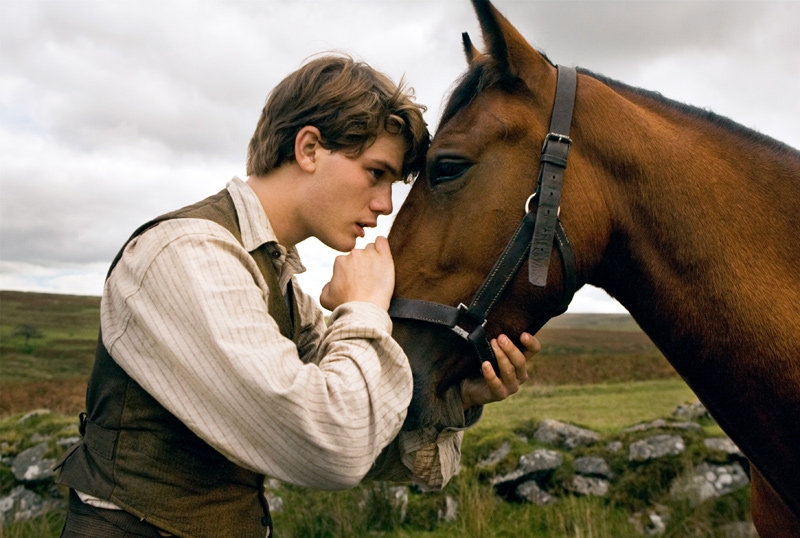 Oscar prognosticators lately have been crowing about Steven Spielberg's other December release: War Horse. A quick internet search should reveal why. It is a World War I narrative set on the English countryside that chronicles the story of "a boy and his horse." The premise is dubious and potentially fraught with ideological quandary, but Spielberg's name on a wartime drama all but guarantees it a spot on the list of Best Picture nominees. Feedback has recently begun to emerge on the movie, and, while I won't speculate very much regarding its Oscar chances, I did have the opportunity to see the film recently and can offer some reflections.
The film centers on a horse named Joey, who is auctioned off to a poor farmer who can hardly afford to maintain the farm and support his family. The farmer's son, Albert (Jeremy Irvine), trains Joey to plow the fields and eventually takes the horse under his wing. Structurally, War Horse resembles Spielberg's film of ten years ago, A.I.. The first act presents a focused family drama before drastically changing course for an episodic second act, which follows the horse on a series of encounters with a variety of folks on different sides of the war. Like A.I., this film is most effective in delivering the shorter vignettes in its long middle section rather than with the main story established in the opening 30 to 40 minutes. However, while A.I. gave us a machine who simulated the actions and emotions of a human, Spielberg here asks us to invest in an animal that cannot feel or simulate human emotion. But to my surprise, the "horse perspective" plot device works very well because the story remains fixed on the human characters that weave throughout the horse's narrative. Each of the smaller portraits in the middle of the film are delicate and compelling in depicting how various individuals are affected by and participate in the war. The human characters are mostly all good people who do little things to help each other out. While not especially subtle, these smaller stories are quilted together into a larger anti-war mosaic that I found much more convincing than the director's 1998 anti-(but-also-pro-)war film Saving Private Ryan. This film gives us characters on all sides of the conflict that are fearful, caring, and human.
In Spielberg's vision, the larger context for the war and the strategic interests of the sides are not factors. This is where the plot element of the horse perspective plays a key role. Without projecting too much human feeling onto the horse, Spielberg uses Joey's story to fashion benign observances of the fear and benevolence. The film adopts a serious view of the implications for war while also citing the need to distort its reality (particularly in a wonderful passage involving on older Frenchmen and his granddaughter). One common thread to the human stories is the often dehumanizing social roles we inevitably must inhabit to survive. And as is typical of a Spielberg film, technology also features prominently among the film's thematic undercurrents, particularly the technology of warfare. Another integral element that begs further exploration is how people communicate, whether with animals, the enemy, or through technology.
Considering all that it has going for it, it's a wonder that the film's main plot is its most problematic element. That is not to say the story of Albert and Joey is vapid; it just doesn't connect on the gut-emotional level that Spielberg is known for registering. He handles the early scenes of familial drama with uncharacteristic sluggishness and sentimentalizes Albert and Joey's relationship and Albert's relationship with his father to an extent that will some will find too much to stomach. And the John Ford-inspired ending —in which Spielberg uses every item at his disposal from the sentimentality toolbox— reminds of the ultimate simplicity of the narrative, which after all is about a boy and his horse. Nonetheless, despite baring the director's weaknesses, War Horse also showcases Spielberg's considerable strengths, which include the ability to infuse a tired, maudlin plot with a high level of visual sophistication and narrative dimension. (Steven Spielberg, 2011) ***
[On the film's Oscar chances I will say this: If War Horse has a shot, it's going to be on audience response. I expect critics are going to be hard on this film. It might have the broad support of the general reviewing community but the more discerning circles will be unsparing, much like response to last year's winner, The King's Speech.]
Monday, October 24, 2011
Almost Still Famous
 Pearl Jam Twenty spans the two-decade-long journey of the other musical act from Seattle. Setting out to author the definitive account of Pearl Jam’s formation and endurance, director and long-time fan Cameron Crowe infuses the project with a breadth of knowledge as well as an appreciation for a band whose influence, he believes, speaks beyond dwindling record sales in recent years. Indeed, few would deny the historical significance of Pearl Jam as a moniker for the rise of grunge (despite the fact that the band would reject the term), but Crowe’s work frames the band at the center of a changing music and cultural scene from the 1990s into the 2000s. Pearl Jam Twenty features extensive interviews with band members and other folks tied to the history of the band. Wrapped within its travelogue of concert footage and behind-the-scenes video are various threads tied to band’s rise and prominence, from its bonds and performances with 1960s music legends such as Neil Young and Pete Townsend, to Andy Rooney’s ignorant rambling about modern teen angst. In Crowe’s vision, these details are integral to how Pearl Jam endures and why their story resonates as one of survival and integrity in the presently grim state of rock.
The film opens in Crowe’s hometown of Seattle with nary a mention of Pearl Jam. Crowe narrates over skyline shots that shift to ground level, humming to the furious guitar chords that would epitomize the underground Seattle rock scene. It is here that, as he sees it, music lovers convened over a mutual thirst for a new sound. Taking his time to establish a context for the formation of Pearl Jam, Crowe gives particular attention to the demise of Mother Love Bone, whose decidedly hair band sound contrasts heavily with the more soulful anthems for which Pearl Jam became famous. Guitarists Stone Gossard and Jeff Ament guide us through a personal journey of their frontman’s tragic death from substance abuse. This set a solemn tone for a band that would eventually conquer music and remain continually wary of the fame that would follow. But it only achieved that status with the entrance of a vocalist named Eddie Vedder, to whom they gave a chance in what became their defining moment.
Whether these early scenes accurately portray these events or their wider significance is practically irrelevant. Pearl Jam Twenty’s assured opening passages establish it as equal parts a profile of the band and a personal journey for the director. Thus, how Crowe sees the band is arguably more revealing than what’s revealed from and about the band. And from the outset, Crowe is unafraid to express his enthusiasm as well as his knowledge of Pearl Jam and rock in general.
The notion of Crowe as a student of rock strikes a familiar chord. His 2000 semi-autobiographical feature Almost Famous depicted the rock and roll scene of the late 1960’s from the perspective of an aspiring music journalist who accompanies a band on the road. The intimate narration in the early-going of Pearl Jam Twenty echoes the quixotic but pained vision of rock culture that Almost Famous cultivated, as expressed through the fictitious band Stillwater’s frontman, Russell Hammond (Billy Crudup). Crowe’s entry point into Pearl Jam as both an enthusiast of rock and a giddy fan of the band bears strong similarities to that of the naïve teenager from Almost Famous. Crowe fawns over Eddie Vedder, painting in enigmatic, poetic tones in effort to put him on the pedestal of rock greats. Crowe elegantly captures the performer’s inner demons and impassioned stage presence, but the film becomes so transfixed with him that both its focus on the personal stories of the band members and its wider plunge into the cultural landscape that Pearl Jam found itself resting on top of somewhat suffers. To be sure, the sight of Vedder dangling some 50 feet above the stage is a brilliant image unto itself, but Crowe lionizes Vedder to such an extent that he renders himself unable to really explore the singer’s inner workings. By extension, the unique brand of observation and personal admiration somewhat morphs into Behind-The-Music territory with its strained rest on Vedder’s reflections.
From Vedder’s introduction onward, Pearl Jam Twenty swiftly navigates the post-mania stage of the band’s popularity, charting its appearance on Capitol Hill to fight Ticketmaster to Vedder’s hot-and-cold relationship with Kurt Cobain. Crowe attempts to balance these points in the band’s history with the performers’ own weighty reflections on fame, success, and (of course) mortality. He also tries to connect all of this to various things outside the band, from a chronicle of Vedder’s on-stage political statements to one inspired shot of David Lynch. And although these components are efficiently deployed, the film frequently feels hurried, as if it must hit every point on a checklist of topics in what ultimately amounts to a “How They Got Together and Stayed Together” narrative. Which is why for all its stylistic and visual flair—which includes some sensational concert footage—Pearl Jam Twenty is more conventional than it aspires and ought to be. The Kids Are Alright or The Last Waltz it is not.
But underneath the stubbornly straightforward presentation of the band’s 20 years together is another far more worthwhile story. As noted previously, Pearl Jam’s impact on and role in the transformation of popular music in the early 1990s is undeniable. But Pearl Jam Twenty eschews this narrative by suggesting that the band’s longevity and integrity have distinguished them in the current, fractured age of culture and music. The implications for this are touched on briefly but in a broader sense capture the overall sentiments of the film. Over 20 years, a band that started as a leading voice in the pulse of music became essentially an independent brand, isolated from the increasingly corporatized face of the music industry. Crowe’s focus on the band’s own feelings and reflections dilutes this story and also prevents him from making a direct case as to the significance of Pearl Jam’s music. But the film’s life comes from how Crowe distills his deep love for and knowledge of rock into a nostalgic tribute to a less tangible idea. For Crowe, Pearl Jam stands for something. Not a political statement or moral cause (though the band has offered plenty of those). Rather, in Crowe’s account, Pearl Jam is one of the last purveyors of rock, which is as much a concept as it is a practice.
If Pearl Jam Twenty suffers from straining to account for various points of view, then it excels as an account of personal idealism. The film’s final moments capture this elegantly, taking a single performance of the song “Alive” and intercutting various clips of the band’s performances over the years into a charged montage of music and motion. Whatever one’s feelings may be on Pearl Jam’s music—an amalgam of styles and periods in American rock—Crowe’s film is a veiled ode to rock and roll and a testament to that euphoric feeling of connecting with music, be it through a single song or a band that endures for two decades.
[Article originally posted at The House Next Door.]
Subscribe to:
Posts (Atom)