Since the release of George A. Romero’s seminal film Night of the Living Dead nearly 50 years ago, the zombie apocalypse has grown into a cultural fascination. The notion of the dead rising to eat the living was visceral and provocative, but audiences learned quickly that zombies were not only inventive villains but also a collective vehicle for pointed social commentary. Recent years have seen zombies again become a center of intrigue, as variations have surfaced across various media platforms—from remakes and parodies of Romero’s classics, to popular zombie books and survival guides. Even Romero himself has gone back to the well, having directed three new entries in his Dead series within the last eight years.
The zombie resurgence came to a head in late 2010, when the zombie apocalypse scenario was resurrected again; this time for the small screen. Adapted from the popular graphic novel series, The Walking Dead was the latest and perhaps most sweeping rendition of the undead phenomenon. It followed Rick Grimes (Andrew Lincoln), a small-town police officer who wakes from a coma at the height of the uprising and gradually regains his bearings, unites with his family, and leads a group of survivors. Despite its conceptual similarities to a myriad of previous zombie narratives, The Walking Dead worked because it had the budget and the freedom to realize and sustain its grim vision of a decaying world. In its short first season, show runner Frank Darabont (who also directed the first episode) and his team served up haunting images of cities deserted, hospitals abandoned, suburban neighborhoods turned into war zones, and hordes of “walkers” whose insatiable need to devour human flesh was graphically depicted.
The mounting dread the show deployed so effectively was not jointedly the result of its unsparing horrors of the undead feasting on the living as well as its a vivid portrayal of society’s crumbled institutions. These aspects fostered a level of authenticity to the proceedings, no matter how preposterous the notion of a zombie apocalypse may be. That it also explicitly avoided how the uprising occurred and offered only glimpses of life before it added to The Walking Dead’s pedigree. Darabont instead keyed on the immediate sensation of fear, survival, and the burden of facing the dangerous new reality into which surviving humans have been violently cast. In whole, the first season was remarkable for how strongly it evoked the feeling of witnessing a doomsday situation play out. Blending a realistic survivalist-type scenario with a far-reaching horror premise, it successfully transmitted deep-ridden collective fears in a way that felt fresh. The show went on to great ratings, making a second season inevitable. AMC extended the the episode count from six to 13, which granted the writers more opportunity to develop the core characters and also expand on the emotional canvas introduced in the initial six episodes.
Keeping in mind the first season of The Walking Dead, as well as the storied history of zombies in popular entertainment, let’s jump to the present. The show recently wrapped its second season, prompting many reviewers to evaluate the zombie-war finale through the lens of the entire season. (Of these I recommend reading Matt Zoller Seitz’s piece, which offers his usual breadth of insight.) Since this angle has been well covered, my aim here is place the show in a broader context. First, I will consider the second season as a companion to the first season, which, as it turns out, reveals major contrasts. Then, I will reflect on the show’s attempts to internalize the vast history of zombie apocalypse representations and how this has resulted in its struggle to offer something new to the lexicon. But let’s begin with how the second season takes shape in relation to the first.
Wednesday, March 28, 2012
Monday, March 26, 2012
The Muppets
The Muppets is another peg on the still-growing list of resurrected pop entertainments from the analog era. But unlike many of these reflexively timid works, it grasps the ethos of its origins. As many fans of The Muppets surely know, Jim Henson’s famed puppet troupe was always keenly aware of its place in the larger world. It parodied famous figures and current events and enmeshed them with an absurd but playful benevolence. Perhaps recognizing this as prime material for nostalgic re-embedding, writers Jason Segel and Nick Stoller make full use of the built-in elements to spin a loving tribute to the The Muppets. Segel stars along with Amy Adams, who together search for Kermit with the hope of reuniting the clan to save the famed Muppet Theater from destruction. Along the way toward rehabilitating the theater and staging a fund-raising telethon, Segel and the muppets strike up a handful of perky musical numbers—which are as joyous as they are random—inspired by everything from Broadway musicals to jaunty 80’s tunes such as Starship’s gloriously awful “We Built This City.”
The easy-going innocence of The Muppets is an endearing quality, which, coupled with a self-awareness of its own conventions, makes for a rare nostalgia trip well worth the indulgence. The film has some problems, but nothing that threatens to derail its smooth offerings. For example, the emphasis on Segel's character and his muppet brother Walter, while charming initially, becomes a bit jarring as the story takes shape; after all, the muppets are what we really want to see. But forgiving this and other minor blemishes (such as some of the voices and characterizations being slightly off-kilter) becomes much easier once the gang is back together and dancing across the famous archways.
Despite not hitting every note, The Muppets more importantly serves up an abundance of wit, absurdity, and delight on its way to delivering one last send-off for these beloved characters. Where so many other long-awaited resurrections of pop-culture’s past try too hard to recreate old wonder, The Muppets makes the difficult task of capturing the source material’s spirit look easy. (James Bobin, 2011) ***
The easy-going innocence of The Muppets is an endearing quality, which, coupled with a self-awareness of its own conventions, makes for a rare nostalgia trip well worth the indulgence. The film has some problems, but nothing that threatens to derail its smooth offerings. For example, the emphasis on Segel's character and his muppet brother Walter, while charming initially, becomes a bit jarring as the story takes shape; after all, the muppets are what we really want to see. But forgiving this and other minor blemishes (such as some of the voices and characterizations being slightly off-kilter) becomes much easier once the gang is back together and dancing across the famous archways.
Despite not hitting every note, The Muppets more importantly serves up an abundance of wit, absurdity, and delight on its way to delivering one last send-off for these beloved characters. Where so many other long-awaited resurrections of pop-culture’s past try too hard to recreate old wonder, The Muppets makes the difficult task of capturing the source material’s spirit look easy. (James Bobin, 2011) ***
Friday, March 16, 2012
Star Wars—Episode VI: Return of the Jedi
Before the prequel films, Return of the Jedi was the punching bag of the "Star Wars" series. The arrival of the Ewoks introduced a “cute-and-cuddly” element that would come to represent the exact moment at which George Lucas had jumped the shark. Of course, now we all know this was just the beginning of Lucas’ eventual focus on brand value instead of strong filmmaking. And while this development is worthwhile to note in the context of the saga’s history, perhaps too often it overshadows the many merits of Richard Marquand’s film. True enough, Return of the Jedi doesn’t reinvent or expand its world the way The Empire Strikes Back did, nor does it have the fresh energy of Star Wars, but it has nearly the same appreciation for detail and storytelling luster that marked the first two films. Moreover, Return of the Jedi may be the weirdest entry in the series, and I love it all the more because of it.
At the outset it is apparent that Return of the Jedi is all about looking back. Just after giving a glance of a new Death Star, it drops us on the same desert planet with the same two droids as the first film did. As it turns out, the film’s outward nostalgia proves to be an asset, particularly as a contrast to the solemn treatment it gives to the dramatic center of the Luke/Vader storyline. Thus, Jedi appears to be driven by two central tasks: 1) to conclude the Luke/Vader story with a strong generational tension, therefore cementing the mythical status of the saga; and 2) to give viewers one last chance to revel in this universe of odd creatures, towering sights, and colorful characters. The result is a strange mix of sensibilities that—despite the bumps—somehow feels right.
Friday, March 9, 2012
Star Wars—Episode V: The Empire Strikes Back
Midway through The Empire Strikes Back is a moment that affixes the Star Wars series as part of the great modern mythologies. It channels a past that we had never seen and a future yet unrealized. The scene starts in a small, fire-lit hut as rain beats down on the swampy terrain outside. After a fit of impatience by Luke Skywalker, the little green creature Yoda—who had until that point had been playfully chirpy—changes in an instant. With a forlorn look on his face, he shakes his head, looks up to the ceiling, and solemnly remarks, “I cannot train him. The boy has no patience.” There is pain and wisdom in his voice, as if he had just seen right through youth and inexperience and saw hope’s flickering light fade away. The moment has weight that resounds beyond the truth of its words. It recalls the vast history of the larger universe of the story while conveying a sense of a gravitas that the series previously lacked. And it is one of several moments in The Empire Strikes Back that strikes a deeper chord.
The Empire Strikes Back is frequently cited as one of the greatest movie sequels. That’s because it expands the first film’s world while offering more a layered story and fuller characterization. It also provides a different kind of experience than Star Wars. Lacking the simple structure and steady build-up that marked George Lucas’ original film, The Empire Strikes Back is a busier film. It is essentially one long chase peppered by endless visual delights and colorful characters. When it cuts away from one place and group of characters and takes to us to another, we want to go and see what’s happening elsewhere in the story. We become submissive to the rhythms of the narrative, simply wishing to keep up with its many moving parts. Watching the film again, I was struck by the apparent ease with which director Irvin Kershner orchestrates such a rich calamity of detail. Sometimes it manifests in big set pieces, such as a brilliant asteroid chase (which also boasts some of John Williams’ most stirring music). But there are also smaller moments that seem so right, as in one sequence in which a ship is pelted by an asteroid, which then cuts inside a different ship where the hologram of the officer on the hit ship cowers and disappears. Then there’s also the swamp planet of Dagobah, with its abundance of fog, vines, and creatures that together create a brooding atmosphere.
To be sure, The Empire Strikes Back is a film of many wondrous sights and sounds. But underneath it all is a story of despair and longing through the course of which we realize that we care deeply for these characters. This crystallizes in moments such as the one I described at the start of this review, or when Han Solo is frozen in carbonite. I noted in my piece on Star Wars last week that its showcase was the movement of its storytelling, whilst failing to mention much in the way of characters. Nearly all of the characters in Star Wars are proxies to broader symbolic ideas, but it’s worth noting that amid its lucid storytelling are a handful of memorable if not terribly complex characters. The Empire Strikes Back expands on what made these individuals so fun initially but also makes them full-bodied through subtle observation in quieter moments. For example, there is an almost sad plea for acceptance in C-3PO’s non-stop commentary, a raging insecurity underneath Han Solo’s confident veneer, and a deep frustration motivating Darth Vader’s obsessive search for Luke Skywalker. These characters and a host of others all become palpable inhabitants of this world and embedded into our imaginations in the process. By extension, the story takes on a greater significance and embodies universal struggles that most everyone can relate to.
Watching The Empire Strikes Back again confirmed and re-invigorated every joyous memory I had of it. It is a fluid piece of moviemaking that rings true on every level. Perhaps why The Empire Strikes Back is so revered is that it takes everything that was great about the first film—its penchant for detail coupled with grand, purposeful storytelling—and channels it into a rousing, but also intimate drama that operates so smoothly that you may easily fail to notice its mastery. It is not only one of the finest of sequels, but indeed one of the great movie entertainments to grace the screen. (Irvin Kirshner, 1980/1997/2004) ****
Tuesday, March 6, 2012
Hugo
It’s refreshing to see Martin Scorsese try his hand at more whimsical material. The famed auteur is renowned for orchestrating sprawling crime sagas and dark fantasies centered on troubled individuals, but Hugo represents a shift in tone and outlook from these and even his more uncharacteristic works. It is dense in narrative but airy in mood. Its fairy tale leanings are clear in the opening shot, which flies through the snowy streets of Paris and into a great clock within a train station. It then maneuvers through smoke and gears without any sense of gravity, following the young title character as he navigates the clock’s endless innards. This is the first of many sequences showing off the endless possibilities of the medium. Aided by Howard Shore's lavish score, Scorsese employs a flood of traditional and contemporary special effects in an effort to fashion an ethereal atmosphere to the train station where many of the main set pieces take place. In fact, the film works best when it is wandering about this world, spinning enchantments with small, but charming character vignettes.
Where Hugo somewhat loses its footing—perversely enough—is with its gradual gaining of narrative direction. Somehow, it fuses Hugo Cabret’s tragic backstory with that of an old man’s who he meets in the station. The crotchety fellow, played by Ben Kingsley, turns out to be George Méliès, a pioneer of cinema who directed such classics as A Trip to the Moon and then later fell into depression when the world lost interest in his movies. How the screenplay converges these disparate back-stories is a bit of a muddle. Nevertheless, the boy eventually brings about the redemption of Méliès in what ultimately amounts to be a love letter to the movies. Once the message about film preservation is revealed in the later passages, so too, it seems, is Scorsese’s inspiration for making the film. Having said that, Scorsese does more to validate the magic of the movies elsewhere throughout the film than with his late focus on Méliès. The old filmmaker’s story isn't a glaring problem, however I found it emotionally distant as compared to the earlier focus on the boy and the other station dwellers. This is one of the many anomalies that make Hugo so difficult to characterize.
Perhaps because I became wrapped up in its web of optimism and filmmaking bravado, I was less bothered by Hugo's inherent problems. I knew when I was watching it there was something distinct about its strange mix of sensibilities and thematic core that would keep me returning to it. Although the explicit message about film preservation doesn’t quite work in context, its underlying ideas and attitudes about art are beautifully realized and reflected in the movement of the storytelling. Thereupon, Hugo is a poignant ode to the great works of art that influence minds old and young alike, those that are with us for generations and those that slip through their maker’s fingers. (Martin Scorsese, 2011) ***½
Friday, March 2, 2012
Star Wars—Episode IV: A New Hope*
In a variety of critical accounts of Star Wars, much has been made of how expertly George Lucas fused together a host of mythological and epic archetypes and set them in motion in galaxies far away. It’s all true. But of equal significance to the story is the storytelling, which ultimately accounts for why this film has endeared itself to audiences and burrowed into our conscious and unconscious minds for more than three decades. No doubt, its images of spaceships dashing through the mechanistic canyon of the Death Star’s surface represent some of the most visionary moments in film history. But we should also take notice of the understated simplicity with which this film moves and unfolds, even in the quiet moments.
Although the greatest achievement of the six-film series belongs to The Empire Strikes Back, the original film is the purest and the leanest. More than any other entry in the saga, Star Wars stands independent of the commercial empire it later signified and operates fully on its own, an emblem of economical storytelling and a sprawling spectacle that would become one of cinema’s greatest treasures. (George Lucas, 1977/1997/2004) ****
* To remain consistent with the approach I’ve established (to watch these films as Lucas intended from Episode I through Episode VI), I am obliged to officially cite this film by its revised title. Although the original 1977 cut would be my preference as a film lover and fan of the original trilogy, in the interest of this project at hand I am watching the more current 2004 DVD editions.**
** Believe it or not, I don’t have much of a problem with the tricked out special editions. Lucasfilm did eventually release the theatrical cuts of the original trilogy (barring one small change to the title card of Star Wars). Although I wish he and his team had done so with more care, Lucas is off the hook as far as I’m concerned. I actually enjoy the fact that there are many versions of these films; at the very least, it’s an intriguing filmmaking experiment.
Tuesday, February 28, 2012
What we can learn from this year's Best Picture winner
Sometimes it's hard to separate a movie from the hype. Anyone who's followed the nauseating Oscar prognostication over the last several months knew full well that Harvey Weinstein's Michel Hazanavicius's The Artist would win the Best Picture crown on Sunday's telecast of the Academy Awards. Nonetheless, given its preordained victory, the critical dialogue about the film has become predictably antipathetic. As Scott Tobias observed recently, the political machine attached to frontrunners and winners often distorts our vision of them and renders reasonable discourse a challenge. Truth be told, these days the Oscar badge doesn't hold much weight. The reason for this, Tobias concludes, is that Best Picture winners represent consensus over excellence. Oscar winners reflect more on the film industry's own image of itself than the artistic significance of film.
Click here to read the full article at The House Next Door.
Friday, February 24, 2012
Star Wars—Episode III: Revenge of the Sith
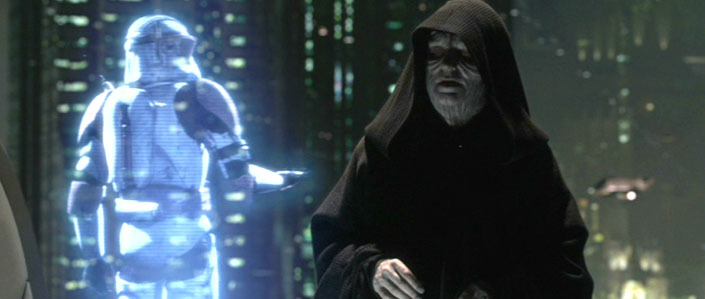
“Execute Order 66.” For Star Wars fans, these words recall the pivotal moment in Episode III when countless Jedi Knights are slaughtered, and the tides of the Force shift seismically. But to this film lover and modest fan of George Lucas’ opus, they represent the moment when the problematic prequel trilogy finally came to life. What follows is a gripping montage of surprising emotional breadth that no other Star Wars film has achieved. Bound together by mournful choral music, the scene depicts various worlds across the galaxy where troops are turning on and exterminating their leaders in the midst of battle. It is bared, visceral filmmaking, and it demonstrates why I find the prequel movies too endearing and interesting to dismiss. Certainly, Lucas deserves every shred of criticism he has received for shoddy storytelling throughout the films, which includes but is not limited to flat dialogue and convoluted plotting. Revenge of the Sith notably contains a similar dose of these flaws. And yet, to its maker’s credit, it crystallizes a compelling story arc with sincerity and vision. To be sure, Episode III is best remembered for its portrayal of Anakin Skywalker’s descent into darkness. However, for all the fuss about the emergence of Darth Vader, Sith belongs to the shadowy emperor (Ian McDiarmid), who subtly preys on every weakness of the political system to gain unfettered power. When he outstretches his hands and basks in rousing applause after announcing the birth of the Empire, the effect is chilling. It’s the kind of moment that caused me to realize through all the hyper-activity of the prequel films—and this entry in particular, with its non-stop jump-cutting, sword-waving, and noise—that George Lucas really has something to say. It may not be terribly profound and I wish he delivered it with more clarity, confidence, and skill, but it has real weight. Revenge of the Sith may be a hot mess of the visually poetic and the plain bad, but this saga-completing entry is elevated beyond its weaknesses by the scale its ambition. (George Lucas, 2005) ***
Tuesday, February 21, 2012
Another Earth
Another Earth imagines a scenario in which an Earth-like planet appears in the skies above our planet. A mirror-Earth, if you like. In newcomer Mike Cahill’s ambitious film, the philosophical implications of a parallel universe serve as a backdrop for an examination of remorse, regret, and identity. Although traveling to "Earth 2" is a main plot point, the film avoids space travel and other sci-fi conventions. It instead tells a more focused story of a young woman whose costly mistake racks her with guilt. The plot circulates around her attempt to make amends with a man that’s lost his family as a result of her action. Despite the conventional character drama (which necessitates that she doesn't tell him the truth until late in the movie), actors Brit Marling and William Mapother work well with the material and find chemistry in protracted periods of silence. Interspersed throughout the proceedings are clips of radio and TV commentary from scientists ruminating on questions of existence and choice. These sequences are augmented by numerous beautiful shots of Earth 2 hanging over the characters. Certainly, the film’s most memorable element is its visual design, which juxtaposes a hand-held style of realism with such simple, fantastical images. But Another Earth is too heavy with allegory to make the most of its unique disposition as a character study and thinkpiece. Accordingly, despite its potential, this “indie sci-fi” experiment somewhat falls short of achieving a distinct vision. (Mike Cahill, 2011) **½
Friday, February 17, 2012
Star Wars—Episode II: Attack of the Clones
Attack of the Clones ventures into new territory for a Star Wars film. Where The Phantom Menace was light, innocent, and regal, this middle episode of the prequel trilogy is brooding and dark. Its noir-ish mystery plot is fairly uncharacteristic of George Lucas’ established narrative approach and a welcome shift in tone. Clones features some exotic locales and set pieces that feel fresh and alive. For instance, after a sensational chase through Coruscant, the film takes us to the city-planet's Blade Runner-esque street level, a seedy place cocooned from the sterile rooftops occupied by Jedi and politicians. But in spite of these energetic flashes in storytelling, Lucas again fails epically at creating a real moment between characters. More pointedly, his struggles with dialogue are especially evident in this entry, which sees young love bloom between Anakin Skywalker and Padme Amidala. Here we see that Lucas’ problem with dialogue is not just a matter of stiff writing, but also with delivery that lacks any sense of rhythm. I suppose Lucas can fall back on how the players in his young lover’s tale don’t know how to be in love (which in part explains their awkwardness), but that doesn’t let him off the hook for his unshakeable propensity for explicitly stating or visualizing every idea he wants to convey. This is the main problem with the prequel films. Since we're taken carefully taken from Point A to Point B with painfully direct methods, the films become incapable of suggesting, observing, or expressing anything beyond their pixilated panoramas and consonant-free dialogue. (Next week I'll discuss how Lucas finally finds his voice and offers more successful attempts at visual poeticism with Episode III.) As for Clones, we are only afforded brief glimpses of the lucid storytelling and simple, powerful images that marked the original films. In particular, one stirring vision of lumbering spaceships riding to the horizon of war amid orange skies captures more feeling than anything before it in the prequel movies. While not making up for Episode II’s flaws, these images fleetingly realize the potential of a marriage between digital technology and narrative. Unfortunately, they also illustrate the missed opportunities of these films. (George Lucas, 2002) **½
Wednesday, February 15, 2012
Drive
Drive is a jolt of aesthetic pleasure the likes of which I can’t recall since Michael Mann’s Miami Vice. Like Vice, it breaks free from the confines of plot and turns what might have been a straightforward genre picture into a wholly original and evocative vision. Some critics have noted that Drive feels like an updated version of Taxi Driver, as both films are about an isolated driver (played in Drive by Ryan Gosling) who carries out a violent fantasy to save a woman. Others have observed that it channels 80s pop cinema (particularly Risky Business), with its sprawling pink title lettering and 80s-infused synth tunes. Both are true, but the list of the film’s thematic and stylistic influences runs much deeper. Drive is a pastiche of disparate styles and genres, gleaning outmoded cinematic dressings and repurposing them onto a splashy canvas of mood and color. Director Nicolas Winding Refn’s precise, sumptuous compositions coupled with a hypnotic soundtrack imbue the proceedings with a dreamy atmosphere that contrasts well with the guarded emotions of the characters. As the performances go, Albert Brooks stands out as a producer-turned-mobster who dispenses with his enemies with casual ease. His portrayal of controlled psychosis is frightening and masterful, and it is one of Drive’s many lyrical touches. (Nicolas Winding Refn, 2011) ***½
Subscribe to:
Posts (Atom)