Showing posts with label Blogging. Show all posts

Thursday, May 24, 2012

A bit of permanence

In 2008, Scott Balcerzak and Jason Sperb, co-editors of the book, Cinephilia in the Age of Digital Reproduction, Vol. 1, invited me to join their panel at the Society of Cinema and Media Studies annual meeting. It was a moment of true happenstance, given that the meeting was held in my home city of Philadelphia. I graciously accepted the offer and focused my presentation on the contributions of internet writing to film criticism and cinephilia, particularly how it might redefine and collapse the space between the two. (Back then, my writing approach was more polemical, reflected by the longer posts.) The presentation went about as well as it could have, when you take into account that I'm a nervous wreck of a public speaker. I was more impressed by the uniquely focused presentations by the other panelists. Afterwards, Jason and Scott asked if I would be interested in contributing something for their planned second volume of the Cinephilia book series. Again, I accepted with equal feelings of excitement and trepidation.
Four years later, I am pleased to report that the outcome of that conversation has taken shape in the form of Cinephilia in the Age of Digital Reproduction, Vol. 2. The book aims to illuminate the larger historical and global contexts of the changes in technology and film spectatorship in recent years. My contribution is a chapter entitled "Revisioning Critical Space in the Digital Age." It represents an attempt to synthesize elements of my 2008 SCMS presentation with some writings that I've done here at The Cinematic Art. In retrospect, I wish I had given more time and energy to the product. But, having said that, I am generally pleased with the piece. It is not the definitive argument for my platform but its very publication may represent an important step in realizing the broader perspective of a kind of "critical cinephilia" that it outlines. It's also worth noting that it is an incredibly dated essay. I suppose that's the nature of the beast when it comes to academic publishing, but I cannot help but note the irony of an essay about the shifting state of media relations and film viewership that in some ways is already obsolete.
Limitations notwithstanding, the article is a standing reminder of what is possible in the digital age. On a personal level, I feel a deep sense of satisfaction that my small contribution to the still-growing network of film writing in the digital sphere has secured a bit of analogic permanence in print. When I started this blog five years ago, I had no inclination that it would result in a presentation at an academic conference and a chapter in a prominent book series in film studies. I am profoundly grateful to Jason and Scott for taking notice of The Cinematic Art—flaws and all (and there are many)—and seeing its potential. Moreover, I am thankful to them for providing me the opportunity to stand amongst scholars and argue the value of this format as an intermediary to criticism and cinephilia.

Cinephilia in the Age of Digital Reproduction: Film, Pleasure and Digital Culture, Vol. 2 is available now through Columbia University Press and can also be purchased via Amazon.

Wednesday, May 2, 2012

Gaining some 'Critical Distance'


At the start of the year, I announced I would be reviving The Cinematic Art and re-appropriating its content to suit my current interests and capacities. Four months in, I am generally pleased with the results. What started as the posting of simple, short capsules has evolved into the regular (and still brief) reviewing of movies and shows. While the format has limitations, it has also helped me understand and address my own limitations as a writer. If you've read this blog before, you know that I take to criticism with a high degree of reflexivity. Although I don't inject this into my writing these days, I am always wrestling with it and trying to improve my writing and approach with each review.

Another benefit of the recent writing I've been doing has been my rediscovery of long-form criticism. It started when I saw The Artist in February. I drafted a short review, but found myself reading more and reflecting on it. I returned to my capsule review and started adding to it. Eventually I molded it into a grander piece that was posted over at Slant Magazine's blog, The House Next Door. I had a similar recent experience with Mission: Impossible—Ghost Protocol, which I began writing as short review but gradually developed it into a longer polemic. Both essays don the "Critical Distance" tag, a name that suits my long-form critical approach and also reflect my own film-viewing limitations. (I often do not see new movies until DVD release). "Critical Distance" covers both of these angles and more broadly represents my approach to come at a film from the perspective of having absorbed the hype and attacking it with a new set set of eyes. I already have a few ideas for movies to explore future Critical Distance pieces (e.g., Prometheus, The Dark Knight Rises), but it's equally important to allow these essays to naturally develop from my reaction to something. (That I often am seeing films and shows well after their initial run adds to this approach). I realize that there isn't much need for a series like "Critical Distance." As David Hudson recently noted over at his new spot, KeyFrame Daily, "never has the mediasphere been noisier, nor have attention spans been shorter." Movies, even mega-commercial releases, have a brief moment in the sun on release, but are quickly chewed up and digested to make room for the next discussion of the moment. That goes for criticism, too. And that's why I like the idea of an essay series that runs against this trend. For the very same reason, I don't expect these article to resound much within the bigger conversation about a given movie. But it is my hope that they contribute a fresher perspective to works that have had their moment and are worth considering in a new light.

As I move forward with the Critical Distance pieces, I hope to put as much effort into the regular reviewing I've undertaken in recent months. Given that I am not a critic by profession, I am usually about six months behind the rest of the circuit with viewing/reviewing. This is an occasionally frustrating reality, but it also reminds me (as the Critical Distance series evidences) that there are other ways of spotlighting critical discussion than what constitutes the current moment. Nevertheless, I plan to have one foot firmly implanted in the new-to-DVD/streaming front and will also review select films in theaters. (On queue: A review of The Avengers, and perhaps also a Critical Distance piece on the same subjects at the end of May.) But as I am now winding down my engagement of 2011 movie fare, my review base will broaden in coming weeks and months, as I return to watching older films and television shows more regularly. This represents a relatively new direction in my reviewing habits, one that I am looking forward to carving out.

Thursday, January 12, 2012

New directions

In comings days and weeks this blog will undergo some changes regarding its content. Given the difficulty I've had with posting frequency, I am adopting a new approach that should keep my writing and posting more in-line and consistent.

The capsule review.

I have avoided short write-ups for some time, mostly because it isn't a terribly exciting model for film writing. But I have recently concluded that for too long this has been my excuse to simply not write. And given the current state of the site, I'll take any writing to no writing at all. Moreover, while good capsule reviews are something of a rarity, this is less a statement about the form than it is a reflection of the difficulty of penning concise, interesting accounts of a film. Some of the best writing I have read recently has been of this variety, and it is about time I start pressing myself to explore it. Short and concise have not exactly been trademarks of my writing o'er these last five years of The Cinematic Art. So, in truth, I take this as a challenge. All news films I see in the theater or at home will receive a short review—probably no more than 200 to 250 words. I may pepper in some reviews of older films, though these will be less frequent.

It is my hope that I still find the time and energy to write commentary pieces on film criticism or a certain trend in film. These pieces tend to represent my preference for writing in this format. But they also require more time and inspiration than I have had lately. Nonetheless, I hope to still chime in to the larger discussion of this great circuit of film writing on the web, even if my contributions are not regular. In the mean time, for the foreseeable future, the capsule review will become this blog's identity.

From a personal viewpoint, I find that I am happier when I write. It is a daunting, often frustrating act for me. It always seems impossible. I write for my day-job in a very different format, and while the task at hand is different the challenge remains the same. Going from blank page to something useful and maybe even interesting is always a source of stress. However, the process is where real discovery happens. Writing helps me to better understand my response to a given movie, or a particular moment within a movie; a shot, a line of dialogue, an edit, etc. Movies are made up of so many things and criticism is a way not only to try to understand how movies work, but more importantly how movies (and art in general) can provoke our innermost states and burrow into our conscious and unconscious minds. For me, writing offers the ability to understand, hone, and develop those thoughts and feelings; which is why I am making a concerted effort to regain some direction for the site.

As always, thanks for reading and I invite your feedback.

Wednesday, August 3, 2011

Up and running again

In a conversation about three months ago with a few close friends over the final Harry Potter film, we mutually decided to embark on a long project. We would convene once a week to watch the seven previous entries in the Potter film series in succession until the release of Deathly Hallows Part 2. We are all fans of the books and movies in various capacities, though I am probably in the minority for aligning more with the movies than the books. I've read maybe half of the novels and reasonably enjoyed them, but my interest was more with the movies. In attempting to articulate my positions on the films —like, for instance, why Prisoner of Azkaban, is the most evocative entry and a great film in its own right— I found myself thinking more about them and the surprisingly affecting mosaic they form. Perhaps realizing that very little serious reflection had been committed to these films, I had idea to write a series of essays. I don't know when exactly it came to me. Nor did I give it much thought. I just began penning reflections on the first film a day or two after watching it.

Turns out that a two-year-plus hiatus from writing about movies left me with a good deal of rust. But thanks to Keith Uhlich, who helped me gain clarity of the project and find a confident voice, I authored eight articles over roughly six weeks. They were posted at The House Next Door in the week following the release of Deathly Hallows Part 2. The series represents my first writing on movies in well over two years. I say, "on movies" because I do a fair amount of writing in my day job as an editor for a monthly medical magazine. Between this, completing my graduate school thesis (which took in excess of one year), and various other personal ventures from home projects to fatherhood in that span, I found little time to update this here blog. As the distance widened from my last update, my desire to return to film writing —even in a more limited capacity— was waning. I've attempted to keep up to speed with movies, still seeing roughly 50 to 60 theatrical releases in a given calendar year. (As usual, I've seen some very good ones and a few great ones. As for 2010, put me among the crop of critics who found The Social Network the only real masterpiece from last year.) I have been content to watch, feel, and reflect without the strain and effort of translating those feelings and reflections into text. To keep slightly abreast of the goings on of film criticism, I would rely on Roger Ebert, Manohla Dargis, and a handful of other critics whose work I have made part of my regular weekly reading for years now.

I never expected to return to this blog. But the unforeseen chain of events that has led to my Potter series has reinvigorated my interest in thinking critically about cinema of many stylings and rejoining this online community again. I should note that I have never had any delusions about the greater significance of this site. As I observed in my last published piece, back in March of 2009, my aim for the site was "to explore the interconnections of film, criticism, and cinephilia in an open forum." However flawed, I feel that in some ways The Cinematic Art achieved that despite my readership never achieving great heights. But as much as I've enjoyed lending my own small voice to the critical discussion, the real joy of it was exploring the work of so many others who are passionate about cinema and writing. In the spirit of the late Manny Farber, Andy Horbal once referred to the ever-expanding plane of film commentary on the web as a kind of "termite criticism." And after years of removal from the film blogging circuit and returning to discover it is as vibrant as ever, I feel that Andy's terming for it is spot-on and very relevant. We are a unique collection of voices. The flaws in our writing and logic are often openly on display, but so is the immediacy of our insights and perspectives. With styles ranging from scholarly prose to fanboy cinephilia (sometimes at the same time!), and everything in between, online film writers are slowly molding new pathways in the discussion of cinema; one that straddles the established structures but that also collapses them. Yes, the old pillars of journalistic and academic criticism will remain the authority on film canon and the officially sanctioned discourse about cinema for a long time to come. But I remain of the belief that a digital discussion of cinema is ubiquitous and can potentially guide dialogues that allow us new ways of engaging cinema, criticism, and cinephilia, by melding them all together. It will not usurp other modalities, but rather deepens the scope of criticism to encompass wider perspectives, styles, and reflections.

It seems that many new technologies and social platforms remove much of the spontaneity from life and our interactions with people, films, and various other things we engage regularly. But they also provide critical potential to harness the nuances and peculiarities of our individual experiences and project them into text and images. That is partly why cinema is so special and maybe why so many of us actively take part in this great experiment of termite criticism and cinephilia. For my part, I am happy to have rediscovered the desire for writing and film, which I hope in some capacity to channel into prose here on this site. In the past I've probably engaged in too much reflexivity for my own good. Going forward, I will try less to provide commentaries about the relationships of cinema, criticism, and cinephilia and focus more on doing my part to create it. I don't know where it will take me just yet. I have a few larger ideas in mind (such as a long-gestating Werner Herzog project that will hopefully unfold in coming weeks and months), but my general attitude is to write about things that mean something to me, to not engage in too much reflexive rumination, and to simply write. Whether it amounts to anything useful in the broader critical dialogue is not for me to decide. It will certainly not have the polish of many published forms of criticism. And there is obviously no guarantee that it will have consistency and structure (as evidenced by my long hiatus from writing). However, the broader canvas it affords me to perform the commentaries I wish will hopefully make it worthwhile. And one thing for sure is that mine will just be one voice amongst many that make this platform so enjoyable to participate in, both as a writer and reader.

Monday, November 10, 2008

On The Dark Knight (again) and other things

It's been a tough scene for film blogging lately, at least from where I'm sitting. There are so many film and media blogs on the web that I couldn't possibly try to surmise an overall state of blogging. But from my perspective, at least, there has been a minor lull in the past few months likely due to a combination of factors. Outside the Toronto and Telluride Film Festivals, it hasn't been a particularly exciting time for new releases. Moreover, a number of writers have probably been so attached to Presidential politics (myself included) that movies have taken a back seat to other concerns. Even a film as politically inflammatory as Oliver Stone's W. couldn't shake things up in film coverage. Then again, the idea of W. is more inflammatory than the film itself, which rather well sums up the state of movies in the last few months.

It's worth noting that I have done nothing to help the situation, as I have taken my longest hiatus from The Cinematic Art since I started it in January 2007. My reasons for doing this ranged from the aforementioned waning interest in films by film culture at large, strange as that sounds. This coupled with my fervent, almost obsessive interest in the election and the media coverage of it made finding time and inspiration to write about movies difficult.

In all fairness, the election was just one of a couple of things to occupy the majority of my time. The Philadelphia Phillies' unlikely journey to a World Series title was another. As a lifelong fan, hearing those words "And the Phillies are World Series Champions!" was one of those perfect and surreal moments. While elections and baseball championships make for great times (especially since the outcomes of both were as unexpected as they were joyous for me), nothing compares to what I experienced just six weeks ago, when my son was born. I can say without exaggeration that moment was the most humbling and illuminating of my short life, and it now lives in my memory as well as in my everyday experiences.

All of these things have contributed to my absence. I've had some time here and there to watch movies, among which Errol Morris' Standard Operating Procedure and Jonathan Demme's Rachel Getting Married stands out. I'll have more on these films in coming posts. But I don't want to stress myself out with writing full-out reviews at this juncture. It took me about four weeks without posting to actually feel content with not posting. Ironically, this has enabled me to begin writing again, stress free. I'll have some collected thoughts on movies again (and on blogging) soon, but for now I want to get my feet again, take it easy, and remember why I began doing this in the first place.

As I attempt to regain focus, it's only appropriate that the article I'll be commenting on was written by another blogger who has taken some time off and only recently re-emerged into the film blogosphere. Ali Arikan, whose Indiana Jones blog-a-thon yielded some nice analyses on the Indy pictures, has written his first post in several months, offering his reflections on the film event of the summer: The Dark Knight. His post is refreshing for a number of reasons; first, because after an influx of discussion about the film before, during, and immediately after its release, interest has dropped off. It's as if critics and bloggers collectively decided that we are all on Dark Knight overload for a while and balanced it out by abruptly cutting off major discussion about it.

Given the context, it makes sense that Ali decided to write about this film for his return from blogging hiatus. But it's what he has to say about the film that's most interesting. He acknowledges the power of Christopher Nolan's juggernaut of a movie, but his implicit observation about the homogenized tone of the critical dialogue about the film is especially intriguing. In short, he's not buying the movie one bit, and for very different reasons than those presented by the film's detractors. He says:

"The Dark Knight is not a sequel to Batman Begins. The actors are the same, sure, and, thus, the characters, but they inhabit two completely different universes. A shadowy organisation of ninjas (none of them diminutive, alas) called The League of Shadows, run by a foppish Frenchman, and intent on razing Gotham, would feel completely out of place in the latter film. The Dark Knight doesn't just have a different tone, it plays a totally different instrument.

Gotham, too, looks different between the two films. In the first one, it has a reddish orange hue; it’s claustrophobic, and, even though I don’t want to use the word, gothic. In the second film, it just looks like Chicago. I know the first film was mainly shot on a soundstage, and that a big deal was made of the second film’s use of Chicago, but still, one would expect some sort of consistency.

Batman Begins is a superhero film that pushes its boundaries to the extreme. The Dark Knight is a film that obliterates those limits in the hopes of becoming a crime noir. And that would be a laudable intention, if it weren’t for the fact that it’s still a film about a guy who dresses up as a fucking bat and fights crime. It is because of its very essence that the film is inherently unable to make that leap towards serious crime drama. Batman Begins succeeds by remaining a superhero movie, The Dark Knight flounders by trying to abandon its roots.[5] And it’s not a pleasant sight."

In my original post on the film, I made a similar argument about the atmosphere and overall presentation of The Dark Knight. Where my thesis was buried in a sea of arguments, Ali directly critiques the movie for its almost complete lack of resemblance to the Batman Begins. Where Begins found a balance between the hero myth and a gritty cynicism. The film blended two very different sensibilities into an ambiguous tone that actually achieved both. The Dark Knight is just about the reverse of that. Thematically, its covering some similar territory, but the movie could not be any different from Begins from an aesthetic point of view. Moreover, that it almost completely shuns the cloudy tones of the first film is jarring.

I have only seen the film once, and I look forward to seeing it again. But on first viewing, the movie failed as both a crime saga and a representation of the hero myth. It failed to build upon anything established in the first film. As Ali notes, we're listening to a different instrument altogether. Equally important as that fact is how little it has figured into the greater discussion about the film. Although a number of critics / bloggers have grown tired of talking about The Dark Knight, we've really only just begun to comprehend its relevance as both a cultural artifact and a piece of cinema.

Wednesday, August 6, 2008

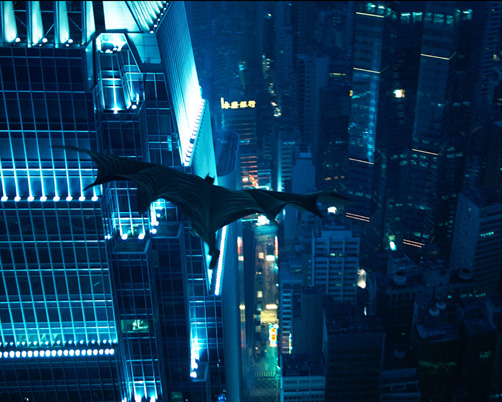
Terrorism, Criticism, and Opinionism: Observations on The Dark Knight


With the influx of discussion about The Dark Knight on the internet these past several weeks, I have deliberately avoided a written reflection on the film. While I normally praise the networked approach to film criticism that blogging enables, the explosion of dialogue over Christopher Nolan's film has left me rather cold about the prospects for critical dialogue via digital media. Of course, it's disconcerting to see such prominent expressions of outright negativity and blind opining, from Rottentomatoes to the comments section of Keith Uhlich's review of the film at The House Next Door. But how ever easy it is to point out extreme examples of this rhetoric, singling out the worst cases often invites (even encourages) one to gloss over the ideological undercurrents of the larger practice, ultimately to validate and re-inscribe those underlying trends while losing sight of them.

My disenchantment with the discussion about The Dark Knight extends well past these often-disgusting negativities to encompass the overall state of critical mud-slinging about the film. On the film's release, the journalistic film critic community nearly unanimously annointed it as one of the finest studio pictures in years, comparable even to sequels like The Godfather Part II and The Empire Strikes Back. Comic-book audiences and general moviegoers echoed those sentiments. (The film has already crossed the coveted $400 million mark in just 18 days.) The massively positive response felt destined, what with the allusions to contemporary American political landscapes and the tragic death of Heath Ledger, who delivers one of the most memorable performances in years. It only seemed appropriate that critics and audiences would stand in solidarity in praise of the film.

Unfortunately, the effect has been devastating. The few dissenters were verbally crucified, with commenters demanding that these reviewers provide explanations and "evidence" for their purported mis-readings of the film. Those with less than positive perspectives provided no more or less evidence than those who liked the film -- they just happened to be singled out and raked over the coals because of those views. As Matt Zoller Seitz noted in the comments thread in Keith's (very good) review of The Dark Knight, what makes this all so scary is not that some commenters were downright vitriolic, but the collective mentality that smothers differing perspectives as if they are not allowed. At times this behavior borders on robotic uniformity, and it's worrisome.

Framing this within the larger discussion about blogging and digital discourse depresses me most. There were some two or three hundred responses to Keith's review, which is almost exponentially more than your typical response to blog posts, even the more controversial ones. We blog writers would like to think there is a silent majority of intelligent individuals reading our posts, but the overwhelming prominence of these naysayers may point to a very say reality that without commercial support, little will come of this experiment. This may signify that blogging or digital communication will eventually become just another corporate commodity with no such ability to influence anyone outside already established camps (e.g. film bloggers).

Equally disappointing was the "serious" discussion that's followed in light of the initial explosion of opinionated sneering on the film's initial release. Almost mirroring the tidal wave of uniform hatred expressed toward those who voiced discontent about The Dark Knight, a small band of determined, well-meaning critics / bloggers launched a counterattack on the film, as if to tear it down from the pedastol on which it has unrightfully been placed. I can't say I've read all of these reactions, but one thing I noticed in many of them was a homogeneous perspective -- ripping the film's formal elements, inept storytelling, and shallow allusions to post-9/11 America. Meanwhile, so few actual inquiries into the film have been attempted and we've instead found ourselves in an ideological and cultural struggle for commercial and/or intellectual superiority. These discussions almost never had anything to do with the film at all. The Dark Knight just happened to be the point through which all these lines of behavior and reaction passed through.

The majority of what I've read about The Dark Knight has not revealed anything worthwhile about the film. Seldom have I encountered pieces in which individuals have reflected on the immediate experience of the movie, its cultural significance, tonal qualities, or thematic relationships. Perhaps the discourse surrounding the film reveals rather than informs the state of culture than.

With the critical and popular responses to the film falling into such a bland pattern, it's now become obvious that a shift away from opinion and towards questions is more relevant. If we rendered ourselves incapable of discussing the film in terms of rateable quality or good-bad judgments, there might be a more varied perspectives. I would never discourage someone from having an opinion, it's basis for which we form those opinions that I would like to see expand. Then our opinions become more nuanced and interesting.

That said, the most interesting pieces about The Dark Knight that I've read were posted relatively recently (notably Rob Humanick's review at The Projection Booth and Ryland Walker Knight's email dialogue with Jennifer Stewart spread over two lengthy posts at Vinyl is Heavy), and I suspect that may be because we've had a little bit more time to digest both the film and the whirlwind of coverage about the film.

I saw the film just once about three weeks ago. So I'm finding it hard to review it in the same capacity as some others. It would also be relatively inconsequential, since thousands have dissected and analyzed the film's significance and plot points over and again. The last thing I would want to do is add my own judgments to the stockpile of opinions about The Dark Knight, suffice to say that it was endlessly intriguing and not at all what I expected. Which is probably why I am so disappointed with the dialogue both in print and online about the film. Nevertheless, there were some things that struck me about the film that are worth exploring in more detail.

I'll start with the "post 9/11" connections. After reading countless posts and articles about the connections of the film's events to Bush-era politics and post-9/11 American life, many of which very interesting, my inclination is to consider these claims in relation to the specific narrative relations in the film. There are countless allusions to the current wars in Iraq and Afghanistan, with images of videotaped torture, as well as a scene in which Batman uses cellular surveillance to track down the Joker. The film makes these allusions very explicit indeed, but to what end? I think the film is far too hazy to simply situate these blatant connection within pro-Bush :: anti-Bush or pro-war :: anti-war schemes. Christopher Nolan no doubt wants viewers to think about these issues, but that doesn't necessarily mean he endorses the actions of his protagonist, or, for that matter, that the film should be a 1:1 comparison to current world events.

On that note, why does Batman and Gotham have to represent something, a la Bush or America? We have connections between the fictitious world of the film and the non-fictitious world in which it is set. But that doesn't mean we have anything tangible. Besides, the "real" world we live in is anything but real, come to think of it. We all have our own perceptions of it, and our engagement in it depends on those perceptions. Who's to say what is fictitious and what is not? If we must ground our criticism in Jungian cine-psychoanalytic approaches, then perhaps Batman and Gotham represent the harsh collision of the fiction and the supposed real world. The Dark Knight could therefore be depicting the collapse of social order under the weight of our obsessions with myths, heroes, and villains. Our desire for these things is insatiable, perhaps because they help to narrativize and streamline the chaos and absence of meaning.

Batman Begins (2005) dealt with these relationships head-on. It speechified too strongly about its themes of fear and justice, among other things, but it balanced its construction of myth and reality so effectively that they bled into each other to become each other. The film made known immediately that it was happening in a world like our own, that it would be less cartoony and comic-book-y and more something that could potentially happen. The action was down-and-dirty; Bruce Wayne made a believable arc to becoming Batman; and Gotham City felt like a real city. Interestingly, the film contrasted this move toward realism against the building desire and purported need for a hero. It romanticized the hero myth. Aesthetically, thematically, and structurally, the film was a blurring of gritty realism and mythmaking, both grounded in and taking flight from the everyday.

The Dark Knight all but leaves this world behind. Entrenched in city politics and the corrosion of social orders, it seems to be moving farther away from the romantic vision established in the previous film. I will have to see it once or twice more before I begin to really delve into the possibility that The Dark Knight is a result of the schizophrenic unity of Batman Begins. But I initially perceived the aesthetic discontinuities (from the first film to this one) as a deep flaw; Gotham is more open, glassy, and overall more cool in tone-- nothing like the Gotham from Begins. Moreover, Batman is hokier this time around. He stands out in an otherwise serious story about the injection of paranoia and chaos into a society. Unlike in Begins, this film seems to fully take place in a more "real" world controlled by fear, where it has become nearly impossible to feasibly envision a hero.

The Dark Knight never achieves the sense of aesthetic flow of the first film. Narratively and aesthetically, Nolan is intently focused on something larger than individual moments or scenes. What that larger something is, I don't know. It would be easy to criticize it for too explicitly manipulating the many elements it has in motion, moving so quickly from one moment to the next and rarely fixating on a pure moments. Plot-wise, so much transpires in the course of the film that there appears to be no narrative rhythm at all. Whether this was Nolan's intent is not really what's important, but I will admit that I found the experience of the film very disorienting, while watching it and in retrospect.

At the heart of this estrangement is Heath Ledger's Joker, who just about takes over the film. His presence makes such an impression that all else seems to fade into the background -- whether that's the aesthetic design or character plotlines. Ledger embodies a void as a man who (some have argued) is the antithesis to the symbol that Bruce Wayne set out to create in the first film. Where Begins represented sound structural precision in developing the evolution of that symbol (The Batman) into an inevitable union of man and symbol by the end, Knight is only interested in the effects that Man as Symbol (The Joker) can have on a society. The Joker has no connection to the human life around him beyond that of maneuvering within the corrupt infrastructures of society and government. He passes through legal systems and defies physical possibility simply by being everywhere and anticipating Batman's every move. Many accounts have situated the Joker as the terrorist to Batman's America, but this is overly reductive. He does not represent a terrorist or terrorism, but is instead both a man and an idea, a manifestation of collective fears and a deeply buried desire for any figure that is both a person and a symbol, even if he is an agent of chaos. There is something attractive about him, which is the real focus of the film. The closing narration explains that Batman is the "hero Gotham needs," but not the one it wants. The Joker may be both the villain the city needs and wants, which is why his presence comes to swallow up the film much like he does the city.

Whether you consider The Dark Knight great, a masterpiece, or "flawed" (whatever that means) will more likely depend on your ideological relationship with its narrative form and aesthetic content. Some will inevitably try to isolate variables of the film to support an argument, but the film (like any) is about the movement and interaction of all of its variables. They are constantly in motion. When I initially saw the film I was extremely disappointed, not just because it failed to live up to my expectation based on the first film, but because it felt rhythmically out of kilter. On more reflection, I've been consistently more fascinated with the movie and all of the things that eluded me on that one viewing. But the impassioned of commentary and debate has distanced me from it to the point that I didn't want to write about it, or even to think about it. But I've since come to understand that The Dark Knight cannot stand by itself as other movies might. It is deeply embroiled in a cultural landscape --both internally and externally-- that the film and what it signifies have become so intertwined, like man (Bruce Wayne) and symbol (Batman) it depicts.

Now that may be a worthwhile starting point for a more relevant critique of the film.

Tuesday, April 29, 2008

Closing the door on a career in professional film criticism

I'm not a strong believer in meanings arising from cycles or circles in life, but it would be impossible to ignore the symmetry of recent activity on the film blogging circuit. About a week after a one of the great professional critics has entered the film blogging cycle (Roger Ebert), another will be departing. Today I heard the news of Matt Zoller Seitz's retirement from the print criticism; a shock to us all. It's not initially a comforting thought knowing that film criticism is losing one of its best practitioners, but after reading the conversation between him and Keith Uhlich, now the lone editor of The House Next Door, I feel only happiness for Matt as he enters a new stage in his life. His criticism won't be in print anymore, but it will be alive in his filmmaking.

Below is the comment I left for Matt over at The House Next Door:

"I guess there isn't too much I can say in the way of gratitude and best wishes that hasn't been said here already. But I would like to wish you the best of luck anyway! As many here have said, you will certainly be missed, and it's to our good fortunate that you'll still be around as a commenter and sometimes poster.

Unfortunately, I haven't participated as much in these forums/discussions as I would have liked. But if there's one thing I've learned from reading your work here and elsewhere, it's that this form of writing requires participation and devotion to accompany the written thoughts of one person. I have learned that this right here -- the community, the discussion, and the real-life critical dialogue -- is criticism. Like filmmaking, criticism is really a collaborative effort in some capacity, and I've learned that in my own writing, and especially in my initial visits to this site several years ago before I even knew what film blogging was.

I am saddened that you will be leaving this "great experiment"
[of blogging] that you've had such a strong hand in building. Although, much to my regret, we haven't interacted much over my time in the blogosphere, your comments on my blog and links here at The House mean a great deal to me. Knowing that you drop in over at my place from time to time, I consider it a privilage to keep pushing myself to be a responsible participant in this format of criticism. Who knows where we'll end up taking this thing, but whether you're actively part of it or not, you'll be a great presence in it."

Best of luck to you in your filmmaking endeavors, Matt! I look forward to your future criticism, whether that's in words or images. And don't forget, your comments are always welcome here.

Tuesday, April 22, 2008

Roger the blogger

I was disheartened once again to hear the news that another setback has besieged Roger Ebert recently. The man doesn't seem to catch a break. In light of these events, I hope I am not alone in wishing him a safe a speedy recovery! But that's not the only story about Ebert that should catch our attention. Many of his readers and film bloggers alike will likely be pleased to see that Roger has officially joined the blogging circle of film critics -- making him one of several professional (and respected) film critics to begin writing in this medium.

As a blogger, I see this as great news, because it signals a peak in the movement to digitize film criticism; to re-calibrate and re-position it in the changing environment of cinema and journalism. I don't know what he plans to write about, or in what capacity he will be able to write for his new blog (entitled Roger Ebert's Journal), but I will look forward to his forthcoming contribution to the film blogging circle. Given the circumstances of his recent medical ailments, the blog may enable him to write more freely and openly than in the more structured and constricting format of writing several film reviews a week. But no matter how he decides to play in this world, his voice will almost certainly deepen the ever-growing dialogue amongst cinephiles and bloggers, professional and non-professional alike. As Matt Zoller Seitz remarked several weeks ago, blogging may not represent "the future" of criticism, but it is a necessary and tangible next step in the continued evolution of criticism. No one knows what lies on the horizon for film criticism, and although the ranks of professional criticism are currently shaken up, the increasing relevance and prominence of film blogging reminds that there is reason to hope.

Welcome, Roger, and I do hope you make it to your essential "Ebertfest" film festival.

Monday, April 7, 2008

A blogger amongst scholars (SCMS Part II)

As I said in the first account of my experiences at the Society of Cinema and Media Studies annual conference, my day at the meeting was was so overwhelming that it was almost too much to process all at once. I wish I had been there for a couple of days, if only to digest all the lectures, workshops and encounters. But I had just one day. And at the end of that day (4:00 PM), I was to present first in a workshop called The Presence of Pleasure: The Work of Cinephilia in the Age of Digital Reproduction. I was asked on to the panel by co-chairs Scott Balcerzak and Jason Sperb, who were seeking the input of a "prominent, academic blogger," even though I may boldly disagree that I am academic or prominent. Nevertheless, I was more than honored to receive the invitation, if a bit nervous. Panel members included myself, Jason and Scott, as well as Catherine Russell and Robert Burgoyne, both respected figures in film scholarship.

As both a student and as a blogger, I felt out of my league. But my presence alone at this workshop may be a reflection of some of the issues I've decided to talk about. Unlike most other presentations on the workshop, each of whom took on the notion of cinephilia in a uniquely focused manner, I elected to speak more broadly about the institutional frameworks that influence the variety of outlets for film criticism. Connecting this discussion with distinct proposal for a kind of digital criticism, i.e. blogging, I tried to examine specific film criticism both as a practice and as a concept, specifically addressing the question of what defines film criticism at all. What interested me most in this discussion was the odd prominence of binary structures in influencing forms of content and expression of film criticism. Working from the idea that film criticism splits into two kinds --academic and journalistic-- I examined the rhetorical and critical styles of both, as well as their respective interfaces and formats.

Given that this was a workshop, presentations were expected to be shorter and so I spoke for about 15 minutes roughly on these topics. While I tried to cover as much as possible in outlining the odd place within which blogging is situated as a medium for communication and a possible model for film criticism, ultimately, I could only introduce a lot of these concepts. My development of them will probably take place over time, perhaps in my thesis preparation and proposal next semester. But for the moment, at least, I had to keep it broad and simple. Which was extremely difficult to do because I was appealing to a particular audience with my presentation. I didn't adopt a distinctly academic or journalistic rhetorical style, and many of my observations I was able to make because of my unique involvement in many facets of film journalism and criticism, as both a reader and performer. I was more interested in the inter-relations among the variety of film criticism modalities, which is not a discussion in which many film enthusiasts seem interested. Depending on our training and expertise, many of us can address conflicts and issues within a particular body of criticism, which is useful and important, but to understand the larger social policies of film criticism, one must extend that discussion to external factors.

As it turns out, varying levels of professional criticism are not just at war with themselves --i.e.. journalistic criticism becoming ever-cutthroat, and academic criticism factioned off into so many theoretical viewpoints-- but also with each other. Academic critics rip into journalistic critics routinely, critiquing their critical values and structures. The same is true vice versa. So what we have are a number of "pockets" of film criticism, each with its own language and rhetoric, engaging views that are designed to fit that scheme (positively or negatively). These are concepts I mentioned in a blog post last October, in which I made many sweeping, mostly unfounded claims, but may have found the beginnings of a larger, more signicant argument:

"[T]he end result is a spectrum of sectioned off critics, scholars, and writers, all subscribing to different norms and practices within that larger spectrum, engaged in masturbatory dialogue wherein those who subscribe to the same theories, views, and opinions love the sound of their own voice, and those who disagree simply do not associate. And never once is the makeup of that larger spectrum that keeps them so divided ever challenged."

These systems have been in interaction for quite some time, as each has evolved over many decades and developed their own styles and sub-styles of critical commentary and theorizing. So how does blogging situate in this discussion? Rather intriguingly, it seems. The following paragraphs strike more to the core of my argument, or at least my articulation of the problem:

"These pockets of film writing culture rarely breach other, but they have nearly unanimously made certain to frame the debate over web discourse and critical validity as if it must "earn" some respect via the same means that enables published writers to lay come claim to validity or qualitification. The blogging debate is continually engaged on the level of asking the question as to digital democracy, which is indicative of publishing trends that too many writers and readers have bought into. Proponents of digital media and blogging are forced to enter the dialogue by defending this supposed wasteland that is the internet. In doing so, they are immediately handicapping themselves to the dominant underlying assumptions as set forth by published writing. The only way of seemingly entering this dialogue is to accept the pre-established position of skepticism regarding digital media and web interaction.

That's not to say that blogging is a "whole new realm", since this too is a rhetorical device emerging as the fierce alternative to the "internet is inherently bad" mindset that permeates the debate. Those who blindly sing the praises of the internet, hailing it as a bold new medium of communication, are essentially playing right into a dominant deology to which they are positioning themselves in direct contrast, thus sustaining a binary level of discourse that is required to preserve that ideology."


I expanded on this notion, in particular, observing that blogging as a form of criticism subject to many of the same problems and conflicts of the existing models of criticism, plus a whole other series of questions with regards to its status as a discursive medium. Speaking more to the connection of blogging and professional criticism, I noted that the model of journalistic/academic has undeniable set the course of criticism, and that won’t change. Digital criticism doesn’t displace other forms of criticism. It should, however, changes how they function and facilitates growth via reflexivity and re-calibrates our modes of vision and analysis for the ever-changing medium of cinema.

For instance, it is possible that the blog embodies a more immediate, flawed, and urgent criticism, one that is arguably more in-demand given the shear amount of cinema that is now available to critics and consumers. Of course, we need to take care not to resort to the "brand new frontier" approach and claim the blog as the site where true critical democracy lives. This is dangerous rhetoric, because, after all, the majority of blogs offer no insights or perspectives than that of mainstream journalistic criticism. Some do, definitely, but the majority of them do not. Furthermore, as Matt Zoller Seitz recently pointed out in a discussion over at the House Next Door about the fragile state of journalistic criticism, the only blogs with high readership and prominence are ones that are commercialized, displaying the same homogenized styles of the media to which they should be an alternative. On my best day here on this blog, I may get 300 hits, most of which come from image searches.

But getting back to this notion of the immediate, flawed, and urgent criticism I mentioned at the beginning of the last paragraph, there seems to be something developing on the non-commercial blogging front that's particularly interesting. For bloggers with or without professional experience, the blog in many ways represents the sort of bare bones criticism that is sorely needed. It's criticism without the gloss and glean of the finished product. it's more about the process of engaging ideas and challenging concepts, wherein we all the flaws of the perspectives are on display. But if we don't engage perspectives at this stage, we would become too attached with the conventional theories and styles of criticism that have become so internalized amongst professional critics of all types; which may partly account for the degree of fierce division I mentioned earlier. With the blog, we are seeing an erasure of line of professionalism between so-called "critics" and "cinephiles." With digital criticism, the meaning of those terms is not all that far off, and depending on your position as a critic and/or cinephile, your comfort with this notion will vary.

------------------------------------------

These were a few of my talking points during my presentation. In retrospect, I wish I had provided a more focused argument about the state of film criticism, because it felt like I was rushing through a lot of it. But when you're dealing with a subject matter such as this, there's no easy way to streamline it. Regarding the discussion afterwards, I should first note that it was a pleasure meeting some fellow bloggers: Jason and Scott, obviously, but I also met Zach Campbell and Chuck Tyron, with whom I talked further about blogging and criticism. I was also struck with the amount of attendees who were almost completely oblivious to the goings on of the film blogging community, let alone journalistic crticism. The disparity of reactions --from those who have not read a blog to those who do so adamantly-- is fascinating, as some of perspectives from those who have "dabbled" on blogs seemed to embody that academic elitisim of which I was so critical. The responses from people who do not associate with journalistic criticism, or the internet for that matter were equally interesting as firsthand evidence of a popular critique of blogs as a self-enclosed community lacking relevance to the overall discussion of film criticism. Although I did discuss the question of relevance earlier in my talk, I wish I was able to articulate my concerns about it; because it's a question not only facing bloggers, but film writers of all kinds.

Despite my own shortcomings and feeling like we only scractched the surface, I was pleased with the presentation and discussions. As I said, the goal was to illuminate central questions and concerns facing critics and cinephiles of all professional backgrounds as we move into the digital age of cinema and criticism. I've tried to explain why it’s become essential that we evaluate different modes of criticism and cinema, as well as the implications for the ever-changing relationship of cinema and criticism. Catherine Russell's comment regarding who specifically is writing for blogs is one we will always have to deal with, but as myself and others pointed out, the more serious (i.e. smaller) circles of film critic blogs are not as male-, white- dominated as one would think. Again, though, these are concerns for all of criticism, not just blogs. The willingness to raise skeptical questions about blogging demonstrates, in my mind, the "otherization" of new forms of discourse, wherein blogs and other new media must rise to the standards of established modes of communication. These concerns are absolutely essential to any discussion of the blog's validity as criticism.

One of central concepts in Gilles Deleuze's writing that informed his increasingly relevant and indispensible logic of cinema is the notion that people should become foriegners to their own language, as well as multilingual with their use of language. Deleuze routinely spoke of making language "stutter," of forming new relations within our systems of signification. That includes not just language, but all media. In doing so, we may thus understand movement in the more nuanced way it demands. This idea applies to cinema, but also to discourse and criticism. We shouldn't be looking outside the binary of academic / journlistic model of criticism, but within it. We need to find the "lines in between," as Deleuze might say. For that is the essence of digital cinema, criticism, and culture.

Moving ahead and advancing these Deleuzian notions of digital criticism will not be easy, since that would requires a fair amount of reflexivity about what we do as film spectators and critics. But if we expect to enact a digital criticism that transcends discursive formats and technological capacities of media, that reflexivity is necessary.

I’ve always thought of criticism as a discovery of thought and ideas, not a vehicle for conveying them. Good criticism, like good art, is always in the process of constructing itself. Like the cinematic image, criticism should be in the perpetual state of becoming. Sometimes all that separates critics and cinephiles is the rhetoric associated with them. And as digital culture and media become more constitutive of our critical, analytical, and professional capacities, we must constantly challenge ourselves to widen our perspective and understanding of the media with which we actively construct these models of criticism.

We are all students of cinema, and our own perspectives will grow only when we are open not just to new perspectives in criticism, but also new modes of it.

Thursday, March 27, 2008

The state of the (Cinematic) Art and other updates

The last six or seven weeks have been extremely busy for me, with business travel, social engagements, college basketball, and other activities filling up my calendar. Added up, these events have left me just barely enough time to upkeep a regular schedule of film viewing. And although I've maintained my screening schedule of about 12 to 15 movies per month, only a few of these films have I seen completely through on one viewing. I find myself starting a movie after 9:00 or 10:00 PM more often now, which I used to do quite frequently a couple of years ago. The difference between now and then is that I would last through a whole movie back then. Now I find myself watching a movie in halves or thirds much more, which is acceptable --even useful-- on second or third viewing, but not ideal for a first viewing.

With that said, I have seen several late 2007 movies on DVD; some wonderful (The Assassination of Jesse James by the Coward Robert Ford, Helvetica, Syndromes and a Century), some good (The Darjeeling Limited), and some mediocre (I Am Legend, Lust, Caution). But it's been nice to catch up on some of the 2007 releases I've missed in theaters, especially as I begin thinking about my upcoming Cinema 2007 post.

Fortunately, I've also had a few moments to counter all of these current films with a few older treasures (by comparison), which I've seen for the first time. One of these gems is Peter Jackson's famous low-budget horror film, Dead-Alive, one of the most delightfully twisted movies I've seen in some time, and a perfect movie to watch after 10:00 PM on a weeknight. It's is a pure joy from both a comedy and a horror standpoint, and its self-conscious nods to genre favorites are great for fans of the genre. And it's worth noting that the third act may boast the grandest orgy of violence these eyes have seen. So much I enjoyed the film that I couldn't resist posting the picture above (from the end of the film), featuring a lawnmower-wielding lovelorn hero ready to mow his way through legions of zombies. After the recent crop of serious zombie flicks, it's nice to look back on one with a bit more of a comedic approach to the irresistible sub-genre.

-----------------------------------

These excursions into cinephile indulgence that have given me reprieve from the busyness of other time-consuming activities. Apart from these film viewing experiences and other events, I've experienced a number of computer problems, which has severely handicapped my ability to write or post a new entry. So even though I've been able to somewhat maintain my film watching, my reading and writing has taken a hit.

Alas, my frustrations have finally paid off, and I'm coming to you now from a brand new computer with all kinds of new features. (Who knew that new versions of Microsoft Word would include a feature for writing blog posts!) I'm still trying to work out the kinks with adapting to the new system and to Vista, but now that I am up and running I can at least plunge head first into all the blogs I've only been glancing at here and there in recent weeks. As my familiarity with the computer grows, and the rest of my schedule begins to settle down (hopefully), I expect to be more active on the blogging front. But before I dive into some more elaborate and focused posts, I'd like to share just a few thoughts on blogging, from both inside and out.

In the past few weeks, I've only managed to visit web sites and blogs on a sporadic and limited basis. But since I've set myself up with the new computer, it's been refreshing to jump right back in to all the fun. One thing I've learned from being away from the film for a short time is that it moves very quickly. There is so much to catch up on. Perhaps Peter Bart wasn't too far off when we referred to bloggers as "busy bodies," because there is so much activity among film blogs that it's hard to streamline any of it. So much of our own material is rigorously controlled and always changing. We are the gods of our own universe, changing posts content and visual interfaces at will, shifting the entries on the all important blogrolls, and moderating the comments following our posts. Millions of threads of discussion are sprouting in new and old places that to try to jump in is like awkwardly trying to join a race already in progress. One just feels out of place. But when Big Events happen, the explosion of discourse is almost overwhelming (in a good way).

A great example of this would be the recent news that Nathan Lee was laid off by the Village Voice. Some of the discussion that's come about on various blogs has been incredible, reminding me of why I love this medium to begin with. But as Matt Zoller Seitz bittersweetly reminds in a comment over at his blog, The House Next Door, blogging as criticism will likely not be defined as the next step.

"What we're seeing here is the passing of a notable and vibrant phase of movie writing. It'll be replaced by something else, yes, but something very different.

I think we're fast approaching the point where criticism will become, for the most part, a devotion rather than a job.

I'm not quite sure what to make of that. There are definitely a lot of hack-y film critics (and there always have been). But some of the great ones that came along during the era of newspapers and magazines could not have reached a national or international audience without the support of a paycheck, editors, and the rest of the superstructure that professional publications have in place. And that's still true. The best film blogs are influential within the context of the film buff community, but the fact is, on their best days, even the biggest independent, halfway serious film blogs don't have a fraction of the readership of blogs that are attached to advertiser-supported big media outlets.

Will that change as the print medium dies out and becomes mulch for the next phase of journalism?

I wish I knew the answer to that."


While the explosion of online film discourse likely signal the dawn of a new movement in film criticism, as Matt remarks, its lack of structure and tangible direction demonstrates its somewhat perishable nature as well. Ultimately, all this blogging from the variety of professional and non-professional writers alike may not amount to much (in the professional sense), but I'm glad to be apart of it as a reader and a contributor. And as many have already said, hardly any of us have a clue where this little experiment is headed. But maybe that is what keeps us compelled to do it.

------------------------------------

On to some matters regarding TCA:

As I noted above, I will be posting more regularly in the near future. Many of these posts, at least for the next two months, may coincide with a project I'll be working on, which, ironically enough, will look at film criticism and new media in the digital age, specifically exploring the problematic binary of analog / digital and its constraining approach to engaging and understanding the role of new media in cultural and critical discourse.

This project will dominate the bulk of my free time until the end of the semester, but I will also reflect on some other topics in film criticism and on the blogging circuit. I may even post the occasional movie review. But I'm still struggling over how much I should indulge in my own cinematic tastes and experiences, as opposed to providing more currently relevant commentaries. Ideally, I don't want to be reactionary or inconsequential, which is a struggle for all of us "non-professional" bloggers, but it's something worth pondering reflexively as I attempt to gain a kind of critical relevance as a blogger. But if I want to build a solid critical relevance, that means engaging other media and critical outlets outside this blog, both online and in print. Coming months will determine what these endeavors may bring.

For now, however, I have some pieces in the pipeline that should give this site the boost it needs. I'll be presenting a piece on my favorite movies of last year, and will also be offering long-delayed thoughts on my presentation at SCMS.

As always, thanks for reading (and feel free to comment!), to those who take the time.

Tuesday, January 29, 2008

Imageless, quoteless blogging

Someone recently asked me why I tend to quote other bloggers, critics, or writers rather than using this medium to put forth my own thoughts. Although I fumbled around a lot of potential reasons in my attempt to defend the high amount of citing I do in my posts, I couldn't articulate a sound argument that satisfactorily surmised my extensive use of quotations as a sort of springboard for my own thoughts. This question has been stayed with me for several weeks now and affected my perspective of my writing, as well as how I read other blogs.

Part of the intrigue of blogging is that the writer is not restricted to a particular mode or style of writing. One can approach writing about cinema in a variety of ways. Some choose to follow a direct format of either formal journalistic review writing, others offer news or links on different areas of the filmmaking industry. Still others prefer to offer commentaries on immediate issues in film criticism and trends in contemporary cinema, while others frame their writing through a certain general time or style in film history. Of course these are only a few examples. There are many more kinds of blogs that defy this sort of label. In fact, many of the best blogs converge pre-established forms of writing about cinema, often resulting in fresh perspectives.

Aside from the "all styles, but no styles" approach to writing on many of these blogs, the multiplicity of these varied perspectives is staggering. When I look at my sidebar of links for blogs that recommend and read regularly, I will usually find links on those blogs to other sites I may not of heard of. When I read these sites, I encounter more perspectives, and then have access to even more unknown venues of film and culture writing via their sidebars. That's what I mean by multiplicity. There is so much out there that I wouldn't even know where to begin to recognize it all. Every sidebar of links on a blog is just a gateway to a corridor of so many other windows and entry ways into other blogs.

When thinking about my own writing, I recognize my position as a small cog in a greater machine of online film discourse. Which may account for why I make it a point to reference so many other sites and writers. My thoughts and perspectives are greatly influenced not just by what films I see, but what books, articles, and blog entries I read. I am constantly exposed to so many kinds of writing that it has a sort of decentering affect on me. My efforts to converge the stream-of-conscious diary-esque forms of writing that blogs with a professional mode of publishing, which itself represents an effort to bridge scholarly and journalistic argumentative and stylistic writing forms, results in posts that are the result of both my own thoughts and words as well as thoughts and words that are not mine. It important not only to acknowledge who or what is influencing my perspectives, but also to draw on different perspectives to assist in structuring my own writing and concepts. No ideas exist in a vacuum. Everything about this blog represents something I'm using that's already in existence, calling for me to use it; whether it's the aesthetic layout, which I can select from a controlled number of options, or the way in which I present links, lists, or other visual features, including images themselves. It all has to appear in a certain way. Therefore it would only seem appropriate that the words, i.e. signifying units, I use come from others sources; sources that lack an author.

My thoughts are sometimes free-flowing, providing me with endless topics and movies to write about. Other times (like now) my ideas are more intangible, messy, unorganized, to the extent that my writing reflects this level of thought rather than structuring it. Lately I've found it difficult to commit my thoughts to one post and follow through with it in spite of my desire to imbue this site with a consistent output of material. Only seldomly have I bothered to provide a structure to my thoughts because in doing so I lose what made those concepts unique: their totally unprocessed nature. It's so difficult to construct pieces of writing that are caught halfway between raw, actual moments and the structured precision of crisp journalistic or scholarly reflections.

Blogging seems to me like a free flowing consciousness serving as a conduit to the disjointed thoughts and ideas of those who write on them. This has its advantages and disadvantages, but often times those pros and cons are the same thing. As a result, the writer can be driven into frustration by a strong desire to honor a sense of order while at the same time shattering it and engaging in a new form of writing and critical exercise. David Edelstein once called blogging (and I'm paraphrasing here) a writing of the id, which he described as both flawed and necessary. I'm no fan of Freudian symbology, but his allusion is relevant inasmuch that it acknowledges the need for a new form, or new system of writing wherein new modulations of comprehension and analysis can be constructed, and those enact them can conceive of information or knowledge(s) in a new way.

Thursday, January 3, 2008

One year

With the knowledge that this blog (or any blog) may be little more than an indulgent proclamation of my own deluded importance, I typically try to avoid writing posts about my own plans, aspirations, and goals. But I think this occasion -- the one year anniversary of The Cinematic Art -- may be appropriate for some outward reflection on the year that was. But before I reminisce on this blog, particularly the act of spontaneity it took for me to actually I create this blog, it's perhaps necessary to provide a bit of history regarding my place in the world of film blogs.

From the time that I had been exposed to Jim Emerson's scanners blog through Roger Ebert's website (sometime in late 2005), the digital film world with which I was largely unfamiliar progressively grew. I started to read other blogs such as That Little Round Headed Boy (which has long since disappeared and has been replaced with Welcome to LA), Dennis Cozzalio's Sergio Leone and the Infield Fly Rule, Matt Zoller Seitz's The House Next Door, Kim Morgan's Sunset Gun, and Steven Shaviro's The Pinnochio Theory, to name a few. These blogs each unique possessed a unique flavor to their writing and perspectives. They offered what I believed to be totally fresh views (both academic and journalistic) on film culture, news, and criticism -- the kind of varied analyses, critiques, and off-the-cuff ramblings on film that was so crucial to film writing and criticism as a whole. As I familiarized myself with this ever-growing world, I came to understand that it was much bigger than I could possibly imagine; too big to wrap my mind around, or to follow to the extent I wanted to. It was a whirlwind of discovery, Encountering new blogs all the time, some which were brilliant, others not, I was entranced by the amount of real, personal, and analytical commentary available online that I didn't even knew existed, not just on blogs but on website, zines, and journals in all shapes and sizes all over the web. All the while I was reading, I became curious about the people who took the time to write them. Some were professional film critics or editors with entertainment publications, while others seemed to be enthusiastic film lovers with the gift of writing craftmanship who wanted to share their insights.

The variety of writing made me curious about my own place in cinephilia or criticism. Quite simply, I was jealous I wasn't becoming more involved with it. My professional path, which saw me take my first job in medical publishing, was moving away toward my aspirations of being in film criticism. Yet, I was still engaging that obsession in my graduate courses in communication, which more mostly geared towards media and culture. Though many of these courses introduced me to schools of inquiry that largely contrasted with film scholarship, I found ways of exploring the relationhip between media, culture, and cinema in my readings of Marshall McLuhan, Gilles Deleuze, Walter Ong, Roland Barthes, Christian Metz, Laura Mulvey, Henri Bergson, Louis Althusser, as well as more contemporary scholars like Paul Messaris, David Bordwell, and Donna Haraway. Of course only a few of these individuals cared to offer analysis of cinema, but all of their work connected to the central concerns of media, culture, and communication that constitute empirical and social inquiry into their intersections and manifestations.

So on this day last year, I had the idea of converging my interests in communication and media and my love of film, writing, and criticism. Arbitrarily named The Cinematic Art (because I was more interested in writing that first entry than with naming this site), this blog would represent a kind of experiment within which I would combine my involvement in various pockets of criticism, education, and film culture. It would be my personal diary of occupying a place that lacks definition. By that, I mean that I felt like I was being torn in so many directions in my pursuits in film. My professional career was headed elsewhere, I was settling down in marriage and home ownership, surrounded by loving family members and friends who had no interest in this world I'd always been a part of. As I was driving away from film in my personal, day-to-day life, which has always been a struggle, my readings (online and in print) and encounters with students and teachers on campus on long nights after work ensured a balance, if maybe a tension, that would enable me to keep that passion alive and to explore it in ways I wasn't even sure of.

Due to all of these disparate elements in my personal and film life, I felt a blog was a way to make sense of my own thoughts on criticism and cinema. It seemed like I had so much to say, but no place to start. Finally on a down week at work, I started writing, and writing, and writing some more. I didn't realize at the time that this was the start of a year in which I would write more than a hundred lengthy, time-consuming, and demanding posts. Over the course of the last year, I've learned a lot of about criticism, cinema, and myself, in trying to keep up with this blog, constantly battling my own thoughts over whether it was worth it to devote so much of my time and energy to something as insignificant as a blog. I never thought it would amount to much, and I am more than gratified that others -- including my blogger heroes -- have linked to my site and cited it on their own blogs. It's still kind of surreal that my name is even recognized in the blogging world, but I am more than flattered because of it. One thing I've learned about writing in this medium is that you never know where it will take you.

But what does it meant to "blog", anyway? I have asked this questions many times in several long-winded posted representing my attempt to reflexively inquire into practices of media and culture. But I'm not sure anyone can really answer that. Digital communication has enabled a variety of possibilities in terms of communicating that to say that "blogging" means one thing would be too simple. I readily admit that a great majority of bloggers aren't using this medium productively. But the possibility of productively using blogs, which no one can actually state right now, is the advantage of it. For me, the best blogging is decentralized, scattered, and lacking a certain definition. It's engaging larger critical discourses and commentaries in ways unexpected and expected. It's a larger discourse, not bunch of isolated, self-enclosed commentaries. The fascination with this medium is the level of connection that exists, among people and among ideas. I've come to learn that my place here in the "film blogosphere" is tiny, practically insignificant. But it is exhilirating to be a part of something larger, something that is quickly becoming the embodiment of criticism, commentary, and discourse: setting ideas in motion, contrasting thoughts and perspectives, and in the process yielding new possibilities without quite being in a position to recognize or define those possibilities yet.

As I look ahead to another year of writing for The Cinematic Art, it is my hope that this site continues to develop along with its author. Writing these rambling, sometimes non-sensical posts has already opened doors for me that I could not have even imagined a year ago. In two months, I will present as part of a workshop for the Society of Cinema and Media Studies. The presentation will be about -- surprise! surprise! -- blogging, film criticism, and cinephilia. I would not have been asked to participate in this if I never started The Cinematic Art. And I would not have launched The Cinematic Art were it not for my educational pursuits. It's all weirdly cyclical, but this is just one example of how blogging can be benefical and produce real positive effects for those who try to productively partake in it.

In terms of my own wishes and desires for this blog, I am unfulfilled (as many writers are), but also hopeful for the future. As I look back now on my postings in the last year, I see great change. I cringe when I read a lot of my own writing, a lot of which I'm in such a hurry to our pout onto the screen that it often comes across as muddled and lacking focus. I seem to be developing my ideas better now and focusing much more, but I have a long way to go.

I'm not sure if I have any future in criticism or scholarship, but I am certain that this blog will continue to morph and develop as I trudge along in whatever I'm doing. And as long that others keep providing me the inspiration in their writings to explore my own ideas in writing. Through this constant process of reading and writing can we begin to grasp our own ideas and the plurality of others that exist in the world. That's one of the many things that all this online reading and writing had taught me in the last year. In the next year, I hope to continue that process, and offer some semblance of insight to readers as many others have provided me.

I acknowledge that there are a number of writers in the published fields who try to convince you that blogging is insignificant or inconsequential, but these positions only speak to the utter importance of online writing, or blogging. As individuals entrenched within the institutional practices of established camps and disciplines assert their importance by making such vast and unsupported value claims, blogging will continue to be relevant to folks seeking new ways of engaging existing dialogues and discourses, about cinema or anything else. The point is not to overthrow previous systems of knowledge and understand, but to harness them differently, to juxtapose them in new ways, and to form new relationships. The best bloggers provide hope and incentive for budding writers, critics, and scholars to achieve their voices and perspectives through this new form of one of the most essential human practices: writing.

With that short reflection, I'd like to thank all of you who contribute to the growing body of great film writing on the web. Most especially, I'd like to thank those who have taken the time to read this blog. Have a great new year, everyone, and happy reading and writing!

Friday, November 9, 2007

Criticism in action: the hard-knock lives of film critics

Although I don't need to point anybody reading this in the direction of Jim Emerson's indispensable blog, I would like to take note of something that's happening there right now: critical debate. It's there unfolding before you in (almost) real time and in all of its impulsive and ideological glory-- the difference in perspective, the faux-reverence, and the rising frustration in attempting to articulate your thoughts and feelings when another person interprets them differently than how you intended.

With the release of No Country For Old Men today, the (mostly positive) reviews have been piling up over the last week, bringing into full focus the scattered critical glimpses of the film from when it screened at Cannes over the summer and more recently at the Toronto Film Festival. I remember Jim's enthusiasm for the Coen brothers' new film back then, so I wasn't surprised to see him visit the topic again on the day of its release. But his piece is much more interesting than your typical print review. Instead of sharing his opinion and interpretation of the film within the identifiable, safe conventions of structured journalistic film criticism, Jim instead voices his love of the film by taking issue with Jonathan Rosenbaum's more negative perspective. He does so rather defensively but with complete conviction and insight. Sure, it's impulsive and (as Jim admits) somewhat agressive, but it's real, as is the debate to follow.

Afer reading the debate, it's clear that Emerson and Rosenbaum are each operating under different assumptions and thus occupying vastly different ideological stances, not only with regards to the practice of film criticism, but in how they understand the ideas brought on by the film and how they approach seeing and responding to cinema in general. Their debate is fascinating on the grounds of pure content, with Jim's more form-based approach seemingly at odds with Rosenbaum's content-based views on examing cinema. This is of course overly simplistic; I would need to see the film about which they are debating to really probe their difference in perspective. But to me, that seems almost besides the point.

What's really important here is that how they're choosing to engage each other reflects more about the ideologies as writers and critics than what they are actually saying. These are two writers I respect immensely, and I feel downright lucky be to treated to a dialogue such as this, let alone be able to participate in it (which I cannot, since I haven't seen the film). And seeing them butt heads as openly as they are and in this forum is a blast. It brings to mind the harsh realities of film criticism, i.e., the very subjectivity of it all, while also highlighting the importance of this kind of writing in general; so raw and upfront and in the moment, where real ideas are discovered and eventually cultivated through the processes of rumination and editing. But here, comments have an urgency and convinction that is often filtered out of most professionally edited and handled writing. That the dialogue is between two well-seasoned professionals whose work we mostly know after those thoughts, feelings, and ideas have gone through those industrial processes is what gives it that unique flair. You won't find this kind of debate in most other forums (at least not that I can think of), other than perhaps academic conferences, which are usually sunk by their properness anyway.

Posts like this and the kind of fiery dialogue they incite reveal many of the strengths and weaknesses of film criticism, and are where real critical discourse lives. It is stripped down of the image of the critic sitting on a perch, walled away from real dialogue and debate, where s/he can comfortably judge and assert his/her own pompous views. Here we see that debate in motion and can in turn understand kind of life a critic leads (which isn't easy), and the kind of discourse s/he attempts to responsibly participate in. This discourse can be both illuminating and frustrating. Sometimes there is understanding, and new perspectives can be achieved. Other times, debate can be like two people speaking in different languages. This particular case seems to be a bit of both, recalling the pleasures and annoyances of trying to perceive a piece of art, interpret it according to universal meaning structures as well as personal ones, and then share with others with the hope of providing insight. This can be successful in some instances, but sometimes it isn't. It's the life of a critic, and it's all right there in this post/discussion. It's great stuff, and yet another reason why this form of writing lends itself so well to critical commentary.

I have not seen the film yet, mind you, but after reading each comment following the post, I am motivated more to do so.

Monday, October 15, 2007

"The State of the Blog" as narrated by...

In consideration of the blogging format's validity as criticism, many have said that the "immediacy" of blogging is probably its greatest weakness as well as its greatest strength. Those who defend blogs, myself included, may tend to use the word, "immediacy" when describing the virtues of web writing and posting. It sounds nice, yes, but it is a painfully vague term. What does it mean that blogging is immediate? That it's "in the now"? That it's all-inclusive? Along with "interactional", "immediacy" has become a cliche in web discourse and in discourse about web discourse. It's one of those words that we so readily throw around without really knowing what it means.

There are a number of terms and familiar writing conventions like this in all critical arenas, from 500-word Weekend Section reviews full of your standard superlatives and remarks on "hapless" or "fluid" direction, to 3,000-word articles in Film Quarterly, which can be so "complex" (another vague word) that they serve to confuse the reader (and writer) into thinking that an all-over-the-place criticism is actually deeply intelligent. That's not to say that all scholarly writing is nothing more than semantics and pontification, or that all journalistic criticism is predictable. Nevertheless, each pocket of film writing culture has its own pool of terms and larger stylistic conventions from which critics draw upon to structure their articles, even their interpretations of a film. Obviously, the goals of journalistic criticism and academic criticism are quite different. Where journalistic criticism serves as something of a quick-hit consumer guide, scholarly writing attempts to probe the thematic depths of narrative and visual tropes in relation to theoretical frameworks. No matter the style or occupational field, each critic has a certain knowledge of that mode of criticism and therefore attempts to engage readers with these acknowledged terms and conventions that have informed reactions, responses, and interpretations of movies. As the now-absent Andy Horbal once observed, criticism is in many ways much like the crafting of the art form itself. After all, what is art without an adequate discourse about it that may inform not only critics but various viewers/consumers of that art?

Where does that leave blogging, or more appropriately, blogging as criticism? We hear arguments from journalistic and scholarly writers as to the validity of the blogging format, with words like freedom, interaction, and immediacy being employed at a high frequency in service of what eventually becomes a "pro" or "con" opinion about whether blogging should be considered a "real" form of criticism. The rhetorical devices used to shape this debate are particularly intriguing. First: it's ironic that the only acknowledged discourse regarding blogging comes from camps whose own views and writing styles have been shaped by the norms of their respective modes of criticism. When Peter Bart or Richard Schickel observe that "busy bloggers" have no sense of film history or that bloggers are more interested in the number of visits at their sites, they do so from rather privelaged positions in journalistic criticism from which they thrive on the acknowledged conventions and their lofty positions of power in that medium. Both of them have disparaged blogging and bloggers, and yet they have offered no insights into the state of criticism. Since they feel threated by the increasing buzz concerning blogging as criticism, which, if either of them took the time to actually research, is a growing presence in film criticism, they instead choose to follow their journalistic impulses and make uninformed claims about blogging from their respective perches in the publishing world.

Meanwhile, on the other side of the published critical spectrum, a number of media scholars are particularly critical of bloggers and fan cultures. Although they are more interested in the level of communicative tendencies and modes of interaction than they are in critical validity, the issue of digital democracy is quite a trendy one. The notion of freedom has always been debated in various academic disciplines, and if the increasing importance of 20th century thinkers like Foucault and Deleuze is any indication, the freedom debate will continue as increased mediation in an age of mechanical and now digital reproduction constitute our presence, individually and collectively. That debate has been taken on by media scholars, and while I think it important to continue wrestling with these issues, I cannot help but feel that we are running in circles in some ways. Instead, I wonder about the implications of considering communicative behaviors and technologies in the 21st century in light of theoretical frameworks that have been long used and developed over hundreds of years.

Radical change may therefore not be possible, since we will forever remain entrenched in and guided by the level of discourse that preceded and informed current discourse and communication. But nor should it be aspired to. Real change occurs when the various elements that constitute a given discourse are forced into juxtaposition and incongruous relationships, thus yielding new perpectives. Sometimes, the norms of a given "section" of a culture --in this case film writing culture-- function so strongly that they actually discourage the exploration of potentially new frontiers. Critics of all kinds are often mirror images of the homogenized styles of Hollywood storytelling that they so often criticize. These accepted norms are exercised to such an extent that they are rarely questioned and they are shallowly understood and used to instead put forth a "yes or no" opinion about a film, a filmmaker, or a movement in cinema. So the end result is a spectrum of sectioned off critics, scholars, and writers, all subscribing to different norms and practices within that larger spectrum, engaged in masturbatory dialogue wherein those who subscribe to the same theories, views, and opinions love the sound of their own voice, and those who disagree simply do not associate. And never once is the makeup of that larger spectrum that keeps them so divided ever challenged.

These pockets of film writing culture rarely breach other, but they have nearly unanimously made certain to frame the debate over web discourse and critical validity as if it must "earn" some respect via the same means that enables published writers to lay come claim to validity or qualitification. The blogging debate is continually engaged on the level of asking the question as to digital democracy, which is indicative of publishing trends that too many writers and readers have bought into. Proponents of digital media and blogging are forced to enter the dialogue by defending this supposed wasteland that is the internet. In doing so, they are immediately handicapping themselves to the dominant underlying assumptions as set forth by published writing. The only way of seemingly entering this dialogue is to accept the pre-established position of skepticism regarding digital media and web interaction.

That's not to say that blogging is a "whole new realm", since this too is a rhetorical device emerging as the fierce alternative to the "internet is inherently bad" mindset that permeates the debate. Those who blindly sing the praises of the internet, hailing it as a bold new medium of communication, are essentially playing right into a dominant deology to which they are positioning themselves in direct contrast, thus sustaining a binary level of discourse that is required to preserve that ideology.

How, then, can one responsibly enter the dialogue about web discourse, let alone become a responsible participant in it? A good starting point, in this blogger's opinion, is to employ the strengths of other writing media while exploiting their weaknesses. So established are the conventions under which journalistic and scholarly writers operate that their arsenal of endless conventions and vague terms have provided cover to a great deal of their advocates to function on auto-pilot, where they sit unengaged to films or film criticism. Bloggers, however, come from all backgrounds, both professionally and cinematically. Those who have helped to build this format into the undeniable growing presence that it is are using their knowledge and background in various traditions of writing, criticism, and cinephilia to enter in a "new" form of dialogue, one that actively acknowledges its influences and history but remains open to allowing these established norms to violently crash together in various ways. It's extremely difficult to embrace new frameworks when so many of our views and theories have lead us to approach cinema and criticism in a very specific way. But I will retain hope that it is possible to grow criticism as cinema itself grows.

The meaningful debates concerning web discourse and critical relevance is happening on the blogging front itself. Where one year ago (before I was blogging myself), I would think this trend to be an exercise in isolation and irrelevance, at least in terms of the accepted norms of published writing, I have learned that the outlook for blogging as criticism is actually quite bright. I say this because I have seen a rise in bloggers who are not merely interested in posting quick-witted thoughts or images (which can be useful, however), or embodying fandom. Perhaps I am biased, naive, and overly hopeful, but blogging may be slowly realizing its own potential through the work of writers coming from various sections of film writing culture who meld various writing styles, in so doing offering unique critical perspectives of the film about which they write. Embracing the new doesn't necessarily mean that established norms and traditions should be completely upheaved. But we must press for new understanding of those very conventions and tradiitions. With any luck, If blogging continues to grow, it may influence other writing media to re-evaluate their dominant practices, while at the same time shaping the image of all critics as being informed by these practices, but fresh to the cinematic experience at the same time.

As filmmakers continually test their capacities for working within this narratological audiovisual medium, so too must the artists who incite dialogue and discourse about the medium. Here on film blogging circuit, critics of all professional backgrounds (or lack there of) challenge cinema and criticism; stretching it, progressing it, and evolving it. The most significant contributors to this movement are not walled off or restricted by our own rhetorical devices and occupational language, but, in their exposure to a variety of styles and perspectives, are confounding those critical norms. Not deconstructing them. Constructing them.