Showing posts with label Technology. Show all posts

Tuesday, June 17, 2008

The House away from home

I am pleased to report that I will now be writing for The House Next Door, a film / media site I have long regarded as one of finest of its kind. I don't have a specific direction or set of goals I'd like to accomplish in my articles for The House, but I anticipate drawing up a number of commentaries on a variety of cinephile subjects, as well as offer some more in-depth film criticism the likes of which is not appropriate on an individual blog like The Cinematic Art. I have every intention of upkeeping this blog at the same pace regarding post numbers and content. I may not write at the same length that I have in the past, but I will continue to keep this site up-to-date in similar capacity as I have over the past year. As always, thanks for reading, and your comments are always welcome!

My first article is an appreciation of Ang Lee's Hulk, a film I believe to be underappreciated and underrecognized. With the release of the new film, Lee's version of the story may likely be driven into even deeper obscurity. I argue that the film is important, both as a work of digital cinema and simply as a melding of experimental and conventional filmmaking styles. At a time of greater nuance and confusion in the film landscape -- with aesthetics and sensibilities shifting to accord to new sociocultural conditions -- Hulk is especially relevant. Hopefully, time will be kinder to it.

Below is an excerpt from the opening portion of the article:

"Midway through Ang Lee's Hulk (2003), Betty Ross (Jennifer Connelly) and a Hulked-out Bruce Banner (Eric Bana) share an exchange that could easily be confused with a scene from a less commercial film made at one of Universal's smaller subsidiaries. Aside from the impressive CG-effects (somewhat obscured, and assisted greatly by the darkness of night), there is palpable affection between the towering digital creation and Connelly. Bruce shamefully gazes on Betty in self-disgust, the moonlight shining off his bulging arms as he moves to gingerly lift her off the ground. When her arms drape over his giant limbs, we can feel it. No dialogue is uttered; there are only faces.

In that moment, Lee achieves something that so few filmmakers have with digital effects. He literally brings a digital creation to life. The scene can be seen as something of a precursor to the under-appreciated
King Kong (2005), wherein director Peter Jackson momentarily mutes out the world so that a flesh-and-blood woman can connect with a pixelated monster. But unlike Jackson's Kong and various other works featuring memorable digital creations, Hulk will not be remembered as a defining moment in the history of CGI. And yet, the film's use of digital technology is more subtle, evocative, and arguably more innovative than a great deal of the so-called greats (e.g. Terminator 2: Judgment Day, Independence Day, The Perfect Storm, etc.).

Lee understands that the quality of effects have little to do with their photorealism. How "real" the Hulk looks is irrelevant—the reality is instead contingent on the conveyance of feeling. This affective connection is not necessarily achieved by top-line effects (a notion that echoes a traditionalist application of digital filmmaking). Instead, Lee illustrates that with the appropriate sensibility and aesthetic unity, such pure moments can be constructed traditionally (analogically), digitally, or with a perfect melding of the two.
Hulk essentially embodies a new kind of cinematic connection that is both subtle and profound. The digital components are physically married to the composition and emotionally embedded in the narrative."

For the full article, head on over to The House Next Door.

Tuesday, April 29, 2008

Links and linkages: Michael Mann, George A. Romero, and Ben Stein

Although my own writing has been admittedly lacking of late, due to the unexpectedly steep rise of of academic, social, and personal engagements, there has been no shortage of great writing on the web. (I don't mean to suggest that film writing in the blogosphere is generally rising in quality; this is both impossible to support, and plainly a boring idea.) While browsing some of my blogroll links this morning, I found myself caught in a seemingly perpetual whirl of thought and response, link after link. Of course, I admire the consistent quality of all of those whose sites/blogs are linked on my blog, but rarely do I encounter an streaking crest of great writing about such different topics. Today, though, I had the benefit of wtinessing an influx of potent ideas and sensations. Aside from the lucidity of these writings/postings, many of the subjects discussed represent critical debates and filmmakers that personal significance to me, i.e. mediation and re-mediation, digital cinema, Michael Mann, George A. Romero, and, oh yeah... Ben Stein.

Below are some highlights and reflections:


First, I visited Reverse Shot (via the indispensible "Links for the Day" at The House Next Door), where this month's issue focuses exlusively on digital cinema. In particular, each article in the current issue focused on a filmmaker who has worked with film and digital video (or effects). Filmmakers covered include Robert Altman, David Lynch, Robert Zemeckis, Terrence Malick, and so on. I haven't gotten to all or even most of these yet, but I did read Ryland Walker Knight's essay on Michael Mann. I was drawn to it immediately for two reasons: First, Michael Mann's Miami Vice is one of the most significant movies in digital filmmaking, and contemporary cinema on the whole, so naturally I anticipate reading something about it. Second, Ryland Walker Knight is a unique voice in film blogger-demia. So forgive me for expecting to like this piece. Although it's short, Ryland's description of Mann's ability to shrink and expand cinematic space evokes similar sensations as the images themselves. His description of Mann's films is direct, yet elusive, capturing the director's binary fixation as well as his aesthetic fluidity. He writes:

"Mann does not move his (often handheld) camera for the same aesthetic reasons as always on-the-go Paul Greengrass, who means to splinter space; despite all that shattered glass in Collateral and those brutal shoot outs in Miami Vice, Mann’s cinema is after a boundlessness, not a fragmentation. Video affords Mann an endless skyline, where things collapse and collide, day or night."

Mann is a pioneer of DV in commercial cinema. His films are commercial in numbers only. He is essentially making hugely budgeted experimental films. Proving the cinema has very little to do with plot, Mann is making cinema "collapse and collide." It's not about digital or analog technologizing or storytelling, but a massive shift in the construction and consumption of images. For Mann, cinema is about sensation. Thought, memory, and experience are images drifting away in front, behind, within, and around you.

Ryland goes on to discuss Miami Vice, effectively evoking the sensuous nature of the film's images and sounds, and how it compresses and expands time:

"The whole opening sting sequence is characterized by this urgent dynamic, this insistent movement of bodies in space. One might see the entire film in miniature in this club: each body pushing its neighbor, everything tactile and in flux, compacted in Mann’s digital camera, speed not a byproduct of the mise-en-scène but a fact of life in this world of collapsed boundaries/spaces/timelines. Miami Vice is, by nature, a fast film. Mann rarely pauses and when he does it’s not for exposition—it’s to look outside the story (as if there is one) and its relentless movement (if not forward then sideways; never backwards). The most obvious moment of reflection comes early when Sonny looks out a window at the ocean and the sound drowns out for only one line of dialogue. Even rest ends quickly here. Where Collateral draws a single night out, stretching time forward, Miami Vice says “Time is luck” and stretches time in every direction, forcing viewers to play catch-up from the get go. (The “director’s cut” compromises the film’s argument by slowing things down.) The frame is collapsed not strictly in the climax but immediately, from the first shot—the field of the dancer and the splay of light behind her made one image—because of digital video’s omnivorous capabilities to devour light."

Digital images don't just devour light, but redefine its properties and effect. Miami Vice shatters the binary of form and content. It epitomizes digital culture and demands the viewer become an active participant in its processes of sensation. These processes seem to be elemental, and yet they are always mediated and situated by the fluxes of the greater culture of which one is apart. My own reflections on Miami Vice have been long in waiting, but whenever I do get around to offering my own opus on the film, I will likely be returning to this one.

------------------------------

The next article is from Steven Shaviro, whose academic prowess continues to inspire me. Although his ideas are often challenging and complex, he streamlines them in such a way that makes it seem easy. Typically, the intricacy of one's argument correlates with its presentation (in terms of complexity), but Shaviro has mastered the art of the argument and the art of writing so well, and his blog is evidence that academic writing isn't necessarily "for its own people," but can be both relevant and accessible. The cinema-related topics he discusses also helps in that regards, as he reviews films of all kinds and usually advocates a positively fresh perspective about them. (His gushing review of Southland Tales is particularly memorable.) His most recent posting is an in-depth analysis of George A. Romero's latest film, which, despite the best efforts of some critics, slipped into critical oblivion.

Sometimes, the selection of films that make it into the film criticism contemporary canon seems completely arbitrary, unfortunately, and Diary of the Dead is among the many interesting films that caught the short end of the stick, so to speak. That doesn't stop Shaviro, though. He rips through the film's themes, dynamics, and moments in one of the best pieces of criticism of an invidual films I've read in a while. He argues that the movie, despite its apparent broad thematic strokes, offers a nuanced perspective of media saturation in the digital age. Here is an excerpt:

"We have moved from being a “society of the spectacle” to being a society of participatory and interactive media. And Diary of the Dead is thinking about this change — not to say that the new media regime is either better or worse than what came before, but to try to delineate just how it is different. The great unitary spectacle of which Guy Debord wrote has been shattered, and replaced by new forms of distraction and activity in what Deleuze called the “society of control.” We are no longer passive, voyeuristic spectators; instead, we actively both give ourselves over to surveillance, and eagerly surveil (is that a word?) both others and ourselves. We fragment, multiply, and network both ourselves and whatever we encounter. This no longer falls under the dipolar schema of subject and object; but rather has the form of a network in which everyone and everything is a node. This also means that we have moved on from representation to simulation: instead of trying to capture the Real via mimesis, we actively produce bits and pieces of a reality that is directly composed of images, rather than merely being captured or reflected in images. The regime of simulacra is not an “extermination of the real” as Baudrillard claimed; it is rather a state in which the real is effectively being micro-produced and virally disseminated. In consequence, the real and the imaginary have become, as Deleuze puts it, “indiscernible”: reality pushes toward a “point of indiscernibility,” as a result of “the coalescence of the actual image and the virtual image, the image with two sides, actual and virtual at the same time” (Deleuze, Cinema 2, p. 69). Every imaginary simulation becomes altogether real, even as every reality is dissolved in simulacral multiplication."

The most intriguing notion in this paragraph is that representation may have morphed into simulation, in the sense that the relationship of the signifier (representation) and that which it signifies (object of representation) is completely obliterated. We have endured innumerable waves of representation that it is now impossible to distinguish between the two. Subject / object relations, therefore, hold little significance in the debate of agency, identity, and culture.

Although the above quote is denesely theoretical and philosophical, you'd have to read the whole piece to understand that Shaviro seamlessly interweaves these concepts with his descriptions of the film itself. A true Deleuzian, he takes on the image in its most pure state and with complete disregard for easy distinctions.

-------------------------------

Finally, the last piece I'll mention here is by Chuck Tyron (whom I had the pleasure of meeting at SCMS several weeks ago). His blog is a great source of a variety links on media and cultural affairs. From time to time, he will provide his own lengthy commentaries, sometims on individual films. His latest is a review of the new, pro-Intelligent Design documentary, Expelled: No Intelligence Allowed, starring everyone's favorite pop intellectuallist, Ben Stein. Part of the reason I enjoyed reading this is that it was refreshing to read the perspective of a film and media scholar/critic rather than a so-called pundit. As many are aware journalistic critics were shut out of the movie, which picked up the bulk of its momentum from promotions on Fox News and others members of the so-called liberal news media. In the following excerpt, Tyron cites the film's biggest atrocity:

"The critique of the theory of evolution would be bad enough on its own, but Expelled is also one of the most transparently manipulative films I’ve ever seen, with Frankowski comparing an utterly homogeneous scientific community to the Communists and the Nazis at various points and referring to scientists who study evolution as “Darwinists,” as if Darwin is just another ideology on par with these political philosophies. One of the film’s structuring elements involves black-and-white footage of the building of the Berlin Wall alongside color stock footage of the major Washington, DC, landmarks in order to position intelligent designers on par with the founding fathers, Lincoln, and conservative hero Ronald Reagan, virtual freedom fighters on the front in the battle against tyranny and totalitarianism. Darwinism becomes or at least logically leads to eugenics, the film seems to argue, and Stein drops a couple of ominous passages from Darwin’s research to reinforce this point, as if all scientists accept Darwin’s theories to the letter. In fact, Expelled crosses a line that few films do in establishing its analogy between evolutionary theory and Hitler’s theories of eugenics by actually entering the concentration camps and showing the ovens where hundreds, if not thousands, of victims were cremated. Such a manipulative use of the Holocaust dead to score relatively cheap political points should not be tolerated."

In light of all of the anti-war, anti-corporation, and anti-Bush documentaries, I suppose it's natural that conservative fire back with their own ammunition. And pretty soon our film artists may embody the same rhetoric of politicians, meaning that film lover will be treated to hours and hours of slanted, essentialist views. This notion is fascinating, as is the booming popularity of these political documentaries. Opponents of this kind of filmmaking are arguing that filmmakers are abusing the term, "documentary," but, in my mind, that's the wrong argument to make. Of course, these are documentaries. Who ever said anything about documentaries representing objectivity? The images and information presented in them are situated and partial, but are often handled more recklessly than the situated, partial information within scientific literature.

More interesting is the notion that media are continually employed for exploitive ends, despite the capability of achieving so much more. New media provide us new ways of thinking. And yet, even in the most progressive atmosphere for the development of knowledge and media, a large majority of people seem to view media and knowledge as little more than a means to a political end. It's tragic, really. Documentary filmmaking is a rare art that demands empathy, vision, and immense courage from its makers, evident in films such as Helvetica, Manufactured Landscapes, and even the politically-charged (in terms of subject matter) Lake of Fire. Hopefully someday these are the types of movies stirring so much debate and interest. But if the current presidential campaign and media coverage is any indication, that day is a long way off.

---------------------------------

Interestingly, the content of the above pieces --despite covering a diverse span of films and concepts-- oddly reflects the awkward phase we as film critics and cinephiles find ourselves in. Media are converging, morphing, and expanding in manners that challenge the structured, linear means by which we could previously separate and categorize knowledge, memory, and experience. As a medium constituted by countless other media, cinema is not just affected by these changes, but is the locus of that change. However, the subtle reminder with all of this talk of change that runs through all three of these articles is that although the landscape is changing, many of the same sociocultural conventions and assumptions are preserved in spite these morphings and alterations and sometime they are reified by these apparent changes.

Who would have thought a discussion Michael Mann, George Romero, and Ben Stein could ever result in such a twisted synthesis?

Thursday, January 10, 2008

Looking back on 2007: Analogic reflections on the digital

I have recently argued that year-end listmaking and reminiscing is quite useful so long that it's employed with a bit of freshness -- an argument that is as vague as it is vulnerable. But I remain hopeful that good criticism can come about from these annual traditions of journalistic film criticism. At a time when avid readers of film criticism are drowned in the numbing sameness and plurality of "Year in film" articles, the most productive annual retrospectives on a year in cinema are a) defined by a more inquistive, humble standpoint; b) free of conventional criticism jargon; and c) wholly uninterested in naming "the best" of anything.

The intelligent critic understands that right now is the only time of year when s/he can step out of the mode of immediacy that defines most mainstream film reviewing, and offer keen insights about the state of the art. Therefore, I would argue that useful annual cinematic reflections offer critical observations that examine a number of trends and practices in film viewing, production, distribution, and criticism. Emerging from these notes and observations is the critic's equally informed and personal insights on the films s/he has deemed important and interesting, not necessarily "The Best." (Who would really pompously believes that number one means that one film is empircally better than all other in a year, or that four stars translates to formal and thematic perfection?) In short, good year-end articles locates relevant ideas and themes in the cultural dialogue about cinema, critical canon, and the movies themselves.

There are a lot of good critics out there who are doing this, but one critic particular has struck me as particularly essential in light of these considerations. The always-relevant Dave Kehr recently posted his thoughts on the year that was. And while he readily admits that he hasn't seen a great number of the sea of films that were released this year, he nonetheless identifies 20 films that stood out to him, and offers sound reasoning for his choices, if not individually but collectively. Looking over his selections, they together represent (for him) the pulse of cinema, and may also offer some foresight regarding the future of cinema and cinema technologies. He writes:

"2007 was a year in which the greatest uncovered story on the movie beat — the transition from analog to digital filmmaking — continued to be uncovered and continued to shape the kind and quality of films being produced.

I think the digital revolution is most obvious in the sudden resurgence of animated films, the genre best positioned to take advantage of the new technology. For Robert Zemeckis, the digital environment of 'Beowulf' provided a way to create some of the most breathtaking and expressive camera movements since the passing of Otto Preminger; for Brad Bird, 'Ratatouille' was the occasion for some marvelously precise, classical decoupage, quite different from the frenzied cutting that has characterized so many of the new live-action digital films.

The now common use of the digital internegative to manipulate color, lighting and composition reached new creative heights in David Fincher’s 'Zodiac,' a film so thoroughly manipulated that it seems more at home in the animated category, a characteristic it shares with Wes Anderson’s 'The Darjeeling Limited' and Tim Burton’s 'Sweeney Todd.'

But the old-fashioned, Bazinian realist aesthetic also saw some triumphs this year, not just in the hardcore form of Straub and Huillet’s 'These Encounters of Theirs' but also in the inconspicuously classical mise-en-scene of Quentin Tarantino’s 'Death Proof' and Tony Gilroy’s 'Michael Clayton.'"


Not all the movies he mentioned made it into his Top 20 list, which is fine. But he made a point to highlight not just a particular movement that is now picking up steam, but also the films standing as counterexamples. He does this so simply, yet it's almost profound when you consider how many arguments are driven by some core thematic ideas, which the critic identifies in a few films around which s/he can then construct an argument. But Kehr observes that for every film ushering in "the digital," or the postmodern, or absense of linearity, many other films (from various levels of cultural and critical relevance) embody the more analogic aspects of cinema, prizing a painterly approach to composition, longer shots.

But the analog/digital dialogue extends far beyond the the physical and technological properties of a given film. Questions of how a film was shot -- on film or digital video -- are absolutely crucial to this discussion, as are questions of a film's narrative content and presentation of information. But equally essential is a larger sense of the cultural affective state of critics and moviegoers, and the sort of dialogue we as viewers are engaged in with the medium itself. You see these kinds of debates happening in academia, with post-structuralists and neoformalists battling each other, as well as other social sciences and disciplines for an edge in the greater debate about cultural agency. And I think it's interesting to point out that the analog/digital discussion often times comes down to the ways in which it's discussed and the ideological and theoretical foundations of the participants in that discussion.

This is relevant now because right now we're seeing cinema change right before our eyes. Of course, some will say that it's not the artifact that's changing, but the viewer of that artifact. Nevertheless, cinema has evolved and progressed as its own medium for more than a hundred years, and has always reflected the underlying ideological tensions of a culture's relationship to technology and narrative. And right now, digital media play an increasingly karge role in all of our lives, with regards to our own memories/experiences with that and those which are outside of us (e.g., digital photography, social networking, etc.), and also in terms of how we perceive and interpret information, as well as harness it to form a knowledge and construct a reality to which we must responst and on which we must always act. It's clear that with the prevalence of digital technology, any notion of the self and of the linear identity (be it individual or cultural) is becoming harder to maintain.

Yet, although digital media, narratives, meaning-making practices, and information are certainly more constitutive of our social existence now than ever before, the digital does not displace the analog. In fact, the analog will continue to thrive, but always in juxtaposition with digital information, meanings, and narratives. Analog and digital have come together in challenging ways, and this convergence manifests in media, particularly in cinema, a "medium of many media," in both its form and content. (The same relationship is probably true for form and content, in that they simply do not exist outside one another and are continually defined by each other.) Therefore, when we apply this notion to the intrepretation of cinema, particularly in the amazing varieties, shapes, and sizes of cinema that now exist, we see this very convergence culminate through various media, technologies, and narrative styles.

Films like Zodiac, one of last year's astounding achievements, explicitly wrestle with these notions. David Fincher's film does this on a number of reflexive levels, from a deconstruction of a popular cinematic sub-genre (the serial killer, police procedural), to an examination of spatial and temporal orientation; specifcally exploring the notion that the way in which we communicate to a large extent determine how and what we communicate. On many levels, Zodiac deals with these issues -- so much so, that it's impossible to unpack and arrange these concepts in a linear, or analogic fashion; which is precisely its project as a digital piece of information. It's a constant negotiation and tension, and one that cinema is directly confronting, not just with films like Zodiac, but also in animated movies, such as Ratatouille, which is so proudly analogic, yet also wholly digital at the same time. It ultimately becomes something that is neither analogic nor digital, but something new entirely. One could also look at linearly structured narratives in films such as Eastern Promises, and upon further examination uncover a deeply reflexive mediation on narrative, perception, and violence. Some documentary filmmaking also exhibits a strong sense of the digital, as is evident in Manufactured Landscapes, a film that actively reflects on visual language, globalization, and matters of authorship in a media economy. Mainstream fare such as 2006's Miami Vice are also redefining a new digital space, in many ways, specifically in how they invert and upend pre-existing, analogic norms of genre and cinematic vision and representation to serve a whole new kind of visual experience.

Films of all kinds are directly questioning knowledge as we know it, knowledge regarding cinema technologies, mediated information, the notion of a singular consciousness, and universalizing systems of knowledge and language. And it's happening right now, which is why right now is an exciting time for cinematic media, particularly criticism. Some may say that 2007 represents a great leap forward toward the digital. This may be true, but if the digital has taught us anything, it's that we are not moving forward to anywhere. We're not moving past or beyond the analog, but engaging it in new ways and new dialogues, creating new systems of interpretation and understanding as we move along. All of cinema is a kind of reflection on the analogic and now-emerging digital properties of aesthetic and narrative information. And as the digital becomes more prominent, so too will be possibility of cinema and aesthetics in general.

And that's why the very analogic process of looking back on a year in film is inevitable and a statement to these perpetual tensions from which great art and criticism will continue to be redefined. As a critical practice, reminiscing on a year in cinema reminds of our cultural entrenchment in analogic means of communicating. We can look back and identify a number of trends that may clue us into where we're going, but this process in itself is a linear mode of thought that cannot encompass the extent to which this new dialogue is changing how we see cinema. The shear variety of filmmaking, both good and bad, makes the future of cinema anyone's guess. Cynics will look at this year's crop of movies and come up with reasons aplenty for why cinema is dying, while others see the diversity of perspectives and a deepening and more abstraction embrace of aesthetic meanings and styles to signify a future in which cinema in its very being will come to represent the all-inclusive artform for the decentralized collective. It all comes down to how you see the movies and how you see the world. I guess I'm a member of the latter camp, because part of why I love cinema is precisely because it eludes essentialism and universalized meaning structures. I strongly believe that great cinema is not a measurement or pre-determined meaning, but an intangible state of mind and aesthetic potential. In other words, every great movie, in some way, reminds the viewer (or critic) that cinema's potential as an art form, technological medium, and cultural artifact is limitless, and can even define new planes of vision and agency.

Wednesday, November 28, 2007

New technologies for old stories

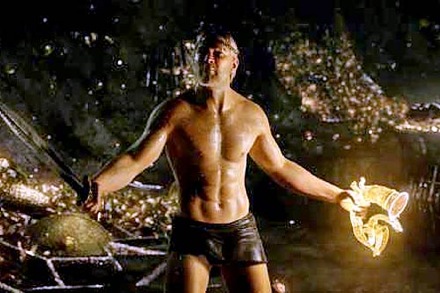
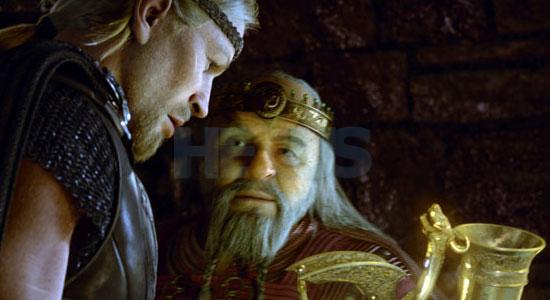
Much has been made about the motion capture animation and 3-D technologies in Beowulf, yet few of the critics (whose reviews I read) mentioned much in regards to what the movie and its technology are actually doing. A fair amount of critics seem comfortable to label the movie as a purely technical affair, a digital incantation of a boring story they read in high school. But in making these bland claims, these critics (if they can be called that) have not just misunderstood the film, but its source material as well. Strange is at may be to them, director Robert Zemeckis is actually after something with this movie, and he is uncharacteristically subtle about it. Beowulf is a deep exploration of the nature of heroism, and the manner in which we cling to hero myths. That Zemeckis has launched his inquiry into the hero myth with perhaps the quintessential hero's tale is no coincidence either.

Matt Zoller Seitz's review of Beowulf is one of the more thoughtful reflections on the film, not because he admired it, but because he's willing to examine the ideological undercurrents embedded within the criticism about the film, ranging from its digital animation to its humorous use of sexual imagery. Seitz certainly acknowledges its shortcomings, but like any good critic he realizes that plainly stated opinions about a film are pretty useless. In his more detailed criticism of the film, Seitz argues that it is much more going on than many are willing to see. He then offers a somewhat different approach to Robert Zemeckis' position in American filmmaking today:

"If indeed Zemeckis lost his way, he lost it in Reagan's first term. He's been on this quest -- applying technological innovation to mainstream commercial blockbusters -- for nearly two decades, starting with 1988's Who Framed Roger Rabbit, which employed motion-controlled cameras to let 'toons interact (often in elaborately choreographed long takes) with flesh-and-blood actors. Even then Zemeckis was accused of being too enamored with the mechanics of technology. From the Back to the Future sequels through Forrest Gump, Contact and What Lies Beneath, the gripes continued. (Only Cast Away escaped them.) The all-style-no-substance rap discounts the possibility that Beowulf's substance is embedded in its style. And it discounts the possibility that, in his determination to tell elemental stories with increasingly daring techniques, Zemeckis is one of the few true visionaries making studio blockbusters today."

Seitz later explains that the film's brains are in its images. This would seem like a fairly ordinary observation until you give it time to sink in. The majority of contemporary film criticism looks past the image, seemingly beyond the image, but really right through it. Movies like Beowulf are written off and placed into the "Hollwood blockbuster" box before viewers/critics even see the images, movements. Film criticism and a great deal of film studies start on the "inside", that which is suggested in or represented by the image, and then work out to the image. This approach to cinema is not about the cinema, however, but the Grand Theory thats supposedly underneath the images. In fact, the viscituded of grand theory are within the critic/spectator's own theoretical world. According to this method, the image is secondary to the ideas that the critic is looking for.

Of course, each viewer approaches a movie based on certain perspectives, values, and assumptions, but the argument here is not whether there is a "right" or objective way to assess a movie. Instead, an emphasis must be placed on seeing the image and drawing an inquiry based on that image and the relations it forges based on movement, shapes, color, and yes, narration. Only then can one approach any level of thematic depth and aesthetic value, rather than slapping images with pre-digested labels and comfortably packaging them into easily understood value claims. Rather than situating our interpretations of a film from the standpoint of whether it's "good" or "bad", critics should first see the images, react to them, and try to understand the how they affect us as spectators.

Concerning my experience with Beowulf, I'd say it was anything but straightforward for a number of reasons. I will readily admit that I approached it with a fair amount of assumptions about Zemeckis, the technology employed to construct the movie, my experience with the story over the last ten years, big-budget Hollywood moviemaking, etc. All of these factors contributed to how I saw and interpreted the film. After two weeks of thinking about it, I've still not really settled on much about it, suffice to say that it struck me. I've since learned that my inability to "place" the film is actually a good thing. (I learn that lesson over and over again, by the way.) In some ways, it was disappointing as an "action ride", but that's only because I was expecting that; all those neat shots and 3-D elements popping out at me. But the action was never really the point of the story, nor is it the focus of the movie, save for its final climactic sequence in which Beowulf fights the dragon.

Unfortunately I cannot offer much in the way of thematic or stylistic depths until I see it again. (MZS does a great job of that in his review, for those interested.) I'd therefore like to shift gears and explore the very thing that prevented me from experiencing the whole movie: the 3-D presentation. Seeing Beowulf in a digital 3-D presentation was my first experience with 3-D, in a feature length film, at least. I should note that I have been cautious about 3-D for quite some time. Rather than digital animation and photography, which I approach with great enthusiasm, 3-D technology is a different beast entirely, and not something I take lightly. Alas, my skepticism was confirmed. After the Paramount Logo and the opening title sequence -- with the stone letters coming from all angles to spell "Beowulf" -- I was entirely put off by the 3-D presentation. Simply put, the 3-D images felt like a gimmick, garnering "oohs" and "ahhs" at first, but then is ultimately distracting from the movie.

As I search my thoughts for a statement to follow such a generic claim, i.e., that the 3-D "distracts from the movie", I have probably uncovered a deep-ridden assumption that may account for why I approach 3-D technology so timidly. To me, cinema is the flatness. No doubt, 3-D makes for exciting moments and more involving action sequences because it blends the lines between the viewer's eye and the screen. But there's something deeply unsettling about it from the consideration of how we define cinema.

While a viewer can navigate the economy of dimension in a "flat" image, discerning its shapes and movements and making sense of them three-dimensionally, a 3-D image requires that the viewer add another lens between the eye and the image. The spectator still views a flat a screen, but the added lens of the 3-D glasses disrupts the dimensional relations of the image and alters the perception and interpretation of "flat" images. Thus, images seem to occupy a real space in front of us.

The 3-D experience is so "distracting" because it disrupts the spatial unity of the cinematic image. For those who approach cinema from a more formal theoretical perspective, 3-D technology makes cinema something else entirely. It is, quite simply, a betrayal of cinema. There are likely a good number of critics who would claim that digital animation and motion capture technology, rather than the r-D presentation, is more a "betrayal", but I would argue that cinema is built upon principles of movement on a flat surface. That's not to say that I'm advocating the "fore fathers" principle to explain why 3-D isn't cinema. (You know, the very foolish "It's what the fore founders intended" argument.) I feel that cinema is wide open with possibility, but once that motion is rendered off the screen or designated space occupying that image, one must wonder whether it's really cinema anymore, and, for that matter, what defines cinema at all.

Pat Graham, of the Chicago Reader, asks many of the same questions of 3-D movement relations and space. In a recent blog entry, he writes:

"The pictorial surface (aka window) seems primarily an occasion for helter-skelter effects. Not that it's a question of Zemeckis's doing this well or badly, it's simply the nature of the 3-D beast, what filmmakers automatically assume you'll be wanting to see—since why else do 3-D at all? Things flying out of the frame at indiscriminate angles, figures interacting (or not) at varying depths of the visual field: can't put all these elements in the same conceptual package, the mind-eye coordination isn't made for it. Not to mention the myriad irrelevant distractions: ceiling candelabras and whatnot floating seductively by you when the actual point of the scene lies elsewhere. It's hard to know which visual data to pay attention to, and by the time you've figured it out the critical dramatic moment's already come and gone.

But why should you figure it out—is it some kind of sadistic test? Because if you've been weaned on Renaissance expectation—that pictorial space has unity, that you take it all in with a kind of "global" awareness, all perspectival elements smooshed into one coordinating surface, the idea of what a fresco does, conventional portraiture or landscape (not to mention the "normal two-dimensional" filmmaking strategies Zemeckis purportedly employs)—this brave new visual paradigm can only seem jarring ... and probably disappointing. But yes, there's lots of random "reality"—details you can't help noticing whether they make any sense or not."


Graham recognizes the flatness of the cinematic image as an inherent quality of cinema. Flatness assumes a space between the spectator and the image. When the separation between spectator and screen is infringed upon, movement is perceived differently. Applying the same set of rules for cinematic interpretation to an altogether different kind of visuality results in a disjointed experience. These new spatial relations disrupt all senses of cinematic space as we've come to know it. We perceive them via interpretive schemata constructed on the principle that images that inhabit some kind of discernable space or surface, usually a screen. In other words, once the image jumps off the screen, it becomes a new kind of image, one that requires a different way of seeing than the one that has been constructed by over a century's worth of cinema.

Like drawing, painting, and even writing, part of the aesthetic beauty of cinema is internalizing the experience of sensory perception and rendering it on a seemingly restricted surface. The spectator can thus experience three dimensions through two-dimensional space. But the miracle of cinema is that through motion and sound, a whole new kind of experience can be created. Through its own spatial reality, it constructs a temporal world within which the limitations and infiniteness of human experience can exist, only in a different way. That's why, as Deleuze says, "the cinema is always as perfect as it can be." Whether its real or artificial doesn't seem to matter.

More on the the animation end of things later...

Friday, September 14, 2007

"Because You're On Television, Dummy."

[Update, Monday, 9/17: The following article is now slightly longer and much more coherent than when I originally posted it on Friday.]

"You have meddled with the primal forces of nature, Mr. Beale, and I won't have it! You think you've merely stopped a business deal? That is not the case. The Arabs have taken billions of dollars out of this country, and now they must put it back. It is ebb and flow, tidal gravity. It is ecological balance. You are an old man who thinks in terms of nations and peoples. There are no nations; there are no peoples. There are no Russians. There are no Arabs. There are no third worlds. There is no West. There is only one holistic system of systems; one vast, interwoven, interacting, multivaried, multinational dominion of dollars. It is the international system of currency which determines the vitality of life on this planet. That is the natural order of things today. That is the atomic and subatomic and galactic structure of things today. And you have meddled with the primal forces of nature, and you will atone! Am I getting through to you, Mr. Beale? You get up on your little 21-inch screen and howl about America, and democracy. There is no America; there is no democracy. There is only IBM, and ITT, and AT&T, and DuPont, Dow, Union Carbide, and Exxon. Those are the nations of the world today."


The above quote comes late in Sidney Lumet's Network (1976), long after Howard Beale's infamous "mad as hell" speech, and long after Beale was imprinted into the collective conscious of the American TV-watching public. Although Beale's early speeches are the locus of the film's ideas, I would argue that the real center of its themes is Arthur Jenson's speech to Beale from across the board room table (pictured above). Enveloped by the ordered surroundings of commerce, a brightly lit Jenson occupying a small portion of the frame informs Beale that there are no countries, no individual voices, and no real humanity beneath our surfaces. This inspires Beale to accuse his audience of having become "humanoids", in doing so Howard becomes just another blip on the screen. After single-handedly reviving a news division and a network, his ratings dip and executives discuss ways of getting him off the air. Audiences didn't want to hear they were humanoids -- they wanted to remain passive recipients of a message about revolution while complacently sitting in front of the television.

Sidney Lumet made Network more than 30 years ago. The film is remembered for Howard Beale's many famous speeches, in which the seemingly crazed news man preaches a revolution from the shackles of capitalism, war, and corporate power. Today, Howard Beale is considered a prophet. Critics and scholars cite the film's relevance in this time of hyper media attention and saturation. The cliche is that we are currently in the "here and now" age of digital reproduction. While I often despise the use of cliches and broad, familiar claims, there may be some amount of truth to this widely held belief. For example, popular magazines of the pre-digital age were known for long articles exhausting all angles of the given subject. Today, however, articles are becoming shorter. Online versions of popular news sources such as CNN or MSNBC routinely make errors in attempt to get something online or in print ahead of the competition. Networks now report "Breaking News" every 20 minutes on their websites without adequate information. Fearing that the consumer will choose another source, news Web sites and shows will do whatever it takes for those precious ratings so as to attract more advertisers. Moreover, our technological gadgets have further enabled us the convenience of shrinking the world into our own hands. Now we have more people to call or text message, more things to consume, and more pictures to take with our camera phones. And "news" -- both in presentation and content -- becomes a passing headline on the screen; faster, less trustworthy, and more controlling.

But it would be a great misunderstanding to assume that these digital media are displacing analogic media. Mechanical reproduction of electronic media enables the benefactors of capitalism to maintain dominion over the public, and digital technology only helps to sustain that. We are now experiencing a greater onslaught of the same systems of power, a greater reproduction of them in which the illusion of choice now becomes more believable to consumers. What appears to be pure democracy as represented by blogs, onDemand service and choice, YouTube, and digital downloads is just another veil of ignorance. Suddenly, Howard Beale's comments strike a resounding chord. Much like he says in his now famous speech, we have learned to isolate ourselves in our homes, cars, and in front of computer screens, surrounding ourselves with the comfort of brand names and products that we've been instructed to "need".

Perhaps, digital media are an intensification of our transformation into a culture of humanoids. Research, inquiry, and real living thought are argued to be devalued in our contemporary media culture in which the mainstream media will do everything in its reach to ensure that we choose between the Right and the Left. There we remain under the illusion that we "know a thing or two" about what's important in this world, totally oblivious that we think in product names and are conditioned to be good consumers. But now I'm starting to sounds like Howard Beale, aren't I?

Although it's tempting to reflect on the film and only think about Howard's illustrious speeches, perhaps our being so struck by them makes us just like the audiencing applauing his death at the end of the film, passive, acting and thinking that we're not going to take it anymore, but really taking all of it. The film poses this question by offering a narrative to which Howard Beale's plotline is the counterpoint. While Howard's speeches endure as some of the most memorable expressions of passion in cinema, the movie is so brilliant because it embraces the very real nature of its satire and the illusory nature of its drama. Lumet juxtaposed the biting satire of Beale's program with a subplot involving television executives Max Schumacker (William Holden) and Diana Christensen (Faye Dunnaway), the former a committed news man, father, and husband approaching the autumn of his life, and the latter a young, ambitious woman who thinks, lives, and breathes her job. Their work on popularizing the Howard Beale show brings them together. It isn't long before Max leaves his wife and home for a relationship with Diana. The film follows this subplot along with the behind-the-scenes subplots with Frank Hackett (Robert Duvall), who manipulates the business end of the Howard Beale show. Intercut with these subplots are new episodes of the Howard Beale show, as he continues to gain popularity by articulating "the rage of the people", as Diana puts it.

These seemingly disparate story threads of drama, comedy, and satire converge as the film reaches its end, and this convergence is Lumet's pedigree. The late scenes represent the movie's punishing blow. Otherwise, it would be just another smart satire about media and capitalism. In these moments, Network really becomes about Max and Diana's dwindling relationship, to which the Beale storyline becomes the counterpoint and mirrors its demise. Although Max's mistakes are many -- and he is by no means a protypical hero -- his leaving Diana represents the only bit of hope in the film; hope that some people will resist the commodification of life and fight for whatever humanity has left. But he too has fallen victim to the overwhelming power of the media that surround him and constitute his life at all. When he's telling Diana why he's leaving her as if he's pitching a script, he describes his own ending as a hopeful one in his desire to re-unite with his wife. If he wasn't so influenced by the illusory nature of his life's work, he'd realize that there is likely no happy ending for him and his wife. He has burned the bridge between them. But the film never shows us what happens to its characters. In fact, what happens to them is essentially besides the point.

The final tragic scene between Diana and Max encompasses the human side of the film's themes, where we see that the line between life and fantasy that Howard Beale speaks of no longer exists, between real people and flickering images on a screen. Those images inhabit our existence, which results in a disconnect from what's real and human, one from which we as a culture cannot return. Much like the heartbreaking exchange between Max and his wife earlier in the film (which won Beatrice Straight the Oscar), Lumet finds a dramatic pulse to the film that is both unexpected and bittersweet. Here we realize that Network is far more than just an intelligent satire. Lumet is not content to just let Howard Beale act as a symbol of his film's messages. Instead, he makes a film with a real story made with concern; it's about real people whose lives and personal relationships become the hollow network plots they discuss in meetings. By the end, these characters are speaking only in television terminology to convey their defeated emotions. Their artificial surfaces have enveloped them to the extent that artifice constitutes their very being.

This is made tragically clear when Howard Beale's popularity begins to slip and becomes just another passing trend. His message is the same, but he delivers it with a more defeated tone and disgust for humanity. Perhaps he finally acknowledges that he is himself another pawn of the corporate power that packages and markets him to consumers. Maybe he realizes that he spouts off messages which resonate only superficially with the massive audience he's amounted; for if it really did have the desired effect, no one would have to watch the show to begin with and Howard wouldn't be on the air ranting. But he is on the air, and his very presence reproduces the problems about which he preaches. His tirades against television fundamentally ignore the fact that he is the content of the medium he so detests. The irony of the film therefore is its McLuhan-inspired acknowledgment that the medium is the message. Control lies not in the message of the medium, but in the medium itself. Network therefore posits that television is an institution in which relatively few can control the interests of its viewers, where capitalism exploits even the smallest trace of humanity and knowledge, transforming it into a means of controlling consumers. This is perhaps best said by Beale himself:

"Right now, there is a whole, an entire generation that never knew anything that didn't come out of this tube. This tube is the gospel, the ultimate revelation; this tube can make or break presidents, popes, prime ministers; this tube is the most awesome goddamn propaganda force in the whole godless world, and woe is us if it ever falls into the hands of the wrong people, and that's why woe is us that Edward George Ruddy died. Because this company is now in the hands of CCA, the Communications Corporation of America; there's a new chairman of the board, a man called Frank Hackett, sitting in Mr. Ruddy's office on the twentieth floor. And when the 12th largest company in the world controls the most awesome goddamn propaganda force in the whole godless world, who knows what shit will be peddled for truth on this network?"

To talk about Network is to talk about issues of media, corporote control, and, of course, being mad as hell. But the film is far deeper than its satirical surface. It's a deep ponderance of humanity in the age of hyper-capitalism as manifest in the mechanical reproduction of media sources and corporate power. But, it also examines these notions within the dramatic spectrum of relationships and characters. Underneath its depictions of a news anchor turned media spectacle named Howard Beale is both a tragic narrative and a profound inquiry into media relations.

Howard Beale tapped into the fears and rage of the people so much that they kept tuning into his program, playing right into the very traps he was enraged about. Therefore, viewers remained in their passive states of inactivity and Beale was reduced to just another image on the screen, one that will vanish with the click of a button. And when Beale began broaching issues that no longer appealed to viewers' passive states of faux-rage, they did precisely that: they changed the channel. Then, a real, breathing individual preaching a message that wasn't condusive to the corporate interests that undergird the medium of "the tube" is shot down on his own show. The camera zooms in on his lifeless body, the lights come up, and the room fills with applause, signaling not just the end of the Howard Beale show and tragic media image that was once a man, but the death of individual voice, reason, and humanity. The finals image of the film consists of four television screens at the corners of the frame repeatedly displaying graphic images of his death intercut with various commercials and advertising. They show quick images at different times; a sensory overload accompanied by a mechanical voiceover narration.

The questions raised by the film's juxtaposition of Howard Beale and the personal struggles of the individuals who made him accessible to the public are startling and troubling: Can humanoids even recognize that they are no longer human if they have purged themselves of the means by which they once embodied humanity? Can one recognize the problem/s with a system (let lone try to solve them) if that very system has provided the tools with which one can determine the problem at all? Since we started speaking these words, writing them down, and reproducing our means of communicating, have we really been able to understand ourselves and that which is outside ourselves to even understand what it means to be human?

The scene I quoted at the start of this article evokes these questions and more when viewed in relation to the rest of the movie. Watch it real closely; the dialogue, the performance, the sound, the framing; it's all right there. Jenson is more right than he, Howard, or any of us really know. Maybe we're not as mad as we think. Maybe we're happy as hell and will continue to take it. After all, it's all we know, and it's all we are.

Monday, August 20, 2007

The Digital Embrace

"To read a narrative continuum is in fact to arrange it in a variety of structures, to strive for concepts or labels which more or less sum up the profuse sequence of observations." - Roland Barthes

Just recently, I watched Zack Snyder's 300 on DVD, which, like Sin City (2005) and Sky Captain and the World of Tomorrow (2004), superimposes "real" actors on a sythnetic canvas: lumbering beasts, endless armies, gallons of blood, severed limbs, and entire cities were added in post-production while production likely consisted of actors in front of a green screen. Like the aforementioned films, 300 is a sometimes harsh melding of digital and analogic properties of cinematic style and narrative. Audience reception of these green screen films varies, but their presence in the Hollywood mainstream is becoming more prominent.

While many would agree that neither Sky Captain nor Sin City were entirely successful as genre narratives, it's tough to say whether that's due to their digital properties. That the manner in which a story is visualized greatly impacts the effect of the story doesn't help when attempting to assess these two elements independent of each other. Nevertheless, both movies relied upon familiar temporal and causual relations as they experimented with cinematic space via their digital design: Sky Captain is a very enjoyable throwback to a number of golden age film styles --from film noir to John Huston adventures-- while Sin City combined a hyper-violent Tarantino-esque visual design with a graphic comic aesthetic. These films' experimentation with spatial and temporal relations were successful with the target audiences for the respective films because their intended viewers were familiar with the genres and visual structures, and could "fill in the gaps" while acknowledging the artifice of the content and the sometimes harsh juxtapositions of the analogic and the digital.

300 is very much in line with this pre-established logic of spectatorship, not deviating much from the editing and compostional styles of contemporary music videos and popular cinema. It features digitally enhanced slow-motion action shots, detailed vistas and digitally created monsters that wrestle with the human actors; but this all serves to sustain the very same purpose as Mel Gibson's Braveheart and George W. Bush's war propoganda about honor, valor, and vanguishing evil. Some hail the film's supposedly groundbreaking visual techniques and synthetic compositions, but in reality, the film's images are purely conventional. That's not to say they can't be effective; but audience response (as well as some critical response) to the film has been overwhelmingly positive in my observations, and that response is what really interests me. 300 wants to convince you that it's status as digital --which the filmmakers boldly pronounce-- elevates it beyond the structural design and trends of photographically based films. It features self-consciously "different" movements and framing techniques by the standards of most risk-free popular cinema, but as compared to sitcom style framing and editing, that's not saying much. If we're comparing the film to the real originality from the likes of Tati or Kubrick, then it becomes evident that 300 fits more with the subset of popular cinema that prides itself on being different and noncomformist by showcasing overtly digital composition, but which really fits the mold of intensified continuity to a tee and challenges nothing.

Nevertheless, the film is worth analyzing for its employment of effects and how we are cued to perceive them. The digital environments inhabited by the respective characters of these films are at once supposed to be real and unreal inasmuch that the spectator may perceive them and form a spatial knowledge of them as concrete despite the acknowledged reality that they are unreal. These films therefore exhibit qualities of real, photographed space (an already questionable term). But by acknowledging the artifice of these environments, the viewer may thus accept the incongruent relations of cinematic space and thereby accept the faker looking effects as part of the storytelling. Coincidentally, this cues the viewer to settle into a state of passive admiration for digital images. It seems that the more overt filmmakers are with digital effects in movies such as 300 or Sin City, the greater response they achieve from their intended audience, of which many journalistic critics are apart. Yet distinct relations between the makeup of the images and the perceiver's ability to interpret them is largely underdiscussed.

Though I have staunchly defended digital technology in cinema since this blog's inception, I have focused on movies that I personally consider innovative. I have praised many big-budget films for their employment of the digital, but few of them have seen such high praise from popular audiences or even critics. As evidenced by what I consider to be significant advancements of the medium in movies like Miami Vice (2006) (a hugely budgeted movie whose treasures are only reaped by cinephiles and a handful of critics since it flopped with popular audiences), my interests in these media clearly differ with a common moviegoer or critic. Nevertheless, attempting to grapple with popular manifestations of digital media in cinema is crucial to my own perspective of digital technology. Specifically, I like to look at popular texts in relation to the greater advancement of the technology, especially how it is viewed in the eyes of consumers and moviegoers. There is undoubtedly a major shift occuring in popular cinema, if not from the filmmaking angle but instead concerning the collective understanding and interpretation of digital cinema.

Looking back on some of the more successful movies extensively employing digital technology, reception of them has been rather inconsistent both with critics and audiences. It's as if we are in a collective state of uncertainty regarding digital technology. Ever since Terminator 2: Judgment Day (1991) and Jurassic Park (1993), two movies that are discussed more for their use of digital effects than their storytelling, it seemed like digital technology was ready to explode. Now, roughly 15 years and millions of effects shots later, I cannot distinguish any clear direction in terms of how audiences and critics receive the technology. Some will often complain that movies are too effects-heavy, while others seem to crave effects since they spell out more destruction in high-budgeted action movies.

The prevailing current attitude in the critical community is one of trepidation, as movies are commonly criticized for their increased use of digital technology. About movies like 300 and The Matrix, we read popular cinema is embodying more aspects of video games as they are increasingly pixelated, to which I respond: How is that a criticism, and what does that mean, anyway? I have seen little real research or deeper analytical inquiries into how digital cinema is actually received with critics, consumers, and cinephiles. There are many opinions about it, but they are often based on uninformed assumptions. Meanwhile, there is so little actual criticism of digital storytelling outside your typical appreciations of digital effects in DVD documentaries and TV specials. Teminator 2 is routinely cited as a digital effects revolution and is considered a great movie because of it, yet its status as such has clouded the real issue of how those effects influence storytelling. (Note: Its arguably superior predcessor, The Terminator, by comparison, doesn't even seem to exist at all sometimes. I guess nobody wants to see a movie with stop motion animation anymore.) It seems that effects are often cited for why certain films are successes and others failures, yet there is no correlation between increased effects use and either box office revenue or critically agreed upon quality, which suggests two things: 1) that the reception of digital cinema may not be in line with the greater use of it in visual narrative, and 2) that critics and audiences are in many ways just as apprehensive about the technology as they were 15 years ago.

George Lucas' Star Wars prequels --which pioneered many of these digital filmmaking techniques and post-production-leaning filmmaking methods-- have raked in millions of dollars at the box office. But much of that can be attributed to the already rabid fan base of the series, Lucasfilm's and 20th Century Fox's successful marketing campaigns, and previous trilogy's status as a familiar mythology in moviegoers' canon. Though each recent Star Wars film made more than $300 million, critical and audience conjecture has not been kind to the films, even now as they are cemented as a trilogy. Yet when we hear about the failures of the films, one of the most common reasons is their reliance on digital effects, which in turns effects performances and the liveliness of the movie. But does that make effects inherently bad?

Since there seems to be little consistency when it comes to how certain digitally-based films are received, perhaps we can speculate that perceivers' expectations have something to do with it. Sure, we can lean on narrative quality, but that is often influenced more by personal and cultural ideology than real objective standards of quality. That some stories are poorly told for their over-reliance on digital cinema says more about viewers' notions of good storytelling (which shift according to the emergence of new technologies) than about the effects themselves. The fact is, there are innumerable potential contributors to how a film's images are perceived and interpreted that to single out effects not only is invalid and reductive, it says a lot about how a viewer conceives of visual storytelling at all.

In the scope of digital cinema's success stories, 300 is distinct insofar that its booming success was a great surprise to many. Although Frank Miller has a strong following, that alone cannot account for more than $200 million in theatrical box office receipts, in March especially (a month not known for generating big box office). The movie could have followed a similar pattern to like-minded predcessors; it could have been a relative success, such as Sin City ($74 million), or it could have borderline flopped, like Sky Captain and the World of Tomorrow ($37 million). But it far surpassed all expectations and is one of Hollywood's biggest success stories of the year. Yet one should note that while each of these films demonstrate the overwhelming presence of the digital in contemporary cinematic narrative with varying degrees of success, they each fit comfortably within specific genre norms and styles, further supporting the hypothesis that their images rely more on spectatorial acknowledgment of narrative relations and genre bounds, which thus yields passive admiration for supposedly new images.

It's clear that digital filmmaking techniques have advanced in extraordinary ways over the last 15 years. However, although movies are becoming increasingly digital in design, it still seems that audiences nor critics can really make sense of this technology, even in spite of 300's success, which just shows me that audiences are becoming more comfortable with this particular use of the technology, which should be expected after 15-20 years of mainstream use. How these technologies alter our way of seeing images is moreoreless uncertain, though, which is evident over the nature of the discourse surrounding digital cinema. There are proponents and naysayers on both sides of the debate for digital cinema's validity, but even considering digital technology in a "good" or "bad" light assumes photographic means of visual narrative is the standard by which all future technology is measured.

I'm sure I could be proven wrong with a number of examples, and I anticipate these arguments. But when we really step back and try to look at the bigger picture of digital cinema, it looks increasingly muddled in terms of the discourse about it and how it is perceived. We can all frame our opinions about the technology --however informed or uninformed they are-- and piece together an argument about digital technology and its place in storytelling, cinema, and visuality. But for every argument one makes, several others can counter that argument and offer another. Now, more perspectives are emerging along with potential uses for digital technology, which is now being used as much more than a tool for special effects-laden movies, but itself is becoming an expression on its own terms. David Lynch's Inland Empire, while not being a huge hit by any stretch, represents a prominent filmmaker actively exploring the possibilities of digital cinema. On the maintream front, Robert Zemeckis' forthcoming Beowulf employs a rare form of digital cinema in which the movements of the actors are digitally captured and then animated into a completely photorealistic, yet synthetic movie. In the case of Beowulf, as well as other animated movies like it (namely Monster House and Zemeckis' own Polar Express), the end result is entirely digital, but is based on photographic properties.

The shear diversity of uses of digital media and the variety of perspectives about them speaks to the lack of definition that really pervades the cleanly defined analog/digital dichotomoy. Having just seen Lynch's Inland Empire, a true convergence of form and content in the digital realm, I was reminded of how much there is still yet to be explored with these media, specifically their relationship to narrative. That connection is rarely breached (at least that I've seen) in discourse concerning digital media.

Filmmaking has drastically changed due to the prominence of digital cinema, not just for filmmakers but for viewers of and participants in these media. Now more than ever, more emphasis is placed on pre-production and post-production, whereas in the analogic days of cinema the greater emphasis was on production itself. How this shift alters the effect of making and seeing a film is difficult to sum up by examining (however in-depth) a number of digitally influenced films. But we may still gain some insight by observing normative trends of popular cinema of today from two broad vantage points: 1) how it sustains and/or deviates from the stylistic and narrative norms established in last 20 years of digital cinema (which entails observation of how digital cinema has evolved in that time), and 2) how it stands in relation to pre-digital cinema, or photographic (analogic) cinema. The binding element of these two modes of analysis is that the digital exists with the analogic rather than displacing it. The medium itself is made up of many media, so to say that a given film is strictly analogic or strictly digital is foolish. How the digital exists in relation to the photographic properties should be the focal point of analysis, since digital cinema abides by stylistic, visual, and narrative norms established long before digital technology.

If we are to accept "digital" as separate from "analog", we would be suggesting that we are in a new age of cinema, free of the constraints of linear storytelling and photographic properties. (I'm not even sure this is possible since even the most abstract of films abide by some visual or stylistic narrative framework, even if that's not adhereing to one.) Nice as that sounds, it's an awfully big claim that just wouldn't hold up if applied in theory or practice. But it's a mentality fueled by the popular analog/digital model that so many of us use to understand these technologies. If anything, the wide use of digital technologies and the endless ways in which they enable narratives and images to be seen, constructed, and interpreted in entirely new ways suggests how flimsy terms like "analog" and "digital" really are. Perhaps as more ways of expressing visual narratives are increasingly exercised in filmmaking through the use of digital video, effects, and animation, the separation of analog and digital will no longer be relied on to understand these emerging media and the analog/digital model may finally be rightly seen as a false dichotomy.

Wednesday, August 1, 2007

Bloggers and cloggers: Cinematic discourse in an age of digital reproduction

As a blogger, I think it's important to maintain a fair amount of reflexivity toward what I do and why I do it. There are times I look back on this experiment of mine and see nothing but good things; I've gotten lots of feedback on my blog, decent readership and comments, and I have seen other blogs from which I learned quite a bit about other areas of cinema studies and criticism. Nevertheless, I am sometimes dogged by the more negative side of what I do. When comparing the levels of discourse here in the online film community versus that of academia, I sometimes get depressed when I think of myself as a "blogger". It is true that perhaps online writing on any subject is viewed negatively as not amounting to anything substantive. And it doesn't help that many online writers (including myself) are easily offended by individuals who claim that the work online writers amounts to little more than message board banter, text messages, and geek/fan dialogue.

I would never try to reduce all online writing about cinema to a simplified plain, suffice to say that I often wonder where this digital discourse is really going and if it can advance film criticism and scholarship. Are we all just cloggers? Are we duped by ourselves into thinking that what we do can compliment and contribute to "real" film criticism. Certainly, essays such as Andy Horbal's termite criticism piece are encouraging and my daily visits to the blogs of David Bordwell, Jim Emerson, Girish Shambu, David Hudson, Henry Jenkins, Steven Shaviro, and others compel me to take this medium seriously. Most of these writers are established forces on either the journalistic or academic end of film writing and can therefore use the digital medium effectively; but I still sometimes wonder if such a small group of serious, reflexive, and informed film writers on the web can really add something when they use the same means of writing as the millions of people individuals who blog because "they have something to say". Some may come down on the due processes and checks and balances of peer-review publishing, but we cannot deny that it is a system that requires a certain amount of credibility. On the contrary, anyone and everyone can blog about their favorite films and try to convince readers that they're more than just a blogger.

The recently released Online Film Community Top 100 (which I participated in) is being cited as one of the most predictable Top 100 Film lists ever constructed. I have been outspoken in the past about lists by committee and I participated in this project because I believe in the advancement of online film writing and thought this would be a step in the right direction, if not for the list itself but because it represents a group of writers organizing for something. Now, seeing the list, it's just as arbitrary and homogeneous as the AFI's, which so many film writers were disparaging. It's funny that with so much vocal online buzz about how horrible the AFI list is, the online list turned out to be not so different. As Edward Copeland observes in the discussion over his post on the list, this list's similarity to the AFI list upholds the influence of canon in film assessment. One should note that the term "Online Film Community" is deceiving and that the list of contributors are by no means representative of the online film community. Nevertheless, the list mostly consists of AFI "safe" choices and films selected by individuals who have taken a film class or two in college and think they understand film history and style, making this list somewhere between the AFI Top 100 and the IMDb Top 250. It's basically a rehash of the AFI list with the inclusion of fan favorites like The Matrix, The Shawshank Redemption, The Big Lebowski, Fight Club, The Usual Suspects, and Reservoir Dogs to be great cinema. Here is the "Online Film Community" list:

1. Godfather, The (Coppola, 1972)
2. Citizen Kane (Welles, 1941)
3. Dr. Strangelove or: How I Learned to Stop Worrying and Love the Bomb (Kubrick, 1964)
4. Raiders of the Lost Ark (Spielberg, 1981)
5. Casablanca (Curtiz, 1942)
6. Blade Runner (R. Scott, 1982)
7. Jaws (Spielberg, 1975)
8. Godfather Part II, The (Coppola, 1974)
9. Star Wars Episode V: The Empire Strikes Back (Kershner, 1980)
10. Alien (R. Scott, 1979)
11. Pulp Fiction (Tarantino, 1994)
12. Chinatown (Polanski, 1974)
13. Star Wars Episode IV: A New Hope (Lucas, 1977)
14. 2001: A Space Odyssey (Kubrick, 1968)
15. Taxi Driver (Scorsese, 1976)
16. Shawshank Redemption, The (Darabont, 1994)
17. Rear Window (Hitchcock, 1954)
18. Psycho (Hitchcock, 1960)
19. Vertigo (Hitchcock, 1958)
20. Seven Samurai (Kurosawa, 1954)
21. Apocalypse Now (Coppola, 1979)
22. It’s a Wonderful Life (Capra, 1946)
23. Fargo (Joel and Ethan Coen, 1996)
24. Lawrence of Arabia (Lean, 1962)
25. Eternal Sunshine of the Spotless Mind (Gondry, 2004)
26. Schindler’s List (Spielberg, 1993)
27. Wizard of Oz, The (Fleming, 1939)
28. Matrix, The (Wachowski/Wachowski, 1999)
29. Third Man, The (Reed, 1949)
30. Die Hard (McTiernan, 1988)
31. Back to the Future (Zemeckis, 1985
32. Annie Hall (W. Allen, 1977)
33. Brazil (Gilliam, 1985)
34. Fight Club (Fincher, 1999)
35. Monty Python and the Holy Grail (Gilliam/Jones, 1975)
36. Usual Suspects, The (Singer, 1995)
37. Princess Bride, The (Reiner, 1987)
38. One Flew Over the Cuckoo’s Nest (Forman, 1975)
39. Once Upon a Time in the West (Leone, 1968)
40. Raging Bull (Scorsese, 1980)
41. Good, the Bad and the Ugly, The (Leone, 1966)
42. Searchers, The (Ford, 1956)
43. Singin’ in the Rain (Donen/Kelly, 1952)
44. E.T. (Spielberg, 1982)
45. Goodfellas (Scorsese, 1990)
46. Run Lola Run (Tykwer, 1998)
47. This is Spinal Tap (Reiner, 1984)
48. Sunset Blvd. (Wilder, 1950)
49. Big Lebowski, The (J. Coen, 1998)
50. Double Indemnity (Wilder, 1944)
51. Bridge on River Kwai, The (Lean, 1957)
52. Memento (Nolan, 2000)
53. M (Lang, 1931)
54. Shining, The (Kubrick, 1980)
55. 12 Angry Men (Lumet, 1957)
56. L.A. Confidential (Hanson, 1997)
57. Unforgiven (Eastwood, 1992)
58. Passion of Joan of Arc, The (Dreyer, 1928)
59. General, The (Keaton/Bruckman, 1927)
60. Apartment, The (Wilder, 1960)
61. A Clockwork Orange (Kubrick, 1971)
62. Incredibles, The (Bird, 2004)
63. Silence of the Lambs, The (Demme, 1991)
64. Aliens (Cameron, 1986)
65. Lord of the Rings, The: The Fellowship of the Ring (Jackson, 2001)
66. Heat (Mann, 1995)
67. Do the Right Thing (S. Lee, 1989)
68. Rules of the Game, The (Renoir, 1939)
69. Halloween (Carpenter, 1978)
70. Network (Lumet, 1976)
71. Graduate, The (Nichols, 1967)
72. Bicycle Thief, The (De Sica, 1948)
73. Conversation, The (Coppola, 1974)
74. Groundhog Day (Ramis, 1993)
75. Maltese Falcon, The (Huston, 1941)
76. American History X (Kaye, 1998)
77. Ed Wood (Burton, 1994)
78. Manhattan (Allen, 1979)
79. King Kong (Cooper/Shoedsack, 1933)
80. North by Northwest (Hitchcock, 1959)
81. Terminator 2: Judgment Day (Cameron, 1992)
82. Manchurian Candidate, The (Frankenheimer, 1962)
83. To Kill a Mockingbird (Mulligan, 1962)
84. Mr. Smith Goes to Washington (Capra, 1939)
85. Modern Times (Chaplin, 1936)
86. Touch of Evil (Welles, 1958)
87. Leon (Besson, 1994)
88. Aguirre, the Wrath of God (Herzog, 1972)
89. 8 ½ (Fellini, 1963)
90. Ghostbusters (Reitman, 1984)
91. 400 Blows, The (Truffaut, 1959)
92. Notorious (Hitchcock, 1946)
93. Toy Story (Lasseter, 1995)
94. Lord of the Rings, The: The Return of the King (Jackson, 2003)
95. His Girl Friday (Hawks, 1940)
96. Reservoir Dogs (Tarantino, 1992)
97. Blue Velvet (Lynch, 1986)
98. On the Waterfront (Kazan, 1954)
99. Cinema Paradiso (Tornatore, 1988)
100. Nosferatu (Murnau, 1922)


I am in full support of people sharing their opinions and sticking to their guns. But I am skeptical to take some of these opinions seriously, however; especially when they lack the knowledge of cinema history and scholarship. I'm not trying to be an elitist here, and I am in no form the authority on film history (especially international cinema, of which I have seen relatively little), but I openly acknowledge this and constantly challenge myself and my views with different kinds of films so that I may advance my knowledge and call myself informed. Yes, I make bold choices in my list of top movies and I acknowledge that my list consists of a large number of safe choices. But if I were to compile a list of a Top 100 films most important works of cinema, in which my opinions were backed up by my growing knowledge of film history and scholarship, it would look nothing like the AFI list, the Online Film Community List, or my own Favorite(st) 149 movies list.

I point this out because I am always trying to find my place in the blogging world. I'm not sure that I have one, really. Certainly, if I were writing for a newspaper, magazine, or scholarly publication, I would not be able to write in the varying styles that I do or write about a variety of topic on the film world. The Blog enables an individual to write however short or long they like, about any topic or issue, satirically, academically, journalistically... the list goes on forever. How could this medium not be worthwhile? It embodies the cultural democracy we so often desire, right? Certainly, some film bloggers take advantage of these freedoms. But perhaps these are only true "freedoms" to those versed in the world of publishing (scholarly or journalistic). Plain and simple, the digital does not exist without acknowledging the analog. Without the basis in knowledge and information, most of which can be honestly and responsibly acquired via analogic means, then digital information is pointless.

These issues interest me for a number of reasons. As someone straddling many world (film blogging, medical journalism, and scholarly writing), I have been exposed to and participating in a number of writing styles and topics. Therefore, I try to meld styles and experiment with how I write and what I write about. But I would undoubtedly benefit from peer review. All of these long entries I wrote, however good or bad, organizationally sound or not, amount to little more than rough sketches of ideas that would require more research, review, and drafting in order to make a solid contribution to the greater spectrum of film writing. I fully believe that established film writers and theorists who have taken to the blogging realm are engaging in a discourse that is important in the digital age of information, consumption, and reproduction. But with the rising number of film blogs out there, it's tough to draw lines on what's important, what's worthwhile, and what's pointless. We all need to ask ourselves sometimes (those of us who blog, that is) why we do what we do and whether we are contributing to it or perpetuating the overall inconsequentiality of online discourse and so-called information.

These issues are central to film criticism and media studies, and I am happy to report that I will have the opportunity to contribute something small to this larger dialogue. I was recently approached by Scott Balcerzak and Jason Sperb of Dr. Mabuse's Kaleidoscope to fill a seat on their workshop panel on cinephilia and digital reproduction for the Society of Cinema and Media Studies' Annual Conference, held next year in Philadelphia, my home town. I graciously accepted the invitation and, now that I'm finished my summer course, will be knee deep in research over the next three weeks as I prepare to put together an abstract by August 15. My portion of the workshop, of course, will focus on the issues I voiced in this post. My observations here in this post represent the beginning of a larger research project which will consider the implications of online discourse and convergence in digital media.

I think I'd like to come at it from a number of perspectives, though, particularly the interactional and immediate nature of posting on a blog and the implications of its use on the institutional frameworks mostly informed by the practices of peer-review and publishing. How the medium of blogging functions with respect to sustaining a "worthy" dialogue about cinema and its possible contribution to the overall spectrum of film criticism are things I would like to consider.

One last point I'd like to mention is that in light of all this conjecture questioning the legitimacy of blogging, I should note that I will be presenting in an academic setting because I started a blog seven months ago. This fact alone is in oddly reflexive entry point into this inquiry I'll be launching, even if there are a considerable number of other factors which have led me here. Nevertheless, the fact remains that I would not be doing pursuing this scholarly task had it not been because I started this experiment of mine back in January. It's quite ironic, really, and it provides me with equal shares of encouragement and discouragement as I move ahead with this. As a blogger and a (hopeful) scholar, I take on this endeavor.

Monday, July 16, 2007

Thoughts on Television and Cinema

In conversation, I often hear the phrases, "It's just entertainment" or "I don't want to have to think, I just want to watch something and enjoy it," and countless others coming from people who claim they are unashamed to watch shows/movies they know aren't "quality drama". This is usually the case with most television and a fair amount of commercial films. Television and cinema are similar in design and function, but the split between them strongly exhibits my adopted notion that not only can nothing be understood or interpreted without context, but that context decides the content; to the point that context is more important than the text. Contextual elements include social, economic, and technological factors (all which are intwined), and they work together to allow consumers/viewers to interpret the difference between television and cinema.

Many have argued that technological and economic factors are drawing together in these media to the extent that the difference between them is growing thinner. Home theater systems and the hypercommercialism of the theater experience, I would argue, blend the boundaries the most. First, home theater systems boast audio and visual perfection so as to replicate one's experience in the theater. Television screens are getting larger, surround sound systems more crisp. Though traditionalists offer that theaters have biggers screens, in reality, one's position in relation to a screen however small or large is more important in terms of the "size" of the image. So what separates these media? It's tough to say. I touched on similar issues recently, which is why I'd rather now look at the texts themselves.

Generally speaking, the medium of television as a visual mode of narrative yields a high level viewer passivity. It seeks to gain a viewer's familiarity with its easily identifiable visual styles and conventions and then loops it, encouraging one to switch off and retreat into a state of numbness. "I don't want to have to think," is one of my favorite phrases because I find it a complete hypocrisy. The process of watching something on a screen, making sense of its narrative and visual cues (however simple they are) requires a lot of thought, actually, and investment. The cognitive and sociocultural elements of watching moving images on a screen and making sense of them are far more complex than most people allow themselves to think about.

Part of the lure of seeing something on a screen as a form of narrative almost entails a bit of shameless voyeurism, as if we know we're not supposed to be watching. This element is intrinsic to all of narrative, but visual narrative especially. And TV is the height of convenient passivity for viewers. That's not to say I'm above it. We all enjoy a little television or simple movies to take our minds off things. It's enjoyable in a very basic sense and for a number of reasons. But the primary source of enjoyment is the desire sameness rather than innovation, which is something that everybody deals with. It is part of our social makeup to fall victim to the lure of convenience and simplicity. Even the most sophisticated of critics cannot deny their indulgences in "guilty pleasures."

But this conflict is much more intricate. Consider the viewer's activity in television. Aside from process of comrehending a moving image, there is a very fundamental essence about TV that enacts its ability to embody passivity yet also breaches this conflict. If we are entertained by something to the extent that we maintain a weekly schedule of watching a show, there is not only thought in that show but investment. Despite readily acknowledging the simplicity of a simple or cliched television show or movie, many of us will invest in spite of this acknowledgment. Where does this come from? Why are we so compelled to watch the screen and engage in thought and feeling (which no one can deny the experience of watching a sitcom or drama is, over long periods of time) yet keep our distance from things we see on that screen that don't adhere to familiar structures and courses? I wish I knew. But it's fascinating to think about. Perhaps even the most sophisticated defenders and/or participants in these media are constantly at battle with some kind of inner desire for the movement-image, which, Deleuze says, is an image one can easily anticipate, and situate within a recognizable field of visual perception. Of course, Deleuze theorized that the time-image frees both the image and the viewer from the limits of the movement-image. But he notes that the movement-image is essentially inevitable, alluding to what seems to be a desire for visual familiarity both social and cognitive in origin.

Though I have only begun reading David Bordwell's Narration in the Fiction Film, its contents have already struck me as revelatory and intriguing. In an early chapter on narration and film form, Bordwell uses constructivist psychology to explore filmic perception and cognition, which proves useful in a discussion of visual perception in light of different visual media. He writes:

"Speaking roughly, the typical act of perception is the identification of a three-dimensional world on the basis of cues. Perception becomes a process of active hypothesis-testing. The organism is tuned to pick up data from the environment. Perception tends to be anticipatory, framing more or less likely expectations about what is out there."

He continues:

"Taken as a purely sensory experience, seeing is a bewildering flutter of impressions. The eye fixates many times per minute, using short and fast movements (called saccades); the eye rotates to compensate for head and body movement; the eyes trembles involuntarily; and most of the visual information we receive is peripheral anyhow. Yet we do not experience a flicker or smear of percepts. We see a stable world, smooth movements, constant patterns of light a nd dark. To the extent that seeing is a bottom-up process, the visual system is organized to make its inferences in an involuntary, virtually instantaneous manner. You 'immediately' see a visual array as consisting of objects distributed in three-dimensional space, and you cannot help seeing this. The automatic construction is also affected by schemat-driven processes that check hypotheses against incoming visual data.... Seeing is thus not a passive absorption of stimuli. It is a constructive activity, involving very fast computations, stored concepts, and various purpose, expectations, and hypotheses."

While Bordwell acknowledges that this concept requires more unpacking if it is to account for the intricasies of visual perception, this theoretical framework for seeing is nonetheless fascinating. The important point about this approach, in my mind, is how it blends the cognitive and the social to the point that they are nearly inseparable. We perceive and interpret according to our own perceptual schemata, hypotheses, and familiarity of visual and auditory conventions.

These concepts intriguingly tie together with the discussion of visual perception in different visual media. The reason I have been thinking about these ideas in more detail of late is that I have observed an a slightly more prominent mention of television's influence over cinema in many reviews of current films. For example, many have written that Live Free or Die Hard is less an organic extension of the previous films featuring Bruce Willis' John McLane but instead a direct inspiration of high intensity action programs such as 24, an assertion I would agree with. While Live Free demonstrates a slick use of action convetions and objects in motion, it rings up hollow as a pure cinematic experience. Perhaps this loose connection to television may have a hand in that. The similarities exist on narrative and stylistic levels, especially since often times the two converge. Other summer movies fall to similar patterns. For example, Evan Almighty contains an unusual amount of infantile "potty" humor for a story that wishes to be so prophetic. This, one could argue, is a direct extension of the sitcom sensibility of sequencing action-reaction shots (e.g. Shot A: squirrel bites Steve Carrell's crotch, shot B: close-up of Carrell's face, eyes widening as he prepares to yell in pain). This trend is seen not just in sitcom-inspired comedies, but also in the action epics like Pirates of the Caribbean. The film's talking-based scenes largely adhere to the same practice of cutting between two actors -- one's face screen left, the other screen right. This aesthetic borrows heavily from sit-coms as well as day time soap operas, both of which came to fruition in the 80's and 90's. For more on this, check out Henry Jenkins' excellent article.

In contemporary mainstream cinema, the "talking heads" method of editing and framing greatly determines the nature of the acting, performance, visual perception, and narrative interpretation. But the influence of contemporary television is much more vast on cinema. The Live Free or Die Hard example works well in this argument, since its visual style, both in its action sequences and expository scenes of establishing its villains heavily borrows from 24, among other shows. Observe the framing of the the villain as he watches a computer screen. Even the lighting gives us the slick, but intense 24-like feeling. The plot of the film could very easily had felt less like a television show than it does. Yes, the screenplay definitely demonstrates its influences, but the real feeling of similarity comes mostly from the editing techniques and compositions, which feel more like a contemporary television show than a movie. Another fascinating example of television affecting "big" cinema is The Lord of the Rings trilogy, which offers a lot of close-ups and talking heads editing contrasted with stereotypically epic compositions (wide open vistas, sustained helicopter shots. While the movies work better in their smaller moments of detail and precision, they definitely represent a strange tension of aesthetic design that echoes the convergence of the visual styles of television and cinema .

While such editing/framing techniques have always been used, they are emphasized much more since the explosion of television as drama/comedy in American culture. This, in fact, is a strange irony. In matters of technology and visual convention, TV was influenced primarily by cinema. But now cinema seems to be more influenced by TV than by its own growth as a medium. Perhaps its growth today is television, which is why so many films abide by conventions employed by TV shows, which themselves are filtered copies of film conventions.

This apparent shift in framing sensibilities no doubt emerges, at least partly, from the tried and true success of sitcom-style, passive-inducing framing styles. In a discussion of mainstream visual perception, one could say that while television was always the influence of the innotivation of cinema, movies are now one step behind television. I am referring to the visual style of its hour-long dramas, not reality television or sitcoms. Shows like Lost, The Sopranos, and various others seem to be pushing into new visual territory (again, by popular standards). They are often more daring and visually unique than genre offerings as served up by Hollywood today.

Yet these shows are not the real trend-setters. Since Hollywood by-and-large seems content to rest safely on conventions of editing, staging, and framing, non-commercial films seem to be the ones now that are exploiting the technological advances of visual media such as digital technology. (Of note, its massive productions employing technology in daring ways often fail, as last year's masterpiece Miami Vice did from a commercial standpoint.) Many of smaller these films engage these technologies and inquire into their role in visual storytelling. I would argue that Television has looked to non-commercial cinema for its influences, and it has done so with great success. Perhaps audiences have embraced these "new" framing and editing techniques because they are loosely and liberally applied to familiar structures that television offer and movies do not. One of the many potential reasons for this is that audiences may have more room for intrigue when they know that something still needs to pan out, whereas the anticipations and expectations of a movie are different. But this is just one of many potential reasons for such varying shifts in visual style in various visual media.

This is really just the beginning of a bigger dialogue about nature of inter-medium influence, connectedness, and disconnectedness and the varying shifts in visual style in various visual media. Situated within David Bordwell's theory of hyperclassical visual style in modern movies as layed out in The Way Hollywood Tells It, an analysis of film and television (on both popular and non-commercial levels) may yield a greater understanding of inter-media influence of visual style and spectator consumption. An even more lucrative entry point into these inquiries is the use of emerging technologies such as HD and digital film.