Showing posts with label The House Next Door. Show all posts

Tuesday, July 16, 2013

Summer of '88: An American in Python: A Fish Called Wanda

Monty Python was arguably the most versatile of comic troupes. Each of its members displayed an abundant range of creative poses and vocal deliveries in addition to wry intelligence. While their act is undeniably outlandish, there's something very subtle about the performances and how the actors interacted that made everything work. Perhaps that's why a majority of the individual efforts after the British ensemble had disbanded lacked the same flair. A noted exception to this is A Fish Called Wanda, a film that channels much of the effortless wit and energy of Monty Python's work but with its own personality.
A Fish Called Wanda's Monty Python influence comes primarily from John Cleese, who stars in and wrote the screenplay about four London jewel thieves chasing some elusive loot after their master plan goes awry. Also on hand from Python-land is Michael Palin, here playing Ken Pile, a stutterer and an animal lover—two attributes that make him the butt of a hefty number of the film's jokes. As Palin hams it up with yet another of his famously nervous characters, Cleese plays the straight man, a barrister brilliantly named Archie Leach. Initially this proves an odd fit for the actor, who so often commands the screen with exaggerated annunciation and body language. But once Archie becomes entangled in the thieves' scheme, Cleese slowly teases out a confection of classic looks and one-liners that rivals the actor's finest work.


Thursday, June 20, 2013

Finding Nemo: Pixar's Quiet Masterpiece

Of all the feature films in Pixar's impressive repertoire, Finding Nemo has arguably proven the most durable. The movie, which celebrated its 10th anniversary last month, is held in high favor critically and with audiences, but to some extent it's also underappreciated, commonly regarded as an admirable, stalwart entry from the animation house. And yet, though it's not a film that's inspired the kind of rapturous following that The Incredibles or WALL-E have cultivated, Finding Nemo remains the heart and soul of the Pixar family of movies. It showcases a number of hallmarks for which the studio has become renowned, such as stunning technical bravura and smoothly elegant storytelling. But what distinguishes Finding Nemo from its studio brethren—and what makes it Pixar's enduring classic to date—is its narrative accessibility and emotional directness.
        At the time of its release, Finding Nemo was primarily heralded for its unparalleled pictorial beauty. Digital animation was still somewhat fresh at the time; just two years before, Shrek had introduced brand new possibilities in digital animation with its crisply rendered environments and characters that had scale and weight. Finding Nemo, by turn, was possibly the first full realization of those possibilities. I still remember seeing it in the theater and feeling completely engulfed by the colors, layers, and textures of the underwater world it fashions. Ten years later, the film still exudes an ethereal quality that's seldom seen in today's animation (which is a credit, also, to the deep musical and overall soundscape). But the abounding detail of the film's visual design, from the scales on Nemo's body to the speckles dancing in the foreground and background of every frame, is all the more astounding for how subtly it's deployed.

Click here to read the full article at Slant Magazine.

Thursday, May 16, 2013

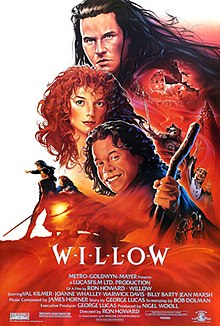
Summer of '88: Willow — Fantasy Departed


One of the many residual effects of the massive success of the Star Wars trilogy was the boom of fantasy films that arrived in theaters in the mid-1980s. Movies such as LegendMasters of the UniverseThe NeverEnding StoryThe Princess Bride, and others were all released within the span of a couple of years, and each to some degree featured sprawling sets, evocative atmospheres, and extensive use of prosthetics and puppets. These elements were staples of George Lucas's storytelling, a quality that proved to be a strong companion to the Star Wars films' grand visual and narrative design. It wasn't long after the trilogy had wrapped that even Lucas himself had dipped into the bankable commercial lore of fantasy moviemaking when he produced Jim Henson's 1986 film Labyrinth. His own contribution to the subgenre followed two years later at a time when fantasy appeared on the decline. With an original story by Lucas, Willow was met with widespread ambivalence upon its release. Retrospectively, however, the film's graceless hybrid of Star Wars-style mythmaking and leftovers from the short-lived fantasy period in commercial cinema that Lucas inspired offers a pointed reflection and portrait of the filmmaker that has grown more compelling as the full trajectory of Lucas’s career has emerged in view.

Wednesday, February 20, 2013

Oscars 2013: Musings and predictions


[This article was originally published on February 1, but I've moved it up to reflect its completion and updated links.]

I really relate to film lovers who reject the pomp and circumstance of the Oscars. To describe the two-month-long awards process as nauseating is an understatement, not just because of the self-importance exuding from many involved, but also because it reduces artistic achievement to the equivalent of a grade school science fair. Inevitably, the movie with the most outward flair, or, as the saying goes, the most of any given category will be crowned victor (i.e. the volcano with the first-prize ribbon). And yet, despite the deep issue I take with the notion of breaking down and awarding films by category, each year I get caught up in the spectacle and follow the contest like I would a Presidential election. While in some respects the Academy Awards represent a political horserace and everything that celebrating cinema shouldn’t be about, I’ve since learned to be at peace with my relationship to Oscar. After all, the commercial aspect is a great part of what makes movies unique, even if it exudes an unseemly aura that often clashes with the aesthetic and narrative depths that movies are capable of producing. And though the Oscars may not have the cultural relevance to which the Academy voters and members aspire, they do hold some relevance. As long as one is able to recognize the perfunctory absurdity of the pageantry, it is quite possible sit back and enjoy the gaudy display of what A.O. Scott once called the American film industry’s impression of itself.
            Given my Oscar appetite, this year I’ve decided to make better use of the energy spent anticipating and watching the show. Here on this site, I've posted short reviews for each film nominated for Best Picture in a series of commentaries in which I also surmised each film’s chances at the top prize. (Here is my write-up on the "Long shots," and here is "The Middleweights," and finally "The Contenders."I am also pleased to have taken part in a bigger Oscar project over at Slant Magazine, where I joined several Slant writers for the site’s annual Oscar Prediction series, running now until Oscar weekend. Following extensive discussion about each category, Ed Gonzalez, Eric Henderson, R. Kurt Osenlund, and myself penned reflections in our assigned categories, with a new commentary posted daily at Slant’s blog The House Next Door. I handled six categories, all of which are linked below. 

Friday, January 11, 2013

Critical Distance: The Hobbit: An Unexpected Journey

The critical response to The Hobbit: An Unexpected Journey, the first part in Peter Jackson's new film trilogy based on J.R.R. Tolkien's novel The Hobbit, or There and Back Again, suggests that it's bloated and deficient of the propulsive energy that typified the Lord of the Rings films. The likely cause of dissatisfaction stems from Jackson's approach toward adapting the book. Whereas Jackson and his writing team condensed each volume of Tolkien's Lord of the Rings trilogy into its own film, with The Hobbit they've opted to adapt a considerably more straightforward narrative into three films. Thus, An Unexpected Journey only represents a small portion of the book. Critics have seized on this and critiqued the nearly three-hour film for being padded and flabby. While not necessarily untrue, these charges have fueled an abundance of banal commentaries bereft of any real insight into or about the movie. What's most discouraging about this is that An Unexpected Journey, though certainly vulnerable to criticism, is a more layered film than we've been led to believe.

Wednesday, December 12, 2012

Moments out of Middle-Earth


Critics appear to be down on The Hobbit: An Unexpected Journey. That Peter Jackson opted to shoot his Hobbit movies at a higher frame rate and also announced a late decision to split two films into three might have something to do the film's early reception. Or it might simply be that The Hobbit fails to live up to the momentous Lord of the Rings trilogy. Although only nine years have passed since The Return of the King was released, both the critical and popular perspectives toward the trilogy appear to have steadily grown more positive. How this will affect Peter Jackson’s return to Middle Earth with The Hobbit trilogy remains to be seen.
In the mean time, I've gone back to The Lord of the Rings trilogy with a slightly fresh perspective. My goal was to look at these films from the inside out. Inspired by Richard T. Jameson and Kathleey Murphy’s annual “Moments out of Time” film retrospective series, I've picked 10 moments from the movies that magnify their great relevance. My article just went up over at The House Next Door. Please take note, these are not my "Top Ten" scenes out of the films. As I note in the introduction, the 10 scenes I've selected “illustrate a slightly different shade of the films’ fluid realization of a complex visual, thematic, and emotional spectrum.” Head on over and have a look, and feel free to weigh in with your own picks. 

Monday, December 3, 2012

The Walking Dead: Season 3, Episode 8: "Made to Suffer"


For all the anticipation and careful setup over the last several episodes of The Walking Dead, the show's mid-season finale was somewhat anticlimactic. Many burning questions were introduced leading up to the episode. What will Andrea (Laurie Holden) think when she finds out about the zombie daughter the Governor (David Morrissey) keeps hidden inside a cage and all those heads floating inside wall-length fish tanks? What will Merle (Michael Rooker) and Daryl's (Norman Reedus) reunion bring? How is Rick (Andrew Lincoln) going to get Glen (Steven Yeun) and Maggie (Lauren Cohan) out of Woodbury? All of these are answered, if not in a particularly satisfying way. We do, though, get bombarded with more questions. "Made to Suffer" delivers on tension, action, and confrontation, but it's all pivot and no release.
The episode's primary focus initially seems to be Rick's mission to penetrate Woodbury and rescue Maggie and Glen. He remains suspicious of Michonne, who disappears after helping Rick's group sneak into the town. Meanwhile, the Governor scampers around trying to manage the residents' fears that their haven's been infiltrated. He also wants to keep Andrea away from the action so she can't learn that the intruders are members of her former group. He's away from much of the episode's action until his confrontation with Michonne in his quarters, where his cool surface disappears when Michonne kills his zombie daughter and the two engage in an intense fistfight that ends with him likely losing an eye. Afterward, he weeps and hunches over his lifeless daughter with a shard of glass protruding from his eye—the defining image of the episode and likely the defining moment for the character going forward.

Monday, November 26, 2012

The Walking Dead: Season 3: Episode 7: "When the Dead Come Knocking"


When it first started, The Walking Dead was about the immediate sensation of living in a post-apocalyptic world. In the shadow of a crumbled society, survivors adjusted to the violent realignment of their lives by banding together, struggling to stay human. Now, because of all they've seen and suffered, the characters who've made it this far are shells of their former selves. Survival is no longer simply a matter of avoiding being eaten by zombies; it also requires a frigid sense of detachment and perhaps even cruelty, both of which course through "When the Dead Come Knocking." No one anymore seems to know what it means to be human.
The opening shot of Merle (Michael Rooker) scraping a splintered table with his knife-arm immediately sets the tone for what follows. With Glen (Steven Yeun) shackled and refusing to give up the location of his group, it's not long before Merle begins torturing him. When Merle sets a walker loose in the room, Glen's ensuing struggle to get free and kill exudes a striking primal ferocity. Such a desperate struggle for survival hasn't been seen since Andrea (Laurie Holden) was being chased through the woods at the end of season two. It's a key moment for Glen, too, who until this point in the season hasn't had much of a presence.

Monday, November 19, 2012

The Walking Dead: Season 3: Episode 6: "Hounded"


When we last left Rick (Andrew Lincoln), he was digging through a zombie's intestines looking for what remained of his wife. It was a grim moment and another illustration of The Walking Dead's increasingly despairing outlook. At IndieWire earlier this week, Alison Willmore wondered whether the series is presenting an argument for the end of humanity. Given the trajectory it's taken thus far, that's not a far-reaching notion. That the writers continue to delve deeper into human despondency and ax more members of the cast in the process quite frankly makes it difficult to see any redeeming future for the characters, and perhaps the series itself. Nevertheless, every so often an episode gives us a fleeting moment of stillness and humanity that cuts through the surrounding gloom. Such a moment arrives late in "Hounded" just when you think Rick might be headed for a total breakdown. For much of the episode, he's away from the group and preoccupied with strange phone conversations with unknown callers. His desperate pleas for help initially suggest that he may be losing it, but this thread evolves into an unexpected moment of catharsis that the series needed as much as its protagonist.
Rick's storyline is one of several in which characters strike up or rekindle a connection. Daryl (Norman Reedus) also experiences a similarly heartening event after he discovers that Carol (Melissa McBride) is still alive, a scene that's intercut with Rick's return to the group. These developments are why "Hounded" may represent The Walking Dead's most significant attempt to revive a sense of hopefulness. But the cruel joke of the episode is that these tender brushstrokes are threaded into a more cynical view that comes into focus through other plot circumstances. Namely, this episode places events in motion that will lead to an eventual collision between the Woodbury community and the prison survivors.

Monday, November 12, 2012

The Walking Dead: Season 3: Episode 5: "Say the Word"


After last week's episode of The Walking Dead ushered in a new level of intensity with the deaths of two major characters and the birth of Lori's (Sarah Wayne Callies) baby, "Say the Word" is comparatively stagnant. This makes it consistent with the narrative rhythm that the writers have committed to since the show's second season: After a dramatic turn of events, everything slows down, often for several episodes. "Say the Word" fits comfortably within that broader framework, but it makes better use of its quieter interludes than similar episodes and also offers a handful of isolated standout moments.
One of these is early on, when the Governor (David Morrissey) is listening to soothing classical music and brushing the hair of his zombie daughter in his secluded second-floor abode. She struggles, but the Governor wrestles the girl's contorting body into a position in which he can safely hug her and tell her how much he loves her. The scene is somewhat of an extension of last season's thread involving Hershel's (Scott Wilson) insistence that walkers are human. Though given what we already know about the Governor, like how he watches the jangling severed heads floating in water tanks for his own pleasure, his hair-brush routine conveys more than simply denial. Rather, the Governor's secret fixation on reliving the past signals a deep level of psychosis masked by his seemingly fair-minded leadership of the Woodbury community.

Monday, November 5, 2012

The Walking Dead: Season 3: Episode 4: "Killer Within"


The latest episode of The Walking Dead, "Killer Within," opens on a hazy morning at the prison where Rick (Andrew Lincoln) and his band of survivors have settled down. The serene atmosphere is offset when a lurking figure opens the gates and baits walkers into the facility. With its dreamlike, foggy setting and a conspicuously waist-down perspective of the saboteur, a peculiar sense of disconnect underlines the implications of what's being depicted. The scene ends with a single close-up of a heart placed on the cold cement. It's a foreboding image that gains magnitude as "Killer Within" gives way to a sudden strike of tragedy. Moreover, the pre-credit sequence lends insight into how the episode amounts to a particularly poignant, if also problematic, entry in the show's run.
I'll return to the significance of the opening scene in a moment. First, let's take a look at how the episode builds to its ultimate disaster through stark tonal contrasts. With apocalyptic shows like this, moments of levity are few and far between. "Killer Within," however, goes so far as to offer something resembling a sustained cheerful mood as it gets going. Now having fortified the prison, Rick guides the crew about the mundane tasks of building a home. Small character moments are peppered along the way and gel nicely together as mini-portraits. Hershel (Scott Wilson) shows progress walking on crutches; Glen (Steven Yeun) and Maggie (Lauren Cohan) get busy in the watchtower; even Rick and Lori (Sarah Wayne Callies) share a brief hopeful exchange from a distance. After a tense encounter with the surviving inmates and a conversation among themselves about whether to allow the prisoners to join their operation, the group is still in better spirits and apparently in control.

Monday, October 29, 2012

The Walking Dead: Season 3: Episode 3: "Walk with Me"


"Do you think they remember anything? The person they once were?" a man asks in the latest episode of The Walking Dead. This is the kind of question you'd expect from someone in a George A. Romero zombie film, specifically one of the more recent ones, wherein zombies exhibit traits of their pre-zombie selves. Here, though, the significance of the question doesn't concern zombies so much as how the human survivors of a zombie uprising project their own fears and insecurities onto the living dead. "Walk with Me" is a notable change of pace for The Walking Dead for several reasons, most clearly its shift in plot trajectory to initiate a new storyline with a new group of survivors. More importantly, however, it's about unearthing the past and recalling a distant life. This becomes clear at the outset, when Andrea (Laurie Holden) and her travel companion, Michonne (Danai Gurira), are discovered by a familiar face at the site of a helicopter crash.
After the first two episodes of the season focused so intensely on Rick's (Andrew Lincoln) fleeting humanity and the group's strategic actions to gain asylum, "Walk with Me" introduces a new survivor group that takes Andrea under its wing. Unwittingly abandoned during the group's escape from Hershel's farm, Andrea came under the protection of Michonne, and together—along with two armless, jawless walkers—they survived the winter. Following an encounter with Daryl's brother, Merrill (Michael Rooker) at the start of the episode, Andrea and Michonne are plucked from the dystopian wilderness and end up in a place that would seem to be its opposite.