Showing posts with label Retrospectives. Show all posts

Tuesday, July 16, 2013

Summer of '88: An American in Python: A Fish Called Wanda

Monty Python was arguably the most versatile of comic troupes. Each of its members displayed an abundant range of creative poses and vocal deliveries in addition to wry intelligence. While their act is undeniably outlandish, there's something very subtle about the performances and how the actors interacted that made everything work. Perhaps that's why a majority of the individual efforts after the British ensemble had disbanded lacked the same flair. A noted exception to this is A Fish Called Wanda, a film that channels much of the effortless wit and energy of Monty Python's work but with its own personality.
A Fish Called Wanda's Monty Python influence comes primarily from John Cleese, who stars in and wrote the screenplay about four London jewel thieves chasing some elusive loot after their master plan goes awry. Also on hand from Python-land is Michael Palin, here playing Ken Pile, a stutterer and an animal lover—two attributes that make him the butt of a hefty number of the film's jokes. As Palin hams it up with yet another of his famously nervous characters, Cleese plays the straight man, a barrister brilliantly named Archie Leach. Initially this proves an odd fit for the actor, who so often commands the screen with exaggerated annunciation and body language. But once Archie becomes entangled in the thieves' scheme, Cleese slowly teases out a confection of classic looks and one-liners that rivals the actor's finest work.


Thursday, June 20, 2013

Finding Nemo: Pixar's Quiet Masterpiece

Of all the feature films in Pixar's impressive repertoire, Finding Nemo has arguably proven the most durable. The movie, which celebrated its 10th anniversary last month, is held in high favor critically and with audiences, but to some extent it's also underappreciated, commonly regarded as an admirable, stalwart entry from the animation house. And yet, though it's not a film that's inspired the kind of rapturous following that The Incredibles or WALL-E have cultivated, Finding Nemo remains the heart and soul of the Pixar family of movies. It showcases a number of hallmarks for which the studio has become renowned, such as stunning technical bravura and smoothly elegant storytelling. But what distinguishes Finding Nemo from its studio brethren—and what makes it Pixar's enduring classic to date—is its narrative accessibility and emotional directness.
        At the time of its release, Finding Nemo was primarily heralded for its unparalleled pictorial beauty. Digital animation was still somewhat fresh at the time; just two years before, Shrek had introduced brand new possibilities in digital animation with its crisply rendered environments and characters that had scale and weight. Finding Nemo, by turn, was possibly the first full realization of those possibilities. I still remember seeing it in the theater and feeling completely engulfed by the colors, layers, and textures of the underwater world it fashions. Ten years later, the film still exudes an ethereal quality that's seldom seen in today's animation (which is a credit, also, to the deep musical and overall soundscape). But the abounding detail of the film's visual design, from the scales on Nemo's body to the speckles dancing in the foreground and background of every frame, is all the more astounding for how subtly it's deployed.

Click here to read the full article at Slant Magazine.

Thursday, May 16, 2013

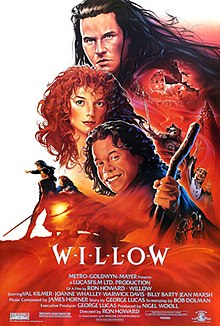
Summer of '88: Willow — Fantasy Departed


One of the many residual effects of the massive success of the Star Wars trilogy was the boom of fantasy films that arrived in theaters in the mid-1980s. Movies such as LegendMasters of the UniverseThe NeverEnding StoryThe Princess Bride, and others were all released within the span of a couple of years, and each to some degree featured sprawling sets, evocative atmospheres, and extensive use of prosthetics and puppets. These elements were staples of George Lucas's storytelling, a quality that proved to be a strong companion to the Star Wars films' grand visual and narrative design. It wasn't long after the trilogy had wrapped that even Lucas himself had dipped into the bankable commercial lore of fantasy moviemaking when he produced Jim Henson's 1986 film Labyrinth. His own contribution to the subgenre followed two years later at a time when fantasy appeared on the decline. With an original story by Lucas, Willow was met with widespread ambivalence upon its release. Retrospectively, however, the film's graceless hybrid of Star Wars-style mythmaking and leftovers from the short-lived fantasy period in commercial cinema that Lucas inspired offers a pointed reflection and portrait of the filmmaker that has grown more compelling as the full trajectory of Lucas’s career has emerged in view.

Wednesday, December 12, 2012

Moments out of Middle-Earth


Critics appear to be down on The Hobbit: An Unexpected Journey. That Peter Jackson opted to shoot his Hobbit movies at a higher frame rate and also announced a late decision to split two films into three might have something to do the film's early reception. Or it might simply be that The Hobbit fails to live up to the momentous Lord of the Rings trilogy. Although only nine years have passed since The Return of the King was released, both the critical and popular perspectives toward the trilogy appear to have steadily grown more positive. How this will affect Peter Jackson’s return to Middle Earth with The Hobbit trilogy remains to be seen.
In the mean time, I've gone back to The Lord of the Rings trilogy with a slightly fresh perspective. My goal was to look at these films from the inside out. Inspired by Richard T. Jameson and Kathleey Murphy’s annual “Moments out of Time” film retrospective series, I've picked 10 moments from the movies that magnify their great relevance. My article just went up over at The House Next Door. Please take note, these are not my "Top Ten" scenes out of the films. As I note in the introduction, the 10 scenes I've selected “illustrate a slightly different shade of the films’ fluid realization of a complex visual, thematic, and emotional spectrum.” Head on over and have a look, and feel free to weigh in with your own picks. 

Tuesday, October 2, 2012

Summer of '87: The Living Daylights


The '80s were tough on James Bond. Sean Connery’s awkward return in the unlicensed Never Say Never Again notwithstanding, the sight of an aging Roger Moore was a blunt reminder of how stale Albert R. Broccoli’s long-running film series had become. Hoping to inject fresh life into the weathering franchise, producers selected a new actor for The Living Daylights and took a more serious approach than previous entries. Alas, the same lack of attitude that mired its immediate predecessors keeps The Living Daylights from going very far with its new star.
As might be expected by this point, the film opens with the all too familiar scenario of a car chase. After skydiving onto the Rock of Gibraltar, 007 (Timothy Dalton) leaps onto a moving truck, is fired at by the driver through the roof, and then climbs into the vehicle to fist fight. Naturally, the car is also speeding down winding roads and mountainous terrain. The chase ends with the requisite destruction of the car and Bond parachuting onto a boat, where it happens that a lovely woman waits for the perfect man to fall out of the sky. “Pick me up in an hour,” he radios in to British Intelligence before noticing the woman’s beauty. He looks her up and down and then says, “Better make it two,” cuing the a-ha title song.

Click here to read the full post at Slant Magazine's blog The House Next Door

Monday, September 17, 2012

Summer of '87: The Lost Boys


The Lost Boys is overflowing with memorable images, from the splashes of smoky red light filling up the frames to its vivid depiction of an emerging punk youth. But one particular sight has stayed with me ever since I watched Joel Schumacher’s film at an entirely too-young age. It occurs during the bonfire feeding roughly halfway through the film. Until this point, violence has only been implied, which lends more potency to visible dismemberment. Amid the orgy of death and futile struggle, a single ephemeral vision: One of the vampires sinks its teeth into a man’s bald head, causing blood to splash out like champagne.
The savage penetration throughout the scene is a raw rebuke of the age-old vampire legend. It deliberately eschews the traditional scenario, which usually sees some variation of a patient, soft-spoken vampire luring his victim into complacency before calmly biting her neck without her ever realizing. Rather, this is about something else. It’s messy. Painful. Unhinged. To see it now through a retrospective lens helps to better grasp how the film’s defining sensibilities elicited such a strong response in 1987. David (Kiefer Sutherland) and his vampire clan didn’t do things the old-fashioned way. “Sleep all day. Party all night. Never grow old. Never die. It’s fun to be a vampire,” the film’s rather perfect slogan read. They were here to bring down the old establishment and corrupt your children. And whether or not audiences consciously grasped these themes at the time, they connected with the material.

Click here to read the full post at Slant Magazine's blog The House Next Door.

Thursday, September 13, 2012

Monthly Retrospective: Rashomon


[This is the first entry in what will be a regular feature at the site, in which I offer reflections and considerations of movies that aren’t on the reviewing circuit of the past year.]

First-generation innovators rarely give us the best version of an idea or expression. Often they provide the groundwork for others to harness and perfect, which has certainly been the case with technology and also to a lesser degree in various artistic modes. In terms of movies, many of the most revolutionary entries (e.g. The Wizard of Oz, The Jazz Singer, Star Wars) are known primarily for how they changed the medium rather than how their advancements helped set a new standard of aesthetics or storytelling. Citizen Kane is one of the more famous examples of a film that offered both visual and narrative invention that few films have approached thereafter. Equally significant in this regard is Akira Kurosawa’s Rashomon. The film is renowned for ascribing a dimension of reflexivity to cinema that had been mostly unexplored until that point. It asks elemental questions about vision and storytelling, specifically: How do the two enter into a relationship through cinema, and what are the roles of truth and perspective in that relationship?
Rashomon offers several different accounts of the same event, which is recounted by the different characters involved. Kurosawa frames this through a trial-like setting in which the characters look directly at you, the viewer, and gives their own description of what happened. But before I discuss Rashomon’s benchmark achievements, I want to point out just how rich it is purely from a visual standpoint, as this can be overlooked. For example, the interrogation scenes—with the witness in the foreground and lookers-on in the background—have a downright avant-garde sensibility that contrasts nicely with the sumptuous visuals that Kurosawa creates in the forest. For a film that notably oscillates between perspectives and points in time, Rashomon is fluid in its storytelling and presentation. In addition, the film’s focus on faces lends an expressive layer to its already complex inquiry into to human nature. Moreover, Kurosawa’s full use of the expressive influence of images and narrative to explore a deep range of emotion makes Rashomon one of cinema’s most significant entries, as well as one of its most poetic.
Rashomon deserves to be renowned for carving out the structural and visual methods that would eventually be incorporated in all types of movies and ingrained into our movie-going minds. But almost entirely apart from it’s pioneering of these techniques, Rashomon employs them as a means of exploring the full breadth of potential that visual storytelling enables. This is evident not only in the film’s groundbreaking techniques, but also in how it moves and feels. In the hands of Kurosawa, something as simple as beating rainfall is eloquent and moving.
To see Rashomon having internalized its DNA in so many other movies is to experience a potential and sense of newness about movies that precious few of them still cultivate. (Akira Kurosawa, 1950) ****

Friday, August 24, 2012

Indiana Jones and the Last Crusade


In my recent piece on Raiders of the Lost Ark, I touched briefly on the nuance that Harrison Ford infuses into what could have been another ordinary hero. In both that film and its sequel, Indiana Jones and the Temple of Doom, Ford embeds a range of detail into the character of Jones that the screenplays do not. He is at once a serious professor and a boyish adventurer. Some would say he womanizes, but Ford makes Jones more as the kind of person who really might have wanted to settle down if he wasn’t so impulsive and defensive. He verbally spars with women as if he was in the schoolyard and exhibits a similar immaturity in his physical fights with enemies. The point is that Indiana Jones is vulnerable, and Harrison Ford taps into that both hilarious and subdued ways throughout both films. While the stylistic splendor of the movies also plays an important role in their success, Ford’s layered portrayal of a character whose heroic persona is offset by his own arrested development is the anchor of the films.            
            The third film, Indiana Jones and the Last Crusade, represents a significant shift for the series. The previous two films kept the storytelling focus on the adventure and left Ford to inject humanity into the character with his performances. In Indiana Jones and the Last Crusade, the emphasis is taken off of the adventure and placed on the character of Jones himself. It does this through the prism of Indy’s rocky relationship with his father, Henry Jones, Sr. (Sean Connery). Although the plot concerns the search for the Holy Grail, the real focus of the film is on Ford and Connery, whose undeniable chemistry results in wonderfully awkward interplay.
Many retrospective accounts of Indiana Jones and the Last Crusade credit Sean Connery for his portrait of a traditionally stern father, but it’s Ford that shines in every exchange between the two. Indy’s plight for his father’s love and acceptance comes through in quiet moments that likely carry subatomic weight for anyone who’s every struggled to connect with a parent. Certainly, there are a few over-the-top moments of speechifying (and a rather contrived finale that converges the Grail and Papa Jones), but the film largely carries out this thread through well-observed humor. Notice the dismissing tone in Ford’s voice in the scene when he and Connery are tied back-to-back and flames are quickly engulfing the room. When Jones Sr. has “something to tell” him, Jones casually retorts: “Don’t get sentimental now, Dad. Save it ‘till we get outta here.” Another favorite exchange of mine comes after a narrow encounter with a plane in a tunnel. As the plane flies away to turn around, Indy races to get away from the scene before stopping and remembering that his father is still with him. After belting out a disapproving “Dad!”, he calms his voice, adjusts his hat, and keeping the same condescending tone, says: “He’s coming back.”
As in moments like these, Indiana Jones and the Last Crusade often beautifully expresses the challenges of father-son relationships. In fact, so affecting is the character focus that it also articulates the triviality of the actual Grail-quest and illustrates the central problem of the film. Aside from a handful of exuberant sequences—most notably the train-chase opener with a young Indy (River Phoenix) escaping from bandits in the Southwest desert—Indiana Jones and the Last Crusade lacks the color and energy of the previous episodes. One of the main missteps with the story is its self-conscious attempt to return to the sensibilities of Raiders of the Lost Ark, which is likely a response to the negative feedback Indiana Jones and the Temple of Doom received. Nevertheless, this entry lacks the lore and the colorful characters that marked Raiders and falls short in generating much tension or interest in the main conflict. The desert tank chase represents a rare moment that coheres the film’s disparate sensibilities into a big set piece with a real sense of stakes, but otherwise Indiana and the Last Crusade struggles to make the combination of its elements work.
Indiana Jones and the Last Crusade is a problematic film. Though despite taking on water in various places, it remains afloat on the unstated benevolence of its observations. In a way, the film can be seen as an allegory for many parent/child relationships. There are certainly rough patches, but sometimes—even when you expect a big moment—a simple brush of the shoulders and a “Well done,” says everything. (Steven Spielberg, 1989) ***

Tuesday, August 21, 2012

Indiana Jones and the Temple of Doom


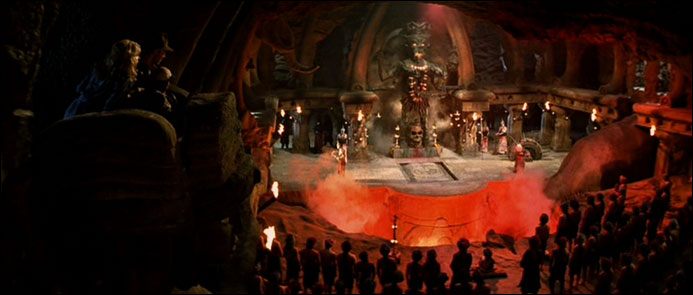
Despite the thrashing it received upon release, Indiana Jones and the Temple of Doom arguably eclipses Raiders of the Lost Ark in at least one respect. The sense of adventure in this second episode of the series may in fact be the sumptuous of all four films. Preserving the Saturday afternoon serial style of Raiders, director Steven Spielberg and writer-producer George Lucas are mostly consistent in approach but opt for a whole new setting for the second adventure. The film opens in a Shanghai nightclub and gives Jones a Bond-esque introduction after a spirited song-and-dance bit for the credits. From there, Indy ends up on a plane that crash lands in India, leading him to a depraved village where the sacred Sankara stones have gone missing along with villagers’ children. This all happens in the film’s opening act—and I'm not even covering the outlandish action sequences. In some ways, the busy first act mimics Raiders of the Lost Ark’s final hour with its random chain of events strung together to resemble a plot. Then, Indy and his companions—the bratty American singer, Willie (Kate Capshaw), and the punchy young Short Round (Jonathan Ke Quan)—are off to a mysterious palace, where within its caverns dwells a cult that enslaves children and makes human sacrifices to its evil god.
            You have to hand it to Spielberg and Lucas: purely in terms of story, Indiana Jones and the Temple of Doom is pretty deranged stuff. More importantly, they dig deep into the material and give it the inspired treatment it deserves. Amid the jungle trekking and heart extractions, Spielberg fashions oozing atmospheres and a frenetic pace that together give Temple of Doom a distinctive feeling from its series companions. The tradeoff, however, is that the film lacks the discipline and patience that distinguished Raiders. For instance, both both Willie and Short-Round are ill conceived, working only as comic relief in an otherwise gloomy film. Even worse, the screenplay has both sub-characters playing key roles in several crucial moments, which throws cold water on any energy the film builds in its second half. But based on the size of the set pieces, it’s clear that Spielberg is so preoccupied with delivering more kicks than the last film that he loses sight of the elements that makes this kind of storytelling such a thrill to begin with. We all know this is inherently kids’ material, but the beauty of Raiders of the Lost Ark is how it plays its scenario with a straight face and gives it such lavish treatment. When you see a 12 year-old beating up fully-grown and fit adults, the magic is lost; whether the material is believable to start with is beside the point.
            What stings the most is that Indiana Jones and the Temple of Doom plunges to depths that no other Jones film approaches. Even Harrison Ford has a hint of demonic zeal behind his eyes and more vigor in his voice. It's a shame that Spielberg and Lucas have publicly apologized for going “too dark,” because the real problem is that they compromise the deliciously dark core of the movie with forced humor and intermittent stupidity. Had they followed through on their initial impulses and not allowed their weaker inclinations to compensate for them, this film could have been really special. Nevertheless, I remain convinced that in spite of its flaws, Indiana Jones and Temple of Doom is a movie of overflowing imagination. That it is sloppy, occasionally appalling, and uncomfortably colonialist doesn’t change that it is inspired filmmaking. Unfortunately, in pouring on mood and excitement, Spielberg left the flaws exposed and revealed just how delicate was the balance Raiders of the Lost Ark achieved. Indeed, Indiana Jones and the Temple of Doom cannot compare to the mastery of its predecessor and deserves some of the criticism it has received. But the sluggish, sometimes balletic experience it offers also makes for a spectacularly unhinged account of cinematic pleasure. (Steven Spielberg, 1984) ***

Friday, August 3, 2012

Raiders of the Lost Ark


Sequel-readiness is a defining element of the Indiana Jones pictures. In addition to each of their self-contained stories intimating a sense of the next inevitable chapter on a larger canvas of exploits, they are also episodic by design. One action set piece often leads right into another, in an apparent nod to 1940s serials from which Steven Spielberg and George Lucas took inspiration. But these films have more going on in them than a high-spirited sense of adventure, particularly when viewed as part of a larger succession. With this in mind, I revisited all four films and will document my observations on each entry over the next several weeks.
Taken in the context of the films’ high standing in popular culture as well as my own moviegoing past, the first film in the series—Raiders of the Lost Ark—is somewhat of an anomaly. Stylistically, Raiders of the Lost Ark may have more in common with the work of Francis Ford Coppola and Martin Scorsese than its series companions (which I will discuss at greater length in my essays on the later entries). The difference, of course, is that Raiders of the Lost Ark has no aspirations of seriousness beyond the sophistication of its own aesthetic. It is pure pulp, meant to imprint on your mind only insofar as its transitory tongue-in-cheek narrative allows. Pauline Kael famously critiqued the film’s forcible dissemination of oversized excitement—a charge that’s undoubtedly true, given how fast it whips from one set piece to the next. (In its second half, the movie goes from a pit of snakes to an airplane fistfight, and then immediately into a truck chase across the desert.) But the film excels beyond its own thrill-induced exhaustion with, among other things, a steady commitment to aesthetic detail.Spielberg frames his shots in wide spaces and edits only when necessary, a technique that apart from its visual appeal also balances out the quick pace of the storytelling. On the other hand, Raiders of the Lost Ark's playful mysticism is equally attributable to John Williams’ brooding music and Lawrence Kasdan’s script—proffering beauties like “The Bible speaks of the Ark leveling mountains and laying waste to entire regions.” Spielberg accentuates and marries the two with compositional techniques that play heavy on shadows, silhouettes, and pronounced background/foreground contrasts. The interplay of these ingredients creates a rich atmosphere of foreboding and whimsy, yielding moments that stand outside of time and create a strong sense of place within the cartoonish world the film fashions. Even simple scenes of exposition and set-up are enticing, such as when Marcus (Denholm Elliot) walks down the corridor and peers into Indy’s classroom or how Marion (Karen Allen) reveals the headpiece that both Jones and his enemies are after.
Aside from the stylistic flourishes, no account of Raiders of the Lost Ark would be complete without a discussion of man wearing the fedora. Indiana Jones could easily have been another stock hero, which almost certainly would have cast the film into the exile of obscurity. But Harrison Ford’s portrayal is the anchor from which Raiders derives its energy, deepening both the sense of excitement and humor. Despite the character’s introduction as a fearless adventurer, Ford brings a boyish enthusiasm to his interpretation of Jones, who has a knack for winding up in overmatched fights, routinely dishes cheap shots to his opponents, and is the benefactor of a great deal of luck. Ford gradually peels away the tough-guy veneer of Jones’ adventurer persona and reveals a man that is reckless, immature, disenchanted, and seeking acceptance. In other words, he is flawed just as the rest of us.
For all the absurdities that Raiders of the Lost Ark serves up, Ford’s portrayal of Jones as an imperfect hero coupled with Spielberg’s smooth aesthetic do more than merely keep grandiosity levels in check. They have engineered a movie and a character that the medium seldom produces and are mirror reflections of each other. Both are simple, yet also larger-than-life. (Steven Spielberg, 1981) ****

Friday, March 16, 2012

Star Wars—Episode VI: Return of the Jedi

Before the prequel films, Return of the Jedi was the punching bag of the "Star Wars" series. The arrival of the Ewoks introduced a “cute-and-cuddly” element that would come to represent the exact moment at which George Lucas had jumped the shark. Of course, now we all know this was just the beginning of Lucas’ eventual focus on brand value instead of strong filmmaking. And while this development is worthwhile to note in the context of the saga’s history, perhaps too often it overshadows the many merits of Richard Marquand’s film. True enough, Return of the Jedi doesn’t reinvent or expand its world the way The Empire Strikes Back did, nor does it have the fresh energy of Star Wars, but it has nearly the same appreciation for detail and storytelling luster that marked the first two films. Moreover, Return of the Jedi may be the weirdest entry in the series, and I love it all the more because of it.
At the outset it is apparent that Return of the Jedi is all about looking back. Just after giving a glance of a new Death Star, it drops us on the same desert planet with the same two droids as the first film did. As it turns out, the film’s outward nostalgia proves to be an asset, particularly as a contrast to the solemn treatment it gives to the dramatic center of the Luke/Vader storyline. Thus, Jedi appears to be driven by two central tasks: 1) to conclude the Luke/Vader story with a strong generational tension, therefore cementing the mythical status of the saga; and 2) to give viewers one last chance to revel in this universe of odd creatures, towering sights, and colorful characters. The result is a strange mix of sensibilities that—despite the bumps—somehow feels right.

Friday, March 9, 2012

Star Wars—Episode V: The Empire Strikes Back

Midway through The Empire Strikes Back is a moment that affixes the Star Wars series as part of the great modern mythologies. It channels a past that we had never seen and a future yet unrealized. The scene starts in a small, fire-lit hut as rain beats down on the swampy terrain outside. After a fit of impatience by Luke Skywalker, the little green creature Yoda—who had until that point had been playfully chirpy—changes in an instant. With a forlorn look on his face, he shakes his head, looks up to the ceiling, and solemnly remarks, “I cannot train him. The boy has no patience.” There is pain and wisdom in his voice, as if he had just seen right through youth and inexperience and saw hope’s flickering light fade away. The moment has weight that resounds beyond the truth of its words. It recalls the vast history of the larger universe of the story while conveying a sense of a gravitas that the series previously lacked. And it is one of several moments in The Empire Strikes Back that strikes a deeper chord.

The Empire Strikes Back is frequently cited as one of the greatest movie sequels. That’s because it expands the first film’s world while offering more a layered story and fuller characterization. It also provides a different kind of experience than Star Wars. Lacking the simple structure and steady build-up that marked George Lucas’ original film, The Empire Strikes Back is a busier film. It is essentially one long chase peppered by endless visual delights and colorful characters. When it cuts away from one place and group of characters and takes to us to another, we want to go and see what’s happening elsewhere in the story. We become submissive to the rhythms of the narrative, simply wishing to keep up with its many moving parts. Watching the film again, I was struck by the apparent ease with which director Irvin Kershner orchestrates such a rich calamity of detail. Sometimes it manifests in big set pieces, such as a brilliant asteroid chase (which also boasts some of John Williams’ most stirring music). But there are also smaller moments that seem so right, as in one sequence in which a ship is pelted by an asteroid, which then cuts inside a different ship where the hologram of the officer on the hit ship cowers and disappears. Then there’s also the swamp planet of Dagobah, with its abundance of fog, vines, and creatures that together create a brooding atmosphere.

To be sure, The Empire Strikes Back is a film of many wondrous sights and sounds. But underneath it all is a story of despair and longing through the course of which we realize that we care deeply for these characters. This crystallizes in moments such as the one I described at the start of this review, or when Han Solo is frozen in carbonite. I noted in my piece on Star Wars last week that its showcase was the movement of its storytelling, whilst failing to mention much in the way of characters. Nearly all of the characters in Star Wars are proxies to broader symbolic ideas, but it’s worth noting that amid its lucid storytelling are a handful of memorable if not terribly complex characters. The Empire Strikes Back expands on what made these individuals so fun initially but also makes them full-bodied through subtle observation in quieter moments. For example, there is an almost sad plea for acceptance in C-3PO’s non-stop commentary, a raging insecurity underneath Han Solo’s confident veneer, and a deep frustration motivating Darth Vader’s obsessive search for Luke Skywalker. These characters and a host of others all become palpable inhabitants of this world and embedded into our imaginations in the process. By extension, the story takes on a greater significance and embodies universal struggles that most everyone can relate to.
Watching The Empire Strikes Back again confirmed and re-invigorated every joyous memory I had of it. It is a fluid piece of moviemaking that rings true on every level. Perhaps why The Empire Strikes Back is so revered is that it takes everything that was great about the first film—its penchant for detail coupled with grand, purposeful storytelling—and channels it into a rousing, but also intimate drama that operates so smoothly that you may easily fail to notice its mastery. It is not only one of the finest of sequels, but indeed one of the great movie entertainments to grace the screen. (Irvin Kirshner, 1980/1997/2004) ****

Friday, March 2, 2012

Star Wars—Episode IV: A New Hope*

After the chaotic orgy of noise and color committed by the prequel episodes, the original Star Wars beams ever stronger with clarity and purpose. It is a self-contained marvel that suggests a larger universe more than showing it. Whether this is symptomatic of the technological limitations of the time or the studio pressures George Lucas faced is hard to say. Nevertheless, Star Wars exhibits a real love of the composition. The famous opening shot is a prime example, with a pan down to a planet before two ships roar into the frame from above. Cutting to the reverse angle to show the ships racing toward us then provides a sense of scale to the proceedings both physically and narratively. These two shots are all we need. This visual elegance is expressed throughout the film, as when R2-D2 finds himself inside the bowels of a giant vessel maneuvering across the sand dunes: the camera moves slowly across the metallic junk and gradually gains focus of R2 amid the clutter. It may not have a “wow” factor but it has atmosphere and patience. These kinds of shots may explain in part why the environments of the film resonate in our minds. Lucas patiently establishes each locale and lets the world envelop you, depicting vast detail while always moving the plot along. This film has such a strong sense of place that even certain settings—such as the interior of the Millennium Falcon, the seedy cantina, and space itself—become characters.
In a variety of critical accounts of Star Wars, much has been made of how expertly George Lucas fused together a host of mythological and epic archetypes and set them in motion in galaxies far away. It’s all true. But of equal significance to the story is the storytelling, which ultimately accounts for why this film has endeared itself to audiences and burrowed into our conscious and unconscious minds for more than three decades. No doubt, its images of spaceships dashing through the mechanistic canyon of the Death Star’s surface represent some of the most visionary moments in film history. But we should also take notice of the understated simplicity with which this film moves and unfolds, even in the quiet moments.
Although the greatest achievement of the six-film series belongs to The Empire Strikes Back, the original film is the purest and the leanest. More than any other entry in the saga, Star Wars stands independent of the commercial empire it later signified and operates fully on its own, an emblem of economical storytelling and a sprawling spectacle that would become one of cinema’s greatest treasures. (George Lucas, 1977/1997/2004) ****


* To remain consistent with the approach I’ve established (to watch these films as Lucas intended from Episode I through Episode VI), I am obliged to officially cite this film by its revised title. Although the original 1977 cut would be my preference as a film lover and fan of the original trilogy, in the interest of this project at hand I am watching the more current 2004 DVD editions.**

** Believe it or not, I don’t have much of a problem with the tricked out special editions. Lucasfilm did eventually release the theatrical cuts of the original trilogy (barring one small change to the title card of Star Wars). Although I wish he and his team had done so with more care, Lucas is off the hook as far as I’m concerned. I actually enjoy the fact that there are many versions of these films; at the very least, it’s an intriguing filmmaking experiment.

Friday, February 24, 2012

Star Wars—Episode III: Revenge of the Sith

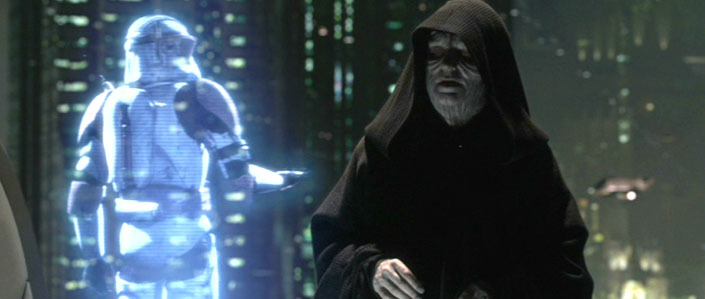
“Execute Order 66.” For Star Wars fans, these words recall the pivotal moment in Episode III when countless Jedi Knights are slaughtered, and the tides of the Force shift seismically. But to this film lover and modest fan of George Lucas’ opus, they represent the moment when the problematic prequel trilogy finally came to life. What follows is a gripping montage of surprising emotional breadth that no other Star Wars film has achieved. Bound together by mournful choral music, the scene depicts various worlds across the galaxy where troops are turning on and exterminating their leaders in the midst of battle. It is bared, visceral filmmaking, and it demonstrates why I find the prequel movies too endearing and interesting to dismiss. Certainly, Lucas deserves every shred of criticism he has received for shoddy storytelling throughout the films, which includes but is not limited to flat dialogue and convoluted plotting. Revenge of the Sith notably contains a similar dose of these flaws. And yet, to its maker’s credit, it crystallizes a compelling story arc with sincerity and vision. To be sure, Episode III is best remembered for its portrayal of Anakin Skywalker’s descent into darkness. However, for all the fuss about the emergence of Darth Vader, Sith belongs to the shadowy emperor (Ian McDiarmid), who subtly preys on every weakness of the political system to gain unfettered power. When he outstretches his hands and basks in rousing applause after announcing the birth of the Empire, the effect is chilling. It’s the kind of moment that caused me to realize through all the hyper-activity of the prequel films—and this entry in particular, with its non-stop jump-cutting, sword-waving, and noise—that George Lucas really has something to say. It may not be terribly profound and I wish he delivered it with more clarity, confidence, and skill, but it has real weight. Revenge of the Sith may be a hot mess of the visually poetic and the plain bad, but this saga-completing entry is elevated beyond its weaknesses by the scale its ambition. (George Lucas, 2005) ***

Friday, February 17, 2012

Star Wars—Episode II: Attack of the Clones

Attack of the Clones ventures into new territory for a Star Wars film. Where The Phantom Menace was light, innocent, and regal, this middle episode of the prequel trilogy is brooding and dark. Its noir-ish mystery plot is fairly uncharacteristic of George Lucas’ established narrative approach and a welcome shift in tone. Clones features some exotic locales and set pieces that feel fresh and alive. For instance, after a sensational chase through Coruscant, the film takes us to the city-planet's Blade Runner-esque street level, a seedy place cocooned from the sterile rooftops occupied by Jedi and politicians. But in spite of these energetic flashes in storytelling, Lucas again fails epically at creating a real moment between characters. More pointedly, his struggles with dialogue are especially evident in this entry, which sees young love bloom between Anakin Skywalker and Padme Amidala. Here we see that Lucas’ problem with dialogue is not just a matter of stiff writing, but also with delivery that lacks any sense of rhythm. I suppose Lucas can fall back on how the players in his young lover’s tale don’t know how to be in love (which in part explains their awkwardness), but that doesn’t let him off the hook for his unshakeable propensity for explicitly stating or visualizing every idea he wants to convey. This is the main problem with the prequel films. Since we're taken carefully taken from Point A to Point B with painfully direct methods, the films become incapable of suggesting, observing, or expressing anything beyond their pixilated panoramas and consonant-free dialogue. (Next week I'll discuss how Lucas finally finds his voice and offers more successful attempts at visual poeticism with Episode III.) As for Clones, we are only afforded brief glimpses of the lucid storytelling and simple, powerful images that marked the original films. In particular, one stirring vision of lumbering spaceships riding to the horizon of war amid orange skies captures more feeling than anything before it in the prequel movies. While not making up for Episode II’s flaws, these images fleetingly realize the potential of a marriage between digital technology and narrative. Unfortunately, they also illustrate the missed opportunities of these films. (George Lucas, 2002) **½

Friday, February 10, 2012

Star Wars—Episode I: The Phantom Menace

I was 16 years old when The Phantom Menace was released. And for the previous 10 years I had watched the three Star Wars films with what some would call an unhealthy regularity. When I saw Episode I for the first time, I didn't mind or even notice many of its problems. I left the film exhilarated by the visions I had seen: dangerous encounters with underwater leviathans; a maze of Venetian streets and pathways; a machine army marching in perfect unison; an entire planet covered in cityscapes. More than a decade later, I am pleasantly surprised by how well many of these images hold up. And I would still argue that the three-way light saber battle at the end of the film is one of the high points of the entire series. Having said that, George Lucas’ failure to meet the most basic criteria of competent filmmaking makes The Phantom Menace feel like an amateur film at times, proving every bit as grating as its reputation suggests. Lucas has become infamous for bad dialogue since the prequels, but this was also a trait of the original Star Wars and can quite honestly add to the fun of storytelling. Where the film really suffers is with its schematic narrative, poorly staged and edited scenes, and a misguided sense of humor that veers on embarrassing. In addition, Lucas' drawing of the young Anakin Skywalker—most notably his accidental late-film heroics—is so wrongheaded that one has to wonder whether Lucas had been questioned at any point as the movie was being made. Unfortunately these flaws are so pronounced that they overshadow what the film gets right. For instance, Liam Neeson is convincing as a calmly defiant Jedi and the villain Darth Maul has a palpable screen presence. I also love the frenzy of the opening scenes and how they move from location to location without allowing much time to take in what's happening. Then there are also the smaller pleasures like the background activity to the marketplace scenes on the desert planet, which very much capture the spirit and detail-oriented sense of the original films. But, in whole, The Phantom Menace is glaringly disjointed. I still maintain that its qualities are overlooked, but Lucas' startling ineptitude with some elements of filmmaking/storytelling craft make it a hard film to defend. (George Lucas, 1999) **½