Showing posts with label Violence. Show all posts

Wednesday, December 12, 2012

Moments out of Middle-Earth


Critics appear to be down on The Hobbit: An Unexpected Journey. That Peter Jackson opted to shoot his Hobbit movies at a higher frame rate and also announced a late decision to split two films into three might have something to do the film's early reception. Or it might simply be that The Hobbit fails to live up to the momentous Lord of the Rings trilogy. Although only nine years have passed since The Return of the King was released, both the critical and popular perspectives toward the trilogy appear to have steadily grown more positive. How this will affect Peter Jackson’s return to Middle Earth with The Hobbit trilogy remains to be seen.
In the mean time, I've gone back to The Lord of the Rings trilogy with a slightly fresh perspective. My goal was to look at these films from the inside out. Inspired by Richard T. Jameson and Kathleey Murphy’s annual “Moments out of Time” film retrospective series, I've picked 10 moments from the movies that magnify their great relevance. My article just went up over at The House Next Door. Please take note, these are not my "Top Ten" scenes out of the films. As I note in the introduction, the 10 scenes I've selected “illustrate a slightly different shade of the films’ fluid realization of a complex visual, thematic, and emotional spectrum.” Head on over and have a look, and feel free to weigh in with your own picks. 

Sunday, September 23, 2012

The Cabin in the Woods


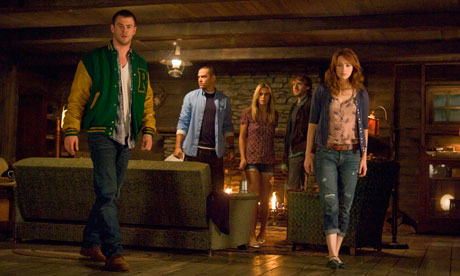
Representing maybe the first real step in the reflexive evolution of the horror film since Scream, Drew Goddard’s The Cabin in the Woods wades into the depths of voyeurism and pleasure that have become embedded into the genre over nearly the last half-century. It ingeniously weaves a heightened sense of self-awareness into a story that steers clear of parody despite deploying an orgy of genre tropes. Much of this can be attributed to how Goddard and co-writer Joss Whedon have structured the film. At the outset we learn of an apparent experiment wherein two men—played with relish by Richard Jenkins and Bradley Whitford—sit in front of screens in a control room and manipulate the fates of five young college students who are off to spend a weekend in a creaking cabin in the middle of nowhere. If the college student scenario sounds derivative, that’s because it is. Each character is walking horror cliché: the athletic jock (Chris Hemsworth), the bookish nerd (Jesse Williams), the innocent virgin (Kristen Connolly), the promiscuous blonde (Anna Hutchinson), and the know-it-all stoner (Frank Kranz). It should then be no surprise that the secluded settings and familiar plot turns that ensue invoke the likes of The Evil Dead, The Shining, Night of the Living Dead, Friday the 13th, and innumerable others.
The overt contrast between the increasingly violent situation at the cabin and the nonchalance of the folks watching/enacting it becomes the film’s major sticking point, and Goddard and Whedon make it work by pouring on the irony. They want to scare you and make you laugh, and then make you wonder why you’re scared and laughing. The eventual explanation for the motivations of the folks in the control room leaves something to be desired, but the resolution seems practically irrelevant and also part of the fun. Moreover, once it enters its third act, The Cabin in the Woods is firmly within the realm of absurdity, carried on by its own inventiveness long after the initial intrigue of the story wears off.
Perhaps the most unique element of all of this is how the film maintains a balance of disparate sensibilities. It actively conflates the serious and the non-serious, inviting a pensive engagement before revealing its ultimate simplicity. (In fact, some of the funniest moments come from deeply intense moments that are interrupted with obviously less important matters.) This playful approach yields an inspired if also problematic result. It’s not a terribly deep experiment and nor is it a reinvention of horror, but it’s a smart take on the ostensibly inherent fixations on death and violence that have long entrenched the genre. And in addition to its modest attempt to reconfigure the elements of horror cinema, The Cabin in the Woods is every bit an homage to their existence. (Drew Goddard, 2012) **½

Monday, April 9, 2012

The Girl with the Dragon Tattoo


On first glance, the American film adaption of Stieg Larsson’s The Girl With the Dragon Tattoo appears an ideal vehicle for director David Fincher. Over a two-decade career, Fincher has explored and re-explored many of the ingredients found in Larson’s novel. Centering on a unique pairing of protagonists who together investigate the mystery of an unsolved murder committed 40 years prior, the story also proffers other Fincher staples, such as a sociopathic villain and long scenes of intense research and investigation. The film naturally latches on to these elements and spins them into richly textured inquiry into the retrospective reconstruction of the past. Fincher has navigated these waters before, but never as gracefully. He uses the Agatha Christie-esque plot as a foundation for an experiment in mood and atmosphere, proving that he is miles ahead of his contemporaries in terms of film craft. In his execution, Fincher effectively emulates Hitchcock, squeezing tension and dread from a simple progression of elegantly crafted compositions.

Larsson’s compelling groundwork sees Daniel Craig’s everyman journalist driving the story at the start, while the victimized, off-putting character of Lisbeth Salander assumes a more passive role. The Girl With the Dragon Tattoo is involving purely on the level of aesthetics, but Fincher’s visualization of Lisbeth’s journey from passive victim to active protagonist is the film’s most significant achievement. Over the two and a half hour run time, Fincher and Rooney Mara craft a full-bodied portrayal of feminine sexualization and strength that defies stereotype and resists broad representation.

Despite earning mostly positive reviews, a prevailing notion that The Girl With the Dragon Tattoo amounts to little more than a stylistic exercise has begun to crystallize in the wake of its release. Even some of its adamant defenders have noted that the film fails to truly distinguish itself from other Fincher works. (That it is also the second film adaptation of a recently published novel only compounds this emerging legacy.) Indeed, Fincher’s Girl fits within an established framework. But look closer and there is a more nuanced movie about vision, technology, and embodiment than its glossy surface and derivative genre trappings would lead to believe. (David Fincher, 2011) ***½

Wednesday, March 28, 2012

The Walking Dead—Season 2

Since the release of George A. Romero’s seminal film Night of the Living Dead nearly 50 years ago, the zombie apocalypse has grown into a cultural fascination. The notion of the dead rising to eat the living was visceral and provocative, but audiences learned quickly that zombies were not only inventive villains but also a collective vehicle for pointed social commentary. Recent years have seen zombies again become a center of intrigue, as variations have surfaced across various media platforms—from remakes and parodies of Romero’s classics, to popular zombie books and survival guides. Even Romero himself has gone back to the well, having directed three new entries in his Dead series within the last eight years.

The zombie resurgence came to a head in late 2010, when the zombie apocalypse scenario was resurrected again; this time for the small screen. Adapted from the popular graphic novel series, The Walking Dead was the latest and perhaps most sweeping rendition of the undead phenomenon. It followed Rick Grimes (Andrew Lincoln), a small-town police officer who wakes from a coma at the height of the uprising and gradually regains his bearings, unites with his family, and leads a group of survivors. Despite its conceptual similarities to a myriad of previous zombie narratives, The Walking Dead worked because it had the budget and the freedom to realize and sustain its grim vision of a decaying world. In its short first season, show runner Frank Darabont (who also directed the first episode) and his team served up haunting images of cities deserted, hospitals abandoned, suburban neighborhoods turned into war zones, and hordes of “walkers” whose insatiable need to devour human flesh was graphically depicted.

The mounting dread the show deployed so effectively was not jointedly the result of its unsparing horrors of the undead feasting on the living as well as its a vivid portrayal of society’s crumbled institutions. These aspects fostered a level of authenticity to the proceedings, no matter how preposterous the notion of a zombie apocalypse may be. That it also explicitly avoided how the uprising occurred and offered only glimpses of life before it added to The Walking Dead’s pedigree. Darabont instead keyed on the immediate sensation of fear, survival, and the burden of facing the dangerous new reality into which surviving humans have been violently cast. In whole, the first season was remarkable for how strongly it evoked the feeling of witnessing a doomsday situation play out. Blending a realistic survivalist-type scenario with a far-reaching horror premise, it successfully transmitted deep-ridden collective fears in a way that felt fresh. The show went on to great ratings, making a second season inevitable. AMC extended the the episode count from six to 13, which granted the writers more opportunity to develop the core characters and also expand on the emotional canvas introduced in the initial six episodes.

Keeping in mind the first season of The Walking Dead, as well as the storied history of zombies in popular entertainment, let’s jump to the present. The show recently wrapped its second season, prompting many reviewers to evaluate the zombie-war finale through the lens of the entire season. (Of these I recommend reading Matt Zoller Seitz’s piece, which offers his usual breadth of insight.) Since this angle has been well covered, my aim here is place the show in a broader context. First, I will consider the second season as a companion to the first season, which, as it turns out, reveals major contrasts. Then, I will reflect on the show’s attempts to internalize the vast history of zombie apocalypse representations and how this has resulted in its struggle to offer something new to the lexicon. But let’s begin with how the second season takes shape in relation to the first.

Tuesday, May 20, 2008

There's something in The Mist

Grocery stores are fascinating places. They are among the few social gathering points that attract people of all classes, races, ethnicities, cultural orders, and religious views. With the exception of the wealthiest of wealthy and the poorest of poor, almost everyone frequents the grocery store; for practical purposes, and also in a more elemental sense, for survival. We need sustenance simply to keep living, and to support or social and cultural practices, different as they are.

Throughout movie history, some of the most tense films have transpired in a single, mostly isolated location. Horror films, in particular, have benefited from a focused setting, where an atmosphere of suspense and terror can be amplified from the feeling of isolation. Stephen King used this basic device as a way to frame a seemingly by-numbers monster thriller against the backdrop of a supermarket. Using a traditional setup and narrative structure, King explored the social relations of a staple institution in many of our lives. On an average day in a New England town, the story is populated with townspeople and out-of-towners alike, all who whom agree on the policies that enable a supermarket --as a social institution-- to function. But when a man comes frantically running through the parking lot --blood dripping from his nose and down his face, eyes widened in shock-- bursting through the entrance doors of the store, that order is ruptured. And in a few short moments, those who expected merely to pass through the store and move along with their lives find themselves enshrouded in mist, enveloped by a perpetual void in the form of a foggy realm moving over the town.

Director Frank Darabont recognizes the importance of character, isolation, and perhaps most importantly, our sociocultural policies, in adapting King's work on film. One of the more difficult tasks that Darabont accomplishes is the juxtaposition of the human drama arising from an expected crisis, and the supernatural forces which besiege them. This is not easy to execute on film, but Darabont achieves a fluid aesthetic of elongated shots and smooth closeups, building an atmosphere out of the relationship between the tangible, palpable fears of isolation, and the creatures who invade the world outside with no regard for those who have ordered it. Darabont draws this distinction sharply, giving equal weight to both narrative threads and allowing them to feed off one another for maximum effect, separated only by a thin sheet of glass. From the inside, the racial, social, and cultural tensions embedded deep within the beliefs and values that inform each of our lives are exploited by the looming vision of mist pressing up against the glass exterior of the market, and slowly penetrating that barrier.

At the heart of the human drama is more than just a fight for survival, which, although compelling as a center of clashing individual ideologies, is heightened even moreso by deeply embedded cultural conflicts that largely determine how individuals organize and construct explanations, notions of justice, and divisions of power. While race, class, and occupation loosely form the ground on which individuals base their perspectives on each other and the external world, the film observes that deeper than all of these fabrics of identity is a more constitutive collective order of the organized belief in a supernatural order: religion.

Although the film simplifies this "culture war" of religious inclinations with its broad narrative strokes, Darabont's magnification of this conflict --in the form of one character who preaches to the townspeople about the wrath of god-- allows him to explore the extent to which theism and religiosity motivates individuals to achieve a particular end. Therefore, King's and Darabont's observations are cutting and cynical. As one of the characters observes in a crucial (though perhaps too literal) exchange midway through the film, "As a species, we're fundamentally insane. Put two of us in a room, we pick sides, and start dreaming up reasons to kill one another." The man who says this is one of the store's workers, who bands together with a small group of forward-thinking protagonists who are more concerned with surviving the chaos around them, rather than explaining it and co-opting those dangerous conditions to exploit the collective's fear of death and the unknown.

Yet, although the film appears to embody the struggle between religiosity and pragmatism, its real focal point is the discussion of whether or not people are fundamentally good. There are those who believe that people are born good, which is usually attributable to some kind of grand design. From this perspective, it's all of the "artificial" and "unnatural" things that corrupt individuals. On the other side, there are those who believe that people are not much more than animals, refined by thousands of years of cultural meaning-making and socialization. Although people divide themselves over those very learned conventions and policies of language and rhetoric, these are also organizing principles that enable civilization as we know it. Division is built into the unifying principles of language and culture. But, when stripped of the complex world if discourse and forms that provides our lives with meaning, all slips into chaos, and people engage in a primal struggle not only for survival, but for power. And the key means by which to achieve that power is fear.

This struggle culminates in a deeply cynical ending that will undoubtedly divide viewers. Wherever you stand in interpreting the film's final moments will likely say much about which kind of person you are, with regards to the film's central questions concerning the fundamental nature of humankind. And while this struggle of ideology and theistic enterprise makes for fascinating human drama, the film embodies that experience so effectively because it is more oriented toward probing human behavior and communication rather than titulating the viewer with shocks and gore.

There's no doubt that The Mist is an intense experience in cinematic horror. But the horror arises out of human interaction, and subtle observations on individuals dividing themselves and bounding together when facing extraordinary circumstances. Life is lost to the creatures in the mist and to hellbent people, but how that life is lost is where the film really takes effect. Darabont's deft vision of humans in crisis is staggering, particularly at moments where life is draining away. Almost every "death scene" in the film is shocking in its quietness, and almost unbearable to see in the level of detail Darabont depicts it. Victims' skin quivers, their eyes well up, and after great struggle, each resign themselves to the inevitable reality of death swallowing them whole. Darabont's images are starkly real, even apocalyptic, often in the most subtle manners. Any fan of the horror genre has seen tentacles swallowing human prey, but Darabont can make it brutally real, focusing more on the in-the-moment details that a body in fear experiences. You feel it when a tentacle pierces flesh. And yet, no single image in The Mist is more frightening than the sharp blade grasped on one end by human hands plunging into the stomach of a fellow man. Encircled by a crowd function as a larger body of righteousness, the defenseless man is the unfortunate target of the twisted logic determined solely by his social position (an army officer). He is reduced to nothing more than the means by which members of a dominant majority can carry out their insatiable desire to provide meaning and structure to things that, quite simply, defy explanation.

Thursday, February 28, 2008

Cops: Special Iraq Edition

Brian DePalma's underlying concept for his lraq war film, Redacted is noteworthy, along with his conviction and outrage regarding the subject matter. But those qualities are often hindered by sloppy execution, at least when it comes to formal film appreciation. Where DePalma is concerned mostly with stylistic details, his empassioned presentation of a soldier's experience in (and perspective of) Iraq is marred by poor acting and connect-the-dots screenwriting. Yet Redacted still manages to fulfill its purpose -- i.e. to disturb and provoke -- despite its failure to engage on the cerebral levels its makers clearly want to. The feelings/reactions that DePalma attempts to evoke are complicated, no doubt, but his film may work best as a piece of sensationalist propaganda, a la "Cops" or its news equivalent, "The O'Reilly Factor." Only instead of the dangerous streets of urban America, this film turns the tables on dominant representations of Iraqis and looks at the atrocities committed by American soldiers in Iraq; not safe territory. But the film isn't so much about heinous acts of bigotry and racism as it is about the dangers of representation in media economy, and how theses representations foster unhealthy and overly simplistic perspectives of people and cultures.

Redacted both critiques and embodies the kind of trash journalism that is pervasive in today's media environment, one that feeds on spectators' fears and nationalistic desires. Despite the formal failings in fundamental areas of filmmaking --acting and writing-- DePalma seems content to explore the nature of perspective in an age of ever-multiplying information sources and commercial interests. Redacted is a literally a visual assault of information, and although it sacrifices sound, formal filmmaking and occupies a particular political position, it is an important film because it is assaultive. It's an active reflection on the crisis of representation that has mounted for some time and is now boiling over in digital culture.

The film follows a squad of American soldiers stationed in Iraq, who, when they're not playing cards and bonding in male comradery (as only the movies can deliver), patrolthe dilapidated streets of an Iraqi city. Children run and play like any kids in a schoolyard might; kicking soccer balls and playing tag. Men and women walk about the rubble of destroyed buildings, going about their days in a more seemingly haphazard manner than would be Manhattan business people, patiently waiting in masses for a "Walk" sign to instruct them. City dwellers regard the soldiers with trepidation, despite having grown accustomed to their presence. Interestingly, the film keeps a strong focus on the soldiers themselves, concerning how hot, uncomfortable, and disoriented they are rather than anyone else. The soldiers loathe being there, and justifiably so. But the film keys in on the soldiers with regards to their view of everything around them, implicitly or explicitly wondering why or how a culture could be so different, violent, and barbaric. Every civilian is a potential suspect in the eyes of the soldiers, and after surprise assaults and bombings, they have gotten used to that.

The movie is especially interesting in these moments, which are mostly captured on a small hand-held camera operated by on of the soliders who is resigned to capture the realism and immediacy of what they're enduring. This narrative and stylistic tactic is brilliantly used to form a soldier's sense of the surroundings and provide a feeling of the underlying tensions between two very different cultures and ideologies in such close prximity, each physically and symbolically occupying the same space. And yet on that ground, there tragically exists no plane of understanding, of sympathy, and of acceptance. Whether each culture's -- i.e. persons on the street (soldiers or citizens) -- perspective of the other is accurate or inaccurate, those perspectives are sealed in the cultural and ideological assumptions underlined in their respective practices. It's a cynical interpretation of everyday encounters between American soliders and Iraqi citizens, but one that's hard to deny.

Redacted doesn't remain grounded in these observations in the first portion of the film, arguably its most provocative. DePalma instead shifts attention to the rape of an innocent girl by two U.S. soldiers, an event depicted in graphic detail via the hand-held camera's night vision. The idealistic soldier operating the camera in no way condones the actions of the two soldiers who raped and killed the girl and her family, but his choice to record it becomes the central thematic groundwork on which the film bases its ehical, social, and philosophical claims. To play witness to an event is to submit to some kind mediating structure which enables one to interpret that image or event in a particular way. In other words, the spectator plays just an integral a role in the construction of a representation as those who construct it to be seen.

Apart from these consideration, the images are difficult to watch. There is a reality to it, one that is all the more sickening knowing that something similar to this actually happened. But if there was no desire to see the event, then it would not have been captured, and only would have existed in the memories of those who experienced it. Nevertheless, the man watches through the lens of the camera before leaving the building in sickness and disgust. The remainder of the film presents a variety if disparate images, some involving soldier's tributes to fallen heroes, others taking on security-cam vision of the soldiers interrogated over the events of rape. And perhaps most interestingly, several scenes offer up internet images of YouTube-like sites, where videos are posted by soldier's wives, anti-war activists, and masked soldiers admitting to having seen the event of the rape.

These moments are provocative in the greater consideration of media economy that the film actively constructs. Where the drama of the characters and soldiers' encounters tends to fizzle out in several scenes of poor acting and literalist writing, these different mediated images imbue the film's final proceedings with a level of interest that was only subtly suggested in first two acts. Whether DePalma knows it, the film eventually becomes the schlock pastiche of violent images and mediated information it seeks to question. The final montage of real images of carnage, death, and destruction suffered by the people of Iraq illustrates the polarizing differences between two cultures that ideologically and now physically clash. The problem is that those physical clashings are captured and portrayed in very particular manners, so as perhaps to facilitate further ideological clashings between what Slavoj Zizek deems the war between the "civilized" West and the "barbaric" culture of Islam it seeks to cleanse. Therefore, when we see these alternative, painful representations of those physical clashings, the need for a stronger and altogether different way of engaging issues of war/violence, media economy, and international relations becomes quite evident in the visceral, emotional reaction of witnessing such tragic occurrences.

In spite of its failings, Redacted strikes a resounding chord in an age in which cable news shows assault viewers with a plurality of violent images designed to evoke a specific emotional response: Fear; of terror, extremism, both which are too often foolishly associated with Islam. DePalma's central premise --that fear is harnessed by media powers as the central tool in the production of misguided nationalism-- is potent and relevant, and is one that mainstream (and so-called "liberal") media wouldn't dare consider.

The real question is to what extent his assertions against mainstream representations of violence and destruction may actually reproduce the very same kind of fears, thus failing to offer the beginnings of an alternative method of thinking the situation. And so we arrive once again to the crisis of representation: by refusing to offer dominant, i.e. patriotic representations of American soldiers and instead constructing a wholly different portrait of Iraq -- one that is readily accessible to those who decide to educate themselves about the American occupation in Iraq -- is DePalma degrading all troops and America? That's tough to say, but I would venture to guess based on the methods of his film's inquiry that he is more likely examining the notion that this "conflict" is more intricate than our narrow interpretations and representations will allow.

Friday, February 22, 2008

The films (and reviewing) that got away

Year-end dialogues regarding the finest films of the year have gradually whittled down the number of films discussed from about 15/20 films to about five or 10 over the past few months. Then the Oscar nominations were released last month, and it was down to five films. Bloggers, pundits, and critics have since argued about the five movies -- whether one of them didn't deserve to be there, which should win the prize, etc. After Sunday, it will only be one. And then we will all move on.

Seeing the plurality of great cinema released last year be reduced to bland discussion of "bests" is no doubt a tragedy. To see only five films, which is really only three -- Juno, There Will Be Blood, No Country For Old Men -- being discussed in spite of the many great films that didn't "peak at the right time" in the politics of awards season can be depressing. That's not to say that the Oscars are the be-all, end-all of critical discussion, but they represent the public's small investment in good, quality cinema. So the fact that only a few films, some of which are considered questionable by many, are being examined by the public eye is somewhat discouraging, especially when thinking back on the many great movies last year that slipped under the radar. Although I at least liked all of the Best Picture contenders this year (including Juno, minus the first 15 minutes), even the one I loved, i.e. No Country For Old Men, which has been written about and discussed in such great detail, is perhaps receiving an excess of attention, especially considering that so many other movies that are equally good, interesting, and worthy of discussion in the public domain.*

That's why it's refreshing to see other movies being talked about this time of year, and not because they were released in theaters or DVD. One of my very favorite movies from last year, David Cronenberg's Eastern Promises, had initial surge of discussion back in September during its theatrical run. (Here's my review of the film, written in September.) But this dialogue was quickly suppressed when the Toronto Film Festival started, and a variety of other films shared the attention. Nevertheless, Eastern Promises is a great achievement; that it's not currently held in the same high esteem as No Country For Old Men is a cinematic/critical crime.

It's easy to forget about wonderful films like Eastern Promises when Oscar talk has smothered all discussion about any other movie. Although Viggo Mortensen was nominated for Best Actor, his presence in the race is an afterthought; further validating the notion that the Oscars are nothing more than a political race. Eastern Promises, for whatever reason, lacks the financial backing and social presence and has lost a lot of steam since its release. It was fortunate enough that Mortensen was even nominated. That said, he doesn't stand a chance against a film that's gaining more momentum, i.e. There Will Be Blood, especially in the Best Actor category. Again, it's all a matter of politics. People are talking about There Will Be Blood and not Eastern Promises; whether the former is more worthy is more than questionable, stripped of the politics. Looking at the films and performances though, Mortensen's performance still stands out to me as the finest by any actor this year.

Which brings me to why it's so refreshing to read insightful articles about another movie, such as Ed Howard's intelligent review of Eastern Promises. Ed's writing demonstrates that this film (or any film) can be discussed, analyzed, and enjoyed from several perspectives; not just can be, but it should be. And he does this with so few words. His writing on Eastern Promises --like much of his work-- serves as an introduction to the film's key themes, and suggests a variety of levels on which Cronenberg's film resonates. Here's an excerpt:

"The story of Cronenberg's film — the real, underlying story lightly disguised by its genre trappings — can be read from the abundant symbols he employs. It's a story of the traditional family undermined by both homosexual desire and explosive violence — a brief that sounds surprisingly conservative on paper, except that Cronenberg clearly takes such gleeful pleasure in disrupting the placid surfaces of Hollywood conventionality that it's hard to take the film as anything but a radical critique of the normative structures it sometimes apes. Unlike A History of Violence, where Cronenberg seemed to disappear too readily into the conventional surfaces of the genre narrative, Eastern Promises is a prickly, genuinely disturbing and potent film that may indicate a fresh new development in Cronenberg's oeuvre. Certainly, it's his most perverse and exciting film since the delirious high point of 1997's Crash, and that alone is reason enough to celebrate this return to form."

I recommend heading over to his site and reading the whole review over at his place, Only the Cinema; a site that, by the way, features some of the most consistently thoughtful and provocative film reviews on the film blogging circuit. This review, in particular, is a model example of strong journalistic criticism, which is so sorely needed in the published and blogging venues. And in the midst of pervasive Oscar previewing and discussion, it reads even better.

I have always strongly felt that journalistic film reviewing can serve a good purpose in film journalism. The best of it can even bridge the gap between analytic examination and reflecting on the immediacy of cinematic sensation in tantalizingly few words. When that happens, it's a special thing.

Your thoughts?

-------------------------------------------

* Note: I'm not proposing that critics stop or greatly reduce discussion of films like No Country For Old Men. Engaging articles like this remind that too much can't be said about films like the Coens' eventual Best Picture winner. I'm instead suggesting that critics and bloggers --the latter of whom can mostly control the content of their output-- broaden their critical horizons and dare to discuss movies that aren't being discussed currently.

Tuesday, October 23, 2007

Month of the living horror

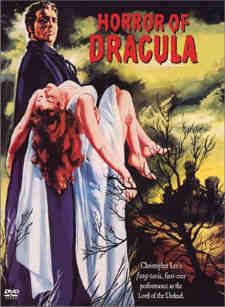
I was in Northeastern Pennsylvania this past weekend, where in a rustic-looking antique store somewhere in the mountains I discovered a dusty, out-of-print book --at least according to the sign-- on a small table in the corner of the store. It appeared to have been written sometime in the 1970's, by the looks of it, and was called "The Horror People." Like a great deal of film books that I purchased in my teen years, this one is more a pictorial journey through a certain area of cinema, that being horror cinema. Its commentaries are hardly critical, but are instead more of appreciations for various figures (mostly actors) who contributed to the construction of horror as not just a literary genre but a cinematic one as well. I have yet to read the book, but I did have a chance to browse the chapters, which were organized by actor. Just from paging through the book, I was able to tell that it was very imformative from a film history standpoint about the famous horror actors through the mid-70's, with extensive notes on Christopher Lee, Peter Cushing, etc.

So I decided to buy the book with the hope that I can brush up on my horror genre history. It was also an irresistible buy because, quite simply, it's that time of year. Like many others, October is a special month in my cinematic calendar because it gives me reason to watch as many horror movies as I can. I am not as well read on the genre as others, but I'd like to think I have a fair grasp of this creatively lucrative genre. October is typically a fertile time for critical reflections on horror cinema, from the classic cinema as evoked in "The Horror People" to the slasher flicks of the 80's, and everything in between. On the film blogging circuit, several enthusiastic horror fans have written dedicated space to writing about horror films in the spirit of October. One of the more ambitious of these writers is Rob Humanick, who is currently trudging through a brilliant series entitled the 31 Days of Zombie! on his blog, The Projection Booth. Over the last several weeks, Rob has posted a review of a different horror film each day, and, apart from the freshness of his writing and perspectives, the films he's chosen to write about are incredibly varied. He's written about movies as diverse as Shaun of the Dead, a recent horror comedy, and Sam Raimi's Evil Dead sequels. He has even written about low-grade zombie flicks that I've never even heard of. Elsewhere on the blogging front, Dennis Cozzalio recently offered reflections on his love of horror (particularly in October), as well as a review of an overlooked horror film of the 50's. In his posts, there is an enthusiasm for this style of moviemaking, a nostalgic yearning to understand the ecstacy of turning the lights off, cozying up on the couch with some popcorn, and watching a scary movie, no matter how laughable or truly scary it may be.

Herein lies the wonder of horror as a genre. It's both amazingly versatile as well as inherently nostalgic, limitlessly calling upon audiences' desires to feel fear deep in their blood. From the shadowy masterpieces of the silent era to cheap midnite flicks of the 60's and 70's, cinema has seized horror from the literary world and claimed it as its own. While some would consider horror films to be low-grade trash, especially when compared literary masterworks by Poe, horror occupies is own unique place in cinema. Its finest entries vary from cliche-ridden, self-proclaimed filth to high-class art cinema. If there's anything I've learned while chronicling the various stages of horror cinema through the years, it's that "horror" is a flexible term that doesn't quite function in the same manner as other genre labels like sci-fi, or western. There are countless narrative and stylistic sub-divisions of horror that have spawned over the years, all interesting in their own ways. Moreover, nothing binds horror to certain setting, locales, or even narrative and stylistic approaches. It is a genre of true diversity that represents an overt exploration of the pleasures of spectatorship.


Although most current critics will try to convince you that horror (like westerns, sci-fi, etc.) is dead, I find quite the opposite to be true. While I concede that popular horror cinema is currently stuck in a rut from a mainstream standpoint, especially with the popularity of "torture porn" (which actually seems to be waning), the genre itself is not dead. Within the sub-division of zombie movies, which have been with us for the better part of 40 years, there continue to be new entries that stand out for different reasons. While 28 Weeks Later brings a contemporary flair of style to a relevant story about refugees of a massive virus outbreak, other films simply have fun with the trashiness of horror storytelling. One such example of this is Robert Rodriguez's Planet Terror, which serves up just about every cliche in the book on zombies and still manages to be ceaselessly compelling. While these two disparate films from this past year serve very different purpose and occupy different position in the "zombie canon", they together illustrate the contempoary relevance of horror cinema both in terms of its contemporary relevance and its ability for pure pleasure in the familiarity of movie convention and the explosion of zombie heads. We can know exactly what's going to happen, which ends up becoming part of the fun, or the fear.

Even torture porn is interesting because, like other sub-specialities of horror, it provokes a different reaction and consideration to the question that all horror films beg: What attracts us to being scared, to being on the edge of our seats, biting our fingernails, and squirming in suspense?

The central principle of horror is that it's designed to stir fear within the viewer. But the importance of this genre is not so much its function of creating fear so much as the viewer's desire for that fear. While it's true that it's largest fan base is a rabid core of individuals who live and breathe horror, horror --as a broader concept-- never seems to fall out of the public spotlight, which is staggering when considering the many morphings and permutations of the genre over the years. Just when you think it's gone, dead, or only for the junkies, a horror film will come along that stirs audiences of all ages. The most recent example of this is probably The Blair Witch Project. Although it was almost ten years ago, that film got people talking. Some loved it, and some hated it. Some laughed, while others were kept up at night thinking about its images. This is usually the case with horror movies, whether the threat is paranormal, supernatural, religioso, psychological, doesn't really matter... we seem to crave fear.

Most critics or film professors will use the term "identification" when describing the frameworks of narrative and cinema. The reader or viewer is supposed to identify with the central character; the protaganist; the hero. But in the case of horror films, I wonder if this really holds true. Some of the most famous "scary stories" on film, from Psycho to Jaws, do not incline the viewer to identify with the protaganist, but rather the villain. In the case of Psycho, Hitchcock deliberately toys with narrative and cinematic convention by following the central character long after the conventional expository death. She feels incredible guilt throughout the film, like everyone is watching her. That's because we are watching her. The viewer is the ultimate voyeur, which is why so much horror cinema seems to delve into voyeuristic fetishization rather than identifying with a fearful character, like most horror stories. In most horror films, there is usually one character who manages to survive and take out the villain, but that has always felt more like an obligcation on the part of storytellers to tell a tidy story and let the hero win. In reality, the most successful horror stories on film force the audience to identify with a voyeuristic, predatory killer, whether that's a 25-foot shark, stalking swimming woman from the depths of the sea, a psychotic motel owner who watches his residents shower through holes in the wall, or a rogue alien, stalking members of a ship in deep outer space.

The most overt example of this form of identification is the "killer vision", used extensively in films like Jaws and Halloween. Beyond these obvious stylistic touches, there is something larger going on in horror cinema that deserves serious consideration, because through horror films we see why cinema differs so greatly from other storytelling media. Showcasing brutal acts of violence, twisted feelings of surveillance, and a impulse for penetrating skin/bodies, horror films seem to tap into something deep within the collective psyche. In its focus on trauma, violence, bodies, and skin, the genre calls to mind several key issues with regard to spectatorship and the perception and interpretation of narrative through images. Apart from latent cultural perspectives on gender, race, class, and narrative, which manifest in a variety of archetypical images of force, power, and domination, the crisis of identification evoked in horror movies almost forces one to consider the relationship of the viewer and the image in a new light. In short, horror cinema is a microcosm for cinema itself.

Saturday, September 22, 2007

Making Body Sense

"It's all about bodies. It's about the destruction of bodies. And I insist on that as the reality of this. And I want to see it all. This fight scene has to make physiological sense. It has to make mechanical sense. It has to make body sense." - David Cronenberg

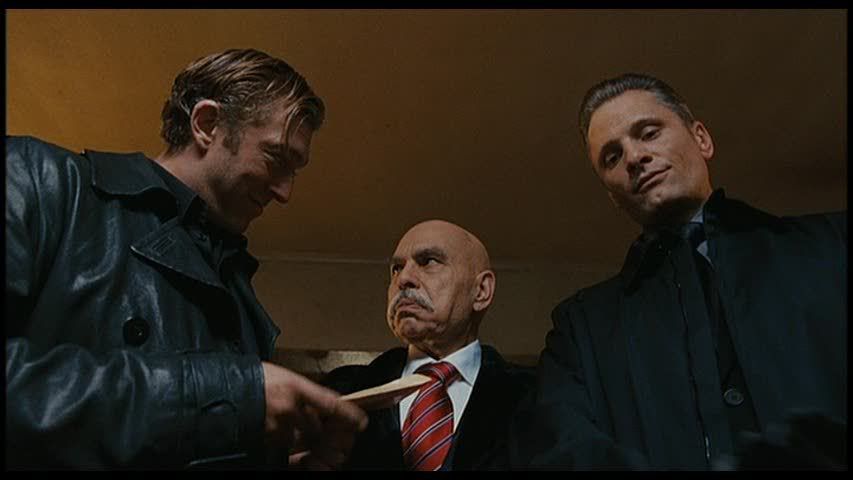
The opening scenes of David Cronenberg's Eastern Promises (2007) depict a man awkwardly severing another's neck. They both quiver in fear; one for losing his life, the other for taking one. Cronenberg draws out this precise feeling to unbearable lengths, with the stable camera refusing to edit to another image as we see the struggle ensue. Where many filmmakers are content to represent brutality via images of slit necks and stabbings often containing just enough detail to keep the viewer at a pleasurable distance, Cronenberg refuses you that pleasure. In doing so, he locates a primal state of feeling blood flow through your vains and his images invites another form of pleasure. The scene consists of a very simple series of shots which (as Jim Emerson expertly notes) evoke the difficulty and the struggle of being on both the perpetrating and receiving ends of the killing of a person. It's almost a sexual encounter in a sense, one that's revealed to be nothing more than business once it's over. Of course, this isn't the last time we see violence of this nature in the film. But in that moment is the whole movie.

Eastern Promises is an equally sumptuous and repulsive exploration of family, bodies, and the social structures that govern the underbelly of society. The narrative focuses on two central characters, one a driver for the Russian mafia (Viggo Mortensen), the other a suburban London midwife (Naomi Watts). Both Nikolai and Anna deal with violence and its effects as part of their jobs, but must remain detached from it. Both also understand the trappings of family. And yet they could not be more different. When Anna uncovers the diary of a young Russian prostitute who died giving birth, she seeks out the Russian company with whom the girl was connected in an attempt to locate the baby's family. This, however, unwittingly involves her in what she soon discovers to be the Russian mafia.

While the exposition seems almost to be setting up a suspenseful thriller about an innocent woman trying to escape the the mafia, Cronenberg instead uses it as a means for exploring the interactions and perceptions of Nikolai and Anna with each other and in their respective environments. He reveals the innermost character of complex individuals who, being typical "villains" in many films, are easy to simplify to bad guys. Instead, Cronenberg observes the simplicity of their lives through the the day-to-day practices of their operation. The head of the family, Semyon (Armin Mueller-Stahl), is a softly spoken gentlemen who wears button down sweaters and moves gingerly about his restaurant, talking of food and wine with family. His son, Kirill (Vincent Cassell), is a lunatic who tries to be tougher than he really wants to be, has no idea how to express anything resembling an emotion in an intelligeble, respectful manner. Nikolai, the driver, maintains a detachment concerning his daily work that represents the face of Semyon's business. He does not emote, show worry or remorse for anything. Nor does he have to. When you look into his eyes, you don't question a thing he says or does. But he remains a mystery to everyone around him. Mortensen has a unique, sublime way of making emotionless behavior so expressive that when Anna is unafraid to approach him, one can relate to her doing so. Nikolai, while seemingly cold and detached, has much going on beneath his surface. Capable of the most brutal of murder and operating seemingly without conscience, however, his motivations and inner secrets cannot be discovered by anyone.

No matter the amount or level of violence, the best mafia/mob movies are never about violence. They instead probe the lives of violent people in honest and subtle detail. There are many long scenes of dialogue among the many characters in Eastern Promises. During them, there is a feeling that we are being let into the mundanities of mafia life, seeing their familial and economic tensions. This of course makes the outbursts of violence all the more intriguing, as we see how violence manifests within the characters' lives as an assertion of power, and a test of will. Even sex for these men is a raw expression of violent impulses, as if that's the only way they now how to interact with another individual meaningfully. In conversation, we see masks and repression. Therefore, it's in how their bodies interact that enable Nikolai, Kirill, and others to attempt to express their inner desires and repressed states.

Physical signifiers of the importance of the body are the tattoos that cover the bodies of the Russian family. Physical markings on one's body tells his story so that it need not be expressed in language, which is used primarly for business interaction. These mens' identities are lliterally cut onto their bodies; which tell stories of their family, country, and achievements. Their naked flesh reveals their innermost passions and memories.

Similar to A History of Violence (2005), Cronenberg's visual and stylistic approach in this film is subdued, with meanings sublimated into the environments and subtle relations among characters and images. During the day, London is shot in washed out colors and seems very gray and gritty. At night, Cronenberg heightens the color palette. He also opts for longer shots, lengthier scenes, and a real exploration of the characters through smaller details of their actions and business deals. Both films also contain outbursts of savage, almost inhuman violence that both feels real and unreal due to the somewhat believable surroundings of the characters and their tangibility in their respective worlds. Cronenberg does not shy away from images of violence, and he never has. His approach to committing violence to images is no different than how he stages conversations between characters: little editing, a mostly steady camera, and always enabling the viewer to see, as he understands that it is through seeing that cinema becomes alive. Unlike his previous efforts in horror and sci-fi, in which Cronenberg heavily stylizes his fetishizations of flesh, both A History of Violence and Eastern Promises are actively more reflexive about violence as its situated in a narrative as well as how it manifests in the lived experience of ordinary, relatable people. In these films, Cronenberg expresses a fascination in the very flimsy boundary separating "normal" people from violent ones. The violence in these two pictures is almost more shocking because it is surrounded by a subtle, yet sublime visual approach that captures both the shade and the color of the characters and the world they inhabit. During the day, London is shot in washed out colors and seems very gray and gritty. At night, Cronenberg heightens the color palette. Cronenberg always reminds that despite the sumptuous colors of Semyan's restaurant and the night rain through which his mafia characters move, these people live and interact in a very real, believable world.

But the glaring difference between his two most recent films is that A History of Violence fetishized mechanical weaponry and its effects on bodies; malforming and mutilated them. However, there is not a single gunshot to be seen or heard in Eastern Promises, and yet many people lose their lives. It does not contain so much as one composition of an automatic weapon of any sort. Here, Cronenberg more explicitly focuses on bodies mutilating bodies and colliding with one another other.

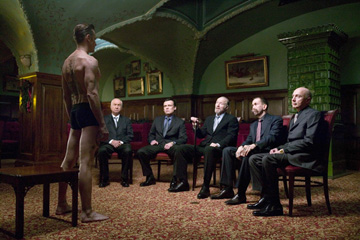
Rather than employing the advantages of mechanical weapons, the characters in this film are instead forced into close contact with each other with the use of knives in combat. Despite that knives starkly contrast with the brute force of a fist, they nonetheness function as extensions of bodies, enabling one body to penetrate fully into the surface of another. It is the convergence of sharply cold surfaces and warm flesh that Cronenberg evokes so sensuously in moments of bodies crashing into each other. He observes the icy precison with which a blade smoothly glides across the skin's warm surface to unleash spools of blood, as well as the sharp plunge of a knife's edge deep into the body. It is both beautiful and harsh, and Cronenberg finds both in individual moments, particularly in a scene late in the film in which Nikolai, naked, must defend himself from two attackers using only his body. In this scene, Cronenberg wants to to see and feel every detail of bodies in action, the vulnerability of it, and the primal behavior of survival. In these moments, in the coming together of bodies, Cronenberg elucidates the complex relationships that emerge from the seemingly simple aspects of lived experience. And his framing it all through the diary of a violated woman, a woman who never had a choice, and the physical marker of that --a baby-- is wrenchingly powerful.

Monday, September 10, 2007

Cronenberg on Sex, Violence, and Cinema

In a perfect world, I wouldn't know very much about the movies I see before seeing them. So often, critics write about the importance of having as little exposure to a film as possible and seeing it with fresh eyes. Since I usually can't see them until well after their release, the reality is that I read quite a bit about movies long before finally watching them. Even in the case of movies I go to see on opening day, I find it utterly impossible not to read interviews and reviews, especially if it's something I'm really looking forward to. One such movie is David Cronenberg's Eastern Promises (2007), which is currently playing at the Toronto International Film Festival, where several critics have written rather enthusiastically about it already. In a recent post, I explain why it's not the worst thing in the world to read about a movie before you see it. But it's a fine line to walk, because it is a more pure experience when you know less.

When it comes to particularl filmmakers (e.g. Spielberg, Scorsese, Sofia Coppola, Guillermo Del Toro, Alfonso Cuaron, Woody Allen, etc.), once I know the littlest thing about their films I become intrigued enough to seek out more. Sometimes, it's almost uncontrollable and I have to consciously stop myself from reading too much; not so much for knowing too much about plot (as plot means very little to me) but instead about compositions, themes, ideas, etc. It's always a struggle, one that the everyday cinephile has to deal with, especially this time of year. And with Eastern Promises coming out this week, I'm on overload with enthusiasm. This morning, I came across this outstanding interview (via GreenCine Daily), in which Michael Guillen talks with Cronenberg and actor Viggo Mortensen about the film. Here is an excerpt from Cronenberg's comments that particularly struck me:

"The nudity in the scene is really about vulnerability; it's not sex. Most nudity in movies has a sexual aspect. Not that this doesn't maybe have some of that as well; but, it's much more sublimated. I've only recently been talking about it - because it just occurred to me - that it's like the shower scene in Psycho. You're naked, you're wet and there's some people with knives who don't like you. This is a very vulnerable kind of thing that people can relate to. Of course, it's all set up properly because of the tattoos that you meet there, so people can see the tattoos and see that it's all legitimate, and then it goes quite wrong.

I said to the stunt coordinator and the camera man, 'This is not Bourne-like impressionistic cutting away, where you don't see anything. Violence is physical. It's all about bodies. It's about the destruction of bodies. And I insist on that as the reality of this. And I want to see it all. This fight scene has to make physiological sense. It has to make mechanical sense. It has to make body sense.'

If an audience is seeing a movie to live another life - which I think is one of the attractions of seeing movies; you get to be out of your own life and live some other life that maybe you [wouldn't] ever really want to live but you're curious about - so, I'm saying, if you're a Nikolai in the movie, then you're going to experience this; I'm not going to throw it away, do it off camera, and do it frivolously. All the hard work and the difficulty of killing someone, if that's what this character has to do, I want you to feel it and see it."


Cronenberg can articulate sex, violence, and images like no other. And yet, despite his reflecting on the film's themes, he's somehow very ambiguous about it all, still inviting the reader/viewer to see the images for her/himself. The mere suggestion that Eastern Promises explores similar notions as A History of Violence (2005) is enough to send me through the roof. Although some yearn for the Cronenberg of old, i.e., the sci-fi Cronenberg, or the horror-Cronenberg, right now may be the most intriguing point in his career. I say this because he is now entering into a realm of reflexivity about narrative, sexuality, violence, memory, identity, and the body, further cementing my belief that he is our foremost scholar on the interconnectedness of these subjects.

Videodrome, 1983

Friday, August 3, 2007

Visualizing Murder: Zodiac and Perfume

Last weekend, I caught up on some movies I missed in the theater earlier this year. Although I didn't intentionally plan it this way, both movies are intense accounts of notorious murderers: Tom Twyker's Perfume: Story of a Murderer and David Fincher's Zodiac. Despite that these films are so different and I that wouldn't ordinarily contrast them if I hadn't seen them on the same weekend, I couldn't help but think of them in relation to each other, especially along the lines of how they each depicted murder, particularly of women. Both films involved male serial killers at different times and places. The narrative focuses are very different, but both films are fascinating in their visualizations of death. How the spectator identifies with the on-screen action is handled uniquely in the case of each film, but both films undoubtedly feature grisly murder scenes that are after much more than sensationalizing violence. These films aren't merely symptomatic of spectatorial obsession with murder but are instead deep inquiries into that fascination. Therefore, each movie is fetishistic of violence in equally disturbing and alluring ways.

In Zodiac, there are three notable murder scenes, all in the first third of the movie, two of which are so suspenseful in their quietness and ambiance. Fincher stages these scenes by primarily focusing on the victims, in both cases a young couple, who are not movie stereotypes. They don't say or do dumb things, but instead feel like they are real, living people, and we are seeing them just before their lives end. Fincher knows the audience is aware of the couples' fate in both scenes, but he takes his time and builds a generally quiet, uneventful atmosphere built on typical conversation. This ordinariness makes the impending murders all the more cold. In the case of the opening scene, we have a more typical serial killer setup, with a young couple in a car overlooking town with the woods behind them. Fincher handles this scene by building quiet suspense, the images are subdued, and yet the spectator is cued to a deeper suspense, like that of watching "mother" walking ever closer to the shower in Psycho, but less visible. When the death occurs, it somehow captures a dramatic beat (as if everything is in slow-motion) and quick shock as if what you cannot believe how everything changes so fast that you cannot process it.

In the next scene, which is arguably more disturbing, a young couple enjoys the calmness of a daylight on the lake. The woman sees someone approaching, shows concerns while her male counterpart pays not attentions. She continually makes reference to this approaching figure, and then instead of a massive shock like before, Fincher draws out an encounter between the killer and the couple, in which points a gun at them. We are inclined to think that it will be a quick murder, like before, especially when he has the woman tie up the man. The killer has a calmness, even a humanity about him, but this changes in shocking fashion when seemingly our of the ordinary, he pulls out a knife and quietly stabs them as they lay, tied up, face down to the ground. They scream in pain, but there is a dreadful realism to it in how the sound of agony and dramatic images are deliberately avoided.

The traditional movie conventions are to play up the screaming when a victim is dying or dramatize the images or sounds. Fincher takes a different approach here, instead maintaining the same visual style previously established. In depicting the violence so plainly, when we're expecting something very different from a conventional standpoint, Fincher captures a voyeuristic crisis of identification and the images are more shocking than they would be if they were more dramatic. This approach would seem appropriate given that the movie examines the rhetorical effects of murder; how it's interpreted, covered, and delivered to people who make sense of it by calling it senseless. Zodiac therefore employs a disjointed style of juxtaposing familiar cinematic conventions of murder, which we all know so well, with deliberately uneventful images of brutal murder.

The effect is chilling. It creates a strange feeling within the spectator, one that both identifies with the killer as well as the victim. Although the movie focuses on the mystery of the killer and the murders are incidental to the rest of the violence-free plot, the incorporation of the murder scenes into the the narrative is both intrusive to its flow and necessary to enable its being. Through these jarring and disturbing scenes, we are provoked to implicitly reflect (knowingly or not) on why we so crave murder mysteries and closure. Some will inevitably claim that the movie "goes too far", but it only offers a dose of realism to typically watered-down violence to which we become desensitized to yet desire all the more as procedural investigations reveal the mysteries of the killer in the end. The movie is an active rumination on our the spectator's insatiable appetite for violence, which just about every spectator would assert is untrue. But Zodiac locates that hypocrisy in its structural and visual style and exploits it.

Perfume, on the other hand, overtly invites you into the pleasures of sensuous desire. It lures you in with sexual overtones before quietly shifting to violence. Despite that the killer is incapable of understanding sexuality, the film links sex and violence together, creating a strange interpretation of each and therefore justifying the taking of life with the innocent but overwhelming sensation of sensual satisfaction. The story centers on a young man, John Baptist-Grenouille (Ben Wishaw), who is gifted with an extraordinary ability of smell. Scents of all kinds are intoxicating to him. He can feel the very essence of pleasure through smelling the variety of aromas -- good and bad -- in 18th century Paris. The film tells the story of how he becomes incapable of understanding anything outside his own pursuit of unending sensual pleasure, which ultimately leads him to murder.

This is best captured early in the movie when Grenouille first walks the streets of Paris, taking in the variety of smells. As others have observed, it's amazing how the film understand the deep connection of sound and image to conjure anything within perceived sensory experience. Through its sounds, images, and music, Perfume is the epitome of sensuous; as Grenouille walks down a street in Paris, the quickly cut close-ups of various objects giving off odors (in which we see every detail) intercut with Grenouille taking it all in is a profound experience of discovery and sensuality.

Shortly thereafter, Grenouille senses a scent that allures him even more: a woman. He captures it from a distance, tracking her down through alleys at night, before he finally sees her. Although he still remains at a distance, the film cuts to incredible close-ups of the woman. In doing so, the images capture and evoke every moving detail of her beauty, from the way her hair touches her skin or the way she holds her basket of fruit. Grenouille is enamored and begins to follow her. At this point the film entirely immerses the spectator into Grenouille's perspective. We become his seemingly innocent stalking presence. As he approaches her -- quietly smelling her from behind -- his nose comes so close to making contact with her skin and the composition pulsates with sensation and pleasure. There is not a bit of dialogue; just pure cinema. It wraps us up in obsession and pure desire.

After she is startled by his presence, she runs away. But he continues to stalk her and he locates her once more. Although he likely has no intention of killing her (since he does not understand feeling or life), he does precisely that in covering her mouth so that she does not alert anyone else to his presence. She struggles within his clutches and he has not the faintest idea that he is draining the life out of her. After she is motionless, he removes her clothing and presses his skin up against hers, taking in her escaping scents. It's a profoundly disturbing scene in its gentleness. The images draws you into its state of innocent lust; you may consciously condemn his actions, but you identify with him and are still inquisitively seeking the pleasure of nostalgia that scent can so easily summon, even for memories and places we may not be able to visualize.

The whole movie is in that four or five scenes. They meld together images and sounds of violence, sensuality, death, and lust in ways that provoke a strange, but compulsive attraction to the images. They would be disturbing if it wasn't so inviting; but then again perhaps that's why it's so disturbing. Therein lies the complexity of the movie. While it doesn't quite sustain itself over its entire running time (that's at least my reaction on one viewing), Perfume is a strange, dark, and fascinating movie.

Both Perfume and Zodiac focus on the famous serial killers, of different times, places, and motivations. The fascination of their stories is how distinctly they explore taking life, life taken, and spectatorial obsessions with watching.

Tuesday, July 3, 2007

"Why Does Michael Bay Get to Keep On Making Movies?"

"I miss you more than Michael Bay missed the mark when he made 'Pearl Harbor'. I miss you more than that movie missed the point, and that's an awful lot, girl."

So go the lyrics of the quintessential love song featured in Team America: World Police. Oh, how knowing that song is. It expertly sums up Michael Bay in a mere matter of words, yet its observations run much deeper.

Although Michael Bay has become a punching bag of critics and "serious" moviegoers, he has an undeniable presence in contemporary mainstream moviemaking. In just over a decade making films, Bay's trademark slow-motion intensity and perfectly formed explosions have become a staple in American cinema. So influential were Bay's early films (e.g. Bad Boys, The Rock, Armageddon), in all their guns-blazin', jingoistic glory, that Bay's unchanging directorial touch in recent films comes off more like a parody (see The Island). It seems that ever since Bay applied his skills to a historical tragedy in the disastrous Pearl Harbor, he has fallen from glory with the American moviegoing public, including the likes of his most ardent fans. Nonetheless, his presence remains strangely powerful in spite of his recent box office disappointments. Sure, his movies are plugged with multi-million dollar ad campaigns, but so are many other films whose directors seem to fade into oblivion. Even those that dislike Michael Bay often love to hate him. And despite that Jerry Bruckheimer has moved on, another somewhat prominent producer by the name of Steven Spielberg has taken Bay under his wing and may likely be the person responsible for upstarting his career once more.

Bay's latest film, Transformers, releases to cineplexes today, and I must admit that I am curious to see it. When I saw the trailer for Transformers, I wasn't surprised to see Bay's name attached, since it appears to have all of his trademark styles, i.e. extreme lighting around actors' faces, shaky close-ups, slow motion upward looking shots of intimidating characters). I tend to dislike sameness in visual style, but there is something really fascinating about la cinema de Michael Bay that I can't quite put my finger on. It's easy to label him as childish or immature, and peg his movies as consisting of little more than incoherent action, but I think there's more to it than that. Something separates Bay from the legion of imitators his films have spawned and even the filmmakers who have influenced him, namely Tony Scott. Maybe it has something to do with his unique image in American filmmaking being so strong even though it has undergone so many changes in such a short amount of time. Or perhaps the massive orgies of violence he orchestrates echo something deep-ridden within our collective unconscious. I think it's probably equal shares of both. But no matter how much critics and movie lovers loathe to see the phrase "a Michael Bay film," there is something to his visual style that remains interesting, if not praise-worthy in the traditional sense.

In short, Bay embodies everything big, simplistic, naive, and bloated about Hollywood blockbuster moviemaking. When he first emerged on the movie scene under the tutelage of one Jerry Bruckheimer, he exhibited a flair for melodrama, high intensity action, and pure movement that was, dare I say, enjoyable in films such as Bad Boys and The Rock. Both movies were sensory overload, but their energy level and quick pacing made them fun. Yet they always walked that line. It's as if Bay was a ticking time bomb, having made two decent action films and then just waiting for just the right story to unleash what he had barely avoided thus far. That opportunity came with Armageddon, one of the most assaulting, painful movies these eyes have seen. Bay demonstrated with this movie that his particular abilities of cinematic movement and sensory overload were delicate and could easily blow up (large pun intended) in his face if not provided the proper boundaries. Unfortunately, Armageddon may as well have been called "Bay Unleashed." The majority of the movie consists of stuff blowing up framed by shaky compositions or perfectly composed shots (depending on the level of visual effects) of city-wide destruction. Either way, it was stuff blowing up, and lots of it. Low and behold, the movie made millions and Bay was crowned the king of the modern action blockbuster.

Then came along Pearl Harbor. Thinking that he could probably take on anything that passed his way, Bay ditched the "asteroids destroying Earth" plot in favor of depicting one of the greatest slaughters in human history. This didn't seem in-line with the spirit of his last three films, all of which featured ludicrous plots, each of which Bay took more seriously as he made them. With Pearl Harbor, he'd be dealing with very delicate material and potentially character-driven drama. As anyone who has seen the movie likely knows, Bay showed for all the world that his gift was not with creating drama. His quick-paced editing may work for frenetic action sequences, but it doesn't hold up well in dialogue-driven scenes which deature sad looks on actors' faces. Fortunately, for him, there was still much to blow up, which he unleashes in the action centerpiece of the movie. Never had I anticipated such horrible death and destruction as I did with Pearl, since clearly the film builds anticipation of the Japanese attack and it wants us to enjoy it. When the movie finally got there, Bay once again went all out for about 30 minutes, creating as much carnage as the PG-13 rating allows.

The best review of the film I read was written by none other than Roger Ebert, whose remarks about Bay's ineptitude at drama and filmmaking in general remain some of the most memorable journalistic film criticism I have read. Ebert said of the film:

As for the raid itself, a little goes a long way. What is the point, really, of more than half an hour of planes bombing ships, of explosions and fireballs, of roars on the soundtrack and bodies flying through the air and people running away from fighters that are strafing them? How can it be entertaining or moving when it's simply about the most appalling slaughter? Why do the filmmakers think we want to see this, unrelieved by intelligence, viewpoint or insight? It was a terrible, terrible day. Three thousand died in all. This is not a movie about them."

Ebert captures the essence of a Michael Bay film in his description of the action, and that is the festishizing of violence, cinematic bodies, and nationalism. He doesn't fetishize these three elements individually so much as in unison with each other. Bay's slick images of violence, destruction, sweaty bodies firing guns, and red, white, and blue is what makes some of his films so striking, memorable, and continually prominent, if not always in a positive way. I wouldn't dare comment on such a massive ideological issue such as the effects and implications of American nationalism, suffice to say that Bay expertly politicizes his movies to pander to the unconscious desires of the general moviegoing public. Pearl Harbor likely failed for more reasons than being poorly made in every sense of cinematic and narrative style. The film represents an odd combination of Bay's worshipping of fantastic violence and a syrupy tone of faux-reverence for something that is very real in America's history. Hence, that movie feels more like mass-produced cinematic equivalent of fast food that it is.

A few short years after Pearl Harbor, Bay returned to his roots with Bad Boys II, Or did he? Yes, he has made a film with all the slow motion shots in the world of Will Smith and Martin Lawrence wielding handguns, yes we have hellicopter chases over water, yes we have incoherent, overly long action sequences. But where this was somewhat enjoyable in a guilty kind of way in the first film, it is excruciating in this sequel, which seems more a sequel to Armageddon than Bad Boys. No doubt, Bay fetishizes violence, death, and flying bodies through the air once again in Bad Boys II, but even that is only pleasurable in moderate amounts, right? ... And just like that, Bay's skill for making sweat-saturated bodies, gun violence, and destruction so enjoyable backfired when he supposedly "went too far." Suddenly, so many moviegoers and critics looked so unfavorably on Michael Bay (as his box office numbers in recent years show), as if we hadn't been enjoying the action films of his and others for the past 20 years, as if we have never slowed down while behind the wheel to observe the carnage of an auto-accident. That is one of the many reasons that I am more than curious ro see Transformers, as well as see how it fares with the American moviegoing public with whom Bay has been so estranged for the last several years.

His films may be juvenile and increasingly overstuffed, but Michael Bay's abilities to depict mass-violence so desirably should not be ignored. Occasionally, they can result in films that are pleasurable to view, if shamefully so. Nevertheless, Bay's images somehow tap into a greater unconscious feeling that both attracts and repulses audiences to/from not just his films, but violence as a greater idea. His melding of nationalism, violence, and bodies in slickly packaged images that ooze of the products they promote is endlessly fascinating. As spectators, we are both ashamed and overjoyed with the success of Michael Bay.

If Transformers tanks, then his career may tailspin and he will forever be remembered as the action director with one of the most successful decades in Hollywood and nothing more. But if it turns to box-office gold over this Fourth of July weekend (which it likely will), then Bay can rest easy knowing that he can safely blow stuff up for the next 10 or 15 years. And we'll either love it or love to hate it; either way, we'll love it.

Thursday, June 7, 2007

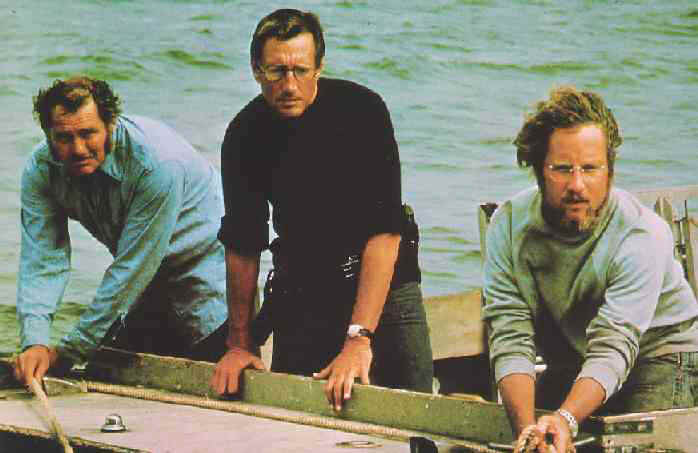
Jaws: Another (deserving) look

"Slow ahead... I can go slow ahead. Come on down and chum some of this shit."

This past weekend, I enjoyed an all-too-short vacation on the beach. Actually, I spent very little time on the beach; I instead sat on a breezy (and shaded) deck, or in cool air-conditioning to catch up on some much-needed reading. Fortunately, in between the lounging and reading, I was able to upkeep a long-standing personal tradition of mine. Since the time I was very young, I have made a habit of watching one of my very favorite “beach” films whenever I’ve been to the beach.

Although most people would probably prefer digging their feet in the sand and engrossing themselves in dark crime novels or unabashed romances while baking in ultraviolet light, I never had a problem sticking to the air conditioning and taking in a “beach watch.” And nothing fits this bill better than Jaws. I say this not to demean the film, as if it was breezy trash designed to “take your mind off things” for a few hours. I instead use the term in the highest regard, because to me Jaws is a very nostalgic film. I saturate myself in its pastel compositions and its incredible ability to contrast the pictaresque townscapes of Amity Island with a more abstract, implacable leviathan of the sea, bringing them together at a shoreline that separates crowded bureacratic establishment and the uncompromising primal instinct of creatures of the sea. I am swept up in this conflict in new ways every time I see the film, but something about breathing in the ocean air on the beach and enjoying the laid back lifestyle of shore houses gives Jaws the extra edge that resonates with me so deeply.

Much has been written about Jaws, from its sexual imagery and symbolic gender relationships to its status as arguably the first true American blockbuster. (While on last year's beach vacation, I read Antonia Quirke's excellent book in the British Film Institute's Modern Classic book series.) The problem with writing on Jaws and countless other classic movies is that it's often hard to write with a fresh perspective since so many approaches have been exhausted, e.g. analyses of any of Alfred Hitchcock's films of the 1950's and 1960's. I devour many of these books and articles and learn a great deal from them, but in instances of films like Jaws or Psycho, much of the literature treads on familiar ground.

There are two opposing issues I have with this. First, sameness in perspective in the literature about a given topic typically breeds a very limited overall approach to the artifact (or movie) in question and makes it so that it would be almost impossible to approach it from another angle. But there is a flip side to this problem. Given the prominence of a certain broad approach to an artifact of study, the critical community may consciously attempt to operate on new ground and yield new perspectives and in doing so become numb to benefit of the dominant consensus. That is why it is much more difficult than it may seem to contribute to the overall critical persective of a film like Jaws. By simply acknowledging the overwhelming emphasis on certain key factors of the movie, I am positioning myself in relation to them and may tend to either assert them too superficially for the sake of comfortable familiarity or potentially pay lip service to crucial details that I don't allow myself to acknowledge due to my inability to really examine a perspective with which I have become so topically familiar. For these reasons, I have elected to focus on specific details about the film's images and how they relate to the overall structure and thematic depth of the film. I will attempt not ignore or privelage the well-tread critical ground concerning Jaws, but instead place them in perspective of some of the film's more subtle moments and compositions.

For many critics, scholars, and movie lovers, any reference to Jaws brings to mind some of the film's most memorable elements: the underwater "shark vision" perspective; the escalating two-note musical motif signaling the shark's closing in on it prey; a skinny dipping young woman violently dragged along the surface of the ocean, disrupting its calmness but not its apathy to her inevitable demise. All of these things are what we remember when recalling Steven Spielberg's 1975 movie. But in focusing on these aspects and examining them from a critical and/or thematic framework, the more subtly stated details of the movie may potentially go undetected, which I think is more likely to happen in a critical and cultural staple such as Jaws.

That is why I honed in on the images, the transitions, the temporal and spatial relationships from shot to shot, scene to scene, the elements of an individual shot, and the structural details of the scenes and how they build together to form a briskly paced and compulsively watchable film. Watching it again recently, the film has revealed to me a number of things. Firstly, minus the inevitable continuity errors of the sun's reflection on the ocean, which at times are glaring, Jaws is nearly compositionally perfect, representing the appropriate combination of deliberately placed elements -- i.e. color palettes, background and foreground stagings, visual thematic details, etc. -- and "accidental" effects, which are necessary for almost all great art to achieve greatness. It is both intensely calculated from a mise-en-scene and framed movement point of view, but it also feels somewhat gritty and natural.

The real beauty of the film is how all of its structural and visual motifs and components interact with each other to form two worlds in the consciousness of the viewer: an innocent vision of Amity island and a bleak nightmare that lurks beneath the surface of its waters in the form of a 25-foot, three-ton weighing shark whose physical presence is only felt in the visera of witnessing its hunt in the film's land based scenes. The spectator, in many ways, becomes the shark that it so desperately wants to see. Thus, Jaws seems to embody a tug of war between representation and embodiment. Are we supposed to identify with the shark or the victim? Do we feel the pain of being enveloped by its teeth, each "the size of a shot glass," or do we feel the pleasure of clamping down on helpless, squirming human flesh? The movie never remains consistent on this, which is partly why it is so effective.

While one could argue that Jaws cleanly adheres to a three-act classical film structure, it is really about the relationship of two distinct sections: a monster story of a relentless predator preying upon an innocent small-town community, and a high seas adventure of male comraderie with a "human vs. nature twist." Aside from the differences of setting, careful detail is provided to each section, in different ways but in similar manners as well. In the "land" section of the film's first hour (roughly), Spielberg builds a beautiful contrast between the recreational activity of a small community, (e.g. beach conversation in which everyone knows each other, a main street parade with kids playing their instruments poorly, and a cloudless sky) with the grisly acknowledgment of death and primal instinct that seemingly corrupts the very innocence that the film works so hard to create. But the shark hardly represents a force deliberately preying upon small town America, but rather an invasion of nature and instinct in a society of people who are "civilized." But the film illustrates that humanity, while distinctly separate from the primal nature of the ocean it so enjoys and builds towns around, is hardly civilized. Amongst the harmless conjecture of the townspeople, we see the slimy actions of Amity's mayor, Larry Vaughn (Murray Hamilton), a bureacratic twit always thinking in the interest of the economic stature of Amity and the monetary gain associated with holidays and the "clean" image of the town.

All of this is established in what I will call the "land" half of the film. In this portion, a relationship is built between three characters, the aforementioned mayor, Chief Martin Brody (Roy Scheider), a family man so eager to make a difference, but touchingly naive in his grappling with his own inability to deal with the simple concerns of townsfolk, and Matt Hooper (Richard Dreyfuss), an oceanologist rich-boy who understands more than his appearance leads on. The focus in this half of Jaws is on the central relations of these characters, specifically Brody and Hooper, and how they team up to work against the arrogance of the mayor. Concerning the shark and its attacks on three individuals (Chrissie, Alex Kitner, and the man in the boat whose leg we remember more than the rest of his body or performance), its presence is always felt despite its surprising lack of involvement. Though the shark isn't in the movie very much in the "land" section, the characters' and spectator's constant acknowledgement of it juxtaposes nicely with the pleasant, sunny atmosphere of the Amity beaches. Even when the shark is devouring its victims, the spectator hardly ever sees it. Instead, we see from its own eyes, which brings to mind the tension of identification mentioned above.

Apart from compositional details, which I will discuss further in my discussion of the "water" portion of the movie, the structural straightforwardness of the "land" section is refreshing and is practically a self-contained movie in its own right, with the mayor finally coming around by the end. After he allows Brody to close down the beaches and go after the shark, mayor Vaughn exits the narrative and the shark hunter, Mr. Quint (Robert Shaw, whose character's first name is never given, or necessary for that matter) takes center stage. The first elongated scene with Quint in his shark sanctuary littered with countless trophies (shark jaws hanging on walls) represents the narrative morphing into almost an entirely new movie: the "water" half, or the ocean hunt. Interestingly, Quint does appear in the "land" section of the movie. Many critics and movie lovers will fondly recall his introduction, slowly scratching his nails down the chalkboard during the town hall meeting, literally and metaphorically disturbing the community culture in which he lives but takes no part. Despite the obvious purpose of the introduction to his character -- in very memorable fashion so that the spectator is more than aware and prepared for his real entry in the film -- Quint's presence on the land-based section of the movie doesn't feel right. He is not a land-based character in the slightest, which is why he doesn't fit. His only home is the sea, which is why his presence in th stagnant town hall feels strange in relation to his more natural environment aboard the Orca, his creaky old boat on which Quint, Brody, and Hooper reside for the remainder of the film.

Although the "land" half of the film represents one long setup due to its practically being a self-contained movie in the sense of the spectator's familiarity and connection to the characters and "world" of the film rather than the narrative arcs, its status as such presents the "water" half of the film as its own narrative as well. The only difference in structure is be the resolution of the two. In the visual depth and thematic unity, the "water" portion of Jaws is entirely different.

This is signaled by the brilliant shot of the Orca leaving the land and heading toward the open sea, as seen through the window of Quint's house, with the vessel framed within the jaws of one of Quint's previous kills. While the camera slowly follows the boat through the jaws, which eventually frame the entire shot, John Williams' music signals the onset of a mythological journey in its muted brass theme complemented by rising strings. But rather than arriving to an end of dramatic spirit and foreshadowing the "man versus nature" duel that makes up film's last hour, Williams instead opts to imbue the images of the Orca's departure with a sense of fun, which, given the preceding setup might seem inappropriate. But the strange thing is, it works. It's as if the narrative is reminding us that it is precisely that: a narrative. The images invite the spectator to take part in the brooding sense of darkness lurking underneath the film's first half as the protagonists now have decided to duel this leviathan in its own territory, but it also reminds the viewer that this will be, plain and simple, a fun ride.

This contrast is present throughout the film, which is reflected in the crisis of identification in the perspective of the stalking/attacks in the first half of the movie. The spectator is constantly torn between enjoying this narrative for pulp adventure and pleasure, and being subjected to a disturbing feeling of being eaten alive as suggested in its exploration of primal fear. But this is all suggested in the many dualistic tensions of the land-based end of the film, e.g. the representation/embodiment of the shark and its relation to its victims and the corruption of bureacracy invading small-town innocence. The simple halfing of "land" and "water" sections is evidence of two opposites coming together. While the two acts are separate, the overriding point seems to be that they take effect due to their individual relation to opposites and their constantly working against each other. The second narrative of Jaws explores these dualities more from the perspective of the viscera of pure adventure and a constant battle between the hunter and the hunted. It becomes a constant battle of strategy among the three members of the Orca but also between the shark and the three men.

The shark's first real appearance in the film is one of pure shock. it is the moment in which the film completely changes gears and is no longer in a "transition" stage. With the unannounced sight of the shark to quickly and unexpectedly, this one shot signals that the rules are now different and that this is the beginning of a massive duel that will dominate the rest of the narrative. In this shot (as seen at the top of the page), Brody stares back over the camera (presumably at Hooper, who is directing the boat) and utters a line that, in my mind at least, has always been more memorable than the one that follows it. Of course, Brody's "You're gonna need a bigger boat" line is one of the classic movie lines in history, I find that his "Slow ahead..." comment is more memorable, mostly due to the context in which it is uttered. The shot consists of his face foregrounded and occupying much of the right half of the frame and his chum tossing and the ocean in the background. A cigarette dangles from his mouth as he speaks comfortably for the first (and only) time aboard the ship. Immediately after he makes the comment "Come on down and chum some of this shit," a gray mass bursts out of the water, encompassing the rest of the frame as it lunges towards the Orca. For me, this is one of the most memorable movie frames I can recall and its purely for the quick burst of energy that was waiting to be unleashed. Before the shark even arrives (note that he does so without his two note motif or three note theme for the first time), there is something uncomfortable about the shot, almost as if it's preparing us for the shock it will contain.

Note that this shot does not resemble that of a contemporary horror film, in which the camera slowly pans over from a character's face to create empty space for an inevitable scare by a killer/monster; those instances are predictable in every fashion. But here, we are given just enough of the ocean in the background to not expect it, yet the elements the composition somehow suggest the inevitable appearance of the shark, perhaps because the nature of the shot differs so much from more elongated takes of the movie. While the movie features plenty of close-ups of Chief Brody, this particular shot is unique because it involves him and the water. By the point, the film has thematically and visually established his fear of water and has kept a distance between Brody and the ocean, but here in this shot they are connected. Another note about the shot is that it scares the hell out of me each time I watch it. I know it's coming, but the details of the frame itself somehow make me uncomfortable in my anticipation of the shark's appearance. There may be a few reasons for this. First, the nature of suspense (as David Bordwell observes in this essential piece) is much more due to how the viewer processes the elements of composition, i.e. editing, staging, background/foreground, in a film rather than the pure shock of something unexpected happening. Following this idea, the shot's ability to create suspense for me nearly every time I see it may be due to how the shark briefly appears, in full view for the first time, in relation to the viewer's previous knowledge of him based on a lack of sight. Roger Ebert observes in his archived Great Movies review of Jaws:

"When the shark does appear for its closeups, it is quite satisfactorily terrifying... The shark has been so thoroughly established, through dialogue and quasi-documentary material, that its actual presence is enhanced in our imaginations by all we've seen and heard."

This effectively captures the experience of the entire movie. Its motions and moving parts interact so fluidly and so brilliantly, so as to operate on conscious and unconscious levels, that they form relationships with the spectator to the extent that the images remain in memory, despite constantly moving and changing. The spectator's memory of these moments then interact with the present shots, giving them a power and viscera that they might not ordinarily have if seen alone. that is the beauty of cinema, and part of the reason why this film is so brilliant. Whether calculated or accidental, every composition (and its elements) is beautifully presented, working together to create a sense of atmosphere and character. Notably, the film rarely provides single shots of characters that are saying one thing at one time or of one place for the purpose of establishing its presence or purpose in the narrative. Jaws works so effectively because it always has so much going on and it creates an environment and a strong sense of the major and minor characters in its more naturalistic approach to editing and compositional details. Yes, there are one-shots of characters (for the purposes of reaction) here and there, but they are always deliberately and sparing placed so as to compliment the more important shots, featuring many characters, conversations, and events. Furthermore, the score is very restrained and seems to enter at just the right time so as to not call attention to itself. The film is more interested in building the essence of its locations through long, wide shots, the level of activity in them, and the authenticity of real sounds. Iit seems that none of the sound was added in post-production but that the natural sounds of the locations and actual organic sounds are what we hear in the movie.

The complicated activity and busyness of the shots work are so authentic, real, and alive not just due to the framing, design, and details within them, but with the surprisingly subtle performances (given the nature of the genre) coupled with the perfectly written dialogue in the screenplay. The dialogue in Jaws is among the best written for a movie. Whether it is expository exchanges or arbitrary background conversation, every word of it is genuine and unique, true to the characters and the world they inhabit. In discussing the complex details of the film's compostions, one must not ignore the pitch-perfect screenplay, both in structure and dialogue.

Regarding my previous point about the complex compositional details of each frame of the movie and how they build together to form a sense of the Amity Island community, Quint's creaking Orca, or the calmness of the ocean surface, these perfect compositions (along with the said dialogue) play a great role in building revealing moments of character. Sometimes, no diaogue is necessary at all. And this is the wonder of the film: it's amazing structural balance between quiet moments and intense moments, dialogue driven conjecture and character revealing asides. It all gels so smoothly, creating fluid movements and actions that complement each other and form a visual narrative that is utterly unique in its lightfooted ability to balance so many various elements and make them work together.

A great example of one of these small, character revealing moments is a scene in the "land" half in which Brody sits at his dinner table, stressed by the increasing danger of the town's waters. What starts as a wide shot of the dimly lit room pulls back and becomes an intimate moment between Brody and his son; the two positioned in either side of the frame with the foregrounded table in between them and the lit kitchen in the background. This is the establishing shot to a beautiful moment that Spielberg captures simple with the shot decisions and honest performances. (Like all great movies, Jaws is about moments.) After Brody realizes that his son is mimicking him, the film cuts between two one-shots of their reactions to each other as they share a playful, loving exchage underscored by John Williams' delicate and unsentimental music. Somewhere in between the editing between these two shots, Spielberg cuts to Ellen Brody, watching on from the kitchen. The moment ends with a return to the establishing shot -- this time with Mrs. Brody between them in the background with her as Hooper knocks on the door (one shot of her being interrupted by the sound him knocking). It's a scene that almost any other movie might have cut or treated as arbitrary "character development" material, but Spielberg makes it a character revealing scene, one with unique, subtle details that not amount of backstory to a character can create in building a sense of that character.

Jaws is full of these kinds of moments, in both the "land" portion and the sea-based half. In the midst of all the fun chases and silent bits between the chases of the "water" section, the heart of that section (and of the film) is night scene in the cabin of the Orca, with Quint's haunting Indianapolis speech bookended by lighter moments of drunken lunacy. After the great "battle scars" comparison between Hooper and Qunit in one beautiful long shot (with the occasional cut to a reactionar one shot of Brody), Quint takes center stage in the movie's most compelling sequence, an eerie speech which showcases many of the film's high points: beautiful compositions, sublime performances, perfect writing, subtle character interaction, and thematic depth. All of that is in Quint's story, and it's the heart of not just the "water" section, but of the entire movie.

The sequence breaks down in a series of long shots of him, with Hooper in a blurred background, as he recounts his memory of the day the USS Indianapolis sunk. The first shot is more clear, with an overall focus on the entire composition (Quint on the left), and lasts about 40 seconds as he sets up the sinking and what the soldiers did to survive. After a very brief reactionary shot of Brody, the next shot of Quint is similar to the previous one but is more focused, with Hooper and other background details more blurry and Quint more clearly in the foreground. The composition rests entirely on Quint's eyes and their expression as he goes on to talk about the "lifeless, like a doll's" eyes of shark, and the "terrible high pitch screaming" of the victims he watched die, all the while maintaining his steady, hypnotic mumbled speech patterns. Lasting more than a minute (76 seconds), this shot maintains such intensity because of its total locking onto Quint. After another reactionary shot of Brody (and then Hooper), the next shot of Quint puts him more in the center of the frame, practically erasing everything else around him, including Hooper, as he explains why he will never put another life jacket on.

This speech is riveting in its shot design, writing, and performance and exemplifies the coming together of so many brilliant elements to form pure cinematic feeling, which encompasses not just one or two emotions or bodily states but many sensations of abstraction and ambiguity. The mystery and mastery of great cinema is right there to be experienced in that scene and it's something to behold. Yet, for as dark as it is, it is bookended by moments of drunken bonding, which are just as genuine and moving but in a more lighthearted manner. In these moments and the speech, the characters and atmosphere come to life here in a scene that functions as both a self-contained moment of cinematic greatness, but a reflection of the movie; all its themes, relationships, and nuances, taking place in its own unique space (within a rickety cabin aboard Quint's vessel) and time (as it is the only night scene in this portion of the movie).

The remainder of the film is a more focused duel between the the Orca and the shark. Not that the film has ever been operating under any principles of logic, the sea half practically shuts off the entire world the film worked so hard to built in the first half, operating according to its own rules. In this section, as the shark becomes more visible, its personality becomes more vivid rather than its mythological presence in the first half. It is intelligent and relentless in its engaging the Orca in a game of strategy in a battle for the sea. Of course, no shark would exhibit such intelligence and downright vigor, but as it progresses the movie leaves logic aside and hones in on the experience of the adventure and the inevitable conclusion of the duel.

Apart from the outstanding first chase sequence, which follows the Brody/shark shot I analyzed above, there are a number of chase scenes that delve into a real sense of pirate fun that contrast so harshly with the quiet subtlties of Quint's speech and the growing relationship among the trifecta of men. But somehow, these strange juxtapositions seem right. The adventure, the chase, the ripping through the ocean surface in pursuit of "the barrels"; none of it infantilizes the more quiet, dark material, but it instead compliments it. When the music isn't riffing on the two note stalking motif, it's bouncing around playful pirate melodies which are more driven by strings and and winds rather than pounding brass. It's the right sound for all those barrel chases and it complements the quick-moving visual sequences to a tee.

These all culminate in an action-based final 20 minutes, in which the average shot length quickens, the attacks by the shark become more relentless and frequent. In the final sequence in which all three men are together (when they are putting the cage together in an irresistible montage sequence), few words are said. But we know that the trifecta relationship is at a close, and that the narrative is nearly at its end as well. There is a sobering sense of seriousness to the rest of the proceedings as we realize for the first time that we truly care about the fates of these characters. This is the result of the sublime visual narrative that has built to the wacky action-packed finale and the moments before it. In these final moments of the film, Quint's fate within the shark's mouth is sealed as he we him stripped of his armor (his coat and his hat), disheveled, angered, and beaten. Long before he is taken by the shark, we know what's in store for him. Interestingly, this process of Quint's breakdown and humanity begins with his Indianopolis soliloquoy.

I should note that the movie intelligently ends before our heroes arrive back to shore. Something tells me it would have lost something had we been treated to an epilogue. The final shot—a long shot connecting the land and the ocean one a peaceful beachline—represents the perfect finale and culmination of the film's themes, interestingly suggesting the triumph of humanity and "land" over the instinct of the water. The shot is at a distance from the land and ocean it presents, each of which take up about half the shot, in essence bringing together to film's two sections. From there, we can imagine for ourselves where Hooper and Brody go, what they do when they get back, how Amity reacts to the news; but the movie necesarily ends with the destruction of the shark and the suggestion of a more happy union between the land of the humans and the sea of nature.

I could go on forever recalling the small details that account for the movie's mastery and status as an American movie classic, e.g. the fabulous night sequence involving the discovery of Ben Gardner's boat, the many chase sequences, the shark's lifeless body bellowing a roar as it plummits to the bottom of the sea, filling the frame with a red cloud to the perfect descending piano motif in the score. But all of these moments, some of which I've rigorously analyzed above, can only be experienced in the two-hour experience that is Jaws. During its duration, Jaws exemplifies why cinema is such an evocative artistic and narrative medium. Its structural perfection, subtle character-revealing moments, precise but naturalistic compositions, and commitment to visually and viscerally exploring a variety of themes all work together to a build a movie experience that is justified for being such a cultural staple. It is entertaining and thoughtful, subtle and overt, terrifying and fun. Capturing all of this with a nostalgia for the never-changing waves of the beaches' oceans, Jaws may be Steven Spielberg's ultimate cinematic experience.