Showing posts with label Cinephilia. Show all posts

Thursday, May 24, 2012

A bit of permanence

In 2008, Scott Balcerzak and Jason Sperb, co-editors of the book, Cinephilia in the Age of Digital Reproduction, Vol. 1, invited me to join their panel at the Society of Cinema and Media Studies annual meeting. It was a moment of true happenstance, given that the meeting was held in my home city of Philadelphia. I graciously accepted the offer and focused my presentation on the contributions of internet writing to film criticism and cinephilia, particularly how it might redefine and collapse the space between the two. (Back then, my writing approach was more polemical, reflected by the longer posts.) The presentation went about as well as it could have, when you take into account that I'm a nervous wreck of a public speaker. I was more impressed by the uniquely focused presentations by the other panelists. Afterwards, Jason and Scott asked if I would be interested in contributing something for their planned second volume of the Cinephilia book series. Again, I accepted with equal feelings of excitement and trepidation.
Four years later, I am pleased to report that the outcome of that conversation has taken shape in the form of Cinephilia in the Age of Digital Reproduction, Vol. 2. The book aims to illuminate the larger historical and global contexts of the changes in technology and film spectatorship in recent years. My contribution is a chapter entitled "Revisioning Critical Space in the Digital Age." It represents an attempt to synthesize elements of my 2008 SCMS presentation with some writings that I've done here at The Cinematic Art. In retrospect, I wish I had given more time and energy to the product. But, having said that, I am generally pleased with the piece. It is not the definitive argument for my platform but its very publication may represent an important step in realizing the broader perspective of a kind of "critical cinephilia" that it outlines. It's also worth noting that it is an incredibly dated essay. I suppose that's the nature of the beast when it comes to academic publishing, but I cannot help but note the irony of an essay about the shifting state of media relations and film viewership that in some ways is already obsolete.
Limitations notwithstanding, the article is a standing reminder of what is possible in the digital age. On a personal level, I feel a deep sense of satisfaction that my small contribution to the still-growing network of film writing in the digital sphere has secured a bit of analogic permanence in print. When I started this blog five years ago, I had no inclination that it would result in a presentation at an academic conference and a chapter in a prominent book series in film studies. I am profoundly grateful to Jason and Scott for taking notice of The Cinematic Art—flaws and all (and there are many)—and seeing its potential. Moreover, I am thankful to them for providing me the opportunity to stand amongst scholars and argue the value of this format as an intermediary to criticism and cinephilia.

Cinephilia in the Age of Digital Reproduction: Film, Pleasure and Digital Culture, Vol. 2 is available now through Columbia University Press and can also be purchased via Amazon.

Wednesday, September 17, 2008

Back to school


In honor of the annual autumnal return to school and the end of the Big Summer Blockbusters, now is as good a time as any to crack out those pencils and erasers, and put on my thinking cap for Dr. Zachary Smith's End of the Summer Quiz over at Sergio Leone and the Infield Fly Rule. As always, Dennis has come up with some doozies for questions, with topics ranging from reflections on the summer to the failed promise of movie posters. Below are my answers.

Your favorite musical moment in a movie

There are just too many. But if I may show my true colors as a rank sentimentalist, the final sequence in Edward Scissorhands still stands out as one of the finest marriages of image and sound, narrative and music. It's tough to say what a musical moment is, because I'm inclined to think that some movies are more musically inclined than others and can be like pieces of music themselves. For someone like Tim Burton, the breadth of a moving image only takes shape with music, and the finale from Edward Scissorhands, as well as various other sequences of musical punctuation provide shape and scope to the affective climate he has created.

Ray Milland or Dana Andrews

Wish I knew more about both of these gentlemen, but I'd give the edge to Dana Andrews, if only for his memorable detective in Laura.

Favorite Sidney Lumet movie

Maybe this will answer the question...

"You have meddled with the primal forces of nature, Mr. Beale, and I won't have it! You think you've merely stopped a business deal? That is not the case. The Arabs have taken billions of dollars out of this country, and now they must put it back. It is ebb and flow, tidal gravity. It is ecological balance. You are an old man who thinks in terms of nations and peoples. There are no nations; there are no peoples. There are no Russians. There are no Arabs. There are no third worlds. There is no West. There is only one holistic system of systems; one vast, interwoven, interacting, multivaried, multinational dominion of dollars. It is the international system of currency which determines the vitality of life on this planet. That is the natural order of things today. That is the atomic and subatomic and galactic structure of things today. And you have meddled with the primal forces of nature, and you will atone! Am I getting through to you, Mr. Beale? You get up on your little 21-inch screen and howl about America, and democracy. There is no America; there is no democracy. There is only IBM, and ITT, and AT&T, and DuPont, Dow, Union Carbide, and Exxon. Those are the nations of the world today."

Substitute some of those proper nouns with the corporate juggernauts of today, and this speech is downright prophetic... in a really scary way.

Biggest surprise of the just-past summer movie season:

How about Brendan Fraser starring in two (nearly) $100 million movies? I'm sure they're both deliciously bad, and I can't wait to see them! Hats off to him.


Since I haven't seen either film in the Fraser double feature, the biggest surprise among films I have seen is that neither Indiana Jones and the Kingdom of the Crystal Skull or The Dark Knight were tops on my list of favorite blockbusters. (That honor goes to Hellboy II: The Golden Army.) Indiana Jones was more of a personal / childhood nostalgia experience than it was a movie, and while I liked it very much I don't think it was among the cream of the summer's crop. The bigger surprise is that The Dark Knight didn't ring true on any level. Unsurprisingly, I loved Wall-E. Finally, if Werner Herzog's Encounters at the End of the World can be considered among the blockbuster crop for its limited run in July, than that would easily take the prize for best film of the summer.

Gene Tierney or Rita Hayworth

Remember that head swing in Gilda? Enough said. Hayworth.

What’s the last movie you saw on DVD? In theaters?

Billy Wilder's Stalag 17 and Woody Allen's Vicky Cristina Barcelona.

Stalag 17 is not among my favorite Billy Wilder pictures, but is worth seeing for William Holden's masterful performance alone. I guess I've seen so many prison break movies to really appreciate the film to which so many owe their existence.

Vicky Cristina Barcelona was the perfect movie to see at summer's end: breezy, gorgeous, tinged with feeling. Like it or not, any critic who wishes to assert that Woody Allen's desire or gift for filmmaking is becoming the broken record that Woody himself is so often called. Allen's observations about people and relationships are resonant (as usual), but what makes this movie special is that it is both painfully tragic but light as a feather. This is movie is about wounded souls, and Allen succeeds at straddling the line between tragedy and comedy.

Irwin Allen’s finest hour?

The Towering Inferno, if only for its massive scope and its great (but little-known) John Williams main theme. Though when it comes to skyscraper disaster movies, I much prefer Joe Dante's Gremlins 2.

What were the films where you would rather see the movie promised by the poster than the one that was actually made?

Cutthroat Island. I'll admit I'm a big sucker for Drew Struzan's work, but this one is especially interesting in how it falsely advertises throwback adventure in the vein of The Sea Hawk. I can't blame Struzan for anything other than turning out some of his best work for a movie that simply can't live up to it. That's not to say I disliked Cutthroat Island at all. But it certainly doesn't live up to the promise of the poster, which promises just about the coolest pirate adventure ever. Renny Harlin has said this is his favorite movie poster. It's a shame he didn't live up to his end of the deal and make a movie deserving of such poster greatness.

On a side note: I'll bet that John Debney's magnificent score was inspired more by the poster than the movie.

Most pretentious movie ever

Most pretentious movie I liked: Dances With Wolves.

This movie is still maligned by just about every critic who didn't vote for the Oscars in 1990. Of course, Dances With Wolves not hold up under close ideological scrutiny, but I was staggered by Costner's vision of the American West. Of all the characters, Two Socks the wolf was most endearing. There is something so benevolent about the early sequences in which Costner and Two Socks are familiarized with one another, with John Barry's music echoing over brown plains stretching into the horizon. This may be shallow stuff, but it hits me hard.


Most pretentious movie I didn't like: The Usual Suspects.

I'm with you, Roger Ebert. I still do not understand why this movie is so beloved by many. It's confusing, uninteresting, and painfully overlong. It exists solely for the big twist, making it little more than a parlor trick. And the fact that director Bryan Singer plays it off so suavely (as if to say "Gotcha! Now aren't we cool?") is even more repulsive. Simply put, this movie is carried away with itself.

Name the movie that you feel best reflects yourself, a movie you would recommend to an acquaintance that most accurately says, “This is me.”

From the moment I saw Sofia Coppola's Lost In Translation, I don't think I've ever felt more close to a movie. I likely never will again. It's not that I "relate" to the characters so much that the film captures the feelings (and subsequent implications) of human interaction and relationships so painfully, fleetingly, and delicately. I can't even describe how it does it. No amount of discussion about performances or shot lengths can explain this movie or sum up why it's good. For me, Lost In Translation is the perfect expression of humanity, from introspective explorations of loneliness to the benign and transient feeling of connecting with another person.

Marlene Dietrich or Greta Garbo

Garbo.

Best movie snack? Most vile movie snack?

Nothing beats it a tall, cold Coke. As for the worst, anything I eat too much of and then feel sick while watching the movie.

Fitzcarraldo—yes or no?

Yes! But it's only Herzog's second best jungle movie starring Klaus Kinski. Much like Aguirre: The Wrath of God, this film is a hypnotic fever dream, both a celebration and revulsion of obsession and Man's awkward relationship with technology, nature, and fellow Man.

Your assignment is to book the ultimate triple bill to inaugurate your own revival theater. What three movies will we see on opening night?

Buster Keaton's Steamboat Bill, Jr., Henri Clouzot's Wages of Fear, and Steven Spielberg's Close Encounters of the Third Kind. These movies fully showcase the wonderment of cinema in very different capacities, exhibiting the range and the perpetually expanding horizon that one can experience in cinema. The series could be called "Movement, narrative, and affect."

Most impressive debut performance by an actor/actress.

Ahmad Razvi in Man Push Cart. Of course, you could say that not much was asked of Ahmad Razvi in portraying an emotionally guarded New York city street vendor, but this performance is among my very favorites in recent memory. The movie reminds me of Lost In Translation in how it so pointedly observes its central characters simply existing in the world around them. The performances may be restrained, but Razvi's in particular is deft and mature.

2008 inductee into the Academy of the Overrated

Iron Man. Conventional wisdom would say The Dark Knight, but at least that film had a small, but vocal crowd of detractors. Very few critics were bold enough to come out against the more harmless and less incisive Iron Man, a film whose politics are curiously irresponsible. Jon Favreau is an excellent craftsman; he lives for this stuff. But he is failed by a pedantic and condescending script. There is very little here.

2008 inductee into the Academy of the Underrated

My Blueberry Nights. Please allow me to quote my favorite piece of criticism this year, Matt Zoller Seitz's review of Wong War-Kai's underrated gem. No words I write could hold a candle to the planes Matt reaches here. Poetic criticism for a poetic film:

"There's no sense pretending that My Blueberry Nights is a towering addition to Wong's filmography. The stakes are quite low throughout, and the movie's pace is as boozy-meandering as the tempo of its soundtrack selections. (Cooder's instrumental tracks recall his work on Wenders' melancholy, Sam Shepard-scripted road movie Paris, Texas.) Jones is a stunning camera subject and never less than likable, but she lacks the technique to suggest a complex interior life. Law is, as usual, gorgeous and charming but not especially exciting. Weisz's performance is a touch shrill, her "southern" accent a botch; she only rallies during Sue Lynn's confession. Portman is livelier here than she's been in some time -- the character's brassiness liberates her -- but the role still doesn't quite seem to fit. (Was it written with an older actress in mind?) Of the major players, only Strathairn makes a deep impression; few actors are better at playing men coming to terms with failure. Yet if you're willing to ease into Wong's mindset -- that of a barfly who's in such a good mood that he doesn't care what he's drinking or what's on the jukebox or how many hours are left till closing time -- none of the aforementioned flaws feel like flaws. My Blueberry Nights seems to be unfolding in a world of perpetual night -- one in which the darkness is illuminating. It's an exploration of interiors, geographical and emotional, and it seems acutely alive -- as if the movie itself is a luminous being that has seen the world and survived heartbreak and resolved to savor each remaining second of its existence, however long or short it may be."

Antonioni once said, “I began taking liberties a long time ago; now it is standard practice for most directors to ignore the rules.” What filmmaker working today most fruitfully ignores the rules? What does ignoring the rules of cinema mean in 2008?

Stylistically, that's tough to say. There are so many filmmakers stretching the capacity of film, from redefining compositional conventions to re-calibrating the notion of "Film as Narrative." Where we still need to make great strides is in overcoming the commercial censorship of cinematic representations of sexuality. Unfortunately, pornography has staked a claim on visualizations of sexuality, which has certain implications for what it means to visually represent sexuality in cinematic terms. Movies have been pushing the envelope for years, challenging the standards and chipping away at the censorship tower. Recently, John Cameron Mitchell made a bold film called Shortbus, which was essentially an attempt at making an artful movie about sex. It succeeded on many symbolic levels -- Mitchell himself has described the film as a statement of rage and protest for having to endure last seven to eight years of the Bush administration. But the tower still remains and is as powerful now as ever, and my hope is that more filmmakers seize on the opportunities presented by the shifting conditions of digital culture.

What’s the movie coming up in 2008 you’re most looking forward to? Why?

Charlie Kaufman's directorial debut, Synecdoche, New York. No screenwriter in recent memory is as creative as Kaufman. The Spike Jonze two-punch of Being John Malkovich and Adaptation is arguably the most impressive tandem of screenplays in contemporary American movies. Eternal Sunshine of the Spotless Mind isn't too far behind, either. I'm really looking forward to what he'll do with a camera.

What deceased director would you want to resurrect in order that she/he might make one more film?

Alfred Hitchcock. Call me a traditionalist, but I don't think there is a more impressive filmmaking resume than the one he has put together between the 1930's and 1970's. It's now trendy to like Hitch, but there is a dangerous tendency to reduce his films to a matter of flashy style and surface detail. For me, Hitchcock has always represented much more; even a great deal of his throwaway films took us to some kind of void. Seeing his style develop over time is a real treat, with his images become more sublime and subtle as he aged. He gave us a brief glimpse of what he might do without the bounds of censorship in Frenzy, but not my mind is only left to wonder.

What director would you like to see, if not literally entombed, then at least go silent creatively?

Rob Reiner. If he hadn't shown so much promise in the 80's (e,g. The Princess Bride, This is Spinal Tap, etc.), I wouldn't be so offended by the atrocities against filmmaking he has been committing for the better part of 15 years.

Thursday, September 4, 2008

Between spaces: Cinema 2007, part II

Well here we are again. With the Telluride Film Festival winding down and the Toronto International Film Festival now in full swing, a four month period of moviegoing relished by cinephiles has officially kicked off. During the course of these two festivals, attendees will be / have been offered a glimpse to the future of independent and international cinemas. Some of these viewers will write about these movies on blogs and web sites. For impatient movie lovers (like myself), reading about so many interesting films is both a great pleasure and a pain, as most of us know full well that we will never see half the movies we read about. Moreover, the ones we manage to see are often many months later.

Having said that, there is something special about knowing there is so much out there. These desires and pleasures are rolled into a certain nostalgia I find myself experiencing this time of year when I indulge my cinephiliac impulses, if only for a taste of that perpetually out-of-reach horizon of affect that movies produce in us. For me, it's actually comforting to know that there is too much for one person to handle. It's the feeling that cinema cannot be contained, that there is so many different kinds of it and such a plurality of aesthetic and narrative forms.

In the introduction to my previous post on my favorite movies of 2007, I argued that a different approach to retrospective commentaries is likely needed to better grasp what these flickering images mean to us. But when it comes to our relationship with movies themselves, it's also important to keep in mind that we are mired in out own constructions of the world around us, and that we approach all movies from within those fields of perception and comprehension. This, I think, is what makes the discussion of movies so unique and potentially enriching. I don't believe in such a thing as all-encompassing Knowledge, the type that underlies all of experience and can be universally accessed. That doesn't mean that all knowledge is useless. Quite the opposite, actually. There are many knowledges, and our relations to them are dependent on the values and assumptions we hold not just about cinema but about our relationships with people and the world around us. These ideological factors are based on both personal and collective meaning structures, giving each of us a unique perspective.

As I alluded to above, we are all coming at movies from such different places and spaces. And when it comes to movies, film festivals are reminders that we occupy a small, but unique position in the scope of cinema, whether we're watching, discussing, writing about, or making films. As the late Manny Farber intoned, termite art exists in all places, most especially in the spaces between spaces typically designated specifically for art. The multiplicity of cinema -- both in terms of the number of individual films, and the infinite spectrum of cinematic moments within individual films -- is all around us, and we each carve out our own place in that spectrum; stretching, expanding, and re-defining it.

Following is the second part of the list of films from last year that meant something to me, personally as well as critically. Together with the films I mentioned in the previous entry, this collection of cinema represents the year 2007 to me. There are some odd picks on here, for sure, some expected critical hits that moved me, and other movies that stood out at to me as revelatory. As Toronto and Telluride prepare to unleash a new crop of cinematic treasure upon us and the cinema of 2007 becomes an afterthought of the moment, allow me to take this moment, however fleeting, to reflect on films that in my estimation deserve recognition.

The Savages (Tamara Jenkins): With startling simplicity, The Savages subverts two massively cliched sub-genres: elderly people / nursing home movies, and dysfunctional family dramas. The film focuses on a brother (Philip Seymour Hoffman) and sister (Laura Linney) who deal with having to put their abusive father (now with vascular dementia) into a nursing home. While this adequately sums up the plot, the movie is so much more than its narrative design. It's full of subtleties and inexplicable joys, mostly stemming from Tamara Jenkins allowing Hoffman and Linney to create real moments of drama on screen. Her style is all but invisible, and it rests in knowing when to let silence fill the screen. The Savages is in many ways a cookie-cutter pseudo-independent film, combining a less showy aesthetic approach with the strong performances of strong, successful actors. Even though it mostly plays by the rules of its stylistic and generic influences, the film has so many moments of real humanity, simply and beautifully committed on-screen.

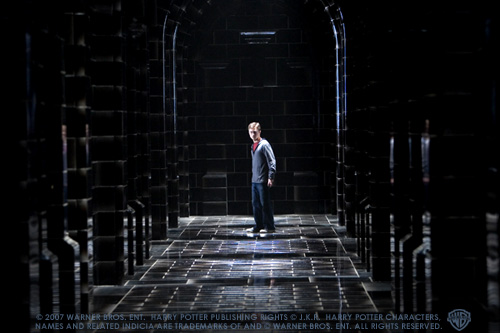
Harry Potter and the Order of the Phoenix (David Yates): Following the now-famous opening of the Warner Bros. logo slowly coming into focus, Harry Potter and the Order of the Phoenix does something very unexpected considering its status as the fifth film in a series. Instead of trudging through more redundant encounters with Harry's cartoon-ish aunt and uncle, this film places its central character (and the audience) in a very different world. On a creaking swing set in a lonely park Harry sits alone in the dreary summer heat, caught between a desire for isolation and a yearning for a connection he will never have. In these opening moments, you know this movie is not just another harmless sequel, or a bland regurgitation of source material like the previous film (enjoyable as it was), Harry Potter and the Goblet of Fire. Instead, this Harry Potter pulses with its own dramatic energy; it crawls underneath your skin like a good horror movie. Equally exciting is how the film balances the wonderment of the magic world and the bureaucratic underbelly of its institutions. The opening sequence establish these conflicts right away and create a stirring atmosphere that's eventually expanded by the rest of the film. Director David Yates makes it known immediately that he wishes to re-explore something that began with Alfonso Cuaron's third film in the series (Harry Potter and the Prisoner of Azkaban), and that is an affective state almost completely independent of the books.

Paprika (Satoshi Kon): From my original review:

"Satoshi Kon's Paprika is a film of many things, but above all, it is about dreams. It shatters all distinctions between actual and virtual, analog and digital, in its exploration of cyberlife, avatars, and digital space via the realm of the unconscious... Paprika is thoroughly conventional in its narrative cues and dramatic beats, even its thematic trappings about the actual/virtual binary. But the manner in which it weaves these threads around, through, and within each other is incredibly inventive. Moreover, its marriage of movement and sounds is like being in a dream through the swirling colors and motions of its animation. Kon's film is an intoxicating experience that will linger in the conscious and unconscious mind. On several levels it could be seen as an allegory for cinema; not just cinematic technology (as the plot deals with scientific advances which enables individuals to explore dreams), but about the state of movement and time that cinema can construct, a way of seeing and hearing that manifests in all of us."

Atonement (Joe Wright): Each year, there is at least one film around awards season that the more "sophisticated" critics make their punching bag. In 2007, Atonement took that title, if only because its World War II setting and apparently generic forbidden lovers plotline, all somewhat typical and expected for awards season. But I'm having none of it. Despite the amazing period detail and formal filmmaking prowess, this movie has tones of thematic and visual subtlety that far transcend its traditional surface details. Constructed with such precision, its aesthetic unity is constantly undermined by a narrative that cannot be trusted. Some have said that Atonement is all about perception. I would argue instead that it's about what shapes perception as well as the implications for manipulating the perceptions of others. It is both a wonderful throwback to old-fashioned epic romances as well as a contemporary critique / update, and it is much more sophisticated than many critics believe.

Syndromes and a Century (Apichatpong Weerasethakul): There are likely hundreds, if not thousands of feature films and shorts each year stretching the aesthetic capacity and narratological structure of images that are unseen by me and millions of others. Syndromes and a Century is a reminder of this. It is a reminder that the quiet simplicity of images often results in the most immediate, even illuminating viewing experiences. The film tells two stories, each with the same characters and dialogue, but in different settings. Rathern than becoming an exercise in shameless narrative manipulation (a la Run Lola Run), Apichatpong Weerasethakul's film is striking rumination on love, memory, and identity. It is neither positive or negative in its portrayal of its ideas and characters, but is instead a reflection on the images, memories, and words that form the basis of our being in relation to each other.

Away From Her (Sarah Polley) Thinking about this movie, I'm tempted to quote Luis Bunuel's statements about memory and self -- featured prominently at Dennis Cozzalio's blog. It goes like this: "You have to begin to lose your memory, if only in bits and pieces, to realize that memory is what makes our lives." Away From Her is a spiritual companion to Syndromes and a Century, but with an entirely different narrative design. The film is deliberate in its insistence on silence. That silence fills the space between an elderly couple, one of whom whose memory slowly fades away. "I fear I'm beginning to disappear," the woman says. How many times these two people have likely failed to understand one anther, to listen and see each other through the course of their lives. But the silent bonds that often keep people together is a mutual experience in each others' memory; the ability to not just experience life together to make meaning out of that experience together through stories and recollections of experience. Sarah Polley's film is a poignant, yet painful meditation on these things, as well as the more intangible qualities of love.

One final note: while Julie Christie was nominated for an Oscar for performance, the real anchor of the film is Gordon Pinsett, who beautifully portrays a man who comes to grips with losing his wife.

3:10 to Yuma (James Mangold): The first time I saw 3:10 to Yuma, I enjoyed certain aspects of it, such as the performances (by Russell Crowe and Christian Bale) and the writing. I was surprised at how moved I was by the end, because I hadn't thought of it as much more than a slightly above-average movie experience. But it was on second and third viewings that the film really came into focus. Simple scenes such as the classic Western night camp seem effortless and simple but are actually quite amazing in their ability to capture the nostalgia of a genre as well as build its own narrative energy, the threads of which are more than relevant in contemporary times. In the age of the great American westerns, John Ford, Howard Hawks, Fred Zinneman, and others used the genre to spin morality tales of good and evil, right and wrong. The genre has undoubtedly evolved into something different, and James Mangold was able to bridge the past and the current with his film, and he does so with eloquence and nuance.

Persepolis (Vincent Parannaud and Marjane Satrapi): Showing off the limitless creative potential of which animation --and the medium of cinema, as a whole-- is capable, Persepolis is also a deeply personal account of one woman growing up in several countries. It's the kind of story that is only enhanced by the whimsy of its style. With unflinching surrealism, Vincent Parannaud and Marjane Satrapi (whose story this is) invite viewers into young Marjane's mind as she witnesses war and family loss and experiences the physical and psychological aches and pains of growing up without an identity. They take full advantage of the autonomy that animation grants filmmakers and viewers, and they offset their brilliant images with a very real portrait of a woman, a family, and a country at a time of crisis. And yet, the directors never let the movie be defined by its settings and circumstances, but instead locate something much more personal in a girl's growth into womanhood.

No Country For Old Men (Joel and Ethan Coen): How does one begin to talk about this film? Discussed constantly on blogs and in print, The Coen brothers' film can be described as nothing short of a masterpiece. I'd like to single out one aspect of its greatness here: sound. A number of critics have discussed the noteworthy absence score in the film, which is surprising considering how comfortable Joel and Ethan Coen are with music in their films. Some of their most memorable images --the Ax Man in Fargo, the hat in Miller's Crossing, etc.-- were so memorable because of Carter Burwell's musical accompaniment. No Country For Old Men is equally memorable for its music, which is almost impossible to notice due to how it is so part of the image. For example, watch closely Anton Chigurh's conversation with the gas station clerk early in the film. Burwell augments the mood of the scene and its perfect compositions with just the right chord, so deep it's almost unrecognizable. But it's right. As for the sparing use of music, one could argue that the decision not to put music to images in this film does not take away from the musicality of those images at all. After all, as I have argued before, we don't just see images, but smell, taste, and hear them too.

Once (John Carney): Speaking of music, there have been many filmmakers and critics that have referred to cinema as something of a sibling to music. From a purely technical standpoint, the two art forms don't appear to have much in common. But both as an expression and as an experience, cinema mirrors the transient affective experience that come from listening to music. John Carney's Once is the perfect expression of this union. The whole film is like a song, and the songs contained in the film tell stories that are movies unto themselves. Simply told, Once is a film that follows the relationship of two individuals. They never kiss, or even embrace (to my knowledge), and yet their connection is sensual and impossible, resulting in one of the more bittersweet, deeply felt films in recent years. Small and seemingly mundane as they are, every look between these two, every smile, is a rich expression of feeling.

Zodiac (David Fincher): Jim Emerson said it best: Zodiac is about information -- its production, distribution, and consumption. David Fincher dares to introduce an irresistible plotline about the unsolved mystery of a serial killer in San Francisco and then turns completely away from it, as if uninterested. What starts as a visceral, brutally physical movie ends up following a cartoonist (Jake Gyllenhal) driving 100 miles to a small-town police station to dig up old records. The murder scenes trail off about midway through the film, and we're left with one person's obsession with uncovering his identity, losing his wife and family in the process. But Zodiac is not so much about the serial murders of the real-life zodiac killer as it is about media and technology, and the massive implications for their use in the digital age. The film paints an idea of its killer with a painstakingly constructed vision of something so unimaginable: a pre-digital world, where information is spread over real physical geography, inked onto pages, and traveling through wires. Information was something to be handled and used for specific means. Fincher's film depicts the unique collision of the analog and the digital that now constitutes our current media culture and manifestations of violence, celebrities, and the ongoing necessity of purpose.

Monday, August 11, 2008

My favorite Randy Newman score

Please excuse this brief excursion into cinephilia...

Last weekend I was out of town, and in my endless channel-flipping one morning during my hotel stay, I came across one of my very favorite comedies, The Naked Gun (1988). I'd seen it numerous times since I was a kid and still cherish it immensely, but I never would have thought to gain insight into why this film always made such an impression on me, especially for being such an absurd comedy. Maybe it was the change of scenery, but I was able to enjoy the movie in a way that was both familiar (i.e. anticipating every shot, every joke) but different. It was kind of like being in a room that you're inside frequently, like an office or bedroom or classroom, but standing in a completely different area of it. You know the room, but it feels so strange and new from a different angle. My epiphany with The Naked Gun was the realization that it contains a perfect montage.

Here's the set-up: The scene occurs late in the movie, when Lt. Drebin (Leslie Nielson) is undercover as the home plate umpire at the Angels / Mariners game, where during the 7th inning stretch, one of the players is supposed to kill the visiting Queen of England. Drebin doesn't know which player will commit the crime, so he attempts to frisk each and every player at some point during the game. This isn't terribly interesting stuff, but it makes for some delightful comedic payoffs in the hands of Leslie Nielson, the world's best actor at playing dumb. It also sets up nicely for an expedient montage that shows us the passage of time in the game and provides comedy in rhythmic doses of visual set-ups.

Well, this montage does that and more, combining the perfect musical score with images of sports bloopers and Nielson-esque comedy. Have a look:


If you're seeing this for the first time, the absence of context may make it difficult to distinguish between this and the current (dismal) crop of spoofs. But for me, it's a time capsule to the 80's-- Not just with the Zucker brand of comedy (which began with Airplane!) that seemed so fresh, delightfully offensive, and hilarious at the time, but also the many minor details such as the old-but-not-vintage baseball uniforms, the facial hair and wardrobe of the spectators, etc.

That music you hear is one of Randy Newman's finest scores, even though it's not the film's score (which was written by Ira Newborn). The song is "I Love L.A.", and it it's got that perfect combination of a pleasurable, jumpy melody and a touch of synthesized sound that grounds the scene in the 80's. Although the song first appeared on Newman's 1983 album, Trouble in Paradise, it was beautifully employed here for this montage, representing a likely scenario in which the music for a scene was selected before the images were edited. In other words, it's the music that guides the images. The quick-cut images would have no life without the music; it would be dull and static. But with that song, the images just seem right. Something about the jovial tune, Newman's raspy voice, and the unbelievability of the game melding together in one short sequence is just perfect.

The images make little sense in the context of baseball or in any other way, whether it's the players rounding second base one-by-one to the high electronic notes in the song, or an elongated celebration at the plate after a home run (while Drebin frisks them all), or the frequent cuts to changing electronic numbers on the scoreboard. But they have an inexplicable rhythm and atmosphere that sells us on the comedy, the passage of time, and most importantly, the affective state or atmosphere that is unique to The Naked Gun which seems to exist outside the bounds of space and time.

While surely bearing no significance to those who didn't grow up watching this movie and associating it with childhood memories, montages like this one illustrate perhaps in some small way the intangible accessibility of movies; the way they are both relevant within and outside of our lives, how they reflect and inform our own state or the state of the world. These sensibilities extend far beyond conventionally attractive movies (by the standards of most critics), as I'm sure all of us have those movies that we simply love, no matter how critically taboo. Only when we change and movies do not can we realize that movies -- no matter how serious, dramatic, absurd, etc. -- mean something to us (both immediately and retrospectively) beyond our conscious appreciation.

How ironic that Montage allows us to experience that impermeability that movies have to time -- since, after all, Montage is all about time. As a concept and practice, montage can be thoroughly analyzed and dissected, but even if we are successful at excavating the sensations it can create in us in a comprehensible way --nostalgic or otherwise-- the sensuousness of that experience would likely be drained. Whether they are comprised of one shot or many, maybe movies themselves are larger montages in that, apart from boasting many individual moments, are moments unto themselves, enrapturing us in an affective experience built on associations and linkages having little to do with logic.

Tuesday, September 4, 2007

Autumn in cinephilia: Or how I learned to stop envying those in Toronto and love my computer

This time of year always has a personal significance for me, as I'm sure it does many movie lovers. Now that August has ended, summer sequels and blockbusters are all but purged from the cineplex, barring the Labor Day stragglers like Rob Zombie's Halloween (which I would like to see). Although I tend to be more generous toward the big, glossy productions of summer (which I have seen noticeably less of this year), I am usually very eager to get to the Fall releases. And no matter how depressed I get in August about the state of cinema or Hollywood, it seems that every year I am re-invigorated and my appetite for great contemporary cinema really kicks into high gear. September is not usually the finest month on the cinematic calendar in terms of release dates, but it represents a crucial time during which the overall atmosphere changes. Film news coverage begins shifting toward studio prestige releases and international cinema with the onset of various film festivals. Also, the quality of the films in release tends to upsurge starting in September. After consistent years of seeing great films in the later end of the year, there's no reason to expect that this year will be any different in terms of the quality of films in release; though I should be careful not to emphasize sameness, because the reason why I love this time of year is that my choices of films become more varied. Although I can't see many of the movies I'm usually reading about in September, seeing my favorite critics and writers sound off about them while knowing that I will see a number of these films eventually is what makes this time in particular so special.

The catalyst of this shift in the cinematic world can be broadly summarized in one word: Toronto. Despite that I have never been to a film festival, the Toronto International Film Festival is my favorite for a number of reasons. Along with its perfect timing, the festival offers hundreds of movies and is open to the general patronage. From what I have read, the festival pretty much takes over the city for two weeks. Though I have never been, I envision thousands of cinephiles and critics walking the streets, wandering in and out of movie houses to see films they either may not have heard of or are directed by big-name directors such as Brian DePalma or Woody Allen.

Last year, I remember reading about The Host, The Fountain, Stranger Than Fiction, Shortbus, Rescue Dawn, and Pan's Labyrinth among others. I just thought of these films off-hand, but even now that I look back at them, I can once again observe the shear diversity of filmmaking talent and style. Many of the films that excited me most I have already seen, while others I have not yet gotten to. Still, some others haven't even been released. While each of the critics whose accounts of the festival I have read (including Jim Emerson and James Berardinelli) didn't see all of the films or even a representative sample, the beauty of it is that its impossible see all of the movies or even sum up all of the films with a handful that one person sees. From the studio award bait to the small-funded shorts, each movie is a discovery waiting to happen. It's all a matter of what compels one to see a given film at a given moment.

Here are some films playing at Toronto that I'm greatly anticipating:

The trailer for Julie Taymor's Across the Universe is evocative and visually inventive. While some reports indicate that Taymor lost creative control of the film when the studio stepped in, I'm still very interested to see how this Beatles story unfolds. Taymor is not often one to offer simple narratives (see Titus), which is why I'm curious for her perspective on not just a biopic, but one that centers on one of the most influential bands of the 20th Century. [Update: Anne Thompson reports that Julie Taymor will retain creative control of her film. Thanks to Peet Gelderblom for the news.]

David Cronenberg's latest, Eastern Promises looks to be in the vain of his last film A History of Violence (2005) insofar that he's taking on violence and sexuality once again seemingly reflexively. I obviously have not seen the film, so I could be wrong, but early word indicates that the movie embodies a reflexivity about its themes and narrative structure. That's not bad news considering that A History of Violence is one of the very best movies I've seen in years. Both Eastern Promises and Across the Universe will have wide releases with month, which greatly pleases me, but just about all of the other films screened at Toronto (from what I've seen) will either be released later this year or have no release date of yet. I've already got Eastern Promises marked on my calendar (I'll be seeing it Saturday, September 15th).

Keeping with contemporary American films, one movie that's not getting strong early buzz is Woody Allen's Cassandra's Dream, which just screened at Venice to rather lukewarm reviews. I've come to expect this from critics today. With the exception of the largely praised Match Point (2005), critics have had no interest in Allen for the last 10 or 15 years. I will write at greater length about Woody Allen, his stature in American cinema for the last 35 years, and the image of him perpetuated by critics who claim to know him. If I see one more article about how he "stopped making us laugh", I just might snap. Nevertheless, his films are as interesting to me as any other filmmaker today and I look forward to this film with great interest, even if he's not trendy anymore.

Another film I am eagerly anticipating is George A. Romero's Diary of the Dead, a continuation in his ever growing zombie universe, which he again recently explored in the underrated Land of the Dead (2004). In each of the Dead films, a new group of people and social environment is explored in the same world overrun with zombies. Although his recent Dead movies don't measure up to the brilliance of Night of the Living Dead (1968) and Dawn of the Dead (1978), they are fascinating entries in what's becoming one of the most intriguing film series in horror cinema.

Other films I greatly look forward to seeing include The Coens' No Country For Old Men, an apparent "return to form" for the once invincible filmmaker brothers; Michael Clayton (Tony Gilroy), I'm Not There (Todd Haynes), The Brave One (Neil Jordan), Reservation Road (Terry George), Redacted (Brian De Palma), Before the Devil Knows You're Dead (Sidney Lumet), Atonement (Joe Wright), The Assassination of Jesse James by the Coward Robert Ford (Andrew Dominik), The Mother of Tears (Dario Argento), Sleuth (Kenneth Branagh), Lust, Caution (Ang Lee), Into the Wild (Sean Penn). The list goes on and on and on... But take note of the variety of filmmakers on this list alone: Lumet, DePalma, Allen, Romero, Argento, Cronenberg, Jordan, Coen (and that's just the North American directors!); figures that have in different ways shaped contemporary cinema. They're still at it, and I can't wait to see what they have to offer now.

What I've learned about TIFF as an outsider is that the festival is sort of a microcosm for (or physical representation of) cinema. A critic or film lover can only see so many movies, and the list of movies that one person sees will differ from the next, despite probably sharing a few. What you have are a bunch of different people seeing different films, all with the potential to inform each other with their own unique experiences with them.

Reading about the many treasures has become something I look forward to every September. This year I'll be reading more reports because of my deeper involvement in the online film world, which I am in tune with than last year and therefore have greater exposure to quality online writing. Other than Emerson, Ebert, Berardinelli, etc., I will also frequently visit the blog, 1st Thursday, a site that's about the TIFF and nothing more. Darren Hughes has done such a great job with this site; it really represents the quintessential TIFF website; it is chock full of information about the festival, its films, as well as the city of Toronto, among other things. If you haven't done so already, I highly recommend visiting his site (click here for an introduction to the site and a description of its task), as I'm sure his updates will be many and informative. What 1st Thursday does best though is conveying an enthusiasm for this event that no other writing I've seen has done. Darren loves this festival; maybe for some of the reasons I've mentioned above, but probably for many others as well that I wouldn't understand since I've never been.

The only gateway I have into the festival is by reading blogs like 1st Thursday as well as the reports by Jim Emerson, Roger Ebert, Girish Shambu, and many, many others has lead me to promise myself that I will one day go to Toronto. But until then, I will read the reports and wet my appetite for what's in store over the next year. The air outside is still warm, but my inner-cinephile couldn't be happier (short of actually being in Toronto) to read about the many movies I will finally see when the air cools off and the leaves start falling.