Showing posts with label Film Genre. Show all posts

Sunday, September 23, 2012

The Cabin in the Woods


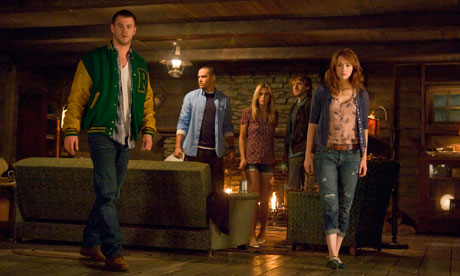
Representing maybe the first real step in the reflexive evolution of the horror film since Scream, Drew Goddard’s The Cabin in the Woods wades into the depths of voyeurism and pleasure that have become embedded into the genre over nearly the last half-century. It ingeniously weaves a heightened sense of self-awareness into a story that steers clear of parody despite deploying an orgy of genre tropes. Much of this can be attributed to how Goddard and co-writer Joss Whedon have structured the film. At the outset we learn of an apparent experiment wherein two men—played with relish by Richard Jenkins and Bradley Whitford—sit in front of screens in a control room and manipulate the fates of five young college students who are off to spend a weekend in a creaking cabin in the middle of nowhere. If the college student scenario sounds derivative, that’s because it is. Each character is walking horror cliché: the athletic jock (Chris Hemsworth), the bookish nerd (Jesse Williams), the innocent virgin (Kristen Connolly), the promiscuous blonde (Anna Hutchinson), and the know-it-all stoner (Frank Kranz). It should then be no surprise that the secluded settings and familiar plot turns that ensue invoke the likes of The Evil Dead, The Shining, Night of the Living Dead, Friday the 13th, and innumerable others.
The overt contrast between the increasingly violent situation at the cabin and the nonchalance of the folks watching/enacting it becomes the film’s major sticking point, and Goddard and Whedon make it work by pouring on the irony. They want to scare you and make you laugh, and then make you wonder why you’re scared and laughing. The eventual explanation for the motivations of the folks in the control room leaves something to be desired, but the resolution seems practically irrelevant and also part of the fun. Moreover, once it enters its third act, The Cabin in the Woods is firmly within the realm of absurdity, carried on by its own inventiveness long after the initial intrigue of the story wears off.
Perhaps the most unique element of all of this is how the film maintains a balance of disparate sensibilities. It actively conflates the serious and the non-serious, inviting a pensive engagement before revealing its ultimate simplicity. (In fact, some of the funniest moments come from deeply intense moments that are interrupted with obviously less important matters.) This playful approach yields an inspired if also problematic result. It’s not a terribly deep experiment and nor is it a reinvention of horror, but it’s a smart take on the ostensibly inherent fixations on death and violence that have long entrenched the genre. And in addition to its modest attempt to reconfigure the elements of horror cinema, The Cabin in the Woods is every bit an homage to their existence. (Drew Goddard, 2012) **½

Tuesday, May 20, 2008

There's something in The Mist

Grocery stores are fascinating places. They are among the few social gathering points that attract people of all classes, races, ethnicities, cultural orders, and religious views. With the exception of the wealthiest of wealthy and the poorest of poor, almost everyone frequents the grocery store; for practical purposes, and also in a more elemental sense, for survival. We need sustenance simply to keep living, and to support or social and cultural practices, different as they are.

Throughout movie history, some of the most tense films have transpired in a single, mostly isolated location. Horror films, in particular, have benefited from a focused setting, where an atmosphere of suspense and terror can be amplified from the feeling of isolation. Stephen King used this basic device as a way to frame a seemingly by-numbers monster thriller against the backdrop of a supermarket. Using a traditional setup and narrative structure, King explored the social relations of a staple institution in many of our lives. On an average day in a New England town, the story is populated with townspeople and out-of-towners alike, all who whom agree on the policies that enable a supermarket --as a social institution-- to function. But when a man comes frantically running through the parking lot --blood dripping from his nose and down his face, eyes widened in shock-- bursting through the entrance doors of the store, that order is ruptured. And in a few short moments, those who expected merely to pass through the store and move along with their lives find themselves enshrouded in mist, enveloped by a perpetual void in the form of a foggy realm moving over the town.

Director Frank Darabont recognizes the importance of character, isolation, and perhaps most importantly, our sociocultural policies, in adapting King's work on film. One of the more difficult tasks that Darabont accomplishes is the juxtaposition of the human drama arising from an expected crisis, and the supernatural forces which besiege them. This is not easy to execute on film, but Darabont achieves a fluid aesthetic of elongated shots and smooth closeups, building an atmosphere out of the relationship between the tangible, palpable fears of isolation, and the creatures who invade the world outside with no regard for those who have ordered it. Darabont draws this distinction sharply, giving equal weight to both narrative threads and allowing them to feed off one another for maximum effect, separated only by a thin sheet of glass. From the inside, the racial, social, and cultural tensions embedded deep within the beliefs and values that inform each of our lives are exploited by the looming vision of mist pressing up against the glass exterior of the market, and slowly penetrating that barrier.

At the heart of the human drama is more than just a fight for survival, which, although compelling as a center of clashing individual ideologies, is heightened even moreso by deeply embedded cultural conflicts that largely determine how individuals organize and construct explanations, notions of justice, and divisions of power. While race, class, and occupation loosely form the ground on which individuals base their perspectives on each other and the external world, the film observes that deeper than all of these fabrics of identity is a more constitutive collective order of the organized belief in a supernatural order: religion.

Although the film simplifies this "culture war" of religious inclinations with its broad narrative strokes, Darabont's magnification of this conflict --in the form of one character who preaches to the townspeople about the wrath of god-- allows him to explore the extent to which theism and religiosity motivates individuals to achieve a particular end. Therefore, King's and Darabont's observations are cutting and cynical. As one of the characters observes in a crucial (though perhaps too literal) exchange midway through the film, "As a species, we're fundamentally insane. Put two of us in a room, we pick sides, and start dreaming up reasons to kill one another." The man who says this is one of the store's workers, who bands together with a small group of forward-thinking protagonists who are more concerned with surviving the chaos around them, rather than explaining it and co-opting those dangerous conditions to exploit the collective's fear of death and the unknown.

Yet, although the film appears to embody the struggle between religiosity and pragmatism, its real focal point is the discussion of whether or not people are fundamentally good. There are those who believe that people are born good, which is usually attributable to some kind of grand design. From this perspective, it's all of the "artificial" and "unnatural" things that corrupt individuals. On the other side, there are those who believe that people are not much more than animals, refined by thousands of years of cultural meaning-making and socialization. Although people divide themselves over those very learned conventions and policies of language and rhetoric, these are also organizing principles that enable civilization as we know it. Division is built into the unifying principles of language and culture. But, when stripped of the complex world if discourse and forms that provides our lives with meaning, all slips into chaos, and people engage in a primal struggle not only for survival, but for power. And the key means by which to achieve that power is fear.

This struggle culminates in a deeply cynical ending that will undoubtedly divide viewers. Wherever you stand in interpreting the film's final moments will likely say much about which kind of person you are, with regards to the film's central questions concerning the fundamental nature of humankind. And while this struggle of ideology and theistic enterprise makes for fascinating human drama, the film embodies that experience so effectively because it is more oriented toward probing human behavior and communication rather than titulating the viewer with shocks and gore.

There's no doubt that The Mist is an intense experience in cinematic horror. But the horror arises out of human interaction, and subtle observations on individuals dividing themselves and bounding together when facing extraordinary circumstances. Life is lost to the creatures in the mist and to hellbent people, but how that life is lost is where the film really takes effect. Darabont's deft vision of humans in crisis is staggering, particularly at moments where life is draining away. Almost every "death scene" in the film is shocking in its quietness, and almost unbearable to see in the level of detail Darabont depicts it. Victims' skin quivers, their eyes well up, and after great struggle, each resign themselves to the inevitable reality of death swallowing them whole. Darabont's images are starkly real, even apocalyptic, often in the most subtle manners. Any fan of the horror genre has seen tentacles swallowing human prey, but Darabont can make it brutally real, focusing more on the in-the-moment details that a body in fear experiences. You feel it when a tentacle pierces flesh. And yet, no single image in The Mist is more frightening than the sharp blade grasped on one end by human hands plunging into the stomach of a fellow man. Encircled by a crowd function as a larger body of righteousness, the defenseless man is the unfortunate target of the twisted logic determined solely by his social position (an army officer). He is reduced to nothing more than the means by which members of a dominant majority can carry out their insatiable desire to provide meaning and structure to things that, quite simply, defy explanation.

Thursday, January 31, 2008

Gems of a genre: Sunshine and Paprika

Much has been made about the supposed revitalization of the western in 2007, with revisionist films like The Assinationation of Jesses James and 3:10 to Yuma garnering a fair amount of critical attention. But the notion that the genre is can be revived is somewhat belittling. It reflects a very particular attitude that certain cinematic styles or genres can "die" when they fall out of current popular trends. This perspective isn't too embracing of innovation of qualitative or quantitative varieties. According to this ideology, cinema is a field of neat, quantifiable categories into which movies may be placed. The viewer/critic watched a movie with the knowledge of these pre-existing categories and the criteria for meeting those categories and then interprets movies accordingly in order to place them neatly into the boxes labeled "Western," "Film Noir," "Classical Hollywood," etc. This is an unfortunate and restricting way to see this a means of artistic expression, if only because cinema is always growing, along with our knowledge of it. The aforementioned categories are very real and necessary, but to perceive films through the lense of this strict perspective is to miss what movies are really about: moving images, sounds, and narrative, specifically the unique interplay between them. Cinema was not meant to be labeled with symptoms or terms, but should instead be seen (and examined) head-on. In other words, the how is more important than the why.

While last year was certainly an integral time for westerns, particularly for revisioning the genre itself for the digital age (not just the age of digital cinema), there have also been a number of other films that expand and/or subvert the genres and cinematic styles from which they took inspiration, despite not embodying the predetermined standard of a particular genre. Much of the "genre talk" in recent months has been about the Western, but other forms and styles have seen additions/expansions as well, such as animation (Persepolis, Ratatouille), film noir (Brick, although this is as 2006 feature), documentary (Helvetica, Manufactured Landscapes), horror (The Orphanage), etc.

The science fiction genre is an ever-elusive one in cinematic terms, because it takes cues from and morphs with so many other narrative and cinematic styles. Like other establishes narrative and stylistic molds, science fiction also grew last year due to several wonderful entries, some of which may not classify as classic science fiction, but in their subversions and differences contribute quite a bit to the development of it. Two films really stand out as great additions to the genre, neither of which has been mentioned much in the whirlwinds of masturbatory dialoguing (lists and awards) about the same films now being ushered into critical canon. But these two films are among the more interesting, even transcendent movies of last year: Paprika and Sunshine.

Satoshi Kon's Paprika is a film of many things, but above all, it is about dreams. It shatters all distinctions between actual and virtual, analog and digital, in its exploration of cyberlife, avatars, and digital space via the realm of the unconscious, of elusive lucidity. Kon masterfully constructs two distinct worlds: one involving cops, scientists, and cityscapes, i.e. reality, and the other about circusses, carnivals, and the gateways between genres. In each respective world, he constructs a story that so effortlessly blends conventional narrative motifs of chases, mysteries, technologies gone haywire, and various other distantly recognizable elements, and somehow he streamlines it in a way that makes sense in the way that a dream makes sense: not linearly, but abstractly. And as the plot develops and the conflict intensifies, the two worlds collide, which results in a frenetic but sublime cinematic experience.

Paprika is the kind of movie that's thoroughly conventional in its narrative cues and dramatic beats, even in its thematic trappings of the subservsion of the actual/virtual binary. But the manner in which it weaves these threads around one another, through each other, and together is incredibly inventive, and its marriage of movement and sounds is like being in a dream through the swirling colors and motions of its animation. It's an intoxicating experience that will linger in the conscious and unconscious mind. On several levels it could be seen as an allegory for cinema; not just cinematic technology (as the plot deals with scientific advances which enables individuals to explore dreams), but about the state of movement and time that cinema can construct, a way of seeing and hearing that manifests in all of us.

Danny Boyle's Sunshine, despite being a different kind of film experience and concerned with different ideas, can be thought of as a kind of companion piece to Paprika because it is a pure visual and auditory experience. It's been called a "great half of a film" by many critics and sci-fi lovers, mainly because after a quietly compelling and cerebral first act, the films veers into more visceral territory. It's perfectly understandable why some would be jarred by the film seemingly changing gears, but the film's change of direction should not be credited to laziness, but rather an attempt at transcendence, one that it nearly achieves.

The driving narrative force behind the film is that the sun is dying, which is why a group of scientists are sent to detonate some kind of advanced bomb on the sun's surface that would re-ignite it. It's a far-fetched notion, but one that's dealth with convincing sincerity by Boyle and his writers. The first half of movie builds a strong sense of the crew and atmosphere, and is refresing on the grounds that it embodies that distant notion of sci-fi being both intelligent and entertaining. It definitely owes a lot to greats like Alien and 2001, but the film seems to be after something different than those movies. It captures a strong sense of an existential void in its quiet tones and long-enduring images of the sun's surface. The characters aren't developed throughout the narrative in the classical sense, but they are very real in terms of how they interact with each other. Besides, good drama is not about building character but revealing it. As the films moves towards its conclusion and the stakes are increasingly raised, it achieves a sublimity in its sights and sounds that few films would dare to attempt. Somehow, it melds its the cold, disslocation of humanity's insignificance with a deeply humanistic spirit that is all the more moving because of the existential backdrop of the film's moods, themes, and images.

As an experience, Sunshine is so many things at once. Like Paprika it assembles various elements of familiar narrative techniques and science fiction staples in a way that serves to honor the genre. But it also forms incongruities by contrasting different ideas and images, and it seeks to disrupt common manifestations of the "man vs. technology" and "the triumph of man" themes. But in doing so, it reveals more nuances to already-established narrative flows and concepts and even broaches new ones, as it reaches a purely visceral climax that can really, truly be called a trumph of the human spirit. It makes the sight of that burning star utterly sublime, whether one is close enough to touch it or millions of miles away on this rock called Earth. It's visual poetry.

Films like Sunshine and Paprika are reminders that branding something with a genre "label" at all is utter nonsense. These movies are more than just great science fiction movies. At the same time, they are also each great works of science fiction, and they should wear that badge with honor. Because science fiction, like any genre, is not a label or a list of symptomological criteria. Not something tangible or concrete, genre is instead a shifting, growing plane of visual and auditory experience, with some of its elements recurring out of necessity of familiarity, and others emerging totally fresh from envisioning those familiar components in new ways. Genres are born out of our individual and cultural experiences and manifest in our memories and images, where they are embedded forever.

Wednesday, October 31, 2007

Halloween special: memorable slasher title sequences

One of the reasons why Jim Emerson's Opening Shots project is so essential is that it highlights the importance of atmosphere and mood in cinema. When seeing a movie, these affective states are established immediately, from the opening shot of a film through its expository scenes. Unlike other scenes, shots, or moments, there is something unique about the opening of a film, which probably has something to do with the idea that in the openings shots and scenes, the "world" of the film is being established. Every sight and sound is working toward the construction of a cinematic universe into which the viewer enters. And the amazing thing about opening scenes (like cinema itself) is that one can do practically anything with them, from establishing themes, characters, and locales, to forshadowing them. Sometimes these sequence are movies unto themselves, offering complexities wrapped in simplicity through the simple power of images and sounds. They have such power so as to manipulate the viewer into perceiving and interpreting particular things that will influence how she or he partakes in or understands the film's elements.

While Jim's project represents a rather thorough exploration of the endless possibilities of opening shots and how they connect to their respective films, there is another cinematic device (often consisting of many shots, or sometimes just one) that can build atmospheres and moods so effectively: the opening titles (or opening scene, if there are no titles). In the spirit of Halloween, ahead are a few of my favorite opening titles sequences from horror movies over the years. Since so many opening sequences from horror cinema stand out in my mind, I'll limit my selection for slasher movies for the sake of brevity and because the treasures of slasher movies are sometimes overlooked. So, without further pontificiation, here are some of my favorite slasher movie opening scenes:

Psycho (Alfred Hitchcock, 1960)

Perhaps the quintessential slasher title sequence is Alfred Hitchcock's Psycho. Part of Hitchcock's intent with this film was to really manipulate audiences' sensibilities and expectations by torturing and twisting around accepting narrative structures. His famous remark about the film, saying that he "played the audience like a violin," all too accurately sums up the film. He relied not just on narrative and cinematic convention, confounding them and contorting them, but also the viewers' expectations of his own work. Hitchcock's most recent films (North by Northwest (1959), Vertigo (1958), The Man Who Knew Too Much (1956)) were wide-spanning stories, almost epic in their execution and thematic detail. Although they were stylistically distinct from one another, Hitchcock's direction in all of these films was enveloping and deeply focused on particular ideas. With Psycho, he wanted to provide the most simple, gritty version of the very same themes (i.e., guilt, murder) he'd been dealing with on a larger scale for quite some time. This comes through in the frantic opening title sequence, which resembles that of Vertigo and North By Northwest only in sense that it's visually conceptual and latent with the film's themes.

Although nothing happens in these moments from a narrative standpoint, one could argue that the entire movie is in this title sequence. Right away, the stark black and white image and the shrilling strings of Bernard Herrmann's score grab you, sweeping the viewer into a frenzy. As the countless perfectly sliced lines move up and down the screen, fading the titles in and out in the process, the string section -- the only section of the orchestra employed in the film's entire score -- harshly and violently chops along to the image, providing a sense that all the lines and titles are stabbing the viewer. But the thing about all the lines is that they are all even, perhaps suggesting the persistent, even chops that Norman unleashes on the poor, unsuspecting Marion Crane (Janet Leigh) midway through the film. After the "Directed by Alfred Hitchcock" title appears, the lines then fade out the gray background to reveal an open shot of the city, the opening shot of the picture. The music comes to an abrupt end, transitioning from its climax of high strings to very low chords suggesting the guilt of the character we will soon be following.

The brilliance of this title sequence is while the film itself hasn't even started, Hitchcock works you into such a state just on the pure combination of images and music that the abrupt contrast to the rather subdued, even talky opening scenes is jarring and unsettling. What Hitchcock is doing, if course, is planting these sounds and images deep within the unconscious of the viewers, preparing them for what's to come but also manipulating their senses by jumping into a seemingly random story about a secret affair. It's a masterful sequence, one that has inspired films of all kinds over the last (almost) 50 years. Hitchcock's ability to play with narrative conventions, stylistic devices, and the psychological states of the film viewer gave him a unique perspective of the relationship between the viewer and the screen.

Halloween (John Carpenter, 1978)

John Carpenter's Halloween is considered by many to be the next generation of Psycho. Where Psycho essentially created the slasher movie, Halloween gave it new life and spawned legions of imitators. Perhaps it is appropriate that its opening title sequence (among other things) has taken inspiration from the historic Hitchcock film. However, while the film has similaritites to Hitchcock's picture, it is its own unique entry in the horror genre, and no doubt one of the finest. Appropriately, the opening titles to Halloween are much more brooding and ominous than Hitchcock's slap-you-in-the-face style. That's due to the fact that Carpenter is not interested in incongruous juxtapositions or reflexivity. He is more interested in building and sustaining an atmosphere of dread set within small-town America, where a masked, implaccable villain terrorizes a community (not unlike the leviathan from another horror masterpiece, Jaws, a movie that owes much to Hitchcock). Every moment of Carpenter's film is building toward the showdown between Laurie Strode and Michael Myers on Halloween night.

In the opening titles, Carpenter shoots a lone, plain-looking jack-o-lantern set amongst the black void, which calls attention to the mesmerizing flickering light within the pumpkin. The pumpin itself is on the left side of the shot, with the orange titles appearing alongside it on the right. As the camera zooms in closer to the pumpkin, the ordinary pumpkin seems to embody the evil that will soon overtake the small town of Haddonfield. As we get closer, the plainness of the face carved out of the pumpkin actually looks like Myers' mask. And what gives the scene that building effect is John Carpenter's now legendary electronic-based music, which takes a simple melody and compounds it, layering it with foreboding chords.

Like Psycho, this opening title sets the stage for the rest of the film, informing you that much lies in store without even showing you a single image other than this pumpkin. I have watched this film every Halloween for the last ten years or so, and it never loses its impact, which is partly due to the perfection of this title sequence. It sucks me in each time, pulling me into its nightmare long before Michael Myers is ever seen on film. While the movie conceals Michael through much of its running time (another tactic borrowed from Jaws), the marriage of the images and music in this title sequence invites you into simply mystery of the seemingly indestructible, reasonless beast that prowls the streets of small-town America wearing only a gray suit and a mask.

A Nightmare on Elm Street (Wes Craven, 1984)

Although the film is often mocked for its wise-cracking villain and infinite bad sequels, A Nightmare on Elm Street remains one of most visually creative and out-and-out enjoyable horror movies that established Wes Craven as the near-legend he is now. While the film suffered from Craven's somewhat clunky dialogue and phony performances, which Craven would gradually tune over the course of his career, it stands out as pinnacle of the endless number of teen slasher pics from the 80's, and boasts quite a few terrifying dream sequences that rank among my favorite moments in horror cinema.

One of the best of these sequences is the film's opening scene, in which Freddy Krueger stalks a young teenage girl through an inferno-like labyrinth full of dripping pipes and endless dark hallways. The scene is very disorienting because it follows a close-up montage of a figure (presumably Freddy) putting together a glove with knives for fingers. Then, it abruptly cuts to this girl entering this maze, where she encounters sheep and hears a deep voice whose voices echoes throughout the chamber as he calls her name. The girl contrasts with her environment, embodying a youthful feminine innocence that Freddy will (quite literally) rape with his knife-fingers later in the film. From the outset, we never get the feeling that Freddy exists within a real time and space, but is everywhere, around every corner, behind every wall. Unlike the end of the film and in all of the sequels, Freddy is seemingly indestructible here, shot in shadow so as to accentuate the scarred, pulsating tissue on his face. But before the climax of murder, the film cuts away to the girl awakening from what we subsequently understand to be a nightmare.

As I mentioned already, the rest of the film doesn't live up to this sequence, which is common of a Craven film (as the next film I'll look at demonstrates as well). However, the movie offers several brilliantly realized scenes showcasing a nightmarish dreamworld wherein the line between reality and the dreamlines is ambiguous.

Despite its falling short just when it should be picking up (at the end) A Nightmare on Elm Street is an, atmospheric, intelligent, and well-structured slasher movie the likes of which is rarely captured nowadays. Its opening sequence will live within my mind for as long as I can still dream at night.

Scream (Wes Craven, 1996)

Just 12 years later, Wes Craven had corrected his initial problems of directing actors and had already built his reputation as a master of horror. This enabled him to enter a more reflexive stage of his career, when he made "meta" horror movies like Wes Craven's New Nightmare (1994), by far the finest of all the Elm Street sequels. But one of his most accomplished and underrated films (despite its popularity) is the 1996 sensation, Scream, which satirized teen slasher comedies while simultaneously playing out as one.

One thing I love about Scream is its opening scene. After the Dimension logo and a very brief title announcing the film, it launches into a six or seven-minute scene starring Drew Barrymore as a defenseless teen, Casey Becker who is home alone. The sequence is the most powerful in the movie, and the most violent. It has Casey (Barrymore) taking calls from a movie-obsessed stalker who at first seems charming but slowly becomes quite terrifying. He first questions her about her favorite scary movies, to which she playfully and flirtatiously responds, feeling very secure. But soon the man alludes to seeing her from outside, and we are hit with the hard reality that she is in a defenseless position against a killer who will stop at nothing to kill her. After a tense moment in which he offers her a horror trivia for her life, the ghost-masked killer breaks into her house, prowls around as she hides and eventually chases her outside as the girl's parents arrive home.

As she is rather mercilessly slaughtered on her lawn, Craven interestingly manages to tap into many of the things Hitchcock was after with his suspense films. He presents a murder in extreme, unrelenting detail, as if to push the boundaries of what we will accept as pleasure. Craven wants to explore how much gore and blood we can take before it affects us and makes us violent. His killer has seen horror movies, internalized them, and is now bringing them to life. And while the scene itself is one of those prototypical horror scenes, Craven imbues it with an edge of realism. Part of what makes it work is Barrymore's earnest performance. When she runs and hides, we don't disbelieve her for a second. You can almost feel the cold rush of blood running through her body, both in disbelief but reacting as necessary. She fights valiantly, but the killer eventually straddles her squirming body and penetrates it with his knife over and over again. Where most horror movies will dump out and cut away after a quick death, Casey dies slowly and is hung to dry (again, literally) for her parents to see. Suddenly, we go from cliche horror to outright tragedy, and the scenes is played to perfection. By the end, it's hard not to be emotionally wrung outof the experience. I still remember sneaking into the theater to see this when I was 13 years old and being so wrenched by it, and by the experience of feeling rebelious (yes, that was rebelious for me at that age). It's just a movie, Craven asserts. And In a quick seven minute scene, he considers the implications of this mentality. The rest of the movie doesn't approach this genius and unnerving sequence, but its resonate nonetheless and represents fine slasher cinema.
Tuesday, October 23, 2007

Month of the living horror

I was in Northeastern Pennsylvania this past weekend, where in a rustic-looking antique store somewhere in the mountains I discovered a dusty, out-of-print book --at least according to the sign-- on a small table in the corner of the store. It appeared to have been written sometime in the 1970's, by the looks of it, and was called "The Horror People." Like a great deal of film books that I purchased in my teen years, this one is more a pictorial journey through a certain area of cinema, that being horror cinema. Its commentaries are hardly critical, but are instead more of appreciations for various figures (mostly actors) who contributed to the construction of horror as not just a literary genre but a cinematic one as well. I have yet to read the book, but I did have a chance to browse the chapters, which were organized by actor. Just from paging through the book, I was able to tell that it was very imformative from a film history standpoint about the famous horror actors through the mid-70's, with extensive notes on Christopher Lee, Peter Cushing, etc.

So I decided to buy the book with the hope that I can brush up on my horror genre history. It was also an irresistible buy because, quite simply, it's that time of year. Like many others, October is a special month in my cinematic calendar because it gives me reason to watch as many horror movies as I can. I am not as well read on the genre as others, but I'd like to think I have a fair grasp of this creatively lucrative genre. October is typically a fertile time for critical reflections on horror cinema, from the classic cinema as evoked in "The Horror People" to the slasher flicks of the 80's, and everything in between. On the film blogging circuit, several enthusiastic horror fans have written dedicated space to writing about horror films in the spirit of October. One of the more ambitious of these writers is Rob Humanick, who is currently trudging through a brilliant series entitled the 31 Days of Zombie! on his blog, The Projection Booth. Over the last several weeks, Rob has posted a review of a different horror film each day, and, apart from the freshness of his writing and perspectives, the films he's chosen to write about are incredibly varied. He's written about movies as diverse as Shaun of the Dead, a recent horror comedy, and Sam Raimi's Evil Dead sequels. He has even written about low-grade zombie flicks that I've never even heard of. Elsewhere on the blogging front, Dennis Cozzalio recently offered reflections on his love of horror (particularly in October), as well as a review of an overlooked horror film of the 50's. In his posts, there is an enthusiasm for this style of moviemaking, a nostalgic yearning to understand the ecstacy of turning the lights off, cozying up on the couch with some popcorn, and watching a scary movie, no matter how laughable or truly scary it may be.

Herein lies the wonder of horror as a genre. It's both amazingly versatile as well as inherently nostalgic, limitlessly calling upon audiences' desires to feel fear deep in their blood. From the shadowy masterpieces of the silent era to cheap midnite flicks of the 60's and 70's, cinema has seized horror from the literary world and claimed it as its own. While some would consider horror films to be low-grade trash, especially when compared literary masterworks by Poe, horror occupies is own unique place in cinema. Its finest entries vary from cliche-ridden, self-proclaimed filth to high-class art cinema. If there's anything I've learned while chronicling the various stages of horror cinema through the years, it's that "horror" is a flexible term that doesn't quite function in the same manner as other genre labels like sci-fi, or western. There are countless narrative and stylistic sub-divisions of horror that have spawned over the years, all interesting in their own ways. Moreover, nothing binds horror to certain setting, locales, or even narrative and stylistic approaches. It is a genre of true diversity that represents an overt exploration of the pleasures of spectatorship.


Although most current critics will try to convince you that horror (like westerns, sci-fi, etc.) is dead, I find quite the opposite to be true. While I concede that popular horror cinema is currently stuck in a rut from a mainstream standpoint, especially with the popularity of "torture porn" (which actually seems to be waning), the genre itself is not dead. Within the sub-division of zombie movies, which have been with us for the better part of 40 years, there continue to be new entries that stand out for different reasons. While 28 Weeks Later brings a contemporary flair of style to a relevant story about refugees of a massive virus outbreak, other films simply have fun with the trashiness of horror storytelling. One such example of this is Robert Rodriguez's Planet Terror, which serves up just about every cliche in the book on zombies and still manages to be ceaselessly compelling. While these two disparate films from this past year serve very different purpose and occupy different position in the "zombie canon", they together illustrate the contempoary relevance of horror cinema both in terms of its contemporary relevance and its ability for pure pleasure in the familiarity of movie convention and the explosion of zombie heads. We can know exactly what's going to happen, which ends up becoming part of the fun, or the fear.

Even torture porn is interesting because, like other sub-specialities of horror, it provokes a different reaction and consideration to the question that all horror films beg: What attracts us to being scared, to being on the edge of our seats, biting our fingernails, and squirming in suspense?

The central principle of horror is that it's designed to stir fear within the viewer. But the importance of this genre is not so much its function of creating fear so much as the viewer's desire for that fear. While it's true that it's largest fan base is a rabid core of individuals who live and breathe horror, horror --as a broader concept-- never seems to fall out of the public spotlight, which is staggering when considering the many morphings and permutations of the genre over the years. Just when you think it's gone, dead, or only for the junkies, a horror film will come along that stirs audiences of all ages. The most recent example of this is probably The Blair Witch Project. Although it was almost ten years ago, that film got people talking. Some loved it, and some hated it. Some laughed, while others were kept up at night thinking about its images. This is usually the case with horror movies, whether the threat is paranormal, supernatural, religioso, psychological, doesn't really matter... we seem to crave fear.

Most critics or film professors will use the term "identification" when describing the frameworks of narrative and cinema. The reader or viewer is supposed to identify with the central character; the protaganist; the hero. But in the case of horror films, I wonder if this really holds true. Some of the most famous "scary stories" on film, from Psycho to Jaws, do not incline the viewer to identify with the protaganist, but rather the villain. In the case of Psycho, Hitchcock deliberately toys with narrative and cinematic convention by following the central character long after the conventional expository death. She feels incredible guilt throughout the film, like everyone is watching her. That's because we are watching her. The viewer is the ultimate voyeur, which is why so much horror cinema seems to delve into voyeuristic fetishization rather than identifying with a fearful character, like most horror stories. In most horror films, there is usually one character who manages to survive and take out the villain, but that has always felt more like an obligcation on the part of storytellers to tell a tidy story and let the hero win. In reality, the most successful horror stories on film force the audience to identify with a voyeuristic, predatory killer, whether that's a 25-foot shark, stalking swimming woman from the depths of the sea, a psychotic motel owner who watches his residents shower through holes in the wall, or a rogue alien, stalking members of a ship in deep outer space.

The most overt example of this form of identification is the "killer vision", used extensively in films like Jaws and Halloween. Beyond these obvious stylistic touches, there is something larger going on in horror cinema that deserves serious consideration, because through horror films we see why cinema differs so greatly from other storytelling media. Showcasing brutal acts of violence, twisted feelings of surveillance, and a impulse for penetrating skin/bodies, horror films seem to tap into something deep within the collective psyche. In its focus on trauma, violence, bodies, and skin, the genre calls to mind several key issues with regard to spectatorship and the perception and interpretation of narrative through images. Apart from latent cultural perspectives on gender, race, class, and narrative, which manifest in a variety of archetypical images of force, power, and domination, the crisis of identification evoked in horror movies almost forces one to consider the relationship of the viewer and the image in a new light. In short, horror cinema is a microcosm for cinema itself.

Tuesday, August 7, 2007

Comedy, Drama, and Everything Else

One of my absolute favorite films of the year so far is the brilliant (yes, brilliant) Hot Fuzz. As with their previous collaboration, Shaun of the Dead, director Edgar Wright and actor Simon Pegg have once again made a film with such care for its images, style, and characters that it transcends the boundaries the buddy movie formula as well as the somewhat predictable formulas of parodies and/or satires of them. Hot Fuzz doesn't fit comfortably within either mold, yet it shamelessly embodies traits of both.

Since buddy cop movies, action movies, and parodic comedies tend to strictly adhere to narrative and stylistic conventions of their respective genres, Hot Fuzz shows how a film can dance between these established norms and practices while maintaining an fresh exuberance in its own creation and pompousness. Structurally, the film follows a familiar mold. Simon Pegg plays police officer Nicholas Angel, a by-the-numbers law enforcer who takes his job very seriously and believes in the power of the law. In fact, his serious approach to the law prevents him from participating in meaningful relationships with those around him; he is unable to proverbally "switch off". At the onset of the film, we see his hard work paying off (or so we and he think) as he receives a promotion. The downside is that he must relocate away from London and to the the trappings of small-town England, which he is naturally unhappy about.

This makes for a solid premise to any drama, with the protagonist being plucked from his desired familiar surroundings and being placed unwillingly in an unfamiliar place. While the film maps these plot points, action movie cliches run rampant in the most mundane of scene transitions and cuts. Every time a door is opened, every time a change of location takes place, we are treated to a loud, rapidly cut montage of close-ups that are now typical by contemporary murder drama/action movie standards. There are small touches of visual humor peppered throughout the proceedings, but the movie keeps a straight face -- mostly through Pegg's earnest performance -- even as it stoops to the most pendantic of visual gags. Such contrasts are the foundation for a narrative that never overtly establishes itself with any kind of consistency when it comes to genre placement. Rather than haphazardly surveying a patchwork pastiche of movie conventions as many other directors might, Wright instead opts to use this aura of stylistic and narrative inconsistency to his advantage by building the drama, action, and comedy of the film around it.

Wright takes his time familiarizing the viewer with the film's strangeness, building visual references that come in handy later in the film while also introducing new characters into the mix in a structurally sound but dramatically honest fashion. Rather than making a mockery out of the town and its inhabitants, the film presents the townspeople as real individuals and allows their quircky details to supply the subtle bits of comedy. Important to note is that the film's visual trademarks of intense audio-visual stimulation during transitions and dramatic beats also contrast with the mundaneness of the proceedings. The funny thing is that Angel doesn't see law enforcement as a buddy cop movie, which clearly the movie itself embodies. He takes his profession very seriously, unlike his partner, Danny Butterman (Nick Frost), who spends most of his free time watching and quoting movies such as Bad Boys II and Point Break.

Hot Fuzz works so brilliantly because it steadily progresses the story from small-town simplicity -- with Angel hunting down shoplifters and elusive swans -- to a utter preposterousness in the form of a rather graphic murder mystery. While we're prepared to laugh at the movie's contrast of intense visual style and mundane events, it continues to move in unexpected directions, despite employing every predictable convention it can do so. Meanwhile, underneath its topical pastiche of movie conventions and comedy, it's building real relationships and real characters that we care about. Thus, when inexplicably violent or downright silly situations begin happening, the viewer is cued to recognize the stark constrasts but the reactions she or he is supposed to have to it is never really layed out. Therefore, the movie works on various levels of comedy and drama in strange ways; which works to perfection when the comedy and drama contionue to ratch up

While these contrasts make for much of the movie's conflict, comedy, and drama through the first two acts, melding together various conventions and styles to execute a less-than-ordinary plot, Wright establishes a narrative and stylistic flow which runs amoothly alongside the progressions of plot and character development. These constrasts and conflicting styles eventually come together to coincide with Angel's character progressions. When he and his partner decide to take down the villains at the beginning of the third act, Angel finally embraces those very hyped-up Bad Boys II-like impulses that the movie all along embodied. In this synthesis of Angel's embrace of his inner action hero and the film's visual and stylistic rhythms, everything towards which the film was building in the previous acts -- which initially seemed like a patchwork of parody -- is unleashed in a perfectly executed third act that is equally hilarious and exciting. This structural cohesiveness works on all levels, including character and visual style, which is why the film emerges as reflexively as embodying both a mockery of movie convention and a massive proponent of them. The movie is as much an actioner as all the movies it takes its cues from; it knows it, and it loves them for it. The third act is an unleashing of action and comedy the likes of which I cannot recall in any action film or comedy in quite some time. But it intwines excitement and humor in uproarious visual manners.

The movie is only so effective, however, due to the earnestness with which it executes its proceedings. Wright and Pegg clearly love the old movie cliches that they parody and embody in the film. They don't mercilessly rip these conventions apart or assert their own cleverness by comedically regurgitating conventional images. They instead infuse the film with wit, intelligence, drama, and comedy, which is more a difficult task than it may seem. It requires a deep knowledge and care of visual motifs and cinematic convention, which Wright demonstrates in every setup and edit and the depth. This film could very easily have been a disaster in the hands of a less-informed filmmaker. Its constrasts and comedic setups are complex and subtle, even if what we see on the screen appears simple. Comedy, after all, is incredibly hard to create in cinematic terms. But when it's done right, it comes off so smooth and can hit the right spot. Add drama, character, and a love of police procedurals, buddy comedies, and action movies into the mix and you've got an extremely difficult task of bringing them all together, which Wright aptly does. Also, the film holds together also because of Simon Pegg's masterful performance, which hits all the right notes as a comedic and action lead role. There is real richness to the character, interestingly enough, and none of the film's tones of humor or seriousness would have melded so effectively were it not for Pegg's wonderful performance.

For as all-over-the-place as the movie might seem, it's consistent in its inconsistency inasmuch that the idiosyncrasies of the characters, plot, and visual style all interact together to form a greater whole of a film that finds its own comedic and dramatic niche by letting elements of both exist at the same moment. Aren't terms like "comedy", "drama" and other cinematic labels just terms for us to limit our interpretations of movies and package them simply? Certainly, some are made with this in mind, and Edgar Wright's film certainly points this out through its references to the stylistic norms of movies that have placed themselves in such boxes. But by having these run up against each other in strange ways, Hot Fuzz explores the potential of cinema as a complex medium of moving images because it is not so easy to place so cleanly into a genre or style box. It covers a whole spectrum of affect both in its own witty references and how their juxtapositions form strange visual cues and relationships. The film is so genuine and original not for its inifinite number of clever incorporations of various established genre conventions and styles, but how it locates its own creative core from which a delightfully strange story emerges. Wright and Pegg seem to intuitively understand how, where, and why comedy manifests itself in cinematic terms and real-life interactions. That is what makes Hot Fuzz such a uniquely reflexive work of stylistic and generic contrast.

Wednesday, July 18, 2007

"Political" Considerations: Documentary as Narrative

Like them or not, documentaries are in. They are the rising trend in contemporary audience sophistication and niche markets. But before I sing the praises of the documentary, maybe I should temper such a blanket statement. A documentary may never top the box office or come anywhere near the hundreds of millions raked in by the overmarketted products currently dominating the cineplexes. But anyone who follows the box office knows that net grosses are all relative. It's a bigger accomplishment for a movie like An Inconvenient Truth to make $49 million than it is for Transformers to make $250 million. It's a statement that Michael Moore's Sicko has cracked the top ten and has experienced a rise in box office receipts since its release. While the blockbuster movie industry directs all marketing efforts to opening weekend grosses, yet another signal of the shift toward cinematic fast food in the mainstream, documentaries (particularly political documentaries) have found their niche in certain markets and arguably outperform the mega-blockbusters. Personally, this pleases me immensely. It's great to see that audiences are seeking out thought-provoking movies (documentary and otherwise) and that this movement is actually starting to make a dent at the box office. Sure, it may not turn around the tidal wave of commodification that has overrun popular cinema, but it's a step in the right direction.

But this whole idea of a "political" movie troubles me. I hate to use the word "political" when describing certain popular documentaries, simply because one could argue that just about any action -- including making a movie in a specific way, marketing it, and distributing it -- is inherently political. Politics and power run deep within the very foundations of human communication that they are simply unavoidable. Certainly, some movies such as Michael Moore's Sicko (still unseen by me), Fahrenheit 9/11, and Bowling For Columbine are surface-level "political" documentaries in that they deal directly with matters of government control and influence. But I would argue that these movies are about much deeper political forces and movements than (dumb as it sounds) politics. Michael Moore seems to divide people and create debate like no other figure in media prominence today, other than perhaps She-Who-Must-Not-Be-Named (or, as Jim Emerson refers to her, The Creature from the Puddle of Mud) and the Televangelist-in-Chief (another one of Jim's titles). Moore is known as an ultra-left wing fact-fudger by some and a working class hero by others. His movies vary in quality; their best and worst elements are a direct extension of Moore's empassioned personality. But they represent a collection of accessible documentary filmmaking which resonates with audiences today. Blending humor with seriousness, thought with emotion, Moore's movies represent the pop face of the contemporary documentary.

It always humors me when I hear someone say things like, "Michael Moore's movies aren't documentaries because documentaries are based in fact and are supposed to be objective." Really? I had no idea. Documentaries differ from fictional movies in their presentation of narrative, certainly, but they are just as much of narratives as fiction movies. There, I said it. Let the masses be up in arms for someone suggesting that "fact" and "objectivity" are idealistic concepts which work fine in a vacuum but not in motion. No matter how factual, everything is narrative; containing perspectives which reflect the experiences and background of the individual, organization, or institution telling them. Some consider this a bad thing. I do not. I think the sooner we all realize this, the better. Narrative is the basis of our conception of self, culture, family, country, and memory etc. It reflects the principles of the language which enacts us to perform as social actors within organizations and the great web of discourse that is communication.

Documentaries may jettison the notion of creating fictional characters to structure a narrative, but they are still representative of some interest, even if they use facts and data to build around. In that sense, even the most fact-based of documentary filmmaking functions like empirical research, which -- in its structure, focus of study and manner of inquiry -- reflects underlying assumptions (both individual and cultural) about the supposedly objective world. That's not to discredit quantitative research or to disparage it. Rather, it's important to understand contextual and relational details that are always in play, for it is those underlying assumptions (even ones we're not conscious of) that constitute consciousness, providing a limited number of interpretations of the world.

To think that documentaries (or anything else) should be fact-based, lacking in perspective, feeling, and experience is a highly unproductive approach to information. It's good that documentaries (like all narratives) express perspectives, thoughts, feelings, opinions, and experiences. As viewers of them, we shouldn't feel positioned by them to either agree or disagree with their "presentation of facts", but instead think about why they provoke us; how they uphold or deviate from our own individual or cultural values, beliefs, and conceptions of how the world outside functions.

As I have said many times before, cinema is about feeling, emotional abstraction, and empathizing with the experience of others - whether that's the experience of fictional characters, artists, storytellers, and people of all different backgrounds and perspectives. This is not exclusive to fiction films, but all films. Good documentaries can be fascinating stories/films/accounts of the most seemingly mundane things, such as the life of a troubled, fascinating comic artist in Crumb, or a deep contemplation of life, death, and choice as in The Bridge; they may shed light on political, ecological, and social issues such as the The Corporation (which I just recently viewed) or An Inconvenient Truth. These movies enable the viewer to see the eccentricities and details of human behavior. They inquire into what it means to be human in a wide variety of challening and provocative perspectives through diverse subject matters. I still can't fathom that so many sophisticated scholars, viewers, and critics of cinema often treat documentaries as having a fundamentally different makeup than so-called fiction films. I believe that documentaries are a necessary component to the greater affective, cerebral, and artistic prism of narrative as channelled through the visuality of cinema. The beauty of this medium is that its affective capabilities are not limited to certain narrative "types" or genres. The narrative is only the beginning...

Along with the above mentioned titles, other favorite documentaries of mine include Nanook of the North, American Movie, The Thin Blue Line, and Man with the Movie Camera. I'm interested to hear the favorites of others. So I ask you: what are some your favorite documentaries?

Thursday, May 31, 2007

Pirates of the Caribbean: At World's End

Just a few weeks ago, I complained that much of the critical body was off-base in deriding Spiderman 3 for its overstuffed plot and epic ambition. I argued that this content-based approach to reviewing movies is a fundamentally weak mode of criticism even by journalistic standards. I think it's fitting for plot-demanding audiences and opinion-driven commentaries that are so marketable today, but as criticism it flounders under its own bloated self-importance. Now comes threequel number three from the endless Hollywood summer arsenal, Pirates of the Caribbean: At World's End. (The second, Shrek the Third, isn't so much a movie but the cinematic equal of the fast food with which the film cross-promotes.)

Given the market-value of this film and its status as both "blockbuster" and "sequel," I suppose it would be easy to lambast its running time, convoluted plot, etc., which is precisely what many critics have done. They may as well have re-printed all of their reviews for Spiderman 3 and switched the names of the films, because the reviews are practically the same. The movies, however, are nothing alike. Yes, both are incredibly long (which is a critique only a consumer-friendly critic would bother mentioning), and both feature extensive plot trails that are borderline impossible to follow. However, while Spiderman 3 was content to lean on the viewer's recognition of the previous films' freshness and popularity, Pirates of the Caribbean: At World's End is only interested in moving ahead, digging deeper into its own mythology, and moving farther away from the easily defined limits of the Hollywood blockbuster. Sure, it speechifies, a la Braveheart and Lord of the Rings, it features cartoonish caricatures, e.g. the monkey, parrot, and two duos of quirky side characters, and it resorts to lots and lots of noise during its climactic duel; but it does all of this with a spirited sense of whimsy, off-setting the increasingly serious tone of the movies and the genuinely strange nature of its oceanic universe. These touches of movie convention, which take inspiration from Star Wars, Kurosawa, old-fashioned epics, and silent comedies of the silent era, lend the films a stable sense of familiarity as they plunge deeper (unexpectedly) into the stories of side characters, working against the more simply stated rules and atmospheres of the original film.

Before looking at the details of At World's End, it is first appropriate to lay the groundwork by looking at the underrated Dead Man's Chest, a film that assaulted the viewer with complex images that rather boldly proclaimed the filmmakers' lack of interest in recreating the naive innocence of The Curse of the Black Pearl, a film that was more of a direct homage to matinee serials, pirate adventures, and Errol Flynn swashblucklers. Dead Man's Chest instead builds elongated and somewhat disturbing sequences featuring an implaccable sea monster, The Kraken, feasting on helpless victims before enveloping the frail and creaking wood of various pirate vessels, including the Black Pearl, swallowing them whole underneath the sea. Dead Man's Chest is more about the dangers of the sea and the uncertainty of what lies beyond that horizon so romanticized in the first film.

Audiences detested Dead Man's Chest and critics ripped it, but its treasures were reaped by those unwilling to pen the movie as a hapless summer blockbuster who are more receptive to the nuances of all movies. Those who categorize movies in a simple manner disallow themselves from actually witnessing their images, seeing them, and processing them with a cynical bias they often impose upon the more expensive ones due to their "consumer" nature. To be fair, the film walked the line of comfortable familiarity a bit too much to really embrace the dark nature of its core; a case in point being how the dark scenes aboard the Flying Dutchman are countered by the more light-hearted nature of the land-based fight sequences late in the film which seemed to echo the first film's innocence. The film was nonetheless interesting cinema, if only for its strange deviations and basking in digital darkness.

On to At World's End...

In his excellent review of the film, Ryland Walker Knight explains:

"At a very basic level, like Irvin Kirshner's The Empire Strikes Back and James Cameron's Aliens, Gore Verbinski's two Pirates sequels disrupt everything (the worlds, the narratives, the structures) the first film (in each trilogy) rightly set up at the outset. The Caribbean world of Verbinski's trilogy is, after the first film, one of constant shuffling, of tangential narrative ruptures: the world of the film, like the world we audience members live in, is chaotic. Of course, this Caribbean world is not the world we live in. In our world, there are no giant mythological squids or sea goddesses, but there are, however, pirates — and daily acts of piracy. And there are social dictums, social pacts, that we appropriate and reconstitute on an individual basis, to live with ourselves, to live with the world. The main thrust of this trilogy is that reckoning: How will we live in the world when our autonomous freedom is continually challenged?"


Interestingly, where the pirates represented the villains in the first film's rose-colored vision of the world, the two sequels envision pirates as a dying breed of individuals willing to fight for freedom. Moreover, where much of the original film is spent on some kind of land with the sea essentially serving as the passage through which our land-based heroes must travel in order to reach destinations, At World's End is set primarily at sea. It is a game of cat-and-mouse, with constant betrayals and backstabbings before arriving at the waters of Shipwreck Cove, where the final stand is made. The three films seem to represent a progression from land to sea from first film to third, with the sea representing the horizon in The Curse of the Black Pearl, a more dangerous and lively world in the second film, with ships inhabiting the waters as well as its surfaces.

In At World's End, the sea is where most of the action occurs and the land is the distant place. The scenes of discomfort take place on land and aboard the stagnant quarters of the East India Trading Company vessels, each ship looking exactly the same, a direct reversal of the disorganized nature of the Black Pearl and Flying Dutchman. But the land-based drones of the East India Trading Company must take to the sea in the third film and can only rule with an iron fist with the heart of Davy Jones in their clutches. While Lord Beckett appears to be more self-assured in the film, attempting to embody the pirate image he so rigorously desires to destroy, he meets his end stradled by the Pearl and the Dutchman, which both unleash canon fire upon his ship. The perfectly constructed and stained wood shatters around him, blown to bits by the creaking lumber of the pirate vessels which now reclaim the seas.

Apart from the mythical archetypes throughout the film's storyline and freedom versus fascism plot, the film is focused on pure moments which seem to exist between the endless interludes of meetings and conversations. One example of this is the re-introduction of Davy Jones, a creature so hell-bent on destruction in the previous film, first seen wiping a tear away from his face with a tentacle in At World's End, fondly reminiscing on his memory of love as his ship wreaks havoc in the open waters. Jones takes no joy in the spectacle of destruction here and is more focused on regaining his own dignity as the would-be villain were it not for Beckett, who controls Jones and his ship. This allows us to see Jones more as the shadow of a pirate who at one time may have understood the joys of piracy, i.e. freedom but has since been taking that from others since his own was stripped of him. His tentacles slither and shake when he is emotional, the skin around his eyes, nose, and mouth tremble, and we see him for the defeated soul he is in these films. His only moment of regaining himself is his ruthless killing of Beckett's number one henchman before directing the Dutchman into the maelstrom to duel the Black Pearl. His tragic story demands that he die in the end, but he does so having embraced the pirate freedom that he had taken away from others for years. He collected their debts to the sea, but his own demanded that he plunge to the depths.

Other standout sequences come in the form of passing moments, in which not only the world of the film is established and built-upon, but that imbue the characters with feeling. It is true that they mostly remain type characters rather than full developed and dimensional individuals, but Verbinski's visuals and brief asides from the complications of the plot actually enable the characters to take some kind of form. Jack Sparrow interacting with his hallucinations of himself in Davy Jones' locker are among the film's finest moments, as well as the bitter rivalry between him and Barbossa, which remains playful throughout the film. In these seemingly arbitrary asides, the film takes life in the sumptious visuals. Another moment of visual beauty is an image of the Pearl cutting through the waters dark, speckled waters (looking very much like space) at the edge of Davy Jones' locker. Another such moment involves the pearl, quietly sailing through the icy wilderness before approaching the end of the world.

All quibbles over logic and plot details aside, At World's End is a movie about moments. It may be an empty embodiment of mythical archetypes on a superficial level of narrative details and plot developments, but it revels in its crazed nature and gets a wit of enjoyment out of portraying them. Through all the action and cartoonish moments of caricaturizing the side characters, the movie actually takes itself serious based on its focus on the strong performances on the part of the cast, of whom Bill Nighy's Davy Jones is the easy standout. Nighy is commanding in portraying Jones' fury and enslaved emotion, and the digital artists that brought him to life may well be the first to imbue a digital character with a performance of subtlty and sublimity, one not achieved (in an artificial "non-human" sense) since Frank Oz's puppetry of Yoda in The Empire Strikes Back.

It is certainly true that these "Pirates" sequels, both Dead Man's Chest and At World's End, are not cinematic masterpieces as defined by classical or contemporary standards, but that's nothing to aspire to. To achieve such a status, a film must meet a checklist of requisites. However, like all of art, cinema is not defined by its meeting of a certain standard of excellence. In the case movies, Narrative (as a broad idea) sets the rules for the familiarity, convention, and identification, and good movies work within them and beyond them to provide images of depth and feeling.

Unfortunately, emotional reactions to sights and sounds on a screen have been devalued in contemporary mainstream critical discourse and pop entertainment just the same, which is why the ambitions of these films are not rewarded, but instead blasted for their bloated nature of "being too long." This fuels a mentality that suppresses one's ability to experience moments and feelings as brought on by images and sounds. But that mentality is one all too common amongst critics and moviegoers, and the fact that these movies are routinely slammed is evidence of an overall inability to experience a moving narrative image.

Dead Man's Chest and At World's End are richer films than many critics are claiming. They celebrate the familiarity of movie conventions and mythical storytelling. While they do not master either end of that spectrum, they explore both sides through the complexity of their compositions and willingness to take enjoyment in their own strangeness and invention, risking a convoluted plot in the name of pure cinematic moments.

Tuesday, May 15, 2007

Following the Ideal Sequel: Where Spiderman Went Wrong

Spiderman 3 (Sam Raimi, 2007)

All criticisms aside (and I have many), Spiderman had a colorful sense of exuberance in its images and characters. Sam Raimi's film was deliberately hokey, revelled in its own naivete, and felt oddly fresh in its familiarity. What it lacked in excitement, it made up for in playful charm. When Spiderman saves Mary Jane and swings with her between the skyscrapers of New York, the images breathe with life as Danny Elfman's choral music swells. That Spiderman looked cartoonish slinging himself through the streets of Manhattan didn't take away from the beauty of the moment. Though far from a truly memorable superhero film, it's no wonder that the film drew such strong box office, especially in the first summer after September 11th.

With Spiderman 2, the visual freshness was maintained and built-upon, with a far more real (though still noticeably animated) Spiderman swinging through town. While the story remains pop drama, there was something endearing to Peter Parker's undying desire to confess his love to Mary Jane, while saddled with the responsibility of keeping the people safe. Its villain, Doc Ock (brilliantly played by Alfred Molina), was much more memorable than Willem Dafoe's Green Goblin, and the film manage its action effectively - both in relation to the film's overall structure as well as from shot to shot of each individual sequence. Raimi seemed more comfortable directing large scale action, and the visual effects were employed to unify with the live action elements, rather than create distance between them (as in the original film).

With a touching story for the hero and villain and visual flair to the action scenes, Spiderman 2 capitalized on its seemingly effortless screenplay. Its personal drama was brilliantly complimented by a unique intensity to the villain and action sequences that the first film lacked. Despite its larger scale, Spiderman 2 felt personal, written and made by filmmakers who cared about the genre and characters, and it showed in its compositions and structure.

The rythyms, compositions, and structure of Spiderman 3, however, feel forced and inconsistent, not only in relation to the previous two films but within the film itself. This is of course the built-in problem that many sequels face. Especially on the heels of such a well-structured and thoroughly original sequel (let alone movie), the next film is typically self-consciously trying to replicate magic, e.g. Alien 3, The Godfather Part III, X-Men 3. But in the case of Spiderman, its not for lack of creativity. Raimi and company certainly try to accomplish new things with the story and character, but they often render themselves moot because the film wanders aimlessly exploring the film's possibilities as if they feel pressured to do so. The resulting film is an awkward mix between corporate studio wishes (appealing to every demographic and having "a little bit of everything") and true creative instinct. The film goes for big moments too consciously and it fails in delivering the emotion it seeks to conjure, whether that's exhiliration, envy, or rage.

Many have criticized Spiderman 3 for offering too many villains, too many plotlines, too many "big" moments. But my criticisms reside not in the film's ambitious disjointedness, which can actually be a good thing, but in how generically an instrusively the film's elements interact with one another. Individual sequences lack the drive they strived for, and what seemed fresh in, say, Spiderman (hokey plotlines, etc.) seemed incongruous with this film's ambition of embodying a more serious, darker drama. None of these elements worked well together because the film felt, by and large, manufactured. The film introduces its plotlines and felt obliged to develop them to logical conclusion. Not only does it feel calculated, but Spiderman 3 lacks vigor and feeling. as if it was comfortable enough to rest upon the spectator's familiarity with the wonder of the previous films and therefore feels no incentive to conjure some on its own.

Had the film been more focused in terms of its plot structuring and was less stuffed, I get the feeling it still would have suffered the same problems. That's why I find it difficult to accept criticisms that the film lacks cohesive structure. While perfectly structured piece of classical filmmaking can achieve great things, so too can a disjointedly structured one. Within the images themselves, the elements don't move with life as they did in the previous film. Interestingly, one of the major subplots involved Peter Parker dealing with an inflated ego and learning to find his true innocent self once more. But the film seems to suffer from the same problem, confident in its own creation despite not really offering a cinematic experience it so well acknowledges the previous entries were.

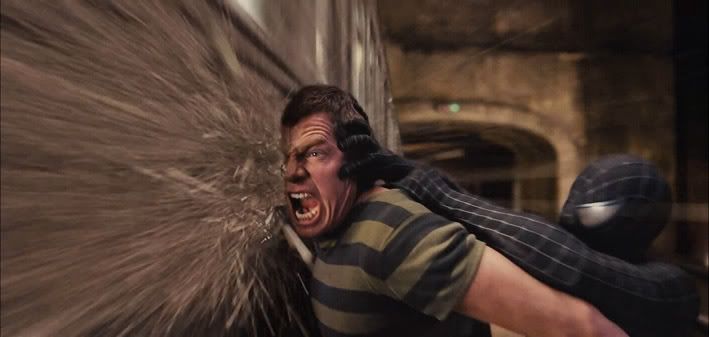
Nevertheless, the film exhibits a tension underneath its manufactured nature, and that is the creativity trying to break through. When I claim that the film feels more like a studio's film than a director's film, I don't mean that Sony all of the sudden stole the reigns from Sam Raimi, but rather that Raimi himself has suffered from studio laziness perhaps due to the massive success of the previous films. The film never feels as though it's not a Sam Raimi film, but that Raimi's images have been filtered through a watered down, lazy-inducing system prizing plot quantity and "big" moments over locating subtlety in dramatic scenes as well as the action-oriented ones. Like Peter Parker with his hair down in his face, sporting all black and swinging his pelvis at women on the sidewalks, Raimi seems too eager to impress out of recognition of his own acknoweldged talent. But, as mentioned, his filmmaker prowess isn't totally eradicated. There are moments of genuine inspiration - notably when Flint Marko (Thomas Hayden Church) becomes the Sandman and tried to form his own body out of a pile of speckled sand, as well as the scene in which Mary Jane breaks up with Peter in Central Park. Raimi's camera locks onto Tobey Maguire's emotive eyes so magnetically and finds true heartbreak in the moment.

To its credit, also, the final action sequence seems in the spirit of the comic books that inspired it, with Sandman and an underused Venom teaming up to battle Spiderman in, on, and around a construction site. The scene has the courage to be true to its somewhat pretentious roots, but Raimi has no problem with it and it is both goofy and enjoyable. The following scenes of closure to the character's individual subplots are as painfully artificial as Raimi has ever been, unfortunately. Spiderman 3 closes on a serious point that effectively sums up its assuming and egotistical nature about itself.

Unlike Spiderman, this film never quells its bloated assurance of its own worth, which is why it feels so comfortable experimenting to employ so many familiar and simple plot devices rather than really exploring this world and its characters. The filmmakers seem comfortable to rest upon their own accomplishments with the last two films. As Spiderman swings about the city's towering structures looking more real than ever in Spiderman 3, the naive sense of wonder created by his previous travels amongst the skies is all but drained away and Spiderman becomes all the more unreal.

Friday, March 9, 2007

Hollywood's New Genre Films

My limited time has certainly been a contributing factor to my absence at the theater over the past several months. But even if I did have the time, I don't think I would have ventured out to see Wild Hogs, Norbit, Hannibal Rising, Primevil, or whatever else has been released. It's been so dreary of late that I haven't even kept up with the journalistic criticism I usually do. Usually, I like reading good criticism from the likes of David Edelstein, A.O. Scott, and others, even if the movies don't interest me. But I've even lost interest in that. Recently, however, that interest has been re-invigorated. While I still don't have a great amount of time, it's nice to see some movies arrive at theaters that actually may warrant some attention; movies that compel me to make time in my schedule for a trip to the movie theater.

One film that really caught my interest is Zack Snyder's 300. It has opened to mostly positive reviews, but the real reason I want to see it is because of how good Snyder's last feature was, the remake of Dawn of the Dead (2004). It was a refreshing horror-action made with skill and energy, something sorely lacking from many contemporary American horror films. It lacked the social commentary that permeated George A. Romero's horror masterpiece, but it did so intentionally. Snyder wanted to make a horror film stripped down to its bones; a down-and-dirty survival pic, the kind rarely made made nowadays. And it was a gem. I remember being so enamored by the first ten minutes of that film that when it finally stopped to breathe, I realized there was still a whole movie to play out, one I was flat-out giddy to be watching. I know very little about 300 outside it's striking images of bodies and violence in trailers. But because of my enthusiasm for Snyder's last film, I look forward to possibly seeing his latest this weekend.

Also, on the topic of horror, Bong Joon-Ho's The Host was released today. I remember reading about the film during the Toronto Film Festival last Fall, but I never expected that its positive reception at that festival and otherswould result in a semi-wide release in America before coming to DVD. (On a somewhat related note, I have also read that Werner Herzog's Rescue Dawn, another hit at Toronto, has targetted a late March theatrical release as well, which is encouraging if true.)

After reading Jim Emerson's recent post, What If They Didn't Spend Millions to Advertise "Norbit"?, in which Jim responds to the comments about film critics from the director of Norbit, I felt positive about the fact that The Host has been given a theatrical release. This simple fact gives me hope that some studios are intent on releasing good films rather than assembly line garbage; the cinematic equivalent of fast food, which is now often mistaken for real movies. Jim's post elucidates some very important issues concerning the state of film production and film criticism that are scary to think about. Therefore, a foreign horror film given a theatrical treatment is so encouraging since a) foreign films, by and large, are thought of as arthouse films and are released only in small movie houses before going to DVD, and b) horror and action films are in a slump right now, to say the least. Outside the major summer blockbusters, which are often so sanitized for family viewing and little more than studio vehicles educating the masses to be good consumers, action/horror films have become practically inconsequential. The ones that are being made are usually so bad and proud of it, boldly turning a cold shoulder to critics before being released in the January/February wasteland of theatrical releases.

Sparing the critics from seeing and writing about such awful films is actually a good thing for critics, since they can focus their attention on films in which their voices are important, such as The Host. Were it not for the critical response to the Host to begin with, it would not be seeing a release right now. So, in my mind, the question regarding the relevance of film critics depends on the film and its context. With context, we have a whole other plethora of considerations, especially considering the issue of critical impact.

There seems to be a division in Hollywood when it comes to genre films. They are either mass-marketed venues for product placement that people like me would hardly consider movies or bad, unimaginative genre flicks with no imagination or originality. And since critics are only influential in ciricles of film audiences, studios are now more prone to ignore the critics and remain content making garbage so long that people will continue buying tickets. Unfortunately, this has become a major problems such as these divisions in Hollywood films. As films are either plugged with multi-million dollar ad campaigns made with slick production values or made with virtually no support and are cringingly awful, interest in actual quality is no longer the issue. In fact, viewers' notions of what consitutes quality is shifting ever so slowly as genre movies are becoming worse. The bar is moving lower and lower, and so many people just don't know it and now come to expect it. Now, the alternatives to the mass marketed films of the summer are comedies like Norbit, horror movies like Primevil, and dramas like Hannibal Rising.

That's why I am always so enthusiastic when a good genre film actually makes it through the Hollwood system. For example, Batman Begins (2005) is a rare big-budget movie that doesn't feel like a commercial or a mass-assembled television show slopped together and made most easily consumable for viewers. Seeing a Hollywood film with actual vision and passion for the cinematic craft is rare and refreshing, which is why films like 300 and Zodiac look good to me; based on what I've seen, they appear to have that quality. Their directors somehow work within the system to defy its current output, and it shows in what I've seen of them.

Then again, I may be wrong about them. They may not be truly great films in the traditional manner of defining good cinema, but I am fairly certain that they are more than studio schlock that is frequently pushed on and swallowed by the moviegoing public. But I think that film quality is often measured not by how effectively a film structures its script or draws its characters, but rather by how interesting its images are and how it tells its story. I think it's more important to ask questions about how a certain image or scene, maybe one that doens't feel right, rather than point out its weaknesses, or what you perceive to be weaknesses.

One would hope that quality films (as defined under such terms) are more successful at these times of year, when studios are experimenting a little bit more before they unleash the "safe" blockbusters into multiplexes this summer plugged with a $40 million advertising campaign. Maybe - just maybe - the success of overseas foreign films like Host would mean that studio execs are willing to take more chances and make real films with real filmmakers, so that we can have more young directors with vision like Zack Snyder.

I should note before singing the praises of films like 300 and Zodiac that I have yet to see them and their marketing campaigns were both very extensive. As I have said before, though, March and April usually represent the studios experimental time. Last year, good genre films like Inside Man and V For Vendetta opened to good box office numbers. (Inside Man was directed by Spike Lee and is a great example of a director working within a studio system and genre conventions even, to tell a good story.) Hopefully, if these films and others are of similar quality, studios will front have more confidence in directors who care about cinema.

Perhaps I'm being overly optimistic, but movies refusing to be defined by the current two-pronged spectrum of Hollywood genre filmmaking could remind viewers of the freshness that genre films can actually exude, which could then increase the output of good genre films. Genre pictures don't have to be static; they don't have to be horrible if they don't have huge marketing campaigns or are watered down into safe blockbusters. They can still be good, and they can have an audience. Hopefully now that the field of theatrical releases is becoming a bit more interesting, audiences and studios will realize this.