Showing posts with label Personal. Show all posts

Thursday, May 24, 2012

A bit of permanence

In 2008, Scott Balcerzak and Jason Sperb, co-editors of the book, Cinephilia in the Age of Digital Reproduction, Vol. 1, invited me to join their panel at the Society of Cinema and Media Studies annual meeting. It was a moment of true happenstance, given that the meeting was held in my home city of Philadelphia. I graciously accepted the offer and focused my presentation on the contributions of internet writing to film criticism and cinephilia, particularly how it might redefine and collapse the space between the two. (Back then, my writing approach was more polemical, reflected by the longer posts.) The presentation went about as well as it could have, when you take into account that I'm a nervous wreck of a public speaker. I was more impressed by the uniquely focused presentations by the other panelists. Afterwards, Jason and Scott asked if I would be interested in contributing something for their planned second volume of the Cinephilia book series. Again, I accepted with equal feelings of excitement and trepidation.
Four years later, I am pleased to report that the outcome of that conversation has taken shape in the form of Cinephilia in the Age of Digital Reproduction, Vol. 2. The book aims to illuminate the larger historical and global contexts of the changes in technology and film spectatorship in recent years. My contribution is a chapter entitled "Revisioning Critical Space in the Digital Age." It represents an attempt to synthesize elements of my 2008 SCMS presentation with some writings that I've done here at The Cinematic Art. In retrospect, I wish I had given more time and energy to the product. But, having said that, I am generally pleased with the piece. It is not the definitive argument for my platform but its very publication may represent an important step in realizing the broader perspective of a kind of "critical cinephilia" that it outlines. It's also worth noting that it is an incredibly dated essay. I suppose that's the nature of the beast when it comes to academic publishing, but I cannot help but note the irony of an essay about the shifting state of media relations and film viewership that in some ways is already obsolete.
Limitations notwithstanding, the article is a standing reminder of what is possible in the digital age. On a personal level, I feel a deep sense of satisfaction that my small contribution to the still-growing network of film writing in the digital sphere has secured a bit of analogic permanence in print. When I started this blog five years ago, I had no inclination that it would result in a presentation at an academic conference and a chapter in a prominent book series in film studies. I am profoundly grateful to Jason and Scott for taking notice of The Cinematic Art—flaws and all (and there are many)—and seeing its potential. Moreover, I am thankful to them for providing me the opportunity to stand amongst scholars and argue the value of this format as an intermediary to criticism and cinephilia.

Cinephilia in the Age of Digital Reproduction: Film, Pleasure and Digital Culture, Vol. 2 is available now through Columbia University Press and can also be purchased via Amazon.

Wednesday, May 2, 2012

Gaining some 'Critical Distance'


At the start of the year, I announced I would be reviving The Cinematic Art and re-appropriating its content to suit my current interests and capacities. Four months in, I am generally pleased with the results. What started as the posting of simple, short capsules has evolved into the regular (and still brief) reviewing of movies and shows. While the format has limitations, it has also helped me understand and address my own limitations as a writer. If you've read this blog before, you know that I take to criticism with a high degree of reflexivity. Although I don't inject this into my writing these days, I am always wrestling with it and trying to improve my writing and approach with each review.

Another benefit of the recent writing I've been doing has been my rediscovery of long-form criticism. It started when I saw The Artist in February. I drafted a short review, but found myself reading more and reflecting on it. I returned to my capsule review and started adding to it. Eventually I molded it into a grander piece that was posted over at Slant Magazine's blog, The House Next Door. I had a similar recent experience with Mission: Impossible—Ghost Protocol, which I began writing as short review but gradually developed it into a longer polemic. Both essays don the "Critical Distance" tag, a name that suits my long-form critical approach and also reflect my own film-viewing limitations. (I often do not see new movies until DVD release). "Critical Distance" covers both of these angles and more broadly represents my approach to come at a film from the perspective of having absorbed the hype and attacking it with a new set set of eyes. I already have a few ideas for movies to explore future Critical Distance pieces (e.g., Prometheus, The Dark Knight Rises), but it's equally important to allow these essays to naturally develop from my reaction to something. (That I often am seeing films and shows well after their initial run adds to this approach). I realize that there isn't much need for a series like "Critical Distance." As David Hudson recently noted over at his new spot, KeyFrame Daily, "never has the mediasphere been noisier, nor have attention spans been shorter." Movies, even mega-commercial releases, have a brief moment in the sun on release, but are quickly chewed up and digested to make room for the next discussion of the moment. That goes for criticism, too. And that's why I like the idea of an essay series that runs against this trend. For the very same reason, I don't expect these article to resound much within the bigger conversation about a given movie. But it is my hope that they contribute a fresher perspective to works that have had their moment and are worth considering in a new light.

As I move forward with the Critical Distance pieces, I hope to put as much effort into the regular reviewing I've undertaken in recent months. Given that I am not a critic by profession, I am usually about six months behind the rest of the circuit with viewing/reviewing. This is an occasionally frustrating reality, but it also reminds me (as the Critical Distance series evidences) that there are other ways of spotlighting critical discussion than what constitutes the current moment. Nevertheless, I plan to have one foot firmly implanted in the new-to-DVD/streaming front and will also review select films in theaters. (On queue: A review of The Avengers, and perhaps also a Critical Distance piece on the same subjects at the end of May.) But as I am now winding down my engagement of 2011 movie fare, my review base will broaden in coming weeks and months, as I return to watching older films and television shows more regularly. This represents a relatively new direction in my reviewing habits, one that I am looking forward to carving out.

Thursday, January 12, 2012

New directions

In comings days and weeks this blog will undergo some changes regarding its content. Given the difficulty I've had with posting frequency, I am adopting a new approach that should keep my writing and posting more in-line and consistent.

The capsule review.

I have avoided short write-ups for some time, mostly because it isn't a terribly exciting model for film writing. But I have recently concluded that for too long this has been my excuse to simply not write. And given the current state of the site, I'll take any writing to no writing at all. Moreover, while good capsule reviews are something of a rarity, this is less a statement about the form than it is a reflection of the difficulty of penning concise, interesting accounts of a film. Some of the best writing I have read recently has been of this variety, and it is about time I start pressing myself to explore it. Short and concise have not exactly been trademarks of my writing o'er these last five years of The Cinematic Art. So, in truth, I take this as a challenge. All news films I see in the theater or at home will receive a short review—probably no more than 200 to 250 words. I may pepper in some reviews of older films, though these will be less frequent.

It is my hope that I still find the time and energy to write commentary pieces on film criticism or a certain trend in film. These pieces tend to represent my preference for writing in this format. But they also require more time and inspiration than I have had lately. Nonetheless, I hope to still chime in to the larger discussion of this great circuit of film writing on the web, even if my contributions are not regular. In the mean time, for the foreseeable future, the capsule review will become this blog's identity.

From a personal viewpoint, I find that I am happier when I write. It is a daunting, often frustrating act for me. It always seems impossible. I write for my day-job in a very different format, and while the task at hand is different the challenge remains the same. Going from blank page to something useful and maybe even interesting is always a source of stress. However, the process is where real discovery happens. Writing helps me to better understand my response to a given movie, or a particular moment within a movie; a shot, a line of dialogue, an edit, etc. Movies are made up of so many things and criticism is a way not only to try to understand how movies work, but more importantly how movies (and art in general) can provoke our innermost states and burrow into our conscious and unconscious minds. For me, writing offers the ability to understand, hone, and develop those thoughts and feelings; which is why I am making a concerted effort to regain some direction for the site.

As always, thanks for reading and I invite your feedback.

Wednesday, August 3, 2011

Up and running again

In a conversation about three months ago with a few close friends over the final Harry Potter film, we mutually decided to embark on a long project. We would convene once a week to watch the seven previous entries in the Potter film series in succession until the release of Deathly Hallows Part 2. We are all fans of the books and movies in various capacities, though I am probably in the minority for aligning more with the movies than the books. I've read maybe half of the novels and reasonably enjoyed them, but my interest was more with the movies. In attempting to articulate my positions on the films —like, for instance, why Prisoner of Azkaban, is the most evocative entry and a great film in its own right— I found myself thinking more about them and the surprisingly affecting mosaic they form. Perhaps realizing that very little serious reflection had been committed to these films, I had idea to write a series of essays. I don't know when exactly it came to me. Nor did I give it much thought. I just began penning reflections on the first film a day or two after watching it.

Turns out that a two-year-plus hiatus from writing about movies left me with a good deal of rust. But thanks to Keith Uhlich, who helped me gain clarity of the project and find a confident voice, I authored eight articles over roughly six weeks. They were posted at The House Next Door in the week following the release of Deathly Hallows Part 2. The series represents my first writing on movies in well over two years. I say, "on movies" because I do a fair amount of writing in my day job as an editor for a monthly medical magazine. Between this, completing my graduate school thesis (which took in excess of one year), and various other personal ventures from home projects to fatherhood in that span, I found little time to update this here blog. As the distance widened from my last update, my desire to return to film writing —even in a more limited capacity— was waning. I've attempted to keep up to speed with movies, still seeing roughly 50 to 60 theatrical releases in a given calendar year. (As usual, I've seen some very good ones and a few great ones. As for 2010, put me among the crop of critics who found The Social Network the only real masterpiece from last year.) I have been content to watch, feel, and reflect without the strain and effort of translating those feelings and reflections into text. To keep slightly abreast of the goings on of film criticism, I would rely on Roger Ebert, Manohla Dargis, and a handful of other critics whose work I have made part of my regular weekly reading for years now.

I never expected to return to this blog. But the unforeseen chain of events that has led to my Potter series has reinvigorated my interest in thinking critically about cinema of many stylings and rejoining this online community again. I should note that I have never had any delusions about the greater significance of this site. As I observed in my last published piece, back in March of 2009, my aim for the site was "to explore the interconnections of film, criticism, and cinephilia in an open forum." However flawed, I feel that in some ways The Cinematic Art achieved that despite my readership never achieving great heights. But as much as I've enjoyed lending my own small voice to the critical discussion, the real joy of it was exploring the work of so many others who are passionate about cinema and writing. In the spirit of the late Manny Farber, Andy Horbal once referred to the ever-expanding plane of film commentary on the web as a kind of "termite criticism." And after years of removal from the film blogging circuit and returning to discover it is as vibrant as ever, I feel that Andy's terming for it is spot-on and very relevant. We are a unique collection of voices. The flaws in our writing and logic are often openly on display, but so is the immediacy of our insights and perspectives. With styles ranging from scholarly prose to fanboy cinephilia (sometimes at the same time!), and everything in between, online film writers are slowly molding new pathways in the discussion of cinema; one that straddles the established structures but that also collapses them. Yes, the old pillars of journalistic and academic criticism will remain the authority on film canon and the officially sanctioned discourse about cinema for a long time to come. But I remain of the belief that a digital discussion of cinema is ubiquitous and can potentially guide dialogues that allow us new ways of engaging cinema, criticism, and cinephilia, by melding them all together. It will not usurp other modalities, but rather deepens the scope of criticism to encompass wider perspectives, styles, and reflections.

It seems that many new technologies and social platforms remove much of the spontaneity from life and our interactions with people, films, and various other things we engage regularly. But they also provide critical potential to harness the nuances and peculiarities of our individual experiences and project them into text and images. That is partly why cinema is so special and maybe why so many of us actively take part in this great experiment of termite criticism and cinephilia. For my part, I am happy to have rediscovered the desire for writing and film, which I hope in some capacity to channel into prose here on this site. In the past I've probably engaged in too much reflexivity for my own good. Going forward, I will try less to provide commentaries about the relationships of cinema, criticism, and cinephilia and focus more on doing my part to create it. I don't know where it will take me just yet. I have a few larger ideas in mind (such as a long-gestating Werner Herzog project that will hopefully unfold in coming weeks and months), but my general attitude is to write about things that mean something to me, to not engage in too much reflexive rumination, and to simply write. Whether it amounts to anything useful in the broader critical dialogue is not for me to decide. It will certainly not have the polish of many published forms of criticism. And there is obviously no guarantee that it will have consistency and structure (as evidenced by my long hiatus from writing). However, the broader canvas it affords me to perform the commentaries I wish will hopefully make it worthwhile. And one thing for sure is that mine will just be one voice amongst many that make this platform so enjoyable to participate in, both as a writer and reader.

Monday, November 10, 2008

On The Dark Knight (again) and other things

It's been a tough scene for film blogging lately, at least from where I'm sitting. There are so many film and media blogs on the web that I couldn't possibly try to surmise an overall state of blogging. But from my perspective, at least, there has been a minor lull in the past few months likely due to a combination of factors. Outside the Toronto and Telluride Film Festivals, it hasn't been a particularly exciting time for new releases. Moreover, a number of writers have probably been so attached to Presidential politics (myself included) that movies have taken a back seat to other concerns. Even a film as politically inflammatory as Oliver Stone's W. couldn't shake things up in film coverage. Then again, the idea of W. is more inflammatory than the film itself, which rather well sums up the state of movies in the last few months.

It's worth noting that I have done nothing to help the situation, as I have taken my longest hiatus from The Cinematic Art since I started it in January 2007. My reasons for doing this ranged from the aforementioned waning interest in films by film culture at large, strange as that sounds. This coupled with my fervent, almost obsessive interest in the election and the media coverage of it made finding time and inspiration to write about movies difficult.

In all fairness, the election was just one of a couple of things to occupy the majority of my time. The Philadelphia Phillies' unlikely journey to a World Series title was another. As a lifelong fan, hearing those words "And the Phillies are World Series Champions!" was one of those perfect and surreal moments. While elections and baseball championships make for great times (especially since the outcomes of both were as unexpected as they were joyous for me), nothing compares to what I experienced just six weeks ago, when my son was born. I can say without exaggeration that moment was the most humbling and illuminating of my short life, and it now lives in my memory as well as in my everyday experiences.

All of these things have contributed to my absence. I've had some time here and there to watch movies, among which Errol Morris' Standard Operating Procedure and Jonathan Demme's Rachel Getting Married stands out. I'll have more on these films in coming posts. But I don't want to stress myself out with writing full-out reviews at this juncture. It took me about four weeks without posting to actually feel content with not posting. Ironically, this has enabled me to begin writing again, stress free. I'll have some collected thoughts on movies again (and on blogging) soon, but for now I want to get my feet again, take it easy, and remember why I began doing this in the first place.

As I attempt to regain focus, it's only appropriate that the article I'll be commenting on was written by another blogger who has taken some time off and only recently re-emerged into the film blogosphere. Ali Arikan, whose Indiana Jones blog-a-thon yielded some nice analyses on the Indy pictures, has written his first post in several months, offering his reflections on the film event of the summer: The Dark Knight. His post is refreshing for a number of reasons; first, because after an influx of discussion about the film before, during, and immediately after its release, interest has dropped off. It's as if critics and bloggers collectively decided that we are all on Dark Knight overload for a while and balanced it out by abruptly cutting off major discussion about it.

Given the context, it makes sense that Ali decided to write about this film for his return from blogging hiatus. But it's what he has to say about the film that's most interesting. He acknowledges the power of Christopher Nolan's juggernaut of a movie, but his implicit observation about the homogenized tone of the critical dialogue about the film is especially intriguing. In short, he's not buying the movie one bit, and for very different reasons than those presented by the film's detractors. He says:

"The Dark Knight is not a sequel to Batman Begins. The actors are the same, sure, and, thus, the characters, but they inhabit two completely different universes. A shadowy organisation of ninjas (none of them diminutive, alas) called The League of Shadows, run by a foppish Frenchman, and intent on razing Gotham, would feel completely out of place in the latter film. The Dark Knight doesn't just have a different tone, it plays a totally different instrument.

Gotham, too, looks different between the two films. In the first one, it has a reddish orange hue; it’s claustrophobic, and, even though I don’t want to use the word, gothic. In the second film, it just looks like Chicago. I know the first film was mainly shot on a soundstage, and that a big deal was made of the second film’s use of Chicago, but still, one would expect some sort of consistency.

Batman Begins is a superhero film that pushes its boundaries to the extreme. The Dark Knight is a film that obliterates those limits in the hopes of becoming a crime noir. And that would be a laudable intention, if it weren’t for the fact that it’s still a film about a guy who dresses up as a fucking bat and fights crime. It is because of its very essence that the film is inherently unable to make that leap towards serious crime drama. Batman Begins succeeds by remaining a superhero movie, The Dark Knight flounders by trying to abandon its roots.[5] And it’s not a pleasant sight."

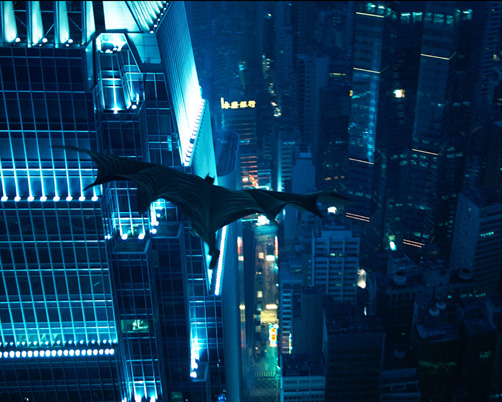
In my original post on the film, I made a similar argument about the atmosphere and overall presentation of The Dark Knight. Where my thesis was buried in a sea of arguments, Ali directly critiques the movie for its almost complete lack of resemblance to the Batman Begins. Where Begins found a balance between the hero myth and a gritty cynicism. The film blended two very different sensibilities into an ambiguous tone that actually achieved both. The Dark Knight is just about the reverse of that. Thematically, its covering some similar territory, but the movie could not be any different from Begins from an aesthetic point of view. Moreover, that it almost completely shuns the cloudy tones of the first film is jarring.

I have only seen the film once, and I look forward to seeing it again. But on first viewing, the movie failed as both a crime saga and a representation of the hero myth. It failed to build upon anything established in the first film. As Ali notes, we're listening to a different instrument altogether. Equally important as that fact is how little it has figured into the greater discussion about the film. Although a number of critics / bloggers have grown tired of talking about The Dark Knight, we've really only just begun to comprehend its relevance as both a cultural artifact and a piece of cinema.