Showing posts with label Visuality. Show all posts

Wednesday, September 7, 2011

On chaos and classicism

I know I'm behind on the ever-growing discussion of chaos cinema, but this is a topic worth expanding, as it has already in so many directions. It started with Matthias Stork's video essay at IndieWire's Press Play. The two videos encase a movement in commercial filmmaking over the past two decades, in which a sense of spatial unity has been displaced by a deliberately less coherent (and sometimes incoherent) aesthetic. Shaky camerawork and quick-cut editing are the base markers of chaos cinema, but lighting, film speed, and zoom are also exploited in the distortion of the "clear" image.

Stork notes that film scholar David Bordwell has already identified this trend and given it a name: intensified continuity. Bordwell has argued that many of these techniques ultimately service a classical agenda but in modified manner. Given that viewers have grown so accustomed to classical techniques of cinematography and editing, the idea is that they can fill in the blanks when a particular sequence removes some of visual clarity. This technique can serve a variety of purposes. In the classic narrative sense, it can mirror a character's disoriented state or it can signal the chaotic environment of war or panic. But Stork looks at this trend as usurping traditional concepts of visual cohesiveness and becoming a new base aesthetic of popular cinema (and action films in particular). He propels Bordwell's notion beyond a matter film aesthetics and addresses the implications of this increasingly prevalent aesthetic.

Stork explains:

"In many post-millennial releases, we're not just seeing an intensification of classical technique, but a perversion. Contemporary blockbusters, particularly action movies, trade visual intelligibility for sensory overload. The result is film style marked by excess, exaggeration, and overindulgence: Chaos cinema."

And Stork doesn't stop there. He adds that chaos cinema is "a never-ending crescendo of flare and spectacle," as well as "an audiovisual war zone." As for the "art" of chaos cinema, Stork notes, "the only art here is the art of confusion." Stork dishes these charges during a montage of film clips from various contemporary action films, including Quantum of Solace, The Bourne Ultimatum, The Dark Knight, Domino, Battle: Los Angeles, and others.

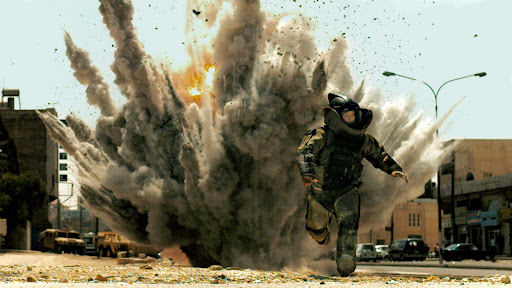
Given the inflammatory nature of the charges, Stork's essay provoked wide-ranging response. Ian Grey, also of Press Play, mounted a bold defense of chaos cinema by going on the offensive. In it, he targets Stork's ostensibly pro-classical tone, which (although Stork never explicitly endorses it) seems to inform his nearly wholesale dismissal of chaos cinema. (Stork briefly addresses the possibility of chaos cinema to achieve something more than empty spectacle with his analysis of The Hurt Locker, but not without noting that the exception proves the rule.)

Says Grey:

"It’s depressing that the ultra-conservative pro-classicists will not even consider that there might be something valuable occurring through these “chaos” films, planting the seeds of a new movement and establishing a new, valid way of seeing things for a new generation."

Grey's impassioned rebuttal highlights the glaring flaw of many accounts of chaos aesthetics, which is to focus almost exclusively on the mechanics of the film image in service of a more rigid ideological agenda. The notion that chaos cinema matters —no matter your opinion of its worth— tends to be glossed over by those launching assaults on it. While Stork briefly mentions music video aesthetics and shortened attention spans in attempt to explain the origins of chaos cinema, he fails to make a convincing connection between chaos cinema and the broader cultural tendencies and transactions on which the broad basis of his argument rests.

For my part, several of Stork's points seemed dead-on. I have always been partial to clarity and geography. Nevertheless I was uncomfortable with the ease of which he dismisses the majority of chaos cinema for not upholding a certain tacit vision of cinema long perpetrated by classical auteurs and formalist critics. Grey hits on this point effectively, but in doing so he makes sweeping generalizations that somewhat diminish the impact of his mostly well-argued response. He observes:

"It’s already a tired remark but it’s no less true: in the pulsing sensorium of multimedia, the sit-down, stand-alone feature film becomes kind of quaint, unless somebody does something to jack it into the world as it is now. And that’s what “chaos cinema” aims to accomplish. The style that many of you hate is probably the only thing (aside from that other thing you probably hate, 3D) persuading people to endure an increasingly god-awful cinematic experience."

Grey goes on to provide an anecdote of sitting through 35 minutes of commercials at a screening in New York to illustrate that viewers today are tired of old models and seek a more strongly visceral response to cinema, which now has to compete with various other modes of aesthetic pleasure in order to stay relevant. This notion warrants more exploration, for sure, but Grey's attempt to connect a movement in film form to something outside the isolation of film analysis is badly needed in film criticism. Too often it is filtered through the same "form/content" lens that it seems to have little relevance. Nevertheless, as part of the pro-chaos/anti-classical argument, Grey's remarks about generation politics leaves his argument vulnerable to criticism, as evidenced by Steven Boone's recent piece over at Big Media Vandalism calling out Grey and other defenders of chaos cinema. Boone concisely streamlines the evolution of our media technologies and senses as a means of explaining how chaos cinema was given to rise. Here's an excerpt (though I encourage you to head over and read the whole piece at least once, if not several times):

"The kids didn't create--or ask for--Chaos Cinema, no more than little Johnny asked for the neighborhood pusher to move onto his block and offer him some new sneakers. Kids just want to escape boredom. They want to feel alive. Chaos Cinema came along at a time when young people and adults alike had learned to expect instant gratification from their DVD players and cable boxes. The kind of spontaneous montage I created as a child couch potato of the '80s, armed only with a cable dial and a slothful VCR, acquired exponentially greater firepower by the late '90s, with thousands of satellite channels and the random-access of DVD chapter stops to draw from.

Concurrently, AVID (and later, Final Cut Pro) non-linear editing systems gave professional film editors the same freedom to make instant selections from their pools of footage.

Meanwhile, the Internet went from a convenient tool for interpersonal and business correspondence to a direct telecommunication and commerce channel. This quickened the pace of everything. Once digital video became widely accessible, it was even easier to feed the beast, 24/7. Finally, cheap portable media devices and Internet screens of varying diminution reduced the amount of information we could be expected to retain in a single image, lending shots the quality of flash cards. Car. Man. Smile. Pile of shit.

In the movie business, this quickening became an opportunity: Storytelling in mainstream movies would get faster and more furious with each year of the last decade, in the style of product upgrades. Let's think of the movies in the aughts as Dell desktops. Each new movie packed more RAM (more footage to draw from, and from a wider variety of camera angles), faster processors (editing that obeys fight-or-flight impulses like a channel surfer) and bigger hard drives (more screen time devoted to densely-packed expository dialogue, like Wikipedia clippings in an undergrad's netbook). Except that, unlike computers, these increasingly tricked-out flicks narrowed our selection of applications (visual styles) to ones with cluttered, user-unfriendly interfaces. This phenomenon was sold as a sign of the times by Ho'wood's de facto publicity outlets and happily/resignedly indulged by consumers who came to think of movies as perishable items. Slurp, burp, next."


Boone's piece is a grand statement against contemporary editing techniques and other staples of chaos cinema. These permeate hyper-masculinized action fare, like Battle: Los Angeles and The Expendables, but also and perhaps more importantly the work of popular cinema's new batch of auteurs, notably Christopher Nolan. Boone's takedown is a good companion piece to Stork's video essays, which were more focused on demonstrating and denouncing chaos cinema. It provides a convincing cultural and ideological context for arguments against chaos cinema. Perhaps most significant about Boone's argument is how it explodes the simple notion of form and content as somehow being internal to filmmaking or film viewing. While Boone stands in support of Stork, the overarching principle I pull from his essay is that how we watch, interpret, and derive enjoyment from cinema is a complex negotiation of innumerable processes both inside and outside of a frame. His narrative of the media state is both beautiful and horrifying to me. No matter how hard we try, we cannot anticipate or even begin to understand the extent to which our minds and brains are being rewired and projected through the increasing number and capacity of transaction in our current media age.

In light of Steven Boone's staggering reflection on the state of affairs in contemporary film standards, I see a number of ways in which the dialogue can continue, grow, and give us more insights into film images and how they continue to hold relevance. With respect to the notion of chaos cinema, I would spin the discussion by first considering that both Stork and Grey have legitimate points to make about the state of the movies. Their opposition may be more the result of ideological and rhetorical posturing than truly repelling concepts. There is more than a kernel of wisdom (as Steven Boone elaborates) to Stork's underlying argument that chaos cinema both reflects and informs a larger cultural movement that is quite honestly concerning. This deserves to be explored as chaos cinema becomes more pervasive in contemporary filmmaking techniques.

While Stork outlines the broad parameters of chaos cinema, we should first try to understand what chaos cinema actually is and how it operates. Stork provides an excellent start (particularly with his analysis of sound), but I am wary of accounts with an established negative outlook of this new aesthetic. While I would not directly refute anything Stork concludes, there are a number of opportunities to explore how and why a destabilized image is significant. Ian Grey broaches this issue with his assault on classical cinema, but this likely stemmed more from Stork's reflexively pro-classical tone. Nevertheless his observations on the beauties of chaos (such as his unashamed love of Resident Evil: Extinction) represent a solid foundation for a pro-chaos approach.

In light of these differing sensibilities toward contemporary visual styles, it might be interesting to look at how classicism and chaos cinema can be melded together. Instead of merely only looking at the work of leading practitioners of chaos cinema such as Paul Greengrass, I might suggest we have a look at films that are more classically influenced but have been inevitably shaped by the increased presence of chaos cinema in film today. Jim Emerson recently did something like this with his response to Stork's video essay (and in countless other pieces over the years, particularly his entries on The Dark Knight). He looks at Philip Noyce's Salt as an example of how the elements of chaos cinema can be assembled in a way that has intelligibility while still conveying the velocity of chaos aesthetics.

Another film that fits this billing is Steven Spielberg's Minority Report. I thought of the film when I read Ian Grey's essay, in which he uses the it as an example of how classicism can bring down an otherwise good film. Grey notes the frustrating extent to which each composition is precisely assembled and positioned. Indeed, Minority Report is largely consistent with Spielberg's self-described geographical aesthetic, but a closer look reveals a strange interplay of classical form and destabilized images typical of chaos cinema. For example, in the film's lone extended action set piece, Spielberg's camera is noticeably more frenetic and busy than in most other action sequences in his catalog. From the jetpack chase in the alley to the car manufacturing plant, the camera is imprecise in its ability to frame the details of the chase and yet there is clarity in how all of the shots and images connect. For example, in the second portion of the chase, John Anderton (Tom Cruise) encounters his pursuer, Danny Witwer (Colin Farrell) on the street outside the manufacturing plant and the two race to the building.


The foot chase is executed with a single hand-held shot, but when we cut inside the sterile hallways of the factory, Anderton is shown from a distance in a stable shot down a long, white hallway. He sprints past the camera, which shakes when he runs past it.


While all of the action until this point is discernible, Spielberg keeps the proceedings off balance with gritty camerawork that counterbalances the cleanly mechanical atmosphere of the factory.


A few bursts of light distort some of the images and even in longer shots the camera never stays still.


As the chase continues, Anderton and Witwer find themselves facing one another on a mobile platform maneuvering above the ground.


Here Spielberg incorporates an even stronger chaos sensibility by jumping between extreme shaky closeups and wide angle shots, which seem to compliment and clarify each other.


When the two plummet off of the platform, notice how the shifting camera denies us a feel of gravity, as the two barrel sideways through the air at the camera (but really down into a car under construction). When we cut to another angle, the transition is both seamless (due to the spatial economy) and jarring (due to the pronounced velocity from the shaky camera work and chaos touches).


This set piece is thoroughly Spielbergian in that we can clearly see what's happening from shot to shot, but it is also a subtly distinctive sequence for how it incorporates several characteristics of the chaos style. In my view, Minority Report exhibits a hyper-classical aesthetic that is difficult to situate within the chaos/classical mold emerging in critical dialogues. What's interesting to me is how this shaky-cam aesthetic joins with the classical stylings of the film's sleek visual palette. It is classical chaos.

In my next entry, I will demonstrate a few more examples of how the principles of chaos cinema have been incorporated in other recent popular films. Specifically, I hope to examine how these elements can alter and/or enhance the effect of classical style in some cases, or establish a brand new aesthetic and emotional spectrum in one particular case of genre filmmaking.

In the mean time, I open the forum to you: Are there any other movies that blend the line between chaos and classicism?

Friday, August 12, 2011

"Film for film's sake"

Variations of this phrase have flowed through critical discussions for some time. Though I lack a solid grasp of what it means for something to be "for its own sake," I think of the phrase as essentially another way of putting the cliche, "All style and no substance," albeit with a less negative connotation. But what does it mean to suggest that a film doesn't have substance (whatever that is), or that it is an exercise in "form over content"? Many critics have pondered this over the years. The question seems to express of the most basic curiosities about cinema, specifically how a film works and what the relationship is between story and image.

Recently I watched Martin Scorsese's After Hours (1985), and I started to think about this question after reading commentaries about the film. I suppose I shouldn't hold it against critics for not knowing how to situate something like After Hours within the director's filmography (especially during the 1980's, when it hadn't yet emerged fully into focus). Nevertheless, the general narrative that emerged about the film was that it represented Scorsese's attempt to blow off some steam without any clear intent or guiding principle. From what I've read, Scorsese made the film to prove to himself and others that great filmmaking was inert to him, like a language through which he required only its most basic tools. There are a number of recurring motifs and visual cues in the film, but they seem to operate without the goal of offering a statement or even an underlying idea. After Hours is not simply the story of a man who has a bad night, or who has that bad night because of a particular bad choice he made. Nor does the movie seem to be the alternative, i.e. a random chain of unfortunate events for this one gentleman who simply wants to go home but encounters resistance with every step he takes toward doing so. That's why the movie seems to exist for its own sake.

Yet, even though After Hours does not seem to have "substance" in the traditional sense, its "style," or narration, is with clear purpose and meticulous design. This is evident from the opening shot swinging fast through the office of New York high rise, to the frequent juxtapositions of festishized close-ups and long-shots of street alleys or stairwells. There are mysteries to this film that work beautifully in the context of the film's visual palette and equally well as evocative images in their own right. And often the same images are alluded to and re-emphasized in obscure ways over and over again. Paper mache figures, beams of light cutting through empty city streets, long stairwells, keys, huge windows, and a curious Mister Softee truck. It's like Scorsese layered these images with only visual unity in mind, even though the images themselves have no relation to each other.

Scorsese spins this seemingly directionless film into a virtuoso work that begs to be interpreted and given some kind of greater meaning. Each scene presents a new vignette of a person, a place, an interaction, each which is as connected to another vignette as it is disconnected. And although I kept searching for some kind of meaning or idea to which I could attach the feelings I experienced watching the film, After Hours works so well because it eschews broader concepts and themes. Maybe that's the strongest statement to emerge from the film.

It's worth noting that After Hours so often is displaced in the conversation about Martin Scorsese and his films. Within his filmography, it doesn't seem to have a place. Yes, it contains signatures that can be identified as staples in the filmmaker's work, but there is little evidence in this film of the preoccupations that guide so many other of his movies. (Scorsese himself has helped facilitate the narrative of his own legend, frequently noting his connection to mob movies, or, as he calls them, gangster pictures. Thus, it somehow seemed as fitting as it was hollow that his industry validation would arrive with the 2006 Best Director/Picture winner, The Departed.) While Scorsese's historical and cultural interests are bared more clearly through the easily connected narrative similarities across the films he has made, his real talents as a filmmaker have always been capturing subtle eccentricities in performances and creating images of urgent beauty. Nowhere in his long career is this more on open display than in After Hours. More than most other movies that proudly lay claim to providing an "exercise in style," or an experimental assembling of disparate images and sounds, After Hours leaves you to wonder just what it is about cinema that is so affecting and how you are so enamored by it.

Monday, August 11, 2008

My favorite Randy Newman score

Please excuse this brief excursion into cinephilia...

Last weekend I was out of town, and in my endless channel-flipping one morning during my hotel stay, I came across one of my very favorite comedies, The Naked Gun (1988). I'd seen it numerous times since I was a kid and still cherish it immensely, but I never would have thought to gain insight into why this film always made such an impression on me, especially for being such an absurd comedy. Maybe it was the change of scenery, but I was able to enjoy the movie in a way that was both familiar (i.e. anticipating every shot, every joke) but different. It was kind of like being in a room that you're inside frequently, like an office or bedroom or classroom, but standing in a completely different area of it. You know the room, but it feels so strange and new from a different angle. My epiphany with The Naked Gun was the realization that it contains a perfect montage.

Here's the set-up: The scene occurs late in the movie, when Lt. Drebin (Leslie Nielson) is undercover as the home plate umpire at the Angels / Mariners game, where during the 7th inning stretch, one of the players is supposed to kill the visiting Queen of England. Drebin doesn't know which player will commit the crime, so he attempts to frisk each and every player at some point during the game. This isn't terribly interesting stuff, but it makes for some delightful comedic payoffs in the hands of Leslie Nielson, the world's best actor at playing dumb. It also sets up nicely for an expedient montage that shows us the passage of time in the game and provides comedy in rhythmic doses of visual set-ups.

Well, this montage does that and more, combining the perfect musical score with images of sports bloopers and Nielson-esque comedy. Have a look:


If you're seeing this for the first time, the absence of context may make it difficult to distinguish between this and the current (dismal) crop of spoofs. But for me, it's a time capsule to the 80's-- Not just with the Zucker brand of comedy (which began with Airplane!) that seemed so fresh, delightfully offensive, and hilarious at the time, but also the many minor details such as the old-but-not-vintage baseball uniforms, the facial hair and wardrobe of the spectators, etc.

That music you hear is one of Randy Newman's finest scores, even though it's not the film's score (which was written by Ira Newborn). The song is "I Love L.A.", and it it's got that perfect combination of a pleasurable, jumpy melody and a touch of synthesized sound that grounds the scene in the 80's. Although the song first appeared on Newman's 1983 album, Trouble in Paradise, it was beautifully employed here for this montage, representing a likely scenario in which the music for a scene was selected before the images were edited. In other words, it's the music that guides the images. The quick-cut images would have no life without the music; it would be dull and static. But with that song, the images just seem right. Something about the jovial tune, Newman's raspy voice, and the unbelievability of the game melding together in one short sequence is just perfect.

The images make little sense in the context of baseball or in any other way, whether it's the players rounding second base one-by-one to the high electronic notes in the song, or an elongated celebration at the plate after a home run (while Drebin frisks them all), or the frequent cuts to changing electronic numbers on the scoreboard. But they have an inexplicable rhythm and atmosphere that sells us on the comedy, the passage of time, and most importantly, the affective state or atmosphere that is unique to The Naked Gun which seems to exist outside the bounds of space and time.

While surely bearing no significance to those who didn't grow up watching this movie and associating it with childhood memories, montages like this one illustrate perhaps in some small way the intangible accessibility of movies; the way they are both relevant within and outside of our lives, how they reflect and inform our own state or the state of the world. These sensibilities extend far beyond conventionally attractive movies (by the standards of most critics), as I'm sure all of us have those movies that we simply love, no matter how critically taboo. Only when we change and movies do not can we realize that movies -- no matter how serious, dramatic, absurd, etc. -- mean something to us (both immediately and retrospectively) beyond our conscious appreciation.

How ironic that Montage allows us to experience that impermeability that movies have to time -- since, after all, Montage is all about time. As a concept and practice, montage can be thoroughly analyzed and dissected, but even if we are successful at excavating the sensations it can create in us in a comprehensible way --nostalgic or otherwise-- the sensuousness of that experience would likely be drained. Whether they are comprised of one shot or many, maybe movies themselves are larger montages in that, apart from boasting many individual moments, are moments unto themselves, enrapturing us in an affective experience built on associations and linkages having little to do with logic.

Wednesday, March 19, 2008

On the cinema of music

"There's a role that music plays in just filling up the screen. You don't necessarily hear every detail, but it's behind all the action, it's around all the action -- in the front of it, on the sides."

"One thing you don't want is for the music to become self-conscious, for the music to draw attention to itself. It really needs to be in the film, not sitting on top of the film."

"It really takes the right notes, the right gesture, the right amount of activity at the right time..."

- James Newton Howard

Musicians and filmmakers who intuitively grasp their art form have a way of tapping into the mysteries of perception, movement, and memory, and how they relate to each other. There are striking remblances between music and cinema. One can even say that cinema is a kind of musical expression, or that music has a cinematic-like motion.

These were thoughts I had while watching Tony Gilroy's Michael Clayton, a movie about law, corporate corruption, and social responsibility. Involving from start to finish, the film has a consistent line of quality regarding formal details, such as writing, acting, lighting, etc. I was surprised with the amount of very distinct moments in Michael Clayton that were like little cinematic universes to themselves. By that I mean the kind of moments that breach that elusive momentary sublimity that the best cinema constructs. These moments creep in, out, and around the movie, despite never really defining it. Sometimes it's a simple composition of a darkly lit street or office building corridor, or a well-acted and crisply-written exchange between two actors. Other times it is an intangible abstraction within seemingly simple movements. These moments often occur when the movement of sound and image interact together.

One of these moment occurs at end of the film, as Clayton (George Clooney) walks away from Karen Crowder (Tilda Swinton) as authorities swarm the premises. He walks directly toward the camera in a simple, evocative shot of hotel lobby area. As Clayton walks from the lobby to the escalator, the musical score enters into the image with just the right sound, speed, and rhythms to imbue the images with nobility and finality. A subtle piano chord accompanies these long shots of Clooney exiting the hotel and getting into a cab. It's a simple theme, consisting of only a few notes, but it compliments the images and the catharsis of the movie's climax to an extent that they breathe outside the typical Cathartic Climax you so commonly see at the end of a film. Until that point in the movie, the score is hardly noticeable. It features eletronics and ambient sounds, and builds subtle motifs for various moments and characters. But at the end, despite it still remaining quiet, it enables the climax a kind of fresh catharsis, one that hits the right note without overstating it. The sustained string chords and the extended shot of Clooney's face in the back of the taxi cab make for one of the more memorable film endings of 2007. Both the image and the music to "fit" each other. Neither would be right without the other.

The music was written by James Newton Howard, one of the more prominent composer of American film scores today. Howard seems to grasp not just musical theory and composition, with a strong knowledge of classical tradition of both the western orchestra and film scores as well as a keen ear for contemporary arrangements and electronic ambiance. Yet unlike many prominent film composers who write for Hollywood studio films, Howard understands the role of music in cinema. Music itself is a kind of cinema. In a recent video interview, Howard discussed the frequencies of music, noting that certain notes have particular textural and sensual properties. Many musicians have noted this in the past, but Howard's explanation of this notion of particularly interesting. He says:

"I've always felt that all music comes from the same source. I visualize a gigantic shpere --maybe it's a universe itself-- and from that sphere is basically everything that already exists. Because let's face it: everything in music already exists. It's just a matter of unravelling certain things and uncovering certain numbers of layers and finding things that were there. We're not inventing any frequencies. The frequencies exist in physics. They have always existed; they're there. The patterns of frequencies, the relationship of frequencies to each other, the timbres involved -- they're all pieces of some wonderful puzzle that a composer takes and puts together in whatever way [she or he] is able to to form a musical idea. But the salient idea for me is that its already there; it's there floating all around us. it's just a question of getting out of one's own way and letting it kind of come to you. That's really all I do. I spend most of my time trying to get out of my own way."

James Newton Howard would make a very good film critic. His understanding of music stretches beyond music, and seems to have more to do with the plane of sensory perception, i.e. experience. When we evaluate movies or pieces of music as cohesive wholes, all we have to go on is our memory if the chain of moments. These moments don't have specific starting or end points, but are instead multi-varied, ambiguous, and constantly bouncing off of each other. Our experience of perceptual stimulii of any kind seems to come down to how we arrange those moments, how we pluck them from the plane of experience and structure them to make sense, to mean. They cannot be reduced to mere linearities, boxed into symptoms or descriptions, but instead function assemblages of sound, memory, and emotion. The specific sensation of one single note or image is difficult to isolate from the rest of the experience and examined; it is changing along with the image and/or music.

In art, or narrative in general, we arranged images and sounds in recognizable patterns according to visual or musical vocabulary so that the viewer/listener may perceive them and situate them according to the pre-established clusters of visual and musical information. But the essence of cinema, and music as well, is in the experience of those sensations. It's not about understanding or interpreting, but seeing, hearing, feeling. The most effective cinematic and musical compositions are about moments that we experience in unison with various other moments, which we then reconstruct in our memories to form a greater sense of a shot, a scene, or a film, or a note, a bridge, and melody. The only difference is that we see images and hear music. But do we not also hear images and see music?

Although we have been socialized to experience and understand perceptual stimuli in a heavy categorical manner—i.e. sight, touch, taste, etc.—one could argue that sensual perception is a far more fluid process, and that we only condition ourselves to separate and distinguish between them. Artistic expressions like cinema or music employ all of the senses to construct and consume. Some would argue they even incorporate different ones. To "see" a film is to hear it, to touch it, to smell it, to taste it.

This idea is the greater basis for a more Deleuzian definition of cinematic movement, in which the movement-image is not exlusively a visual phenomenon, but also an auditory one, a musical one. Images—even those without sounds—are rhythmic, auditory, even musical. By the same token, cinematic sound deeply embodies the aesthetics of fluid motion and movements in an image. Movement and sound are entwined together. And that's the beauty of each. Cinema and music are the same expression insofar that they each dive into the senses and innate processes of sensation, thought, and lived experience.

We can analyze cinema from a particular theoretical perspective, e.g. Lacanian psycoanalysis or Bordwellian cognitivism, but as useful as it is learn about a film's thematic meaning or systematic relations, perhaps cinema creates a new kind of sensual experience that goes beyond the universalization of experience, which many of said bodies of concepts purport. Maybe it's difficult to recognize how perfect cinema really is because we've broken it down via theoretical or empirical means. But the Deleuzian cinema is right there in front of us. Maybe we just need to know how to see it.

What are some other movies or movie moments that capture this fleeting wonderment of sound and motion?

Wednesday, February 20, 2008

Indiana Jones and the Trailer of Digital Nostalgia

With last week's debuting of the long-awaited Indiana Jones and the Kingdom of the Crystal Skull trailer, cinephiles, Indy fans, and casual movie watchers are now officially engaged in a three-month period of hype for the Man with the Hat's return to the big screen. For fans of the beloved 80's action series, the trailer serves up a heavy dose of nostalgia in painting Jones as a conqueror of worlds. The first minute (roughly) is a travelogue over the three films as a long build-up to the sight of Indy, 20 years later and fiesty as ever. After Indy and his hat are appropriately introduced via silhouette, all set to the instantly recognizable horn notes of the Raiders March, the trailer then presents a rapid-fire series of images from the new film, showing various explosions, wide-shots of exotic locations, character close-ups, and tons of "punchings." And within two minutes, the trailer has succeeded in reminding you why the world simply can't live without this character.

Although I don't usually keep up with the latest movie trailers (outside the occassional on-Demand trailer search), I should admit to having anticipated this one for some time. This is just one of those films that will escape all logical criticism for me. The series is too closely tied to my childhood for me to even pretend like this is any other movie. But now that I've seen it, digested it, and listened to various interpretations of its quality (or lack thereof), I've been thinking a lot about movie trailers in general; that is, how trailers and their condensed images work on viewers in the variety of ways they do. Obviously, a trailer for an "Indiana Jones" movie is different than your average trailer, especially with regards to how it's staged as "an event" (like the movie itself), and because it's function is not so much to advertise the movie as it is to envelop the viewer in a kind of cultural nostalgia. Specifically, the image-sound relations of this trailer are constructed in such a way so as to sell you on the idea that there has been a great void in "the movies" since Indy left the screen in 1989.

And indeed much has changed, both in the world and in mainstream filmmaking styles. While the cultural significance of "Indiana Jones" as a brand name for old-fashioned adventure, and/or the aesthetics of American action films are certainly interesting topics to think about and discuss, I'm more interested here in how these concepts are envisioned, drawn on, and constructed through a two minute advertisement. The notion that a movie trailer can create a kind of cinematic nostalgia as a device to sell a movie is really quite interesting, particularly when it comes to the warring aesthetics of the trailer. Also, how this discussion can be framed fromt the concept of "movie trailer as event" is .

In today's market for action films --as opposed to 20 years ago-- the trailer is everything. The task of the preview is essentially to play out the film in two to three minutes, or at least provide a sense of the film's visual styles. When it comes to plot, viewers don't want to know too much. But you can never have too many quick action shots of guns, explosions, and chases. Interestingly, action films themselves have disappointed in recent years. Even long-awaited sequels to Die Hard and Rambo, two of the more successful franchises in the heyday of action franchises, are failing to garner the same interest they once did. A large number of current action films fail both at the box office and in terms of overall cultural significance. The films (for the most part) are so dependent on the level of destruction rather than a sense of space, tension, and character; elements that must work for a strong action film. After all, there is an art to these movies -- the serious ones and even the throwaway B-movies -- that has largely been forgotten with regards to large-scale filmmaking.

Although the movies themselves may fail to resonate, their respective trailers are so hyped, so pumped-up with action, that they have become the event, or the movies themselves. Thinking about trailers for Bad Boys II, Pearl Harbor, Terminator 3: Rise of the Machines, and others, there is an epic cinematic quality to them, something that wasn't present in the action/fantasy/adventure/sci-fi films of the 80's, and even the 90's. The aesthetics of movie trailers have changed so much in recent years to reflect changes in mainstream contemporary action filmmaking, which now prizes not seeing rather than seeing. With more close-ups, shaky camera work, and rapid editing, action films are intensifying established styles to such an extent that they are embodying a new aesthetic: a trailer aesthetic of sorts. (Of course, many filmmakers are fiercely contesting this popular trend; namely David Cronenberg. But I'm mostly talking about mainstream cinematic conventions.) This movement is so firmly established that when one looks back on old action flicks, it's easy to recognize the massive gap between the then and the now. It also may account for why trailers for mega-budgeted productions are more memorable than the movies themselves. These extremely popular hyper-styles of camerawork and editing work excellently in short stints, as for trailers. It's almost designed for trailers. But in many cases, this aesthetic doesn't sustain itself in two hour-long films. When it works though, e.g. The Bourne films, Cloverfield, etc., you've got a hit. Interestingly, the trailers for the Bourne films as well as Cloverfield were very different than the epic trailers for other established franchises that floundered.

Trailers aesthetics is one small part of the picture when it comes to analyzing the box office success and cultural impact of action films in the digital age. There are so many more elements at play, but before I blow this discussion up to something epic in itself, I'd like to regain a little bit of focus and get back to the trailer for "Indiana Jones," and tackle the issue of why it seems so... off. Broadly speaking, it's caught between two worlds: one that's firmly built around contemporary demographics and current mainstream action film appeal, and one that's built on nostalgia for an age of filmmaking that couldn't be further removed from now. The first half of the trailer employs synthesized orchestral music to accompany the digitally mastered images from the first three films, which is a clear nod to new/old appeal it's trying to bridge. But in the second portion, everything goes haywire. The famous Indy theme seems misplaced with the rapid-fire and somewhat artificial-looking computer-generated images.

Looking at the trailers for the previous films, John Williams' music was far more conducive to the rhythms of the longer shots, which, captured the more old-fashioned style in which the films are made. Even if the images were cut together more quickly, the sense of hyper-motion doesn't pervade the old trailers. Which is why they aren't nearly as exciting. Nevertheless, it worked for its time because trailers were not nearly as significant a force in selling a movie as they are now. For the new preview, this old-fashioned musical approach simply doesn't work, and comes off as quite awkward. From a visual standpoint, the trailer is thoroughly contemporary, making the melodic beats of the Raiders March seem almost cartoonish as accompaniment to the images, resulting in a disorienting experience. And yet, looking at the films themselves, one should note that the Raiders March fits like a glove in some of the more memorable action set-pieces, notably in the quintessential chase scene, the desert truck chase from Raiders of the Lost Ark. The average shot length in that eight or nine minute sequence is probably not too different from, say, the trailer to The Kingdom of the Crystal Skull, and yet the music is rhythmically sound with the images.

One the best criticisms of the Kingdom of the Crystal Skull trailer comes in the form of another trailer --fan-made, presumably-- using the same images from the recent trailer. This trailer, now on YouTube, is arguably more effective than the trailer we've got. What it does is break up the images of the trailer, re-assembles them, and present them according to the traditional model and aesthetic design for action films of the 80's. It uses audio and visual cues from previous "Indiana Jones" previews, displaying the disparate styles of trailers from 20 years ago and trailers from now. Despite the deliberate datedness and strange constrasts (especially after seeing the official trailer), this "old school" trailer actually works more effectively than the new trailer. It's still cut too quickly, which is perhaps inevitable since the source of most of images is the overcut preview. But it works still in spite of this. The images and the music together feel more appropriate for each other, and there is a consistent aesthetic structure throughout. The "old school" trailer is a strong reminder that a single image or shot is dependent on context. Its effect of an individual image depends on how it exists in relation not just to other images and shots, but to sounds as well. Which is why this fan-made trailer is more consistent and overall more satisfying than the colliding stylistic sensibilities of the official trailer.

Another fascinating venue of discussion is the 2008 representing a digital age, not so much in terms of specific technologies, but as a social environment. The conditions under which images are made and seen are overall much less linear than it was before the introduction of the digital. Information is not conveyed the same way or even defined in a similar manner. Which is perhaps why a sequel to a popular action series of the 1980's, made by a director who has long since changed his own aesthetics, is especially interesting in today's market. Twenty years ago this trailer analysis would not have even occurred, let alone have been possible. There would no old school trailers or discussions about the contrasts between aesthetic styles of different times. The "old school" trailer is reflective of the current sensibility of reflexivity with regards to how contemporary viewers understand older stylistic tendencies and conventions; it's self-awareness is oddly reminiscent of Tarantino-style pastiche, in which digital viewers come to udnerstand older styles through reflexive visual cues.

Ultimately, this discussion of digital reflections and nostaglia may breach on larger issues of why Indiana Jones and the Kingdom of the Crystal Skull was made at all, and what kind of movie it will be... if it's even a movie at all, that is, rather than an experience in cultural nostalgia and digital reflexivity. But in keeping this discussion closely linked to the trailer itself, I would like to know your thoughts and reactions, no matter what angle you're coming from. Thus far, most reactions I've read/heard have been either extremely positive, mostly people who have bought right into the nostalgia, or extremely negative, i.e. those complaining about the use of CGI and the rapid-fire editing, and such. I feel both positively and negatively about it. I was swept into old reliable state of watching an Indiana Jones film. But the aesthetics of the preview are a constant reminder that no matter how true to style this film may be with regards to the previous films, it simply cannot recreate something that it's trying so hard to recreate. That's not to say that the movie will be made in this style -- just that the trailer is disjointed because of it. The movie may be an entirely different matter. It will be quite an interesting movie to watch indeed. Although it will be set in the 1950's, we will undoubtedly be seeing Indiana Jones in the digital age.

--------------------------------------------------------

Update - 2/20 - 4:25 PM: Some post-thoughts after reading one comment and writing one myself... If the trailer is any indication, this movie will be try to show that Indiana Jones is a timeless, mythic hero. After all, this trailer is not selling the movie at all. It's selling the significance and recognizability of the brand name of Indiana Jones. Just pay attention to how Indy is re-introduced without showing the face of Harrison Ford. The two most key points to Indy's re-introduction is the hat --seen first on the ground (when the music starts up), then in silhouette-- and the shot of Indy dodging bullets to the tune of "dah--dah-dah-DAHHH," which is the clear money-shot of the trailer. This trailer clearly demonstrates that it's not about proving anything in terms of Harrison's Ford age. If anything, they're using the impossibilty of his age --he is currently 65 years-old-- as an asset to Indy's timelessness and cementing as the modern heroic archetype.

Let's keep this discussion up!

---------------------------------------------------------

In the next (and final) episode of The Cinematic Art's "Indiana Jones" discussion series, we will take a look at the evils of the Motion Picture Association of America, who have once again wreaked havoc on the American moviegoing public, using censorship to impose certain values and ideas on us in their phantom removal of guns. The real question is: whose values/ideas are they representing? All that and more in the next chapter in this blogging saga... "Indiana Jones and the MPAA's Crusade."

Thursday, December 27, 2007

A semiotics of hair

The two characters pictured on the right, Anton Chigurh (from No Country For Old Men, played by Javier Bardem) and Briony Tallis (from Atonement, played by Saoirse Ronan) each represent the destructive forces of their respective movies. The nature of their destructiveness may initially appear quite different -- one is based in violent amoriality, the other in classist jealousy. Helping this division along is their contrasting physicial presence. Where Chigurh is a physically imposing figure whose eyes, nose, and mouth are blunt and hard-edged, Briony is petite, almost weak-looking, and amazingly pale. Chigurh primarily wears dark clothes that fit him like a glove and are an extension of him, while Briony wears clothes that don't appear to be on her body at all. The differences are amazing, or at least they seem to be. But I think these performances --these characters-- are of the same material and bodily presence.

No two sets of eyes are more piercing and forceful than theirs; and each of their distinctly similar haircuts seem to drape over their stone faces - still, and as motionless as their eyes. While their inexpressive eyes and hair complement both characters' calm, non-chalant demeanor, the contrast of their bodily presence may seem to separate them, because Chigurh is physically intimidating (and destructive), and Briony is not. But don't be fooled by this apparent contrast of physical presence. They appear in different kinds of films and impose their will on others around them in wildly different ways, but what they are communicating with their faces, eyes, mouths, and hair is deadly similar.

Also, consider how each of these characters are framed within specific shots in such a way that highlights their lack of gesturing and overall control of the shot. Notice how each of these characters are framed within the visual scheme of each movie. They occupy the space of the shots in which they appear in intimidating, imposing, and sometimes disturbing ways. Although each is quiet and methodical in their methods, they occupy the space of their respective films' images incongruously to other characters. In some shots, they both appear to look directly into the camera, at the audience, with those lifeless stares. Other images envision them as enveloped by the larger, equally still world around them. Even when they move, the rest of the image remains strangely still.

I began thinking about this because I was thinking about how similarly evocative are their hair styles, particularly how their hair is both separate and apart of their existence. The more I considered this idea, and thought about the similarity of those styles, i.e. how their hair hugs their heads, embodies their stillness, and defines their existence in the world and their relation to the people whose lives are violently altered due to encounters with them.

As a pure aesthetic device, hair can define a performance and give it a life it would not otherwise have. And in this case, it has led me to re-evaluate screen presence and performance. It is a microcosm for the core of a truly great screen performance. It suggests the intangible, the untouchable, but also most importantly, the aesthetic aspects of the perception in a visual narrative.

There's something intangible about good film performances. It's not just about the level of one's acting craft. Actors can sometimes turn in very good performances that is right in all aspects of how we define good screen performances, but still lack that special something that makes it transcendant. Unlike the theater, acting for the screen involves more than just an actor, and moves well beyond body movement, facial expression, and voices. A strong performance is defined by how an actor builds a relationship between the "inner" character and her/his material and/or bodily surroundings, i.e. mise-en-scene, props, costumes, other actors; in other words how that actor jointly shares space with other elements of the image. Since the composition is often controlled by the director, a performance is never a single effort on the part of an actor. An inuitive director understands that great performances emerge in strange ways, and can come from average acting talent. It's all a matter of how that particular screen presence exists in relation to the totality of the image.

Beyond a literalist level of interpreting cinematic images, fine screen performances are a perpetual mystery and a constant discovery. Juxtaposing characters from movies as apparently different as Atonement and No Country For Old Men, two of the finest films of 2007, might seem ridiculous to a literalist, but actually reveals the level to which screen performances are deeply abstract works of motion, movement, and framing.

Monday, November 5, 2007

Socializing the senses (of cinema)

Many would argue that cinema is an experience that simulates a kind of reality. To see a movie and make sense of it depends on the viewer understanding the spatial and temporal relations of the compositional economy of the film, as well as possess an extensive knowledge of language, narrative, and the cultures and behaviors both depicted and reflected in the movies themselves. Since the rise of cinema, television, and videogames in the 20th Century, one could say that we have created multiple realities wherein viewers partake in a sort of co-constructed world by perceiving and interpreting the sights and sounds of movies, television shows, and games. Academia has attempted to grapple with our individual and collective abilities to interpret sensory perceptions, to separate "real" affective responses from "simulated" ones. It's certainly a provocative debate, one that's been dealt with by a number of 20th Century thinkers in a variety of ways.

On his blog, Steven Shaviro (whose book, The Cinematic Body, is a must-read for anyone interested in cultural meaning-making of bodies, sex, and violence in cinema) sounds off on the subject by considering the assumptions of an individual (Satoshi Kanazawa) who claims to know a thing or two about sensory perception and experience from the standpoint of evolutionary psychology. Shaviro strongly refutes Kanazawa's claim that our brains often cannot tell the difference between what's simulated and what's real. Shaviro explains:

"'Pretend' (as my daughters call it) or simulated experience is perfectly real in its own right, of course; and we get scared from movies just as 'authentically' as we get scared when something dangerous or horrible threatens us in 'real life.' But not only does this have nothing to do with not being able to tell the difference, it absolutely depends upon being able to tell the difference. Vicariousness is crucial to aesthetic experience (it is the basis for what Kant called “disinterest”). I eagerly go to watch horror films. I do not eagerly go to places where there is a strong likelihood of feral monsters or chainsaw-wielding psychopaths dismembering me limb from limb. And I cry much more readily at the movies than I do in real life situations.

Probably if I said this to Kanazawa, he wouldn’t disagree with me, exactly, but rather say something about how the fear response evolved in such a way that it operates on its own, on the assumption that what is being seen is real — before some other, more highly conscious, part of our mind can remind us that, after all, 'it’s only a movie.' But I don’t think this gets him off the hook. For the point of the example — and, I’d argue, the point of aesthetics (among other things) overall — is precisely that the brain, or the mind, or 'human nature' in general, is massively underdetermined by the particular biological traits of which the evolutionary psychologists make so much. In the example here, the dismissal of vicariousness, together with the unexamined assumption that the physiological fear-response is meaningful in itself and enough to account for all the varied situations in which human beings can possibly feel afraid, or give meanings to being afraid, exemplifies the extreme naivete to which evolutionary psychology in general is always prone.

I am inclined to think that William James is right in saying that we feel afraid because we have a certain physiological reaction, rather than we have the physiological reaction because we feel afraid. But this is precisely why it is a category error to think that fear can be defined in cognitive terms, which would have to happen in order for the question of whether the experience is real or simulated to even come up. A corollary of this is that, when the cognitive question does come up, it is not constrained by the physiological response in the way that Kanazawa assumes. This is the ground of possibility for the astonishing diversity, between individuals and even more among cultures, of the meanings that are assigned to fear, of the situations that give rise to fear, of the ways that fear is dealt with, and so on and so forth. Evolutionary psychology can dismiss these differences as inconsequential (just as it dismisses the question of vicariousness as inconsequential) only because it has already assumed what it claims to prove. Its cognitivist assumptions (such as the assumption that the physiological fear-response has something to do with a cognitive judgment as to whether something is real or simulated) leave it utterly incapable of dealing with the non-cognitive, affective aspects of human life, as well as (ironically enough) with the ways that 'cognition' itself contains far more than it can account for."


For as much that we know about the brain, perhaps even more expansive is what we don't know about the brain. Ever since I started reading about cognitivism in cinema and media studies, a movement popularized by David Bordwell in the 1980's, it's been difficult to take a stand on the issue of affective response. So much of what cognitivism posits stands in direct contrast to much of my own stance on behavior, one which focuses more on discursive norms of language as constituting that which we refer to "time" and "space", or lived experience. Nonetheless, several theorists have made compelling arguments, including Bordwell himself. (Although much of his work dates back to the 1980's, Bordwell has written an intriguing entry on cognitivism and cinema more recently on his blog entitled This is Your Brain On Movies, Maybe.)

The general problem I have with the cognitivist camp is that it seems to leave very little wiggle room for the social factors entrenched within the biological and physiological experiences of sensory perception and experience. Rather than attributing the interpretation of sensory perception and constitution of self, memory, and culture solely to quantitatively measurable aspects of brain function, communication scholars tends to look at language itself as mediating device from which our infinite webs of discourse flow.

That's not to say that physics or psychology cannot account for behavior in more scientific terms, but rather to suggest that how our social behaviors and institutions are organized according to the principles of language greatly influences what is performed or understood within those practices and institutions. Communication theorists (by and large) don't necesarily reject the notion that a "real world" exists out there, but are instead more focused on how individuals or groups of individuals structure it and contribute to it via their understanding of and participation in the signifying principles of language. Systems of signification, i.e., language, have developed in oral, written, and textual form over thousands of years, and they enable us to differentiate between objects and to categorize sensory perceptions according to the structural makeup that language has constructed.

For these broad reasons, I find it difficult to accept phrases like "human nature" when describing emotions such as fear, jealousy, rage or any other behavior or affective action/reaction. Beyond these conundrums, however, is an even greater concern for the relationship between the self and that which is outside the self. A question as simple as, "How does one interpret sensory perceptions in a ways that makes sense?" becomes quite problematic when considering the ideological assumptions deeply embedded within the methodologies and discursive norms of empirical research. In that sense, I would argue, quantitative data is as much informed by qualitative methods as qualitative data is informed by quantitative components. They are entwined much in the same way that the social and the physiological/biological are inexorably wrapped within one another. To assume that these binary relationships, i.e., real/fake, subject/object, masculine/feminine, quantiative/qualitative, good/evil, are defined by two opposing forces, a yin and a yang, not only speaks more to the categorical properties of language shaping cultural understanding, but also foolishly undercuts the nuances, ambiguities, and vastness of lived experience.

Saturday, September 22, 2007

Making Body Sense

"It's all about bodies. It's about the destruction of bodies. And I insist on that as the reality of this. And I want to see it all. This fight scene has to make physiological sense. It has to make mechanical sense. It has to make body sense." - David Cronenberg

The opening scenes of David Cronenberg's Eastern Promises (2007) depict a man awkwardly severing another's neck. They both quiver in fear; one for losing his life, the other for taking one. Cronenberg draws out this precise feeling to unbearable lengths, with the stable camera refusing to edit to another image as we see the struggle ensue. Where many filmmakers are content to represent brutality via images of slit necks and stabbings often containing just enough detail to keep the viewer at a pleasurable distance, Cronenberg refuses you that pleasure. In doing so, he locates a primal state of feeling blood flow through your vains and his images invites another form of pleasure. The scene consists of a very simple series of shots which (as Jim Emerson expertly notes) evoke the difficulty and the struggle of being on both the perpetrating and receiving ends of the killing of a person. It's almost a sexual encounter in a sense, one that's revealed to be nothing more than business once it's over. Of course, this isn't the last time we see violence of this nature in the film. But in that moment is the whole movie.

Eastern Promises is an equally sumptuous and repulsive exploration of family, bodies, and the social structures that govern the underbelly of society. The narrative focuses on two central characters, one a driver for the Russian mafia (Viggo Mortensen), the other a suburban London midwife (Naomi Watts). Both Nikolai and Anna deal with violence and its effects as part of their jobs, but must remain detached from it. Both also understand the trappings of family. And yet they could not be more different. When Anna uncovers the diary of a young Russian prostitute who died giving birth, she seeks out the Russian company with whom the girl was connected in an attempt to locate the baby's family. This, however, unwittingly involves her in what she soon discovers to be the Russian mafia.

While the exposition seems almost to be setting up a suspenseful thriller about an innocent woman trying to escape the the mafia, Cronenberg instead uses it as a means for exploring the interactions and perceptions of Nikolai and Anna with each other and in their respective environments. He reveals the innermost character of complex individuals who, being typical "villains" in many films, are easy to simplify to bad guys. Instead, Cronenberg observes the simplicity of their lives through the the day-to-day practices of their operation. The head of the family, Semyon (Armin Mueller-Stahl), is a softly spoken gentlemen who wears button down sweaters and moves gingerly about his restaurant, talking of food and wine with family. His son, Kirill (Vincent Cassell), is a lunatic who tries to be tougher than he really wants to be, has no idea how to express anything resembling an emotion in an intelligeble, respectful manner. Nikolai, the driver, maintains a detachment concerning his daily work that represents the face of Semyon's business. He does not emote, show worry or remorse for anything. Nor does he have to. When you look into his eyes, you don't question a thing he says or does. But he remains a mystery to everyone around him. Mortensen has a unique, sublime way of making emotionless behavior so expressive that when Anna is unafraid to approach him, one can relate to her doing so. Nikolai, while seemingly cold and detached, has much going on beneath his surface. Capable of the most brutal of murder and operating seemingly without conscience, however, his motivations and inner secrets cannot be discovered by anyone.

No matter the amount or level of violence, the best mafia/mob movies are never about violence. They instead probe the lives of violent people in honest and subtle detail. There are many long scenes of dialogue among the many characters in Eastern Promises. During them, there is a feeling that we are being let into the mundanities of mafia life, seeing their familial and economic tensions. This of course makes the outbursts of violence all the more intriguing, as we see how violence manifests within the characters' lives as an assertion of power, and a test of will. Even sex for these men is a raw expression of violent impulses, as if that's the only way they now how to interact with another individual meaningfully. In conversation, we see masks and repression. Therefore, it's in how their bodies interact that enable Nikolai, Kirill, and others to attempt to express their inner desires and repressed states.

Physical signifiers of the importance of the body are the tattoos that cover the bodies of the Russian family. Physical markings on one's body tells his story so that it need not be expressed in language, which is used primarly for business interaction. These mens' identities are lliterally cut onto their bodies; which tell stories of their family, country, and achievements. Their naked flesh reveals their innermost passions and memories.

Similar to A History of Violence (2005), Cronenberg's visual and stylistic approach in this film is subdued, with meanings sublimated into the environments and subtle relations among characters and images. During the day, London is shot in washed out colors and seems very gray and gritty. At night, Cronenberg heightens the color palette. He also opts for longer shots, lengthier scenes, and a real exploration of the characters through smaller details of their actions and business deals. Both films also contain outbursts of savage, almost inhuman violence that both feels real and unreal due to the somewhat believable surroundings of the characters and their tangibility in their respective worlds. Cronenberg does not shy away from images of violence, and he never has. His approach to committing violence to images is no different than how he stages conversations between characters: little editing, a mostly steady camera, and always enabling the viewer to see, as he understands that it is through seeing that cinema becomes alive. Unlike his previous efforts in horror and sci-fi, in which Cronenberg heavily stylizes his fetishizations of flesh, both A History of Violence and Eastern Promises are actively more reflexive about violence as its situated in a narrative as well as how it manifests in the lived experience of ordinary, relatable people. In these films, Cronenberg expresses a fascination in the very flimsy boundary separating "normal" people from violent ones. The violence in these two pictures is almost more shocking because it is surrounded by a subtle, yet sublime visual approach that captures both the shade and the color of the characters and the world they inhabit. During the day, London is shot in washed out colors and seems very gray and gritty. At night, Cronenberg heightens the color palette. Cronenberg always reminds that despite the sumptuous colors of Semyan's restaurant and the night rain through which his mafia characters move, these people live and interact in a very real, believable world.

But the glaring difference between his two most recent films is that A History of Violence fetishized mechanical weaponry and its effects on bodies; malforming and mutilated them. However, there is not a single gunshot to be seen or heard in Eastern Promises, and yet many people lose their lives. It does not contain so much as one composition of an automatic weapon of any sort. Here, Cronenberg more explicitly focuses on bodies mutilating bodies and colliding with one another other.

Rather than employing the advantages of mechanical weapons, the characters in this film are instead forced into close contact with each other with the use of knives in combat. Despite that knives starkly contrast with the brute force of a fist, they nonetheness function as extensions of bodies, enabling one body to penetrate fully into the surface of another. It is the convergence of sharply cold surfaces and warm flesh that Cronenberg evokes so sensuously in moments of bodies crashing into each other. He observes the icy precison with which a blade smoothly glides across the skin's warm surface to unleash spools of blood, as well as the sharp plunge of a knife's edge deep into the body. It is both beautiful and harsh, and Cronenberg finds both in individual moments, particularly in a scene late in the film in which Nikolai, naked, must defend himself from two attackers using only his body. In this scene, Cronenberg wants to to see and feel every detail of bodies in action, the vulnerability of it, and the primal behavior of survival. In these moments, in the coming together of bodies, Cronenberg elucidates the complex relationships that emerge from the seemingly simple aspects of lived experience. And his framing it all through the diary of a violated woman, a woman who never had a choice, and the physical marker of that --a baby-- is wrenchingly powerful.

Thursday, September 6, 2007

The Power (and Indifference) of Nature in Cinema

Werner Herzog's Aguirre, the Wrath of God (1972) represents cinema at its most evocative, elusive state. Last year, Jim Emerson added Aguirre to his massive Opening Shots Project, an entry that includes a reader's remarks as well as a few of Jim's own. They both commented on the total indifference of nature towards human beings as suggested by the stark images and sounds of the opening sequence, one of the most masterful of cinematic moments. The scene is almost hypnotic in its ambiance and atmosphere. It's underscored with the echoing, drawn out notes of the film's score as the ant-like soldiers descend down the mountain seeking to bring Western culture to a land they soon discover is incongruous with their ideas of God and society. The movie left an indelible imprint on my mind, and for some reason I kept thinking back to that opening sequence. It's amazing how those evocative moments stand out, not just on first viewing but seen in relation to the rest of the film. I remember being so enamored by the images and music when I first saw them that I felt somehow honed into the sensibilities of the film before it really unfolded. Only in retrospect can one appreciate the thematic depth of the images.

After seeing the whole film, I went back and watched the opening sequence again, which was both the same but also different because I had the knowledge of the film's events, characters, themes and images already fresh in my mind. The aura of feeling still remained, but I could detect more subtleties within the compositions, framings, and sounds, and I essentially experiencing them differently even though they have not changed. By the third time of watching the opening sequence, I realized that many of the central tensions and themes of the film itself are suggested in that descent that lasts only a few moments. It builds wonderful contrasts and relationships through its images and sounds, essentially planting them in the first-time viewer's mind, not allowing her/him to really understand them but rather to allow them to blossom and come into focus (however subconsciously) as the film plays out.

Throughout the film, we see the banality and insistence with which the conquistadors attempt to conquer the jungle and its natives. They seek to reach the city of El Dorado, but as their journey descends to madness they are slowly enveloped and eventually swallowed by their surroundings. All the customs, traditions, and social contructions that constitutes their Westernized lives are rendered totally insignificant. Herzog's observations of this with his stark compositions, gritty atmospheres of quietness, and long interludes of nature's own wrath (e.g. the mesmerizing slow pan of the rapids) effectively contrast but eventually coincide with Aguirre's own madness as the batallion of conquistadors slowly dwindles into oblivion.

I suppose the beauty of great opening moments in films such as this is the elusiveness of feeling created within sounds and images as they interact. It reminds how essential a film's opening moments are; they set the tone for how one sees the rest of a movie, as Jim explains in the introduction to his project. We see them differently as we would images later in a movie after we've become accustomed to its rhythms. But since the opening of a film establishes those rhythms, the experience of seeing those initial images is radically different. The viewer has no sense of the styles, rhythms, or temporal and spatial relationships. Without that knowledge, seeing an image is a wholly different experience. The moods, feelings, and thoughts provoked by the sights and sounds of a great film's opening moments both tells the story of a film, yet remains intangible to the viewer and digs deeper than the story. Those feelings and thoughts build, shift, and evolve as the movie plays out. In Aguirre, there's no dialogue or discernable character that we're following, but instead a line of people carrying their riches and armor through mud and water, shrouded and mist. Somehow, on a more abstract level, the whole movie is in those moments; not the story, but the movie.

Monday, August 20, 2007

The Digital Embrace

"To read a narrative continuum is in fact to arrange it in a variety of structures, to strive for concepts or labels which more or less sum up the profuse sequence of observations." - Roland Barthes

Just recently, I watched Zack Snyder's 300 on DVD, which, like Sin City (2005) and Sky Captain and the World of Tomorrow (2004), superimposes "real" actors on a sythnetic canvas: lumbering beasts, endless armies, gallons of blood, severed limbs, and entire cities were added in post-production while production likely consisted of actors in front of a green screen. Like the aforementioned films, 300 is a sometimes harsh melding of digital and analogic properties of cinematic style and narrative. Audience reception of these green screen films varies, but their presence in the Hollywood mainstream is becoming more prominent.

While many would agree that neither Sky Captain nor Sin City were entirely successful as genre narratives, it's tough to say whether that's due to their digital properties. That the manner in which a story is visualized greatly impacts the effect of the story doesn't help when attempting to assess these two elements independent of each other. Nevertheless, both movies relied upon familiar temporal and causual relations as they experimented with cinematic space via their digital design: Sky Captain is a very enjoyable throwback to a number of golden age film styles --from film noir to John Huston adventures-- while Sin City combined a hyper-violent Tarantino-esque visual design with a graphic comic aesthetic. These films' experimentation with spatial and temporal relations were successful with the target audiences for the respective films because their intended viewers were familiar with the genres and visual structures, and could "fill in the gaps" while acknowledging the artifice of the content and the sometimes harsh juxtapositions of the analogic and the digital.

300 is very much in line with this pre-established logic of spectatorship, not deviating much from the editing and compostional styles of contemporary music videos and popular cinema. It features digitally enhanced slow-motion action shots, detailed vistas and digitally created monsters that wrestle with the human actors; but this all serves to sustain the very same purpose as Mel Gibson's Braveheart and George W. Bush's war propoganda about honor, valor, and vanguishing evil. Some hail the film's supposedly groundbreaking visual techniques and synthetic compositions, but in reality, the film's images are purely conventional. That's not to say they can't be effective; but audience response (as well as some critical response) to the film has been overwhelmingly positive in my observations, and that response is what really interests me. 300 wants to convince you that it's status as digital --which the filmmakers boldly pronounce-- elevates it beyond the structural design and trends of photographically based films. It features self-consciously "different" movements and framing techniques by the standards of most risk-free popular cinema, but as compared to sitcom style framing and editing, that's not saying much. If we're comparing the film to the real originality from the likes of Tati or Kubrick, then it becomes evident that 300 fits more with the subset of popular cinema that prides itself on being different and noncomformist by showcasing overtly digital composition, but which really fits the mold of intensified continuity to a tee and challenges nothing.

Nevertheless, the film is worth analyzing for its employment of effects and how we are cued to perceive them. The digital environments inhabited by the respective characters of these films are at once supposed to be real and unreal inasmuch that the spectator may perceive them and form a spatial knowledge of them as concrete despite the acknowledged reality that they are unreal. These films therefore exhibit qualities of real, photographed space (an already questionable term). But by acknowledging the artifice of these environments, the viewer may thus accept the incongruent relations of cinematic space and thereby accept the faker looking effects as part of the storytelling. Coincidentally, this cues the viewer to settle into a state of passive admiration for digital images. It seems that the more overt filmmakers are with digital effects in movies such as 300 or Sin City, the greater response they achieve from their intended audience, of which many journalistic critics are apart. Yet distinct relations between the makeup of the images and the perceiver's ability to interpret them is largely underdiscussed.

Though I have staunchly defended digital technology in cinema since this blog's inception, I have focused on movies that I personally consider innovative. I have praised many big-budget films for their employment of the digital, but few of them have seen such high praise from popular audiences or even critics. As evidenced by what I consider to be significant advancements of the medium in movies like Miami Vice (2006) (a hugely budgeted movie whose treasures are only reaped by cinephiles and a handful of critics since it flopped with popular audiences), my interests in these media clearly differ with a common moviegoer or critic. Nevertheless, attempting to grapple with popular manifestations of digital media in cinema is crucial to my own perspective of digital technology. Specifically, I like to look at popular texts in relation to the greater advancement of the technology, especially how it is viewed in the eyes of consumers and moviegoers. There is undoubtedly a major shift occuring in popular cinema, if not from the filmmaking angle but instead concerning the collective understanding and interpretation of digital cinema.

Looking back on some of the more successful movies extensively employing digital technology, reception of them has been rather inconsistent both with critics and audiences. It's as if we are in a collective state of uncertainty regarding digital technology. Ever since Terminator 2: Judgment Day (1991) and Jurassic Park (1993), two movies that are discussed more for their use of digital effects than their storytelling, it seemed like digital technology was ready to explode. Now, roughly 15 years and millions of effects shots later, I cannot distinguish any clear direction in terms of how audiences and critics receive the technology. Some will often complain that movies are too effects-heavy, while others seem to crave effects since they spell out more destruction in high-budgeted action movies.

The prevailing current attitude in the critical community is one of trepidation, as movies are commonly criticized for their increased use of digital technology. About movies like 300 and The Matrix, we read popular cinema is embodying more aspects of video games as they are increasingly pixelated, to which I respond: How is that a criticism, and what does that mean, anyway? I have seen little real research or deeper analytical inquiries into how digital cinema is actually received with critics, consumers, and cinephiles. There are many opinions about it, but they are often based on uninformed assumptions. Meanwhile, there is so little actual criticism of digital storytelling outside your typical appreciations of digital effects in DVD documentaries and TV specials. Teminator 2 is routinely cited as a digital effects revolution and is considered a great movie because of it, yet its status as such has clouded the real issue of how those effects influence storytelling. (Note: Its arguably superior predcessor, The Terminator, by comparison, doesn't even seem to exist at all sometimes. I guess nobody wants to see a movie with stop motion animation anymore.) It seems that effects are often cited for why certain films are successes and others failures, yet there is no correlation between increased effects use and either box office revenue or critically agreed upon quality, which suggests two things: 1) that the reception of digital cinema may not be in line with the greater use of it in visual narrative, and 2) that critics and audiences are in many ways just as apprehensive about the technology as they were 15 years ago.

George Lucas' Star Wars prequels --which pioneered many of these digital filmmaking techniques and post-production-leaning filmmaking methods-- have raked in millions of dollars at the box office. But much of that can be attributed to the already rabid fan base of the series, Lucasfilm's and 20th Century Fox's successful marketing campaigns, and previous trilogy's status as a familiar mythology in moviegoers' canon. Though each recent Star Wars film made more than $300 million, critical and audience conjecture has not been kind to the films, even now as they are cemented as a trilogy. Yet when we hear about the failures of the films, one of the most common reasons is their reliance on digital effects, which in turns effects performances and the liveliness of the movie. But does that make effects inherently bad?

Since there seems to be little consistency when it comes to how certain digitally-based films are received, perhaps we can speculate that perceivers' expectations have something to do with it. Sure, we can lean on narrative quality, but that is often influenced more by personal and cultural ideology than real objective standards of quality. That some stories are poorly told for their over-reliance on digital cinema says more about viewers' notions of good storytelling (which shift according to the emergence of new technologies) than about the effects themselves. The fact is, there are innumerable potential contributors to how a film's images are perceived and interpreted that to single out effects not only is invalid and reductive, it says a lot about how a viewer conceives of visual storytelling at all.

In the scope of digital cinema's success stories, 300 is distinct insofar that its booming success was a great surprise to many. Although Frank Miller has a strong following, that alone cannot account for more than $200 million in theatrical box office receipts, in March especially (a month not known for generating big box office). The movie could have followed a similar pattern to like-minded predcessors; it could have been a relative success, such as Sin City ($74 million), or it could have borderline flopped, like Sky Captain and the World of Tomorrow ($37 million). But it far surpassed all expectations and is one of Hollywood's biggest success stories of the year. Yet one should note that while each of these films demonstrate the overwhelming presence of the digital in contemporary cinematic narrative with varying degrees of success, they each fit comfortably within specific genre norms and styles, further supporting the hypothesis that their images rely more on spectatorial acknowledgment of narrative relations and genre bounds, which thus yields passive admiration for supposedly new images.

It's clear that digital filmmaking techniques have advanced in extraordinary ways over the last 15 years. However, although movies are becoming increasingly digital in design, it still seems that audiences nor critics can really make sense of this technology, even in spite of 300's success, which just shows me that audiences are becoming more comfortable with this particular use of the technology, which should be expected after 15-20 years of mainstream use. How these technologies alter our way of seeing images is moreoreless uncertain, though, which is evident over the nature of the discourse surrounding digital cinema. There are proponents and naysayers on both sides of the debate for digital cinema's validity, but even considering digital technology in a "good" or "bad" light assumes photographic means of visual narrative is the standard by which all future technology is measured.

I'm sure I could be proven wrong with a number of examples, and I anticipate these arguments. But when we really step back and try to look at the bigger picture of digital cinema, it looks increasingly muddled in terms of the discourse about it and how it is perceived. We can all frame our opinions about the technology --however informed or uninformed they are-- and piece together an argument about digital technology and its place in storytelling, cinema, and visuality. But for every argument one makes, several others can counter that argument and offer another. Now, more perspectives are emerging along with potential uses for digital technology, which is now being used as much more than a tool for special effects-laden movies, but itself is becoming an expression on its own terms. David Lynch's Inland Empire, while not being a huge hit by any stretch, represents a prominent filmmaker actively exploring the possibilities of digital cinema. On the maintream front, Robert Zemeckis' forthcoming Beowulf employs a rare form of digital cinema in which the movements of the actors are digitally captured and then animated into a completely photorealistic, yet synthetic movie. In the case of Beowulf, as well as other animated movies like it (namely Monster House and Zemeckis' own Polar Express), the end result is entirely digital, but is based on photographic properties.

The shear diversity of uses of digital media and the variety of perspectives about them speaks to the lack of definition that really pervades the cleanly defined analog/digital dichotomoy. Having just seen Lynch's Inland Empire, a true convergence of form and content in the digital realm, I was reminded of how much there is still yet to be explored with these media, specifically their relationship to narrative. That connection is rarely breached (at least that I've seen) in discourse concerning digital media.

Filmmaking has drastically changed due to the prominence of digital cinema, not just for filmmakers but for viewers of and participants in these media. Now more than ever, more emphasis is placed on pre-production and post-production, whereas in the analogic days of cinema the greater emphasis was on production itself. How this shift alters the effect of making and seeing a film is difficult to sum up by examining (however in-depth) a number of digitally influenced films. But we may still gain some insight by observing normative trends of popular cinema of today from two broad vantage points: 1) how it sustains and/or deviates from the stylistic and narrative norms established in last 20 years of digital cinema (which entails observation of how digital cinema has evolved in that time), and 2) how it stands in relation to pre-digital cinema, or photographic (analogic) cinema. The binding element of these two modes of analysis is that the digital exists with the analogic rather than displacing it. The medium itself is made up of many media, so to say that a given film is strictly analogic or strictly digital is foolish. How the digital exists in relation to the photographic properties should be the focal point of analysis, since digital cinema abides by stylistic, visual, and narrative norms established long before digital technology.

If we are to accept "digital" as separate from "analog", we would be suggesting that we are in a new age of cinema, free of the constraints of linear storytelling and photographic properties. (I'm not even sure this is possible since even the most abstract of films abide by some visual or stylistic narrative framework, even if that's not adhereing to one.) Nice as that sounds, it's an awfully big claim that just wouldn't hold up if applied in theory or practice. But it's a mentality fueled by the popular analog/digital model that so many of us use to understand these technologies. If anything, the wide use of digital technologies and the endless ways in which they enable narratives and images to be seen, constructed, and interpreted in entirely new ways suggests how flimsy terms like "analog" and "digital" really are. Perhaps as more ways of expressing visual narratives are increasingly exercised in filmmaking through the use of digital video, effects, and animation, the separation of analog and digital will no longer be relied on to understand these emerging media and the analog/digital model may finally be rightly seen as a false dichotomy.