Showing posts with label Sex. Show all posts

Monday, June 11, 2012

Shame

These days, few movies are intrepid enough to don the NC-17 badge. The MPAA’s most notorious rating is reserved for movies crammed with sex. Movie sex is usually ok; you know, the kind that’s limited to women’s breasts, men’s buttocks, and some implied thrusting. But when you start showing babymaking parts (even in a non-sexual context), you’re in trouble. Steve McQueen’s Shame is the latest entry on the short list of NC-17 rated films, and it likely has the distinction of being the only one to earn the rating with its opening shot. It peers from above at Brandon (Michael Fassbender) lying in bed, his body motionless and half exposed. After a prolonged stillness he gets up, opens the blinds, and walks around bare in his empty apartment, listening to voicemails from someone beckoning his attention.
Shame is not about sex, but a man imprisoned by it. The opening scenes establish all this with little visualization of Brandon’s sexual encounters. McQueen is more interested in what happens after the impulse and release, which in this case is profound indignity. From here, Shame delves into Brandon’s life, which despite his giving the appearance of control is, in fact, teetering. We are introduced to a number of supporting characters—from Brandon’s chauvinist of a boss to his unstable sister. But, the more the film shows us of Brandon’s life, the less compelling it is. Part of the reason for this is that the screenplay sells the premise short. Its symmetrical bookends (an encounter on the subway) and too-neat character arcs are not especially genuine or interesting, nor do they pair well with McQueen’s minimalist aesthetic (which perhaps requires less rigorous structure from the screenplay).
Michael Fassbender’s portrayal of the numbness into which his character’s relentless pursuit of pleasure inevitably transforms is wrenching. His ability to express profound suffering with so little speech and movement borders on poetic. Needless to say, Fassbender is Shame’s greatest asset. Paradoxically, the pain he movingly exudes is most potent and fully realized at the outset of the film, when we have less of a sense of Brandon’s life. That’s because despite eschewing a concrete resolution, Shame remains tightly sealed and with curiously little to do. I admire McQueen’s frank approach to addiction—which netted the film an NC-17 rating—and I wish more directors were as brave purely on a conceptual level. However, McQueen fails to leverage both his broader mission and Fassbender’s withering vision of dependency into something substantive. (Steve McQueen, 2011) **

Thursday, May 31, 2012

A Dangerous Method


Since shifting away from creatures and techno-fetishes in recent years, David Cronenberg’s macabre sensibilities have manifested in new ways. He expounded on the intersection of violence and identity in both A History of Violence and Eastern Promises, whilst stretching each of their narratives to reflexively visceral extremes. His latest film, A Dangerous Method, continues this trend and ventures onto new ground for the noted auteur. It deals with the beginnings of psychoanalysis. Specifically, A Dangerous Method tells the story of the relationship of two of the most influential practitioners of psychoanalysis: Sigmund Freud and Carl Jung. If the thought of a turn-of-the-century drama about the birth of one of the most influential movements in human thought doesn’t excite you, don’t let the plot fool you. For beneath its fiercely theoretical overtones, A Dangerous Method arouses the senses and provokes thought in typically strong Cronenbergian fashion. In fact, the glossy period trappings and meticulous language play an important part in the film’s rich evocation of the underlying ambiguities of thought and sexuality at its core.
A Dangerous Method opens with a virtuoso sequence involving Keira Knightley’s contorting body. Its rawness forms a stark contrast to the composed characters introduced thereafter. Knightley has been criticized for the unhinged nature of her physical performance, but she handles the role with assuredness and merges a range of sexual foibles rather convincingly. Knightly provides the source of the film’s manic energy, while Michael Fassbender, as Carl Jung, gradually sheds his mannered veneer and slips deeper into imprudence in order to satisfy his sexual desires. Finally, Viggo Mortensen balances the film’s hyper-sexuality by imbuing his portrayal of Sigmund Freud with a cool intellectualism and serene arrogance. His ongoing dialogue with Fassbender’s Jung (both in person and more compellingly through letters) makes for some of the movie’s most tantalizing moments as the animosity between the two grows deeper.
While A Dangerous Method parts ways with Cronenberg’s usual preoccupation with violence, the ease with which it fashions a vividly sensual aesthetic in such an understated manner remains consistent with the director’s past work and shines in fresh ways here. But don’t buy the hype that A Dangerous Method is somehow incongruent with Cronenberg’s style because it is not concerned with violence. The director’s usual savagery is very much intact (especially considering that each of the trio of characters inflicts harm upon the others that is equally devastating as any physical pain), along with his keen fixation on bodies. The difference with this film is that it more explicitly hones in on and explodes the Cartesian notion of the separation of mind and body that has afflicted psychoanalysis and invaded broader cultural notions of the two. Instead of highlighting the contrast between humanity’s base sensibilities—intellect and sex—A Dangerous Method removes the seams between them and dares to suggest that, in actuality, each intensifies the other. (David Cronenberg, 2011) ****

Monday, April 9, 2012

The Girl with the Dragon Tattoo


On first glance, the American film adaption of Stieg Larsson’s The Girl With the Dragon Tattoo appears an ideal vehicle for director David Fincher. Over a two-decade career, Fincher has explored and re-explored many of the ingredients found in Larson’s novel. Centering on a unique pairing of protagonists who together investigate the mystery of an unsolved murder committed 40 years prior, the story also proffers other Fincher staples, such as a sociopathic villain and long scenes of intense research and investigation. The film naturally latches on to these elements and spins them into richly textured inquiry into the retrospective reconstruction of the past. Fincher has navigated these waters before, but never as gracefully. He uses the Agatha Christie-esque plot as a foundation for an experiment in mood and atmosphere, proving that he is miles ahead of his contemporaries in terms of film craft. In his execution, Fincher effectively emulates Hitchcock, squeezing tension and dread from a simple progression of elegantly crafted compositions.

Larsson’s compelling groundwork sees Daniel Craig’s everyman journalist driving the story at the start, while the victimized, off-putting character of Lisbeth Salander assumes a more passive role. The Girl With the Dragon Tattoo is involving purely on the level of aesthetics, but Fincher’s visualization of Lisbeth’s journey from passive victim to active protagonist is the film’s most significant achievement. Over the two and a half hour run time, Fincher and Rooney Mara craft a full-bodied portrayal of feminine sexualization and strength that defies stereotype and resists broad representation.

Despite earning mostly positive reviews, a prevailing notion that The Girl With the Dragon Tattoo amounts to little more than a stylistic exercise has begun to crystallize in the wake of its release. Even some of its adamant defenders have noted that the film fails to truly distinguish itself from other Fincher works. (That it is also the second film adaptation of a recently published novel only compounds this emerging legacy.) Indeed, Fincher’s Girl fits within an established framework. But look closer and there is a more nuanced movie about vision, technology, and embodiment than its glossy surface and derivative genre trappings would lead to believe. (David Fincher, 2011) ***½

Wednesday, April 23, 2008

Forgetting Sarah Marshall... and most other women

With the recent success of Forgetting Sarah Marshall (unseen by me), Hollywood's love affair with Judd Apatow shows no signs of letting up. I must admit that the Apatow phenomenon interests me a great deal, but I don't count myself among the legion of critics who have deemed him one of the more important American filmmakers today. His films collectively make for great discussion about trends in current filmmaking, gender issues, and "the contemporary male," as can be seen in enormously interesting pieces written about them. (Most recently, Jim Emerson offered his thoughts on the Apatow machine. If you haven't read it, check it out.)

Despite the spirited discussion about this budding comedy auteur, there is something irksome about all of these Judd Apatow comedies that are now storming the multiplex, as well as with the critical reactions to them. I don't have a problem with Apatow's earlier films (as producer and director) individually --Anchorman is brilliant, and The 40-Year-Old Virgin is almost equally good, and Superbad was one of my favorite movies from last year-- but the more I think about them as an emerging brand of comedy entertainment, I am less interested in their individual virtues and more discouraged by the implications of the popularity of Judd Apatow.

David Edelstein hits the nail on the head in his review of Apatow's latest production, Forgetting Sarah Marshall, which is getting great reviews from critics and audiences. Edelstein says:

What makes Apatow-produced sex comedies more vivid than most of their ilk is that they actually feature sex—awkward, relatively realistic sex—and that the men hit authentic notes of psychosexual weirdness. But even with bits that are crazily inspired, Forgetting Sarah Marshall is depressing. The Apatow Factory is too comfy with its workers’ arrested development to move the boundary posts. If they could find scripts by female writers that dramatize the other side of the Great Sexual Divide, it might be a place of joy—and embarrassed recognition—for everyone.

Despite their fixation on women and their honesty about sexuality, Apatow's films elucidate a sad reality that plagues both Hollywood filmmaking and mainstream film criticism: masculinity. Some (mostly female) critics picked up on this last year, when Apatow took over the summer with Knocked Up and Superbad. At the time, some critics weighed in with commentaries regarding the absence of Female in Apatow's work. This has been mostly shut down by Apatow defenders, who cited that his films frequently feature "strong" and "intelligent" women. And they do... right?

Aesthetics and formal film appreciation aside, Apatow's films are often cited as being progressive in matters of gender and (straight) male / female relations. And while they are not dastardly by any means, the problem some critics have with Apatow as much related to the overwhelming positive response to the films as the films themselves. Taken together, the movie are a reflection of the current state of affairs on gender, wherein commentators proclaim that so much progress is being made when that progress appears to be an illusion, as some critics have argued. That we are still referencing the roles of women as "strong" and "intelligent" is evidence of this.

No doubt, Apatow has a keen sense of comedy and character, but I'm not sure his movies or his current popularity reflects progress on the state of gender in cinema. If anything, it more clearly teeses it out. While the Apatow women are certainly "strong" and "intelligent," among other things, Edelstein is right to point out that they are still the object of the men's fixation, and not much more. Movies that reverse this scenario are mostly hypothetical, since they rarely get made. But if they were made, they'd be seen by few. When you have an honest movie about male sexuality involving women, it's a $100 million dollar smash; simply a successful movie with raw honesty about sex. But an honest movie about female sexuality involving men? Well, that's just a "chick flick."

Now, a more interesting perspective might be that Apatow's emotional, but fearing men --of women and growing up-- are byproducts of the patriarchal, male-dominant culture in which we all live, where movies about freaks and geeks who "get the girl" can achieve such popularity.

Your thoughts?

Friday, September 28, 2007

Lust, But No Caution

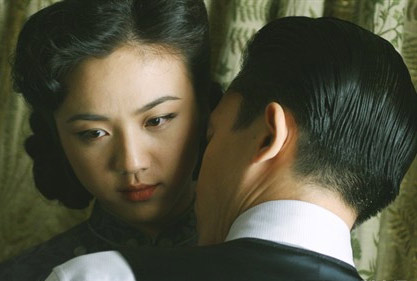
There has been much conjecture following news that Lust, Caution was slapped with an NC-17 rating by the MPAA. As many pundits and critics have explained, the NC-17 is the kiss of death in Hollywood. Although Lust, Caution will not be distributed by a major studio on thousands of screens across the country, the expected move on the part of the studio (Focus Features) and director would be to appeal the rating and make the appropriate edits for an R rating, as that would ensure higher distribution and box office, especially for an awards season "prestige" film. But the appeal never came. Lee instead accepted the NC-17, and Focus Features is moving ahead as planned with the release of the film next month.

As a recent Los Angeles Times article observes, many claim that the MPAA's system for movie ratings is more than questionable, and that the dreaded NC-17 is typically assigned for strong sexual content rather than strong violence. Pornographically violent movies like The Passion of the Christ (2004) are never questioned, but any movie showing pubic hair or female pleasure is an immediate danger of receiving an NC-17 rating. Although I haven't seen Lust, Caution as of yet, early reports indicate that the sexuality, while erotic, is by no means pornographic. Like many, I'm not surprised that the movie was hit with the rating, since the MPAA has always imposed infantile values on the American public, in doing so reducing expression and representations of sexuality to sitcom-style innuendo that reflects our insecurity and fear about sexuality than our embrace of it. Therefore, that this film was hit with the kiss of death rating is not at all a surprise.

The real surprise here (and a welcome one at that) is that Lee has accepted the rating and that the film continues to pick up steam as it moves toward release. Though it was never going to be a wide release, news of the NC-17 could have severely damaged the film's chances of turning a respectable gross and gaining enough media exposure to be a contender come time for awards season. Focus Features and Ang Lee have instead turned this into a positive for the film, which may be the first sign of progress toward upending a criminal ratings system. As critics, movie goers, filmmakers, etc., we have to accept that the ratings system is here to stay. The MPAA and its "clients" have structured a system that makes it nearly impossible for filmmakers to take the cinematic medium seriously as an art form. The MPAA is a tentpole institution for the commodification of images, and it functions as such by informing the American public how it should feel about sexuality, religion, drugs, etc. While film goers can voice their dissatisfaction in their consumer choices, one of the few ways that filmmakers can work for change is to work within the confines of the very systems of power to work against them. Of course, this isn't easy, but Ang Lee has done just that.

By not caving in to the MPAA's intimidation and accepting their rating, Lee and co. are trusting in the intelligence and will of their audience. I may be overly optimistic, but if more filmmakers stood up for the art of cinema and braved the distribution and box office risk of the NC-17, then the rating's image as the kiss of death would evaporate. Of course this isn't as easy as it sounds, but I remain confident that the weakness of the system is the expectation that filmmakers and studios will always comply. The moment one does not, it may influence others to test the NC-17 waters, and (at best) maybe create a snowball effect that would relieve the rating of its death wish status. It won't change the pomposity of the rating, and it won't alter our collective approach towards sexuality in art, cinema, and culture like the flip of a switch, but it may be a starting point; the foundation of change.

I guess it shouldn't come as a surprise that the filmmaker behind this potentially revolutionary step is Ang Lee, the filmmaker who two years ago made a quiet drama about the love of two men that captured the nation. Hollywood and Indiewood have dealt with homosexuality in cinema before, but never have I seen a movie work both as broadly appealing storytelling and as an intimately personal narrative grappling with some of the most relevant themes in American culture today. I was not among the camp touting Brokeback Mountain (2005) as more of a love story that happened to involve gay men, as if that's some kind of compliment. Brokeback Mountain is a gay love story, plain and simple. Lee wants you to know that, as he should. Through sublime images and brilliant performances, Lee digs deep into the minds of two men who learn to hate themselves because they love each other, in so doing digging even deeper into the collective unconscious of viewers. It is a profound film, one in which Lee manages to find just the right balance in approaching matters of repression, sexuality, and cultural Otherness through a straightforward narrative account of a gay relationship beautifully committed to images. It didn't preach messages or politicize, and its impact on America was vast. But the collective response and constant jokemaking resulting from the film's popularity essentially demonstrated why it was so necessary.

Although Lust, Caution does not deal with any hot-button issues and will not likely have the impact on American pop-culture that Lee's last film did, it nonetheless marks an important step in American cinema consistent in spirit with everything that Brokeback Mountain represented. Along with David Cronenberg, Ang Lee is emerging as one of the most important voices in contemporary cinema. Yes, I am aware that both of these filmmakers have made great films for many years. But each of them right now are uniquely addressing utterly essential issues in how we behave, communicate, and situate ourselves within a culture in their recent films. Lee is now doing so both inside his films and out.

Although I haven't seen the film yet, its title, Lust, Caution strikes me as simple, urgent. Two words that, in light of Lee's refusal to bow to the MPAA, rather concisely sums up a major cultural problem. Its impending release may well represent a monumental step in cinematic activism.

Monday, September 10, 2007

Cronenberg on Sex, Violence, and Cinema

In a perfect world, I wouldn't know very much about the movies I see before seeing them. So often, critics write about the importance of having as little exposure to a film as possible and seeing it with fresh eyes. Since I usually can't see them until well after their release, the reality is that I read quite a bit about movies long before finally watching them. Even in the case of movies I go to see on opening day, I find it utterly impossible not to read interviews and reviews, especially if it's something I'm really looking forward to. One such movie is David Cronenberg's Eastern Promises (2007), which is currently playing at the Toronto International Film Festival, where several critics have written rather enthusiastically about it already. In a recent post, I explain why it's not the worst thing in the world to read about a movie before you see it. But it's a fine line to walk, because it is a more pure experience when you know less.

When it comes to particularl filmmakers (e.g. Spielberg, Scorsese, Sofia Coppola, Guillermo Del Toro, Alfonso Cuaron, Woody Allen, etc.), once I know the littlest thing about their films I become intrigued enough to seek out more. Sometimes, it's almost uncontrollable and I have to consciously stop myself from reading too much; not so much for knowing too much about plot (as plot means very little to me) but instead about compositions, themes, ideas, etc. It's always a struggle, one that the everyday cinephile has to deal with, especially this time of year. And with Eastern Promises coming out this week, I'm on overload with enthusiasm. This morning, I came across this outstanding interview (via GreenCine Daily), in which Michael Guillen talks with Cronenberg and actor Viggo Mortensen about the film. Here is an excerpt from Cronenberg's comments that particularly struck me:

"The nudity in the scene is really about vulnerability; it's not sex. Most nudity in movies has a sexual aspect. Not that this doesn't maybe have some of that as well; but, it's much more sublimated. I've only recently been talking about it - because it just occurred to me - that it's like the shower scene in Psycho. You're naked, you're wet and there's some people with knives who don't like you. This is a very vulnerable kind of thing that people can relate to. Of course, it's all set up properly because of the tattoos that you meet there, so people can see the tattoos and see that it's all legitimate, and then it goes quite wrong.

I said to the stunt coordinator and the camera man, 'This is not Bourne-like impressionistic cutting away, where you don't see anything. Violence is physical. It's all about bodies. It's about the destruction of bodies. And I insist on that as the reality of this. And I want to see it all. This fight scene has to make physiological sense. It has to make mechanical sense. It has to make body sense.'

If an audience is seeing a movie to live another life - which I think is one of the attractions of seeing movies; you get to be out of your own life and live some other life that maybe you [wouldn't] ever really want to live but you're curious about - so, I'm saying, if you're a Nikolai in the movie, then you're going to experience this; I'm not going to throw it away, do it off camera, and do it frivolously. All the hard work and the difficulty of killing someone, if that's what this character has to do, I want you to feel it and see it."


Cronenberg can articulate sex, violence, and images like no other. And yet, despite his reflecting on the film's themes, he's somehow very ambiguous about it all, still inviting the reader/viewer to see the images for her/himself. The mere suggestion that Eastern Promises explores similar notions as A History of Violence (2005) is enough to send me through the roof. Although some yearn for the Cronenberg of old, i.e., the sci-fi Cronenberg, or the horror-Cronenberg, right now may be the most intriguing point in his career. I say this because he is now entering into a realm of reflexivity about narrative, sexuality, violence, memory, identity, and the body, further cementing my belief that he is our foremost scholar on the interconnectedness of these subjects.

Videodrome, 1983

Friday, August 3, 2007

Visualizing Murder: Zodiac and Perfume

Last weekend, I caught up on some movies I missed in the theater earlier this year. Although I didn't intentionally plan it this way, both movies are intense accounts of notorious murderers: Tom Twyker's Perfume: Story of a Murderer and David Fincher's Zodiac. Despite that these films are so different and I that wouldn't ordinarily contrast them if I hadn't seen them on the same weekend, I couldn't help but think of them in relation to each other, especially along the lines of how they each depicted murder, particularly of women. Both films involved male serial killers at different times and places. The narrative focuses are very different, but both films are fascinating in their visualizations of death. How the spectator identifies with the on-screen action is handled uniquely in the case of each film, but both films undoubtedly feature grisly murder scenes that are after much more than sensationalizing violence. These films aren't merely symptomatic of spectatorial obsession with murder but are instead deep inquiries into that fascination. Therefore, each movie is fetishistic of violence in equally disturbing and alluring ways.

In Zodiac, there are three notable murder scenes, all in the first third of the movie, two of which are so suspenseful in their quietness and ambiance. Fincher stages these scenes by primarily focusing on the victims, in both cases a young couple, who are not movie stereotypes. They don't say or do dumb things, but instead feel like they are real, living people, and we are seeing them just before their lives end. Fincher knows the audience is aware of the couples' fate in both scenes, but he takes his time and builds a generally quiet, uneventful atmosphere built on typical conversation. This ordinariness makes the impending murders all the more cold. In the case of the opening scene, we have a more typical serial killer setup, with a young couple in a car overlooking town with the woods behind them. Fincher handles this scene by building quiet suspense, the images are subdued, and yet the spectator is cued to a deeper suspense, like that of watching "mother" walking ever closer to the shower in Psycho, but less visible. When the death occurs, it somehow captures a dramatic beat (as if everything is in slow-motion) and quick shock as if what you cannot believe how everything changes so fast that you cannot process it.

In the next scene, which is arguably more disturbing, a young couple enjoys the calmness of a daylight on the lake. The woman sees someone approaching, shows concerns while her male counterpart pays not attentions. She continually makes reference to this approaching figure, and then instead of a massive shock like before, Fincher draws out an encounter between the killer and the couple, in which points a gun at them. We are inclined to think that it will be a quick murder, like before, especially when he has the woman tie up the man. The killer has a calmness, even a humanity about him, but this changes in shocking fashion when seemingly our of the ordinary, he pulls out a knife and quietly stabs them as they lay, tied up, face down to the ground. They scream in pain, but there is a dreadful realism to it in how the sound of agony and dramatic images are deliberately avoided.

The traditional movie conventions are to play up the screaming when a victim is dying or dramatize the images or sounds. Fincher takes a different approach here, instead maintaining the same visual style previously established. In depicting the violence so plainly, when we're expecting something very different from a conventional standpoint, Fincher captures a voyeuristic crisis of identification and the images are more shocking than they would be if they were more dramatic. This approach would seem appropriate given that the movie examines the rhetorical effects of murder; how it's interpreted, covered, and delivered to people who make sense of it by calling it senseless. Zodiac therefore employs a disjointed style of juxtaposing familiar cinematic conventions of murder, which we all know so well, with deliberately uneventful images of brutal murder.

The effect is chilling. It creates a strange feeling within the spectator, one that both identifies with the killer as well as the victim. Although the movie focuses on the mystery of the killer and the murders are incidental to the rest of the violence-free plot, the incorporation of the murder scenes into the the narrative is both intrusive to its flow and necessary to enable its being. Through these jarring and disturbing scenes, we are provoked to implicitly reflect (knowingly or not) on why we so crave murder mysteries and closure. Some will inevitably claim that the movie "goes too far", but it only offers a dose of realism to typically watered-down violence to which we become desensitized to yet desire all the more as procedural investigations reveal the mysteries of the killer in the end. The movie is an active rumination on our the spectator's insatiable appetite for violence, which just about every spectator would assert is untrue. But Zodiac locates that hypocrisy in its structural and visual style and exploits it.

Perfume, on the other hand, overtly invites you into the pleasures of sensuous desire. It lures you in with sexual overtones before quietly shifting to violence. Despite that the killer is incapable of understanding sexuality, the film links sex and violence together, creating a strange interpretation of each and therefore justifying the taking of life with the innocent but overwhelming sensation of sensual satisfaction. The story centers on a young man, John Baptist-Grenouille (Ben Wishaw), who is gifted with an extraordinary ability of smell. Scents of all kinds are intoxicating to him. He can feel the very essence of pleasure through smelling the variety of aromas -- good and bad -- in 18th century Paris. The film tells the story of how he becomes incapable of understanding anything outside his own pursuit of unending sensual pleasure, which ultimately leads him to murder.

This is best captured early in the movie when Grenouille first walks the streets of Paris, taking in the variety of smells. As others have observed, it's amazing how the film understand the deep connection of sound and image to conjure anything within perceived sensory experience. Through its sounds, images, and music, Perfume is the epitome of sensuous; as Grenouille walks down a street in Paris, the quickly cut close-ups of various objects giving off odors (in which we see every detail) intercut with Grenouille taking it all in is a profound experience of discovery and sensuality.

Shortly thereafter, Grenouille senses a scent that allures him even more: a woman. He captures it from a distance, tracking her down through alleys at night, before he finally sees her. Although he still remains at a distance, the film cuts to incredible close-ups of the woman. In doing so, the images capture and evoke every moving detail of her beauty, from the way her hair touches her skin or the way she holds her basket of fruit. Grenouille is enamored and begins to follow her. At this point the film entirely immerses the spectator into Grenouille's perspective. We become his seemingly innocent stalking presence. As he approaches her -- quietly smelling her from behind -- his nose comes so close to making contact with her skin and the composition pulsates with sensation and pleasure. There is not a bit of dialogue; just pure cinema. It wraps us up in obsession and pure desire.

After she is startled by his presence, she runs away. But he continues to stalk her and he locates her once more. Although he likely has no intention of killing her (since he does not understand feeling or life), he does precisely that in covering her mouth so that she does not alert anyone else to his presence. She struggles within his clutches and he has not the faintest idea that he is draining the life out of her. After she is motionless, he removes her clothing and presses his skin up against hers, taking in her escaping scents. It's a profoundly disturbing scene in its gentleness. The images draws you into its state of innocent lust; you may consciously condemn his actions, but you identify with him and are still inquisitively seeking the pleasure of nostalgia that scent can so easily summon, even for memories and places we may not be able to visualize.

The whole movie is in that four or five scenes. They meld together images and sounds of violence, sensuality, death, and lust in ways that provoke a strange, but compulsive attraction to the images. They would be disturbing if it wasn't so inviting; but then again perhaps that's why it's so disturbing. Therein lies the complexity of the movie. While it doesn't quite sustain itself over its entire running time (that's at least my reaction on one viewing), Perfume is a strange, dark, and fascinating movie.

Both Perfume and Zodiac focus on the famous serial killers, of different times, places, and motivations. The fascination of their stories is how distinctly they explore taking life, life taken, and spectatorial obsessions with watching.

Wednesday, January 17, 2007

Sex and violence as filtered by the MPAA

"Remember what the MPAA says: horrific, deplorable violence is ok, just don't say any naughty words."
- South Park: Bigger, Longer, and Uncut (Trey Parker, 1999)


When I saw the headline in Variety reporting that the MPAA will be making alterations to the film rating system, I was momentarily high with excitement. It turned out that my naive sense of hope once again has gotten the better of me, because after reading about these proposed changes to the system, I quickly settled back to the same frustrated state when thinking about our film ratings system. The changes are minimal, and although they may impact certain areas of the appeal process in particular, these changes will likely not amount to much more than a political and bureaucratic move.

Not surprisingly, the state of movie ratings has become a very strong political issue. Many well known liberal commentators call for the system to be totally renovated, while conservatives tend to favor it and encourage that it clamp down even more than it already does, in the spirit of the FCC with radio and television. Where one falls on this issue inevitably depends on a great deal on individual values and what is considered appropriate when it comes to regulating arts and entertainment.

I am not much of a political person in a right/left sense, but I don't pretend to have an unbiased take on this issue. As a cinema lover, I do not approve of the system in the smallest way. I would eradicate it and start from scratch if I had the chance. However, I am not foolish enough to think that such a momentous course of action could ever be feasible.

Esentially, the MPAA ratings system is a sectioned off version of the Hays code, the one and only standard of film censorship in the United States from the 30's into the 60's, before the MPAA. All films released in the United States were subject to the same restrictions. There were certain things one could suggest, and certain things one couldn't. For example, a kiss could only be held on screen for a certain amount of seconds. It was a cut and dry system that ensured that all films had similar standards. Filmmakers were always trying to get around the rules and slip through the cracks in the system (see the romance scene between Cary Grant and Ingrid Bergman early in Alfred Hitchcock's 1946 film, Notorious). Hitchcock and others were always trying to push the envelope while also point out the utter hypocrisy of the system and its fundamental inability to encapsulate film content. Filmmakers like Hitchcock knew that the content of moving images often went beyond what was visible at a given moment. So much more can be suggested in cinema that attempting to quantify the appropriateness of sexual content, violence or anything else is practically irrelevant, and a facile understanding of what images are capable of.

Today, the ratings system essentially categorizes films with the G, PG, PG-13, R, and NC-17 ratings. And, being that films are hugely marketing pieces of merchandise, studios and filmmakers have learned what quantifies each system and make their films accordingly. In a perfect world, from my point of view, we wouldn't have anything like this. It greatly undermines the artistic endeavor that filmmaking can and should be and it promotes films being forced into a specific territory when it comes to content. Instead of one big code, there are now segregated options. The MPAA claims to be a voluntary system, but, economically, the reality is that films that do not submit for an MPAA ratings have no chance of being distributed.

The meaning of ratings has changed, and such change is often ushered by adding or deleting ratings. For example: the PG-13. The rating was first suggested by Steven Spielberg after angry viewers complained about the level of violence in the PG-rated Indiana Jones and the Temple of Doom (1984). Feeling that the level of violence didn't deserve an R rating, (at the time, R was much less acceptable and less mainstream than it is today) Spielberg suggested an "in between" rating. But all it has done was alter the content of other ratings. The G - meant to suggest family entertainment - is all but gone and has been replaced by the PG - a rating that allows some innuendo and minor curse words, but is a far cry from films like Jaws, which was rated PG in 1975. The PG-13 has replaced the old PG rating, and the R is now much more acceptable and regular than in the 70's and 80's. The NC-17, previously X, is the phantom rating because there are so few films that have been rated it. It's a commercialdeathwish to get an NC-17 since it's viewed as pornography. Therefore, the standards of the R, which are much more constraining than many think, have not adapted. Therefore, the level of violence, sex, and "thematic content" (a great MPAA phrase) are standardized and are allowed within very careful bounds. It doesn't matter if ratings are added or subtracted, because in the end, any change in system will adjust and level out accordingly, and films will continue to be made and seen according to what's "allowed" under each rating. What skewers the whole thing, however is the phantom NC-17 rating; since no film ever achieves it, and it is supposed to represent something, the more tame R of today is essentially the maximum level of "mature" content allowed. I'm no fan of having to make films that adhere to this system, but I suppose it must exist on some level.

Determining the level of content allowed in each rating category is where all of the controvery has risen. Observing trends in filmmaking and culture reveal that the MPAA is notoriously soft on violence, yet strangely limiting when it comes to sexuality, which to some degree reflects the values of our culture.

Many filmmakers have spoken out against the hypocrisy of the MPAA, notably Kirby Dick, who made a expose-like documentary, This Film is Not Yet Rated, which I have yet to see. Since it was deemed an NC-17 rating, no studio or theater chain wanted to distribute it, which in a way is another way for Dick to make a statement. The film will be released next week, and I have every intention of seeing it. Some speculate that the changes to the system were partly due to the film, which apparently exploits the biased natures of the ratings board.

In the minds of the ratings board members, depictions of violence is quite alright, but when it comes to sex and curse words, filmmakers better be careful. Now, let's be clear about something. Cinema allows such acts as sex and violence to be depicted in a variety of ways, and they have both featured prominently in cinema throughout its history. Over time, viewers form a familiarity with particular conventions of how they are depicted. Many techniques exist that suggest certain emotions or events and are used quite frequently. Shot-by-shot analyses of films would reveal many of these devices and stylistic techniques, but right now I would just like to vent my beliefs about how these particular devices have defined the overall cinematic understanding of such things.

Sex and violence are fascinating ideas to study in a cinematic context. Many question why films feature so much sex and violence, and the answer to such a question is complicated. Firstly, there is something about the senses of sight and sound that, when you put moving images on a screen, we respond in a very immediate way. The cinema can make you feel in ways different than other narrative and/or art forms. Sexuality and violence can be very visceral and emotive, which is what cinema can do evoke best. Where some viewers claim that depictions of these acts corrupts minds (which, in many cases really depends on the depiction and context), I contest that through the cinema, viewers can particpate in an emotional and immediate experience capable of provoking different manners of feeling and thinking. However, as much they are built-in or socialized into our individual selves and cultures, sex and violence are large elements of who and what we are. Therefore, I think these ideas manifested through the narrative art form of moving images may allow us to feel and think about them in ways more productive than merely claiming they corrupt people. We can learn much about ourselves and our culture and society (especially considering the increasingly visual culture of which we are now a part) based on how violence and sex are made visible through narrative art. Images are so powerful, and based on the feelings they provoke, we can question and expand upon our own views about such matters by exposing ourselves to different ways of seeing, feeling, and thinking. A discussion framed from this standpoint can therefore be very useful and worthy of study.

Several writers and critics rarely waste an opportunity to blast the MPAA for its inconsistent, extremely biased approach to rating films. Roger Ebert has written extensively about the MPAA's influence of filmmakers and viewers, and how they make sexuality visible in the cinema. This from his review of Alfonso Cuaron's Y Tu Mama Tambien:

"The movie is realistic about sex, which is to say, franker and healthier than the smutty evasions forced on American movies by the R rating. We feel a shock of recognition: This is what real people do and how they do it, sexually, and theMPAA has perverted a generation of American movies into puerile masturbatory snickering...

It is clear Cuaron is a gifted director, and here he does his best work to date. Why did he return to Mexico to make it? Because he has something to say about Mexico, obviously, and also because Jack Valenti and the MPAA have made it impossible for a movie like this to be produced in America. It is a perfect illustration of the need for a workable adult rating: too mature, thoughtful and frank for the R, but not in any sense pornographic. Why do serious film people not rise up in rage and tear down the rating system thatinfantilizes their work?"


I couldn't agree more with Roger's sentiments. As a culture, we are much more at ease with images of violence than we are with sexuality, which is something that I don't understand. We seem to fetishize violence in different forms; sometimes in the form of pleasurable entertainments, sometimes in the form of serious narrative trying to depict violence honestly and responsibly, while some films represent more of a cross between these two ideologies of depicting violence. The point is that there are so many ways in which violence is depicted, viewed, felt, and understood in the cinema, but when it comes to sexuality, there is much less available, at least in terms of the mainstream. Many films made outside America are much more comfortable with it, as well as lesser known productions within American. But for the most part, in this country, people appear to be afraid of sex. Some might disagree and claim that there is so much suggestion and innuedo featured in entertainment, to which I say, of course! Because we have become so timid in regards to depicting and viewing human sexuality in any kind of mature way, it has manifested itself in other ways, usually in the form of comedy, innuendo, and representations suggesting just enough sex that is acceptable. Such standards are defined by the FCC and MPAA . which wield great power in what we see and consume. Films that are daring, honest, and up-front with approach sexuality maturely are slapped with an NC-17 rating and are never seen, let alone produced and distributed by a major studio. As for television and radio, advertisers wouldn't touch such material with a 50-foot pole. Instead, we are given the same assembly-line, mass-produced schlock that is "acceptable." Perhaps if we are more honest and unafraid of sexuality, it won't be such a hush-hush topic and we can actually see it as something more than forbidden and immoral, which is how it's currently viewed and depicted.

The point I make with all of this is that the MPAA (as well as the FCC) sustains and upholds supposedly tasteful standards for sex as part of our culture that are sickening and hypocritical. Images are everywhere. All of us are affected by mainstream entertainment, consumerism, and advertising in one form or another. In fact, I would argue (and this is the subject of a later post) that images have become more influential in shaping our views and interaction with our society and its institutions than words. We are all influenced by these infantile visions of sex perpetrated on us, and until the MPAA and FCC and the American people (it's a cyclical effect and it starts with those in power) are willing to embrace a more open and healthy perspective of sexuality, we will be uncomfortable with it not just as participants in media and culture, but as individuals. The cinema is an essential and relevant visual medium that can reflect and inform, and it is the responsibility of filmmakers to construct and present images that provoke thought and feeling, especially in regard to the increasingly visual culture of which we all are members.

What we have now isn't working, and making little tweaks to the current approach will not address the issue. I suppose the current changes can be viewed in a positive light, because, hey, at least it's something. But I urge that we must go further. I know it's not easy, but as cinema lovers and as social beings, we must refuse to be manipulated any further and press for change.

But perhaps I'm just being naive and overly hopeful again...