Monday, January 7, 2008

Post-thoughts on Into the Wild

Ah, January... that special time in the cinematic year. It's the thick of awards and listmaking, and it's also the season for unimaginably awful movies to be released. (Anyone see One Missed Call this weekend? Anyone?) That's why now is a great time to reflect on the movies from the past year that continue to stand out. While I will have my own reflections on the year in cinema sometime in early March -- when I finally catch up with the many major releases I missed this Fall which will be landing on DVD -- I would like to note one tidbit in a recent article by A.O. Scott regarding the vastly misunderstood Into the Wild, one of the year's most oddly cold, yet inspirational movies. And definitely one of the most memorable. For a film that plays by a lot of rules (i.e. voiceover narration, slow-motion nature shots, etc.), it has moments that infuse those conventions with real power. One such moment, in my mind, is when Hal Holbrook's character gazes searchingly at the youthfully naive Chris McCandless, wishing, hoping for the boy to see what's in front of him. Those scenes, in particular Holbrook's moving performance, and others such as Chris trying to hunt and cook in the wild haunt me to this day.

Anyway, I'm mentioning this because I've had a few conversations about the movie recently in which I've defended the movie and its maker from the claim that he romanticized Chris McCandless all out of proportion (as Woody Allen might say). Shortly after my most recent conversation, I visited the New York Times website and came across A.O. Scott's article, in which he pointedly observes Chris' strong attachment to the social, even though he consciously denounces society and is suspicious of human connection. Scott's final words may be the best I've read about the movie since I saw it in September. He says:

And much as Mr. Penn’s film invites us to identify with Chris, to share vicariously in the exhilaration and the terror of his roaming and rambling, it also frequently places us in the sensible shoes of the people he leaves behind. And that is why we feel his death so acutely. The lesson of the film may be that, while the bonds of affection that hold people together may be frail, imperfect and frustrating, especially when compared with the majesty and integrity of nature, those attachments are more durable and more necessary than Chris McCandless may have wanted to admit. Only other people, after all, can welcome you home, or miss you when you’re gone."

As I have noted before, Sean Penn definitely seems to be inspired and perplexed by McCandless, to the point of seeing him as an essential, relevant figure, even a hero, in some ways. But the film never shies away from the truth that Chris was also arrogant, naive, and neglectful of those around him. Into the Wild is such a strong film because it captures a real sense of the person; his flaws, his strong points, and his ambiguities. His story was fascinating, and his insistence on connecting to the natural world is more than admirable; it's incendiary. As we face greater environmental threats. and as we integrate mechanical and digital technologies into our cultural and individual existence and relationships, Chris McCandless' story is inspiring. And the tragedy comes out of Chris inability to find that medium we should all be searching for; a connection with people, and a connection with the world.

Thursday, January 3, 2008

One year

With the knowledge that this blog (or any blog) may be little more than an indulgent proclamation of my own deluded importance, I typically try to avoid writing posts about my own plans, aspirations, and goals. But I think this occasion -- the one year anniversary of The Cinematic Art -- may be appropriate for some outward reflection on the year that was. But before I reminisce on this blog, particularly the act of spontaneity it took for me to actually I create this blog, it's perhaps necessary to provide a bit of history regarding my place in the world of film blogs.

From the time that I had been exposed to Jim Emerson's scanners blog through Roger Ebert's website (sometime in late 2005), the digital film world with which I was largely unfamiliar progressively grew. I started to read other blogs such as That Little Round Headed Boy (which has long since disappeared and has been replaced with Welcome to LA), Dennis Cozzalio's Sergio Leone and the Infield Fly Rule, Matt Zoller Seitz's The House Next Door, Kim Morgan's Sunset Gun, and Steven Shaviro's The Pinnochio Theory, to name a few. These blogs each unique possessed a unique flavor to their writing and perspectives. They offered what I believed to be totally fresh views (both academic and journalistic) on film culture, news, and criticism -- the kind of varied analyses, critiques, and off-the-cuff ramblings on film that was so crucial to film writing and criticism as a whole. As I familiarized myself with this ever-growing world, I came to understand that it was much bigger than I could possibly imagine; too big to wrap my mind around, or to follow to the extent I wanted to. It was a whirlwind of discovery, Encountering new blogs all the time, some which were brilliant, others not, I was entranced by the amount of real, personal, and analytical commentary available online that I didn't even knew existed, not just on blogs but on website, zines, and journals in all shapes and sizes all over the web. All the while I was reading, I became curious about the people who took the time to write them. Some were professional film critics or editors with entertainment publications, while others seemed to be enthusiastic film lovers with the gift of writing craftmanship who wanted to share their insights.

The variety of writing made me curious about my own place in cinephilia or criticism. Quite simply, I was jealous I wasn't becoming more involved with it. My professional path, which saw me take my first job in medical publishing, was moving away toward my aspirations of being in film criticism. Yet, I was still engaging that obsession in my graduate courses in communication, which more mostly geared towards media and culture. Though many of these courses introduced me to schools of inquiry that largely contrasted with film scholarship, I found ways of exploring the relationhip between media, culture, and cinema in my readings of Marshall McLuhan, Gilles Deleuze, Walter Ong, Roland Barthes, Christian Metz, Laura Mulvey, Henri Bergson, Louis Althusser, as well as more contemporary scholars like Paul Messaris, David Bordwell, and Donna Haraway. Of course only a few of these individuals cared to offer analysis of cinema, but all of their work connected to the central concerns of media, culture, and communication that constitute empirical and social inquiry into their intersections and manifestations.

So on this day last year, I had the idea of converging my interests in communication and media and my love of film, writing, and criticism. Arbitrarily named The Cinematic Art (because I was more interested in writing that first entry than with naming this site), this blog would represent a kind of experiment within which I would combine my involvement in various pockets of criticism, education, and film culture. It would be my personal diary of occupying a place that lacks definition. By that, I mean that I felt like I was being torn in so many directions in my pursuits in film. My professional career was headed elsewhere, I was settling down in marriage and home ownership, surrounded by loving family members and friends who had no interest in this world I'd always been a part of. As I was driving away from film in my personal, day-to-day life, which has always been a struggle, my readings (online and in print) and encounters with students and teachers on campus on long nights after work ensured a balance, if maybe a tension, that would enable me to keep that passion alive and to explore it in ways I wasn't even sure of.

Due to all of these disparate elements in my personal and film life, I felt a blog was a way to make sense of my own thoughts on criticism and cinema. It seemed like I had so much to say, but no place to start. Finally on a down week at work, I started writing, and writing, and writing some more. I didn't realize at the time that this was the start of a year in which I would write more than a hundred lengthy, time-consuming, and demanding posts. Over the course of the last year, I've learned a lot of about criticism, cinema, and myself, in trying to keep up with this blog, constantly battling my own thoughts over whether it was worth it to devote so much of my time and energy to something as insignificant as a blog. I never thought it would amount to much, and I am more than gratified that others -- including my blogger heroes -- have linked to my site and cited it on their own blogs. It's still kind of surreal that my name is even recognized in the blogging world, but I am more than flattered because of it. One thing I've learned about writing in this medium is that you never know where it will take you.

But what does it meant to "blog", anyway? I have asked this questions many times in several long-winded posted representing my attempt to reflexively inquire into practices of media and culture. But I'm not sure anyone can really answer that. Digital communication has enabled a variety of possibilities in terms of communicating that to say that "blogging" means one thing would be too simple. I readily admit that a great majority of bloggers aren't using this medium productively. But the possibility of productively using blogs, which no one can actually state right now, is the advantage of it. For me, the best blogging is decentralized, scattered, and lacking a certain definition. It's engaging larger critical discourses and commentaries in ways unexpected and expected. It's a larger discourse, not bunch of isolated, self-enclosed commentaries. The fascination with this medium is the level of connection that exists, among people and among ideas. I've come to learn that my place here in the "film blogosphere" is tiny, practically insignificant. But it is exhilirating to be a part of something larger, something that is quickly becoming the embodiment of criticism, commentary, and discourse: setting ideas in motion, contrasting thoughts and perspectives, and in the process yielding new possibilities without quite being in a position to recognize or define those possibilities yet.

As I look ahead to another year of writing for The Cinematic Art, it is my hope that this site continues to develop along with its author. Writing these rambling, sometimes non-sensical posts has already opened doors for me that I could not have even imagined a year ago. In two months, I will present as part of a workshop for the Society of Cinema and Media Studies. The presentation will be about -- surprise! surprise! -- blogging, film criticism, and cinephilia. I would not have been asked to participate in this if I never started The Cinematic Art. And I would not have launched The Cinematic Art were it not for my educational pursuits. It's all weirdly cyclical, but this is just one example of how blogging can be benefical and produce real positive effects for those who try to productively partake in it.

In terms of my own wishes and desires for this blog, I am unfulfilled (as many writers are), but also hopeful for the future. As I look back now on my postings in the last year, I see great change. I cringe when I read a lot of my own writing, a lot of which I'm in such a hurry to our pout onto the screen that it often comes across as muddled and lacking focus. I seem to be developing my ideas better now and focusing much more, but I have a long way to go.

I'm not sure if I have any future in criticism or scholarship, but I am certain that this blog will continue to morph and develop as I trudge along in whatever I'm doing. And as long that others keep providing me the inspiration in their writings to explore my own ideas in writing. Through this constant process of reading and writing can we begin to grasp our own ideas and the plurality of others that exist in the world. That's one of the many things that all this online reading and writing had taught me in the last year. In the next year, I hope to continue that process, and offer some semblance of insight to readers as many others have provided me.

I acknowledge that there are a number of writers in the published fields who try to convince you that blogging is insignificant or inconsequential, but these positions only speak to the utter importance of online writing, or blogging. As individuals entrenched within the institutional practices of established camps and disciplines assert their importance by making such vast and unsupported value claims, blogging will continue to be relevant to folks seeking new ways of engaging existing dialogues and discourses, about cinema or anything else. The point is not to overthrow previous systems of knowledge and understand, but to harness them differently, to juxtapose them in new ways, and to form new relationships. The best bloggers provide hope and incentive for budding writers, critics, and scholars to achieve their voices and perspectives through this new form of one of the most essential human practices: writing.

With that short reflection, I'd like to thank all of you who contribute to the growing body of great film writing on the web. Most especially, I'd like to thank those who have taken the time to read this blog. Have a great new year, everyone, and happy reading and writing!

Thursday, December 27, 2007

A semiotics of hair

The two characters pictured on the right, Anton Chigurh (from No Country For Old Men, played by Javier Bardem) and Briony Tallis (from Atonement, played by Saoirse Ronan) each represent the destructive forces of their respective movies. The nature of their destructiveness may initially appear quite different -- one is based in violent amoriality, the other in classist jealousy. Helping this division along is their contrasting physicial presence. Where Chigurh is a physically imposing figure whose eyes, nose, and mouth are blunt and hard-edged, Briony is petite, almost weak-looking, and amazingly pale. Chigurh primarily wears dark clothes that fit him like a glove and are an extension of him, while Briony wears clothes that don't appear to be on her body at all. The differences are amazing, or at least they seem to be. But I think these performances --these characters-- are of the same material and bodily presence.

No two sets of eyes are more piercing and forceful than theirs; and each of their distinctly similar haircuts seem to drape over their stone faces - still, and as motionless as their eyes. While their inexpressive eyes and hair complement both characters' calm, non-chalant demeanor, the contrast of their bodily presence may seem to separate them, because Chigurh is physically intimidating (and destructive), and Briony is not. But don't be fooled by this apparent contrast of physical presence. They appear in different kinds of films and impose their will on others around them in wildly different ways, but what they are communicating with their faces, eyes, mouths, and hair is deadly similar.

Also, consider how each of these characters are framed within specific shots in such a way that highlights their lack of gesturing and overall control of the shot. Notice how each of these characters are framed within the visual scheme of each movie. They occupy the space of the shots in which they appear in intimidating, imposing, and sometimes disturbing ways. Although each is quiet and methodical in their methods, they occupy the space of their respective films' images incongruously to other characters. In some shots, they both appear to look directly into the camera, at the audience, with those lifeless stares. Other images envision them as enveloped by the larger, equally still world around them. Even when they move, the rest of the image remains strangely still.

I began thinking about this because I was thinking about how similarly evocative are their hair styles, particularly how their hair is both separate and apart of their existence. The more I considered this idea, and thought about the similarity of those styles, i.e. how their hair hugs their heads, embodies their stillness, and defines their existence in the world and their relation to the people whose lives are violently altered due to encounters with them.

As a pure aesthetic device, hair can define a performance and give it a life it would not otherwise have. And in this case, it has led me to re-evaluate screen presence and performance. It is a microcosm for the core of a truly great screen performance. It suggests the intangible, the untouchable, but also most importantly, the aesthetic aspects of the perception in a visual narrative.

There's something intangible about good film performances. It's not just about the level of one's acting craft. Actors can sometimes turn in very good performances that is right in all aspects of how we define good screen performances, but still lack that special something that makes it transcendant. Unlike the theater, acting for the screen involves more than just an actor, and moves well beyond body movement, facial expression, and voices. A strong performance is defined by how an actor builds a relationship between the "inner" character and her/his material and/or bodily surroundings, i.e. mise-en-scene, props, costumes, other actors; in other words how that actor jointly shares space with other elements of the image. Since the composition is often controlled by the director, a performance is never a single effort on the part of an actor. An inuitive director understands that great performances emerge in strange ways, and can come from average acting talent. It's all a matter of how that particular screen presence exists in relation to the totality of the image.

Beyond a literalist level of interpreting cinematic images, fine screen performances are a perpetual mystery and a constant discovery. Juxtaposing characters from movies as apparently different as Atonement and No Country For Old Men, two of the finest films of 2007, might seem ridiculous to a literalist, but actually reveals the level to which screen performances are deeply abstract works of motion, movement, and framing.

Wednesday, December 26, 2007

The dreaded Top Ten lists we've been anticipating all year

Critics often write about year-end top ten lists as if they are journalistic necessities demanded by the institution of journalism. Nevertheless, top ten lists are staple of journalistic film criticism. Moreover, some critics who denounce them seem to demonstrate a strong passion for them.

Though I have railed against year-end listmaking in the past, I have also expressed my insatiable desire to construct my own and read others. There's something undeniably enticing about ranking movies, as if the critic espouses some kind of power or control over the image. S/he is the judge, and only one movie can stand above all others in a year.

Of course, measuring cinematic greatness is arbitrary, as well as problematic on a number of levels. There are no criteria for "Great Filmmaking," and the idea of naming one movie above another just is absurd. Nonetheless, this practice is a stamp of journalistic film criticism that seems to undermine criticism. Yet we love to do it. Our enjoyment of constructing and/or reading these Top Ten lists is thus a kind of masochism; or perhaps the sort of pleasure that invokes guilty pleasure.

Although some of us more outwardly complain about simplifying film criticism to a childish ranking system, these rankings/ratings/lists/awards actually hold some kind of meaning when you consider the shear amount of movies released in a year. Trying to make sense of film history, or a particular area of film history or style, even a calendar year, becomes a great burden without the canonical practices that enable us to sort them out. For example, I keep an annual log of every film I see and how I rated each film on a four-star scale. This helps me look back on a given year in film and to organize what I consider the best movies of that year accordingly. This is but a small example of how critics enact these larger ideological practices of evaulating cinema. The process of organizing and thereby assessing films whittles down the complexity, nuance, and ambiguity of the film world. Of course, this is inevitable and necessary, but it's potentially dangerous too. It's like using grades to signify one's level of intelligence, as our education system demonstrates. It can work, but its fundamental purpose as a universalizing system by which anything can be measures is also its central conceit.

That said, these practices structure a history of film and criticism as we know it, which is why some critics (myself included) look unfavorably on what appears to be a necessary evil. However, since listmaking is here to stay, perhaps the best way to participate in it is to think about why we attach ourselves to such reductive models of evaluating films and their "quality." This may be as simple as keeping a broad perspective of the films we see and not measure them on a scale of useless terms like "direction," "style," or "acting." Cinema is about the unique combination of all these things and more, specifically how they work together to create the moving sound-image.

An inquiry into these matters is really an inquiry into criticism itself, and how our vision of film may often determine what we see in them. A theoretical perspective on how film works is crucial to film criticism, but so is an inquiry into the pleasure associated with seeing and hearing moving images on a screen. That means that we must not just be good theorists of cinema, but also spectators of it. Performing film criticism is like walking a tight rope between engagement in and detachment from the emotions provoked by the sensory perceptions of seeing an image. We must be part of that image, actively feeling the film, but also removed from it. One or the other simply will not do, as each breeds a particular mentality that requires temperament from the other. We cannot "destory the pleasure", as Laura Mulvey asserts, but must be actively involved in the production and consumption of that pleasure in order to understand it.

How does all of this relate to how we read Top Ten lists, as well as form our own? It's more a philosophy to how we see and evaluate films at all. Although star systems and lists provide a structure that we wouldn't otherwise have, it's important to be reflexive of the them while using then. We need to form -- as the great communication scholar Kenneth Burke might say -- perspectives by incongruity. In other words, using star systems and top tens for the broad sense of structure they provide can be useful, so long that the critic/reader maintains a wider perspective of them. It's more productive to have some fun with them than to painstakingly determine which ten films in a given calendar year are the ten best films of the year.

In my experience reading countless Best Of lists a year, I find the most stimulating and educational of these lists to be the ones that loosely adhere to the rules of the Top Ten. Some critics will stringently adhere to the top ten and attempt to name one film as the film of the year. Roger Ebert is a foremost figure among these critics. He is quite aware of the limits of the top ten, which is why he names a bunch of other films that stood out to him. Nevertheless, he plays by the rules, and offers up ten films, ranked by quality, that he believes were the best of the year. But the interesting aspect of his lists are that he tends to choose films that have a very personal significance to him. Of course, his personal and intimate style of writing and approach to movies is what makes him unique, but it stands out in his often bold selections, particularly his number one film. In recent years, he has selected films like Monster, Minority Report, and Monster's Ball; all films that have their followers, but few of which were selected as The Best Film of the Year, or even appeared in many top tens, for that matter. This year, he named Juno as the film that struck him most deeply on an emotional level, if not a formal one.

Other critics whose selections tend to a reflect a particular ideology of cinema, e.g., cinema as Serious Art, may turn the structure of the top ten against itself while offering choices that generally represent that school of thought. (Keep in mind: That's not to say that a little predictability is a bad thing.) For example, A.O. Scott and Manohla Dargis of The New York Times provide lists that don't adhere to the rules of the top ten, even though many of the films they selected generally represents more internationally- and "smaller film"- based critical lens. They both feature one or two mainstream selections (Scott selected Ratatouille, while Dargis opted for The Bourne Ultimatum), but their lists tends to fit within that overall sphere of film criticism and appreciation. But because they package that differently, i.e., not in an ordered or ranked list of ten films, their selections are more fresh than many lists containing similar films.

Scott's list is comprised more of combinations and juxtapostions of films than ranked order. This, I feel, is a fresh way of thinking about films. It shatters the notion that films are better or worse than other films, that they can all be ranked on the same scale, and that they exist in a vacuum. Scott instead wants you to think about these films in relation to each other; not just how they tie together thematically, or stylistically, but how they don't connect. He says:

"...Apart from the top two entries, the list below consists of pairs (and in one case a trio) of films that complete, complement, contradict or otherwise engage each other. Taken alone each film on the list is in some way exemplary, but each is also enriched and complicated by its companion. The twinned selections might work as double features, or as possible alternatives (if not x, then maybe y); above all they demonstrate the vitality and mutability of this impossibly fertile art form. It’s a big world, and we can never have too many movies."

Dargis, also, bucks the system and refuses to list, number, or rank her favorite films of the year. Her commentary regarding why she does this is nothing short of incendiary. The opening paragraph of her article containing her picks for the best of '07 captures the absurdity and necessity of top ten lists quite well:

"The whole point of a Top 10 list, a friend recently scolded me, is to number them. (I was declining to do so.) My friend was wrong, but only because Top 10 lists are artificial exercises, assertions of critical ego, capricious and necessarily imperfect. (I have a suspicion that the sacred 10 is meant to suggest biblical certainty, as if critics are merely worldly vessels for some divine wisdom.) More than anything they are a public ritual, which is their most valuable function. I tell you what I liked, and you either agree with my list (which flatters us both) or denounce it (which flatters you). It’s a perfect circle."

Although she cannot elaborate on these concepts (after all, she must get to her top ten!), her words cut deeply into a number of questions and concerns looming over criticism. (One last note on Dargis: the more I read her work, the more I am reminded how important she is to film critiism.) According to some, criticism is becoming less relevant as commercial cinema continues to take over the box office and dictate film journalism and, some fear, film criticism. These concerns are very real, and some even wonder what kind of legitimate future film criticism really holds. Let's be honest, many critics' top ten lists do not include films that would be included in Joe Moviegoer's top ten.

Questions of the critical schism are always raised, and critics themselves don't seem to know how to deal with it. While some have argued that critics' relevance may be waning (Richard Corliss most recently banged that drum), contemporary criticism commands strong influence over critical canon. More films are made and released each year; so many that it would be nearly impossible for any film critic or lover to recall the movies s/he has seen three, four, or five years ago, and beyond. Therefore, as film culture (i.e., critics, scholars, film lovers) looks beyond the films of the moment, and back to films of the past, it increasingly depends on these year-end lists and awards -- not so much the AFI Lists or the Oscars, but the various features by prominent film critics all over the country. No matter how similar or unique these lists may be, they provide a larger sense of critical trends at the time. (This past year, 2007, for example, will be reflected on as "the year of the Coens," among other things.) There are always loose trends and patterns emerging from these critical discourses at the end of the year. These trends are what survive when critics and readers move onto the next year, or the following year. They are what defines a year long after it's gone.

That's why these lists are important. They constitute a sense of film history for those select few who actively enact film criticism and cinephilia as we know it. Year-end lists collectively represent a frustrating inevitability, but they trademarks of criticism for those both within and outside its practices. And since Top Tens are a reality, perhaps it's not best to scorn them and think of oneself "above" them. The beauty of them, after all, is that they are personal reflections on a year a film. The best of these reflections are informed by a deep knowledge of the medium and its history, as well as one's own unique experiences, perspectives, and opinions. We all have different impressions of a given year in film. In the end, we're not just evaluating the year's offerings of movies and identifying films that advance the medium in some way; we're looking back on a year that further shaped and progressed ourselves, as critics and individuals. We can get a real sense of the critic by reading her/his selections for the best films of the year; especially critics who select films that struck them and interested them as film lovers as well as critics.

The examples of productive top ten lists which I've cited above represent but a snapshot of the variety of lists and critics out there. For evert bland top ten, there are countless other examples of interesting lists and year-end reflections; in print, on blogs, even in images (see Jim Emerson's list). The point of these lists is to highlight a diversity in cinematic art out there today, some of which are in the cineplex, others which don't receive a commercial release. The usefulness of these lists, then, is to identify films from all ends of the spectrum, arrange them in some kind of sequence, and argue why this particular band of films is indicative of the diversity of cinema in a year Will we get through to all readers and film goers? Of course not. But we will be actively incorporating familiar critical models to advance cinema and criticism. This hopefully will be what keeps keeps both alive, and will enhance our collective sense of film history and appreciation.

The best film criticism celebrates the diversity of cinema. This criticism envisions cinema as a cultural artifact, a commercial institution, and, most importantly, an art form. It eludes essentialist claims, easy labels, and universalizing frameworks for analysis. It is instead a blend of historical, theoretical, and personal reflections on art, narrative, and aesthetics. That is why we should situate these ranking systems and lists within a the greater empirical and social inquiry that defines the best film criticism.

Top ten lists do not represent the ideal model for reminiscing on a cinematic year. But their flaws and their strengths enable them to endure; keeping us in eager anticipation of writing and reading them, and influencing the perspectives of others interested in this medium we - critics - so passionately value.

Tuesday, December 11, 2007

Some quick thoughts

For the first ten months of writing this blog, I've attempted to maintain some amount of consistency regarding the frequency of posts. The content and length tends to vary, but post count is something I've always considered important, especially if I wish for this blog to amount to anything. For the last month and a half, however, this has been hard to do. As alluded to in my previous post, much of my time has been spent on holiday preparation, taking care of my partner (who has been sick for the better part of two months), and the project I've been researching/writing/working on for class. These have all contributed to my lack of posts of late. Under typical circumstances, I would have posted some thoughts here or there, but I've lately lacked the inspiration to write. I've seen very few movies, and I haven't been able to structure my film-related thoughts at all. But things are looking brighter...

Looking ahead, I hope to bring that consistency and (hopefully) improved quality to future blog posts as we move towards the new year. I say this with confidence because many of the things I mentioned above that have taken up so much of my time are beginning to wrap up, and I'm starting to feel that tingle in my fingers again. This is not an official return to regular writing/posting/movie watching just yet, but more of a precursor to what will certainly be an overflow of those things starting next week. As of Monday, my class will be over, and then a few days later I will have a nice, long holiday break to enjoy. I will have plenty of time to catch up on writing, movie watching, and reading as well, now that all the end-of-the-year top ten lists are pouring in.

At that point, I'll begin shifting my writing slightly away from the journal-like entries (which have dominated the past couple months) to more structured and developed articles. In the meantime, here are a few quick updates on cinema-related topics:

.......

Last weekend, I saw Blade Runner: Final Cut on the big screen -- it was playing at the Ritz East in Philadelphia. I always love the opportunity to see classics projected on the big screen. Although I've seen Blade Runner - The Director's Cut a number of times over the years, I don't recall being so intimate with it, in the sense of seeing it in the dark, completely uninterrupted, and on a massive screen. I've since understood that no matter how familiar with a film you are, it takes on a new form when projected in a theater. The moment the Ladd logo appeared on screen and Vangelis' foreboding electronic music introduced the opening titles, I entered into a euphoric state of disbelief. Eventually, that feeling wore off a little bit, but the film's majestic opening sequence was something special: pure intoxication. And seeing it on a massive cinema screen assisted in completely enveloping me in the image. That blaring sythnesizer score coupled with images of endless metropolis cityscapes makes for an experience at the cinema house I'll not soon forget.

I've watched different chunks of the movie at different times and places over the years, but just to see it in that environment helped me to see the movie more purely as a movie. In that sense, it was completely new. But because I was so entranced by the visual/auditory experience of the film in the theater, I think I missed a lot of the details I probably should have picked up on, especially for a film I've seen so many times. When the DVD is released next week, I will be purchasing it and watching it again to experience the detail of the new, cleaned-up cut, which I didn't fully appreciate. (I'm also looking forward to the original 1982 cut, which I have read about, but never seen.)

There were some things I noticed seeing it over the weekend, though. First, the digital enhancements are first-rate. Were it not for the very dated computer technology, the film doesn't look like it was made in 1982. It's unique melding of science fiction and film noir contributes to that timeless feel, but the digital clean-up really elevates the movie into its own temporal realm. Another thing I noticed, more on the level of the narrative, is that Harrison Ford's Deckhard is really quite clumsy. He's reckless with his weapon, and he spends most of his pursuit of the replicants being tossed around and beaten. I think I've implicitly recognized this before, but I was finally able to piece together how the film is disorienting and how that contributes to its purpose. These kind of details require further examination, but I was fascinated by the final action sequences in which Deckhard and Batty battle each other. Because of that long, intense encounter, Batty's searing speech before his death is so powerful. To this day, it remains one of my all time favorite moments in all of cinema. Every time I see it, I realize how banal and inconsequential all the conjecture over whether Deckhard is definitively a replicant or not actually is.

.......

Over Thanksgiving, I saw The Coen Brothers' No Country For Old Men and have been thinking about it a great deal over the past few weeks. Although I am convinced of its greatness and would consider it among the Coens' best, I haven't located a direction for my thoughts to actually commit to writing. That's probably because I've read so many intriguing perspectives on the film, that my own seems more like a hodgepodge of all of these. Nevertheless, here's some initial thoughts. I will have more later when I recount my favorite films of 2007 in January or February...

No Country For Old Men represents a formally sound piece of moviemaking, with stunning compositions and stunning performances. But its storytelling is so seemingly and disturbingly straightforward that the contrast between its arresting images and the stark nature of the story makes for a reflexive experience of cinema, one that cues the viewer to both enjoy and revile the experience of the chase, the shootout, and the violent confrontation. Of course, the movie is so much more than its plot execution partly because it refuses to overtly delve into the more metaphorical aspects of its story, whatever they may be. Instead, this film is quiet (with almost no musical score), simple in design, and rich in formal detail. But "simple" is the most deceptive word when talking about cinema, for it is often in simplicity that movies achieve aesthetic heights. To say that a film like No Country For Old Men is "simple" is accurate, and it is misleading. In that apparent simplicity, the Coens manage to tap into human psyche to examine our perceptions of evil, the agency of disparate bodies, and the morality of choice. They do this by inviting viewers to take pleasure in the spatial complexity of their images, the idiosyncrasies of the characters, and the lack of "big" movie drama. We are instead taken into the quietest pockets of life, where a man drinking milk is as compelling as seeing him chased through the desert.

In the film's first act, Llewalyn Moss (Josh Brolin) is twinged with curiosity when he accidentally discovers the site in the middle of the desert of a drug deal gone wrong, where he finds brief case containing two million dollars. When Moss comes home and tells his wife that he found two million dollars, he responds to her questions with annoyance that she asked, but he does so casually and without realizing that his simple choice to take the money has changed and likely shortened his life.

We are never allowed into the minds of Moss, nor his pursuer, Anton Chigruh (Javier Bardem), but the great majority of the movie consists of their continued encounters with one another; Chigruh the predator, Moss the prey. But even though these men speak so little, both to each other and their associates, they are endlessly fascinating in how they act on each other and their surroundings. Even though we may consciously fear Chigurh, he is one of the most compelling figures in contemporary cinema. No matter how grisly things get, it's impossible to take your eyes off of him. He operates without the entanglements of ethics or morals that so often clout one's efficiency for killing. Whether we are repulsed or intrigued, we want him to be on screen and to continue after Moss. Knowing so little about his motivation, thought-process, or feelings, we are drawn to him, even as he commits the most terrible acts of unfettered violence. His character is just one aspect amongst many that the Coens orchestrate to perfection. Their film is an incredibly deep inquiry into human behavior and agency.

.......

Finally, a note on the paper I've been working on...

I am writing it for a feminist theories class, and it represents an effort of mine to bridge feminist theorizing with cinema studies. As it is, this is not a simple task. Film studies are steeped in a long-standing tradition of psychoanalysis, which essentially hold that there are meanings within, or underneath images that the viewer/critic must unlock. This notion was made popular by Laura Mulvey in her 1975 essay "Visual Pleasure and Narrative Cinema."

Naturally, I'm very critical of this idea. Nevertheless it's pervasive in film studies. Therefore, from a feminist standpoint, I am examining the level to which oppositional binaries have shaped what we knows as gender, class, and race, which have influenced and structured systems of commerce and economy, and how these manifest in cinema. Since psychoanalytic film theory readily employs these binaries (as the model is built upon them) I question its validity as a feminist model of criticism, even though it is the primary model for feminist approaches to cinema. From there, I analyze the social components of vision, specifically relationships of power forged within visuality, which results in representations supporting dominant ideological assumptions about race, gender, class, and economic relations. These representations are no doubt the result of oppositional binaries, and have very real implications. However, psychoanalytic film theory, I argue, does little more than reproduce these binaries and therefore the same social and institutional norms.

Although cinema is prone to many of these representations and now exists as a dreamscape for a patriarchal society, it does not inherently exist as such. Vision and visuality are more complicated, and a feminist approach entails one examine the image itself, not so much from the approach of how it reflects patriarchal norms of culture, but how it enacts and reproduces them within larger social networks and relations of race, gender, class, and relations global and media economy.

Friday, November 30, 2007

"Life is what happens when..."

Some individuals are perfectly happy to get through a day and accomplish all that they set out to do, however simple or far-reaching those goals may be. I admire these folks, but I am not one of them. Chores, errands, and daily rituals, while admittedly necessary for one's own sanity, often prevent me from doing all the things I want to do. The problem is, I'm not sure exactly what it is I need to be doing. Getting out more, living more, seeing more, etc. (Key word here is "more", for those who haven't picked up on my bloated sense of self-importance). There is no set list of things I want or need to do; it's all very cluttered, and most usually ambiguous to my own identification. It's nice to experience Big and Profound things, but I also like to sit at a diner and eat a delicious omelet, or stop off on some random exit on an interstate highway and see the lived-in world around me. There is as much richness and poetry in seemingly mundane experiences/destinations as in the stereotypically fulfilling ones, sometimes more. I guess I see a little of Jack Kerouac in me, or at least I wish. I could travel the world and meet thousands of different people and still feel like I need to see more. But when I become so bogged down by the simple tasks of day-to-day experience, as we all do to varying degrees, watching a movie can be downright therapeutic. I suppose it's only therapeutic when I forget how absolutely necessary it is to have a quiet outlet as a break from the busyness of daily ritualizing. Nevertheless, it's downright essential. I forget this quite frequently, only to re-learn it again in new ways.

Lately, I've had a build-up of schedules, "to do" lists, and all those random things that pop up and conveniently require a great deal of attention. While I've accepted there to be a certain amount of this in my life, which is probably a good thing, my tolerance for these chores begins to wane when it occupies the majority of my time in a given stretch. Regular movie watching has been down as a result; what little of it I've done has been 20 minutes here, 40 minutes there. But it's absolutely critical that I squeeze in those little bits of movie-watching, no matter the kind of movie, because sometimes the right movie at the right (or wrong) time is just what I need. Of course, it's impossible to know it until I've seen it and internalized it. You never know when that therapeutic experience of cinema will sneak up. Some of these movies just take your mind off things, providing necessary reprieve and absurdity to counter all the reality of life. Others penetrate the very depths of your consciousness, impacting how you view and partake in all of those daily rituals. Sometimes they can even help one to appreciate those pesky errands, schedules, and jobs a little more.

Here's about the point where I narcisitically mention my own experience with cinema therapy. The movie is Ramin Bahrani's Man Push Cart (2006), which I've been waiting to watch for quite some time. I saw it under the most thankless of circumstances, squeezing it in where I could over the course of a few days, but finally having the chance to take in most of its running time after several attempts. It's an easy film to admire purely on "technical" grounds. (I place quotations on the word, technical, after having read Jim Emerson's recent post concerning the petty way so many critics understand and employ terms like "technical" and "style".) But there is something so intangible about seeing this quiet, simple story unfold before me in such perfect detail, i.e. involving me in both the internal experience of its central character as well as the environment (New York City) within which he lives and works anonymously, cut right into me. It captures that world so effectively -- all the cars, trucks, and people swooping by at brisk pace, unable to see each other or connect. More importantly, it captures the feeling of complete insignificance as a member of that world; the feeling of being the tiniest cog in the massive web of society unfolding around you.

But the film is anything but cynical or depressing. Even though we never quite learn about Ahmad's tragedy, who quietly moves about the city every day in his push cart, there is a profound sense of existential aching to the proceedings that's captured in every movement of the camera and every sound of a vehicle driving by. Existentialism is not really about misery anyway, but about how to live with one's choices and take responsibility for them. Quite simply, it's about the choices one makes regarding how to exist in the world out there.

Often times in the movies, or stories in general, we play witness to the "drama" of the characters' lives. There is a tidy beginning, middle, and end so as to enable our pleasure, like we experienced the dramatic arc with the characters. People go through highs and lows, and learn something in the end, where themes culminate and the narrative takes on a particular significance to the reader/viewer/critic. But often times the most honest of films are the ones that can capture the everyday motion and ritualizing of someone's life other than your own (in a non-creepy way of course). Cinema is a powerful aesthetic expression because it can transcend boundaries of narrative and capture organic life, right down to the most seemingly mundane of details. Its visualization of nearly any abstraction or connection enacts an ambiguity of perspective that defines the richness of lived experience.

Man Push Cart, like another favorite film of mine, Lost In Translation, captures an exact moment of a person's life. We can't get inside his head; his expressions don't communicate pre-packaged emotions such as "anger", "rage", or "jealousy", and the manner in which his life is portrayed does not follow the dramatic archs of most storytelling. We have a man, his interactions with those around him. Even though we cannot peer into his thoughts in the same way we can observe his everyday actions, the portrayal of his small place in the larger world around him ultimately becomes the gateway into his innermost dreams, thoughts, and frustrations. That's because he is doing what we are all doing; existing. Getting through each day. His thoughts and passions may differ from yours and mine. They probably don't always make sense or connect in ways that typical narratives tend to present. But the expression in his eyes and face represent everything that he is, everything he is not, and everything he wants to be.

Wednesday, November 28, 2007

New technologies for old stories

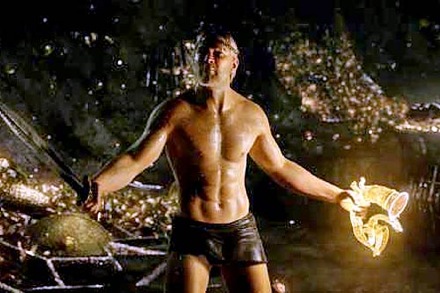
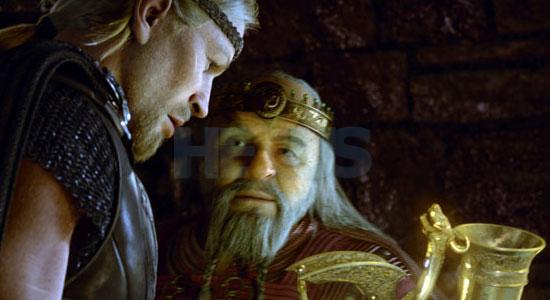
Much has been made about the motion capture animation and 3-D technologies in Beowulf, yet few of the critics (whose reviews I read) mentioned much in regards to what the movie and its technology are actually doing. A fair amount of critics seem comfortable to label the movie as a purely technical affair, a digital incantation of a boring story they read in high school. But in making these bland claims, these critics (if they can be called that) have not just misunderstood the film, but its source material as well. Strange is at may be to them, director Robert Zemeckis is actually after something with this movie, and he is uncharacteristically subtle about it. Beowulf is a deep exploration of the nature of heroism, and the manner in which we cling to hero myths. That Zemeckis has launched his inquiry into the hero myth with perhaps the quintessential hero's tale is no coincidence either.

Matt Zoller Seitz's review of Beowulf is one of the more thoughtful reflections on the film, not because he admired it, but because he's willing to examine the ideological undercurrents embedded within the criticism about the film, ranging from its digital animation to its humorous use of sexual imagery. Seitz certainly acknowledges its shortcomings, but like any good critic he realizes that plainly stated opinions about a film are pretty useless. In his more detailed criticism of the film, Seitz argues that it is much more going on than many are willing to see. He then offers a somewhat different approach to Robert Zemeckis' position in American filmmaking today:

"If indeed Zemeckis lost his way, he lost it in Reagan's first term. He's been on this quest -- applying technological innovation to mainstream commercial blockbusters -- for nearly two decades, starting with 1988's Who Framed Roger Rabbit, which employed motion-controlled cameras to let 'toons interact (often in elaborately choreographed long takes) with flesh-and-blood actors. Even then Zemeckis was accused of being too enamored with the mechanics of technology. From the Back to the Future sequels through Forrest Gump, Contact and What Lies Beneath, the gripes continued. (Only Cast Away escaped them.) The all-style-no-substance rap discounts the possibility that Beowulf's substance is embedded in its style. And it discounts the possibility that, in his determination to tell elemental stories with increasingly daring techniques, Zemeckis is one of the few true visionaries making studio blockbusters today."

Seitz later explains that the film's brains are in its images. This would seem like a fairly ordinary observation until you give it time to sink in. The majority of contemporary film criticism looks past the image, seemingly beyond the image, but really right through it. Movies like Beowulf are written off and placed into the "Hollwood blockbuster" box before viewers/critics even see the images, movements. Film criticism and a great deal of film studies start on the "inside", that which is suggested in or represented by the image, and then work out to the image. This approach to cinema is not about the cinema, however, but the Grand Theory thats supposedly underneath the images. In fact, the viscituded of grand theory are within the critic/spectator's own theoretical world. According to this method, the image is secondary to the ideas that the critic is looking for.

Of course, each viewer approaches a movie based on certain perspectives, values, and assumptions, but the argument here is not whether there is a "right" or objective way to assess a movie. Instead, an emphasis must be placed on seeing the image and drawing an inquiry based on that image and the relations it forges based on movement, shapes, color, and yes, narration. Only then can one approach any level of thematic depth and aesthetic value, rather than slapping images with pre-digested labels and comfortably packaging them into easily understood value claims. Rather than situating our interpretations of a film from the standpoint of whether it's "good" or "bad", critics should first see the images, react to them, and try to understand the how they affect us as spectators.

Concerning my experience with Beowulf, I'd say it was anything but straightforward for a number of reasons. I will readily admit that I approached it with a fair amount of assumptions about Zemeckis, the technology employed to construct the movie, my experience with the story over the last ten years, big-budget Hollywood moviemaking, etc. All of these factors contributed to how I saw and interpreted the film. After two weeks of thinking about it, I've still not really settled on much about it, suffice to say that it struck me. I've since learned that my inability to "place" the film is actually a good thing. (I learn that lesson over and over again, by the way.) In some ways, it was disappointing as an "action ride", but that's only because I was expecting that; all those neat shots and 3-D elements popping out at me. But the action was never really the point of the story, nor is it the focus of the movie, save for its final climactic sequence in which Beowulf fights the dragon.

Unfortunately I cannot offer much in the way of thematic or stylistic depths until I see it again. (MZS does a great job of that in his review, for those interested.) I'd therefore like to shift gears and explore the very thing that prevented me from experiencing the whole movie: the 3-D presentation. Seeing Beowulf in a digital 3-D presentation was my first experience with 3-D, in a feature length film, at least. I should note that I have been cautious about 3-D for quite some time. Rather than digital animation and photography, which I approach with great enthusiasm, 3-D technology is a different beast entirely, and not something I take lightly. Alas, my skepticism was confirmed. After the Paramount Logo and the opening title sequence -- with the stone letters coming from all angles to spell "Beowulf" -- I was entirely put off by the 3-D presentation. Simply put, the 3-D images felt like a gimmick, garnering "oohs" and "ahhs" at first, but then is ultimately distracting from the movie.

As I search my thoughts for a statement to follow such a generic claim, i.e., that the 3-D "distracts from the movie", I have probably uncovered a deep-ridden assumption that may account for why I approach 3-D technology so timidly. To me, cinema is the flatness. No doubt, 3-D makes for exciting moments and more involving action sequences because it blends the lines between the viewer's eye and the screen. But there's something deeply unsettling about it from the consideration of how we define cinema.

While a viewer can navigate the economy of dimension in a "flat" image, discerning its shapes and movements and making sense of them three-dimensionally, a 3-D image requires that the viewer add another lens between the eye and the image. The spectator still views a flat a screen, but the added lens of the 3-D glasses disrupts the dimensional relations of the image and alters the perception and interpretation of "flat" images. Thus, images seem to occupy a real space in front of us.

The 3-D experience is so "distracting" because it disrupts the spatial unity of the cinematic image. For those who approach cinema from a more formal theoretical perspective, 3-D technology makes cinema something else entirely. It is, quite simply, a betrayal of cinema. There are likely a good number of critics who would claim that digital animation and motion capture technology, rather than the r-D presentation, is more a "betrayal", but I would argue that cinema is built upon principles of movement on a flat surface. That's not to say that I'm advocating the "fore fathers" principle to explain why 3-D isn't cinema. (You know, the very foolish "It's what the fore founders intended" argument.) I feel that cinema is wide open with possibility, but once that motion is rendered off the screen or designated space occupying that image, one must wonder whether it's really cinema anymore, and, for that matter, what defines cinema at all.

Pat Graham, of the Chicago Reader, asks many of the same questions of 3-D movement relations and space. In a recent blog entry, he writes:

"The pictorial surface (aka window) seems primarily an occasion for helter-skelter effects. Not that it's a question of Zemeckis's doing this well or badly, it's simply the nature of the 3-D beast, what filmmakers automatically assume you'll be wanting to see—since why else do 3-D at all? Things flying out of the frame at indiscriminate angles, figures interacting (or not) at varying depths of the visual field: can't put all these elements in the same conceptual package, the mind-eye coordination isn't made for it. Not to mention the myriad irrelevant distractions: ceiling candelabras and whatnot floating seductively by you when the actual point of the scene lies elsewhere. It's hard to know which visual data to pay attention to, and by the time you've figured it out the critical dramatic moment's already come and gone.

But why should you figure it out—is it some kind of sadistic test? Because if you've been weaned on Renaissance expectation—that pictorial space has unity, that you take it all in with a kind of "global" awareness, all perspectival elements smooshed into one coordinating surface, the idea of what a fresco does, conventional portraiture or landscape (not to mention the "normal two-dimensional" filmmaking strategies Zemeckis purportedly employs)—this brave new visual paradigm can only seem jarring ... and probably disappointing. But yes, there's lots of random "reality"—details you can't help noticing whether they make any sense or not."


Graham recognizes the flatness of the cinematic image as an inherent quality of cinema. Flatness assumes a space between the spectator and the image. When the separation between spectator and screen is infringed upon, movement is perceived differently. Applying the same set of rules for cinematic interpretation to an altogether different kind of visuality results in a disjointed experience. These new spatial relations disrupt all senses of cinematic space as we've come to know it. We perceive them via interpretive schemata constructed on the principle that images that inhabit some kind of discernable space or surface, usually a screen. In other words, once the image jumps off the screen, it becomes a new kind of image, one that requires a different way of seeing than the one that has been constructed by over a century's worth of cinema.

Like drawing, painting, and even writing, part of the aesthetic beauty of cinema is internalizing the experience of sensory perception and rendering it on a seemingly restricted surface. The spectator can thus experience three dimensions through two-dimensional space. But the miracle of cinema is that through motion and sound, a whole new kind of experience can be created. Through its own spatial reality, it constructs a temporal world within which the limitations and infiniteness of human experience can exist, only in a different way. That's why, as Deleuze says, "the cinema is always as perfect as it can be." Whether its real or artificial doesn't seem to matter.

More on the the animation end of things later...

The school of reflexivity

If I were to say there is one overriding concept that most defines, influences, and reflects cinema as a narrative medium, a technological device that communicates, an artistic expression, etc., it would be reflexivity. It defines every aspect of cinema as a social practice, an aesthetic model, and a medium of many media. For me, reflexivity captures the illustrious diversity that cinema represents, from the commercial to the artistic, and everything in between. So then what is reflexivity? It's a difficult idea to label with a simple definition, let alone think of it as something that can be "applied" to the study of something like cinema or various other media. It is not so much a singularity, but a plurality of meaning. I've been wrestling with it for years now as a student of communication studies, particularly media and culture, wherein I have been not been driven by questions of "What?" (which would be the project of empiricism) or "Why?" (Philosophy's question), but rather "How?". Of course, this is a simplification of the discipline, but it rather pointedly evokes the difficulty of approaching cultural meaning making and the ideological tensions that underlie the production and consumption of media in global and political economy.

At times, narrowing my focus to studying cinema both ignores and involves the theoretically rich study of communication and its implications for cultural and individual agency. Many critics would like to believe that a movie is just a movie, there for my critical assessment. But what informs me as a critic, as a privilaged spectator passing judgment on a movie's "aesthetic quality"? How do I assume that role, and under what assumptions am I operating when I look at moving images on a screen and attempt to measure their value? Certainly, there are a innumerable factors that contribute to my position as a watcher, lover, and critic of cinema; systems of values and beliefs that together constitute my consumption and understanding of cinema. But how do I individually, and we culturally define what we call "cinema" or "movies"? It is indeed a unique intersection of a various media, technologies, and narratives that have developed through various cultures over thousands of years. And only now are we in a position to understand it through various theoretical lenses, such as Marxism, psychoanalysis, cognitivism, formalism, neoformalism, etc. The fracturing of cinema studies into varied schools of thought as diversified how cinema is viewed, relate to, and understood. But despite the disparity among these various approaches, the increasing level of diversity signals the necessity that elusive concept of reflexivity.

But, again, what is reflexivity? I'm not sure it can be understood directly for the very reasons mentioned above. It's just too big to try to understand linearly. But in my recent reading, I came across a wonderfully stated approach to reflexivity, one that broadly encapsulates reflexivity, yet avoids the very clear-cut tendencies it critiques. It's from Gillian Rose's book, Visual Methodologies:

"Reflexivity is a crucial aspect of work that participates in the so-called cultural turn. There, reflexivity is an attempt to resist the universalizing claims of academic knowledge and to insist that academic knowledge, like all other knowledges, is situated and partial. Reflexivity is thus about the position of the critic, about the effects that position has on the knowledge that the critic produces, about the relation between the critic and the people or materials she/he deals with, and about the social effects of the critic's work."

That summation captures the feeling and presence of reflexivity. For me, reflexivity is a constant state of repositioning and revisioning how I see what I see, and how I perform what I perform. Its the abstraction that what makes it so essential, so necessary in our individual/cultural being.

Sunday, November 18, 2007

Tommy Lee Jones and his masterpiece

"If you turn the movie's sound off and just watch the movement of it, and try to look at it the way a dog or a bird would, not recognizing any shapes, it's quite pleasing. It's a balletic event. It moves beautifully; the shapes, the colors have an abstraction. It's about movement."
- Tommy Lee Jones, director, The Three Burials of Melquiades Estrada (2005)

Tommy Lee Jones is one of the finest actors working today. His facial expressions, body movements, and speech patterns are mesmerizing; communicating so little, but suggesting so much. Watching his film, The Three Burials of Melquiades Estrada, I discovered that his mastery over the craft of acting has carried over to his direction, which has that same sense of understated lyricism that defines his best performances. As soon as the film ended, I started it again with the commentary. Watching the movie with the commentary, I learned that Jones is not just great actor and director, but a outstanding critic as well! That it's his directorial debut is perhaps most staggering.

Maybe his knack for these seemingly different modes of expression, i.e., acting, filmmaking, criticism, stems from his understanding of cinema, which he suggests in his commentary. The quote (at the top) was something he mentioned seemingly off-the cuff, in his down-trodden voice, like he's merely making any plain observation; which it is, and it isn't. Turns out the man himself is just as soulful and elusive as the characters he inhabits, not to mention even more compelling. There's no "artist's genius" attitude or pomposity in that statement. It spoken so simply, without any complicated language or scholarly terminology. Yet it is as deep an insight that can be offered about the film. He makes statements like these throughout the commentary. Listening to him reflect in his quietly introspective sort of way is inspiring. It's like he's channeling all the great artists and thinkers that have inspired his art, which this film certainly is. His knowledge and demeanor may speak to not just to his lyrical artistry, but also his strong sense of criticism. After all, as my loyal readers are aware, I've argued to great extent in previous posts that criticism is inextricably linked to cinema.

I am mentioning this quote (at the top) in particular because as I was thinking about the film, I couldn't stop wondering how Jones envisioned its compositions, finding such beauty and benevolence in the most simple of things. Unlike many actor-turned-directors, he seems to understand that acting/actors, while important, are elements of the larger picture, or image. That said, the best movies find rhythms and poetic impulses through the most simple observations of people, or lived experience in general. Good cinema is therefore focused on the image, the framing of a narrative. It's not about what's on screen or suggested underneath, but the relationship between the image and that which it depicts. In that convergence, the spectator becomes part of the image. We process it according to a wide array of physiological and social principles, all stemming from the pleasure of pure movement -- shapes, and colors -- and the primal urge and necessity of communication, or narrative (which is really just another word for communication).

I realize that I've not included a single observation regarding the story, plot, or characters. This is intentional, but I realize just the same that for those who haven't seen the film, it may be difficult to draw any connections with no knowledge of the more concrete elements of the movie. Therefore, I'll let someone else handle that explanation: Jeff Shannon, of Amazon.com, who is much more adept than myself in the art of plot commentary. But I'm singling out his account because it's suggestive of those lyrical moments that the film is really about. Shannon says:

"While the majority of critics and Oscar®-voters heaped praise upon the "gay cowboy" breakthrough of Brokeback Mountain, Jones delivered this equally resonant, elegiac study of male friendship in a Western setting, crafting a flawless parable of borderline existence on the border of Texas and Mexico. It is there, amidst some of the most beautifully bleak landscapes in recent American film, that Jones and screenwriter Guillermo Arriga (Amores Perros, 21 Grams) set their existential quest for meaning, focusing on the honor-bound commitment of Texas ranch foreman Pete (played by Jones with a heavy heart and deep moral conviction) to return the body of illegal Mexican immigrant ranch-hand Melquiades Estrada (played in flashback scenes by Julio Cedillo) to his preferred resting place in the Mexican wilderness. Estrada had been accidentally shot by Mike (Barry Pepper), a newly-arrived U.S. border patrolman, and Pete forces Mike to participate in his cross-country ritual of duty--a voyage of revenge and redemption that will change both men forever, and bring some semblance of meaning to the senseless death of Pete's good friend. In triumphant collaboration with cinematographer Chris Menges, Jones carefully instills his superior cast (including Dwight Yoakam, January Jones, and Melissa Leo) with the slow, desperate rhythms of lives on the border (of Texas and Mexico, and life and death), prompting many critics to draw praiseworthy comparisons to Sam Peckinpah's thematically similar 1974 drama Bring Me the Head of Alfredo Garcia and the exquisite absurdities of Luis Bunuel. Whatever your own reaction might be, Three Burials is not a film to view or respond to lightly; there's humor and more than a bit of madness to this great, inquisitive film, but Jones is looking deeply into the soul of humankind, and he dares you to draw your own conclusions about the journey Pete and Mike have taken."

Strange as it is, the film is subtly operatic in its climax. It brings story elements and thematic details together, as any classical climax would, while continually revealing more and layering what's there. Somehow, it's where the film was always going, if it was indeed "going" anywhere at all through it's journey. That exact question is what Jones so deftly explores in his subtle compositions, morbid humor, and quirky observations of life on the border, literally and figuratively. Although the film is linearly structured narrative for the most part, it evokes the underlying tension of all narrative (i.e., communication) via the juxtaposition of the desire for structure and the complete absence of it, as in instances of untimely, senseless death. Like Pete (Jones' character), we are all searching for that structure, yearning for it, needing it, even if it may not really be there.

Those who claim that cinema is dead, or is not an art, or that all movies are the same, should take the time to see this film and take it in. The Three Burials of Melquiades Estrada is that perfectly intangible experience of cinema, both celebrating and ruminating on narrative and faith, and the extent to which they define experience, let alone each other. It's poetry, fable, and myth. Living, dreaming, dying.

Friday, November 9, 2007

Criticism in action: the hard-knock lives of film critics

Although I don't need to point anybody reading this in the direction of Jim Emerson's indispensable blog, I would like to take note of something that's happening there right now: critical debate. It's there unfolding before you in (almost) real time and in all of its impulsive and ideological glory-- the difference in perspective, the faux-reverence, and the rising frustration in attempting to articulate your thoughts and feelings when another person interprets them differently than how you intended.

With the release of No Country For Old Men today, the (mostly positive) reviews have been piling up over the last week, bringing into full focus the scattered critical glimpses of the film from when it screened at Cannes over the summer and more recently at the Toronto Film Festival. I remember Jim's enthusiasm for the Coen brothers' new film back then, so I wasn't surprised to see him visit the topic again on the day of its release. But his piece is much more interesting than your typical print review. Instead of sharing his opinion and interpretation of the film within the identifiable, safe conventions of structured journalistic film criticism, Jim instead voices his love of the film by taking issue with Jonathan Rosenbaum's more negative perspective. He does so rather defensively but with complete conviction and insight. Sure, it's impulsive and (as Jim admits) somewhat agressive, but it's real, as is the debate to follow.

Afer reading the debate, it's clear that Emerson and Rosenbaum are each operating under different assumptions and thus occupying vastly different ideological stances, not only with regards to the practice of film criticism, but in how they understand the ideas brought on by the film and how they approach seeing and responding to cinema in general. Their debate is fascinating on the grounds of pure content, with Jim's more form-based approach seemingly at odds with Rosenbaum's content-based views on examing cinema. This is of course overly simplistic; I would need to see the film about which they are debating to really probe their difference in perspective. But to me, that seems almost besides the point.

What's really important here is that how they're choosing to engage each other reflects more about the ideologies as writers and critics than what they are actually saying. These are two writers I respect immensely, and I feel downright lucky be to treated to a dialogue such as this, let alone be able to participate in it (which I cannot, since I haven't seen the film). And seeing them butt heads as openly as they are and in this forum is a blast. It brings to mind the harsh realities of film criticism, i.e., the very subjectivity of it all, while also highlighting the importance of this kind of writing in general; so raw and upfront and in the moment, where real ideas are discovered and eventually cultivated through the processes of rumination and editing. But here, comments have an urgency and convinction that is often filtered out of most professionally edited and handled writing. That the dialogue is between two well-seasoned professionals whose work we mostly know after those thoughts, feelings, and ideas have gone through those industrial processes is what gives it that unique flair. You won't find this kind of debate in most other forums (at least not that I can think of), other than perhaps academic conferences, which are usually sunk by their properness anyway.

Posts like this and the kind of fiery dialogue they incite reveal many of the strengths and weaknesses of film criticism, and are where real critical discourse lives. It is stripped down of the image of the critic sitting on a perch, walled away from real dialogue and debate, where s/he can comfortably judge and assert his/her own pompous views. Here we see that debate in motion and can in turn understand kind of life a critic leads (which isn't easy), and the kind of discourse s/he attempts to responsibly participate in. This discourse can be both illuminating and frustrating. Sometimes there is understanding, and new perspectives can be achieved. Other times, debate can be like two people speaking in different languages. This particular case seems to be a bit of both, recalling the pleasures and annoyances of trying to perceive a piece of art, interpret it according to universal meaning structures as well as personal ones, and then share with others with the hope of providing insight. This can be successful in some instances, but sometimes it isn't. It's the life of a critic, and it's all right there in this post/discussion. It's great stuff, and yet another reason why this form of writing lends itself so well to critical commentary.

I have not seen the film yet, mind you, but after reading each comment following the post, I am motivated more to do so.

Tuesday, November 6, 2007

Ratatouille on DVD

It's not often you'll find me endorsing the purchase of Disney commodity, but with today's DVD release of Ratatouille (2007), I'll make an exception. I saw the movie back in July and was completely dazzled; so much that I described it as one of the most engrossing cinematic experiences I'd had in years. One could go on forever trying to explicate the depth of the story or characters, but it's the sumptuous compositions that elevate this movie to sublimity.

Here's a passage from my original review wherein I try to focus on these these more intangible qualities:

"Ratatouille, despite being purely digital, exhibits a real love of the art of filmmaking: the cinematic staging of actors and mise en scene, the simple beauty of composition, the depth-of-focus in how the camera 'captures', and the shear viscera of movement. This movie is not over-edited, but rather enjoys its 'filmness' despite not existing as 'film'. Interestingly, [Brendon] Bouzard was responsible for some of the finest writing I've come across about another film which blends the photographic with the digital: Miami Vice. In different ways, both Vice and Ratatouille represent crucial works in the advancement of the medium of digital cinema. They each acknowledge and romanticize their photographic origins and properties, but which actively pursue new syntactical approaches to how we see cinematic images and construct the world of a film in our memory.

There are moments in
Ratatouille so visually arresting and yet challenging at the same time. Its images do not exist for the spectator to become a passive recipient of information. These images actively involve the viewer in the construction of the "world" of the movie, which (in my mind) is closely connected to a movie's affective abilities. As we process the visual, auditory, and narrative information, we construct a knowledge of the cinematic space occupied by the characters and action. Too often, this aspect of film viewing goes unrecognized in criticism, but I maintain that the construction of cinematic space is crucial; specifically, how a viewer makes sense of a moving image and constructs a relational memory of its elements. This is no doubt an intricate process that I couldn't even begin to lay out in precise detail, suffice to say that the film exhibits a joy for movement and cinematic space that takes advantage of its digital and analogic properties. The end result is a film with so many memorable moments, images, and feelings that is both incredibly subtle and accessible to all viewers.

Its richness features in moments both large and small, from the detailed atmosphere of the film's rainy opening shot, to the sweeping majesty of Paris when it is first revealed. Amazing detail went into the construction of every aspect of this movie; its tones and moods come through in every scene and every shot. Sometimes, one can notice such details; others have to just be enjoyed to be understood."


Indeed, the fantastically realized world of the film is both real and dream-like, breaking simple barriers between "digital" and "analog" in how its fluid movements and images enable the viewer to see, hear, and feel its linear story and characters in a nonlinear way. Brad Bird finds amazing subtlty in what seems to be standard Disney material. Its dance between realism and moody surrealistic rhythms results in an intoxicating visual and narrative experience the likes of which Disney has rarely produced. Ratatouille, in its transcendence of quantifiable boundaries and categories, accomplishes what the best of digital cinema can: it destroys the walls between animation and live-action, film and video, realism and fantasy. Seeing it as a critic and lover of cinema, I couldn't help but feel like the discerning critic, Anton Ego, tasting the dish of ratatouille in the final moments of the movie. Great cinema is an experience that washes over you; sometimes that's the best way to describe it.