Thursday, July 21, 2011

Week With a Wizard, Day 4: Harry Potter and the Goblet of Fire

[Re-posted from The House Next Door.]

As the middle entry in the book series, Harry Potter and the Goblet of Fire occupies a curious position. Much of its story is inconsequential, yet it contains sequences of wide-spanning significance that vaunt the tale into new and darker depths. This posed some challenges for the film adaptation, which needed to serve as a gateway to the later installments' more serious storytelling. Additionally, it also had to deal with how to maintain interest in a set of characters who are so established that they may begin to grow stale. Even though the third film, Harry Potter and the Prisoner of Azkaban, breathed much-needed life into the series, the dramatic tonal and aesthetic changes it brought about required that each successive film provided a distinct enough vision while remaining consistent with the tropes and styles already established. This struggle is evident in the otherwise ambitious and swift version of Goblet of Fire (2005), which signals a change in storytelling rhythm right at the start.

The movie opens with a long, winding shot of a snake slinking in-between tall grass and tombstones and into a dark mansion to meet a shadowy figure assumed to be a still-weakened Voldemort. This is eventually revealed to be a recurring nightmare for Harry (Daniel Radcliffe), who we rejoin after he's already escaped from the Dursleys. Harry and company set forth to the Quidditch World Cup, a wizard sporting event set among the English countryside where Muggles are ignorant to a towering stadium. These early passages are dense with activity and are frenetically paced, which is a welcome change after three films that take their time to unfold. Perhaps the reason for such rapidity is that the film condenses nearly 150 pages of Rowling’s long text into so little screen time. Working with a novel of roughly 800 pages, screenwriter Steve Kloves can no longer afford to slightly abbreviate the text. This turns out to be an asset to the later films, which are adapted from longer, more intricate novels and tend to find their own beats and rhythms.

These early scenes set the stage for sport and competition to feature prominently. Upon arrival at Hogwarts, the children learn that the school will host the Tri-Wizard tournament, an Olympics-like competition in which students from international schools of wizardry and witchcraft compete for one trophy. As a vehicle to move the plot forward, the tournament provides a steady point of interest. And the notion of an international tournament would seem to allow director Mike Newell to present a vaster world of magic that is only hinted at in the first three films. But this sense quickly evaporates in an early scene portraying the students’ arrival at Hogwarts in glaring and (almost certainly unintended) comedic fashion. The two sets of visiting students embody profound stereotypes of cultural Otherness. There’s the synchronized female group, each of whose perfectly straight blonde hair and uniform movements bewitch the boys with their gracefulness. Then we have the hyper-masculine school of muscle men donning dark colors and parkas while back-flipping through the Great Hall.

The scene plays like an original SyFy Channel film and reflects Goblet of Fire's general tendency to serve up exaggerated characterizations and performances. Save for Harry and Ron, nearly every character in the film is subject to over-expressive speechifying. All of the new characters and a good deal of established ones act and speak with protracted urgency, as if to suggest that everything they say carries weight. Many of the actors do not appear comfortable in their surroundings. Michael Gambon’s Dumbledore is especially notable for his aggressive behaviors, at one point even shoving Harry against a wall during interrogation. Although Gambon offered a more youthful take on Dumbledore in the previous film, his outright fierceness in Goblet of Fire is off-putting. (In later installments, particularly in Harry Potter and the Half-Blood Prince, Gambon is finally given free reign to make Dumbledore the contemplative, tender wizard he is portrayed as in the novels.) Moreover, these performances are not assisted by Newell’s cartoonishly hackneyed shot framings, e.g. the introductions of tournament entrant Viktor Krum (Stanislav Ianevski) and minor villain Barty Crouch, Jr. (David Tennant), in separate scenes.

In the wake of Prisoner of Azkaban, such elements are conspicuous. Alfonso Cuarón offered a more intimate and practical take on the wizarding world, using the imagery and surroundings expressively. With Goblet of Fire, Newell places more emphasis on character and performance to the extent that many dramatic scenes lose their potency (many of the adult actors seem as though they are performing in a stage production).

The hokey representations on display here tend not to mesh with the scope of the tournament games, which include underwater bouts with mer-people and navigating an ominous maze. These scenes are, for the most part, exciting thanks to Newell’s deft talent for action sequences and creating tension. The director's eye for action becomes quite clear with a sensational dragon chase among the rooftops of the school. Aided with soaring fanfares from composer Patrick Doyle (taking the reigns from John Williams), these scenes are fluid and appropriately epic.

Goblet of Fire's real achievement is its portrayal of the sexual discomfort of its young characters. This is where Mike Newell’s emphasis on performance (or overperformance) actually works as an asset, particularly as compared to the subtler expressions of intimacy and closeness in the third installment. If Cuarón's film represents the understated beginnings of sexual discovery, then Goblet of Fire takes the next step and turns the discovery into bewilderment and frustration. Newell centers on all the small actions and posturings that accompany a teenager’s inevitable acknowledgement not just of sex, but also of the social practices drawn around sex. Newell elicits every uncomfortable moment he can from his actors: Harry and Ron’s (Rupert Grint) struggle to find dates to the Yule Ball are funny, yet sweet. And Harry’s nervous proposal to his crush is a beautifully observed moment of the shame and pride that often follow after finally mustering the courage to say something to someone with whom you’re smitten.

Goblet of Fire is most effective as a look at the fleeting trivialities and growing uncertainties of young adulthood—an age at which you are old enough to experience a complex range of feelings but do not yet possess the tools necessary to understand them. The young characters are burdened with apparently trivial matters, yet Newell seems to understand that these things only appear trifling in retrospect. It is a nice balance of observation and empathy. We are still at a distance, but are slightly more endeared to the characters for witnessing their unhinged and subsequently guarded behaviors.

The innocence of these encounters serves as a nice backdrop for the climax, when Harry faces down the newly risen Lord Voldemort, played with wily delight by Ralph Fiennes. It is not until later in the series that Fiennes gives you a sense of the character’s calm sadism and profound disdain for non-pure-bloods. Here we are exclusively focused on the fleshy embodiment of the arch-villain who until this point has lurked only in shadow and memory. His pale skin and reptile-like nose complement his skeleton-like body structure, which is forceful and domineering, particularly over the feeble Harry. The dead-serious nature of this scene contrasts heavily with much that has gone before. Everything else wipes away in one single moment.

That Newell doesn’t handle the acting or his over-visual approach with much subtlety can be frustrating. I noted at the start of this essay that Newell’s economical aesthetic in some ways resembles Chris Columbus’ style with the first two films. But this assessment is not entirely warranted, in part because the strengths of this film consistently outmeasure Columbus’ efforts. However, there is a more general point that bears mentioning. While Azkaban unraveled the workings of Columbus and offered a fresh take on the tone and feel of the series, Goblet is more significant as a transitional episode in the narrative. It is understandable, then, why this film attempts to take on disparate elements of the three films that preceded it, before culminating with events that shift the course of the story. Given its place in Rowling’s opus, the material perhaps doesn’t lend itself to the kind of brooding vision that Cuarón provided with the third film. That’s not to say that Newell would not have benefitted from fewer goofy close-ups and an overall stronger aesthetic. However, placed in context, Goblet of Fire widens the scale of this fantasy universe and fashions a solemn emotional resonance that—despite needing to still develop—no longer requires the stylings of the previous films going forward.

Week With a Wizard, Day 3: Harry Potter and the Prisoner of Azkaban

[Re-posted from The House Next Door.]

Early in Harry Potter and the Prisoner of Azkaban (2004), after an unpleasant encounter with a hooded creature known as a dementor, Harry (Daniel Radcliffe) looks through the window of the Hogwarts Express, his reflection projected against the rain-soaked night. The image wipes to the exterior of the familiar castle as a children’s chorus sings a rhythmic, medieval-sounding tune with words taken from Shakespeare’s Macbeth. We then enter the Great Hall, where a choir of students with frogs in hand concludes the song with the forceful and ominous phrase, “Something Wicked This Way Comes.” This is one of the film’s many small departures from author J.K. Rowling’s source material, which had been followed to a tee in the previous two films. Both playful and sinister, the song (titled “Double Trouble”) turns up in various capacities in the score and permeates the proceedings. But its first appearance in the scene described above boldly announces a new direction in the Harry Potter series. What once felt so clean and mechanical under the even hand of Chris Columbus suddenly bleeds with mystery and mood.

Director Alfonso Cuarón shakes up Columbus’ work with changes extending beyond small alterations or additions to Rowling’s text. Some of these changes were inevitable, such as the replacing the late Richard Harris with Michael Gambon as Dumbledore. But even with a new actor in the role, Cuarón essentially re-imagines the character as more jolly and quick-witted. Innumerable franchises have undergone reboots in the years since, so all these changes don't seem as significant now as they did then. But for a series that is partially built on maintaining a strict level of sameness, Cuarón pushes the envelope in challenging ways, and the shift in tone and aesthetic deepens the film’s emotional underpinnings.

A good example of this is how Hogwarts is depicted. I mentioned already that the music has a distinctly medieval flavor, and this carries over to the entire castle. In the first two films, the castle is more gothic with its imposing stone structures and chilly, fire-lit hallways. Here, the spaces within the castle—and more generally among the students—is more intimate. The corridors are smaller, brighter, and less domineering. Rather than feeling like a cold, lifeless locale, Hogwarts has its own personality in Prisoner of Azkaban. This can partly be attributed to the newly designed school grounds, which have rolling hills and boulders, a courtyard with trees and bushes growing outside the windows, and a creaky corridor bridge that look out onto the damp grounds. Even the Whomping Willow seems to be happier in this Hogwarts, as it delights in swallowing birds that cheerfully fly about the school grounds before meeting their doom among the tree’s dancing branches. I could list many details that give the castle and school grounds a personality, but to put it more generally, by making Hogwarts feel like it is a part of some kind of larger environment, it takes on a greater life.

Cuarón's eye for environments serves him well, from the snowy pathways of Hogsmeade village to the tall wooden towers of the Quidditch field where Harry flies through beating rain and lightning in pursuit of the golden snitch. While the changes to certain locales affect how they look, they more importantly alter how they feel. Moreover, the characters are now an integral part of the surroundings, often framed against and defined by them. Cuarón's deft use of foreground and background, in particular, aid in creating fully dimensional, expressive images in which both location and characters are carefully observed with a subtle balance of distance and intimacy.

Cuarón's aesthetic seems perfectly suited to the narrative, which focuses on Harry’s near-despondent state. Unlike most other stories in Rowling’s series, the plot of Azkaban is less driving and more focused on brooding dread. This provides Cuarón good opportunity to amplify Harry’s loneliness and uncertainty. He is no longer a tragic victim of growing up without parents, but is instead actively angry that he cannot have them in his life. The plot deals directly with the looming threat of a man named Sirius Black (Gary Oldman), who is thought to have betrayed Harry’s parents and directly contributed to their murder by Lord Voldemort. Black has escaped from Azkaban prison and now presumably aims to hunt down and kill Harry at Hogwarts. In light of the rising threat, dementors—prison-keepers of Azkaban—are stationed outside the castle to intercept Black and bring him back to the wizard prison. These creatures levitate motionlessly, their shredded hoods caressed by the wind. They have the ability to drain the life out of anything around them. Despite not playing an active role for much of the film, their presence is chilling. Cuarón portrays them as deliberate, methodical, and lifelike but without fully seeming alive. As such, they become manifestations of Harry’s fears as well as his doubts and inadequacies.

Though the film’s focus rests with Harry’s growing state of melancholy, Prisoner of Azkaban aptly counters the despair with a sense of youth and joy. Harry has a blissful personal moment early on where he rides a winged beast above the castle and the lake. Flying high, he is afforded a brief reprieve from the problems that await him below. Gliding along the lake, Harry outstretches his arms and enjoys a momentary ecstasy that further punctuates his sadness. In another instance, Harry fumbles beneath his bed covers and performs spells while pretending to be asleep each time his uncle enters the room. Allusions to masturbation aside, this shows Harry using his wizard fantasy to retreat from the outside world. It is a simple, but delicate moment. The frequent hints of blossoming sexuality elsewhere are a nice touch as well, in particular because they are not made overt. There is an intimacy to the way the trio of young actors (Radcliffe, Rupert Grint, Emma Watson) interacts. They have a comfortable rapport with each other and appear to naturally move and act in ways they don’t even quite fully understand.

As Prisoner of Azkaban moves toward its conclusion, it presents oddities ranging from shape-shifting animals to souls being sucked out of bodies. It's all pointedly absurd, but since an emotional anchor has already been so effectively established, Cuarón maintains course. And surprisingly, while the climactic time travel sequence is depicted with much humor, it also coldly signifies Harry’s inability to change time and rid himself of a memory he does not even have. Despite his ability to manipulate the means by which he experiences time, he cannot alter the memories and feelings left behind by its passage.

Ultimately, Harry’s journey stops short of delving into total gloom. The longing images and emotional undercurrents never coalesce, as we might wish. They instead allude to a darker road to come; indeed, Prisoner of Azkaban ends on a jubilant note with an image suggesting that even Harry’s rare excursions of fun are soon to exit his life. That the film offers little payoff for its brewing feelings of sadness and pain does not reflect negatively on it. While the movie is satisfying on its own, it serves a critical function in the broader scheme of things. Though the arc of the plot is barely progressed, there is an emotional core here that resonates back to the earlier entries and ahead to the future installments. Perhaps the most remarkable thing is that the film finds subtlety and rich aesthetic expressions not just within the established world of the series, but also within the aesthetic and narrative frameworks of popular cinema.

Tuesday, July 19, 2011

Week With a Wizard, Day 2: Harry Potter and the Chamber of Secrets

[Re-posted from The House Next Door.]

In my commentary on Harry Potter and the Sorcerer’s Stone, I observed that director Chris Columbus seemed to rely heavily on production values to create the sense of wonderment that was inherently absent in his images. How a film moves—from scene to scene, shot to shot—is not entirely dependent on massive sets, panoramic effects work, blaring symphonic music, and moody lighting. As I set out to watch Harry Potter and the Chamber of Secrets (2002), the second and final entry from Columbus, I paid close attention to the director’s visual sensibilities and how they compared to the previous film.

To his credit, Columbus attempts to add deeper visual dimension to this sequel. His camera is more mobile; it hurdles, swipes, and dives every which way. This is clear in the opening shot, which starts high above the clouds, zooming past the title before maneuvering over the rooftops of suburban Britain and down to Harry's (Daniel Radcliffe) window. It's smooth, but moves so quickly that it reeks of artifice. Columbus is in such a hurry to get to Harry’s window, as well as to whip around Hogwarts castle between scenes, that the film feels as though it’s playing on fast forward. Another trick Columbus saves for this go-round is the angled shot to signify mystery or villainy. However, like the camera movements in general, these dramatic tilts are so hasty and exaggerated that the effect is mostly hokey. Despite these flourishes, it quickly becomes evident that when he’s not swiping or tilting the camera around, Columbus’ approach is still the same: Action, Reaction. Repeat.

But let’s get into the story. This is, after all, the second installment in the series, so it shouldn't need to waste time with unending exposition and set-up. Alas, the opening passages of Chamber of Secrets are marred by unending exposition and set-up. We have various comings and goings, a few new characters (notably Kenneth Branagh, whose pompous Gilderoy Lockhart brings much-needed life to the film), and no sense that anything of interest will happen at all. Like Sorcerer's Stone, screenwriter Steve Kloves adapts the novel so faithfully that the film suffers. This, coupled with Columbus’ vapid directorial style, suggests that we'll be getting more of the same. But after taking its time getting the characters back to Hogwarts, Chamber of Secrets eventually displays an edge largely absent from the first film. There is a spirited sense of camp that matches well with the darker themes of racial purification and bigotry. Storytelling-wise it is still a mess, but this film has a sense of authorship that, however hokey, sets it apart from Sorcerer's Stone. Columbus' hand is more assured, particularly with action sequences. The final duel, for example, is surprisingly well-orchestrated: Harry takes on a giant snake that has been terrorizing the castle. When the serpentine beast comes into sight for the first time, it is a classic moment that recalls the joyous images of monster movies past. Unlike many CG effects, the creature has weight and dimension and carries with it a genuine sense of awe.

Another highlight finds Harry and Ron (Rupert Grint) in the Dark Forest surrounded by spiders the size of Buicks. Harry’s desire to know who opened the chamber of secrets bounces off Ron’s fear of the increasingly threatening spiders, which appear larger with each successive glimpse. The scene creates tension and builds to a strong payoff, with an army of spiders storming through the woods in pursuit of the heroes. This sequence, like the snake-dueling scene, shows Columbus’ direction coming alive. It has less dialogue, puts aside plot and seems to exist unto itself—a fluid series of images that blend the frightening and the absurd.

Taken together the pair of Sorcerer’s Stone and Chamber of Secrets serve an explicit function—to provide a sterile visualization of Rowling's text. They don’t resonate beyond the relatively inoffensive entertainment they were designed to provide. As I noted in my commentary on Sorcerer’s Stone, both of the Columbus-directed entries feel insulated from the subsequent movies and are thus difficult to situate in relation to the overall arc. But if I am to adopt a more positive view, Sorcerer's Stone and Chamber of Secrets competently create a foundation of characters and settings and establish a world that has since been developed into a far more interesting one. Columbus’ baseline aesthetic may have been the right approach for providing such groundwork. I can say with confidence that, if nothing else, both films managed this task. They supplied the first images and impressions that, against all criticisms, have permeated the series and fostered its growth.

Monday, July 18, 2011

Week With a Wizard, Day 1: Harry Potter and the Sorcerer's Stone

[Re-posting an article I've written for The House Next Door. It is the first of a series of articles looking at all eight of the Harry Potter films.]

Few film franchises have been more constitutive of the modern movie spectacle (and the digital age of cinema) than Harry Potter. The series is made up of eight movies spread evenly over a ten-year period, each a handsomely mounted production featuring a considerable cast of respected actors. With a collection of record-breaking bestsellers serving as a foundation, the consistently high box-office draw of the films was a foregone conclusion. Yet for non-loyalists of the book series, the adaptations' densely plotted stories and long running times all but demand a general knowledge of the broader story. This, coupled with the critic-proof nature of such a popular series, perhaps suggests that the Harry Potter films are not worthy of serious critical attention.

But with each new movie, my growing feeling is that these films may coalesce into something rare in the lexicon of sequels and franchises. Whereas so many movie series slowly or abruptly abandon ambitious storytelling and/or filmmaking in favor of selling the brand, the Harry Potter series is marked by what seems to be a simple and persistent earnestness, as if all the parties involved—from actors to studio heads—wanted to do good work. Moreover, the films also evolve stylistically and aesthetically, each installment facilitating stronger maturation of storytelling and character. The result is a compelling series that defies traditional stereotypes of blockbuster moviemaking.

In this week-long series of commentaries devoted to the Harry Potter films, I will hone in on notable aspects of each individual movie while maintaining a sense of the larger mosaic. Topics will range from thematic undercurrents and visual styles (I hope to show how the films develop a serious, even challenging visual language that both reflects and informs current traits of the modern blockbuster) and will also touch on more subtle or obscure details that deserve heightened focus. I am not interested in definitively deciding which parts are superior to others. I certainly am partial to certain installments, but the goal here is not simply to document the strengths and weaknesses of each respective film. This is a collection of personal reflections that will articulate why the Harry Potter series warrants more serious consideration.

Now that I’ve established the ground rules, let’s look at the first installment, Harry Potter and the Sorcerer’s Stone (2001). It's pleasant enough as an introductory episode but is somewhat challenging to view 10 years later. That is to say, I found myself incapable of ignoring the glaring contrast between the film I was watching and the more recent Potter entries. The players and most of the locations are the same, but the look and feel is entirely different. Despite establishing the characters and world that eventually develops over the course of the series, both this installment and its follow-up, Harry Potter and the Chamber of Secrets, now seem isolated from what follows (perhaps in part due to the dramatic changes brought by Prisoner of Azkaban). Nevertheless, this film along with its immediate successor is fascinating to see again, perhaps because it is so curiously detached from the wonderment and magic it seeks to conjure.

When I first saw Sorcerer’s Stone, I was lock-step in agreement with Roger Ebert that it was “a red-blooded adventure movie, dripping with atmosphere, filled with the gruesome and the sublime.” For years I defended the film against its detractors and encouraged more serious-minded moviegoers to see it. And though I experienced some of the things in Ebert’s description while watching it again, these sentiments more resembled a kind of channeled nostalgia than something I was actively feeling.

Some of the most interesting passages occur early on. After a short prologue swashed in campy mystery (punctuated by a long-bearded wizard and pointy hat-donning witch rendezvousing on a foggy night), the film settles into a cartoonish mood with the introduction of our 11-year-old hero (Daniel Radcliffe) imprisoned in suburban England. He lives in a cupboard under the stairs in a bright home whose walls are coated with hideous wallpaper. But it isn’t long before an increasing number of owls overrun the neighborhood to deliver young Harry his acceptance letter/s to Hogwarts School of Witchcraft and Wizardry. The animated tone of these introductory scenes, while bordering on irritating, is weird enough to keep the film from sinking, but afterwards Columbus regrettably tones down the silliness, with only a handful of characters serving to liven up the affair.

The goal is seemingly to create an atmosphere of innocence, discovery, and—as Columbus never allows you to forget—magic. He wants you to know this with every epic shot and every repetition of the now-famous musical theme. But despite these proclamations, the general aesthetic is banal. Every character, every significant action, is framed with staggering exactitude, to the extent of becoming suffocating. It’s worth pointing out that the movies that serve most clearly as narrative and visual influences for Sorcerer's Stone—from The Wizard of Oz to Willy Wonka and the Chocolate Factory—have been framed and presented with similar directness. But with those works, the sense of the strange and incredulous saturate the viewer and unfold with less haste. By contrast, Columbus is always in a rush to get to the next point on the schematic: the next line of dialogue; the next shot; the next scene. This is a film charged with immersing the viewer in an entirely new world, and it is presented as if it were a soap opera. And when Columbus pulls back to give us the spectacle, the strain with which he attempts to elicit a big response is glaring. Consider, for example, the first reveal of the castle, accompanied by the requisite “ooh”-ing and “aah”-ing in the musical score. It should be a monumental moment. All of the signifiers are present, but the effect is hollow.

The plot structure is worth looking at as well, because it unfolds in the exact opposite manner to how Columbus executes his visuals. The screenplay is so close to J.K. Rowling’s text as Columbus and his screenwriter, Steve Kloves, have tried to cram in every detail of the book without much regard for the differences between cinema and literature. Thus, while the book reads briskly, the film’s depictions of our protagonists attending classes and walking the school halls prove tiring as the running time ticks up. Sorcerer's Stone is often aimless. The plot eventually comes into focus and deals with the Dark Lord Voldemort’s attempted rise back to power, but Columbus and Kloves are in no real hurry to unveil the narrative. Consequently, the film never quite builds enough momentum for the story to take hold. This nonchalance regarding plot development may account for Columbus’ maddening and problematic visual approach. Perhaps he felt it necessary to frame his compositions in the most straightforward, concise manner possible, given that the screenplay afforded him little time to slow down. This is a shame, because there is so much to relish in the far corners of the compositions, but Columbus often smothers them with framing and editing that are pedantic and a plot that meanders.

Despite these criticisms, there are moments—sights and sounds—that burst through to fleetingly realize the potential so clearly evident beneath the mostly lifeless aesthetic. These range from Harry’s first sight of the busyness of the brilliantly designed Diagon Alley; a quick shot of a goblin using magic to put Christmas ornaments on a tree; and a sublime encounter with a noble, soft-spoken centaur in the Dark Forest late in the film. Taken in the context of the entire series, these brief moments serve to remind how a more ambitious narrative and aesthetic approach would eventually blossom and flourish.

Tuesday, March 24, 2009

Critical (re-)evaluation

I started The Cinematic Art with a desire to explore the interconnections of film, criticism, and cinephilia in an open forum. Among my predominant concerns was and still is the question of blogging as a relevant practice in cinephilia and a vehicle for film criticism, but a criticism of a different making. I wanted this site to be an experiment in criticism; a rumination on cinema, grounded in theory, vested cinephilia and personal narrativizing. Its style and content emerged from academic and journalistic tropes of film criticism, but I also sought to subvert and confound them, fold them in to each other, and explore new capabilities for engaging images.

Alas, I was weighed down by the scale of my ambitions.

This post brings an end to my longest drought since I started The Cinematic Art and caps off a disappointing year in the site's development. In my brief sabbatical, I had plenty of time to think about this blog and blogging as a practice. I've come to accept that this site will probably never operate in the capacity that I would like. The offerings here mostly consist of half-formed thoughts, occasional sloppy writing, and a startling lack of focus — all things that don't help to legitimize my cause of giving blogging a good name. My prolonged absence from updating the site with new content does not help my argument either.

Having said all that, I remain stubbornly convinced that there are new paths to forge and that this writing form grants me and so many others the possibility to discover them. The bigger question is if this gradual realization resonates beyond the constraining dialogue about digital technologies and comprehension of their properties.

Sobered with the reality that I cannot realize the ambitious vision I once held for the site, I now recognize the need to re-frame my expectations and goals, and I need to reposition my approach toward understanding what I and so many others are doing here in digital space.

The film blogging circuit is a community of voices from all across the spectrum of cinephilia and criticism. This isn't news to most writers and readers familiar with blogging, but this simple fact is the nonetheless the base of a more complex inquiry into and about critical modalities of film criticism. Digital media seem to allow us an understanding of the process of making and seeing film, but they also allow us to harness critical tools and engage criticism at a different level. The difficulty will be in using and comprehending these media as we gradually learn the tools they provide us to do just that. This form cannot simply assimilate the properties of other media and culminate in a Grand Form of writing or criticism. Many questions remain regarding how these media are used and the implications for their use, among other things.

Some more sophisticated members of the film community would scoff at the notion of blog authors as critics. In public and critical discourse, blogging still largely connotes blind opining and empty commentating. Some have argued that it is relevant only to those who perform it. But how can we dispute who is or is not a critic when we are at a moment in which film criticism has been problematized in so many ways? That criticism lacks a well-defined identity is largely due to a growing digital mediascape wherein the meanings of journalism and filmmaking are constantly in flux. Still more, it's not necessarily a negative thing. Both filmmaking and criticism are at an uneasy place. Their respective practitioners are adjusting to new conditions in which the professional seems to be quickly meeting the non-professional.

For those of the mindset that there is an very specific framework for practicing of criticism, the idea of non-professional individuals practicing the "craft" of something built on expertise and experience is central to the collapse of that very craft. But is it not possible to gain expertise and knowledge outside the annals of professional film criticism? If films (and art in general) are supposed to celebrate the diversity of peoples and cultures through images and narrative, why must film criticism remain such a stagnant practice where homogeneous frameworks empower a particular narrative about what films are, how they function, and which are deemed worthy to be recognized in the canon of film history?

I am not asking these questions to tear down professional film criticism, but to propose a new approach to its position and practice. For years, we've heard some critics sensationally talk about the death of movies or the death of criticism; not a majority, mind you, but a vocal minority. What they were really saying is that their limited idea of what film or criticism should be was diminishing. And when you look around at faltering arts and entertainment sections, it's obvious that professional avenues of film criticism are suffering. To suggest that digital media (e.g., blogging) are to blame for film criticism and print journalism faltering simplifies the issue to pinning blame for an event that is without blame. Digital media are prominent and relevant; this much we know. But we do not quite know how to situate them in commercial terms.

Here on this blog, I come to you unfiltered by the institutional limitations that structure professional criticism. This is an advantage and a disadvantage. All writers bring a part of themselves to their writing, but those of us who do this unprofessionally are on naked display. In other words, we're writing about what we feel is worth writing about. It can be more personal, more probing. The problem for those who do it is often an overall lack the skills, resources, and/or time to launch the kind of inquiry that those in the paid ranks are granted. And yet, in the commercial world, writers are often constrained to such a large extent, so as to remain commercially viable. This is where bloggers come in. The best bloggers are good writers and are informed on their subject matters, but they also have a talent to key into a dialogue, and they do it in a variety of fashions. There is no formula for this. It's almost an intuitive sense that some writers possess for just the right level of articulation (or lack there of) to expand on an existing dialogue or kickstart another. We can do more than just fill the space between, but can create that space — a function that is essentially inherent in the form.

A plurality of voices can and should open new avenues of engaging images and perspectives, and shed light on old ones. Criticism therefore should not be limited to a particular inquiry or based on presupposed means and conditions. Both academic and journalistic criticism explore films in different ways, but they are not opposite ends of a film criticism line. We don't necessarily need to search in between to locate new molds of criticism. Possibilities exist in a number of manifestations, not the least of which is the crucial relationship between criticism and cinephilia.

I would contend that we will never truly have the ability to describe or consciously project the purpose or relevance of moving images, or narrative, for that matter. The anomaly of film criticism is that while it should focus very much on the films themselves — images, sounds, perspectives — it is not about those things at all. A film is made up of cuts, colors, figures, lights, sounds, etc. It is a machine with so many moving parts; parts that function together to form an aesthetic unity beyond the function of these individual elements. While close analysis is required for film criticism to exist at all, the critic ultimately is examining a phenomenon that is not on "film." The film is merely the line through which many other threads pass. The critic should penetrate those depths and swim in them, not unlock meaning or extract value. Criticism helps viewers, filmmakers, and critics to understand the process of seeing images, making sense of them, and grasping their significance.

If I may offer a more positive approach to the issue of "the death of film criticism", I would argue that film criticism is always happening, much in the same vein that film or cinema is happening. It may just a matter of how much we open our eyes to it. Cinema will continue to grow and thrive as an industrial art. Images exist and are produced and reproduced ubiquitously. The same is true of film criticism. It's not only happening in recognized forums, such as newspapers, magazines, and publicized websites. It's in conversations, on personal blogs, comment sections, and elsewhere. In this respect, criticism mirrors the cinema in that it cannot be quantified or set to a definition, as much as we may try. It will always have a professional face, but if that is the only view we allow ourselves to have then it wouldn't be able to grow. More important is to examine how it is harnessed and expressed, and under what conditions.

Wednesday, March 4, 2009

A quick word

Many apologies for the unannounced three-month hiatus. I haven't forgotten about this place. The site will be up and running again soon with regular updates and postings. Stay tuned...

Tuesday, November 25, 2008

Familial lament: Rachel Getting Married


With his 1975 film, Nashville, director Robert Altman located a connectedness in people's disconnectedness. He created fluidity out of chaos. Seemingly without regard, the film moved from one place in town to another, following characters with no apparent relation or connection to one another. Nashville instead captured the spirit of something much larger. Altman was also obsessed with details and atmospheres; with people filling a space and living in it. He was not after some great message. He didn't "use" narrative as a vehicle for overlying perspectives or ideas. He was after the motion of life, using one geographical destination as a lens through which to observe it. Narrative emerged from movements, actions, and moments.

It's no wonder that Altman is given special thanks in the end credits of Jonathan Demme's Rachel Getting Married, a film made very much in the spirit of that intangible Altman sensibility. The plot focuses the affairs of a family as it prepares for a wedding over the course of a couple of days. Rachel (Rosemarie Dewitt) is due to marry Sidney (Tunde Adebimpe), and the family gathers to organize final preparations for the ceremony and celebration at their house. Although the event for which crowds gather is altogether different, Demme's naturalistic approach to character and tone enables him to paint an intimate portrait of a real family. Where a lesser film would center itself aesthetically and tonally on the conflicts of the main characters, Rachel Getting Married is all about the "small" details --the exchanges between new acquaintances, former spouses, and everyone else. There is a sense that we're looking through the lens of our own eyes as we wander around this house, listening to conversations, gauging facial expressions, and surveying reactions.

The key role in the film is Rachel's sister Kym (Anne Hathaway), who is greeted with an uneasy sense of enthusiasm and overwhelming trepidation by her family. The small talk is accompanied by the expected smiles, hugs, and kisses, but is painfully and obviously hollow. At the same time, Rachel, a psychiatrist with all the right things to say, appears genuinely happy to see her sister, as do some others. But, as we learn, there are deep-ridden problems sustaining and bolstering the conflicts between family members. Kym's drug addiction is revealed to be the white elephant clouding every exchange and and encounter within the family.

The treasure of this film is not in the gradual unveiling of plot details, but in the intimate and intensely relatable portrayals of familial relationships. Demme is not attempting to represent "the American family." The core of this film is instead its dynamic observations of one particular family and the confluence of both similar and clashing ideals, perspectives, and backgrounds. Rachel Getting Married is not about anything more than the immediate and complex emotions it conjures. It is compelling in the purest sense of medium; connecting the viewer affectively and cerebrally to action on screen.

In many ways, taking part in this movie is as much a pleasure as it is demanding. This is a tricky relationship, but the best of movies involve you in an experience that is both external and internal. All viewers, those of us with and without families, can fundamentally relate to the conflicts of these characters. We see all their shortcomings, but we also feel those inexplicable and transient highs from just being with people and sharing something with them. The only flaws rest in the occasional insistence on significant dramatic moments, e.g. the lost brother plotline, Kym's relationship with her mother. The movie is at its best in moments between the drama, when quiet fills the air.

While a direct comparison to Nashville wouldn't be appropriate, both movies are propelled by keen observations of people in motion around an event. The players are different, all with different tasks, concerns, and wishes, but in both films the event is both lived and not; it becomes idea, or an ideal. The country festival of Nashville embodied deeper ideals and fleeting ideologies, and although the event here is shared among a more intimate group of people, the motions and feelings are nearly the same. That these actions are framed through a wedding, and in "real-time," i.e. without formalistic or narrative thematic threads guiding the viewer's perception and comprehension, every nuance and flaw can be experienced both in the moment and as a broader examination of relationships to which any viewer can relate.

The film ends with a wedding celebration so intoxicating and hopeful in its own right that, ironically, actually expands the distance between Kym, Rachel, and everyone else in the now-larger family. Rachel Getting Married culminates in a moment of sad beauty, lamenting the inherent void in human connection while finding hope in the transient moments when people come together.

Monday, November 10, 2008

On The Dark Knight (again) and other things

It's been a tough scene for film blogging lately, at least from where I'm sitting. There are so many film and media blogs on the web that I couldn't possibly try to surmise an overall state of blogging. But from my perspective, at least, there has been a minor lull in the past few months likely due to a combination of factors. Outside the Toronto and Telluride Film Festivals, it hasn't been a particularly exciting time for new releases. Moreover, a number of writers have probably been so attached to Presidential politics (myself included) that movies have taken a back seat to other concerns. Even a film as politically inflammatory as Oliver Stone's W. couldn't shake things up in film coverage. Then again, the idea of W. is more inflammatory than the film itself, which rather well sums up the state of movies in the last few months.

It's worth noting that I have done nothing to help the situation, as I have taken my longest hiatus from The Cinematic Art since I started it in January 2007. My reasons for doing this ranged from the aforementioned waning interest in films by film culture at large, strange as that sounds. This coupled with my fervent, almost obsessive interest in the election and the media coverage of it made finding time and inspiration to write about movies difficult.

In all fairness, the election was just one of a couple of things to occupy the majority of my time. The Philadelphia Phillies' unlikely journey to a World Series title was another. As a lifelong fan, hearing those words "And the Phillies are World Series Champions!" was one of those perfect and surreal moments. While elections and baseball championships make for great times (especially since the outcomes of both were as unexpected as they were joyous for me), nothing compares to what I experienced just six weeks ago, when my son was born. I can say without exaggeration that moment was the most humbling and illuminating of my short life, and it now lives in my memory as well as in my everyday experiences.

All of these things have contributed to my absence. I've had some time here and there to watch movies, among which Errol Morris' Standard Operating Procedure and Jonathan Demme's Rachel Getting Married stands out. I'll have more on these films in coming posts. But I don't want to stress myself out with writing full-out reviews at this juncture. It took me about four weeks without posting to actually feel content with not posting. Ironically, this has enabled me to begin writing again, stress free. I'll have some collected thoughts on movies again (and on blogging) soon, but for now I want to get my feet again, take it easy, and remember why I began doing this in the first place.

As I attempt to regain focus, it's only appropriate that the article I'll be commenting on was written by another blogger who has taken some time off and only recently re-emerged into the film blogosphere. Ali Arikan, whose Indiana Jones blog-a-thon yielded some nice analyses on the Indy pictures, has written his first post in several months, offering his reflections on the film event of the summer: The Dark Knight. His post is refreshing for a number of reasons; first, because after an influx of discussion about the film before, during, and immediately after its release, interest has dropped off. It's as if critics and bloggers collectively decided that we are all on Dark Knight overload for a while and balanced it out by abruptly cutting off major discussion about it.

Given the context, it makes sense that Ali decided to write about this film for his return from blogging hiatus. But it's what he has to say about the film that's most interesting. He acknowledges the power of Christopher Nolan's juggernaut of a movie, but his implicit observation about the homogenized tone of the critical dialogue about the film is especially intriguing. In short, he's not buying the movie one bit, and for very different reasons than those presented by the film's detractors. He says:

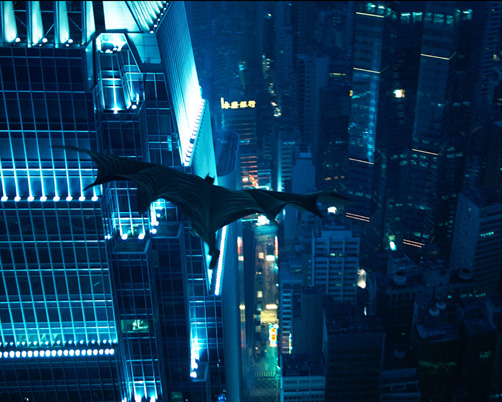
"The Dark Knight is not a sequel to Batman Begins. The actors are the same, sure, and, thus, the characters, but they inhabit two completely different universes. A shadowy organisation of ninjas (none of them diminutive, alas) called The League of Shadows, run by a foppish Frenchman, and intent on razing Gotham, would feel completely out of place in the latter film. The Dark Knight doesn't just have a different tone, it plays a totally different instrument.

Gotham, too, looks different between the two films. In the first one, it has a reddish orange hue; it’s claustrophobic, and, even though I don’t want to use the word, gothic. In the second film, it just looks like Chicago. I know the first film was mainly shot on a soundstage, and that a big deal was made of the second film’s use of Chicago, but still, one would expect some sort of consistency.

Batman Begins is a superhero film that pushes its boundaries to the extreme. The Dark Knight is a film that obliterates those limits in the hopes of becoming a crime noir. And that would be a laudable intention, if it weren’t for the fact that it’s still a film about a guy who dresses up as a fucking bat and fights crime. It is because of its very essence that the film is inherently unable to make that leap towards serious crime drama. Batman Begins succeeds by remaining a superhero movie, The Dark Knight flounders by trying to abandon its roots.[5] And it’s not a pleasant sight."

In my original post on the film, I made a similar argument about the atmosphere and overall presentation of The Dark Knight. Where my thesis was buried in a sea of arguments, Ali directly critiques the movie for its almost complete lack of resemblance to the Batman Begins. Where Begins found a balance between the hero myth and a gritty cynicism. The film blended two very different sensibilities into an ambiguous tone that actually achieved both. The Dark Knight is just about the reverse of that. Thematically, its covering some similar territory, but the movie could not be any different from Begins from an aesthetic point of view. Moreover, that it almost completely shuns the cloudy tones of the first film is jarring.

I have only seen the film once, and I look forward to seeing it again. But on first viewing, the movie failed as both a crime saga and a representation of the hero myth. It failed to build upon anything established in the first film. As Ali notes, we're listening to a different instrument altogether. Equally important as that fact is how little it has figured into the greater discussion about the film. Although a number of critics / bloggers have grown tired of talking about The Dark Knight, we've really only just begun to comprehend its relevance as both a cultural artifact and a piece of cinema.

Monday, October 6, 2008

"A fervent and frightened prayer..."


Over the last week, I've been reading tributes in newspapers and on websites to the enduring career of Paul Newman. I heard reports of his sickness in recent months, almost refusing to accept that the frail man pictured in photos was actually him. When I learned of his death late last Saturday morning, I was as surprised as I was saddened -- not just because cinema has lost one of its greatest actors, but because it lost a true artist and model citizen. He gave the movies a positive face at a time in which American movies were undergoing such great change. He was an honest, sensitive actor whose charisma endured over many decades and defied easy categorization, even though that smile was so recognizable. One might even say that Paul Newman was born to star in the movies, with his classic good looks, commanding voice, and unending charm.

Thinking back on his most memorable roles now immortalized in the pantheon of cinematic images, I came to see that Newman as more than a good actor boasting several significant performances. He had a way of uniquely embodying each character he played while still making it his own. There was an undeniable "Paul Newman" spirit to his characters, despite never playing two characters the same. He didn't "disappear" into roles, but instead made them apart of him. It's not often when being yourself is noted as an actor's strengths, but Newman was one of the few who was both himself and whoever he was portraying; the likely result of the shear honesty he brought to his craft.

That honesty was also revealed through his many humanitarian efforts and political activism. I am not nearly knowledgeable enough to fully honor that work, suffice to say that there were many instances from his life on screen that revealed the many sides of Paul Newman.

Perhaps my favorite performance of his is from Sidney Lumet's brilliant 1982 film, The Verdict. Newman plays a depressed alcoholic whose best prosecuting days are behind him. In the film, he finds himself at a moral crossroad, where doing the right thing stretches far beyond the one single case he is serving on. Here is Newman's final case to the jury:


This speech crystallized the vision I have held of Paul Newman for as long as I can remember; i.e., what he means to the movies, his enduring acting career, his humanitarian efforts. Everything I admire about the man and his work can be seen in this singular moment.

Monologues in movies are so often remembered for their intense dramatic rhythms and strong delivery, yet what makes this one of the very finest is the perfect tone Newman finds between defeat and hope. His summation is more than three minutes, but consisting of only a few hundred words. It is somber, soulful, and especially relevant as Americans head to the polls for one of the most important Presidential elections they'll take part in. (One could say that this election itself is a frightened and fervent prayer.) It's also a great tribute to Paul Newman's career in movies and commitment to justice.

Wednesday, September 17, 2008

Back to school


In honor of the annual autumnal return to school and the end of the Big Summer Blockbusters, now is as good a time as any to crack out those pencils and erasers, and put on my thinking cap for Dr. Zachary Smith's End of the Summer Quiz over at Sergio Leone and the Infield Fly Rule. As always, Dennis has come up with some doozies for questions, with topics ranging from reflections on the summer to the failed promise of movie posters. Below are my answers.

Your favorite musical moment in a movie

There are just too many. But if I may show my true colors as a rank sentimentalist, the final sequence in Edward Scissorhands still stands out as one of the finest marriages of image and sound, narrative and music. It's tough to say what a musical moment is, because I'm inclined to think that some movies are more musically inclined than others and can be like pieces of music themselves. For someone like Tim Burton, the breadth of a moving image only takes shape with music, and the finale from Edward Scissorhands, as well as various other sequences of musical punctuation provide shape and scope to the affective climate he has created.

Ray Milland or Dana Andrews

Wish I knew more about both of these gentlemen, but I'd give the edge to Dana Andrews, if only for his memorable detective in Laura.

Favorite Sidney Lumet movie

Maybe this will answer the question...

"You have meddled with the primal forces of nature, Mr. Beale, and I won't have it! You think you've merely stopped a business deal? That is not the case. The Arabs have taken billions of dollars out of this country, and now they must put it back. It is ebb and flow, tidal gravity. It is ecological balance. You are an old man who thinks in terms of nations and peoples. There are no nations; there are no peoples. There are no Russians. There are no Arabs. There are no third worlds. There is no West. There is only one holistic system of systems; one vast, interwoven, interacting, multivaried, multinational dominion of dollars. It is the international system of currency which determines the vitality of life on this planet. That is the natural order of things today. That is the atomic and subatomic and galactic structure of things today. And you have meddled with the primal forces of nature, and you will atone! Am I getting through to you, Mr. Beale? You get up on your little 21-inch screen and howl about America, and democracy. There is no America; there is no democracy. There is only IBM, and ITT, and AT&T, and DuPont, Dow, Union Carbide, and Exxon. Those are the nations of the world today."

Substitute some of those proper nouns with the corporate juggernauts of today, and this speech is downright prophetic... in a really scary way.

Biggest surprise of the just-past summer movie season:

How about Brendan Fraser starring in two (nearly) $100 million movies? I'm sure they're both deliciously bad, and I can't wait to see them! Hats off to him.


Since I haven't seen either film in the Fraser double feature, the biggest surprise among films I have seen is that neither Indiana Jones and the Kingdom of the Crystal Skull or The Dark Knight were tops on my list of favorite blockbusters. (That honor goes to Hellboy II: The Golden Army.) Indiana Jones was more of a personal / childhood nostalgia experience than it was a movie, and while I liked it very much I don't think it was among the cream of the summer's crop. The bigger surprise is that The Dark Knight didn't ring true on any level. Unsurprisingly, I loved Wall-E. Finally, if Werner Herzog's Encounters at the End of the World can be considered among the blockbuster crop for its limited run in July, than that would easily take the prize for best film of the summer.

Gene Tierney or Rita Hayworth

Remember that head swing in Gilda? Enough said. Hayworth.

What’s the last movie you saw on DVD? In theaters?

Billy Wilder's Stalag 17 and Woody Allen's Vicky Cristina Barcelona.

Stalag 17 is not among my favorite Billy Wilder pictures, but is worth seeing for William Holden's masterful performance alone. I guess I've seen so many prison break movies to really appreciate the film to which so many owe their existence.

Vicky Cristina Barcelona was the perfect movie to see at summer's end: breezy, gorgeous, tinged with feeling. Like it or not, any critic who wishes to assert that Woody Allen's desire or gift for filmmaking is becoming the broken record that Woody himself is so often called. Allen's observations about people and relationships are resonant (as usual), but what makes this movie special is that it is both painfully tragic but light as a feather. This is movie is about wounded souls, and Allen succeeds at straddling the line between tragedy and comedy.

Irwin Allen’s finest hour?

The Towering Inferno, if only for its massive scope and its great (but little-known) John Williams main theme. Though when it comes to skyscraper disaster movies, I much prefer Joe Dante's Gremlins 2.

What were the films where you would rather see the movie promised by the poster than the one that was actually made?

Cutthroat Island. I'll admit I'm a big sucker for Drew Struzan's work, but this one is especially interesting in how it falsely advertises throwback adventure in the vein of The Sea Hawk. I can't blame Struzan for anything other than turning out some of his best work for a movie that simply can't live up to it. That's not to say I disliked Cutthroat Island at all. But it certainly doesn't live up to the promise of the poster, which promises just about the coolest pirate adventure ever. Renny Harlin has said this is his favorite movie poster. It's a shame he didn't live up to his end of the deal and make a movie deserving of such poster greatness.

On a side note: I'll bet that John Debney's magnificent score was inspired more by the poster than the movie.

Most pretentious movie ever

Most pretentious movie I liked: Dances With Wolves.

This movie is still maligned by just about every critic who didn't vote for the Oscars in 1990. Of course, Dances With Wolves not hold up under close ideological scrutiny, but I was staggered by Costner's vision of the American West. Of all the characters, Two Socks the wolf was most endearing. There is something so benevolent about the early sequences in which Costner and Two Socks are familiarized with one another, with John Barry's music echoing over brown plains stretching into the horizon. This may be shallow stuff, but it hits me hard.


Most pretentious movie I didn't like: The Usual Suspects.

I'm with you, Roger Ebert. I still do not understand why this movie is so beloved by many. It's confusing, uninteresting, and painfully overlong. It exists solely for the big twist, making it little more than a parlor trick. And the fact that director Bryan Singer plays it off so suavely (as if to say "Gotcha! Now aren't we cool?") is even more repulsive. Simply put, this movie is carried away with itself.

Name the movie that you feel best reflects yourself, a movie you would recommend to an acquaintance that most accurately says, “This is me.”

From the moment I saw Sofia Coppola's Lost In Translation, I don't think I've ever felt more close to a movie. I likely never will again. It's not that I "relate" to the characters so much that the film captures the feelings (and subsequent implications) of human interaction and relationships so painfully, fleetingly, and delicately. I can't even describe how it does it. No amount of discussion about performances or shot lengths can explain this movie or sum up why it's good. For me, Lost In Translation is the perfect expression of humanity, from introspective explorations of loneliness to the benign and transient feeling of connecting with another person.

Marlene Dietrich or Greta Garbo

Garbo.

Best movie snack? Most vile movie snack?

Nothing beats it a tall, cold Coke. As for the worst, anything I eat too much of and then feel sick while watching the movie.

Fitzcarraldo—yes or no?

Yes! But it's only Herzog's second best jungle movie starring Klaus Kinski. Much like Aguirre: The Wrath of God, this film is a hypnotic fever dream, both a celebration and revulsion of obsession and Man's awkward relationship with technology, nature, and fellow Man.

Your assignment is to book the ultimate triple bill to inaugurate your own revival theater. What three movies will we see on opening night?

Buster Keaton's Steamboat Bill, Jr., Henri Clouzot's Wages of Fear, and Steven Spielberg's Close Encounters of the Third Kind. These movies fully showcase the wonderment of cinema in very different capacities, exhibiting the range and the perpetually expanding horizon that one can experience in cinema. The series could be called "Movement, narrative, and affect."

Most impressive debut performance by an actor/actress.

Ahmad Razvi in Man Push Cart. Of course, you could say that not much was asked of Ahmad Razvi in portraying an emotionally guarded New York city street vendor, but this performance is among my very favorites in recent memory. The movie reminds me of Lost In Translation in how it so pointedly observes its central characters simply existing in the world around them. The performances may be restrained, but Razvi's in particular is deft and mature.

2008 inductee into the Academy of the Overrated

Iron Man. Conventional wisdom would say The Dark Knight, but at least that film had a small, but vocal crowd of detractors. Very few critics were bold enough to come out against the more harmless and less incisive Iron Man, a film whose politics are curiously irresponsible. Jon Favreau is an excellent craftsman; he lives for this stuff. But he is failed by a pedantic and condescending script. There is very little here.

2008 inductee into the Academy of the Underrated

My Blueberry Nights. Please allow me to quote my favorite piece of criticism this year, Matt Zoller Seitz's review of Wong War-Kai's underrated gem. No words I write could hold a candle to the planes Matt reaches here. Poetic criticism for a poetic film:

"There's no sense pretending that My Blueberry Nights is a towering addition to Wong's filmography. The stakes are quite low throughout, and the movie's pace is as boozy-meandering as the tempo of its soundtrack selections. (Cooder's instrumental tracks recall his work on Wenders' melancholy, Sam Shepard-scripted road movie Paris, Texas.) Jones is a stunning camera subject and never less than likable, but she lacks the technique to suggest a complex interior life. Law is, as usual, gorgeous and charming but not especially exciting. Weisz's performance is a touch shrill, her "southern" accent a botch; she only rallies during Sue Lynn's confession. Portman is livelier here than she's been in some time -- the character's brassiness liberates her -- but the role still doesn't quite seem to fit. (Was it written with an older actress in mind?) Of the major players, only Strathairn makes a deep impression; few actors are better at playing men coming to terms with failure. Yet if you're willing to ease into Wong's mindset -- that of a barfly who's in such a good mood that he doesn't care what he's drinking or what's on the jukebox or how many hours are left till closing time -- none of the aforementioned flaws feel like flaws. My Blueberry Nights seems to be unfolding in a world of perpetual night -- one in which the darkness is illuminating. It's an exploration of interiors, geographical and emotional, and it seems acutely alive -- as if the movie itself is a luminous being that has seen the world and survived heartbreak and resolved to savor each remaining second of its existence, however long or short it may be."

Antonioni once said, “I began taking liberties a long time ago; now it is standard practice for most directors to ignore the rules.” What filmmaker working today most fruitfully ignores the rules? What does ignoring the rules of cinema mean in 2008?

Stylistically, that's tough to say. There are so many filmmakers stretching the capacity of film, from redefining compositional conventions to re-calibrating the notion of "Film as Narrative." Where we still need to make great strides is in overcoming the commercial censorship of cinematic representations of sexuality. Unfortunately, pornography has staked a claim on visualizations of sexuality, which has certain implications for what it means to visually represent sexuality in cinematic terms. Movies have been pushing the envelope for years, challenging the standards and chipping away at the censorship tower. Recently, John Cameron Mitchell made a bold film called Shortbus, which was essentially an attempt at making an artful movie about sex. It succeeded on many symbolic levels -- Mitchell himself has described the film as a statement of rage and protest for having to endure last seven to eight years of the Bush administration. But the tower still remains and is as powerful now as ever, and my hope is that more filmmakers seize on the opportunities presented by the shifting conditions of digital culture.

What’s the movie coming up in 2008 you’re most looking forward to? Why?

Charlie Kaufman's directorial debut, Synecdoche, New York. No screenwriter in recent memory is as creative as Kaufman. The Spike Jonze two-punch of Being John Malkovich and Adaptation is arguably the most impressive tandem of screenplays in contemporary American movies. Eternal Sunshine of the Spotless Mind isn't too far behind, either. I'm really looking forward to what he'll do with a camera.

What deceased director would you want to resurrect in order that she/he might make one more film?

Alfred Hitchcock. Call me a traditionalist, but I don't think there is a more impressive filmmaking resume than the one he has put together between the 1930's and 1970's. It's now trendy to like Hitch, but there is a dangerous tendency to reduce his films to a matter of flashy style and surface detail. For me, Hitchcock has always represented much more; even a great deal of his throwaway films took us to some kind of void. Seeing his style develop over time is a real treat, with his images become more sublime and subtle as he aged. He gave us a brief glimpse of what he might do without the bounds of censorship in Frenzy, but not my mind is only left to wonder.

What director would you like to see, if not literally entombed, then at least go silent creatively?

Rob Reiner. If he hadn't shown so much promise in the 80's (e,g. The Princess Bride, This is Spinal Tap, etc.), I wouldn't be so offended by the atrocities against filmmaking he has been committing for the better part of 15 years.

Thursday, September 4, 2008

Between spaces: Cinema 2007, part II

Well here we are again. With the Telluride Film Festival winding down and the Toronto International Film Festival now in full swing, a four month period of moviegoing relished by cinephiles has officially kicked off. During the course of these two festivals, attendees will be / have been offered a glimpse to the future of independent and international cinemas. Some of these viewers will write about these movies on blogs and web sites. For impatient movie lovers (like myself), reading about so many interesting films is both a great pleasure and a pain, as most of us know full well that we will never see half the movies we read about. Moreover, the ones we manage to see are often many months later.

Having said that, there is something special about knowing there is so much out there. These desires and pleasures are rolled into a certain nostalgia I find myself experiencing this time of year when I indulge my cinephiliac impulses, if only for a taste of that perpetually out-of-reach horizon of affect that movies produce in us. For me, it's actually comforting to know that there is too much for one person to handle. It's the feeling that cinema cannot be contained, that there is so many different kinds of it and such a plurality of aesthetic and narrative forms.

In the introduction to my previous post on my favorite movies of 2007, I argued that a different approach to retrospective commentaries is likely needed to better grasp what these flickering images mean to us. But when it comes to our relationship with movies themselves, it's also important to keep in mind that we are mired in out own constructions of the world around us, and that we approach all movies from within those fields of perception and comprehension. This, I think, is what makes the discussion of movies so unique and potentially enriching. I don't believe in such a thing as all-encompassing Knowledge, the type that underlies all of experience and can be universally accessed. That doesn't mean that all knowledge is useless. Quite the opposite, actually. There are many knowledges, and our relations to them are dependent on the values and assumptions we hold not just about cinema but about our relationships with people and the world around us. These ideological factors are based on both personal and collective meaning structures, giving each of us a unique perspective.

As I alluded to above, we are all coming at movies from such different places and spaces. And when it comes to movies, film festivals are reminders that we occupy a small, but unique position in the scope of cinema, whether we're watching, discussing, writing about, or making films. As the late Manny Farber intoned, termite art exists in all places, most especially in the spaces between spaces typically designated specifically for art. The multiplicity of cinema -- both in terms of the number of individual films, and the infinite spectrum of cinematic moments within individual films -- is all around us, and we each carve out our own place in that spectrum; stretching, expanding, and re-defining it.

Following is the second part of the list of films from last year that meant something to me, personally as well as critically. Together with the films I mentioned in the previous entry, this collection of cinema represents the year 2007 to me. There are some odd picks on here, for sure, some expected critical hits that moved me, and other movies that stood out at to me as revelatory. As Toronto and Telluride prepare to unleash a new crop of cinematic treasure upon us and the cinema of 2007 becomes an afterthought of the moment, allow me to take this moment, however fleeting, to reflect on films that in my estimation deserve recognition.

The Savages (Tamara Jenkins): With startling simplicity, The Savages subverts two massively cliched sub-genres: elderly people / nursing home movies, and dysfunctional family dramas. The film focuses on a brother (Philip Seymour Hoffman) and sister (Laura Linney) who deal with having to put their abusive father (now with vascular dementia) into a nursing home. While this adequately sums up the plot, the movie is so much more than its narrative design. It's full of subtleties and inexplicable joys, mostly stemming from Tamara Jenkins allowing Hoffman and Linney to create real moments of drama on screen. Her style is all but invisible, and it rests in knowing when to let silence fill the screen. The Savages is in many ways a cookie-cutter pseudo-independent film, combining a less showy aesthetic approach with the strong performances of strong, successful actors. Even though it mostly plays by the rules of its stylistic and generic influences, the film has so many moments of real humanity, simply and beautifully committed on-screen.

Harry Potter and the Order of the Phoenix (David Yates): Following the now-famous opening of the Warner Bros. logo slowly coming into focus, Harry Potter and the Order of the Phoenix does something very unexpected considering its status as the fifth film in a series. Instead of trudging through more redundant encounters with Harry's cartoon-ish aunt and uncle, this film places its central character (and the audience) in a very different world. On a creaking swing set in a lonely park Harry sits alone in the dreary summer heat, caught between a desire for isolation and a yearning for a connection he will never have. In these opening moments, you know this movie is not just another harmless sequel, or a bland regurgitation of source material like the previous film (enjoyable as it was), Harry Potter and the Goblet of Fire. Instead, this Harry Potter pulses with its own dramatic energy; it crawls underneath your skin like a good horror movie. Equally exciting is how the film balances the wonderment of the magic world and the bureaucratic underbelly of its institutions. The opening sequence establish these conflicts right away and create a stirring atmosphere that's eventually expanded by the rest of the film. Director David Yates makes it known immediately that he wishes to re-explore something that began with Alfonso Cuaron's third film in the series (Harry Potter and the Prisoner of Azkaban), and that is an affective state almost completely independent of the books.

Paprika (Satoshi Kon): From my original review:

"Satoshi Kon's Paprika is a film of many things, but above all, it is about dreams. It shatters all distinctions between actual and virtual, analog and digital, in its exploration of cyberlife, avatars, and digital space via the realm of the unconscious... Paprika is thoroughly conventional in its narrative cues and dramatic beats, even its thematic trappings about the actual/virtual binary. But the manner in which it weaves these threads around, through, and within each other is incredibly inventive. Moreover, its marriage of movement and sounds is like being in a dream through the swirling colors and motions of its animation. Kon's film is an intoxicating experience that will linger in the conscious and unconscious mind. On several levels it could be seen as an allegory for cinema; not just cinematic technology (as the plot deals with scientific advances which enables individuals to explore dreams), but about the state of movement and time that cinema can construct, a way of seeing and hearing that manifests in all of us."

Atonement (Joe Wright): Each year, there is at least one film around awards season that the more "sophisticated" critics make their punching bag. In 2007, Atonement took that title, if only because its World War II setting and apparently generic forbidden lovers plotline, all somewhat typical and expected for awards season. But I'm having none of it. Despite the amazing period detail and formal filmmaking prowess, this movie has tones of thematic and visual subtlety that far transcend its traditional surface details. Constructed with such precision, its aesthetic unity is constantly undermined by a narrative that cannot be trusted. Some have said that Atonement is all about perception. I would argue instead that it's about what shapes perception as well as the implications for manipulating the perceptions of others. It is both a wonderful throwback to old-fashioned epic romances as well as a contemporary critique / update, and it is much more sophisticated than many critics believe.

Syndromes and a Century (Apichatpong Weerasethakul): There are likely hundreds, if not thousands of feature films and shorts each year stretching the aesthetic capacity and narratological structure of images that are unseen by me and millions of others. Syndromes and a Century is a reminder of this. It is a reminder that the quiet simplicity of images often results in the most immediate, even illuminating viewing experiences. The film tells two stories, each with the same characters and dialogue, but in different settings. Rathern than becoming an exercise in shameless narrative manipulation (a la Run Lola Run), Apichatpong Weerasethakul's film is striking rumination on love, memory, and identity. It is neither positive or negative in its portrayal of its ideas and characters, but is instead a reflection on the images, memories, and words that form the basis of our being in relation to each other.

Away From Her (Sarah Polley) Thinking about this movie, I'm tempted to quote Luis Bunuel's statements about memory and self -- featured prominently at Dennis Cozzalio's blog. It goes like this: "You have to begin to lose your memory, if only in bits and pieces, to realize that memory is what makes our lives." Away From Her is a spiritual companion to Syndromes and a Century, but with an entirely different narrative design. The film is deliberate in its insistence on silence. That silence fills the space between an elderly couple, one of whom whose memory slowly fades away. "I fear I'm beginning to disappear," the woman says. How many times these two people have likely failed to understand one anther, to listen and see each other through the course of their lives. But the silent bonds that often keep people together is a mutual experience in each others' memory; the ability to not just experience life together to make meaning out of that experience together through stories and recollections of experience. Sarah Polley's film is a poignant, yet painful meditation on these things, as well as the more intangible qualities of love.

One final note: while Julie Christie was nominated for an Oscar for performance, the real anchor of the film is Gordon Pinsett, who beautifully portrays a man who comes to grips with losing his wife.

3:10 to Yuma (James Mangold): The first time I saw 3:10 to Yuma, I enjoyed certain aspects of it, such as the performances (by Russell Crowe and Christian Bale) and the writing. I was surprised at how moved I was by the end, because I hadn't thought of it as much more than a slightly above-average movie experience. But it was on second and third viewings that the film really came into focus. Simple scenes such as the classic Western night camp seem effortless and simple but are actually quite amazing in their ability to capture the nostalgia of a genre as well as build its own narrative energy, the threads of which are more than relevant in contemporary times. In the age of the great American westerns, John Ford, Howard Hawks, Fred Zinneman, and others used the genre to spin morality tales of good and evil, right and wrong. The genre has undoubtedly evolved into something different, and James Mangold was able to bridge the past and the current with his film, and he does so with eloquence and nuance.

Persepolis (Vincent Parannaud and Marjane Satrapi): Showing off the limitless creative potential of which animation --and the medium of cinema, as a whole-- is capable, Persepolis is also a deeply personal account of one woman growing up in several countries. It's the kind of story that is only enhanced by the whimsy of its style. With unflinching surrealism, Vincent Parannaud and Marjane Satrapi (whose story this is) invite viewers into young Marjane's mind as she witnesses war and family loss and experiences the physical and psychological aches and pains of growing up without an identity. They take full advantage of the autonomy that animation grants filmmakers and viewers, and they offset their brilliant images with a very real portrait of a woman, a family, and a country at a time of crisis. And yet, the directors never let the movie be defined by its settings and circumstances, but instead locate something much more personal in a girl's growth into womanhood.

No Country For Old Men (Joel and Ethan Coen): How does one begin to talk about this film? Discussed constantly on blogs and in print, The Coen brothers' film can be described as nothing short of a masterpiece. I'd like to single out one aspect of its greatness here: sound. A number of critics have discussed the noteworthy absence score in the film, which is surprising considering how comfortable Joel and Ethan Coen are with music in their films. Some of their most memorable images --the Ax Man in Fargo, the hat in Miller's Crossing, etc.-- were so memorable because of Carter Burwell's musical accompaniment. No Country For Old Men is equally memorable for its music, which is almost impossible to notice due to how it is so part of the image. For example, watch closely Anton Chigurh's conversation with the gas station clerk early in the film. Burwell augments the mood of the scene and its perfect compositions with just the right chord, so deep it's almost unrecognizable. But it's right. As for the sparing use of music, one could argue that the decision not to put music to images in this film does not take away from the musicality of those images at all. After all, as I have argued before, we don't just see images, but smell, taste, and hear them too.

Once (John Carney): Speaking of music, there have been many filmmakers and critics that have referred to cinema as something of a sibling to music. From a purely technical standpoint, the two art forms don't appear to have much in common. But both as an expression and as an experience, cinema mirrors the transient affective experience that come from listening to music. John Carney's Once is the perfect expression of this union. The whole film is like a song, and the songs contained in the film tell stories that are movies unto themselves. Simply told, Once is a film that follows the relationship of two individuals. They never kiss, or even embrace (to my knowledge), and yet their connection is sensual and impossible, resulting in one of the more bittersweet, deeply felt films in recent years. Small and seemingly mundane as they are, every look between these two, every smile, is a rich expression of feeling.

Zodiac (David Fincher): Jim Emerson said it best: Zodiac is about information -- its production, distribution, and consumption. David Fincher dares to introduce an irresistible plotline about the unsolved mystery of a serial killer in San Francisco and then turns completely away from it, as if uninterested. What starts as a visceral, brutally physical movie ends up following a cartoonist (Jake Gyllenhal) driving 100 miles to a small-town police station to dig up old records. The murder scenes trail off about midway through the film, and we're left with one person's obsession with uncovering his identity, losing his wife and family in the process. But Zodiac is not so much about the serial murders of the real-life zodiac killer as it is about media and technology, and the massive implications for their use in the digital age. The film paints an idea of its killer with a painstakingly constructed vision of something so unimaginable: a pre-digital world, where information is spread over real physical geography, inked onto pages, and traveling through wires. Information was something to be handled and used for specific means. Fincher's film depicts the unique collision of the analog and the digital that now constitutes our current media culture and manifestations of violence, celebrities, and the ongoing necessity of purpose.