
Friday, May 18, 2012
The state of the superhero


Monday, May 7, 2012
The Avengers

In the realm of superhero movies, a subgenre that has flourished financially in the last decade, if not creatively, The Avengers is a small miracle. It is just as inconsequential as its brethren (evidenced by the static “Earth in Peril” scenario it employs), but, boy, does it hum. For such a behemoth, The Avengers moves nimbly and with purpose. Credit that to writer-director Joss Whedon, who seems to have recognized that films like this should not get by on their fights and tights, but on crisp writing and perhaps an implicit admission of their goofy nature. The plot involves a wormhole, an alien army, and a mysterious substance that grants everlasting power, but Whedon wisely recognizes that these elements don’t demand the attention that the characters do. He keeps a playful tone regarding the conventions of the genre—especially the degree to which many situations hinge on serendipitous convergences—while also weaving the backstories and personalities of the various heroes who must assemble to save the world. And in this sense, The Avengers is a juggling act of rock-solid precision. As many a fan and even critic will tell you, each character has a moment to shine. Moreover, seeing everything in kinetic motion together and bouncing off each other is delightful bit of viewing, even if you haven’t invested much in the characters. Of course, it helps when you have actors like Mark Ruffalo and Robert Downey, Jr. on board. Tom Hiddleston is also a blast as the arch-villain, bellowing phrases like “Kneel before me!” about as convincingly an actor can. Almost as impressive as the actors is the design of the film’s main setting, a lumbering techno-vessel that soars invisibly in the sky. The inevitable third-act demolition of Manhattan is less successful and a reminder of the form's limitations. Nevertheless, it doesn’t diminish the achievement of this super-opus, which balances the solemn and the ridiculous to smooth effect.
The curious tonal disparity to the largely positive
reviews of The Avengers is testimony
to the reality that how we
approach “event” films like this in large part determines how we receive them.
Thus, some critics might appear to offer backhanded praise, as if begrudgingly
acknowledging that Joss Whedon has made all the right moves with a tired
foundation. Indeed, Whedon doesn’t try to subvert the genre, but instead points out how fun this kind of storytelling is supposed
to be. In doing so, he also articulates exactly how his predecessors have
failed. Ultimately, The Avengers’s
most significant achievement is how proficiently it assimilates the more savory
elements of the modern comic book movie, as well as those of the contemporary blockbuster,
and streamlines them into a swift commercial package. The Avengers fits into a genre and style of filmmaking that may
very well have run its course. However, as a tribute to the transient pleasures of archetypical lore, it proves that, with the right execution, a shallow story is anything but a shallow film.
What to make of this underlying truth is another matter. (Joss Whedon, 2012) ***
Wednesday, May 2, 2012
Gaining some 'Critical Distance'

At the start of the year, I announced I would be reviving The Cinematic Art and re-appropriating its content to suit my current interests and capacities. Four months in, I am generally pleased with the results. What started as the posting of simple, short capsules has evolved into the regular (and still brief) reviewing of movies and shows. While the format has limitations, it has also helped me understand and address my own limitations as a writer. If you've read this blog before, you know that I take to criticism with a high degree of reflexivity. Although I don't inject this into my writing these days, I am always wrestling with it and trying to improve my writing and approach with each review.
Another benefit of the recent writing I've been doing has been my rediscovery of long-form criticism. It started when I saw The Artist in February. I drafted a short review, but found myself reading more and reflecting on it. I returned to my capsule review and started adding to it. Eventually I molded it into a grander piece that was posted over at Slant Magazine's blog, The House Next Door. I had a similar recent experience with Mission: Impossible—Ghost Protocol, which I began writing as short review but gradually developed it into a longer polemic. Both essays don the "Critical Distance" tag, a name that suits my long-form critical approach and also reflect my own film-viewing limitations. (I often do not see new movies until DVD release). "Critical Distance" covers both of these angles and more broadly represents my approach to come at a film from the perspective of having absorbed the hype and attacking it with a new set set of eyes. I already have a few ideas for movies to explore future Critical Distance pieces (e.g., Prometheus, The Dark Knight Rises), but it's equally important to allow these essays to naturally develop from my reaction to something. (That I often am seeing films and shows well after their initial run adds to this approach). I realize that there isn't much need for a series like "Critical Distance." As David Hudson recently noted over at his new spot, KeyFrame Daily, "never has the mediasphere been noisier, nor have attention spans been shorter." Movies, even mega-commercial releases, have a brief moment in the sun on release, but are quickly chewed up and digested to make room for the next discussion of the moment. That goes for criticism, too. And that's why I like the idea of an essay series that runs against this trend. For the very same reason, I don't expect these article to resound much within the bigger conversation about a given movie. But it is my hope that they contribute a fresher perspective to works that have had their moment and are worth considering in a new light.
As I move forward with the Critical Distance pieces, I hope to put as much effort into the regular reviewing I've undertaken in recent months. Given that I am not a critic by profession, I am usually about six months behind the rest of the circuit with viewing/reviewing. This is an occasionally frustrating reality, but it also reminds me (as the Critical Distance series evidences) that there are other ways of spotlighting critical discussion than what constitutes the current moment. Nevertheless, I plan to have one foot firmly implanted in the new-to-DVD/streaming front and will also review select films in theaters. (On queue: A review of The Avengers, and perhaps also a Critical Distance piece on the same subjects at the end of May.) But as I am now winding down my engagement of 2011 movie fare, my review base will broaden in coming weeks and months, as I return to watching older films and television shows more regularly. This represents a relatively new direction in my reviewing habits, one that I am looking forward to carving out.
Monday, April 30, 2012
Being Elmo: A Puppeteer's Journey
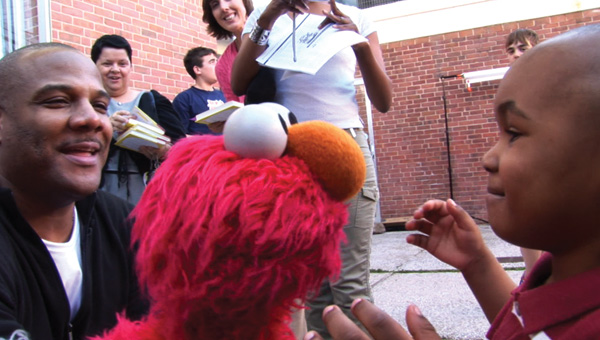
One of Sesame Street’s lasting qualities is how its band of puppets channels the spectrum of human personality. Each character has one or two unique behavioral characteristics—and problems to overcome—with which audiences can identify. You have Big Bird’s small ego and casual lack of awareness, Cookie Monster’s compulsive impulsiveness, Oscar’s general crankiness, and so many more. Indeed, we love these characters for their flaws, which are simply stated and yet completely, even painfully relatable. Their deficiencies are the characters’ defining qualities, which in part explains why a character representing pure, unfiltered love was both a surprising yet also inevitable addition to Sesame’s Street’s puppet troop. With a shrill voice and voracious drive to give hugs and kisses, Elmo would become a force that redefined and ultimately transcended Sesame Street. Indeed, the omnipresence of Elmo represented more than simply love, but also the commercial desire to exploit it. Maybe this explains the fiercely divisive response to the character, whose exaltation for children typically translates to irritation for adults.
Constance Marks’ documentary Being Elmo: A Puppeteer’s Journey is only tangentially concerned
with Elmo’s commercially ubiquitous existence. Instead of using the character
as a basis, it chronicles the life of the man who brought Elmo to life. The
film argues that the love that Elmo puppeteer Kevin Clash experienced
through his life is the defining quality of Elmo that would inspire and enrapture
the imaginations of children the world over. Marks uses pictures and old
camera footage to draw an evocative picture of Clash’s life, from his modest
upbringing outside Baltimore, to his dedication to creating and operating
puppets. Clash achieved success at a young age due in part to good fortune, but
mostly from his commitment to the craft of puppetry and the love and support of
his family. It’s standard stuff as movie narratives go, but that is about
a man whose fame and influence is known to the world only as Elmo makes it unique. Moreover, to see Clash, his family, and colleagues reflect on his unique fame is richly compelling, mostly because these reflections come across as wholly genuine.
Being Elmo is also worthwhile for the story it tells about
the world of puppetry in entertainment. It offers a distinctive
perspective on the zeitgeist of Jim Henson and the muppet empire to which he
gave voice. The anecdotes and behind-the-scenes perspective on this world are
captivating, particularly Clash’s relationship with Kermit Love, who designed
many of the puppets we know and love today. Love is a magnetic personality; the
kind of quiet, but zany fellow who was likely blissfully unaware of his own
genius. Another highlight is a brief, but poignant interlude at Jim Henson’s
funeral, where Clash and other esteemed Muppet/Sesame Street veterans perform a
song in character and on stage. Being Elmo contains a number of these small
vignettes fashioning a “legends-in-action” aura that lends nice contrast to the
central profile of Clash.
Being Elmo’s
achievements may be limited by the focus of its premise, but it is nevertheless
a fascinating portrait of a person whose influence stretches across nations and
generations but whose face is unknown to nearly all. Even those who resist Elmo
may find themselves warming up to puppet after learning about the character's benevolent creator. Its message may be too
deliberate, but, like the show that has given us Elmo and countless other
memorable characters, Being Elmo
inspires because of the simplicity and earnestness with which it delivers that message. (Constance Marks, 2011) ***
Wednesday, April 25, 2012
Critical Distance: Mission Impossible—Ghost Protocol

As commercial cinema goes, animation and live action are seen as divergent modes of filmmaking sharing the mutual goal of aesthetic cohesiveness; they only achieve it by different means. While Avatar and The Adventures of Tintin achieve a melding of live-action and animation techniques, other examples suggest that the sensibilities of animation and live action are more disparate and incompatible. If the static shots and deadened rhythms of the big-budget fantasy films John Carter and the first two Chronicles of Narnia entries are any indication, the qualities of animation may not so easily translate to live action. These films were directed by animation veterans—Andrew Stanton and Andrew Adamson, respectively—whose authorial voices evaporated under the conditions of live-action filmmaking.
Given the standing casualties, it would be reasonable to expect that Brad Bird, the venerable and considerably gifted director of Pixar greats Ratatouille and The Incredibles, would encounter similar difficulties working in live action as did Adamson and Stanton. Bird's first project in the non-animated realm would pose a more considerable test than those of his predecessors, both of whom were essentially handed the reins of a new film franchise. If the translation from animation to live action weren't already revealed as problematic by the previous examples, the challenge of making a fourth entry in the moribund Mission: Impossible franchise would be potentially as significant. Yet, despite these (and forgive me for saying) impossible conditions, Bird makes Mission Impossible - Ghost Protocol work. It succeeds not only as the resurrection of a franchise but also as an exercise in the rarified practice of artful action filmmaking. Whether the story makes a bit of sense is hard for me to say, as I certainly can't recount it very well. More importantly, this fourth Mission: Impossible makes visual sense.
Click here to read the full article at Slant Magazine's The House Next Door
Friday, April 20, 2012
The Descendants

There is an old-fashioned, Cary Grant-esque movie star quality about George Clooney. He exudes quiet confidence, intelligence, and social awareness, each which contribute to his magnetic personality, on screen and off. Clooney is also a somewhat accomplished director whose aesthetic lands somewhere in between the Coen brothers and Steven Soderbergh. With all these qualities, it’s easy to see how Clooney has risen to become a premiere figure in today’s moviemaking world. Yet while I admire the actor/director’s various talents, I have also felt an odd distance from his work. For example, he was effective as the grizzled CIA agent in Syriana, and still I never connected with the performance. Even his subdued work in Tony Gilroy’s Michael Clayton lacked the necessary texture to elevate the film to the heights I felt it should have achieved. I realize it is a peculiar position; to like an actor’s performances despite that they often leave me cold; to applaud a director’s films without ever really bonding with them.
Perhaps my bewildered stance regarding George Clooney’s work has brought me to The Descendants with a cautiously optimistic sensibility. Maybe I was primed for another admiring stance despite my deepest wishes to like it. After all, I am huge fan of Alexander Payne, whose Sideways is a recent favorite of mine. But even this couldn’t prepare me for how astonished I was over Clooney’s masterful performance in The Descendants. His portrayal of an absent father and husband with essentially a good heart is a thing of subdued beauty. Tonally, Clooney here is not far off from his past attempts at understatement. But in this role, something clicks. He plays Matt King, a successful lawyer who also happens to be the proprietor of thousands of acres of land on Hawaii. How much of his life is really his own making, however, is a question the film explores. It proffers a crisis scenario that sees King's wife beset by a terrible boating accident that puts her in a coma and subsequently exposes the unacknowledged unhappiness beneath the sheen of their life. Clooney’s deadpan voiceover provides an angry confessional for the character of King, who otherwise hasn't a clue how to interact with his friends, loved ones, and fellow Hawaiians. And yet, it is apparent that even he doesn’t believe the deep cynicism of his own words.
The Descendants is as hilarious as it is bleak—depressing but also life affirming. It is all of these at once, often at the same moment in a given scene. That it is such a whirlwind of a movie is a credit to Alexander Payne and George Clooney, as well as the entire cast. The characters each have the trademark quirks of an Alexander Payne film, but they also individually have mystery and humanity that is revealed in unexpected places. As significant is the film's portrait of the Hawaii, which has never been depicted quite like this by the movies. It is a real, breathing place and the actors inhabit it so believably that it becomes much more than setting or atmosphere.
Monday, April 9, 2012
The Girl with the Dragon Tattoo

On first glance, the American film adaption of Stieg Larsson’s The Girl With the Dragon Tattoo appears an ideal vehicle for director David Fincher. Over a two-decade career, Fincher has explored and re-explored many of the ingredients found in Larson’s novel. Centering on a unique pairing of protagonists who together investigate the mystery of an unsolved murder committed 40 years prior, the story also proffers other Fincher staples, such as a sociopathic villain and long scenes of intense research and investigation. The film naturally latches on to these elements and spins them into richly textured inquiry into the retrospective reconstruction of the past. Fincher has navigated these waters before, but never as gracefully. He uses the Agatha Christie-esque plot as a foundation for an experiment in mood and atmosphere, proving that he is miles ahead of his contemporaries in terms of film craft. In his execution, Fincher effectively emulates Hitchcock, squeezing tension and dread from a simple progression of elegantly crafted compositions.
Larsson’s compelling groundwork sees Daniel Craig’s everyman journalist driving the story at the start, while the victimized, off-putting character of Lisbeth Salander assumes a more passive role. The Girl With the Dragon Tattoo is involving purely on the level of aesthetics, but Fincher’s visualization of Lisbeth’s journey from passive victim to active protagonist is the film’s most significant achievement. Over the two and a half hour run time, Fincher and Rooney Mara craft a full-bodied portrayal of feminine sexualization and strength that defies stereotype and resists broad representation.
Despite earning mostly positive reviews, a prevailing notion that The Girl With the Dragon Tattoo amounts to little more than a stylistic exercise has begun to crystallize in the wake of its release. Even some of its adamant defenders have noted that the film fails to truly distinguish itself from other Fincher works. (That it is also the second film adaptation of a recently published novel only compounds this emerging legacy.) Indeed, Fincher’s Girl fits within an established framework. But look closer and there is a more nuanced movie about vision, technology, and embodiment than its glossy surface and derivative genre trappings would lead to believe. (David Fincher, 2011) ***½
Monday, April 2, 2012
Carnage
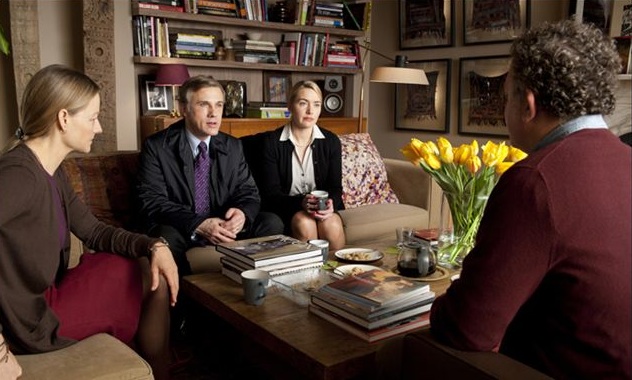
Carnage can rightly be described as an actor’s showcase; all four actors give terrific performances. Moreover, the one-act structure and sense of intimacy with the actors/performances are evidence of its origins in theater, which is oft referred as the ultimate actor’s medium. And while Polanski’s understated visual approach may at first appear ordinary, its genius gradually emerges such that the slightest of details reflect and inform the wariness of the guarded individuals. Even something as simple as a vase of flowers resting on the coffee table becomes an aching expression of the pervading suffocation that befalls the characters via their intensifying codified reprisals. (The film also has a keen claustrophobic disposition, as Ali Arikan pointedly observes.) But arguably Carnage’s most twisted play on existential irony is how it reverses the Waiting For Godot scenario and portrays characters that cannot bring themselves to walk away. The final shot is a clever visual punchline (one of many in Polanksi’s filmography) that doubles as a metaphor for the universality of misery that the simplest of conflicts expose. (Roman Polanski, 2011) ***
Wednesday, March 28, 2012
The Walking Dead—Season 2

The zombie resurgence came to a head in late 2010, when the zombie apocalypse scenario was resurrected again; this time for the small screen. Adapted from the popular graphic novel series, The Walking Dead was the latest and perhaps most sweeping rendition of the undead phenomenon. It followed Rick Grimes (Andrew Lincoln), a small-town police officer who wakes from a coma at the height of the uprising and gradually regains his bearings, unites with his family, and leads a group of survivors. Despite its conceptual similarities to a myriad of previous zombie narratives, The Walking Dead worked because it had the budget and the freedom to realize and sustain its grim vision of a decaying world. In its short first season, show runner Frank Darabont (who also directed the first episode) and his team served up haunting images of cities deserted, hospitals abandoned, suburban neighborhoods turned into war zones, and hordes of “walkers” whose insatiable need to devour human flesh was graphically depicted.
The mounting dread the show deployed so effectively was not jointedly the result of its unsparing horrors of the undead feasting on the living as well as its a vivid portrayal of society’s crumbled institutions. These aspects fostered a level of authenticity to the proceedings, no matter how preposterous the notion of a zombie apocalypse may be. That it also explicitly avoided how the uprising occurred and offered only glimpses of life before it added to The Walking Dead’s pedigree. Darabont instead keyed on the immediate sensation of fear, survival, and the burden of facing the dangerous new reality into which surviving humans have been violently cast. In whole, the first season was remarkable for how strongly it evoked the feeling of witnessing a doomsday situation play out. Blending a realistic survivalist-type scenario with a far-reaching horror premise, it successfully transmitted deep-ridden collective fears in a way that felt fresh. The show went on to great ratings, making a second season inevitable. AMC extended the the episode count from six to 13, which granted the writers more opportunity to develop the core characters and also expand on the emotional canvas introduced in the initial six episodes.
Keeping in mind the first season of The Walking Dead, as well as the storied history of zombies in popular entertainment, let’s jump to the present. The show recently wrapped its second season, prompting many reviewers to evaluate the zombie-war finale through the lens of the entire season. (Of these I recommend reading Matt Zoller Seitz’s piece, which offers his usual breadth of insight.) Since this angle has been well covered, my aim here is place the show in a broader context. First, I will consider the second season as a companion to the first season, which, as it turns out, reveals major contrasts. Then, I will reflect on the show’s attempts to internalize the vast history of zombie apocalypse representations and how this has resulted in its struggle to offer something new to the lexicon. But let’s begin with how the second season takes shape in relation to the first.
Monday, March 26, 2012
The Muppets

The easy-going innocence of The Muppets is an endearing quality, which, coupled with a self-awareness of its own conventions, makes for a rare nostalgia trip well worth the indulgence. The film has some problems, but nothing that threatens to derail its smooth offerings. For example, the emphasis on Segel's character and his muppet brother Walter, while charming initially, becomes a bit jarring as the story takes shape; after all, the muppets are what we really want to see. But forgiving this and other minor blemishes (such as some of the voices and characterizations being slightly off-kilter) becomes much easier once the gang is back together and dancing across the famous archways.
Despite not hitting every note, The Muppets more importantly serves up an abundance of wit, absurdity, and delight on its way to delivering one last send-off for these beloved characters. Where so many other long-awaited resurrections of pop-culture’s past try too hard to recreate old wonder, The Muppets makes the difficult task of capturing the source material’s spirit look easy. (James Bobin, 2011) ***
Friday, March 16, 2012
Star Wars—Episode VI: Return of the Jedi

At the outset it is apparent that Return of the Jedi is all about looking back. Just after giving a glance of a new Death Star, it drops us on the same desert planet with the same two droids as the first film did. As it turns out, the film’s outward nostalgia proves to be an asset, particularly as a contrast to the solemn treatment it gives to the dramatic center of the Luke/Vader storyline. Thus, Jedi appears to be driven by two central tasks: 1) to conclude the Luke/Vader story with a strong generational tension, therefore cementing the mythical status of the saga; and 2) to give viewers one last chance to revel in this universe of odd creatures, towering sights, and colorful characters. The result is a strange mix of sensibilities that—despite the bumps—somehow feels right.
Subscribe to:
Posts (Atom)