Monday, October 22, 2012

The Walking Dead: Season 3: Episode 2: "Sick"


If last week's season premiere of The Walking Dead teased the promise of a rebound from the choppy second season, this week's episode pivots forward into more fruitful dramatic terrain. It articulates the growing anxieties of the weary-minded members of the group, honing in on their struggle to retain control in the midst of rising threats. This plays out in two central scenarios amid the claustrophobic surroundings of the prison, where conditions are graver and Hershel's (Scott Wilson) life is in jeopardy after being bit by a walker. While Maggie (Lauren Cohan), Lori (Sarah Wayne Callies), Carol (Melissa McBride), and Glen (Steven Yeun) attend to Hershel with the dimming hope that he'll survive the wound, Rick (Andrew Lincoln), Daryl (Norman Reedus), and T-Dog (IronE Singleton) jostle with four prison inmates who've been cocooned from the outside world and now lay claim to the facility.
The former thread consists mostly of the standard "hope and reminisce" dialoguing between characters that's earned The Walking Dead some negative criticism. However, Rick's encounter with the four inmates takes the series into dangerous new territory. The inmates' intentions aren't quite clear, though their ringleader openly engages Rick in an alpha-male battle of wills that intensifies through the episode. Despite the threat of outsiders to the group, Rick is forced to negotiate a compromise with the prison survivors because they have access to food and also possess a better knowledge of the facility.

Monday, October 15, 2012

New York Film Festival 2012: Flight


In Robert Zemeckis's Flight, Denzel Washington stars as Whip Whitaker, a pilot with an addiction problem who guides a jetliner to the ground after a sudden failure sends the plane into freefall. Nearly everyone aboard survives and Whitaker is branded a national hero. Soon after, the pilot's union discovers that he had alcohol and cocaine in his system, which sends Whitaker's life into a tailspin. Believing that the crash had nothing to do with his consumption, Whitaker frantically navigates the shambles of his personal life to avoid dealing with his own problems. He's assisted by a longtime union friend (Bruce Greenwood) and lawyer (Don Cheadle) for the airline, both of whom compromise ethical lines for their friend. He also meets a fellow addict, Nicole (Kelly Reilly), who's more realistic about the state of her life and tries to help Whitaker recognize his.
As a character study and a somber portrait of addiction, Flight works nicely within its commercial framework, thanks largely to one of Washington's best performances, as well as John Gatins's rhythmic dialogue. The extent of Whitaker's addiction is a gradual revelation the filmmakers don't overtly tease out, and Washington strikes a balance somewhere between the disparate sensibilities of manipulation and benevolence. As Whitaker becomes more complicit with the large-scale corruption seeking to preserve his status, he steeps further into rage-infused depression, which allows Washington to carve out his character's increasingly unbalanced behavior and self-loathing.

The Walking Dead: Season 3: Episode 1: "Seed"


[Editor's Note: Over at The House Next Door, I will be penning review for The Walking Dead's third season. After each recap has been posted over at Slant, I will also post a preview (with a link-through to the full piece) here on this site. Finally, on a somewhat related note, to read my full review of the second season of The Walking Dead, click here.]

The Walking Dead's season-three premiere suggests that the program's showrunner, Glen Mazzara, and writing team have listened to everyone's gripes about season two's frequent and labored pontificating. Bearing almost none of the heated bickering and discussions of morality that personified the previous season, "Seed" is about persistence and strategy. It picks up several months after Rick (Andrew Lincoln) and the group's escape from Hershel's (Scott Wilson) farm, which was overrun with walkers. Despite any unrest among them, the group exhibits a renewed sense of unity as it trudges on in an increasingly dangerous world. In the pre-credit sequence, Rick, his wife, Lori (Sarah Wayne Callies), Hershel, Daryl (Norman Reedus), and the rest of the gang raid a home in the middle of the woods and share a brief meal consisting of canned food. If for no other reason, the sequence is striking for its silence. Without a word of dialogue, the opening ostensibly sets the series forth in a new direction, thematically and otherwise.
The characters inevitably get back to talking, but mostly absent from their conversations is all the unsubtle moral agonizing. The writers seem more confident in the new material and the urgency with which they deliver it. Some of the characterizations and performances are marked by obviousness, such as the way Rick appears to be less human with each passing moment, and how Lori still seems intent on breaking the barriers around them. Overall, though, the characters more concerned about survival. Consequently, the series more closely resembles the sprawling dystopian vision it suggested in its first season than the soapy dramatic palette of the second. The moments shared between characters are punctuated by quiet exchanges, such as in an early scene around a campfire when Hershel's daughter, Beth (Emily Kinney), is encouraged to sing. The scene is drawn out to nice effect, articulating both the hollowness and camaraderie that now defines the group.

Tuesday, October 9, 2012

The non-existent puzzle: Prometheus


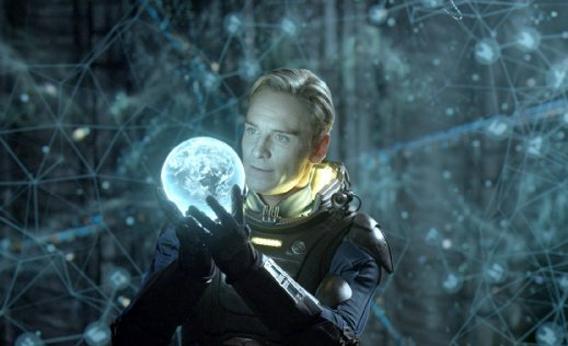
I saw Prometheus and intended to write about it in June. A few days after, the critical commentary had swelled to such a saturated state that I didn’t feel much compelled to weigh-in. Now that the dust has somewhat settled, I remain intrigued by how it inspired such impassioned feedback on both positive and negative reactions. Marking the return of Ridley Scott to science fiction, Prometheus was pitched as a prequel to Scott’s own Alien, despite its scarce resemblance to the 1979 classic. Prometheus can more fittingly be described as the cultivation of a century’s worth of science fiction—from Clarke to Asimov. It asks big questions about the humankind’s place in the universe and what it means to create life. All these questions are wrapped within a simpler sci-fi/horror story about a team of scientists travelling to another planet to learn of their origins. Of course, the naïve and pointedly stupid characters quickly learn that they are not welcome and the requisite chaos ensues.
The mix of heady material and B-movie conventions is a novel idea (and not necessarily ill-fitted, as proven by the likes of H.P. Lovecraft and David Cronenberg), but in the case of Prometheus it yields unsatisfying results. Detractors are quick to blame writer Damon Lindelof, whose screenplay introduces so many characters and subplots to what is really a rather direct story. In addition to the general glut, the script establishes several notions and potential directions without sufficiently committing to any of them. Then you have Ridley Scott, who seems to think he is making a companion to 2001: A Space Odyssey and never realizes that the beauty of Alien is the simplicity. The early scenes invoke the quiet wonder of Alien while introducing HAL-9000-like robot played by Michael Fassbender that proves much more interesting than any of its human counterparts. Compelling as some of these early scenes may be, Scott strains to recapture a sense of visual grammar that he channeled effectively at one time in his career to which he is now only attuned via nostalgia. Once the wheels start coming off the story, Scott’s command is revealed to be equally shaky.
Compounding the disappointment is that fact that many individual scenes might hold up in a better movie. Amid the ornate overtones, Prometheus is awash with well-crafted shots and interesting ideas. But none of them go anywhere. Scott and Lindelof are perfectly content to suggest a deeper mythology without telling a competent story or offering a rounded thematic concept. They believe that substance is the search for substance. They want you to think that their portentous allusions are pieces of a more intricate puzzle. And if you don’t like it, then you are failing to grasp the bigger picture. In other words, they expect the movie to take effect based on what it doesn’t do. (Ridley Scott, 2012) **

Friday, October 5, 2012

Death, sex, and an orange moustache: September capsule reviews


The Hunger Games
Through the muck of shaky-cam aesthetics and poorly rendered futuristic design, there is something I admire about The Hunger Games. Though not short, the film offers a compact rendering of Suzanne Collins’ massively popular novel about a ruthless game of survival among kids in a totalitarian world. The intermittently compelling arena sequences and Jennifer Lawrence’s serviceable lead performance keep the proceedings somewhat engaging, but Gary Ross’ spiritless direction does no favors to the mostly recycled Orwellian plot. Equally disappointing is how the filmmakers miss nearly every opportunity to draw a deeper connection amid the elements of violence, economic disparity, and societal unrest. Alas, The Hunger Games is emblematic of a growing trend that has beset many film adaptations of popular books: It strips away any the source material’s strengths and settles for numbing blandness so as not to offend anyone. (Gary Ross, 2012) **


Dr. Seuss’ The Lorax
It’s hard to say anything more about the wretchedness of The Lorax that A.O. Scott hasn’t already expressed in his appropriately outraged review. Unfortunately, this film is not the first to contort the work of Dr. Seuss into something wholly misrepresentative and tonally afoul of the beloved author’s work. And although it is not as actively repulsive as the Mike Myers live action The Cat in the Hat from several years ago, The Lorax has a more rotten core. It peddles a message of environmentalism but then undermines it at every turn with the same over-stimulating, mass-induced thoughtlessness it purports to be against. The worst gut punch comes when the Zac Efron-voiced lead character—after venturing outside of the plastic town of Thneedville for the first time—becomes visibly annoyed at having to sit through an old man’s story about the death of trees. Sadly, young audience members are probably thinking the same thing. After all, why try to engage and instruct with actual storytelling when a bounty of noise and colors get the job done much swifter? (Chris Renauld, Kyle Balda, 2012) *


American Reunion
After the mildly disappointing Scream 4 last year, the idea of resurrecting another popular '90s franchise seemed positively dour. And while American Reunion heads down the same road of awkward nostalgia in its early-going, it eventually settles into a nice rhythm. Part of the reason it works is that it takes a more somber approach to its own premise. It turns out that revisiting the glory days of high school can unearth some pretty deep-seated unhappiness about who we were and who we become. John Hurwitz and Hayden Schlossberg wisely avoid anything too serious in their conventional approach to the same brand uncomfortable situational comedy that marked previous entries franchise (to varying degrees of success). The film’s probing doesn’t venture beyond sex, which works just fine. There is nothing too memorable about American Reunion, nonetheless it’s a rare welcome visit with old friends. (John Hurwitz, Hayden Schlossberg, 2012) **½ 

Tuesday, October 2, 2012

Summer of '87: The Living Daylights


The '80s were tough on James Bond. Sean Connery’s awkward return in the unlicensed Never Say Never Again notwithstanding, the sight of an aging Roger Moore was a blunt reminder of how stale Albert R. Broccoli’s long-running film series had become. Hoping to inject fresh life into the weathering franchise, producers selected a new actor for The Living Daylights and took a more serious approach than previous entries. Alas, the same lack of attitude that mired its immediate predecessors keeps The Living Daylights from going very far with its new star.
As might be expected by this point, the film opens with the all too familiar scenario of a car chase. After skydiving onto the Rock of Gibraltar, 007 (Timothy Dalton) leaps onto a moving truck, is fired at by the driver through the roof, and then climbs into the vehicle to fist fight. Naturally, the car is also speeding down winding roads and mountainous terrain. The chase ends with the requisite destruction of the car and Bond parachuting onto a boat, where it happens that a lovely woman waits for the perfect man to fall out of the sky. “Pick me up in an hour,” he radios in to British Intelligence before noticing the woman’s beauty. He looks her up and down and then says, “Better make it two,” cuing the a-ha title song.

Click here to read the full post at Slant Magazine's blog The House Next Door

Thursday, September 27, 2012

New York Film Festival 2012: Hyde Park on Hudson


[This is the first of two reviews for The House Next Door to mark my coverage of the 2012 New York Film Festival. The second will be a review of Robert Zemeckis' Flight on October 14.]

While at first the idea of Bill Murray playing Franklin D. Roosevelt may seem counterintuitive to the actor's sensibilities, on further thought the combination is quite rife with possibility. Throughout his career, Murray has offered up intimate portraits of individuals whose personal vices he spun into inspired bits of comedy (the challenged greenskeeper of Caddyshack, the insufferably self-obsessed Phil Connors in Groundhog Day, etc.), and every so often into devastating visions of isolated, broken men (see Broken Flowers and Lost in Translation). In Hyde Park on Hudson, Murray is up to the task of channeling our country's 32nd president despite a scarce resemblance in appearance and voice. He succeeds in doing so by summoning the otherworldly presence of his famous comedy roles as well as the understatement of his more serious efforts, melding them into a compelling portrayal of a larger-than-life yet mysterious figure such as Roosevelt.
Despite its virtuoso lead performance, Hyde Park on Hudson is nonetheless a tonal misfire and a disappointment. The problems start with how the film is framed through the perspective of one of Roosevelt's mistresses, a quiet woman named Daisy (Laura Linney). Her modest upbringing makes Daisy both an unlikely and fitting assistant to the president as he makes stay in the secluded surroundings of rural New York. The story concerns Daisy's fascination with the president and how it blossomed into an affair that the two carried on as his administration plays host to the king and queen of England.

Click here to read the full review at Slant Magazine's blog The House Next Door.

Sunday, September 23, 2012

The Cabin in the Woods


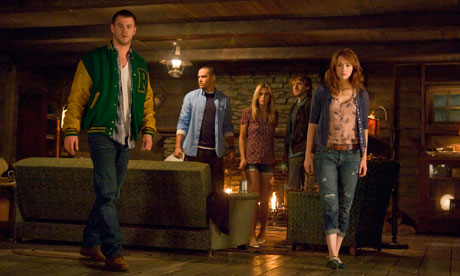
Representing maybe the first real step in the reflexive evolution of the horror film since Scream, Drew Goddard’s The Cabin in the Woods wades into the depths of voyeurism and pleasure that have become embedded into the genre over nearly the last half-century. It ingeniously weaves a heightened sense of self-awareness into a story that steers clear of parody despite deploying an orgy of genre tropes. Much of this can be attributed to how Goddard and co-writer Joss Whedon have structured the film. At the outset we learn of an apparent experiment wherein two men—played with relish by Richard Jenkins and Bradley Whitford—sit in front of screens in a control room and manipulate the fates of five young college students who are off to spend a weekend in a creaking cabin in the middle of nowhere. If the college student scenario sounds derivative, that’s because it is. Each character is walking horror cliché: the athletic jock (Chris Hemsworth), the bookish nerd (Jesse Williams), the innocent virgin (Kristen Connolly), the promiscuous blonde (Anna Hutchinson), and the know-it-all stoner (Frank Kranz). It should then be no surprise that the secluded settings and familiar plot turns that ensue invoke the likes of The Evil Dead, The Shining, Night of the Living Dead, Friday the 13th, and innumerable others.
The overt contrast between the increasingly violent situation at the cabin and the nonchalance of the folks watching/enacting it becomes the film’s major sticking point, and Goddard and Whedon make it work by pouring on the irony. They want to scare you and make you laugh, and then make you wonder why you’re scared and laughing. The eventual explanation for the motivations of the folks in the control room leaves something to be desired, but the resolution seems practically irrelevant and also part of the fun. Moreover, once it enters its third act, The Cabin in the Woods is firmly within the realm of absurdity, carried on by its own inventiveness long after the initial intrigue of the story wears off.
Perhaps the most unique element of all of this is how the film maintains a balance of disparate sensibilities. It actively conflates the serious and the non-serious, inviting a pensive engagement before revealing its ultimate simplicity. (In fact, some of the funniest moments come from deeply intense moments that are interrupted with obviously less important matters.) This playful approach yields an inspired if also problematic result. It’s not a terribly deep experiment and nor is it a reinvention of horror, but it’s a smart take on the ostensibly inherent fixations on death and violence that have long entrenched the genre. And in addition to its modest attempt to reconfigure the elements of horror cinema, The Cabin in the Woods is every bit an homage to their existence. (Drew Goddard, 2012) **½

Monday, September 17, 2012

Summer of '87: The Lost Boys


The Lost Boys is overflowing with memorable images, from the splashes of smoky red light filling up the frames to its vivid depiction of an emerging punk youth. But one particular sight has stayed with me ever since I watched Joel Schumacher’s film at an entirely too-young age. It occurs during the bonfire feeding roughly halfway through the film. Until this point, violence has only been implied, which lends more potency to visible dismemberment. Amid the orgy of death and futile struggle, a single ephemeral vision: One of the vampires sinks its teeth into a man’s bald head, causing blood to splash out like champagne.
The savage penetration throughout the scene is a raw rebuke of the age-old vampire legend. It deliberately eschews the traditional scenario, which usually sees some variation of a patient, soft-spoken vampire luring his victim into complacency before calmly biting her neck without her ever realizing. Rather, this is about something else. It’s messy. Painful. Unhinged. To see it now through a retrospective lens helps to better grasp how the film’s defining sensibilities elicited such a strong response in 1987. David (Kiefer Sutherland) and his vampire clan didn’t do things the old-fashioned way. “Sleep all day. Party all night. Never grow old. Never die. It’s fun to be a vampire,” the film’s rather perfect slogan read. They were here to bring down the old establishment and corrupt your children. And whether or not audiences consciously grasped these themes at the time, they connected with the material.

Click here to read the full post at Slant Magazine's blog The House Next Door.

Thursday, September 13, 2012

Monthly Retrospective: Rashomon


[This is the first entry in what will be a regular feature at the site, in which I offer reflections and considerations of movies that aren’t on the reviewing circuit of the past year.]

First-generation innovators rarely give us the best version of an idea or expression. Often they provide the groundwork for others to harness and perfect, which has certainly been the case with technology and also to a lesser degree in various artistic modes. In terms of movies, many of the most revolutionary entries (e.g. The Wizard of Oz, The Jazz Singer, Star Wars) are known primarily for how they changed the medium rather than how their advancements helped set a new standard of aesthetics or storytelling. Citizen Kane is one of the more famous examples of a film that offered both visual and narrative invention that few films have approached thereafter. Equally significant in this regard is Akira Kurosawa’s Rashomon. The film is renowned for ascribing a dimension of reflexivity to cinema that had been mostly unexplored until that point. It asks elemental questions about vision and storytelling, specifically: How do the two enter into a relationship through cinema, and what are the roles of truth and perspective in that relationship?
Rashomon offers several different accounts of the same event, which is recounted by the different characters involved. Kurosawa frames this through a trial-like setting in which the characters look directly at you, the viewer, and gives their own description of what happened. But before I discuss Rashomon’s benchmark achievements, I want to point out just how rich it is purely from a visual standpoint, as this can be overlooked. For example, the interrogation scenes—with the witness in the foreground and lookers-on in the background—have a downright avant-garde sensibility that contrasts nicely with the sumptuous visuals that Kurosawa creates in the forest. For a film that notably oscillates between perspectives and points in time, Rashomon is fluid in its storytelling and presentation. In addition, the film’s focus on faces lends an expressive layer to its already complex inquiry into to human nature. Moreover, Kurosawa’s full use of the expressive influence of images and narrative to explore a deep range of emotion makes Rashomon one of cinema’s most significant entries, as well as one of its most poetic.
Rashomon deserves to be renowned for carving out the structural and visual methods that would eventually be incorporated in all types of movies and ingrained into our movie-going minds. But almost entirely apart from it’s pioneering of these techniques, Rashomon employs them as a means of exploring the full breadth of potential that visual storytelling enables. This is evident not only in the film’s groundbreaking techniques, but also in how it moves and feels. In the hands of Kurosawa, something as simple as beating rainfall is eloquent and moving.
To see Rashomon having internalized its DNA in so many other movies is to experience a potential and sense of newness about movies that precious few of them still cultivate. (Akira Kurosawa, 1950) ****

Monday, September 10, 2012

A Separation


“He is a good man.” So says Simin (Leila Hatami) about her husband in the opening scene of A Separation, in which she explains before a judge (off-screen) why she seeks a divorce. Not the words one would expect to hear in a divorce hearing. Nevertheless, sitting next to Simin, her husband Nader (Peyman Moadi) is indifferent to the proceedings. We gather that he loves his wife, but he obliges with her request because his priorities lie with his ailing father, who requires care that would prevent the couple and their child from leaving their home country of Iran. Simin and Nader’s situation is not unlike the conflicts that many married couples face. What distinguishes A Separation is how perceptibly it articulates the circumstances within which the two become entangled.
The film unwinds as an uncommonly observed tragedy about Simin and Nader, as well as a handful of other characters that play in the evolving drama. The conflict eventually escalates and results in a chain of events that is as compelling as it is unpredictable. All the while, writer-director Asghar Faradi keeps a tight focus of the human scale and what really drives these folks to their actions, even as misunderstandings heighten and deceptions occur. None of these individuals wishes to inflict pain on those around them but nonetheless do—out of pain or mistrust or simply fear. A Separation never resorts to violence, but it resolves in an arguably more devastating way. And it plays out so convincingly because Faradi doesn’t have the agenda that shapes many other stories about broken connection and communication. Thus, the drama unfolds smoothly and with the further aid of an understatedly intimate aesthetic that sharpens the film's emotional verisimilitude.
A Separation went on to win the Oscar in the foreign language film category at the 2011 Academy Awards, but there was little doubt that it would have performed otherwise. Due largely to the influence of the Weinstein brothers on Oscar campaigning, the race in many categories is seldom about artistic merit. However, A Separation represents an example in which a genuinely great work deserved the recognition it received from being awarded Oscar Gold. It resounds beyond its own intimate settings and focused dramatic scope to channel a much broader human struggle of navigating the complex trappings of political, religious, and cultural identity. A Separation is about the intersections of these facets of ourselves and where and how they collide in our relationships. (Asghar Farhadi, 2011) ****