Thursday, November 15, 2012

Think on your sins: Skyfall


Perhaps in honor of James Bond’s half-century stay in cinema, Skyfall is all about looking back. It juxtaposes contemporary threats of cyber-terrorism and institutional corruption with the brazenly retro idea of rogue heroism that 007 personifies. Consequently Skyfall feels as though it is suspended in limbo along with its hero. The reflexively pulpy sheen of James Bond films has long been a trait of the running series, but director Sam Mendes spins the self-awareness into an introverted form of nostalgia, in which everything from older weapons and technology, to Bond’s own childhood simmers to the surface.
Skyfall also heavily invokes and reflects the legacy of Bond, evidenced most by the character's frequent silhouetted appearances. Cinematographer Roger Deakins frames Bond as a specter amid colorful surfaces, resulting in several memorable images and set pieces. Two that particularly stand out are Bond’s duel with an assassin set against the neon billboards of Shanghai and his entrance at a Macau casino, where his motionless pose is enveloped in a warm glow. As for Daniel Craig, the actor now finally owns the legendary character. He suggests much beneath 007’s cool demeanor but expresses little. Still spouting all the confident one-liners you would expect, 007 is nonetheless very flawed and doubtful of his own ability to survive. As it turns out, Bond’s aging brand of espionage becomes the foundation for Skyfall’s broader lament of the past and also joins well with the primary conflict. The villain, Silva (Javier Bardem) is a former M16 agent who feels betrayed by M (Judi Dench). Perhaps more than any other Bond picture, M plays an integral role in the story, and Judi Dench is more than up to the task. 
Skyfall doesn’t produce the immediate sense of satisfaction that the most famous Bond films elicit. Once you get past all the gunplay and acrobatics, it is really a slow burner: deliberate and lyrical. Moreover, the action set pieces are drawn-out and largely eschew the operatic movement that the series is known for. None of this is to say that Skyfall re-envisions the character or the wider canvas of these films, however. Despite the tweaks and updates, Sam Mendes very much upholds the Bond template. Nonetheless, the fun of Skyfall is how it emphasizes different ingredients and fluidly mixes in dread and guilt into the formula. (Sam Mendes, 2012) ***

Monday, November 12, 2012

The Walking Dead: Season 3: Episode 5: "Say the Word"


After last week's episode of The Walking Dead ushered in a new level of intensity with the deaths of two major characters and the birth of Lori's (Sarah Wayne Callies) baby, "Say the Word" is comparatively stagnant. This makes it consistent with the narrative rhythm that the writers have committed to since the show's second season: After a dramatic turn of events, everything slows down, often for several episodes. "Say the Word" fits comfortably within that broader framework, but it makes better use of its quieter interludes than similar episodes and also offers a handful of isolated standout moments.
One of these is early on, when the Governor (David Morrissey) is listening to soothing classical music and brushing the hair of his zombie daughter in his secluded second-floor abode. She struggles, but the Governor wrestles the girl's contorting body into a position in which he can safely hug her and tell her how much he loves her. The scene is somewhat of an extension of last season's thread involving Hershel's (Scott Wilson) insistence that walkers are human. Though given what we already know about the Governor, like how he watches the jangling severed heads floating in water tanks for his own pleasure, his hair-brush routine conveys more than simply denial. Rather, the Governor's secret fixation on reliving the past signals a deep level of psychosis masked by his seemingly fair-minded leadership of the Woodbury community.

Thursday, November 8, 2012

The young person's guide to life: Moonrise Kingdom


Wes Anderson's vibrant aesthetic has earned him a reputation as one of the most original voices in American cinema. Yet, inventive the filmmaker's melding of visual fancy and narrative idiosyncrasy often is, Anderson’s films rarely allow you access to an underlying affect. Despite often conjuring fleeting moments of wistfulness, they tend to keep you at arm's length. Moonrise Kingdom at first suggests the same impenetrable aura of his other films, but the colorful surface and shoebox set design quietly reveal a poignant character mosaic underneath. The film is set in the mid-1960’s and tells the story of a boy and a girl that come together against nearly all other forces in their lives. The boy is a resourceful, but estranged member of a scout team, while the girl silently endures the misery of her parents’ loveless marriage. The two bond over Benjamin Britten, books, and other miscellanies, before setting out together into the wilderness. Anderson finds the right level of intimacy in expressing the benevolence of their relation while juggling numerous subplots involving adults characters (played by the likes of Bruce Willis, Frances McDormand, Bill Murray, Edward Norton, Tilda Swinton, and others), all of whom yearn for the kind of connection that the boy and girl share but seemed destined to lose. Moonrise Kingdom's balance of various story threads and disparate sensibilities comes with all the trademark wit and creativity we've come to expect from the filmmaker. But rather than using these tools to create barriers around the characters, Anderson instead spins them into a benign tale of human vulnerability and a celebration of the simple joy of narrative. (Wes Anderson, 2012) ***½ 

Monday, November 5, 2012

The Walking Dead: Season 3: Episode 4: "Killer Within"


The latest episode of The Walking Dead, "Killer Within," opens on a hazy morning at the prison where Rick (Andrew Lincoln) and his band of survivors have settled down. The serene atmosphere is offset when a lurking figure opens the gates and baits walkers into the facility. With its dreamlike, foggy setting and a conspicuously waist-down perspective of the saboteur, a peculiar sense of disconnect underlines the implications of what's being depicted. The scene ends with a single close-up of a heart placed on the cold cement. It's a foreboding image that gains magnitude as "Killer Within" gives way to a sudden strike of tragedy. Moreover, the pre-credit sequence lends insight into how the episode amounts to a particularly poignant, if also problematic, entry in the show's run.
I'll return to the significance of the opening scene in a moment. First, let's take a look at how the episode builds to its ultimate disaster through stark tonal contrasts. With apocalyptic shows like this, moments of levity are few and far between. "Killer Within," however, goes so far as to offer something resembling a sustained cheerful mood as it gets going. Now having fortified the prison, Rick guides the crew about the mundane tasks of building a home. Small character moments are peppered along the way and gel nicely together as mini-portraits. Hershel (Scott Wilson) shows progress walking on crutches; Glen (Steven Yeun) and Maggie (Lauren Cohan) get busy in the watchtower; even Rick and Lori (Sarah Wayne Callies) share a brief hopeful exchange from a distance. After a tense encounter with the surviving inmates and a conversation among themselves about whether to allow the prisoners to join their operation, the group is still in better spirits and apparently in control.

Monday, October 29, 2012

The Walking Dead: Season 3: Episode 3: "Walk with Me"


"Do you think they remember anything? The person they once were?" a man asks in the latest episode of The Walking Dead. This is the kind of question you'd expect from someone in a George A. Romero zombie film, specifically one of the more recent ones, wherein zombies exhibit traits of their pre-zombie selves. Here, though, the significance of the question doesn't concern zombies so much as how the human survivors of a zombie uprising project their own fears and insecurities onto the living dead. "Walk with Me" is a notable change of pace for The Walking Dead for several reasons, most clearly its shift in plot trajectory to initiate a new storyline with a new group of survivors. More importantly, however, it's about unearthing the past and recalling a distant life. This becomes clear at the outset, when Andrea (Laurie Holden) and her travel companion, Michonne (Danai Gurira), are discovered by a familiar face at the site of a helicopter crash.
After the first two episodes of the season focused so intensely on Rick's (Andrew Lincoln) fleeting humanity and the group's strategic actions to gain asylum, "Walk with Me" introduces a new survivor group that takes Andrea under its wing. Unwittingly abandoned during the group's escape from Hershel's farm, Andrea came under the protection of Michonne, and together—along with two armless, jawless walkers—they survived the winter. Following an encounter with Daryl's brother, Merrill (Michael Rooker) at the start of the episode, Andrea and Michonne are plucked from the dystopian wilderness and end up in a place that would seem to be its opposite.

Monday, October 22, 2012

The Walking Dead: Season 3: Episode 2: "Sick"


If last week's season premiere of The Walking Dead teased the promise of a rebound from the choppy second season, this week's episode pivots forward into more fruitful dramatic terrain. It articulates the growing anxieties of the weary-minded members of the group, honing in on their struggle to retain control in the midst of rising threats. This plays out in two central scenarios amid the claustrophobic surroundings of the prison, where conditions are graver and Hershel's (Scott Wilson) life is in jeopardy after being bit by a walker. While Maggie (Lauren Cohan), Lori (Sarah Wayne Callies), Carol (Melissa McBride), and Glen (Steven Yeun) attend to Hershel with the dimming hope that he'll survive the wound, Rick (Andrew Lincoln), Daryl (Norman Reedus), and T-Dog (IronE Singleton) jostle with four prison inmates who've been cocooned from the outside world and now lay claim to the facility.
The former thread consists mostly of the standard "hope and reminisce" dialoguing between characters that's earned The Walking Dead some negative criticism. However, Rick's encounter with the four inmates takes the series into dangerous new territory. The inmates' intentions aren't quite clear, though their ringleader openly engages Rick in an alpha-male battle of wills that intensifies through the episode. Despite the threat of outsiders to the group, Rick is forced to negotiate a compromise with the prison survivors because they have access to food and also possess a better knowledge of the facility.

Monday, October 15, 2012

New York Film Festival 2012: Flight


In Robert Zemeckis's Flight, Denzel Washington stars as Whip Whitaker, a pilot with an addiction problem who guides a jetliner to the ground after a sudden failure sends the plane into freefall. Nearly everyone aboard survives and Whitaker is branded a national hero. Soon after, the pilot's union discovers that he had alcohol and cocaine in his system, which sends Whitaker's life into a tailspin. Believing that the crash had nothing to do with his consumption, Whitaker frantically navigates the shambles of his personal life to avoid dealing with his own problems. He's assisted by a longtime union friend (Bruce Greenwood) and lawyer (Don Cheadle) for the airline, both of whom compromise ethical lines for their friend. He also meets a fellow addict, Nicole (Kelly Reilly), who's more realistic about the state of her life and tries to help Whitaker recognize his.
As a character study and a somber portrait of addiction, Flight works nicely within its commercial framework, thanks largely to one of Washington's best performances, as well as John Gatins's rhythmic dialogue. The extent of Whitaker's addiction is a gradual revelation the filmmakers don't overtly tease out, and Washington strikes a balance somewhere between the disparate sensibilities of manipulation and benevolence. As Whitaker becomes more complicit with the large-scale corruption seeking to preserve his status, he steeps further into rage-infused depression, which allows Washington to carve out his character's increasingly unbalanced behavior and self-loathing.

The Walking Dead: Season 3: Episode 1: "Seed"


[Editor's Note: Over at The House Next Door, I will be penning review for The Walking Dead's third season. After each recap has been posted over at Slant, I will also post a preview (with a link-through to the full piece) here on this site. Finally, on a somewhat related note, to read my full review of the second season of The Walking Dead, click here.]

The Walking Dead's season-three premiere suggests that the program's showrunner, Glen Mazzara, and writing team have listened to everyone's gripes about season two's frequent and labored pontificating. Bearing almost none of the heated bickering and discussions of morality that personified the previous season, "Seed" is about persistence and strategy. It picks up several months after Rick (Andrew Lincoln) and the group's escape from Hershel's (Scott Wilson) farm, which was overrun with walkers. Despite any unrest among them, the group exhibits a renewed sense of unity as it trudges on in an increasingly dangerous world. In the pre-credit sequence, Rick, his wife, Lori (Sarah Wayne Callies), Hershel, Daryl (Norman Reedus), and the rest of the gang raid a home in the middle of the woods and share a brief meal consisting of canned food. If for no other reason, the sequence is striking for its silence. Without a word of dialogue, the opening ostensibly sets the series forth in a new direction, thematically and otherwise.
The characters inevitably get back to talking, but mostly absent from their conversations is all the unsubtle moral agonizing. The writers seem more confident in the new material and the urgency with which they deliver it. Some of the characterizations and performances are marked by obviousness, such as the way Rick appears to be less human with each passing moment, and how Lori still seems intent on breaking the barriers around them. Overall, though, the characters more concerned about survival. Consequently, the series more closely resembles the sprawling dystopian vision it suggested in its first season than the soapy dramatic palette of the second. The moments shared between characters are punctuated by quiet exchanges, such as in an early scene around a campfire when Hershel's daughter, Beth (Emily Kinney), is encouraged to sing. The scene is drawn out to nice effect, articulating both the hollowness and camaraderie that now defines the group.

Tuesday, October 9, 2012

The non-existent puzzle: Prometheus


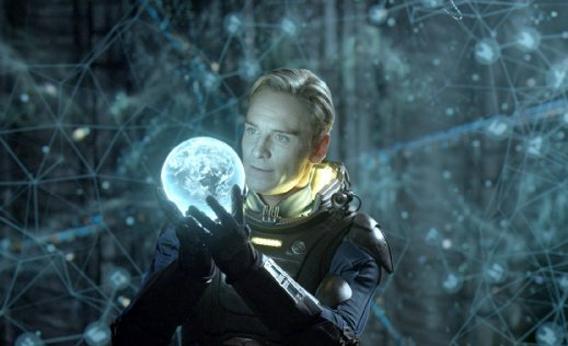
I saw Prometheus and intended to write about it in June. A few days after, the critical commentary had swelled to such a saturated state that I didn’t feel much compelled to weigh-in. Now that the dust has somewhat settled, I remain intrigued by how it inspired such impassioned feedback on both positive and negative reactions. Marking the return of Ridley Scott to science fiction, Prometheus was pitched as a prequel to Scott’s own Alien, despite its scarce resemblance to the 1979 classic. Prometheus can more fittingly be described as the cultivation of a century’s worth of science fiction—from Clarke to Asimov. It asks big questions about the humankind’s place in the universe and what it means to create life. All these questions are wrapped within a simpler sci-fi/horror story about a team of scientists travelling to another planet to learn of their origins. Of course, the naïve and pointedly stupid characters quickly learn that they are not welcome and the requisite chaos ensues.
The mix of heady material and B-movie conventions is a novel idea (and not necessarily ill-fitted, as proven by the likes of H.P. Lovecraft and David Cronenberg), but in the case of Prometheus it yields unsatisfying results. Detractors are quick to blame writer Damon Lindelof, whose screenplay introduces so many characters and subplots to what is really a rather direct story. In addition to the general glut, the script establishes several notions and potential directions without sufficiently committing to any of them. Then you have Ridley Scott, who seems to think he is making a companion to 2001: A Space Odyssey and never realizes that the beauty of Alien is the simplicity. The early scenes invoke the quiet wonder of Alien while introducing HAL-9000-like robot played by Michael Fassbender that proves much more interesting than any of its human counterparts. Compelling as some of these early scenes may be, Scott strains to recapture a sense of visual grammar that he channeled effectively at one time in his career to which he is now only attuned via nostalgia. Once the wheels start coming off the story, Scott’s command is revealed to be equally shaky.
Compounding the disappointment is that fact that many individual scenes might hold up in a better movie. Amid the ornate overtones, Prometheus is awash with well-crafted shots and interesting ideas. But none of them go anywhere. Scott and Lindelof are perfectly content to suggest a deeper mythology without telling a competent story or offering a rounded thematic concept. They believe that substance is the search for substance. They want you to think that their portentous allusions are pieces of a more intricate puzzle. And if you don’t like it, then you are failing to grasp the bigger picture. In other words, they expect the movie to take effect based on what it doesn’t do. (Ridley Scott, 2012) **

Friday, October 5, 2012

Death, sex, and an orange moustache: September capsule reviews


The Hunger Games
Through the muck of shaky-cam aesthetics and poorly rendered futuristic design, there is something I admire about The Hunger Games. Though not short, the film offers a compact rendering of Suzanne Collins’ massively popular novel about a ruthless game of survival among kids in a totalitarian world. The intermittently compelling arena sequences and Jennifer Lawrence’s serviceable lead performance keep the proceedings somewhat engaging, but Gary Ross’ spiritless direction does no favors to the mostly recycled Orwellian plot. Equally disappointing is how the filmmakers miss nearly every opportunity to draw a deeper connection amid the elements of violence, economic disparity, and societal unrest. Alas, The Hunger Games is emblematic of a growing trend that has beset many film adaptations of popular books: It strips away any the source material’s strengths and settles for numbing blandness so as not to offend anyone. (Gary Ross, 2012) **


Dr. Seuss’ The Lorax
It’s hard to say anything more about the wretchedness of The Lorax that A.O. Scott hasn’t already expressed in his appropriately outraged review. Unfortunately, this film is not the first to contort the work of Dr. Seuss into something wholly misrepresentative and tonally afoul of the beloved author’s work. And although it is not as actively repulsive as the Mike Myers live action The Cat in the Hat from several years ago, The Lorax has a more rotten core. It peddles a message of environmentalism but then undermines it at every turn with the same over-stimulating, mass-induced thoughtlessness it purports to be against. The worst gut punch comes when the Zac Efron-voiced lead character—after venturing outside of the plastic town of Thneedville for the first time—becomes visibly annoyed at having to sit through an old man’s story about the death of trees. Sadly, young audience members are probably thinking the same thing. After all, why try to engage and instruct with actual storytelling when a bounty of noise and colors get the job done much swifter? (Chris Renauld, Kyle Balda, 2012) *


American Reunion
After the mildly disappointing Scream 4 last year, the idea of resurrecting another popular '90s franchise seemed positively dour. And while American Reunion heads down the same road of awkward nostalgia in its early-going, it eventually settles into a nice rhythm. Part of the reason it works is that it takes a more somber approach to its own premise. It turns out that revisiting the glory days of high school can unearth some pretty deep-seated unhappiness about who we were and who we become. John Hurwitz and Hayden Schlossberg wisely avoid anything too serious in their conventional approach to the same brand uncomfortable situational comedy that marked previous entries franchise (to varying degrees of success). The film’s probing doesn’t venture beyond sex, which works just fine. There is nothing too memorable about American Reunion, nonetheless it’s a rare welcome visit with old friends. (John Hurwitz, Hayden Schlossberg, 2012) **½ 

Tuesday, October 2, 2012

Summer of '87: The Living Daylights


The '80s were tough on James Bond. Sean Connery’s awkward return in the unlicensed Never Say Never Again notwithstanding, the sight of an aging Roger Moore was a blunt reminder of how stale Albert R. Broccoli’s long-running film series had become. Hoping to inject fresh life into the weathering franchise, producers selected a new actor for The Living Daylights and took a more serious approach than previous entries. Alas, the same lack of attitude that mired its immediate predecessors keeps The Living Daylights from going very far with its new star.
As might be expected by this point, the film opens with the all too familiar scenario of a car chase. After skydiving onto the Rock of Gibraltar, 007 (Timothy Dalton) leaps onto a moving truck, is fired at by the driver through the roof, and then climbs into the vehicle to fist fight. Naturally, the car is also speeding down winding roads and mountainous terrain. The chase ends with the requisite destruction of the car and Bond parachuting onto a boat, where it happens that a lovely woman waits for the perfect man to fall out of the sky. “Pick me up in an hour,” he radios in to British Intelligence before noticing the woman’s beauty. He looks her up and down and then says, “Better make it two,” cuing the a-ha title song.

Click here to read the full post at Slant Magazine's blog The House Next Door