Thursday, February 7, 2013

Best Picture 2013: The Long Shots


There is no reason why the list of Best Picture nominees should be limited to five. Then again, there is no reason why it shouldn’t be limited to five. It’s one of the countless arbitrary distinctions the Academy of Motion Picture Arts and Sciences makes. But the recent tinkering with the Best Picture nominee roster—which saw the number of potential nominees double starting in 2009—comes across as especially gimmicky since it’s the only category to have been expanded in this manner. The idea, I suppose, is to highlight more films. But one could also make the argument that it dilutes the process and the winner, especially since the race really comes down to only a handful of nominees. Whether it would have been better to stick with the five strongest is up for debate, but there is little arguing that this year’s slate of (nine total) films is a fairly predictable bunch, at least in terms of how the Academy seems to be swinging.
Rather than tackling each film separately in this Best Picture nominee analysis series, I’ve decided come at it with a similarly arbitrary approach as the Academy. Thus, I am dividing the Best Picture nominees into three categories: “Long Shots,” “Middleweights,” and “Contenders.” Today I’ll cover three films in that I'm considering the long shots. Before getting started, one thing worth noting is that, among these three films that are least likely to win, two of them (Amour and Beasts of the Southern Wild) have also been nominated in the Best Director category. If the old logic of Best Director/Best Picture running pretty lock-in-step is true, then each of these films can also be considered as much for Best Director, which effectively makes that race between three nominees: David O. Russell, Ang Lee, and Steven Spielberg.
I’ll have more to say about this odd year (from a nominees standpoint) as we get further along, but for now, here is my assessment of the “Long Shots,” or, if you like, the “Happy to be here” entries. It’s a pretty good trio, but in terms of their Oscar chances, each of their victories were in the nominations. (Note: star ratings next to the titles represent my rating and bear no relation to each film's likelihood of winning.)

Amour (***½)
That Michael Haneke’s latest film has been so visible throughout this awards cycle is something of a surprise, no matter how much of a departure Amour is considered for the director. The reality is that Amour is very much in the Haneke mold, thematically and stylistically. Its chronicling of the last stages of an elderly woman’s (Emanuelle Riva) life through the eyes of her lifelong husband (Jean-Louis Trintignant) is shattering, to say the least. Deeply humanistic in some respects, Amour also offers a window into the painful emotions of watching someone wither away. Haneke’s slow rhythms and steady compositional approach pair well with quiet distance that gradually and inevitably separate the husband and wife. It’s a terrific film, but devastating in ways that the Academy is not prepared to reward at the top level. It's also not in the English language, which just about rules it out no matter how high the quality.
Bottom Line: While it’s a sure bet in the Foreign Language category, Amour’s real victory was landing in the Best Director and Best Picture fields. The Academy’s embrace of Haneke's film will be as cold as the director's storytelling, however.

Beasts of the Southern Wild (***)
Also a surprise in both the Best Picture and Best Director categories is Benh Zeitlin’s Beasts of the Southern Wild. With the category expanded to nine films this year, it’s become harder for the Academy to justify the absence of at least one contemporary indie-styled film, which Beasts well satisfies. Despite it’s problematic tendency to ennoble the young protagonist with zen-like wisdom and penetrating insights (summed up well by Dana Stevens’ “anthropological voyeurism” takedown), I was moved by the odyssey and rich portrait of a world far removed from the social and commercial restraints of modern society. Its seamless melding of gritty realism with sweeping emotional gusts and fantastical visions of folk legend probably won Academy voters as much as they did for me, but not enough for them to consider it as Best Picture.
            Bottom Line: While it will enjoy a nice boost from the exposure, Beasts of the Southern Wild is a niche film as the Oscars go. It was destined to be in the mix, but it’s road ended with the nomination.
Django Unchained (***)
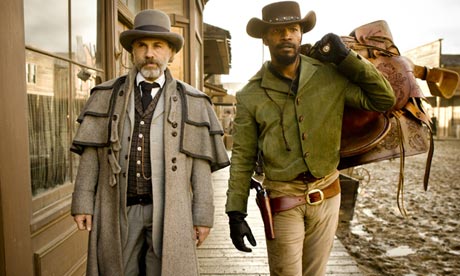
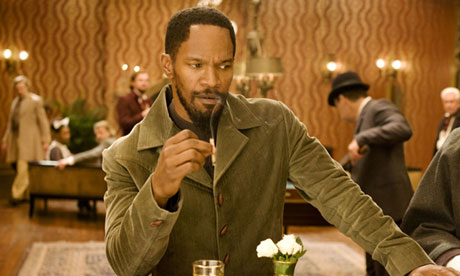
With Harvey Weinstein deciding to throw his weight behind Silver Linings Playbook, it’s no wonder that Quentin Tarantino couldn’t get lightning to strike twice after his strong 2009 showing with Inglourious Basterds, which netted the director nominations in both Directing and Best Picture fields. Django Unchained is a similar kind of movie, an anachronistic revenge tale threaded into a painful chapter in history. Powered by beautiful photography by Robert Richardson and a collection of fine performances, Django is salient and layered in ways similar to Basterds, but it lacks the focus and the rhythm that characterized that film. With all these factors in play, Harvey’s opting to lobby for the safer, smaller Playbook makes sense. Nevertheless, Tarantino's film, while spotty, is another solid entry for the director.
            Bottom Line: Tarantino might have a shot at Original Screenplay, but it was a surprise that Django Unchained was even nominated for Best Picture. Thus, it’s arguably the film that’s least likely to win.

Monday, January 21, 2013

Looking for a silver lining: January capsule reviews


Silver Linings Playbook
“Reckless” is not usually how I would describe a movie, but Silver Linings Playbook is such an egregious misfire that no other characterization would be appropriate. That’s not to say that David O. Russell's film, which has all the moves of a tired romantic comedy, doesn’t have some satisfying features. These include strong turns from Jennifer Lawrence and Robert DeNiro and an evocative rendering of the blue-collar outskirts of Philadelphia. But a handful of good performances and skillful visual grammar cannot overcome the unsettling reality that Silver Linings Playbook unforgivably trivializes a sensitive and difficult subject—mental illness—with silly plot contrivances and a dubious underlying message about blind faith. *½

Beasts of the Southern Wild
Benh Zeitlin’s Beasts of the Southern Wild takes you to a flood-prone locale outside New Orleans called The Bathtub, where a young girl named Hushpuppy sets off on an odyssey. Despite its problematic tendency to ennoble the girl and other members of this community with penetrating insights into the mysteries of life, Beasts nonetheless authors a rich portrait of a world far removed from the social and commercial restraints of modern society. Moreover, the film’s most distinctive trait is that it seamlessly melds a gritty brand of realism with sweeping emotional gusts and fantastical visions of folk legend that come to play a major role in Hushpuppy’s coming of age. ***

Looper
Looper has everything a good science fiction film should offer, including a new spin on an old concept (time travel), a bold depiction of the future, and most importantly a character-centric story. The plot is too detailed to recount here, suffice to say that director Rian Johnson approaches it only as an extension character, an emphasis that deepens the film's many bursts of intense violence. Bruce Willis and Joseph Gordon-Levitt are both in fine form (playing, respectively, an older and younger version of the same man), but this is Johnson’s show, from the crisp writing to the distinctly understated visuals. Not every beat is successful, but Looper’s moving treatise on grief and remorse approaches greatness. ***½

The Deep Blue Sea
The Deep Blue Sea has an unbound emotional core, and yet it is defined by its reserve. Director Terence Davies adapts this play as if it were for the stage, giving us only a handful of characters and locations in telling this tale of a woman whose infidelities in post-World War II England magnify her deeper sadness. A stirring opening with sumptuous music and color set the tone for what becomes a somewhat muted and yet atmospheric work. The supporting characters are rendered too thinly for such challenging material, but the film is elevated by Rachel Weisz, who has no easy task in transmitting the suffering of a suicidal woman. Her restrained portrayal of transient hope and lingering depression is stunning. *** 

Friday, January 11, 2013

Critical Distance: The Hobbit: An Unexpected Journey

The critical response to The Hobbit: An Unexpected Journey, the first part in Peter Jackson's new film trilogy based on J.R.R. Tolkien's novel The Hobbit, or There and Back Again, suggests that it's bloated and deficient of the propulsive energy that typified the Lord of the Rings films. The likely cause of dissatisfaction stems from Jackson's approach toward adapting the book. Whereas Jackson and his writing team condensed each volume of Tolkien's Lord of the Rings trilogy into its own film, with The Hobbit they've opted to adapt a considerably more straightforward narrative into three films. Thus, An Unexpected Journey only represents a small portion of the book. Critics have seized on this and critiqued the nearly three-hour film for being padded and flabby. While not necessarily untrue, these charges have fueled an abundance of banal commentaries bereft of any real insight into or about the movie. What's most discouraging about this is that An Unexpected Journey, though certainly vulnerable to criticism, is a more layered film than we've been led to believe.

Wednesday, December 12, 2012

Moments out of Middle-Earth


Critics appear to be down on The Hobbit: An Unexpected Journey. That Peter Jackson opted to shoot his Hobbit movies at a higher frame rate and also announced a late decision to split two films into three might have something to do the film's early reception. Or it might simply be that The Hobbit fails to live up to the momentous Lord of the Rings trilogy. Although only nine years have passed since The Return of the King was released, both the critical and popular perspectives toward the trilogy appear to have steadily grown more positive. How this will affect Peter Jackson’s return to Middle Earth with The Hobbit trilogy remains to be seen.
In the mean time, I've gone back to The Lord of the Rings trilogy with a slightly fresh perspective. My goal was to look at these films from the inside out. Inspired by Richard T. Jameson and Kathleey Murphy’s annual “Moments out of Time” film retrospective series, I've picked 10 moments from the movies that magnify their great relevance. My article just went up over at The House Next Door. Please take note, these are not my "Top Ten" scenes out of the films. As I note in the introduction, the 10 scenes I've selected “illustrate a slightly different shade of the films’ fluid realization of a complex visual, thematic, and emotional spectrum.” Head on over and have a look, and feel free to weigh in with your own picks. 

Monday, December 3, 2012

The Walking Dead: Season 3, Episode 8: "Made to Suffer"


For all the anticipation and careful setup over the last several episodes of The Walking Dead, the show's mid-season finale was somewhat anticlimactic. Many burning questions were introduced leading up to the episode. What will Andrea (Laurie Holden) think when she finds out about the zombie daughter the Governor (David Morrissey) keeps hidden inside a cage and all those heads floating inside wall-length fish tanks? What will Merle (Michael Rooker) and Daryl's (Norman Reedus) reunion bring? How is Rick (Andrew Lincoln) going to get Glen (Steven Yeun) and Maggie (Lauren Cohan) out of Woodbury? All of these are answered, if not in a particularly satisfying way. We do, though, get bombarded with more questions. "Made to Suffer" delivers on tension, action, and confrontation, but it's all pivot and no release.
The episode's primary focus initially seems to be Rick's mission to penetrate Woodbury and rescue Maggie and Glen. He remains suspicious of Michonne, who disappears after helping Rick's group sneak into the town. Meanwhile, the Governor scampers around trying to manage the residents' fears that their haven's been infiltrated. He also wants to keep Andrea away from the action so she can't learn that the intruders are members of her former group. He's away from much of the episode's action until his confrontation with Michonne in his quarters, where his cool surface disappears when Michonne kills his zombie daughter and the two engage in an intense fistfight that ends with him likely losing an eye. Afterward, he weeps and hunches over his lifeless daughter with a shard of glass protruding from his eye—the defining image of the episode and likely the defining moment for the character going forward.