Tuesday, June 17, 2008

The House away from home

I am pleased to report that I will now be writing for The House Next Door, a film / media site I have long regarded as one of finest of its kind. I don't have a specific direction or set of goals I'd like to accomplish in my articles for The House, but I anticipate drawing up a number of commentaries on a variety of cinephile subjects, as well as offer some more in-depth film criticism the likes of which is not appropriate on an individual blog like The Cinematic Art. I have every intention of upkeeping this blog at the same pace regarding post numbers and content. I may not write at the same length that I have in the past, but I will continue to keep this site up-to-date in similar capacity as I have over the past year. As always, thanks for reading, and your comments are always welcome!

My first article is an appreciation of Ang Lee's Hulk, a film I believe to be underappreciated and underrecognized. With the release of the new film, Lee's version of the story may likely be driven into even deeper obscurity. I argue that the film is important, both as a work of digital cinema and simply as a melding of experimental and conventional filmmaking styles. At a time of greater nuance and confusion in the film landscape -- with aesthetics and sensibilities shifting to accord to new sociocultural conditions -- Hulk is especially relevant. Hopefully, time will be kinder to it.

Below is an excerpt from the opening portion of the article:

"Midway through Ang Lee's Hulk (2003), Betty Ross (Jennifer Connelly) and a Hulked-out Bruce Banner (Eric Bana) share an exchange that could easily be confused with a scene from a less commercial film made at one of Universal's smaller subsidiaries. Aside from the impressive CG-effects (somewhat obscured, and assisted greatly by the darkness of night), there is palpable affection between the towering digital creation and Connelly. Bruce shamefully gazes on Betty in self-disgust, the moonlight shining off his bulging arms as he moves to gingerly lift her off the ground. When her arms drape over his giant limbs, we can feel it. No dialogue is uttered; there are only faces.

In that moment, Lee achieves something that so few filmmakers have with digital effects. He literally brings a digital creation to life. The scene can be seen as something of a precursor to the under-appreciated
King Kong (2005), wherein director Peter Jackson momentarily mutes out the world so that a flesh-and-blood woman can connect with a pixelated monster. But unlike Jackson's Kong and various other works featuring memorable digital creations, Hulk will not be remembered as a defining moment in the history of CGI. And yet, the film's use of digital technology is more subtle, evocative, and arguably more innovative than a great deal of the so-called greats (e.g. Terminator 2: Judgment Day, Independence Day, The Perfect Storm, etc.).

Lee understands that the quality of effects have little to do with their photorealism. How "real" the Hulk looks is irrelevant—the reality is instead contingent on the conveyance of feeling. This affective connection is not necessarily achieved by top-line effects (a notion that echoes a traditionalist application of digital filmmaking). Instead, Lee illustrates that with the appropriate sensibility and aesthetic unity, such pure moments can be constructed traditionally (analogically), digitally, or with a perfect melding of the two.
Hulk essentially embodies a new kind of cinematic connection that is both subtle and profound. The digital components are physically married to the composition and emotionally embedded in the narrative."

For the full article, head on over to The House Next Door.

Monday, June 16, 2008

David Hudson sounds off

"Movies make you want to see more movies - but, because of the collaborative nature of their making, often in very interesting ways. If I read a book and I like it, or I'm moved or intrigued by it, I'll probably go looking for another book by the same author. Same with a painting and its artist. With movies, it might be more movies by the same director I'll want to seek out, but it might just as well be an actor's work I'll want to see more of, or a cinematographer's. Or maybe it's more the look and feel of that movie's genre or origin - noir, Iran, what have you - I'll want to seek out and sample again.

'The other thing's related: Just as movies arouse a hunger for more movies, they also arouse a hunger for more real living. They make you want to get out and do things - stay out late, eat, drink, fall in love, see new places, meet new people - even the downers. In a way, these last two impulses - see more movies; live more fully - are contradictory. Again, the old anxiety: not enough hours in a day, days in a week, years in a life."


These are the words of GreenCine Daily editor David Hudson, who was recently the focus of Adam Ross's indispensable Friday Screen Test series. Hudson is oft-referred to as the hardest working blogger on the internet. In this piece, Hudson waxes about film, philosophy, and the daily struggles of his work. The interview is a joy to read, especially for those who keep up with his daily work. The quote above does more than highlight the collaborative nature of the cinema. His description of the endless doorways and passages that film can open works as both a concrete metaphor -- i.e. exploring the work of another filmmaker, actor, etc. -- and a more abstract one, which he teases out in the last paragraph. In my view, his final remarks articulate the tensions dormant within cinema and of life so perfectly, evoking the transience of both more effectively than any essay or book that I've read on the subject.

This interview represents a glimpse into the mind of a man whose passion and enthusiasm for movies come through more in his coverage of films rather than his opinions about them. His tireless coverage of the hundreds of films released each year is enough to inspire any cinephile to embrace the larger worlds of international and independent cinema, while still keeping up with the cultural dialogue spurned from discussing studio films. As the subject of discussion here rather than the facilitator of it, Hudson paints a portrait of himself and the art form about which he writes that is reflected in his daily postings on GreenCine.

In some ways, Hudson is film criticism equivalent of that eclectic teacher you had in high school who inspired you to ask new questions, make bold observations, and embrace new forms of thinking; all without ever revealing his own "take" on the material about which s/he teaches.

Do check out the interview if you haven't already.

Wednesday, June 11, 2008

At world's end with Werner Herzog

It's been almost eight months since I've seen Encounters at the End of the World, and to this day its images live in my memory. Amazing underwater sequences; pleasantly absurd interactions with Antartica's resident culture of researchers, scientists, and poets; and the haunting sight of a single penguin briskly waddling away from the group to "certain death." All of these moments and more have taken on their own life in my mind, strung together by the occasional voice of Werner Herzog, who lends his perspective to the encounters that he and his camera operater have on the dwindling ice block at the bottom of the world.

The film opens in New York and Los Angeles today, and in honor of its release, I have included excerpts from the piece I wrote when I saw the film late last year. Framed and presented in this form, they constitute a brief review of the film:

"In Encounters at the End of the World, [Herzog] travels to the most remote location of this planet to observe the people who inhabit it. The film is comprised of a series of interviews with various scientisits, divers, and "dreamers", as Herzog calls them. He is not merely attempting to observe and gain insight into the desolate ice world and the planet, but also to understand what motivates the people who have elected to live there and study it. Herzog seems to believe that while human beings and nature cannot connect or live together in harmony, they constantly intersect, inevitably so, even in the the most far-off land, where people require the best of minds and technological access to survive at all. This tense relationship fueled his last documentary, Grizzly Man (2005), and while he isn't exploring life and death and the harsh collision of humans and nature, Herzog is nonetheless searching for something in his probing of the Antartic culture, wildlife, aquatic life, and the glaciers that move about the ice-cold waters.

By observing the idiosyncrasies and odditities of the continent's residents, Herzog captures both the beauty and absurdity of what they do. He uses voiceover to frame his questions and thoughts, some of which are practical and humorous, others more subliminal. Regarding Antartica and its residents, Herzog wants to understand their unique motivations, as he paints them as dreamers (as I mentioned above). But he also uses the voiceover to interject his own very estranged thoughts (i.e., distanced from their thoughts and thought-processes) in the form of hilarious observations such as "Her story goes on forever", which typically cut off the person talking. However, these hilarious moments are often times genuine, whether they're honest feelings of his or simply elongated takes of a given individual after she or he is finished talking; It's esepcially interesting to see how uncomfortable people become when they've said what they wanted to say but the camera keeps rolling, as if its stalking them. But these bits of humorous discomfort are never outwardly mocking of the interviewees. In fact, Herzog often finds real humanity in all of persons with whom he speaks in the most mundane or comedic of times. Whether he's enamored, bored, or "searching for something to talk about", Herzog often finds life in the simplest of ways.

He juxtaposes his encounters with the people of Antartica with some of the most awesome cinematic sequences of underwater footage. Throughout the film's 99 minutes, there are several long sequences underwater in which the camera follows divers down to explore the chilly depths underneath the ice. There is nothing overtly flashy about the images, yet they exude a real sense of discovery, as if the viewer is among the privelaged few to be able to see that which rests underneath the ice, which is a whole other world. We can observe this world, shoot it on film, and try to explain it with science, math, or language, but such attempts ultimately fail. Sometimes sounds and images stand for themselves. As is typical of Herzog's films, Encounters at the End of the World finds sublimity in the most seemingly mundane of ways; in patches of air traveling between the ocean and the ice that sits on top of it, in lone penguins who "walk to certain death", and in the ramblings of its many interviewees. The most outwardly poetic moments are those underwater, where the sea life seems almost alien in that it resembles nothing we have categorized into a species or form of life. Underneath the ice in Antartica, life eludes the human capacity to understand it. And in these sequences, whether underwater or in ice caves, Herzog rarely interjects with his own voice, except when observing peoples' strange ways of trying to connect with it. (Buried in a tunnel of ice is a frozen fish and strings of popcorn!)

With all his wanderings about this world "off the map" with no real understanding it, Herzog finds great clarity in balancing "Profound Moments" with seemingly pointless ones. He is utterly fascinated by everything, prompting him to contribute his own thoughts about it. After seeing the film and reflecting on its rather free-flowing tendencies and sensibilities, think I now understand a bit more why Herzog enjoys making documentaries, even though he keeps the term "documentary" at a distance. There are things so wonderfully strange and strangely wonderful about this film, which is more an exploration of a foreign land and culture. No "narrative" film or talking heads" documentary" could ever broach the eccentricities of the people interviewed and observed in this people, and no amount of creative framing or special effects could yield the kind of strange, almot too gloroius for words images of the lost world underneath the glaciers. With this style of documentary, Herzog can frame his own narrative and present this world as he sees it. He is the true master of this cinematic universe, and I must admit that it's a universe I love to lose myself in. In this universe, Herzog dives into different places of our shared world --or collective unconscious-- to observe how each of us interpret the very same matter and sensory perceptions differently, crafting our own worlds in the process.

Encounters at the End of the World is yet another attempt to explore ecstatic truth in one of the endless amounts of ways one can. It reminds of the true elusiveness that is cinema, which itself is a tool for experiencing ecstatic truth. It is a medium rich with possibility. Only with cinema can a filmmaker foster such a world in such a unique way so as to offer insight into how humans construct their own narratives and fancy their own worlds. It is a medium of many media, itself the true convergence of technologies and artistic perspectives developed and progressed over thousands of years to shape our consciousness, individually and collectively.

If I do happen to miss tonight's conversation with Herzog, I won't feel like I've missed on on something once in a lifetime. I say that because watching his films is itself a sort of personal experience with the filmmaker, like a conversation wherein I am constantly engaged in his thoughts and observations, which in turn provoke my own, which may thus inspire me to approach the film in a different or unique way. I find some version of this pattern occuring each time I watch a Herzog film, whether that's a narrative film or a documentary. But the greatness of his body of work is in the way in which he makes films collapses these broad frameworks that turn the cinematic experience into a process of structuring and categorizing."


Some of the concepts referenced in these passage correspond to thoughts on ecstatic truth, which I discussed earlier in the piece. (Here's the whole article.) Reading this review again, the images and sounds stand out to me even more. I don't want to create any false notions about the dramatic aspirations of this movie, because they are nowhere near those of Herzog's Grizzly Man; He is after something very different here, or so it seems. There is a profound absence of direction in this movie, which, guided by Herzog's thought processes and strange observations on his adventure, makes for an equally compelling, albeit very different kind of experience than than the more somber Grizzly Man, or some of his other documentaries. That said, Encounters at the End of the World is in some ways the movie that Herzog has been making his whole career. Centering on themes of the interrelations of humanity, nature, and technology, the film is full of those Herzogian moments of simple profundity manifesting in its interviews and underwater compositions. We learn that his preoccupations haven't change; only his manner of exploring them.

Friday, June 6, 2008

Patriarchy and criticism

An increasingly bitter dialogue about Sex and the City has developed in the past several days, on blogs and in publications. Currently, the movie stands at a mediocre 53 percent on the Tomatometer, which seems awfully high for the drumming this movie has received. I don't doubt that's it's true, though, and that critics are more split on the merits of the movie than it appears. For whatever reasons, and I'm sure there are many, Sex and the City represents one of those rare cases in criticism where the detractors are making so much noise, despite not quite representing a majority. It's not so much the "for or against" rhetoric that's especially interesting, but the condescending manner in which the film is approached, even by its supporters. It seems to me that even critics who are fairly indifferent about the movie are going to great lengths to let their readers know that Sex and the City simply isn't their thing.

I don't want to make any grand suppositions, but this phenomenon seems to reflect the hegemony of patriarchy within journalistic film criticism. The irony of this statement is that when it comes to the proliferation of masculinity in cinema, Hollywood usually takes the blame and critics get a free pass. But the level of discourse about Sex and the City reveals a few tendencies in even the most productive sects in American film criticism, about the assumed male spectator.

I have not seen Sex and the City, so I cannot say what is true or untrue. But that's not really the aim of my observations. What really interests me about the SATC discourse is that it features so much self-conscious defensiveness. Critics who are downright vitriolic are targeting Sex and the City for its glorification of hyper-materialism and consumer culture, and its audacity for centering on four female characters more interested in the latest fashion trends anything else. This seems an odd claim to me, since American cinema represents one of the pinnacle commodities in contemporary culture. When critics are routinely pumping out 600-word formulaic pieces in support of "consumer culture," I wonder why films like Sex and the City are singled out, and not some of the massive action blockbusters whose saturation in media and advertising reaches sickening heights.

On the other hand, you have critics who are not outright hateful of the movie, but admit that it's not their thing. This position is much more useful than blind rage, but, again, why do critics speak this way of movies like Sex and the City and not other show-turned movies like The Simpsons, or even just certain genres or styles, like horror films or sword-and-sandal epics?

Not two weeks ago, critics largely raved about Jon Favreau's Iron Man, a comic-book actioner about a war profiteer turned-action hero. The film was competently made, no doubt, but it's hard to account for the overenthusiastic critical reception. Even critics who outright said they were getting sick of comic book movies seemed to like it. Winning over just about everyone, the film is an anomaly to me, and evidence that perhaps critics should be more reflective of their practice and reflexive. I know that it's a critic's job to treat a movie on its own terms, but if there's one thing anyone studying the arts and social sciences should know, it's that nothing stands in isolation. And part of the job of critics is to identify trends, anticipate them, and critique not just formal craft in individual movies, but to situate them amongst a larger inquiry into art, commercialism, and socioeconomic policies.

Now, I didn't read all of the reviews for Iron Man, so I don't want to make a sweeping generalization. But I did read a number of them. The best one I read was by Filmbrain, over at Like Anna Karina's Sweater. He didn't write a review, or talk about plot or character. He offered a simple observation that qualifies as evocative, interesting criticism. The post was entitled, What I learned from Iron Man, and it read:

"A pretty, Ivy League educated, socially (and politically) conscious Vanity Fair reporter will, in a matter of minutes, toss aside her personal ideology (to say nothing of her professional ethics) and jump into bed with an alpha-male war profiteer who first questions her intelligence, and then follows up with a sleazy pickup line."

I don't expect professional critics to muster the courage to write anything like this, but a number of online writers with this potential don't exercise it for that kind of commentary. Moreover, at no point did I read anything in the sea of positive reviews for Iron Man that the film not being the reviewer's cup of tea, so to speak. I would guess not, since so many of the films critics are subjected to in a year are of this variety. I suppose no one goes into professional criticism expecting that they won't see hundreds of movies like this a year. Apparently, male-centric films are ok with most critics, and why not? Hollywood cinema has always been a dreamscape for a patriarchal society, so why should critics be any different? It's the expectation of these trends, the passive acceptance of the imposition of particular values and assumptions about gender, individualism, class, race, etc. that worries me; the fact that critics appear more interested in playing the game, than looking past the surface of film cultures and analyzing trends and practices, revealing new perspectives and enabling other, in hopes of bettering the production and consumption of movies.

As Andy Horbal once noted, there is a scary amount of sameness in professional film criticism, so much that it's hard not to wonder that criticism has become the very commodity about which many of its participants complain movies have become. It's hard to hold individual critics responsible for these larger ideological trends, but at what point do we begin questioning the punditry that criticism seems to represent when viewed in a collective light. There are definitely bright spots in film criticism, but they are shining lights enshrouded in a dominant cultural system that doesn't reward progressive thought; which is, in fact, positioned as "the alternative."

Some argue that other modes of criticism are a way of correcting some of the weaknesses of professional criticism. But this largely depends on the ideological stance of the argument. Framed from a perspective of representations of gender in cinema, and the manifestations of deeply embedded cultural notions of masculinity and femininity, I'd say that all venues of journalistic film criticism are subject to massive interpretive problems stemming from a hegemony of patriarchy that pervades media.

I'm sure this isn't a popular perspecitve, so I'm welcome to counterarguments. Discuss!

Tuesday, June 3, 2008

Sounds of the Knight

Of all the Hollywood blockbusters released in recent years --from superhero flicks to fantasy epics-- none stand out to me as more memorable and significant than Christopher Nolan's Batman Begins. Although there are other worthwhile, even great studio films in the last decade, Batman Begins is distinct in that it weaves intelligence, craftmanship, and character together with a narrative that is relevant.

At the heart of the film lies a central tension regarding the hero myth, which the film neither embraces nor shuns. The movie poses the question: Can one person rise above sweeping corruption, and make a difference in the lives of those preyed upon most by those with power? Moral fiber is the one attribute that has always separated heroes from villains, and yet the film seriously questions whether a moral center is enough to counter the fear and complacency that mass corruption breeds. Moreover, the film outright questions whether morality and goodness are productive in this struggle at all.

Complementing and enlivening these thematic depths is a dense aesthetic that is noirish in mood, but naturalistic in structure. Gotham city lacks an architectural identity. It is instead defined by labyrinthine streets and contemporary glass skyscrapers rising above the poverty beneath them. Their twinkling lights glimmer in the background of many compositions, obscured by the shear multitude of their numbers.

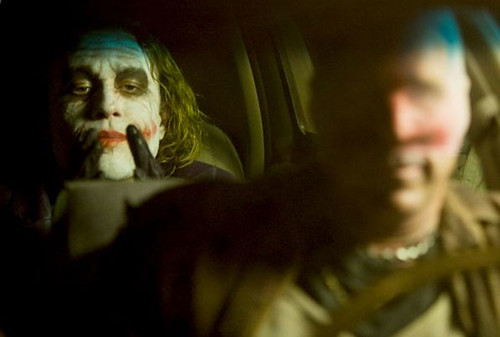
Part of what enables these images to breathe life to the narrative is the music by Hans Zimmer and James Newton Howard. Interestingly, traditional film score fans single out this score as one of the worst in recent years, which is likely due to the fact that it --like the film-- is incongruous with the expectations of a "superhero" film. The score rarely waltzes into the familiar ground of brass-driven heroic ostinatos (such as in Danny Elfman's outstanding theme for Tim Burton's Batman films), as the composers instead opted to auditorily augment the noir-ish visual style and subtle characterization with rhythmic, driving music for a man who seeks to embody a more primitive state of mind than most other heroes. When the camera pans the rooftops of Gotham, we can hear these rhythms building, pulsing, but not necessarily with much direction. Contrasting with these rhythms are frequent swirlings of strings and faint electronic echoes giving voice to a city (and a film) with no clear villain, but a plurality of pain, fear, and corruption underneath the slick, glossy surface.

Although The Dark Knight is still almost two months away, Hans Zimmer and James Newton Howard have recently given an interview to the LA Times. On The Dark Knight and Nolan's "intellectual" style, they shared their views about the place for music in this film and the 2005 film that preceded it. Excerpts below:

"Why go with a fast-and-simple string pattern rather than give the film a big, easily recognizable theme?

Zimmer: I wanted to take the romance out of it -- the fake fantasy to it. One of the things I kept thinking about was just how iconic the bat symbol is, and at the same time how dark and unadorned it is. I spent forever getting rid of notes to get it down to just two notes in this ostinato pattern.... The bat symbol is so efficient at getting the idea across. I wanted to get really efficient.

Howard: At the same time, when you write a traditional, conventional superhero theme, it gives you so much information that it might be misleading about that character. Our Batman? We're still getting to know him. He's a very complicated guy. To attach a theme to him, a theme you can sort of hum, it defines him emotionally in a way that is false.... It advertises so much about who you are during the film. I think, in a way, a theme like that would have done that. This theme is about implication, and it's about menace.

And there is still a recognizable sound attached to the character.

Zimmer: But I'm letting the character finish the thought. It leaves a lot more space. I don't see Batman as a superhero. I wanted to be very clear about that. I wanted to take out anything that is super about this.

Let’s talk about the "Joker Suite." This almost sounded like an orchestral interpretation of an industrial song.

Zimmer: Look, I'm German, so I come from the German tradition of Kraftwerk.... But I kept thinking I wanted to find a way to bring corrosion into Gotham -- corrosion and recklessness. The funny thing about that piece is that I knew what I wanted to do, but it took me months to actually do it. Nobody could play it.

It's all about acting and attitude, in a way. It's very much of the idea of taking one note and expressing any part of fearlessness and recklessness and surprise.... It is very industrial music. I tried to give it a punk attitude. I used to work with the Damned and bands like that.

Howard: What's great about the Joker theme to me is that it feels totally untethered. It just kind of exists. It lives somewhere in the cracks.

What else is different this time around?

Zimmer: This is what surprised me, and I think this needs a little clarifying. Everyone keeps saying that this film is darker than the last one. I always think that people think that means more violence. It's not that at all. There's much more of a precise intellectual thought that went into Christopher [Nolan] and his brother [Jonathan] while writing. The ideas are somehow more real and more grown-up. We're doing a summer blockbuster that deals with anarchy and old-fashioned values versus the modern man. That's a lot of fun to play with.

You guys split up characters a bit. James, can you talk about what you created for Harvey Dent/Two Face?

Howard: Basically, Harvey Dent is Gotham's great hope. He's going to turn things around. He starts out with the best of intentions. He's a brave, courageous, high-minded man. Over the course of this story, he becomes seduced and corrupted -- really by the Joker. The Joker kind of wins. It's just the arc of his character, which ultimately ends up in a very tragic self-destructive place. That was the musical line.

Zimmer: What makes it interesting is that there are such extremes. The music James wrote for Harvey Dent is really beautiful. On the hand, you have the Joker theme, and on the other hand you have that contrast of something really elegant and beautiful.

What makes this movie -– and this score -– interesting is the extremes. The black is a lot blacker because of the light."


It's first worth noting that Hans Zimmer is nowhere close to the talent level of James Newton Howard when it comes to film score, at least in my view. That said, his perspectives on how he approaches a film or character are always interesting and upfront. He also takes over the interview, as Howard's comments are usually pushed to the side.

At any rate, it's a very interesting interview that's worth the read if you're an admirer of Batman Begins, both the film and the score. There are definitely some hints dropped about the movie, but what's really intriguing is how they explain their approach to the musical texture of the first film, and how that carries over to Knight.

Howard's comments are more appealing on an intellectual level (as I noted in March), especially his reflection on how brashly heroic or dark themes for characters can constrict their ability to develop and morph. He describes the theme they've written for Batman to be more about "implication," which is certainly reflected in the score, I would say. It will be especially interesting how that theme is developed in Knight, and whether Batman will become more of a hero in that film. Something tells me that the film is headed in a new direction, as Zimmer notes in the later passage about the new film being more outwardly cerebral than the last movie.

Although my sensibilities are more aligned with Howard's more quiet, intangible sense of marrying music and images, Zimmer wins the award for the most provocative remark about "letting the character finish the thought," and the music "leaving more space," in being more about implication.

I would be interested to hear how others feel on these matters. So, your thoughts regarding your likes or dislikes in the score to Batman Begins, or the overall approach that Howard and Zimmer advocate about the role of music in the construction of character?

Thursday, May 29, 2008

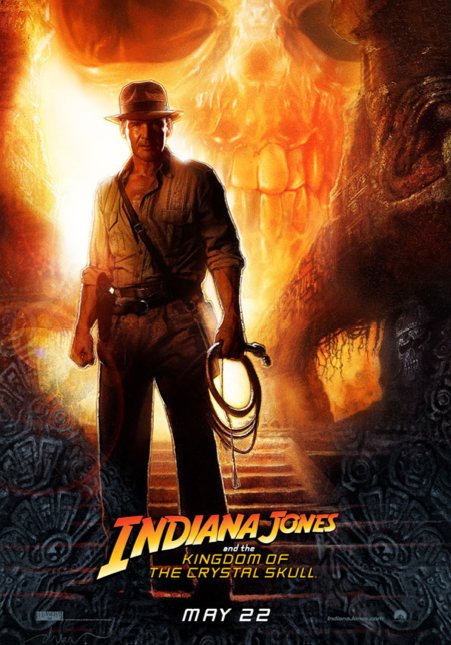
Strained nostalgia: Indiana Jones and the Kingdom of the Crystal Skull


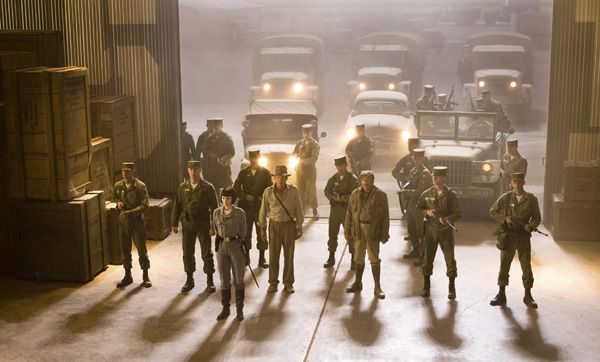
In the opening scenes of Indiana Jones and the Kingdom of the Crystal Skull, we are cued on multiple occasions to swell up in nostalgia for a sense of old-time moviemaking that even the filmmakers seem to think is dead. In the very first shot, director Steven Spielberg wastes no time to make a joke out of the established tradition of the Paramount logo dissolving into the film's opening shot. We think we're looking at a mountain, which turns out to be quite different. From there, the opening title sequence begins with the same letter font that was used for Raiders of the Lost Ark and Indiana Jones and the Last Crusade. After the title sequence, Indiana Jones makes his "grand" return to the screen with the famous Raiders March performed triumphantly in spite of the downbeat circumstances of his situation. Even when the action begins (in the warehouse from the end of Raiders), the filmmakers can't resist allowing us a small look at the lost ark. These pinch-yourself moments remind viewersm and remind them again that they are in for a trip down memory lane. But with the film resolutely and insistently banging the nostalgia drum every moment it can, the feeling that it is a true Indiana Jones film often seems manufactured.

This mood hangs over the fourth installment in the popular action-adventure series. It's as if Steven Spielberg and George Lucas are winking at us, expecting that we will simply play along in their harmless revisiting of an old friend. Lucas has openly stated that the film is "just a movie," which is no doubt true, even if the marketing campaign would convince you otherwise. Lucas has also said that the film is like the previous films; but this statement is only half-true. While Indiana Jones and the Kingdom of the Crystal Skull embodies the Indy mood and style to a tee, it also strains to imitate the previous films, rather than fully embracing the energetic spirit of this kind of storytelling. The other films --at least the first two-- worked partly because they delved so deeply and unashamedly into absurdity, reveling in seemingly ancient filmmaking and storytelling conventions. They were travelogues through movie sensations that were made with full conviction, whereas Crystal Skull is far too self-conscious to build and sustain its own rhthyms.

That said, Indiana Jones and the Kingdom of the Crystal Skull still boasts a few moments of pure, unfiltered energy. These inspired bits surface in small places and throwaway sequences, such as in scene transitions, stagings of dialogue, and less than big moments during action sequences. An early example of this is during the extended opening sequence, after Indy escapes from the Russians and makes for a small town in the middle of the Nevadan desert. The vision of an aged Jones -- donning his iconic, unchanged getup of brown slacks, a fedora, and a whip-- running frantically through a sunny, colorful suburban town is a stroke of brilliance. The sequence culminates with a silhouette of Jones foregrounded in the corner of a shot pulling up to reveal a massive mushroom cloud in the background. This play against expectations establishes a harsh contrast in setting and mood that pulled me right into the narrative even more than the sound of the whip cracking in the warehouse scene.

Following these scenes, we return to Marshall College, where the Red Scare has invaded campus grounds. With the constant reminders of the Cold War affecting academia, it's oddly welcoming to return to the classroom and see Indy teaching. Although archeology remains dictated by the same principles, it's obvious that in spite of his love of archeology and adventuring, Indiana has changed. During these expository scenes, the film sets up the main plotdilemma in two ways: First, by establishing the Russians as a collective force and threat, as Indy is dismissed from teaching duties due to a suspicion of his national allegiance. This is an interesting plot device that sets up the remainder of the film rather beautifully, especially since it brings together Indy's absence of place in the world. The next plot push, however, is not as successful. Spielberg and screenwriter David Koepp bridge the two plot shifts in a beautiful sequence where Indy gets on a train leaving town. In just a few economical shots, we go from feeling Jones' estrangement from the world --with train smoke billowing in the background as a solemn version of the Raiders March going through what seems to be its last, dying statement-- to the introduction of Mutt Williams, a la Marlon Brando in The Wild One, who glides into the film as if to remind that there's a story to tell. Before Indy takes off on the train, Mutt informs him that an old professor of his (and friend of Jones) is missing. This is the basis of the film's real plot hook.

This all sounds like a great set-up, but Koepp sidesteps many of the potential points of drama surrounding Jones' age and his self-realization about never having grown up. Instead, Koepp plunges right into a complicated legend surrounding the crystal skull, the main artifact of interest, mistakenly referred to by George Lucas as the McGuffin. As students of Alfred Hitchcock know, the McGuffin does more then push the plot; it does so for no good reason. The McGuffin actually has no real significance or relevance at all. It's merely the thing everyone is after. Each of the other Indiana Jones films feature a pseudo-religious or supernatural artifact that drives each of their respective stories. Moreover, the first three films concluded with some kind of exposure to the other-worldly power of these artifacts. Indiana Jones and the Kingdom of the Crystal Skull follows a similar path, but the difference is that the artifact actually is a McGuffin. It doesn't have any significance at all, beyond vanquishing the villain and giving the heroes some place to go. This wouldn't be a problem if the film focused more on style than plot, which the others did. Crystal Skull, however, is weighed down by a mid-section that explains everything and features so much talking about the skull. As a result, no amount of style can maintain the level of interest initiated so brilliantly in the opening 30 minutes of the film. That's not to say it becomes a bore, since there are a few nice flashes through the second act, such as a nice dialogue between Indy and Mutt as they walk through a town in Peru. Even some of the skull jibber-jabber is somewhat interesting early on, as in the nicely staged scene in Professor Oxley's (John Hurt) cell in the town asylum, where Indy and Mutt try to decipher the professor's drawings on the walls and floors.

However, once the skull is discovered, the plot becomes much less interesting. For the first time in the Indiana Jones series, the hokeyness of the plot gets in the way of the real storytelling. I don't want to make it a habit of comparing Crystal Skull to Raiders of the Lost Ark, but consider the "Discovery of the Artifact" scenes from the respective films. In Raiders, Indy and Sallah find the ark in the Well of Souls -- where the jokes about Indy's fear of snakes are actually organic to the narrative. The first shot of the ark itself is one of the film's most memorable moments. As the shiny gold object is removed from the stone chamber, you can feel the power of it. Of course, the concept is absurd, but the brilliance of Raiders of the Lost Ark rests in how effectively in balances that cartoonishness with a real sense of wonder. They are derived from each other. From the moment the ark is discovered, the film's narrative moves to a new stage of intensity, where the stakes are raised, the questions around the ark are still looming, and the mysticism pervading the narrative is taken to new heights. When the film then engages in episodic fist-fighting and truck-chasing, we know that the power of the ark will be unleashed by the time it's done. The action is all anchored by the interest in the ark, and Spielberg was able to comfortably go off on wild tangents of action.

In Crystal Skull the narrative actually loses something when the skull is discovered. The plot susbsequently thickens, as we are reintroduced to Marion (who turns out to be Mutt's mom), as well as the same Russian baddies from the opening scenes. And yet, in spite of all of these plot points coming together and setting up for an action-packed third act, muted interest in the artifact and a convoluted plot distort the enjoyment of seeing all these plot threads in action. I have absolutely no problem with the amount of characters and story threads in the movie; the problem arises out of none of them being terribly interesting. Characters like Irina Spalko (Cate Blanchett), the head villain, and Mac (Ray Winstone), Indy's old friend turned enemy, should be compelling enough to anchor the action, but I found my interest in all of the details and characters fading as the complicated second act unfolded.

Nevertheless, Indiana Jones and the Kingdom of the Crystal Skull manages to pick up steam, starting with the great jungle chase sequence. Beginning as a bickering match between a captive Indy and Marion, this 15-minute action centerpiece of the film is brimming the kind of energy that made the original films so lasting. The action starts with Indy's off-screen punch of a Russian driver. As his body hits the ground on the side of the moving truck --a trademark Indy shot-- John Williams' brass chords essentially announce the onset of an urgent, epic sequence. Once the scene takes flight, we are catapulted into symphony of crashing vehicles, bullets spraying through the jungle greens, and a swashbuckling sword fights on moving cars.

I'll admit that the first time I saw this scene, I had trouble following the action (which is reflective of the overly complicated plot, perhaps). But on second viewing, after realizing that I didn't care about the plot, I opened myself to the sequence as a pure cinematic experience. Interestingly, where the scene doesn't cohere narratively, it does visually. Even if you can't make sense of all the action at a given moment, the flow of the images is masterful. A couple of shots particularly stand out, like when one vehicle flies over an uprooted tree and we see many Russian bodies flailing up into the air just as the vehicle touches down and exits the shot (rather than the shot continuing along with the vehicle). Also, one has to appreciate Spielberg's willingness to hold action shots beyond the norms of contemporary action aesthetics. We've been conditioned to expect edits between shots (usually a string of close-ups) at points of impact, but Spielberg allows the clarity of the action to flow within singular, sustained compositions rather than stringently adhering to traditional montage. When Indy leaps from one truck to the next, the image may not contain the visceral impact of, say, the Bourne films, but we are more entranced by the spectacle of movement. I would have preferred a little less editing on the whole, but Spielberg still manages to orchestrate a wonderful sequence of balletic action that rings very memorable.

On the topic of the visual experience, many critics and audiences have complained that the film is overly reliant on digital effects. There are are certainly sequences that come off as blatantly computer-generated (e.g. certain shots in the duel between Irina and Mutt), but I'm more taken with the successful integrations of digital effects, which are many. Spielberg often employs CGI to lengthen of those sustained shots (mentioned earlier), except he gets more out of them with digital enhancements. He never treats the CG aspects any different from anything else. Perhaps my favorite shot in the whole film occurs during the jungle chase, and features two vehicles emerging from the jungle to approach the cliffs along the river. The composition starts by closely framining Indy and Spalko as the points of focus, but then pulls back to reveal the rocky, jagged cliffs. That it's all accomplished in one shot, with the main characters eventually shrinking out of fucus, is what makes it so simple and perfect. Adding to the visual wonder of the sequence is a shift in musical direction, beginning at the start of the shot, in which John Williams introduces a whole new rhythm on the brass and snares. This all makes for a gorgeous, transient moment of excitement that still dances in my memory. These are the kinds of moments that Spielberg has made a career of conjuring, and yet they are so rarely discussed. Critics would rather seem to discuss the "bigger" moments in Spielberg's library of memorable images.

The remainder of the film is a series of short-stinted action sequences, some of which are rousing and fun, others that are less so. It all leads to a finale that's short on explanation and heavy on supernatural activity. The closing scenes mostly involve the fate of the skull, and work purely as schlocky hocus-pocus fun. Placing them in the context of the building excitement and frustration around a complex plot, the finale represents a weak way to end the movie. Considering the number of potentially interesting characters featured in the climax, it's hard not to see the characters (Mac, Marion, Mutt, Oxley, Irina) as missed opportunities. None of them get the attention they deserve, including Indy. Much of the drama about Indy losing relevance in the world drifts into the background in favor of the standard Spielbergian familial themes that dominate the latter half of the picture. Most of this, even, appears rushed along.

Despite the family dynamics, Crystal Skull is the least involving of all four films, from an emotional standpoint. The glimmers of affection in the opening 30- 40 minutes are all but absent in the second half, when the script has its characters in sand pits, waterfalls, and running through Mayan ruins rather than building anything between them. When the end comes, one's emotional response will likely depend on one's affinity for the previous films, particularly Raiders of the Lost Ark. This strange detachment is reflective of the overall tension of the movie: In trying to be relaxed, Spielberg and co. are at their most boring and ineffective. The real life of the film seems to come where the filmmakers committed less effort to consciously imitating the fun of previous movies. Instead, Crystal Skull introduces a lot of new elements to the series and the character, but never does anything with them. The action moves fast, the plot moves slow, and in the midst of the plot and action, promising thematic ideas are lost in the mix. These include the nation's paranoia that manifests not just in the Russians, but in the increasing prominence nuclear warfare, and suspicions that beings from another world have visited ours. Also tossed aside is Indy's struggle of aging in a changing world, and the implications of his generational divide and its implications for knowledge. These are all hinted at in the film, but it never explores them with enough detail because it's too busy reminiscing.

With Indiana Jones and the Kingdom of the Crystal Skull, Steven Spielberg aimed to make a light, non-threatening, throwback picture. And although he unfortunately largely succeeds at this task, he thankfully contradicts himself with occasional bursts of audiovisual bliss. These portions of bold, unhinged energy are inconsistent, for sure, but they appropriately subvert the atmosphere of comfortable familiarity that Spielberg and Lucas were out to produce. Just like there is never a sense of urgency or threat in the film, Spielberg doesn't seem all that concerned with making a film anywhere near the level of visceral energy as Raiders of the Lost Ark or the almost as brilliant Temple of Doom. Even at it's best, Crystal Skull is tame in comparison to the audacious, and absurdly beautiful imagery of the first two films. The wonder of movement achieved by those films requires a filmmaker to operate completely outside a sense of higher purpose and a feeling of distanced affection for a lovable hero. While Spielberg still loves Indy, he is not willing to give him the kind of film that endeared him so greatly with viewers. As Manohla Dargis noted, Spielberg is not so much bored with this material, but he has clearly moved on from it. He will likely always love the storytelling and ideas that these films represent, but it's obvious that he simply doesn't have the burning desire to make old-fashioned adventures with that kind of fiery vigor that is required of them to be truly memorable in an age of action saturation.

But, to return to the initial observations at the start of this article, there is also something else at play regarding the the reception of the film, and the attitude about Indiana Jones that lead to the film being made in the first place. The nonchalant mood of the movie seems to represent the filmmakers' and audience's self-conscious acknowledgment that Indiana Jones is no longer a hero of the moment, but now a pop culture icon. To see him constricted to a flawed, nearly inconsequential narrative may damage the increasingly positive retrospective of the original three films, which now seem to operate within their own universe and logic. But the underlying tension between the self-conscious approach to the narrative and the real sense of storytelling rhythm that the film only sporadically produces, may be attributed to the notion that both the maker (Spielberg) and the audience, are simply not that interested in the kind of things that Indiana Jones --as a film series and as a cultural idea-- represents, no matter how much we're convinced of that we are.

Wednesday, May 21, 2008

The event of the year, and the movie too

Now that Indiana Jones and the Kingdom of the Crystal Skull is here, we may soon finally catch a break from the film's marketing machine. Seeing Harrison Ford's face plastered over everything from buses to candy bar was cute for a while, but in recent weeks the saturation of Indiana Jones has reached a frightening high.

I expected this with the new Star Wars trilogy, since the 20 years between Return of the Jedi and The Phantom Menace have shown that Star Wars was not about the movies or the storytelling, but instead about the consumer product, as evident in the resulting movies. But with Indiana Jones, the films have always stood on their own, as big budget, old-fashioned Hollywood entertainments. The films weren't advertised to death, wrapped in plastic, or spewing out products in every kids market. They achieved their notoriety in American culture because of their charm and style; you know... things internal to the movies themselves. Now that Indy is everywhere, though, my spirits are somewhat dampened. I am looking forward to the film as much as any die-hard Indy fan, having grown up watching the films, but I am more than a little turned off by the media blitz, to be honest.

The (marginally positive) reviews are piling in now, and soon I will have finally seen the movie. But when I sit down in the theater tomorrow morning, I don't think I'll so easily be able to divorce myself from the assault of advertising images I've seen in the past weeks and months. And it will have a bearing on how I see the movie.

I'll offer my thoughts on the actual movie by Thursday evening or Friday, but for now I'm interested in where the many symbols and images of Indiana Jones converge. The two that most interest me are: Indiana Jones, as both a character and a popular movie franchise, and also, Indiana Jones as a successful business model and marketing tool. This may be hard for me, due to my previously established connection to the original three Indy films. But my allegiance to those movies (and to Raiders of the Lost Ark, especially) may actually make for an interesting exploration of the cultural status of Indiana Jones, and what its popularity indicates and reflects about American culture.

My interest in this discussion began when I read Carrie Rickey's refreshingly negative perspective on Dr. Jones, which appeared in the Philadelphia Inquirer only a couple of days ago. In her article, she refers to the films as sexist, and their hero a colonialist. These are hefty claims that she couldn't possibly justify in one article; but that's not really the point of the article. With all the sensational media buzz about Jones, it's a breath of fresh air to see a prominent film critic voice her near disdain for the franchise, deeming it an masculinist and nationalist fable. I'm not sure I agree with all of Rickey's claims, but I applaud her willingness to raise them. Her piece represents the best thing I've read about Indiana Jones in the last six months, and it got me to consider these films in a different light. While I have been slowly realizing over the years how many of my beloved movies as a kid tend to represent dominant masculinity and American domination, I've resisted situating the Jones films in this discussion, mostly due to my love of the first film.

I try to avoid being too Jungian with movies, but it's hard to deny the allusions in the Indiana Jones series. Jones himself represents the ultimate masculinist in the tradition of James Bond, with a new girl in each flick, none of whose combined screen time in all three films add up to his time in one film. Moreover, the films are made in the male-centric Hollywood tradition, where the men are always heroes, and the women damsels in distress. But besides the issues of gender in these movies, there are also some trouble nationalistic conflicts as well. One could say that in the movies where Jones battles the Nazis, that he represents America; a sometimes reckless, but ultimately pure hero who comes just at the right moment to save the day, and bringing peace to the world by stopping the Nazis. And then, in the Temple of Doom he arrives (by mistake) in poverty-stricken India, where primitive villagers need the white man to bring prosperity and purpose to their lives again.

As I said before, these connections are by no means definitive, or even substantive. But they are troubling in their bluntness. And now that Indiana Jones is invading all areas of commercial America, it's hard not to consider the implications of these notions for American consumer culture, where, despite a proliferation of media and information, many age-old assumptions and stereotypes about gender, race, and class are intensified.

The other side to Rickey's argument, one for which I hold considerably less optimism, is her assessment of the movies' effect on Hollywood action aesthetics. She cites David Bordwell in a concerted effort to demonstrate Steven Spielberg's ushering in of contemporary visual styles of shortened shot lengths and attention-deficit cinema. There's certainly no denying that Raiders of the Lost Ark boasted a considerably reduced average shot length than Spielberg's previous pictures, it's important to note that in comparison to most other motion-oriented action films, 4.5 seconds per shot (which was that of Raiders) is quite long.

Where we're on shaky ground here is in the potential confusion of forms of content and expression. Spielberg can certainly be credited (along with George Lucas) to invigorating Hollywood cinema with speed and motion, he did not do so with heavier editing and more close-ups. He did it by mastering classical styles, and achieving a maximum effect of impact and movement on screen. Say what you will about what Raiders of the Lost Ark signifies as a narrative or cultural artifact, it employed a thoroughly traditional visual style to create some of the most amazing sequences. Indict Spielberg for a hundred other things, but it would be foolish to argue from a pure formal standpoint that Spielberg ushered in a shorter attention span for cinematic consumption. He may have done so in his synergistic approach to Hollywood moviemaking and marketing, or in building on traditional racial and gender stereotypes, but his aesthetic is grounded firmly in a rich classical tradition. If it appears intensified, it's because he imbued that tradition with greater impact and motion, staging more impossible sequences and only cutting for impact.

Interestingly, Spielberg's Indy films were amazingly influential on Hollywood moviemaking, but in the worst of ways. Because while he stayed true to a traditional aesthetic design, his imitators took his ideological direction and pushed it forward by intensifying those aesthetics. Hence, shot times have diminished, and the average moviegoer's sensibilities are skewed to favor quick flashes of sight and sound rather than formal appreciation of a moving image. Subsequently, movies have been made with this kind of consumption in mind, and fewer filmmakers working on a bigger budget have a sense of the craft of filmmaking anymore. But Spielberg has always honored the rick cinematic tradition of moving images, and it's why his work is significant as not only that of a icon of economic synergy, but also of real cinematic artistry. He may be a slave to American capitalism, but his aesthetics are honest, and therefore he demands attention and consideration.

So as the dialogue continues about the cultural significance of Indiana Jones and the implications of its mass distribution in a globalized (although some would say Americanized) market, there is only one thing left to discuss: the movie. Lucas' Star Wars flicks suffered immensely from being placed on the back burner of the commodity machine. Soon we'll see if Spielberg has followed the same path, and in doing sacrificing the one aspect of his commercial filmmaking that makes him interesting: the filmmaking.

[As I noted earlier, I will be seeing the film early tomorrow morning, and will post a review of the film on its own terms (as much as I can, at least) shortly thereafter. After this discussion of the movie as a piece of pop pulp, I will do everything I can to keep my focuses on the movie itself in the review.]

Tuesday, May 20, 2008

There's something in The Mist

Grocery stores are fascinating places. They are among the few social gathering points that attract people of all classes, races, ethnicities, cultural orders, and religious views. With the exception of the wealthiest of wealthy and the poorest of poor, almost everyone frequents the grocery store; for practical purposes, and also in a more elemental sense, for survival. We need sustenance simply to keep living, and to support or social and cultural practices, different as they are.

Throughout movie history, some of the most tense films have transpired in a single, mostly isolated location. Horror films, in particular, have benefited from a focused setting, where an atmosphere of suspense and terror can be amplified from the feeling of isolation. Stephen King used this basic device as a way to frame a seemingly by-numbers monster thriller against the backdrop of a supermarket. Using a traditional setup and narrative structure, King explored the social relations of a staple institution in many of our lives. On an average day in a New England town, the story is populated with townspeople and out-of-towners alike, all who whom agree on the policies that enable a supermarket --as a social institution-- to function. But when a man comes frantically running through the parking lot --blood dripping from his nose and down his face, eyes widened in shock-- bursting through the entrance doors of the store, that order is ruptured. And in a few short moments, those who expected merely to pass through the store and move along with their lives find themselves enshrouded in mist, enveloped by a perpetual void in the form of a foggy realm moving over the town.

Director Frank Darabont recognizes the importance of character, isolation, and perhaps most importantly, our sociocultural policies, in adapting King's work on film. One of the more difficult tasks that Darabont accomplishes is the juxtaposition of the human drama arising from an expected crisis, and the supernatural forces which besiege them. This is not easy to execute on film, but Darabont achieves a fluid aesthetic of elongated shots and smooth closeups, building an atmosphere out of the relationship between the tangible, palpable fears of isolation, and the creatures who invade the world outside with no regard for those who have ordered it. Darabont draws this distinction sharply, giving equal weight to both narrative threads and allowing them to feed off one another for maximum effect, separated only by a thin sheet of glass. From the inside, the racial, social, and cultural tensions embedded deep within the beliefs and values that inform each of our lives are exploited by the looming vision of mist pressing up against the glass exterior of the market, and slowly penetrating that barrier.

At the heart of the human drama is more than just a fight for survival, which, although compelling as a center of clashing individual ideologies, is heightened even moreso by deeply embedded cultural conflicts that largely determine how individuals organize and construct explanations, notions of justice, and divisions of power. While race, class, and occupation loosely form the ground on which individuals base their perspectives on each other and the external world, the film observes that deeper than all of these fabrics of identity is a more constitutive collective order of the organized belief in a supernatural order: religion.

Although the film simplifies this "culture war" of religious inclinations with its broad narrative strokes, Darabont's magnification of this conflict --in the form of one character who preaches to the townspeople about the wrath of god-- allows him to explore the extent to which theism and religiosity motivates individuals to achieve a particular end. Therefore, King's and Darabont's observations are cutting and cynical. As one of the characters observes in a crucial (though perhaps too literal) exchange midway through the film, "As a species, we're fundamentally insane. Put two of us in a room, we pick sides, and start dreaming up reasons to kill one another." The man who says this is one of the store's workers, who bands together with a small group of forward-thinking protagonists who are more concerned with surviving the chaos around them, rather than explaining it and co-opting those dangerous conditions to exploit the collective's fear of death and the unknown.

Yet, although the film appears to embody the struggle between religiosity and pragmatism, its real focal point is the discussion of whether or not people are fundamentally good. There are those who believe that people are born good, which is usually attributable to some kind of grand design. From this perspective, it's all of the "artificial" and "unnatural" things that corrupt individuals. On the other side, there are those who believe that people are not much more than animals, refined by thousands of years of cultural meaning-making and socialization. Although people divide themselves over those very learned conventions and policies of language and rhetoric, these are also organizing principles that enable civilization as we know it. Division is built into the unifying principles of language and culture. But, when stripped of the complex world if discourse and forms that provides our lives with meaning, all slips into chaos, and people engage in a primal struggle not only for survival, but for power. And the key means by which to achieve that power is fear.

This struggle culminates in a deeply cynical ending that will undoubtedly divide viewers. Wherever you stand in interpreting the film's final moments will likely say much about which kind of person you are, with regards to the film's central questions concerning the fundamental nature of humankind. And while this struggle of ideology and theistic enterprise makes for fascinating human drama, the film embodies that experience so effectively because it is more oriented toward probing human behavior and communication rather than titulating the viewer with shocks and gore.

There's no doubt that The Mist is an intense experience in cinematic horror. But the horror arises out of human interaction, and subtle observations on individuals dividing themselves and bounding together when facing extraordinary circumstances. Life is lost to the creatures in the mist and to hellbent people, but how that life is lost is where the film really takes effect. Darabont's deft vision of humans in crisis is staggering, particularly at moments where life is draining away. Almost every "death scene" in the film is shocking in its quietness, and almost unbearable to see in the level of detail Darabont depicts it. Victims' skin quivers, their eyes well up, and after great struggle, each resign themselves to the inevitable reality of death swallowing them whole. Darabont's images are starkly real, even apocalyptic, often in the most subtle manners. Any fan of the horror genre has seen tentacles swallowing human prey, but Darabont can make it brutally real, focusing more on the in-the-moment details that a body in fear experiences. You feel it when a tentacle pierces flesh. And yet, no single image in The Mist is more frightening than the sharp blade grasped on one end by human hands plunging into the stomach of a fellow man. Encircled by a crowd function as a larger body of righteousness, the defenseless man is the unfortunate target of the twisted logic determined solely by his social position (an army officer). He is reduced to nothing more than the means by which members of a dominant majority can carry out their insatiable desire to provide meaning and structure to things that, quite simply, defy explanation.

Wednesday, May 14, 2008

The curious case of Woody Allen-- Psychoanalysis, auteurism, and film criticism

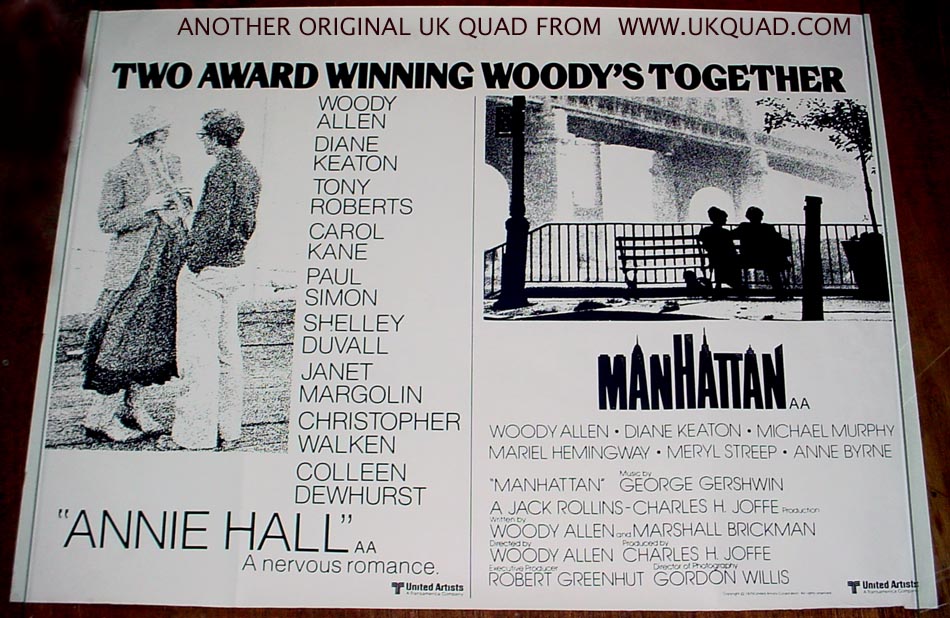
Of all the films in Woody Allen's extensive filmography, Annie Hall (1977) is the one we have latched onto. It's the one by which all other Woody movies are measured. Announcing to critics and moviegoers that its star and director was more than a clever stand-up with a flair for making funny movies, Annie Hall is a naked statement of vulnerability, about a man who turns everything into a joke as way of covering up his misery. At the time, Annie Hall represented Allen in a nutshell. Like the Alvy Singer-penned play (shown at the end of the film) replicating his life, the film was seen as something of a self-portrait, an image of Allen as he saw himself.

The film also established many of the themes and motifs to which Allen would eventually return in some capacity, from narrative arcs (e.g. the difficulty of relationships, talky and unhappy characters, etc.) to aesthetic styles (e.g., jazz and classic music, voiceover narration, long shots, practical effects, deep points of focus, etc.). But ever since the film unexpectedly nabbed Best Picture from Star Wars in 1978, Allen's career elevated to new heights, if not commercially than artistically. In short, he had the freedom to make the films he wanted. Post-Annie Hall, Allen's films have explored many of the same concepts, as well as a variety of new ones. Running down everything from death, separation, religion (or lack thereof), psychoanalysis, and other obsessions to varying degrees, Allen has philosophized in tragic and existential undercurrents in some of his movies, while in others he has waxed in comedic overtones. And in others, he went for both.

Allen has paced about one film a year for the last thirty-some-odd years, and has made more than a handful of intriguing, sometimes even masterful films. And still, Annie Hall continues to shine as his quintessential film. It may likely always be known as the defining movie in his career. That being said, it did not gain that status alone. In fact, one could argue that another movie (for better or worse) enabled Annie Hall to become the artist-defining, cultural milestone it became. Released two years later, Manhattan was and still is perpetually compared to Annie Hall. Like Allen's Oscar winner, Manhattan stars Allen as a neurotic man who loathes himself too much to let someone else love him. Moreover, it's set in Manhattan and stars Diane Keaton... just like Annie Hall!

It didn't take critics long --clever beasts that they are-- to catch on, almost unanimously deciding that Allen liked to make the same movie over and over again. Unfortunately, that's all it took, because it was critics and moviegoers who constructed such an identity of Allen, and it's one that he himself even believes. Now, many films and personal controversies later, Allen is looked upon as a 70-year-old version of the 40-year-old in Annie Hall, as a neurotic, overanalytic, cynical, dismissive, and emotionally frail little fellow with glasses who is unable to embrace happiness is how the rest of the world sees him. And rather than examining the extent to which the dialogue about Allen has informed critical analyses of his work, critics instead continue to (rather stubbornly) insist that Allen is himself solely responsible for his own image image.

Now that this dialogue has saturated, members of film culture have inevitably accepted the broader image of Allen on some level. These projections and assumptions manifest within the framing devices used to discuss his films, both current and classic. Not unlike the neverending dialogue about Keaton vs. Chaplin, conversations amongst cinephiles tend to be divisive affairs in which an individual's sensibilities are defined almost exclusively according to which film she or he prefers, Annie Hall or Manhattan. As much as it may appear that this dialogue illuminates the nuances that distinguish the films from each other, these divisions amongsts cinephiles likely thrive because of similarities between the two films, not the differences. If they are seen as different, one still has to question the usefulness of the dialogue simply because the films are defined by each other.

Although Annie Hall takes the lion's share of the credit, and it may be the film that resonates more on the cultural front, Manhattan made possible the comparison of Woody's films. It is the first and most famous example of Woody Allen's supposed self-plagiarism. For example, many a critic have argued that Scoop is a re-hash of Manhattan Murder Mystery. and, more prominently, that Match Point and Crimes and Misdemeanors are essentially the same movie. Apart from these plagiaristic duos, there are a number of other stereotypes about Allen's films, like how they have to fit into one extreme of "dark, brooding character studies about murder and deception," or "light, airy comedies with dated dialogue." These are but a few examples of the critical dialogue taking on an established rhetorical design. And now that critics have become so familiar with this pattern, reading a review of a Woody Allen film is every bit as routine as the films many critics label so.

Importantly, many of these trends began not just with Annie Hall, but in its rhetorical pairing with Manhattan. The two are inseparable. The Annie Hall / Manhattan duo is also significant for how critics and moviegoers would build an image of Allen --as an artist, and as a person. But this only holds up when the two are taken as one continuous idea, separated by only a few "minor" differences. Or at least that's how they are positioned. Whether the films are individually distinct from one another is not really the issue in these dialogues. Any differences between them are inconsequential to the fact that the conversation has been framed as one film defining the other. Neither will truly stand on its own beyond commercial worth. Taken together, the two films are equally integral in comprising the vision of "The Woody Allen Film" that still informs critics to this day. And their dichotomous relationship has cemented the prevailing notion that Allen plagiarizes his own work. Some would argue that this is evident in the films themselves, but few can deny that this trend has persisted in critical dialogue for years, which suggests that there may be more to this scheme than Allen's narrative and stylistic repetition. Many published critiques of Allen and his movies --e.g. books, articles, reviews-- focus on recurring fixations, themes, character traits, and narrative tendencies.

While the similarities in Allen's work are as undeniable as they are influential, I sometimes wonder whether his films actually resemble the discursive representations of them that critics have been piling up and recycling for years. The film criticism canon on the cinema of Woody Allen has reduced him to a simplified image, framing his films according to very defined properties emerging from the popularity of Annie Hall, and the subsequent critical discourse placing Manhattan in direct relation to Annie Hall. In spite of the high critical status of both movies, each film's individual merit is based on the other. That they are compared and contrasted so heavily prevents one from seeing each film on any other terms besides the counterpart, or the "other half" of the other. No matter how much Allen grows, that growth is only judged by how it relates to the established Woody Allen Film lexicon.

Having a brand of filmmaking and broad narrative and aesthetic styles assocated with a filmmaker's name is a sign of respect or significance, but the downside is that it also places the filmmaker in a bind, since she or he will likely always be critiqued by it -- e.g., Alfred Hitchcock (suspense master) and Steven Spielberg (king of the blockbuster). But the difference is that Allen doesn't get the credit as a filmmaker that Hitchcock and Spielberg do. Woody Allen didn't define or revolutionize the medium. Instead, critics, moviegoers, and Allen himself see his films as imitations of those from cinema's great directors. He's considered an American wannabe, pining after the European greats like Bergman and Fellini, his filmmaking idols. Taking this discussion into account, one could say that despite the Annie Hall / Manhattan tandem having opened many doors for the filmmaker to grow into fruition as an artist, it now prevents viewers from appreciating the richness of those films. Much like Allen's own obsession with psychoanalysis preventing him from recognizing his own worth, psychoanalysis has also jaded critics --particularly auteurists-- from engaging movies in a productive and open-minded manner.

Woody Allen is an extreme example, but the critical discussion about his films evidences the dominion psychoanalysis holds over film criticism. Guided by the principle that films hold meaning that the viewer must unlock, psychoanalysis has clamped down on film theory and criticism ever since academia took on film studies in the 1970's, allowing no other possible way of engaging movies. Some would say that filmmakers like Hitchcock and Allen invite this criticism by "making the same movie over and over," focusing on similar themes, fixations, and character relations. But just because Allen makes psychoanalysis explicit to many of his narratives does not entitle critics to position his films according to the same theoretical principles. To think in this way plays right into psychoanalysis itself, allowing its universalized logic to fit over movies like a glove, block all other theoretical or critical perspectives to penetrate.

It's no wonder, then, that psychoanalysis and auteurism are so condusive with one another. In each model, the critic runs a similar risk of looking through a film's images, and "arranging" them according to the established knowledge of filmmaker or filmmaking convention. Auteurism groups films and their directors in a way that makes them taken on meaning as part of a larger collection. This approach holds that movies are little more the sites where plot structures, narrative arcs, and character development converge. All formal details --composition, framing techniques, editing, and overall aesthetics-- are understood only in relation to these narrative elements. Because, after all, narrative is the driving force of cinema; at least according to this view. This approach, however, does not constitute a overarching inquiry into cinema, let alone a respectable criticism of it. I would go as far to argue that overreliance on this kind of criticism is reductive and potentially dangerous.

In the case of Allen, it seems as though we cannot evaluate his films with any bit of freshness. A new perspective of his work is bound to be "the alternative" to the dominant perspective, rather than being truly its own perspective. I'm not saying that critics should ignore similarities in plot, theme, and aesthetic design, since to deny these factors would indeed be foolish. Blowing up what's there and starting over will do criticism no good. Of course there are similarities between in Allen's films with respect to the aforementioned elements, especially between Annie Hall and Manhattan. The problem is when you end the discussion at the similarities. Both films are tragedies from purely a narrative standpoint, since each sees its central character as his own worst enemy. But if one's sensibilities are slightly more open it's evident that Allen in pursuit of very different sentiments and aesthetic unities with each of them.

Annie Hall is a reflection on the intoxication of new love and the hardships of commitment. It evokes the tension of refusing to let go, and yet not being able to take the appropriate measures to ensure an enduring relationship. The flashbacks and fantasies are impossible to differentiate from reality, and that's the point; they are intertwined to the extent that neither is an accurate representation of Alvy, Annie, or their relationship. What we have are images, memories, and feelings of "love and loss," essentially. Allen presents this narrative in a series of short scenes, each like a half-formed thought escaping from his consciousness as if interrupted by another.

Manhattan, while certainly boasting similar plot and character threads, motivic elements, and even some visual techniques (present in many of his film), presents more focused tension between romance and cyncism. In terms of pure comparison, Isaac is a much more bitter person than Alvy. He seems singularly focused on the present -- what benefits him right here, right now. He's also slightly more mature than Alvy in the sense that his attention is directed at what is occupying his moment, rather than constantly reflecting on the past. He ultimately makes the same mistake as Alvy, in letting the one person who brought happiness to his life slide through his fingers. But the manner in which we expereince this loss, and thus the loss itself, is entirely different. There are budding moments of romanticism in the film, especially for New York and classic love stories, but ultimately the cynicism prevails in spite of the dream of romanticism. Annie Hall, on the other hand, is not about cyncisim at all; it's a bittersweet proclamation of loneliness and self-loathing.

These reflections are brief, and represent only the beginning point from which one could launch a very different inquiry into the two films, individually and together. One might also say that my descriptions fall under plot details and formal elements, a practice I criticized earlier in this piece. But my descriptions of these components only topically resemble the style in which many critics use them. Again, the acknowledgment that film criticism should shift from its current format of placing formal details in relation to narrative-centric aspects does not mean that matters of narrative should be ignored. In the end, there is no right or wrong way to dissect a movie; a critical analysis requires that the critic discuss tangible elements, definitely, but not to a specific end. Film criticism at its best goes far beyond narrative and aesthetic relations, no matter complex they may be.

However, within the psychoanalytic, broadly auteurist model, further examination is not necessary beyond these elements. Those who approach film from this standpoint find what they are looking for. It has already sealed itself off and justified its own existence, based on the logic it has conveniently employed to do so. As is typical of psychoanalysis and (to an extent) auteurism, the viewer/critic is prompted to sidestep the immediate engagement of the senses that a film provides with its moving images and sounds. The kind of reflection these models seek is one based in symbolism and causality. But these don't engage one in the experience itself; they're more interested in providing meaning to that experience; placing it. Film criticism --in academic journals, newspapers, and independent blogs-- should be more atuned to personal reflections of seeing the film, but it should also be invested in the reflexive exploration of movement, memory, and sensation, and how these notions relate to narrative and character identification. These latter elements are important to film criticism, but they are not themselves the means to the ends of valid critical inquiry.

Movies are about more than a simple matter of plot, characters, and narrative, and they're about more than simply computing aesthetic sensations according to categorized responses or emotions. These tangible details are very relevant, even important toward understanding film spectatorship and and criticism. But sometimes even the best critical minds lose sight of the fact that movies are really about the movement of images and sounds, the very stuff of memory itself, as well as narrative. To paraphrase Jim Emerson, movies are about what happens to you while you're watching them. This seems simple enough, but it's actually a testament to the unending complexity of the film viewing experience. It's become a trend in film criticism for critics to use tangible details --i.e. plot, character, structure, etc.-- as a means for justifying or supporting a simplified response to a movie, their reaction; which is actually much harder to try to understand. But the more we lean on these tangible explanations, the more we're conditioning ourselves to look through the images rather than at them. That's not to say that the more abstractly we speak about cinema, the better. Logic is essential to any critical or theoretical inquiry. But there's a difference between logic and universalized rationale.

This is precisely why film criticism should begin repositioning auteurist theory. An inquiry into movies should address psychologistic components, for sure, but should also unashamedly delve into philosophy and lyricism, along with science and psychology. Ultimately, the perspectives expressed and the way in which they are expressed probably reveal more about the critic than the movie, but sometimes they illuminate aspects of the experience of seeing a images—and the thoughts, memories, and sensations they produce—which are at once permanent and fleeting.

Friday, May 9, 2008

Deleuze and film theory: An excerpt

Another semester has come to a close, and once again I have completed a paper that probably deserved a great more attention and reflection than I granted it. Although I may continue working on it, it was "officially" complete when I handed it in earlier this week. What once was a clean, unmarked collection of pages will soon become a sea of red, with a single letter at the end, determining the significance of the past four months of reading and study. Already, I see at as an incomplete work that will most probably be abandoned (although hopefully not).

Nevertheless, I see the paper (at the very least) as pregnant with possibilities. Which is why I have included an excerpt from the opening section of the paper. It essentially lays out the questions and thoughts that drove my research, and it suggests the beginnings of a thesis that may or may not have come together by the end of it. It doesn't, however, provide a full angle of the core analysis, which focuses on psychologistic models of film criticism --specifically psychoanalytic film theory and cognitivism-- and the implications of their respective rhetoric and positioning in relation to one another in the spectrum of academic film criticism. Approaching this relationship from a Deleuzian perspective was the point of emphasis of my theoretical exploration.

I honestly don't know if I was able to bring together all those elements and construct unique pathway of theoretical inquiry into cinema. I think I need more time away from this paper to really understand whether it has anything significant to offer. In the meantime, here's the introduction, which, as I said, presents the underlying questions and conflict. For me at least, the introduction nicely sets up a number of potential conflicts and relationships, and although much still needs to be addressed, it leaves me with the thought that Deleuze and film criticism may be more conducive than I previously thought.

I'm eager for feedback, so please feel free to volunteer your thoughts:

"Gilles Deleuze is known as a philosopher by some, a theorist of the cinema by others, and even an artist by his most ardent followers. His writings are ubiquitous, and his concepts unorthodox by the standards of philosophy, cinema and media studies, and art criticism. Despite the rising relevance of his two Cinema volumes in film scholarship, Deleuze’s place in the broader institution of media and cinema studies is oddly situated. Adamantly rejecting the claim that he was a “critic” or even a theorist, Deleuze constructed what he termed a philosophy – or logic – of cinema and movement. Film theorists who consider Deleuze’s concepts significant often draw on this logic, as rendered in Cinema 1: The Movement-Image, and Cinema 2: The Time-Image. Meticulous in its description of spatiotemporal properties of movement and sensation, Deleuze’s philosophy of cinema at first appears to glide along the lines of neoformalist theories. Yet while Deleuze provided dense descriptions of action-images, affection-images, and perception-images, his concepts decidedly subvert the methods of dominant psychologistic models that now constitute a large amount of scholarly film theory.

While Deleuze’s Cinema volumes are gaining prominence, many theorists harness his principles of sensation as means for explaining or defining the cinematic image in a new way. However, this “application” of Deleuze is a fundamental misunderstanding of his concepts. In spite of their systematic detail and intricate design, Deleuze’s writings on cinema are not a critical model for evaluating or critiquing films, but the foundation for a larger inquiry into movement and sensation. For Deleuze, the cinema is not a communicator of messages or medium for delivering sights and sounds (Deleuze, 1983). And it is most certainly not a representational narrative or aesthetic device. Instead, the cinema is the site of pure immanence and sensation (Deleuze, 1985); it is quite literally its own reality. The image is not something projected onto a screen, but is instead the manifestation of pure thought.

Placing Deleuze in relation to existing theories of cinema is a complicated task. It’s not easily accomplished by employing his concepts as an extension or deviation from various established critical models. Deleuze’s logic of sensation lays the foundation for a fundamentally different engagement of cinema. This logic may provide the theorist with a different kind of criticism, or, moreover, a spectrum of theoretical possibility for engaging and seeing cinema. And yet, to grapple with this new vision of cinema as the basis for a new critical inquiry, one cannot simply stand outside the pillars of theory that have attempted to encapsulate and explicate cinematic motion and sensation. Exploring the possibility of a Deleuzian criticism requires that theorists actively engage the established theories, by analyzing the assumptions on which they are built and the values under which they operate, and situatating them in relation to Deleuze’s mapping of cinematic movement."

Tuesday, April 29, 2008

Closing the door on a career in professional film criticism

I'm not a strong believer in meanings arising from cycles or circles in life, but it would be impossible to ignore the symmetry of recent activity on the film blogging circuit. About a week after a one of the great professional critics has entered the film blogging cycle (Roger Ebert), another will be departing. Today I heard the news of Matt Zoller Seitz's retirement from the print criticism; a shock to us all. It's not initially a comforting thought knowing that film criticism is losing one of its best practitioners, but after reading the conversation between him and Keith Uhlich, now the lone editor of The House Next Door, I feel only happiness for Matt as he enters a new stage in his life. His criticism won't be in print anymore, but it will be alive in his filmmaking.

Below is the comment I left for Matt over at The House Next Door:

"I guess there isn't too much I can say in the way of gratitude and best wishes that hasn't been said here already. But I would like to wish you the best of luck anyway! As many here have said, you will certainly be missed, and it's to our good fortunate that you'll still be around as a commenter and sometimes poster.

Unfortunately, I haven't participated as much in these forums/discussions as I would have liked. But if there's one thing I've learned from reading your work here and elsewhere, it's that this form of writing requires participation and devotion to accompany the written thoughts of one person. I have learned that this right here -- the community, the discussion, and the real-life critical dialogue -- is criticism. Like filmmaking, criticism is really a collaborative effort in some capacity, and I've learned that in my own writing, and especially in my initial visits to this site several years ago before I even knew what film blogging was.

I am saddened that you will be leaving this "great experiment"
[of blogging] that you've had such a strong hand in building. Although, much to my regret, we haven't interacted much over my time in the blogosphere, your comments on my blog and links here at The House mean a great deal to me. Knowing that you drop in over at my place from time to time, I consider it a privilage to keep pushing myself to be a responsible participant in this format of criticism. Who knows where we'll end up taking this thing, but whether you're actively part of it or not, you'll be a great presence in it."

Best of luck to you in your filmmaking endeavors, Matt! I look forward to your future criticism, whether that's in words or images. And don't forget, your comments are always welcome here.