Thursday, August 21, 2008

The year that was, the year that is: Cinema 2007 (Part I)

Journalism has become more about the moment in recent years. As news networks and publications rush to be the first rather than the best to report something, mainstream film criticism has been trying to keep pace. In an increasingly crowded market of films. Journalistic criticism is suffering from the many of the same flaws as mainstream media. These drawbacks can best be summed up in the overall poor coverage of the nuanced crop of films currently available. It's become clear that the old model of film reviewing simply isn't condusive with the economic and cultural changes in film, criticism, and media. A consumer model for years, journalistic film criticism has stayed relevant simply by keeping up with the ever-revolving door of films in current release. But now more movies are released each year and the conditions of digital culture have enabled viewers to see a wider variety of films. There will always be blockbusters to help critics (and most others in the movie industry) pay the bills, but the current system of film reviewing is failing economically and critically.

Nowhere is this more evident than in those end-of-the-year Top Ten lists. Apart from the mostly homogeneos structure of these annual reflections, they also only turn up only between December 15 and January 15. While this appropriate for economic purposes, it reproduces a notion of film and criticism as plastic-wrapped products, appropriated and consumed in the moment, forgotten quickly in the desire to consume more. I want to avoid being hypocritical, though. In many ways, movies are commodities. And so often are movie reviews. My main concern here is not so much the commodification of film and film criticism, but when this underlying truth absorbs any and all other potential paths to participate in movies and criticism as readers, writers, and spectators.

There is nothing inherently wrong with following the conventions of the trade, whether we're talking about deadlines, word length, or content. I do, however, fear that with the normalization of these Top Tens and retrospectives, it's become difficult for criticism to really engage cinema outside the boundaries of commercial consumption, because it appears now that even memory has been co-opted. These boundaries condition us to keep on trucking through new films and to appreciate anything not "in the now" in a very controlled way. We should accustom our minds and memories to contain the sounds and images we associate with great films. We need to re-calibrate our critical consciousness, place movies, images, and modes of criticism in such a way that we aren't accepting or rejecting the current system or methods of inquiry / discourse.

One way of beginning this process is for those of us outside the professional laurels of film criticism to take advantage of the autonomy granted by the digital media we work within. Although many critics are forced to move on from discussing films from last year or the year before, all of us have the unique opportunity to continue those dialogues, start new ones, and set new patterns for what films are being talked about and how they are discussed. I'll be doing that here by writing about movies that have mostly dropped off the film critical radar. I've been squirming to keep up with as many '08 releases as possible. But all the while I've been thinking, reflecting, sometimes writing about my favorite films from last year, especially since I've only recently caught up with many of them on DVD. So instead of a Top Ten, I'll look at all of the films that I believe to be important. Moreover, I've seen them all at different times and some more than others. My goal is to try to locate a new way of talking about some of the more popular ones and getting some other movies talked about at all.

Allowing some distance between yourself and a "cinematic year" helps situate certain films or the year as a whole in the context of a changing life. We can see the reflections and the shadows of ourselves in movies, and time. Some movies are still fresh in my memory as if I've seen them yesterday, where others have lurked deep in my consciousness and may appear different than I remember seeing them. Often I will recall a certain time of year or an event in my life that I associate when I return to these films.

The movies I'm going to discuss here stood out to me in some way, sometimes in the moment of seeing them, sometimes after a passage of time. The circumstances are different with each movie. Some films on this list probably are more significant to me personally than to the artistic growth of cinema, and others may illuminate cultural moments in terms of either their impact on audiences or in terms of their narrative / thematic content. It's difficult to say where exactly the lines between these different levels of significance are; which is partly why these kinds of retrospectives are so relevant, especially when they are situated outside the commercial tides of film criticism. Movies are all about time; shrinking it, expanding it, and recreating moments within it. Maybe they mean so much to us because we are constantly caught in the flux of time, narrativizing our lives out of the raw material of experience.

So without further pontification, I now share with you my impressions on a year in cinema that still lives in my mind, even if we're well into a new one. Rather than trying to capture movies themselves into a matter of paragraphs, I have opted to pick out moments and details -- a scene, character, movement, a line of dialogue, or something else -- that locks each respective movie in time, personally and culturally, defining it rather than representing it.

[Note: Because there are many movies I'd like to discuss, this is the first of two posts with my reflections on 2007 movies. Next post to follow in a couple of days.]

-----------------------------------------

I'm Not There (Todd Haynes): "It's like you got yesterday, today and tomorrow, all in the same room. There's no telling what can happen." This line --the last in the film, I believe-- says it all. Unlike many other supposedly postmodern movies which slice up their narratives and present them out-of-sequence, this film actually achieves a fluidity with its disconnected components. These disparate elements include visual styles and the many lives of Bob Dylan, and they manifest in different aesthetic rhythms and physical incarnations of Dylan himself (with six different actors playing him). Rather than chopping up a linear narrative and presenting it in puzzle form (which is ultimately linear), this movie really follows through in its non-linear aesthetic and narrative style. And the most amazing thing is that it comes together in the oddest, most abstract, and lyrical ways.

Eastern Promises (David Cronenberg): This movie was a standout to me when I first saw it in September of last year, and its images still invade my memory to this day. Having to pick just one scene would be cruel. I'll instead reference the opening paragraph from my original review of the film, which describes the opening scene of the film.

"The opening scenes of David Cronenberg's Eastern Promises depict a man awkwardly severing another's neck. They both quiver in fear; one for losing his life, the other for taking one. Cronenberg draws out this precise feeling to unbearable lengths, with the stable camera refusing to edit to another image as we see the struggle ensue. Where many filmmakers are content to represent brutality via images of slit necks and stabbings often containing just enough detail to keep the viewer at a pleasurable distance, Cronenberg refuses you that pleasure. In doing so, he locates a primal state where you can feel the blood flowing through your veins. His images invite another form of pleasure. The scene consists of a very simple series of shots which evoke the difficulty and the struggle of being on both the perpetrating and receiving ends of the killing of a person. It's almost a sexual encounter, one that's revealed to be nothing more than business once it's over."

Helvetica (Gary Hustwit), Lake of Fire (Tony Kaye), and Manufactured Landscapes (Jennifer Baichwal): I know, I know. Lumping three movies together simply because they are documentaries is pretty inexcusable. Having said that, my choice to run them all under one heading was inspired more by what their differences as well as their similarities. Each of these films is visually inventive, eluding the simplistic conceptions of documentary that many individuals hold. And although they deal in different subject matters and aesthetics, they are bound by an underlying inquiry into culture, social action, and responsibility. These films don't preach about a message or assemble various talking heads to blather on; they are earnest, inquisitive films examining social actions, issues, and phenomena -- from abortion, to language, to biosocial aesthetics -- and they do so in a way that illuminates something about the world. I fail to find a moment in any one of them that defines or represents their worth. They are each a collection of images, thoughts, and representations that engage you in questions of what it means to be a member of culture/s, belief system/s, and the social fields and constellations that we inhabit.

The Assassination of Jesse James by the Coward Robert Ford (Andrew Dominik): Under cover of trees and night, Jesse James (Brad Pitt) rides alongside his next victim, talking casually, slowly, as if the thought that he was not about to take a man's life didn't once cross his mind. James tells the man to "go on ahead," reassuring him that he'll be just behind him. They both know what's happening and yet neither makes a rise. The man obliges and begins walking his horse foreward into the darkness. In one sustained shot, Jesse is slowly obscured into a motionless figure in the background as we lock on to this man's face as fear and dread beckoning in his eyes. Finally, a gunshot cuts through the night silence.

Few movies from last year are as introspective about death as The Assassination of Jesse James. This scene haunted me for days in how much it was unlike typical shooting or death scenes in movies. The feeling I had while watching it hangs over the whole movie, as if the spirits of Clint Eastwood and Terrence Malick were somehow melded together.

Rescue Dawn (Werner Herzog): In the opening minutes of Rescue Dawn, you'll feel like you're seeing a Herzog film from the 1970's. Images of scorched earth fly by slowly in one fluid shot (from a helicopter flying over jungle in Southeast Asia) to the ethereal sounds of Klaus Badelt's score. Herzog has always been fascinated by the collision of nature and technology, and this shot sets the mood perfectly for a quietly riveting film about one man's survival from being a POW. The remainder of the film is less like it's opening minutes and more committed to a gritty realism, heavily contrasting with these introductory images. Christian Bale and Jeremy Davies are both brilliant, mostly without ever speaking above a whisper as they conspire to break free from the camp they are imprisoned within. Some have said that Herzog has gone "Hollywood" with this film due to its ending. But its clear that Herzog is not much interested in survival itself, but the intangible drive for it.

Hot Fuzz (Edgar Wright): Both a work of comedic brilliance and formally sound filmmaking, Hot Fuzz is one of last year's underrated treasure. Here's an excerpt from my original review:

"Every time a door is opened, every time a change of location takes place, we are treated to a loud, rapidly cut montage of close-ups that are now typical by contemporary murder drama/action movie standards. There are small touches of visual humor peppered throughout the proceedings, but the movie keeps a straight face -- mostly through Pegg's earnest performance -- even as it stoops to the most pendantic of visual gags. Such contrasts are the foundation for a narrative that never overtly establishes itself with any kind of consistency when it comes to genre placement. Rather than haphazardly surveying a patchwork pastiche of movie conventions as many other directors might, Wright instead opts to use this aura of stylistic and narrative inconsistency to his advantage by building the drama, action, and comedy of the film around it."

Ratatouille (Brad Bird):
Django: We look out for our own kind, Remy. When all is said and done, we're all we've got.
Remy: No. Dad, I don't believe it. You're telling me that the future is - can only be - more of this?
Django: This is the way things are; you can't change nature.
Remy: Change is nature, Dad. The part that we can influence. And it starts when we decide.
Django: Where are you going?
Remy: With luck, forward.

Most discussions I've read and been apart of about Ratatouille have focused on the whimsy of the narrative or the wonder of the animation. Sadly, little of said of what the film is really after. The dialogue I've posted above is an exchange between Remy and his father facing one another in the rain, each breaking the other's heart without a voice needing to be raised. Out of context, this chunk of dialogue may appear to be speechifying about a message, but it's actually articulating of a conflict that affects every individual within or a part of a culture, gender, race, sex, religion, etc. This thematic focus is subtly stated through the film, and it's not about party lines or moral balance so much as perception. One could say that Brad Bird is making a statement about digital cinema and animation as they fight for validity amongst the tide of traditional photography-based filmmaking, bu it's about that and so much else. Ratatouille will speak to its viewers in various ways, but for me, this dialogue is the centerpiece of the movie because it painfully evokes the wounds at the heart of all social divides.
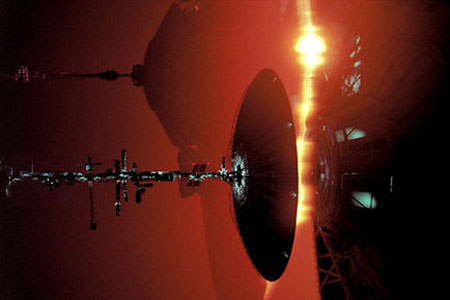
Sunshine (Danny Boyle): "What can you see?" So asks the spaceship's crewsperson as his captain stands immobile on the hull awaiting certain death, with the sun's rays moving closer. Sudden waves of light and movement surround the captain, enveloping and filling the composition with sharp, disjointed sensibilities. But as the plane of light passes over his body, all of these currencies of beams and vibrations disappear. What we have is an isolated, even intimate moment of intense senation as time and space fold into one transient moment of illumination -- life and death. One of the memorable motifs throughout the film involves sight or the power of the vision. Sight is often obscured in focus and movement, but in moments of death, it becomes the vantage point through which transcendence and death are intensely experienced. As I observed in a previous post, Sunshine "makes the sight of the sun utterly sublime, whether one is close enough to touch it or millions of miles away..."

Into the Wild (Sean Penn): There is a moment between Hal Holbrook's father figure and Chris McCandless (Emile Hirsch) so heartbreaking that it captures the whole film. Holbrook clearly doesn't want Chris to leave for Alaska so he offers to adopt him. Through most of this quiet exchange, Penn locks on Holbrook's beaten, worn-down face, tears filling his eyes, as he must come to terms with the fact that Chris simply will not listen. What struck me most about the negative response to Into the Wild is the misguided focus on the central character's arrogance and/or foolishness. I don't see how that equates to the film being arrogant and/or foolish, but that distinction was lost on many. Sean Penn's film may not be one of the very finest from 2007 when it comes to critical or formal analysis; I'm sure I could watch it right now and point out flaws galore. But that is exactly the kind of attitude toward movies and art in general that I find arrogant and foolish. Into the Wild is an empassioned, ambitious, and heartfelt experience centered around the life of a person who saw and lived in a very different world.

Stay tuned for more...

Tuesday, August 19, 2008

Manny Farber: In Memory

"The liveliest, smartest, most original film critic this country ever produced."
-- Susan Sontag, on Manny Farber

Considering who those words are coming from, this is the highest compliment one could receive. And Manny Farber deserved it. Having provided us so many indispensable ideas about visuality and criticism, Farber now leaves us --termite critics, as Andy Horbal once wrote in the spirit of Farber-- to realize his vision of engaging the multitude of images in the world. He will always be one of the most unique voices in film criticism and aesthetics.

Some tributes:

-- Jim Emerson at scanners
-- Brendon Bouzard at My Five Year Plan
-- Glenn Kenny at Some Came Running
-- David Schwartz at the Moving Image Resource
-- Ryland Walker Knight at Vinyl is Heavy
-- Zach Campbell at Elusive Lucidity

Monday, August 11, 2008

My favorite Randy Newman score

Please excuse this brief excursion into cinephilia...

Last weekend I was out of town, and in my endless channel-flipping one morning during my hotel stay, I came across one of my very favorite comedies, The Naked Gun (1988). I'd seen it numerous times since I was a kid and still cherish it immensely, but I never would have thought to gain insight into why this film always made such an impression on me, especially for being such an absurd comedy. Maybe it was the change of scenery, but I was able to enjoy the movie in a way that was both familiar (i.e. anticipating every shot, every joke) but different. It was kind of like being in a room that you're inside frequently, like an office or bedroom or classroom, but standing in a completely different area of it. You know the room, but it feels so strange and new from a different angle. My epiphany with The Naked Gun was the realization that it contains a perfect montage.

Here's the set-up: The scene occurs late in the movie, when Lt. Drebin (Leslie Nielson) is undercover as the home plate umpire at the Angels / Mariners game, where during the 7th inning stretch, one of the players is supposed to kill the visiting Queen of England. Drebin doesn't know which player will commit the crime, so he attempts to frisk each and every player at some point during the game. This isn't terribly interesting stuff, but it makes for some delightful comedic payoffs in the hands of Leslie Nielson, the world's best actor at playing dumb. It also sets up nicely for an expedient montage that shows us the passage of time in the game and provides comedy in rhythmic doses of visual set-ups.

Well, this montage does that and more, combining the perfect musical score with images of sports bloopers and Nielson-esque comedy. Have a look:


If you're seeing this for the first time, the absence of context may make it difficult to distinguish between this and the current (dismal) crop of spoofs. But for me, it's a time capsule to the 80's-- Not just with the Zucker brand of comedy (which began with Airplane!) that seemed so fresh, delightfully offensive, and hilarious at the time, but also the many minor details such as the old-but-not-vintage baseball uniforms, the facial hair and wardrobe of the spectators, etc.

That music you hear is one of Randy Newman's finest scores, even though it's not the film's score (which was written by Ira Newborn). The song is "I Love L.A.", and it it's got that perfect combination of a pleasurable, jumpy melody and a touch of synthesized sound that grounds the scene in the 80's. Although the song first appeared on Newman's 1983 album, Trouble in Paradise, it was beautifully employed here for this montage, representing a likely scenario in which the music for a scene was selected before the images were edited. In other words, it's the music that guides the images. The quick-cut images would have no life without the music; it would be dull and static. But with that song, the images just seem right. Something about the jovial tune, Newman's raspy voice, and the unbelievability of the game melding together in one short sequence is just perfect.

The images make little sense in the context of baseball or in any other way, whether it's the players rounding second base one-by-one to the high electronic notes in the song, or an elongated celebration at the plate after a home run (while Drebin frisks them all), or the frequent cuts to changing electronic numbers on the scoreboard. But they have an inexplicable rhythm and atmosphere that sells us on the comedy, the passage of time, and most importantly, the affective state or atmosphere that is unique to The Naked Gun which seems to exist outside the bounds of space and time.

While surely bearing no significance to those who didn't grow up watching this movie and associating it with childhood memories, montages like this one illustrate perhaps in some small way the intangible accessibility of movies; the way they are both relevant within and outside of our lives, how they reflect and inform our own state or the state of the world. These sensibilities extend far beyond conventionally attractive movies (by the standards of most critics), as I'm sure all of us have those movies that we simply love, no matter how critically taboo. Only when we change and movies do not can we realize that movies -- no matter how serious, dramatic, absurd, etc. -- mean something to us (both immediately and retrospectively) beyond our conscious appreciation.

How ironic that Montage allows us to experience that impermeability that movies have to time -- since, after all, Montage is all about time. As a concept and practice, montage can be thoroughly analyzed and dissected, but even if we are successful at excavating the sensations it can create in us in a comprehensible way --nostalgic or otherwise-- the sensuousness of that experience would likely be drained. Whether they are comprised of one shot or many, maybe movies themselves are larger montages in that, apart from boasting many individual moments, are moments unto themselves, enrapturing us in an affective experience built on associations and linkages having little to do with logic.

Wednesday, August 6, 2008

Terrorism, Criticism, and Opinionism: Observations on The Dark Knight


With the influx of discussion about The Dark Knight on the internet these past several weeks, I have deliberately avoided a written reflection on the film. While I normally praise the networked approach to film criticism that blogging enables, the explosion of dialogue over Christopher Nolan's film has left me rather cold about the prospects for critical dialogue via digital media. Of course, it's disconcerting to see such prominent expressions of outright negativity and blind opining, from Rottentomatoes to the comments section of Keith Uhlich's review of the film at The House Next Door. But how ever easy it is to point out extreme examples of this rhetoric, singling out the worst cases often invites (even encourages) one to gloss over the ideological undercurrents of the larger practice, ultimately to validate and re-inscribe those underlying trends while losing sight of them.

My disenchantment with the discussion about The Dark Knight extends well past these often-disgusting negativities to encompass the overall state of critical mud-slinging about the film. On the film's release, the journalistic film critic community nearly unanimously annointed it as one of the finest studio pictures in years, comparable even to sequels like The Godfather Part II and The Empire Strikes Back. Comic-book audiences and general moviegoers echoed those sentiments. (The film has already crossed the coveted $400 million mark in just 18 days.) The massively positive response felt destined, what with the allusions to contemporary American political landscapes and the tragic death of Heath Ledger, who delivers one of the most memorable performances in years. It only seemed appropriate that critics and audiences would stand in solidarity in praise of the film.

Unfortunately, the effect has been devastating. The few dissenters were verbally crucified, with commenters demanding that these reviewers provide explanations and "evidence" for their purported mis-readings of the film. Those with less than positive perspectives provided no more or less evidence than those who liked the film -- they just happened to be singled out and raked over the coals because of those views. As Matt Zoller Seitz noted in the comments thread in Keith's (very good) review of The Dark Knight, what makes this all so scary is not that some commenters were downright vitriolic, but the collective mentality that smothers differing perspectives as if they are not allowed. At times this behavior borders on robotic uniformity, and it's worrisome.

Framing this within the larger discussion about blogging and digital discourse depresses me most. There were some two or three hundred responses to Keith's review, which is almost exponentially more than your typical response to blog posts, even the more controversial ones. We blog writers would like to think there is a silent majority of intelligent individuals reading our posts, but the overwhelming prominence of these naysayers may point to a very say reality that without commercial support, little will come of this experiment. This may signify that blogging or digital communication will eventually become just another corporate commodity with no such ability to influence anyone outside already established camps (e.g. film bloggers).

Equally disappointing was the "serious" discussion that's followed in light of the initial explosion of opinionated sneering on the film's initial release. Almost mirroring the tidal wave of uniform hatred expressed toward those who voiced discontent about The Dark Knight, a small band of determined, well-meaning critics / bloggers launched a counterattack on the film, as if to tear it down from the pedastol on which it has unrightfully been placed. I can't say I've read all of these reactions, but one thing I noticed in many of them was a homogeneous perspective -- ripping the film's formal elements, inept storytelling, and shallow allusions to post-9/11 America. Meanwhile, so few actual inquiries into the film have been attempted and we've instead found ourselves in an ideological and cultural struggle for commercial and/or intellectual superiority. These discussions almost never had anything to do with the film at all. The Dark Knight just happened to be the point through which all these lines of behavior and reaction passed through.

The majority of what I've read about The Dark Knight has not revealed anything worthwhile about the film. Seldom have I encountered pieces in which individuals have reflected on the immediate experience of the movie, its cultural significance, tonal qualities, or thematic relationships. Perhaps the discourse surrounding the film reveals rather than informs the state of culture than.

With the critical and popular responses to the film falling into such a bland pattern, it's now become obvious that a shift away from opinion and towards questions is more relevant. If we rendered ourselves incapable of discussing the film in terms of rateable quality or good-bad judgments, there might be a more varied perspectives. I would never discourage someone from having an opinion, it's basis for which we form those opinions that I would like to see expand. Then our opinions become more nuanced and interesting.

That said, the most interesting pieces about The Dark Knight that I've read were posted relatively recently (notably Rob Humanick's review at The Projection Booth and Ryland Walker Knight's email dialogue with Jennifer Stewart spread over two lengthy posts at Vinyl is Heavy), and I suspect that may be because we've had a little bit more time to digest both the film and the whirlwind of coverage about the film.

I saw the film just once about three weeks ago. So I'm finding it hard to review it in the same capacity as some others. It would also be relatively inconsequential, since thousands have dissected and analyzed the film's significance and plot points over and again. The last thing I would want to do is add my own judgments to the stockpile of opinions about The Dark Knight, suffice to say that it was endlessly intriguing and not at all what I expected. Which is probably why I am so disappointed with the dialogue both in print and online about the film. Nevertheless, there were some things that struck me about the film that are worth exploring in more detail.

I'll start with the "post 9/11" connections. After reading countless posts and articles about the connections of the film's events to Bush-era politics and post-9/11 American life, many of which very interesting, my inclination is to consider these claims in relation to the specific narrative relations in the film. There are countless allusions to the current wars in Iraq and Afghanistan, with images of videotaped torture, as well as a scene in which Batman uses cellular surveillance to track down the Joker. The film makes these allusions very explicit indeed, but to what end? I think the film is far too hazy to simply situate these blatant connection within pro-Bush :: anti-Bush or pro-war :: anti-war schemes. Christopher Nolan no doubt wants viewers to think about these issues, but that doesn't necessarily mean he endorses the actions of his protagonist, or, for that matter, that the film should be a 1:1 comparison to current world events.

On that note, why does Batman and Gotham have to represent something, a la Bush or America? We have connections between the fictitious world of the film and the non-fictitious world in which it is set. But that doesn't mean we have anything tangible. Besides, the "real" world we live in is anything but real, come to think of it. We all have our own perceptions of it, and our engagement in it depends on those perceptions. Who's to say what is fictitious and what is not? If we must ground our criticism in Jungian cine-psychoanalytic approaches, then perhaps Batman and Gotham represent the harsh collision of the fiction and the supposed real world. The Dark Knight could therefore be depicting the collapse of social order under the weight of our obsessions with myths, heroes, and villains. Our desire for these things is insatiable, perhaps because they help to narrativize and streamline the chaos and absence of meaning.

Batman Begins (2005) dealt with these relationships head-on. It speechified too strongly about its themes of fear and justice, among other things, but it balanced its construction of myth and reality so effectively that they bled into each other to become each other. The film made known immediately that it was happening in a world like our own, that it would be less cartoony and comic-book-y and more something that could potentially happen. The action was down-and-dirty; Bruce Wayne made a believable arc to becoming Batman; and Gotham City felt like a real city. Interestingly, the film contrasted this move toward realism against the building desire and purported need for a hero. It romanticized the hero myth. Aesthetically, thematically, and structurally, the film was a blurring of gritty realism and mythmaking, both grounded in and taking flight from the everyday.

The Dark Knight all but leaves this world behind. Entrenched in city politics and the corrosion of social orders, it seems to be moving farther away from the romantic vision established in the previous film. I will have to see it once or twice more before I begin to really delve into the possibility that The Dark Knight is a result of the schizophrenic unity of Batman Begins. But I initially perceived the aesthetic discontinuities (from the first film to this one) as a deep flaw; Gotham is more open, glassy, and overall more cool in tone-- nothing like the Gotham from Begins. Moreover, Batman is hokier this time around. He stands out in an otherwise serious story about the injection of paranoia and chaos into a society. Unlike in Begins, this film seems to fully take place in a more "real" world controlled by fear, where it has become nearly impossible to feasibly envision a hero.

The Dark Knight never achieves the sense of aesthetic flow of the first film. Narratively and aesthetically, Nolan is intently focused on something larger than individual moments or scenes. What that larger something is, I don't know. It would be easy to criticize it for too explicitly manipulating the many elements it has in motion, moving so quickly from one moment to the next and rarely fixating on a pure moments. Plot-wise, so much transpires in the course of the film that there appears to be no narrative rhythm at all. Whether this was Nolan's intent is not really what's important, but I will admit that I found the experience of the film very disorienting, while watching it and in retrospect.

At the heart of this estrangement is Heath Ledger's Joker, who just about takes over the film. His presence makes such an impression that all else seems to fade into the background -- whether that's the aesthetic design or character plotlines. Ledger embodies a void as a man who (some have argued) is the antithesis to the symbol that Bruce Wayne set out to create in the first film. Where Begins represented sound structural precision in developing the evolution of that symbol (The Batman) into an inevitable union of man and symbol by the end, Knight is only interested in the effects that Man as Symbol (The Joker) can have on a society. The Joker has no connection to the human life around him beyond that of maneuvering within the corrupt infrastructures of society and government. He passes through legal systems and defies physical possibility simply by being everywhere and anticipating Batman's every move. Many accounts have situated the Joker as the terrorist to Batman's America, but this is overly reductive. He does not represent a terrorist or terrorism, but is instead both a man and an idea, a manifestation of collective fears and a deeply buried desire for any figure that is both a person and a symbol, even if he is an agent of chaos. There is something attractive about him, which is the real focus of the film. The closing narration explains that Batman is the "hero Gotham needs," but not the one it wants. The Joker may be both the villain the city needs and wants, which is why his presence comes to swallow up the film much like he does the city.

Whether you consider The Dark Knight great, a masterpiece, or "flawed" (whatever that means) will more likely depend on your ideological relationship with its narrative form and aesthetic content. Some will inevitably try to isolate variables of the film to support an argument, but the film (like any) is about the movement and interaction of all of its variables. They are constantly in motion. When I initially saw the film I was extremely disappointed, not just because it failed to live up to my expectation based on the first film, but because it felt rhythmically out of kilter. On more reflection, I've been consistently more fascinated with the movie and all of the things that eluded me on that one viewing. But the impassioned of commentary and debate has distanced me from it to the point that I didn't want to write about it, or even to think about it. But I've since come to understand that The Dark Knight cannot stand by itself as other movies might. It is deeply embroiled in a cultural landscape --both internally and externally-- that the film and what it signifies have become so intertwined, like man (Bruce Wayne) and symbol (Batman) it depicts.

Now that may be a worthwhile starting point for a more relevant critique of the film.

Saturday, August 2, 2008

Moments that mean: A novelist's perspective on movies, literature

[Editor's note: This essay was originally published at The House Next Door.]

A few weeks ago I listened to a Diane Rehm interview with Salman Rushdie, whose work is revered in literary circles and regarded among the finest in contemporary fiction. He discussed his novels, religion, and world affairs in typically compelling fashion. My own encounters with Rushdie's work are limited—I have only read The Satanic Verses in my college "Forms of the Novel" class, but that nevertheless represented one of the more memorable experiences I've had with current literature. Reading The Satanic Verses was like watching a film with the shared sensibilities of David Lynch and Stanley Kubrick, particularly as regards its reflexive journey through conventions of the narrative form. Unlike other supposedly "deconstructive" works, The Satanic Verses didn't distance me with its nonlinear approach to character and storytelling. I found it utterly mesmerizing, not once wishing it would focus its disparate elements and seemingly random interludes around a coherent narrative or character design.

It may seem problematic to compare the work of a writer such as Rushdie to filmmakers like Lynch and Kubrick. We often hear that books and movies are very different media/cultural artifacts. Although each deal in narrative to some capacity, the means by which films and books are made and consumed are vastly different. The academic dialogue on the topic largely resists the tendency to draw easy comparisons between books and movies, even when it comes to movie adaptations of books that tend to exemplify the respective form's strengths and weaknesses (with film usually on the low end of the spectrum). But the other side of this extreme—the insistence on these media being too different to reduce to the same plane, to even compare in any productive manner—is also problematic. That's because the experiences of reading a book and watching a movie are separated and united by more than mere narrative structures.

How appropriate that Rushdie touched on this idea, albeit briefly, during his interview. A caller asked for his insights on the potential competition between film and the novel as artistic, narrative media. The caller was compelled to ask the question after hearing a statement by Ridley Scott, who said something to the effect that film was the theater of the 20th century and will become the literature of the 21st century. Rushdie's response:

"I'm a great admirer of film, so I don't see this as an either/or question. Ridley Scott is a friend of mine, and I enormously admire his work. I do think film at its best is fully the equal of a great novel. Blade Runner, for example, is a film that would stand up against most contemporary novels. I do think that the great gift literature has is its intimacy. It takes place in a reader's mind, whereas a movie takes place on a screen and you watch it. But a novel is played out in your imagination, and interacts with the imagination. The reason for the durability of the form is that private conversation between the imagination of the writers and the imaginations of the reader. People have always found that attractive, and I suspect always will. The great gift of literature is that it takes you into worlds that are not your world and makes it feel like your world. I read the literature of the United States before I ever came to America, and when I came here I felt like I knew something about the country from reading Faulkner and Steinbeck, up to contemporary writers. So whether it's taking us into the past or into another country, we can gain the world through literature, and I think that is a unique gift of the form."

One thing to keep in mind is that Rushdie is responding off the cuff, so we perhaps shouldn't view his remarks as his definitive take on the subject. Having said that, his rendering of the novel in relation to film illustrates the discourse of dualisms that has shaped how we think about each of these forms. In his opening statement, Rushdie emphasizes that film should not be thought of as a lesser form than the novel. This is rather appropriate since film's status as an industrial art was born as much out of the mechanical technologies of the 19th and 20th centuries as it was from aesthetic and narrative traditions of painting, literature, and theater. Since the beginning of the medium, filmmakers and film theorists have felt as though they've needed to defend it from classicists who scoffed at the simplicity of its images, the lack of nuance in its narrative capacity. Unfortunately, this mentality has been preserved throughout the 20th century and into the 21st, to the extent that every theoretical inquiry into cinema's artistic, commercial, and cultural worth must be precluded by an argument for why movies are "worthy."

Given this background and now-familiar mold for thinking about film, it's nice to see a famed novelist speak so highly of movies. His response even seems to suggest that there is much bad fiction in the world as there is bad filmmaking. However, novels tend to get a pass in this department, mostly because—good or bad—they don't have the public exposure that films do. In the populist sense, movies appear to only be thought of as commodities. The proportion of bad movies to bad books may not be so far off, but as a commercial institution, studio films are immensely scrutinized. Their historical association with melodrama and flamboyance, and more recent connections with demographic-appealing schlock, does not help their image.

Tied to commercial interests is the fact that film is industrial, not just in terms of the end product but in terms of its construction. Auteurism certainly thrives in the annals of film theory and directors get the lion's share of the credit for a film's artistic success or failure, but the simple fact is that film is a collaborative medium. Even if a director has "total control" s/he requires the hands of many others to realize that vision, whether set builders, camera operators, or the lowly production assistants who organize flights and meal schedules. One person or even a few people cannot feasibly make a movie in the vast majority of cases, no matter what the reach or commercial aspiration, which may speak to why so many great visions are not fully realized on film, and why great films can happen seemingly by accident.

All of these discursive, social, and technological components have great implications for how movies are made, watched, and viewed as a medium—why they've always been generally seen as a "lesser" form of narrative, lacking artistic significance. Rushdie's refusal to pick between them or to make sweeping statements about one medium's superiority over the other is refreshing and intelligent. The remainder of his response addresses the other major part of this discussion, one which is more shaky from a cultural, even theoretical perspective. This has to do with the experience of engaging the work as a reader/viewer.

In a general sense, experiencing any form of art—or for that matter, any form of experience—is at once similar and dissimilar. Whether it's everyday life, looking at a photograph, reading a book, watching a movie, all of these activities are mediated by the countless technologies and signifying practices that give rise to them. We separate and categorize them because we need to contain and quantify them, as evidenced by our systems of communication and economics that are based on separation and distinction. As an active construction, engagement, and comprehension of sensual fields, however, experience is infinite in its capacity. In my view, this is the central condition that constitutes all art—reproducing, engaging, and representing experience in intangible ways, in ways that both separate us and immerse us in moments that mean.

When it comes to the specific similarities and differences of reading a book and watching a movie, Rushdie's comments are both right and wrong. Reading a book can be very personal and represent more of an exchange between a writer and a reader. It is certainly a gift of literature. But everything he says in the later portion, about how books can take you "into worlds that are not your world and make it feel like your world," or "into the past or into another country," can similarly be true of a film's sights and sounds. The media, technologies, and biological processes by which the moving image appears on screen and is branded onto the viewer's brain may differ from the kinds of images and sounds that the formations of words may stir from a good book. But the effect of sensual engagement with an image, sound, memory, is as unique to audiovisual media as it is to books.

When it comes to the production and consumption of cinematic images and affections, the circumstances are undoubtedly different and changing all the time. We can create new kinds of images based on new approaches to established styles in framing, composition, performance, and narrative structure, but we can also construct them in digital space, a method that continues to open new doors with regards to how we conceive of and see films. From a viewing standpoint, films are now not only communal experiences we share at a theater, but are also intimate adventures that we can view in our homes with media that enable us to freeze, quicken, or slow down the compositions. These various social and technological developments allow us to experience films differently and enable their images to saturate our memories in new ways.

We're still discovering the kinds of images and sensations that this ubitquitous medium is capable of. Those sensibilities will continue to evolve along with our media landscape and definitions of culture. To see, hear, and feel a moving image is an experience both personal and universal. It is a unique immersion in cerebral and affective processes that will continue to develop according to unique sociocultural and technological conditions. It may exist on celluloid or in digital space, but much like the images we conjure when reading words on a page, it also exists in our minds and memories. The world of a film extends far beyond the four corners of the frame, and is realized in greater detail beyond the onscreen color schemes, effects, and sounds. Movies invite an interaction between the viewer and the image, between our organic bodies and the synthetic world that we have constructed and and maneuver within. The changes seen in film form and narrative likely reflect the evolving ways in which we inhabit physical and digital space, stretch it, and embody it. Movies collapse the divide between self and other, all the while expanding our capacity for perceiving and creating new images and relations to the world around us. We are images, narratives, and agents of artifice, and we can gain the world through movies.

Sunday, July 27, 2008

"Minor" Welles

Whether in front of or behind the camera, Orson Welles was commanding screen presence. He had a voice that carried words softly but authoritatively, and his on-screen portraits have given cinema some of its finest and most memorable images. Anyone who has seen Carol Reed's The Third Man (1949) will not ever likely forget his face when he first appears in the film enveloped in shadow. Even his mouth, as the focus of a single short close-up in Citizen Kane (1941), will be long-remembered as that which uttered the impassioned whisper, "Rosebud!" These images and countless others have cemented themselves in the minds of cinephiles and film historians.

As a director, Welles is perhaps even more respected. He famously made several critical darlings in film history and is also remembered as one of the first filmmakers to dare to take on Shakespeare. Aside from his individual film by film achievements, he is rightly considered on of cinema's best craftspersons and artists. Welles brought unparalleled aesthetic quality to "high art" material like Citizen Kane and The Magnificent Ambersons (1942), but also potboiler pulp such as in the brilliant Touch of Evil (1958). Many of these films I have seen long ago. I often revisit them in my memory as well as occasionally on-screen. However, I should admit that my place in the world of Welles (regrettably) hasn't extended beyond these films. Before the cinephile police come and arrest me, I should note that I have dutifully excavated films like Citizen Kane and Touch of Evil in multiple viewings. And on these occasions, I have discovered and learned more with each subsequent viewing regularly uncover in each of them, relishing Welles' ability to stretch the reach of cinema's aesthetic potential. Welles has a fascination with storytelling, but his occupation in the film canon has more to with how subtly and eruditely he engages narrative and aesthetics with each other.

Having thoroughly dissected just a few of the director's films and altogether not seeing a majority of others, my critical vantage point into Welles and his work is characterized by both expertise and estrangement. I become more aware of this unique position when I step outside the familiar trappings of the "core" Welles films I've seen over and over again. Seeing other films in Welles' filmography is as disorienting as it is familiar, and on the few times I've ventured to do it has resulted in new cinematic discoveries, not just in the films themselves but in gaining new angles on the increasingly problematic yet necessary concept of auteurism and aesthetic reflexivity.

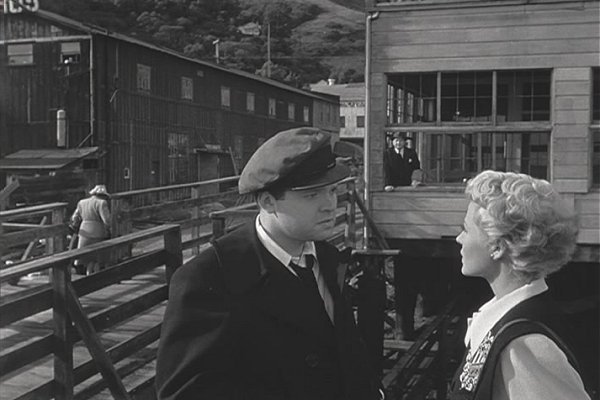
Recently, I watched one of Welles' supposedly "minor" works, The Lady From Shanghai (1948). I was not surprised to find out that it was yet another intriguing exercise in Welles' career-long inquiry into the potential of the moving image. But how the film does this is especially significant, particularly from my Kane / Evil-tilted understanding of Welles. Throughout the film's short running time, I drew a number of comparisons to Touch of Evil in its experimentation with undertones of film noir, even though The Lady From Shanghai is tonally very different. Nevertheless, there are traces of the gritty noir realm he constructed for the former film. As it is, The Lady From Shanghai will likely not be remembered with the same loving embrace as Touch of Evil because it lacks thematic consistency. It is both playful and brooding, and it never locates a balanced stroke of either. A 90-minute tale of ambiguity, murder, and class divides, The Lady From Shanghai converges a variety of narrative and stylistic approaches common to Welles. But these elements are streamlined so smoothly that it's treasures may glide right past you on first viewing.

Welles plays Mike O'Hara, an admittedly naive Irishmen who falls for the Elsa Bannister (Rita Hayworth, with a rare updo), wife of a rich man, Arthur Bannister. O'Hara is invited on a yachting cruise with the Brittons, where finds himself caught in a web of lies and deceit surrounding a murder plot that goes horribly wrong. Standard murder drama stuff, to be sure. But Welles spins it so deliriously and seemingly effortlessly and still manages to squeeze out so many genuine moments and keen commentaries that one can't single out individual moments to describe the compositional beauty and the perfect fusion of movement and storytelling.

No doubt The Lady From Shanghai initially comes across is a distinctly enjoyable film, but it appears to only achieve greatness in moments, most notably in the hall of mirrors climax, where Welles delights in the deconstruction and reconstruction of images. He multiplies them, overlays them, and runs them through our minds in twisted fashion. The wonder of the scene, however, is that he finds a poetry in the hyper-motion; it's the kind of surrealistic fusion that makes sense only in the motion of the figures on screen.

However, with scenes like the funhouse exuding bold explosions of style, the film's small treasures can be easily overlooked. In the seamless setup and execution of narrative, Welles' visual allusions are aplenty and aided greatly by his uncanny eye for compositional detail and fluidity, i.e. foregrounding and lighting techniques that are both straightforward and densely rich. A fine example of this narrative-stylistic synthesis is the scene in which O'Hara (Welles) and Mr. Grisby (Glenn Anders) walk along the cliffs of the ocean line discussing how they will fake Grisby's murder. While keeping his actors foregrounded in the shots, Welles never allows the ocean to leave the background. He creates such a distance between the actors and the crashing ocean water behind and below them. These shots are spatially uneasiness, as we can never quite make sense of the surroundings as O'Hara and Grisby make their way down to a particular point on one cliff's edge with the conservation becoming more strange is it evolves. The tension is dually heightened, but not for reasons unknown. It's an intangible discomfort, one that doesn't become evident until the last shot of the sequence, when Brisby abruptly "falls out" of the shot, inducing a feeling of vertigo as the scene culminates in a cryptic, sudden abruption. We know Grisby hasn't fallen, but the simple stagings and framings create a strange spatial orientiation.

These are only a few examples of the film's breezy mastery of style. The Lady From Shanghai is fully of these little moments, from a humorous courtroom scene to its yachting travelogue through many luxurious locales. Part of what makes it so special is that it downplays its dramatic aspirations and demonstrates the versatility of visual storytelling. Welles' seems to be indulging in a bit of fun with the film, but in doing so he hones in on the great pleasure of storytelling and simply watching images. For every bit of deliberate formal detail there are so many naturalistic tones breaking through the formalism, giving them a sense of weightless playfulness that only highlights the film's formal strengths, however sporadic or straight-ahead they are. All of these components come together so easily to enliven deceptively simple story about (conveniently enough) the physical and emotional pains of simple deception.

The Lady From Shanghai will likely always be pigeon-holed as nothing more than a pleasurable diversion, and that fact all the more elucidates the intangible simplicity that makes this film such an important one in Welles' oeuvre. It also highlights the strengths and weaknesses of auteurist criticism. Were it made by any other director its many treasures would be reaped by more viewers. I fear that if I had seen the film after watching more of his movies, I would not appreciate its virtues in quite the same way. Where I go with Welles from here I do not know, and that's something I'm happy to admit.

Monday, July 14, 2008

Spirituality through narrative: Hellboy II—The Golden Army

With some seven feature films under his belt, Guillermo del Toro's filmmaking resume is beginning to take shape. Whether you mostly love his films (like I do) or are kept at a distance by his strange preoccupations and sometimes sluggish storytelling, del Toro's growing body of work is among the more noteworthy achievements in contemporary studio filmmaking. Hellboy II: The Golden Army, which opened over the weekend, is his latest. It's a worthy sequel, an exceptional comic book movie, and a wonderfully strange funhouse of weird creatures and formal beauty.

Critical responses to the film have been mostly positive, but now that the critics have accepted, even embraced Guillermo del Toro, I have noticed more varied approaches to his films. Hopefully it's the beginning of a dialogue that will only become more interesting and multi-dimensional. For a lively discussion already underway about Guillermo del Toro and his work, check out the comments section Jonathan Pachecho's House review from Friday.

Below are excerpts from my review of the film, which is now up over at The House Next Door:

"While a number of critics are positioning Hellboy II: The Golden Army in relation to director Guillermo del Toro’s forthcoming venture into Middle Earth, the film sits more comfortably as a companion piece to the director’s last film, Pan’s Labyrinth. The 2006 Oscar-winner was not just formally beautiful, but resonated with deeply realized themes of spirituality and the necessity of storytelling. Structurally and aesthetically, del Toro rendered two worlds—fascist Spain and a magical fairy world—that couldn’t thrive, grow, or exist without the other. He carefully denied the viewer the pleasure of escaping into myth or narrative, while also establishing a disjointed “reality,” with persistent intrusions of the fantastic. This was precisely his purpose: to illustrate that these two worlds are mutually constitutive and inseparable from one another.

By contrast, Hellboy II more outwardly revels in its fantasy. It serves up a delicious menu of goblins, trolls, armies, and angels of death, all brought to life with unparalleled vision. But even though del Toro is steadfastly focused on populating his world (which he established in Hellboy II’s 2004 predecessor) with as many odd creatures as his mind can dream up, evident also in the film’s swirling compositions of color and movement is the same commitment to narrative that ran through Pan’s Labyrinth. You may not be overwhelmed by the thinly drawn Shakespearean character dynamics or the predictably action-heavy denouement, but this movie is about the moments in between—the simple, seamless unfolding of narrative energy."

...

"In Guillermo del Toro’s worldview, storytelling is not about structure, cohesion, or resolution, but about the experience of being in a world, a place, a mind, and feeling it from the inside out. It’s essentially about sensation and encountering magic in the everyday world, where such things are often thought to have no place. Del Toro believes that storytelling is worth fighting for simply because it is the defining element of humanity. We may draw distinctions between reality and fantasy, but del Toro wants to shatter that divide and revel in the pure experience and immediacy of narrative.

The elements of his narrative in Hellboy II may not be real, or even deep for that matter, but del Toro allows them to fill the screen and the imagination, reminding that the fantasy can become real as much as the real can become fantasy. They bleed into each other and inform one another."


For the full review, click here.

Whether or not you have seen the film and have thoughts on it, the career trajectory of Guillermo Del Toro, or anything else, comment away!

Wednesday, July 9, 2008

The cinematic condition

One of the great projects of criticism and of inquiries into media aesthetics is the philosophical inclination to try to answer the question of what a medium is. But I resist this tendency simply because in defining something, we lose that which we are defining. It becomes just another filled space in a field of language and identification, serving little purpose and holding little meaning outside of that. Having said that, I accept that these practices are inevitable and I engage in them as much as anyone else. Film theorists, for example, are plagued by the question "What is Cinema?" It's a seemingly simple question commonly used as a spring board for philosophical reflection and debate. Yet the problem of thinking this way about media and communication may not be in the discourse to come from asking the question, but in the question itself.

Over at Elusive Lucidity, Zach Campbell asks another question. Instead of focusing on what cinema is, he asks what is cinema for. In other words, what are social, aesthetic, cultural, economic conditions under which images are produced and consumed? I would add that we maybe shouldn't study the act of consumption or production, but of the position of the producer, consumer, and any other individual within this scheme. He problematizes very efficiently the notion of thinking in terms of essences and definitions. For example, he lists off all that cinema is, can be, and in some cases isn't:

"To what all can we equate the cinema? For starters: lost causes, mirror images, failures, dream-food, a drug, a certain form of reality, lèse majesté, toadying, bullying, pleading, pornography, a captured sequence of sounds/images that may give a reasonably identical experience to the viewer over multiple viewings, a substitute for action, a displacement of life, a patriarchal funhouse, today's Grand Guignol, faith, celluloid, maybe pixels, beginnings and ends, a two-lane blacktop."

I do recommend visiting Zach's site to read his reflections, which are far more compact and (dare I say) lucid than my own.

Tuesday, June 17, 2008

The House away from home

I am pleased to report that I will now be writing for The House Next Door, a film / media site I have long regarded as one of finest of its kind. I don't have a specific direction or set of goals I'd like to accomplish in my articles for The House, but I anticipate drawing up a number of commentaries on a variety of cinephile subjects, as well as offer some more in-depth film criticism the likes of which is not appropriate on an individual blog like The Cinematic Art. I have every intention of upkeeping this blog at the same pace regarding post numbers and content. I may not write at the same length that I have in the past, but I will continue to keep this site up-to-date in similar capacity as I have over the past year. As always, thanks for reading, and your comments are always welcome!

My first article is an appreciation of Ang Lee's Hulk, a film I believe to be underappreciated and underrecognized. With the release of the new film, Lee's version of the story may likely be driven into even deeper obscurity. I argue that the film is important, both as a work of digital cinema and simply as a melding of experimental and conventional filmmaking styles. At a time of greater nuance and confusion in the film landscape -- with aesthetics and sensibilities shifting to accord to new sociocultural conditions -- Hulk is especially relevant. Hopefully, time will be kinder to it.

Below is an excerpt from the opening portion of the article:

"Midway through Ang Lee's Hulk (2003), Betty Ross (Jennifer Connelly) and a Hulked-out Bruce Banner (Eric Bana) share an exchange that could easily be confused with a scene from a less commercial film made at one of Universal's smaller subsidiaries. Aside from the impressive CG-effects (somewhat obscured, and assisted greatly by the darkness of night), there is palpable affection between the towering digital creation and Connelly. Bruce shamefully gazes on Betty in self-disgust, the moonlight shining off his bulging arms as he moves to gingerly lift her off the ground. When her arms drape over his giant limbs, we can feel it. No dialogue is uttered; there are only faces.

In that moment, Lee achieves something that so few filmmakers have with digital effects. He literally brings a digital creation to life. The scene can be seen as something of a precursor to the under-appreciated
King Kong (2005), wherein director Peter Jackson momentarily mutes out the world so that a flesh-and-blood woman can connect with a pixelated monster. But unlike Jackson's Kong and various other works featuring memorable digital creations, Hulk will not be remembered as a defining moment in the history of CGI. And yet, the film's use of digital technology is more subtle, evocative, and arguably more innovative than a great deal of the so-called greats (e.g. Terminator 2: Judgment Day, Independence Day, The Perfect Storm, etc.).

Lee understands that the quality of effects have little to do with their photorealism. How "real" the Hulk looks is irrelevant—the reality is instead contingent on the conveyance of feeling. This affective connection is not necessarily achieved by top-line effects (a notion that echoes a traditionalist application of digital filmmaking). Instead, Lee illustrates that with the appropriate sensibility and aesthetic unity, such pure moments can be constructed traditionally (analogically), digitally, or with a perfect melding of the two.
Hulk essentially embodies a new kind of cinematic connection that is both subtle and profound. The digital components are physically married to the composition and emotionally embedded in the narrative."

For the full article, head on over to The House Next Door.

Monday, June 16, 2008

David Hudson sounds off

"Movies make you want to see more movies - but, because of the collaborative nature of their making, often in very interesting ways. If I read a book and I like it, or I'm moved or intrigued by it, I'll probably go looking for another book by the same author. Same with a painting and its artist. With movies, it might be more movies by the same director I'll want to seek out, but it might just as well be an actor's work I'll want to see more of, or a cinematographer's. Or maybe it's more the look and feel of that movie's genre or origin - noir, Iran, what have you - I'll want to seek out and sample again.

'The other thing's related: Just as movies arouse a hunger for more movies, they also arouse a hunger for more real living. They make you want to get out and do things - stay out late, eat, drink, fall in love, see new places, meet new people - even the downers. In a way, these last two impulses - see more movies; live more fully - are contradictory. Again, the old anxiety: not enough hours in a day, days in a week, years in a life."


These are the words of GreenCine Daily editor David Hudson, who was recently the focus of Adam Ross's indispensable Friday Screen Test series. Hudson is oft-referred to as the hardest working blogger on the internet. In this piece, Hudson waxes about film, philosophy, and the daily struggles of his work. The interview is a joy to read, especially for those who keep up with his daily work. The quote above does more than highlight the collaborative nature of the cinema. His description of the endless doorways and passages that film can open works as both a concrete metaphor -- i.e. exploring the work of another filmmaker, actor, etc. -- and a more abstract one, which he teases out in the last paragraph. In my view, his final remarks articulate the tensions dormant within cinema and of life so perfectly, evoking the transience of both more effectively than any essay or book that I've read on the subject.

This interview represents a glimpse into the mind of a man whose passion and enthusiasm for movies come through more in his coverage of films rather than his opinions about them. His tireless coverage of the hundreds of films released each year is enough to inspire any cinephile to embrace the larger worlds of international and independent cinema, while still keeping up with the cultural dialogue spurned from discussing studio films. As the subject of discussion here rather than the facilitator of it, Hudson paints a portrait of himself and the art form about which he writes that is reflected in his daily postings on GreenCine.

In some ways, Hudson is film criticism equivalent of that eclectic teacher you had in high school who inspired you to ask new questions, make bold observations, and embrace new forms of thinking; all without ever revealing his own "take" on the material about which s/he teaches.

Do check out the interview if you haven't already.

Wednesday, June 11, 2008

At world's end with Werner Herzog

It's been almost eight months since I've seen Encounters at the End of the World, and to this day its images live in my memory. Amazing underwater sequences; pleasantly absurd interactions with Antartica's resident culture of researchers, scientists, and poets; and the haunting sight of a single penguin briskly waddling away from the group to "certain death." All of these moments and more have taken on their own life in my mind, strung together by the occasional voice of Werner Herzog, who lends his perspective to the encounters that he and his camera operater have on the dwindling ice block at the bottom of the world.

The film opens in New York and Los Angeles today, and in honor of its release, I have included excerpts from the piece I wrote when I saw the film late last year. Framed and presented in this form, they constitute a brief review of the film:

"In Encounters at the End of the World, [Herzog] travels to the most remote location of this planet to observe the people who inhabit it. The film is comprised of a series of interviews with various scientisits, divers, and "dreamers", as Herzog calls them. He is not merely attempting to observe and gain insight into the desolate ice world and the planet, but also to understand what motivates the people who have elected to live there and study it. Herzog seems to believe that while human beings and nature cannot connect or live together in harmony, they constantly intersect, inevitably so, even in the the most far-off land, where people require the best of minds and technological access to survive at all. This tense relationship fueled his last documentary, Grizzly Man (2005), and while he isn't exploring life and death and the harsh collision of humans and nature, Herzog is nonetheless searching for something in his probing of the Antartic culture, wildlife, aquatic life, and the glaciers that move about the ice-cold waters.

By observing the idiosyncrasies and odditities of the continent's residents, Herzog captures both the beauty and absurdity of what they do. He uses voiceover to frame his questions and thoughts, some of which are practical and humorous, others more subliminal. Regarding Antartica and its residents, Herzog wants to understand their unique motivations, as he paints them as dreamers (as I mentioned above). But he also uses the voiceover to interject his own very estranged thoughts (i.e., distanced from their thoughts and thought-processes) in the form of hilarious observations such as "Her story goes on forever", which typically cut off the person talking. However, these hilarious moments are often times genuine, whether they're honest feelings of his or simply elongated takes of a given individual after she or he is finished talking; It's esepcially interesting to see how uncomfortable people become when they've said what they wanted to say but the camera keeps rolling, as if its stalking them. But these bits of humorous discomfort are never outwardly mocking of the interviewees. In fact, Herzog often finds real humanity in all of persons with whom he speaks in the most mundane or comedic of times. Whether he's enamored, bored, or "searching for something to talk about", Herzog often finds life in the simplest of ways.

He juxtaposes his encounters with the people of Antartica with some of the most awesome cinematic sequences of underwater footage. Throughout the film's 99 minutes, there are several long sequences underwater in which the camera follows divers down to explore the chilly depths underneath the ice. There is nothing overtly flashy about the images, yet they exude a real sense of discovery, as if the viewer is among the privelaged few to be able to see that which rests underneath the ice, which is a whole other world. We can observe this world, shoot it on film, and try to explain it with science, math, or language, but such attempts ultimately fail. Sometimes sounds and images stand for themselves. As is typical of Herzog's films, Encounters at the End of the World finds sublimity in the most seemingly mundane of ways; in patches of air traveling between the ocean and the ice that sits on top of it, in lone penguins who "walk to certain death", and in the ramblings of its many interviewees. The most outwardly poetic moments are those underwater, where the sea life seems almost alien in that it resembles nothing we have categorized into a species or form of life. Underneath the ice in Antartica, life eludes the human capacity to understand it. And in these sequences, whether underwater or in ice caves, Herzog rarely interjects with his own voice, except when observing peoples' strange ways of trying to connect with it. (Buried in a tunnel of ice is a frozen fish and strings of popcorn!)

With all his wanderings about this world "off the map" with no real understanding it, Herzog finds great clarity in balancing "Profound Moments" with seemingly pointless ones. He is utterly fascinated by everything, prompting him to contribute his own thoughts about it. After seeing the film and reflecting on its rather free-flowing tendencies and sensibilities, think I now understand a bit more why Herzog enjoys making documentaries, even though he keeps the term "documentary" at a distance. There are things so wonderfully strange and strangely wonderful about this film, which is more an exploration of a foreign land and culture. No "narrative" film or talking heads" documentary" could ever broach the eccentricities of the people interviewed and observed in this people, and no amount of creative framing or special effects could yield the kind of strange, almot too gloroius for words images of the lost world underneath the glaciers. With this style of documentary, Herzog can frame his own narrative and present this world as he sees it. He is the true master of this cinematic universe, and I must admit that it's a universe I love to lose myself in. In this universe, Herzog dives into different places of our shared world --or collective unconscious-- to observe how each of us interpret the very same matter and sensory perceptions differently, crafting our own worlds in the process.

Encounters at the End of the World is yet another attempt to explore ecstatic truth in one of the endless amounts of ways one can. It reminds of the true elusiveness that is cinema, which itself is a tool for experiencing ecstatic truth. It is a medium rich with possibility. Only with cinema can a filmmaker foster such a world in such a unique way so as to offer insight into how humans construct their own narratives and fancy their own worlds. It is a medium of many media, itself the true convergence of technologies and artistic perspectives developed and progressed over thousands of years to shape our consciousness, individually and collectively.

If I do happen to miss tonight's conversation with Herzog, I won't feel like I've missed on on something once in a lifetime. I say that because watching his films is itself a sort of personal experience with the filmmaker, like a conversation wherein I am constantly engaged in his thoughts and observations, which in turn provoke my own, which may thus inspire me to approach the film in a different or unique way. I find some version of this pattern occuring each time I watch a Herzog film, whether that's a narrative film or a documentary. But the greatness of his body of work is in the way in which he makes films collapses these broad frameworks that turn the cinematic experience into a process of structuring and categorizing."


Some of the concepts referenced in these passage correspond to thoughts on ecstatic truth, which I discussed earlier in the piece. (Here's the whole article.) Reading this review again, the images and sounds stand out to me even more. I don't want to create any false notions about the dramatic aspirations of this movie, because they are nowhere near those of Herzog's Grizzly Man; He is after something very different here, or so it seems. There is a profound absence of direction in this movie, which, guided by Herzog's thought processes and strange observations on his adventure, makes for an equally compelling, albeit very different kind of experience than than the more somber Grizzly Man, or some of his other documentaries. That said, Encounters at the End of the World is in some ways the movie that Herzog has been making his whole career. Centering on themes of the interrelations of humanity, nature, and technology, the film is full of those Herzogian moments of simple profundity manifesting in its interviews and underwater compositions. We learn that his preoccupations haven't change; only his manner of exploring them.