Thursday, September 13, 2012

Monthly Retrospective: Rashomon


[This is the first entry in what will be a regular feature at the site, in which I offer reflections and considerations of movies that aren’t on the reviewing circuit of the past year.]

First-generation innovators rarely give us the best version of an idea or expression. Often they provide the groundwork for others to harness and perfect, which has certainly been the case with technology and also to a lesser degree in various artistic modes. In terms of movies, many of the most revolutionary entries (e.g. The Wizard of Oz, The Jazz Singer, Star Wars) are known primarily for how they changed the medium rather than how their advancements helped set a new standard of aesthetics or storytelling. Citizen Kane is one of the more famous examples of a film that offered both visual and narrative invention that few films have approached thereafter. Equally significant in this regard is Akira Kurosawa’s Rashomon. The film is renowned for ascribing a dimension of reflexivity to cinema that had been mostly unexplored until that point. It asks elemental questions about vision and storytelling, specifically: How do the two enter into a relationship through cinema, and what are the roles of truth and perspective in that relationship?
Rashomon offers several different accounts of the same event, which is recounted by the different characters involved. Kurosawa frames this through a trial-like setting in which the characters look directly at you, the viewer, and gives their own description of what happened. But before I discuss Rashomon’s benchmark achievements, I want to point out just how rich it is purely from a visual standpoint, as this can be overlooked. For example, the interrogation scenes—with the witness in the foreground and lookers-on in the background—have a downright avant-garde sensibility that contrasts nicely with the sumptuous visuals that Kurosawa creates in the forest. For a film that notably oscillates between perspectives and points in time, Rashomon is fluid in its storytelling and presentation. In addition, the film’s focus on faces lends an expressive layer to its already complex inquiry into to human nature. Moreover, Kurosawa’s full use of the expressive influence of images and narrative to explore a deep range of emotion makes Rashomon one of cinema’s most significant entries, as well as one of its most poetic.
Rashomon deserves to be renowned for carving out the structural and visual methods that would eventually be incorporated in all types of movies and ingrained into our movie-going minds. But almost entirely apart from it’s pioneering of these techniques, Rashomon employs them as a means of exploring the full breadth of potential that visual storytelling enables. This is evident not only in the film’s groundbreaking techniques, but also in how it moves and feels. In the hands of Kurosawa, something as simple as beating rainfall is eloquent and moving.
To see Rashomon having internalized its DNA in so many other movies is to experience a potential and sense of newness about movies that precious few of them still cultivate. (Akira Kurosawa, 1950) ****

Monday, September 10, 2012

A Separation


“He is a good man.” So says Simin (Leila Hatami) about her husband in the opening scene of A Separation, in which she explains before a judge (off-screen) why she seeks a divorce. Not the words one would expect to hear in a divorce hearing. Nevertheless, sitting next to Simin, her husband Nader (Peyman Moadi) is indifferent to the proceedings. We gather that he loves his wife, but he obliges with her request because his priorities lie with his ailing father, who requires care that would prevent the couple and their child from leaving their home country of Iran. Simin and Nader’s situation is not unlike the conflicts that many married couples face. What distinguishes A Separation is how perceptibly it articulates the circumstances within which the two become entangled.
The film unwinds as an uncommonly observed tragedy about Simin and Nader, as well as a handful of other characters that play in the evolving drama. The conflict eventually escalates and results in a chain of events that is as compelling as it is unpredictable. All the while, writer-director Asghar Faradi keeps a tight focus of the human scale and what really drives these folks to their actions, even as misunderstandings heighten and deceptions occur. None of these individuals wishes to inflict pain on those around them but nonetheless do—out of pain or mistrust or simply fear. A Separation never resorts to violence, but it resolves in an arguably more devastating way. And it plays out so convincingly because Faradi doesn’t have the agenda that shapes many other stories about broken connection and communication. Thus, the drama unfolds smoothly and with the further aid of an understatedly intimate aesthetic that sharpens the film's emotional verisimilitude.
A Separation went on to win the Oscar in the foreign language film category at the 2011 Academy Awards, but there was little doubt that it would have performed otherwise. Due largely to the influence of the Weinstein brothers on Oscar campaigning, the race in many categories is seldom about artistic merit. However, A Separation represents an example in which a genuinely great work deserved the recognition it received from being awarded Oscar Gold. It resounds beyond its own intimate settings and focused dramatic scope to channel a much broader human struggle of navigating the complex trappings of political, religious, and cultural identity. A Separation is about the intersections of these facets of ourselves and where and how they collide in our relationships. (Asghar Farhadi, 2011) ****

Thursday, August 30, 2012

Indiana Jones and the Kingdom of the Crystal Skull


As compared to the other Indiana Jones follow-ups, Indiana Jones and the Kingdom of the Crystal Skull fosters an altogether different sensibility. While Indiana Jones and the Temple of Doom and Indiana Jones and the Last Crusade bear noticeable (however different) flaws, they each have an aura that’s identifiable by various visual or narrative elements. Kingdom of the Crystal Skull is less accessible than those films, both in terms of its relation to the broader lexicon of the series and as a unique chapter within it. At the time of its release four years ago (and 19 years after Last Crusade), I noted that it strained heavily to honor and amplify the nostalgia of its own legend. Seeing the film again several years later, away from the commercial hype, and in succession with its predecessors, I can more readily appreciate its layered compositions and busy thematic undercurrents. None of this changes the fact that this is coldest and least inviting of the four Jones affairs, a fact that only makes the film more intriguing than its reputation suggests.
            The nearly two-decade gap between Indiana Jones and the Crystal Skull and its immediate predecessor may explain its heavy dose of reflexive mythology. Dating back to Raiders of the Lost Ark, Steven Spielberg has frequently framed Jones in silhouette, and here he takes the concept to new planes. After a traditional introduction to Harrison Ford's hero (with his shadow cast against a military truck), an encounter in plastic suburban platitudes resolves with the obscured shape of Jones subjugated by an atomic mushroom cloud encompassing the frame. Allusions to modern technology abound throughout the otherwise historically fixated Crystal Skull. David Koepp’s screenplay features long discussions about a Spanish conquistadors and intra-dimensional space, while Spielberg only shows a passing interest in Jones’ evolving family drama. Compared to Last Crusade, in particular, Crystal Skull is light in emotion and is more concerned about how a hero like Jones finds a place—both physically and symbolically—in a world increasingly defined by suspicion and the specter of desolation.
            These elements play well against the atmospheres and jaunty rhythms of 1950's. (The brilliant opening title sequence offers a slice of American innocence, complete with Elvis Presley's "Hound Dog" playing over, before unveiling how its been infiltrated by KGB.) To boot, Spielberg’s fluid visual senses are ever sharp. The action sequences are beautiful to look at; every time you expect an edit the shot lingers and plays out the action in smooth fashion. The film falters in its loose grasp of conflict (translating to a general lack of tension) and its poor rendering of characters. Both Cate Blanchett’s villain and Shia Labeouf’s “Jr.” are poorly realized, and the tough bad guy henchman is cartoonishly excessive. These sour notes spotlight the film's curiously murky and overdone performances across the board. (Even the reliable Jim Broadbent does a lot of unnecessary shouting.) Additionally, while I confess to loving the central conceit of the alien plot, it feels neither fully complete nor fully integrated into the proceedings. This is ultimately what sets Kingdom of the Crystal Skull apart from its predecessors. It arguably has more going for itself with intricate thematic overtones and visual acuities but most of them are half-formed, resulting in a film that—despite serving up a handful of great moments and several other good ones—lacks a definitive stamp.
            Overall, I find Indiana Jones and the Kingdom of the Crystal Skull the most difficult Jones film to penetrate. On one hand, I see an uncommonly nuanced film for its type (as Keith Uhlich argued in a wonderful piece several years ago), but I also understand why Jones devotees and casual fans alike felt distanced by it enough to lump it with George Lucas’ shunned Star Wars prequel trilogy. (Steven Spielberg, 2008) **½

Friday, August 24, 2012

Indiana Jones and the Last Crusade


In my recent piece on Raiders of the Lost Ark, I touched briefly on the nuance that Harrison Ford infuses into what could have been another ordinary hero. In both that film and its sequel, Indiana Jones and the Temple of Doom, Ford embeds a range of detail into the character of Jones that the screenplays do not. He is at once a serious professor and a boyish adventurer. Some would say he womanizes, but Ford makes Jones more as the kind of person who really might have wanted to settle down if he wasn’t so impulsive and defensive. He verbally spars with women as if he was in the schoolyard and exhibits a similar immaturity in his physical fights with enemies. The point is that Indiana Jones is vulnerable, and Harrison Ford taps into that both hilarious and subdued ways throughout both films. While the stylistic splendor of the movies also plays an important role in their success, Ford’s layered portrayal of a character whose heroic persona is offset by his own arrested development is the anchor of the films.            
            The third film, Indiana Jones and the Last Crusade, represents a significant shift for the series. The previous two films kept the storytelling focus on the adventure and left Ford to inject humanity into the character with his performances. In Indiana Jones and the Last Crusade, the emphasis is taken off of the adventure and placed on the character of Jones himself. It does this through the prism of Indy’s rocky relationship with his father, Henry Jones, Sr. (Sean Connery). Although the plot concerns the search for the Holy Grail, the real focus of the film is on Ford and Connery, whose undeniable chemistry results in wonderfully awkward interplay.
Many retrospective accounts of Indiana Jones and the Last Crusade credit Sean Connery for his portrait of a traditionally stern father, but it’s Ford that shines in every exchange between the two. Indy’s plight for his father’s love and acceptance comes through in quiet moments that likely carry subatomic weight for anyone who’s every struggled to connect with a parent. Certainly, there are a few over-the-top moments of speechifying (and a rather contrived finale that converges the Grail and Papa Jones), but the film largely carries out this thread through well-observed humor. Notice the dismissing tone in Ford’s voice in the scene when he and Connery are tied back-to-back and flames are quickly engulfing the room. When Jones Sr. has “something to tell” him, Jones casually retorts: “Don’t get sentimental now, Dad. Save it ‘till we get outta here.” Another favorite exchange of mine comes after a narrow encounter with a plane in a tunnel. As the plane flies away to turn around, Indy races to get away from the scene before stopping and remembering that his father is still with him. After belting out a disapproving “Dad!”, he calms his voice, adjusts his hat, and keeping the same condescending tone, says: “He’s coming back.”
As in moments like these, Indiana Jones and the Last Crusade often beautifully expresses the challenges of father-son relationships. In fact, so affecting is the character focus that it also articulates the triviality of the actual Grail-quest and illustrates the central problem of the film. Aside from a handful of exuberant sequences—most notably the train-chase opener with a young Indy (River Phoenix) escaping from bandits in the Southwest desert—Indiana Jones and the Last Crusade lacks the color and energy of the previous episodes. One of the main missteps with the story is its self-conscious attempt to return to the sensibilities of Raiders of the Lost Ark, which is likely a response to the negative feedback Indiana Jones and the Temple of Doom received. Nevertheless, this entry lacks the lore and the colorful characters that marked Raiders and falls short in generating much tension or interest in the main conflict. The desert tank chase represents a rare moment that coheres the film’s disparate sensibilities into a big set piece with a real sense of stakes, but otherwise Indiana and the Last Crusade struggles to make the combination of its elements work.
Indiana Jones and the Last Crusade is a problematic film. Though despite taking on water in various places, it remains afloat on the unstated benevolence of its observations. In a way, the film can be seen as an allegory for many parent/child relationships. There are certainly rough patches, but sometimes—even when you expect a big moment—a simple brush of the shoulders and a “Well done,” says everything. (Steven Spielberg, 1989) ***

Tuesday, August 21, 2012

Indiana Jones and the Temple of Doom


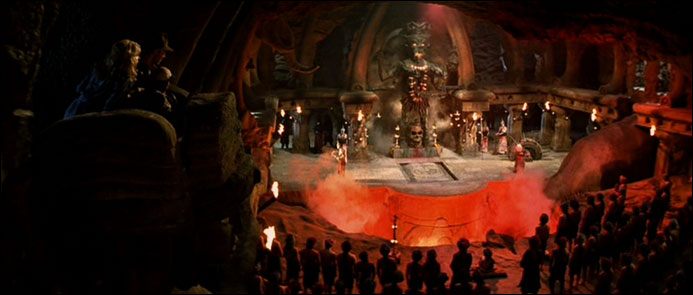
Despite the thrashing it received upon release, Indiana Jones and the Temple of Doom arguably eclipses Raiders of the Lost Ark in at least one respect. The sense of adventure in this second episode of the series may in fact be the sumptuous of all four films. Preserving the Saturday afternoon serial style of Raiders, director Steven Spielberg and writer-producer George Lucas are mostly consistent in approach but opt for a whole new setting for the second adventure. The film opens in a Shanghai nightclub and gives Jones a Bond-esque introduction after a spirited song-and-dance bit for the credits. From there, Indy ends up on a plane that crash lands in India, leading him to a depraved village where the sacred Sankara stones have gone missing along with villagers’ children. This all happens in the film’s opening act—and I'm not even covering the outlandish action sequences. In some ways, the busy first act mimics Raiders of the Lost Ark’s final hour with its random chain of events strung together to resemble a plot. Then, Indy and his companions—the bratty American singer, Willie (Kate Capshaw), and the punchy young Short Round (Jonathan Ke Quan)—are off to a mysterious palace, where within its caverns dwells a cult that enslaves children and makes human sacrifices to its evil god.
            You have to hand it to Spielberg and Lucas: purely in terms of story, Indiana Jones and the Temple of Doom is pretty deranged stuff. More importantly, they dig deep into the material and give it the inspired treatment it deserves. Amid the jungle trekking and heart extractions, Spielberg fashions oozing atmospheres and a frenetic pace that together give Temple of Doom a distinctive feeling from its series companions. The tradeoff, however, is that the film lacks the discipline and patience that distinguished Raiders. For instance, both both Willie and Short-Round are ill conceived, working only as comic relief in an otherwise gloomy film. Even worse, the screenplay has both sub-characters playing key roles in several crucial moments, which throws cold water on any energy the film builds in its second half. But based on the size of the set pieces, it’s clear that Spielberg is so preoccupied with delivering more kicks than the last film that he loses sight of the elements that makes this kind of storytelling such a thrill to begin with. We all know this is inherently kids’ material, but the beauty of Raiders of the Lost Ark is how it plays its scenario with a straight face and gives it such lavish treatment. When you see a 12 year-old beating up fully-grown and fit adults, the magic is lost; whether the material is believable to start with is beside the point.
            What stings the most is that Indiana Jones and the Temple of Doom plunges to depths that no other Jones film approaches. Even Harrison Ford has a hint of demonic zeal behind his eyes and more vigor in his voice. It's a shame that Spielberg and Lucas have publicly apologized for going “too dark,” because the real problem is that they compromise the deliciously dark core of the movie with forced humor and intermittent stupidity. Had they followed through on their initial impulses and not allowed their weaker inclinations to compensate for them, this film could have been really special. Nevertheless, I remain convinced that in spite of its flaws, Indiana Jones and Temple of Doom is a movie of overflowing imagination. That it is sloppy, occasionally appalling, and uncomfortably colonialist doesn’t change that it is inspired filmmaking. Unfortunately, in pouring on mood and excitement, Spielberg left the flaws exposed and revealed just how delicate was the balance Raiders of the Lost Ark achieved. Indeed, Indiana Jones and the Temple of Doom cannot compare to the mastery of its predecessor and deserves some of the criticism it has received. But the sluggish, sometimes balletic experience it offers also makes for a spectacularly unhinged account of cinematic pleasure. (Steven Spielberg, 1984) ***

Thursday, August 16, 2012

Margaret

Given its tumultuous six-year history from filming to release, the vantage point from which I waded into Kenneth Lonergan’s Margaret undoubtedly colored my complicated response. I should note before going on that the only version of the film available to me was the 150-minute theatrical cut, which, according to several essays I’ve read, is a very different experience than the three-hour plus cut recently released on Blu-Ray.
Having acknowledged this fact, the shortened version of Margaret is kind of profound. It has uncommon insight into the cracks of its characters’ lives, exposing the difficulties of communicating and wanting to be heard. At the center is Anna Paquin, who gives a fervent performance as a privileged Manhattan high school student who is both confident in her every word and uncertain of her actions. Her character witnesses and plays a part in an accidental tragedy that leads to the death of another person. The remainder of the film deals with her guilt as she navigates through various relationships and social roles (daughter, student, citizen, sexually inexperienced teen, etc.). As she becomes more fixated on the truth of what happened concerning the accident, her own life becomes defined by the lies she tells herself and others.
Writer-director Lonergan (who also made the terrific 2000 film, You Can Count on Me) has an intimate approach to the material. He is after more than the guilt and pain of this young woman, and yet he smartly avoids the trap of allegory. Extending the film’s view onto Lisa’s mother, teachers, and other acquaintances, Lonergan creates a web of nuanced character portraits of people who misunderstand and are misunderstood. (It also helps when you have actors like Matt Damon, Mark Ruffalo, Jean Reno, Allison Janney, and Matthew Broderick on hand.) Margaret is a bared film to which you must make yourself vulnerable to reap its rewards. While the performances are uniformly excellent and the degree of the painful transactions at times unbearably high, the film lends depth to its perceptive screenplay and performances with an almost hypnotic sense of place. Lonergan’s camera scans up and down city streets and across window-lit rooftops, deriving poeticism from both the stillness and movement of the city. Nevertheless, the frequent shifts in focus cause Margaret to stumble as it unfolds unto other narrative territories. As I noted earlier, I haven’t seen the longer cut, but knowing of its existence compels me to wonder if the film’s problems of flow can be accounted for by its truncated nature. Nevertheless, in its theatrical incarnation, Margaret is an impassioned, if also frustratingly choppy work. (Kenneth Lonergan, 2011) ***

Saturday, August 11, 2012

If I Had a Sight & Sound Film Ballot

For film critics, Top Ten lists are a fact of life. Yet, despite frequent complaints that Top Tens are a bore to compose at the end of each year, the British Film Institute’s Sight & Sound poll is one of those rare lists to which most critics would love to be asked to contribute. It’s the Top Ten. The lists themselves tend to represent each critic’s best effort to express the knowledge and creativity that the invitation supposes. You can imagine the arduousness, then, of limiting one’s selections of the greatest movies of all time to just ten entries.
Given that my role in the larger critical dialogue is minute as compared to those participating in this year’s Sight & Sound poll, I took to the challenge of a personal Top Ten more in the spirit of fun than soul-searching. Indeed, I’ve spent a good deal of time thinking about all of the below films in various capacities and stages of my life. Some meant more to me years ago than they do now, while others have lingered in my thoughts and memories beyond what seemed like an ordinary experience of watching them. Some are predictable, others perhaps naïve. But they each played an important part in my own development as a film lover, a writer, and a person.
So while individual Top Ten lists represent an opportunity for us all to showcase our film knowledge, I see them more as a reflection of who we are as people. They are all unique, interesting, and flawed, both in concept and execution, which also makes them less significant than their epic design would suggest. That’s why I have opted for simplicity in deciding on the films for my list. While a certain amount of self-reflection is essential, some things are better felt than pondered. The following list is no doubt an expression of my personal tastes and knowledge about film and perhaps even a statement about how I approach life. Then again, it is also a fairly arbitrary ordering of 10 films that mean a great deal to me.

Click here to see my list of Top Ten Films of All Time at Slant Magazine's blog The House Next Door.

Friday, August 10, 2012

Critical Distance: The Dark Knight Rises

Due in part to the late Heath Ledger's iconic portrayal of The Joker, The Dark Knight's huge box-office performance cemented writer-director Christopher Nolan's interpretation of the Batman legend as a zeitgeist-defining spectacle. The three films have aroused a wide range of responses, spanning such topics as the director's aesthetic approach, the self-consciously realistic tone of the films, and even their political underpinnings. In fact, the bounty of critical conjecture and fan praise that followed The Dark Knight was in many ways more important than the film itself, which has become an indirect measure of success in our current age of blockbusters.
Given the enormity of The Dark Knight and the circumstances under which it was released, The Dark Knight Rises, Nolan's third and final entry in the series, was certain to generate similar buzz, despite also shouldering an enormous burden to meet unreasonable expectations. The film represents the most sprawling installment of the series, as well as the most vunerable to criticism. While critical and audience reactions have been mixed, I found it more emotionally involving and less aesthetically jarring than The Dark Knight. Yet, despite my enjoyment as I watched it, I came away from the experience curiously having retained very little of its frenzy of plot and action. The reasons for this are similar to those that plagued the earlier entries. In short, the film is a muddle of images and ideas. As such, however, The Dark Knight Rises is more significant than the previous films in Nolan's trilogy. I would even go as far as to say that it is a defining statement regarding its director, not necessarily due to the concerns and ideas he embeds into the film, but for what it says about his concept of storytelling. I arrived at this somewhere over the course of the film's nearly three-hour running time, during which many character and story arcs converge and expand amid endless jawing about social equality and revolution, before finally deflating and signifying nothing.

Click here to read the full article at Slant Magazine's blog The House Next Door.

Friday, August 3, 2012

Raiders of the Lost Ark


Sequel-readiness is a defining element of the Indiana Jones pictures. In addition to each of their self-contained stories intimating a sense of the next inevitable chapter on a larger canvas of exploits, they are also episodic by design. One action set piece often leads right into another, in an apparent nod to 1940s serials from which Steven Spielberg and George Lucas took inspiration. But these films have more going on in them than a high-spirited sense of adventure, particularly when viewed as part of a larger succession. With this in mind, I revisited all four films and will document my observations on each entry over the next several weeks.
Taken in the context of the films’ high standing in popular culture as well as my own moviegoing past, the first film in the series—Raiders of the Lost Ark—is somewhat of an anomaly. Stylistically, Raiders of the Lost Ark may have more in common with the work of Francis Ford Coppola and Martin Scorsese than its series companions (which I will discuss at greater length in my essays on the later entries). The difference, of course, is that Raiders of the Lost Ark has no aspirations of seriousness beyond the sophistication of its own aesthetic. It is pure pulp, meant to imprint on your mind only insofar as its transitory tongue-in-cheek narrative allows. Pauline Kael famously critiqued the film’s forcible dissemination of oversized excitement—a charge that’s undoubtedly true, given how fast it whips from one set piece to the next. (In its second half, the movie goes from a pit of snakes to an airplane fistfight, and then immediately into a truck chase across the desert.) But the film excels beyond its own thrill-induced exhaustion with, among other things, a steady commitment to aesthetic detail.Spielberg frames his shots in wide spaces and edits only when necessary, a technique that apart from its visual appeal also balances out the quick pace of the storytelling. On the other hand, Raiders of the Lost Ark's playful mysticism is equally attributable to John Williams’ brooding music and Lawrence Kasdan’s script—proffering beauties like “The Bible speaks of the Ark leveling mountains and laying waste to entire regions.” Spielberg accentuates and marries the two with compositional techniques that play heavy on shadows, silhouettes, and pronounced background/foreground contrasts. The interplay of these ingredients creates a rich atmosphere of foreboding and whimsy, yielding moments that stand outside of time and create a strong sense of place within the cartoonish world the film fashions. Even simple scenes of exposition and set-up are enticing, such as when Marcus (Denholm Elliot) walks down the corridor and peers into Indy’s classroom or how Marion (Karen Allen) reveals the headpiece that both Jones and his enemies are after.
Aside from the stylistic flourishes, no account of Raiders of the Lost Ark would be complete without a discussion of man wearing the fedora. Indiana Jones could easily have been another stock hero, which almost certainly would have cast the film into the exile of obscurity. But Harrison Ford’s portrayal is the anchor from which Raiders derives its energy, deepening both the sense of excitement and humor. Despite the character’s introduction as a fearless adventurer, Ford brings a boyish enthusiasm to his interpretation of Jones, who has a knack for winding up in overmatched fights, routinely dishes cheap shots to his opponents, and is the benefactor of a great deal of luck. Ford gradually peels away the tough-guy veneer of Jones’ adventurer persona and reveals a man that is reckless, immature, disenchanted, and seeking acceptance. In other words, he is flawed just as the rest of us.
For all the absurdities that Raiders of the Lost Ark serves up, Ford’s portrayal of Jones as an imperfect hero coupled with Spielberg’s smooth aesthetic do more than merely keep grandiosity levels in check. They have engineered a movie and a character that the medium seldom produces and are mirror reflections of each other. Both are simple, yet also larger-than-life. (Steven Spielberg, 1981) ****

Sunday, July 29, 2012

Summer of '87: Jaws: The Revenge: This Time, It's (Im)Personal

"This time, it's personal." So reads the tagline for the ill-fated Jaws: The Revenge. Never mind that in each of the three previous films the sharks died. Jaws 2 and Jaws 3-D may have foisted hopelessly contrived plots on viewers, but neither went as far as to imply that their respective sharks were exacting revenge on Chief Brody and his family for past crimes. We weren't led to think that the sharks were in the same family or part of a hive-mind network. But here is a premise that—while no more implausible than the other films in the series—actually seems to acknowledge the folly of a franchise chronicling one family's long saga of encounters with great whites. That's why I give the writers (or the marketing team?) of Jaws: The Revenge credit for understanding at least one thing: If you're going to serve up the absurd, don’t hold back. In fact, pour it on. Both the title and tagline of Joseph Sargent's film more than meet this standard. The movie itself is another story.
In this final entry in the gray people-eater series, Ellen Brody (Lorraine Gary) carries on at Amity Island without her husband, Police Chief Martin Brody (Roy Scheider), who has died of a heart attack. Ellen lives with her youngest son Sean (Mitchell Anderson), who undertakes his father's legacy as an Amity Police Deputy. But a shark still lurks in the waters of Amity and makes Sean its first meal. Already scarred by a deep family history of shark attacks, Ellen follows the advice of her eldest son Michael (Lance Guest) and travels to the Bahamas to gain reprieve from heartbreak. "There are no great whites in the Bahamas, Mom. They don’t like warm water," Michael assures her. Once there, Ellen finds a budding new romance with an eccentric pilot and family friend named Hoagie (Michael Caine), but she remains haunted by visions of a shark. Meanwhile, as Michael studies shells on the sea floor with his friend Jake (Mario Van Peebles), he learns that a great white is prowling the waters but decides not to tell his mother. (The shark's introduction in the Bahamas portion of the film is priceless. The beast just kind of shows up, bumping up against Jake’s underwater vehicle. No tension. No excitement.) Once she discovers that a great white is terrorizing the community (Banana boat!), Ellen becomes convinced that it wants to devour her family and complete the cycle.

Click here to read the full article at Slant Magazine's blog The House Next Door.

Thursday, July 26, 2012

Friends with Kids


In the celebrity-populated opening of Friends with Kids, two couples and one non-couple attend a Manhattan restaurant and bemoan the presence of a family with small children. This triggers a discussion about the perceived burden of responsibility of children, which is then followed by the obligatory revelation that one of the couples is expecting a baby. The scene economically portends concerns about the struggles to define happiness in adulthood and also establishes a pleasant rapport between the actors (including John Hamm, Kristen Wiig, Chris O’Dowd, and Maya Rudolph, among others). The problem is that it plays like a schematic, with each line and delivery serving a very specific function in service of the film’s agenda. Given the promising elements at play, however, I hoped after a sluggish start that Friends with Kids would eventually ease up on the tendency to package its every thematic concern into its dialogue. Alas, the forced nature of the early goings is an unfortunate sign of things to come.
Written, directed, and starring Jennifer Westfeldt, Friends with Kids plays its heady concept for laughs and drama. But rather than peering into the lives of the couples with children, Westfeldt instead opts to follow two non-committed (and considerably less interesting) members of the group, played by Adam Scott and Westfeldt herself. The two are best friends who decide to have a child together and skip past the marriage/relationship thing to maintain their respective independence. Both actors are up to the challenge and are given each a handful of well-scripted vulgarity-tinged one liners, but they tread a path that many a romantic comedy has gone down before and the film quickly finds itself drowning in a sea of tired rom-com conventions and situations. It comes to life whenever the remainder of the ensemble cast re-enters, but it’s not enough to elevate the material above the typical shallow comedy that Westfeldt ostensibly wants to avoid.
I confess that part of my disappointment stems from the fact that Westfeldt was behind the much fresher Kissing Jessica Stein from 2001. Both films end with Westfeldt striking up a typical hetero-normative romance, but Kissing Jessica Stein takes a unique journey to arrive there, whereas with Friends with Kids there is never a doubt how any of it will end up, nor does it fashion much more than a few errant laughs along the way. (Jennifer Westfeldt, 2012) **