Thursday, November 29, 2012

Pixar's identity crisis


When Cars 2 came out last year, the general attitude it was greeted with from audiences and critics alike verged on relief. After an uncommonly long streak of good (and often great) movies, the mighty Pixar had created a stinker. More than that, it was stinker from the hand of Pixar’s own leader John Lasseter. Though not a box office bomb and nary a complete misfire, Cars 2 lacked creative spirit and was deservedly deemed a failure. But given the good will that Pixar has built up over the last 15 years, and add in the fact that the property itself wasn’t all that inspiring to start with (given that Cars was the studio’s weakest effort before the sequel), many viewers were willing to give the studio a pass.
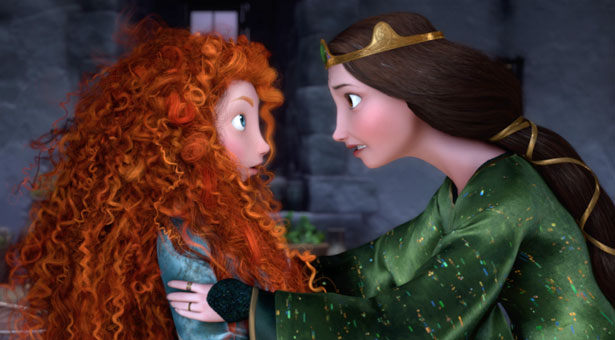
            Fast forward to this year. With the Cars 2 debacle in the proverbial rear view mirror, Pixar seemed poised to return to form with a new original story following its previous two sequel releases (the other being the universally praised—and justly so—Toy Story 3 in 2010). The film is Brave. While it fronts some of the standard elements of traditional Disney fare—character from royalty, fairy tale story elements, etc.—Brave also bears several unique distinctions in the Pixar canon. One of these is a rich period setting among the gray countryside of old Scotland. For all the studio has accomplished in digital vistas and beautifully rendered landscapes, nature had been mostly non-existent until now. One of Brave’s best assets is how well it captures the look and feel of a dense wilderness of rocks and trees.
More important than the quality of the animation, however, is the film’s focus on women. Brave tells the story of a rebellious princess named Merida (Kelly Macdonald) and her mother (Emma Thompson). The two are at odds over how Merida should carry herself as the kingdom’s next queen. While Merida would rather be riding on horseback through the forest, bull’s-eyeing targets with arrows along the way, her mother wishes that the red-haired rebel carried herself instead as a proper woman and fulfill her duties as future queen. Brave traces the trajectory of the tumultuous relationship between Merida and her mother, with other characters— such as the Billy Connolly-voiced king and Merida’s three devilish little brothers—serving as comic relief. But like many Pixar movies, Brave has a solemn core. Separating it from other Pixar works is the plot twist it serves up midway through. I won’t spoil it here; suffice to say that it significantly shifts the film’s tone and direction. The result is uneven, but Brave recovers enough to gain some momentum toward a modestly satisfying finale.
Taken on its own, Brave is enjoyable enough. But that’s where I have a problem. “Enjoyable enough” isn’t enough. More pointedly, Brave hews closer to the kind of modern animated movie to which Pixar has long been the alternative. It lacks an intangible sense of patience and timing that so many other works in the studio’s past have achieved so effortlessly. Both comedically and dramatically, the film is too eager to please. Nonetheless, directors Mark Andrews and Brenda Chapman ostensibly strive for a sublime effect but fall very short of that goal.
Before I go further, I should admit that judging Brave against other Pixar films is a slippery slope. After all, it would be unfair to expect every film from the studio to have the nuance of Ratatouille, the wonderment of Up, the forbearance of Wall-E, or the emotional roundedness of Monsters, Inc. And yet, to pay no heed to that heritage is unrealistic, particularly when a film bearing the studio’s name comes across so ordinary. Perhaps if I had seen Brave without any knowledge of its origins, I would have been more willing to recommend it. But that’s not really the point, nor is that scenario desirable. We bring so much with us when we watch movies, from our own implicit grasp of visual and narrative conventions, to our knowledge and expectations regarding certain acting and filmmaking talent. And lest we forget, we also bring our own individual life experiences and immediate feelings of the moment.
To critique a work based on the expectations promised by the names involved is not an entirely invalid way to come at a movie. Art demands that we take it in and respond to it, and for every viewer and critic, our judgments are formed based on what we bring to each movie and how we respond to the different elements in motion. So apart from what's in the movie, we're also dealing with elements outside it. (As Martin Scorsese imparts, "Cinema is a matter of what's in the frame, and what's out.") The critic’s job is to weigh these initial responses and contextual factors against a deeper knowledge of movies, storytelling, and various other things that inform our responses to movies.
But let me get back to Pixar, because I think what I’ve been wrestling with in my response to the Brave is the concept of legacy, or, specifically, how we respond to movies based on the legacies attached to them and those who make them. In the case of Brave, I knew little about the movie, so my frame of reference was based on the studio’s track record. Although different filmmakers have contributed to the Pixar catalogue, there are key similarities between the films that have since become associated with the studio's work in a more general sense. Pixar earned its untouchable reputation by making understated yet expressive films that also happened to be commercially slick and “family-safe.” As technology and entertainment increasingly demand our attention and time but not our minds and imaginations, Pixar has stood as a beacon of hope.
Which brings me back to Brave. If for no other reason, Brave merits a place in the Pixar canon for breaking important new ground with its focus on female characters. It is also an entertaining movie for the most part. But the fact that it fails to take hold in any deeper way (despite promising elements and a studio pedigree) underscores a potentially more troubling reality as Pixar is concerned. While Cars 2 showed the studio in pure cash-in mode, Brave is a different sort of effort; one in which the filmmakers are striving for a greatness that Pixar films so routinely achieve. And while Brave may be a better movie than Cars 2, it is arguably a greater disappointment. It suggests that Pixar may have reached a point where it is comfortable; where its imaginative forces have become enmeshed with financial interests of its parent company Disney. Art and commerce have always been strange bedfellows, but the work of Pixar has proven that the combination can yield visionary results. If Brave is any indication, the problem Pixar faces going forward is how it will come to terms with its own legacy of greatness while still always pressing forward into new creative domains.

Monday, November 26, 2012

The Walking Dead: Season 3: Episode 7: "When the Dead Come Knocking"


When it first started, The Walking Dead was about the immediate sensation of living in a post-apocalyptic world. In the shadow of a crumbled society, survivors adjusted to the violent realignment of their lives by banding together, struggling to stay human. Now, because of all they've seen and suffered, the characters who've made it this far are shells of their former selves. Survival is no longer simply a matter of avoiding being eaten by zombies; it also requires a frigid sense of detachment and perhaps even cruelty, both of which course through "When the Dead Come Knocking." No one anymore seems to know what it means to be human.
The opening shot of Merle (Michael Rooker) scraping a splintered table with his knife-arm immediately sets the tone for what follows. With Glen (Steven Yeun) shackled and refusing to give up the location of his group, it's not long before Merle begins torturing him. When Merle sets a walker loose in the room, Glen's ensuing struggle to get free and kill exudes a striking primal ferocity. Such a desperate struggle for survival hasn't been seen since Andrea (Laurie Holden) was being chased through the woods at the end of season two. It's a key moment for Glen, too, who until this point in the season hasn't had much of a presence.

Monday, November 19, 2012

The Walking Dead: Season 3: Episode 6: "Hounded"


When we last left Rick (Andrew Lincoln), he was digging through a zombie's intestines looking for what remained of his wife. It was a grim moment and another illustration of The Walking Dead's increasingly despairing outlook. At IndieWire earlier this week, Alison Willmore wondered whether the series is presenting an argument for the end of humanity. Given the trajectory it's taken thus far, that's not a far-reaching notion. That the writers continue to delve deeper into human despondency and ax more members of the cast in the process quite frankly makes it difficult to see any redeeming future for the characters, and perhaps the series itself. Nevertheless, every so often an episode gives us a fleeting moment of stillness and humanity that cuts through the surrounding gloom. Such a moment arrives late in "Hounded" just when you think Rick might be headed for a total breakdown. For much of the episode, he's away from the group and preoccupied with strange phone conversations with unknown callers. His desperate pleas for help initially suggest that he may be losing it, but this thread evolves into an unexpected moment of catharsis that the series needed as much as its protagonist.
Rick's storyline is one of several in which characters strike up or rekindle a connection. Daryl (Norman Reedus) also experiences a similarly heartening event after he discovers that Carol (Melissa McBride) is still alive, a scene that's intercut with Rick's return to the group. These developments are why "Hounded" may represent The Walking Dead's most significant attempt to revive a sense of hopefulness. But the cruel joke of the episode is that these tender brushstrokes are threaded into a more cynical view that comes into focus through other plot circumstances. Namely, this episode places events in motion that will lead to an eventual collision between the Woodbury community and the prison survivors.

Thursday, November 15, 2012

Think on your sins: Skyfall


Perhaps in honor of James Bond’s half-century stay in cinema, Skyfall is all about looking back. It juxtaposes contemporary threats of cyber-terrorism and institutional corruption with the brazenly retro idea of rogue heroism that 007 personifies. Consequently Skyfall feels as though it is suspended in limbo along with its hero. The reflexively pulpy sheen of James Bond films has long been a trait of the running series, but director Sam Mendes spins the self-awareness into an introverted form of nostalgia, in which everything from older weapons and technology, to Bond’s own childhood simmers to the surface.
Skyfall also heavily invokes and reflects the legacy of Bond, evidenced most by the character's frequent silhouetted appearances. Cinematographer Roger Deakins frames Bond as a specter amid colorful surfaces, resulting in several memorable images and set pieces. Two that particularly stand out are Bond’s duel with an assassin set against the neon billboards of Shanghai and his entrance at a Macau casino, where his motionless pose is enveloped in a warm glow. As for Daniel Craig, the actor now finally owns the legendary character. He suggests much beneath 007’s cool demeanor but expresses little. Still spouting all the confident one-liners you would expect, 007 is nonetheless very flawed and doubtful of his own ability to survive. As it turns out, Bond’s aging brand of espionage becomes the foundation for Skyfall’s broader lament of the past and also joins well with the primary conflict. The villain, Silva (Javier Bardem) is a former M16 agent who feels betrayed by M (Judi Dench). Perhaps more than any other Bond picture, M plays an integral role in the story, and Judi Dench is more than up to the task. 
Skyfall doesn’t produce the immediate sense of satisfaction that the most famous Bond films elicit. Once you get past all the gunplay and acrobatics, it is really a slow burner: deliberate and lyrical. Moreover, the action set pieces are drawn-out and largely eschew the operatic movement that the series is known for. None of this is to say that Skyfall re-envisions the character or the wider canvas of these films, however. Despite the tweaks and updates, Sam Mendes very much upholds the Bond template. Nonetheless, the fun of Skyfall is how it emphasizes different ingredients and fluidly mixes in dread and guilt into the formula. (Sam Mendes, 2012) ***

Monday, November 12, 2012

The Walking Dead: Season 3: Episode 5: "Say the Word"


After last week's episode of The Walking Dead ushered in a new level of intensity with the deaths of two major characters and the birth of Lori's (Sarah Wayne Callies) baby, "Say the Word" is comparatively stagnant. This makes it consistent with the narrative rhythm that the writers have committed to since the show's second season: After a dramatic turn of events, everything slows down, often for several episodes. "Say the Word" fits comfortably within that broader framework, but it makes better use of its quieter interludes than similar episodes and also offers a handful of isolated standout moments.
One of these is early on, when the Governor (David Morrissey) is listening to soothing classical music and brushing the hair of his zombie daughter in his secluded second-floor abode. She struggles, but the Governor wrestles the girl's contorting body into a position in which he can safely hug her and tell her how much he loves her. The scene is somewhat of an extension of last season's thread involving Hershel's (Scott Wilson) insistence that walkers are human. Though given what we already know about the Governor, like how he watches the jangling severed heads floating in water tanks for his own pleasure, his hair-brush routine conveys more than simply denial. Rather, the Governor's secret fixation on reliving the past signals a deep level of psychosis masked by his seemingly fair-minded leadership of the Woodbury community.

Thursday, November 8, 2012

The young person's guide to life: Moonrise Kingdom


Wes Anderson's vibrant aesthetic has earned him a reputation as one of the most original voices in American cinema. Yet, inventive the filmmaker's melding of visual fancy and narrative idiosyncrasy often is, Anderson’s films rarely allow you access to an underlying affect. Despite often conjuring fleeting moments of wistfulness, they tend to keep you at arm's length. Moonrise Kingdom at first suggests the same impenetrable aura of his other films, but the colorful surface and shoebox set design quietly reveal a poignant character mosaic underneath. The film is set in the mid-1960’s and tells the story of a boy and a girl that come together against nearly all other forces in their lives. The boy is a resourceful, but estranged member of a scout team, while the girl silently endures the misery of her parents’ loveless marriage. The two bond over Benjamin Britten, books, and other miscellanies, before setting out together into the wilderness. Anderson finds the right level of intimacy in expressing the benevolence of their relation while juggling numerous subplots involving adults characters (played by the likes of Bruce Willis, Frances McDormand, Bill Murray, Edward Norton, Tilda Swinton, and others), all of whom yearn for the kind of connection that the boy and girl share but seemed destined to lose. Moonrise Kingdom's balance of various story threads and disparate sensibilities comes with all the trademark wit and creativity we've come to expect from the filmmaker. But rather than using these tools to create barriers around the characters, Anderson instead spins them into a benign tale of human vulnerability and a celebration of the simple joy of narrative. (Wes Anderson, 2012) ***½ 

Monday, November 5, 2012

The Walking Dead: Season 3: Episode 4: "Killer Within"


The latest episode of The Walking Dead, "Killer Within," opens on a hazy morning at the prison where Rick (Andrew Lincoln) and his band of survivors have settled down. The serene atmosphere is offset when a lurking figure opens the gates and baits walkers into the facility. With its dreamlike, foggy setting and a conspicuously waist-down perspective of the saboteur, a peculiar sense of disconnect underlines the implications of what's being depicted. The scene ends with a single close-up of a heart placed on the cold cement. It's a foreboding image that gains magnitude as "Killer Within" gives way to a sudden strike of tragedy. Moreover, the pre-credit sequence lends insight into how the episode amounts to a particularly poignant, if also problematic, entry in the show's run.
I'll return to the significance of the opening scene in a moment. First, let's take a look at how the episode builds to its ultimate disaster through stark tonal contrasts. With apocalyptic shows like this, moments of levity are few and far between. "Killer Within," however, goes so far as to offer something resembling a sustained cheerful mood as it gets going. Now having fortified the prison, Rick guides the crew about the mundane tasks of building a home. Small character moments are peppered along the way and gel nicely together as mini-portraits. Hershel (Scott Wilson) shows progress walking on crutches; Glen (Steven Yeun) and Maggie (Lauren Cohan) get busy in the watchtower; even Rick and Lori (Sarah Wayne Callies) share a brief hopeful exchange from a distance. After a tense encounter with the surviving inmates and a conversation among themselves about whether to allow the prisoners to join their operation, the group is still in better spirits and apparently in control.

Monday, October 29, 2012

The Walking Dead: Season 3: Episode 3: "Walk with Me"


"Do you think they remember anything? The person they once were?" a man asks in the latest episode of The Walking Dead. This is the kind of question you'd expect from someone in a George A. Romero zombie film, specifically one of the more recent ones, wherein zombies exhibit traits of their pre-zombie selves. Here, though, the significance of the question doesn't concern zombies so much as how the human survivors of a zombie uprising project their own fears and insecurities onto the living dead. "Walk with Me" is a notable change of pace for The Walking Dead for several reasons, most clearly its shift in plot trajectory to initiate a new storyline with a new group of survivors. More importantly, however, it's about unearthing the past and recalling a distant life. This becomes clear at the outset, when Andrea (Laurie Holden) and her travel companion, Michonne (Danai Gurira), are discovered by a familiar face at the site of a helicopter crash.
After the first two episodes of the season focused so intensely on Rick's (Andrew Lincoln) fleeting humanity and the group's strategic actions to gain asylum, "Walk with Me" introduces a new survivor group that takes Andrea under its wing. Unwittingly abandoned during the group's escape from Hershel's farm, Andrea came under the protection of Michonne, and together—along with two armless, jawless walkers—they survived the winter. Following an encounter with Daryl's brother, Merrill (Michael Rooker) at the start of the episode, Andrea and Michonne are plucked from the dystopian wilderness and end up in a place that would seem to be its opposite.

Monday, October 22, 2012

The Walking Dead: Season 3: Episode 2: "Sick"


If last week's season premiere of The Walking Dead teased the promise of a rebound from the choppy second season, this week's episode pivots forward into more fruitful dramatic terrain. It articulates the growing anxieties of the weary-minded members of the group, honing in on their struggle to retain control in the midst of rising threats. This plays out in two central scenarios amid the claustrophobic surroundings of the prison, where conditions are graver and Hershel's (Scott Wilson) life is in jeopardy after being bit by a walker. While Maggie (Lauren Cohan), Lori (Sarah Wayne Callies), Carol (Melissa McBride), and Glen (Steven Yeun) attend to Hershel with the dimming hope that he'll survive the wound, Rick (Andrew Lincoln), Daryl (Norman Reedus), and T-Dog (IronE Singleton) jostle with four prison inmates who've been cocooned from the outside world and now lay claim to the facility.
The former thread consists mostly of the standard "hope and reminisce" dialoguing between characters that's earned The Walking Dead some negative criticism. However, Rick's encounter with the four inmates takes the series into dangerous new territory. The inmates' intentions aren't quite clear, though their ringleader openly engages Rick in an alpha-male battle of wills that intensifies through the episode. Despite the threat of outsiders to the group, Rick is forced to negotiate a compromise with the prison survivors because they have access to food and also possess a better knowledge of the facility.

Monday, October 15, 2012

New York Film Festival 2012: Flight


In Robert Zemeckis's Flight, Denzel Washington stars as Whip Whitaker, a pilot with an addiction problem who guides a jetliner to the ground after a sudden failure sends the plane into freefall. Nearly everyone aboard survives and Whitaker is branded a national hero. Soon after, the pilot's union discovers that he had alcohol and cocaine in his system, which sends Whitaker's life into a tailspin. Believing that the crash had nothing to do with his consumption, Whitaker frantically navigates the shambles of his personal life to avoid dealing with his own problems. He's assisted by a longtime union friend (Bruce Greenwood) and lawyer (Don Cheadle) for the airline, both of whom compromise ethical lines for their friend. He also meets a fellow addict, Nicole (Kelly Reilly), who's more realistic about the state of her life and tries to help Whitaker recognize his.
As a character study and a somber portrait of addiction, Flight works nicely within its commercial framework, thanks largely to one of Washington's best performances, as well as John Gatins's rhythmic dialogue. The extent of Whitaker's addiction is a gradual revelation the filmmakers don't overtly tease out, and Washington strikes a balance somewhere between the disparate sensibilities of manipulation and benevolence. As Whitaker becomes more complicit with the large-scale corruption seeking to preserve his status, he steeps further into rage-infused depression, which allows Washington to carve out his character's increasingly unbalanced behavior and self-loathing.

The Walking Dead: Season 3: Episode 1: "Seed"


[Editor's Note: Over at The House Next Door, I will be penning review for The Walking Dead's third season. After each recap has been posted over at Slant, I will also post a preview (with a link-through to the full piece) here on this site. Finally, on a somewhat related note, to read my full review of the second season of The Walking Dead, click here.]

The Walking Dead's season-three premiere suggests that the program's showrunner, Glen Mazzara, and writing team have listened to everyone's gripes about season two's frequent and labored pontificating. Bearing almost none of the heated bickering and discussions of morality that personified the previous season, "Seed" is about persistence and strategy. It picks up several months after Rick (Andrew Lincoln) and the group's escape from Hershel's (Scott Wilson) farm, which was overrun with walkers. Despite any unrest among them, the group exhibits a renewed sense of unity as it trudges on in an increasingly dangerous world. In the pre-credit sequence, Rick, his wife, Lori (Sarah Wayne Callies), Hershel, Daryl (Norman Reedus), and the rest of the gang raid a home in the middle of the woods and share a brief meal consisting of canned food. If for no other reason, the sequence is striking for its silence. Without a word of dialogue, the opening ostensibly sets the series forth in a new direction, thematically and otherwise.
The characters inevitably get back to talking, but mostly absent from their conversations is all the unsubtle moral agonizing. The writers seem more confident in the new material and the urgency with which they deliver it. Some of the characterizations and performances are marked by obviousness, such as the way Rick appears to be less human with each passing moment, and how Lori still seems intent on breaking the barriers around them. Overall, though, the characters more concerned about survival. Consequently, the series more closely resembles the sprawling dystopian vision it suggested in its first season than the soapy dramatic palette of the second. The moments shared between characters are punctuated by quiet exchanges, such as in an early scene around a campfire when Hershel's daughter, Beth (Emily Kinney), is encouraged to sing. The scene is drawn out to nice effect, articulating both the hollowness and camaraderie that now defines the group.