Monday, June 18, 2007

Desiring Closure

Jim Emerson has written a few posts about the controversy surrounding The Sopranos finale. (For details about the ending or the show itself, he is a much better resource than me). His response to the naysayers that have come down on the show's supposedly ambiguous ending ("What, that's it?") is perfect. Rather than providing a rationale or structured argument for why people should like it, he simply asks: whaddaya want? Those two words just about sum it up.

Many viewers invest in a show/movie to the extent that they willingly participate in the manipulation of the narrative: its plot details, character arcs, etc. This is especially true of television since an individual must invest a lot of time, on multiple occasions over an extended duration. Though a great majority of commercial media and visual narratives are built around the principles of plot and structural familiarity, many viewers don't seem to notice their manipulation until the end. An ending cannot simply be an ending. It must mean something. The elements of a narrative need to come together, and if they don't, that too is often treated with some kind of thematic unity and is subject to convention. If an ending "leaves you hanging," most viewer react negatively and feel abused and manipulated, as if the whole experience was worth nothing simply due to the absence of a satisfactory ending. But what makes an ending satisfying? Moreoever, what is it about endings that attracts/repels most viewers?

The very idea of closure is synomonous with narrative, folklore, and mythological tales. Perhaps our fascination with happy endings is partly due to our sequential understanding of time and our own lives in which we constantly move along some straight line, with death marking the end of that line. Many have argued that narrative, language, and communication -- in its principles of organization and providing structure to perceived stimuli -- are mechanisms which assist socialized members of a culture to process the finitude of death. Happy endings would then represent the repressed fear of death that is somehow intrinsic to human lived experience, physically and socially. One could take that argument further and attribute the cultural creation of religion, spirituality, and the idea of an afterlife to the fundamental logic of our understanding of and participation in language and narrative; specifically, one's conscious or unconscious acknowledgement that narrative essentially constitutes any sense of memory, self, and purpose, which is why no culture or individual can divorce it/him/herself from narrative.

These issues undoubtedly play a great role in understanding narrative as a uniquely human invention, an idea I could not even begin to claim to understand but am at the very least provoked by. But I get the feeling that there's something more with regards to the nature of the public response to finale of The Sopranos. I should note that have not seen a full episode of The Sopranos in its eight-year run. Over the years, I've caught bits and pieces of the show and was consistently impressed with its focus on character, and its prizing subtlty and ambiguity over plot. In the world of television, such qualities are typically nowhere to be found. That is why I think there is more going on with the conjecture of the show's finale and the public response to it. In wake of the show's apparently controversial final episode, I have been thinking about issues of spectatorship, specifically concerning the viewer's relationship with the content of a given medium such as television or cinema.

I use the term spectator here as both a greater idea of "cultural audience" and in a basic individual sense. That relationship continually drives me to question my own motivations as a spectator of an image and a witness to a narrative. With cinema, television and other visual arts, one must account for both spectatorship and the "narrative experience." While visual media often converge these roles, we must be careful not to lump them together. This idea is crucial to understanding visual narratives, but for many reasons -- such as the absence of a formal manner of appreciating the moving image in education systems and a general negative attitude toward electronic media as artistic -- audiences/spectators tend to think they watch something on television or a movie in the same way they might read something on a page, which is why audiences by an large claim to favor thickly plotted stories that follow familiar paths so as to allow for easy interpretation and entertainment.

I realize that the last couple of sentences may be construed as something of an attack on the literary-minded, but that is not my aim. The point I wish to articulate is that the socialization process of education and beyond tend to condition individuals to appreciate the written form of narrative, and due to the rising visual nature of most narrative media and the continued absence of a real understanding of their components, a great amount of people interpret narrative media as if they were of the literary variety. While I would argue that there are many similarities and that visual narrative media by and large emerged from the literary (though I don't think this is entirely true), it is an act or pure laziness to lump visual media in with everything else. The written form -- be it the novel or analytic essay -- is not any less important or more simplistic, but should instead be understood as different. While all forms of media and technology extend from the relationships among various other media forms collide, part of the reason for this is that we construct and interpret new media based on our understandings of previous media. Therefore, any new elements introduced to a given system must be assessed based on how they contribute to that already existing system. Does this mean that "everything is the same" and that narrative is narrative no matter what form it is manifested in? Not at all.

In fact, the best way to understand new forms of media and narrative is to explicitly focus on their elements and seek to understand how they function by serving to sustain familiar frameworks of narrative idenfitication yet also create new relationships. I understand that television and cinema are vastly different (as I will explore in more detail in a forthcoming post), but the example of The Sopranos finale exemplifies a great struggle in visual narrative, and that is the overemphasis on plot and familiar narrative frameworks over the viewer's saturation of living, breathing images that transcend the simple boundaries of plot structure. I am not claiming that the fundamental process of experiencing a narrative is simple -- I would argue the reverse -- but that we are in a sense trained to discard narratives that take full advantage of the intricate nature of images and present abstractions and ambiguities. For sure, some narratives make anti-convention an exercise in pure convention (e.g. Paul Haggis's Crash), but these types of narratives are usually at the mercy of the same perspective that breeds the mentality faovring plot and narrative structure over ambiguity. In these cases, the filmmaker/storyteller, while trying to be different, usually goes about doing so with an approach firmly embedded in the very conventions they claim to fight. A work of true abstraction is one in which the image lives, and compositional details serve to either uphold or question those frameworks that form the basis of our understanding. In doing so, that very mode of understanding may be expanded, stretched, and confounded.

The debate will surely continue over The Sopranos and other movies/shows with controversial or surprising endings. But so long that we are arguing about them, we only assert our total surrender to them. While we continue discussing the relevance of endings -- our frustrations and surprises with them -- we affirm the the real mystery of narratives by consciously diverting ourselves away from the unconscious pleasures of their details. The ending may be what's discussed and debated, but whether one consciously likes or dislikes it was never the point. Whadda we want, then? Now that's a question I can't begin to understand the answer to. But rather than thinking about the possibilities, perhaps the expectation of an answer to that (or any) question is what we really ought to be thinking about.

Tuesday, June 12, 2007

Precision On Queue: How Netflix Changes the Movie Experience

Over the last two months, my Netflix queue hasn't moved very much at all. That's not to say I didn't catch a few movies. For example, I've seen Steven Soderbergh's The Good German, Kelly Reichardt's Old Joy, John Cameron Mitchell's Shortbus, and Gabriel Range's Death of a President. When I wasn't catching up on missed 2006 releases, I took in a few 80's flicks I've waited a long time to see, such as John Carpenter's Escape From New York, David Cronenberg's Videodrome (which I want to write at length on in the near future), and Brian De Palma's Dressed to Kill.

The queue is moving slowly lately due to a number of things, such as summer housework, a summer class, and the day job. But this hasn't stopped me from wanting to see more movies and continually reading and learning about what's new in Hollywood and Indiewood, film reviews, and books on film history and theory (you should see my ever growing Amazon.com wish list...) As you can guess, I suffer from a bad case of inflated ambition though, which is why the list keeps getting longer, rather than shorter. (I think it's somewhere between 400 and 500 right now; and I think I'm going to watch all of these movies!) Today, I will be receiving Eric Steel's The Bridge, a movie I've wanted to see ever since I read Jim Emerson's great review of it last year. Also upcoming are a few movies I've let slip by in recent years, including Terrence Malick's The New World, Michael Winterbottom's 24 Hour Party People, Tommy Lee Jones's The Three Burials of Melquiades Estrada and Jonathan Glazer's Birth. I've read so much about these movies that I decided to move them all to the top of my list and stop procrastinating. Also, a few unseen classic await my viewing, particularly Jacques Tati's Playtime, Werner Herzog's Stroszek and Robert Altman's The Long Goodbye. I must admit that I'm trying to catch up on all three of these auteur's (Tati, Herzog, and Altman) work since I have inexcusably only seen a small number of each of their films (in the case of Tati, I've seen none).

It's a lament of mine that I'm sure will continue to grow: my time to watch movies is diminishing. I will never be at a point when I can't watch any movies at all, since I will make it a point to do so no matter what, but coming to terms with the fact that I must cut it down can sometimes be depressing. It got me thinking about how other cinephiles upkeep their movie watching trends. Of course, critics watch and write about movies for a living, which makes it a bit easier. But for those of us whose professions don't involve seeing/writing on movies, it can be quite a commitment to take this "hobby" seriously. I hate to use the term, hobby, because I think it's demeaning of the passion and commitment I have for cinema. It's a great part of who I am, as is true for many movie lovers I've read on various blogs and websites. Andy Horbal said once that even though it may not be a job, it's good to think of it as one. That being watching a variety of films and upkeeping a website about cinema which one would hope really may contribute something to the greater discussion and evolution of film criticism.

So often we discuss how blogging is changing film criticism, making it so accessible for almost anyone with a computer and internet access. Yes, it has its drawbacks and suffers from an image of zero credibility, but this experiment is continually growing and is really pushing into new avenues and modes of thinking and writing about cinema. If I'm a small part of that in any way, I'm more than lucky to be a part of it. So to me, this is a job, one that I take very seriously. But I must take care not to take it too seriously, as Dennis Cozzalio's second sub-head quote to his blog indicates.

Anyway, I want to highlight one key point about these topics before going off the deep end about on particular issue. Us bloggers are often reflexive about what it is we do and how this medium of writing and participating in a dialogue about movies is contributory to the overall approaches of criticism. But equally important as the medium in which we write about movies -- i.e. blogging -- is the medium through which we watch movies. This can take us down the root of home theater systems and how the experience of watching movies has changed or remained the same with ever advancing home theater and digital technology (For more thoughts about this, check out Jim Emerson's thoughtful post on the DVD experience and David Bordwell's article about how new media may alter a film experience by sustain other kinds of viewing/reading experiences.) I plan on commenting on these topics more extensively after I have read this book. But right now I think an equally intriguing topic is online rentals, a business that has gained massive popularity with Netflix and is now the standard for film renting. How Netflix has altered the film experience is of real interest to me, especially since the retail store industry is kicking and splashing to stay afloat because of it and how it stands in relation to the inevitable soon-to-be standard of digital downloads. Netflix really represents the transition from going to a store to rent a realy physical movie to shopping online with the click of a mouse and watching a digital composite of a movie, right then and there.

From an availability standpoint, Netflix and the forthcoming medium of digital downloads clearly have an advantage over video stores. Netflix has some 60,000 titles to choose from, far more than your typical video store. Also, the consumer can choose a plan that works best for her/him and pay accordingly. No late fees. No driving the film back. It would seem that online renting, then, presents a number of advantages over the video store, much like the home theater experience is more cost-efficient and ever-more-comparable to the theater experience, right? For me, this is tough to accept. Call me traditional, but I don't think any amount of advancing technology can recreate the theatrical experience, and there are a number of reasons for this (as Jim points out in the above-mentioned piece). In short, it comes down to the conditions under which you see the actual films that really create that experience. With DVDs you have total control. You can freeze the frame at any point, take a phone call, check your email, exchange words with a spouse/boyfriend/child as they walk through the door. You can also see movies in pieces. I hate to do this when watching a movie for the first time, but I'll admit I have done it for the sake of convenience, say when I'm getting tired and want to watch the rest of a movie in the morning or if I only have an hour but want to start a movie. Such a thought does not enter my mind when I drive to the theater, pay my money, and sit in the dark to watch the movie. In that scenario I am at the movie's mercy, whereas the home market flips that around. While this presents many advantages, the pure movie experience is one that the theater provides, one in which I literally and figuratively shut off the world around me and form a relationship to the screen's images for two hours. These may seem like small things, but they shape our conceptions of movie watching and movies as narrative and visual media.

Just like the home theater will never replace the movie theater, online renting will never replace the video store. Neither of these claims may be true (as some suggest that theater and video chains may be obselete someday), but they reflect my own perspective and desire to keep them. Let's think about the advantages of the video store. Yes, the selection is limited. Yes, it costs more. Yes, there are lines and (oh no, not that!) human interaction. But there is something about perusing the aisles and finding some obscure movie that looks interesting based on its cover. Online, I can see how others have rated it. I can see every detail about it and read reviews of it by one-clicking over to Imdb or Rottentomatoes). But at the video store, barring the intrusive presence of cell phones ("Honey, I did we see this one? It's got Matt Damon and he's..."), you're locked away, forced to make decisions based on little information and your own intuition. And while I love having information at my disposal on the web, there's something genuine about deciding to take that movie home, pop it in your player, and see where it takes you. Instead, I have a shopping list of movies which I have total control over. I have everything at my fingertips, but I can't help but feel a sense of nostalgia for the time in which I was driven more by curiousity when choosing movies. That experience is being lost both at the theater and at home. But I'm not coming out against online renting; not at all. I wouldn't be able to see half the movies I watch were it not for the selection and ease of use of Netflix. It's a great resource. But it doesn't represent the best form of renting movies by any stretch, even if it's so convenient.

Netflix is marriage of the real and the digital. You order and pay online but have real, physical DVDs sent to your house. It has given way to its own competition (though it may go all digital, once that takes effect) and represents the old with the new. But it's only a transition. Soon, we may not even have the pleasure of putting a movie in our player. This may be a long way's off, but it's immanent. This is all so important because the technological advances in the home theater market, advertising, and information-acquiring have truly restructured our thought-processes with regard to the context in which we see movies and thus our conceptions about the movies themselves have changed along with it. What's the big deal? Well, this is affecting how movies are made and thought of. While no one big thing may be occuring, many small things about the movie experience are changing and, slowly but surely, it's changing right before our eyes.

This is really only the beginning to the issues, concerns, and questions being raised concerning the "movie experience in the digital age." There still remains much more to be discussed, questioned, thought-about, and proposed, and I will hopefully have more to contribute to this greater discussion sometime in the future. But now that I've layed out my initial thoughts, this topic may be a bit lower on my queue. What's on yours?

Monday, June 11, 2007

Shifting Reflections

I am deeply suspicious of "movements" within critical discourse of any medium or mode of communication. I tend to align myself more with a McLuhan-esque model of thinking which holds that media are extensions of ourselves and of each other.* To simply state where, when, and how one era, movement, or period ends and another begins is too simplistic and problematic. Nevertheless, this manner of thinking restructures thought to the extent that media and institutions come to embody the properties and categories through which we understand them, despite not intrinsically existing as such. In other words, I would venture to guess that even though categorizing modes of thought, media, narrative, etc. is inherently reductive, it nonetheless enables our cultural institutions and media to embody the oversimplifications that we impose on them.

In terms of the cinema's technological evolution, there are undeniably certain "movements," e.g. the introduction of sound, color, animation (though animation preceded photographic properties of cinema), and countless other subtle advances which affected the construction of images. There were also institutional, economic, and social factors that guided particular movements in cinema such as the implementation of the Hays Code in the early days of cinema or the MPAA in the late 60's. Even beyond these factors specifically relating to cinema and its production are cultural and social components that have yielded certain stages in the development of the movies as an art form, critical artifiact, and technological medium. There are probably hundreds, thousands more factors that influence periods in cinema, and this broad idea should be something that all critics, viewers, and scholars should take note of. Interestingly, many of these factors convened in the late 1960's and early 1970's, resulting in many undeniable changes in the direction of American cinema. However, in favor of highlighting these changes and asserting a liberated filmmaking atmosphere (an attitudes that persists even today) in which American cinema "came into its own" and made great strides to catch up with European art cinema, it's very tempting to screen out certain elements of the time that may call the consistency and tidiness of such an argument into question.

No one can deny that American cinema changed immensely at that time, but the reception of that (or any) change often depends on the already established context and conditions under which such change takes place. In terms of stylistic and narrational aspects of filmmaking, of which there were many shifts in the 1970's, many of these aesthetic properties were influenced by the technical knowledge and expansion of cinematic media. For example, that filmmakers began employing widescreen cameras changed how shots could be framed, which then affected how filmmakers envisioned compostions. This example is overly simple, yes, but it effectively captures the notion that many of the artistic changes were undergirded by not only subtle technical changes in technology as well as the cultural familiarity and preparedness for that change. If a culture, audience, or individual is accepting of change, they/she/he are usually already accustomed to what to expect in this change and are therefore more willing to embrace it. This is usually the case in more subtle alterations in films and filmmaking capabilities as the increased use of widescreen camera lens late 60's and 1970's American cinema shows.

However, when it comes to changes that greatly affect the technical, stylistic, narrational, and even structural aspects of cinema, cultures/audiences/individuals are almost unanimously opposted to such change. This is likely because they have built a familiarity (consciously and unconsciously) with the specific elements that contributed to cinematic storytelling before sound and therefore came to view sound in cinema as bastardization of all that cinema was. But the overriding claim I'm making -- one that deserves much more critical thought -- is that how positively or negatively a movement or change is received seems to vary according to social and technical conditions, i.e. the nature of the change is measured and understood by manners in which the "new" elements interact with existing familiar styles and cinematic elements, which are influenced by social and technical conditions. Thus, epistemological and phenomenological questions about cinema are central to responsible criticism of and thought about it.

Today, we are experiencing something similar to the introduction of sound in cinema: digital cinema. While there was no one film that signaled the onset of a new mode of cinematic intrepretation -- a la The Jazz Singer -- many movies of the past 20 years (Young Sherlock Holmes, The Abyss, Jurassic Park, Terminator 2: Judgment Day, Toy Story, the "Star Wars" prequels, Miami Vice, Inland Empire) have given ushered (in some cases, demanded) new ways of constructing and interpreting cinematic images and movements. The digital movement is happening continually, and its effects are seen in movies of all shapes and sizes, not just films using the technology. It has been met with plenty of resistance, i.e. those claiming that the only true form of cinema is that which is captured on celluloid and projected onto a screen. This perspective is baffling in how stubborn its advocates are. It also doesn't hold up under close scrutiny, but instead only works in generalities. The very discussion of whether it's "good" or "bad" for cinema is more revealing of the ideological issues that sustain particularly limited approaches to media, art forms, and organizations. Nevertheless, ideology enables us to make sense of and advance these very modes of communicating, so to try to act independently of them is foolish as well.

My argument (in very broad terms) is that we are married to forms of language and categorization, which enable the formation and understand of eras, movements, etc. We are trapped within them but inevitably constituted by them. While I am skeptical about movements, I cannot deny their very real presence and take part in the construction of said changes as well. Nevertheless, it's very important to be reflective participants rather than passive viewers of cinema (or any medium) and ask questions of such "changes" that reduce so many technological, social, and cultural factors contributing to all media to one simple plane. Maybe we should question the glory of the American 1970's, actively ponder the validity of the overwhelmining critical denouncement of digital cinema, or the basic claims that certain modes of storytelling or film styles are inherently bad or not "artistic." That is not to say that any broad assumption is incorrect; just that we should push ourselves to think about all factors that may contribute to any advances or movements of any kind. Reducing them to generalities promotes highly reductive understanding of them.

Assuming we choose to engage in critical thought about cinema that refuses to abide by a single plane of understanding, one that takes easily tagged movements and simplified understandings of periods, genres, and visual techniques with a grain of salt, what then is cinema? This is harder to answer. Nevertheless, one must acknowledge the nearly infinite amount of elements that contribute to an experience many consider to be simple: watching a movie. For those who approach cinema on a critical level, this becomes all the more important (as the digital movement reminds) as the medium itself and the other media that influence it continue to change along with our relation to them. Approaching the production and interpretation of cinema from affective, cognitive, and social schools of thought may reveal much about position to and understand of it; its narrational, representative, and structural properties as they pertain to the relation to and understanding of visuality. Doing so may finally spark the critical thought that such an influential, complex, and important medium demands.


* Note: I do not worship at the altar of McLuhan in all matters of media since I find him overly simplistic regarding some things, but I think his contributions to communication and media studies are essential and innovative in the age of electronic media.

Thursday, June 7, 2007

Jaws: Another (deserving) look

"Slow ahead... I can go slow ahead. Come on down and chum some of this shit."

This past weekend, I enjoyed an all-too-short vacation on the beach. Actually, I spent very little time on the beach; I instead sat on a breezy (and shaded) deck, or in cool air-conditioning to catch up on some much-needed reading. Fortunately, in between the lounging and reading, I was able to upkeep a long-standing personal tradition of mine. Since the time I was very young, I have made a habit of watching one of my very favorite “beach” films whenever I’ve been to the beach.

Although most people would probably prefer digging their feet in the sand and engrossing themselves in dark crime novels or unabashed romances while baking in ultraviolet light, I never had a problem sticking to the air conditioning and taking in a “beach watch.” And nothing fits this bill better than Jaws. I say this not to demean the film, as if it was breezy trash designed to “take your mind off things” for a few hours. I instead use the term in the highest regard, because to me Jaws is a very nostalgic film. I saturate myself in its pastel compositions and its incredible ability to contrast the pictaresque townscapes of Amity Island with a more abstract, implacable leviathan of the sea, bringing them together at a shoreline that separates crowded bureacratic establishment and the uncompromising primal instinct of creatures of the sea. I am swept up in this conflict in new ways every time I see the film, but something about breathing in the ocean air on the beach and enjoying the laid back lifestyle of shore houses gives Jaws the extra edge that resonates with me so deeply.

Much has been written about Jaws, from its sexual imagery and symbolic gender relationships to its status as arguably the first true American blockbuster. (While on last year's beach vacation, I read Antonia Quirke's excellent book in the British Film Institute's Modern Classic book series.) The problem with writing on Jaws and countless other classic movies is that it's often hard to write with a fresh perspective since so many approaches have been exhausted, e.g. analyses of any of Alfred Hitchcock's films of the 1950's and 1960's. I devour many of these books and articles and learn a great deal from them, but in instances of films like Jaws or Psycho, much of the literature treads on familiar ground.

There are two opposing issues I have with this. First, sameness in perspective in the literature about a given topic typically breeds a very limited overall approach to the artifact (or movie) in question and makes it so that it would be almost impossible to approach it from another angle. But there is a flip side to this problem. Given the prominence of a certain broad approach to an artifact of study, the critical community may consciously attempt to operate on new ground and yield new perspectives and in doing so become numb to benefit of the dominant consensus. That is why it is much more difficult than it may seem to contribute to the overall critical persective of a film like Jaws. By simply acknowledging the overwhelming emphasis on certain key factors of the movie, I am positioning myself in relation to them and may tend to either assert them too superficially for the sake of comfortable familiarity or potentially pay lip service to crucial details that I don't allow myself to acknowledge due to my inability to really examine a perspective with which I have become so topically familiar. For these reasons, I have elected to focus on specific details about the film's images and how they relate to the overall structure and thematic depth of the film. I will attempt not ignore or privelage the well-tread critical ground concerning Jaws, but instead place them in perspective of some of the film's more subtle moments and compositions.

For many critics, scholars, and movie lovers, any reference to Jaws brings to mind some of the film's most memorable elements: the underwater "shark vision" perspective; the escalating two-note musical motif signaling the shark's closing in on it prey; a skinny dipping young woman violently dragged along the surface of the ocean, disrupting its calmness but not its apathy to her inevitable demise. All of these things are what we remember when recalling Steven Spielberg's 1975 movie. But in focusing on these aspects and examining them from a critical and/or thematic framework, the more subtly stated details of the movie may potentially go undetected, which I think is more likely to happen in a critical and cultural staple such as Jaws.

That is why I honed in on the images, the transitions, the temporal and spatial relationships from shot to shot, scene to scene, the elements of an individual shot, and the structural details of the scenes and how they build together to form a briskly paced and compulsively watchable film. Watching it again recently, the film has revealed to me a number of things. Firstly, minus the inevitable continuity errors of the sun's reflection on the ocean, which at times are glaring, Jaws is nearly compositionally perfect, representing the appropriate combination of deliberately placed elements -- i.e. color palettes, background and foreground stagings, visual thematic details, etc. -- and "accidental" effects, which are necessary for almost all great art to achieve greatness. It is both intensely calculated from a mise-en-scene and framed movement point of view, but it also feels somewhat gritty and natural.

The real beauty of the film is how all of its structural and visual motifs and components interact with each other to form two worlds in the consciousness of the viewer: an innocent vision of Amity island and a bleak nightmare that lurks beneath the surface of its waters in the form of a 25-foot, three-ton weighing shark whose physical presence is only felt in the visera of witnessing its hunt in the film's land based scenes. The spectator, in many ways, becomes the shark that it so desperately wants to see. Thus, Jaws seems to embody a tug of war between representation and embodiment. Are we supposed to identify with the shark or the victim? Do we feel the pain of being enveloped by its teeth, each "the size of a shot glass," or do we feel the pleasure of clamping down on helpless, squirming human flesh? The movie never remains consistent on this, which is partly why it is so effective.

While one could argue that Jaws cleanly adheres to a three-act classical film structure, it is really about the relationship of two distinct sections: a monster story of a relentless predator preying upon an innocent small-town community, and a high seas adventure of male comraderie with a "human vs. nature twist." Aside from the differences of setting, careful detail is provided to each section, in different ways but in similar manners as well. In the "land" section of the film's first hour (roughly), Spielberg builds a beautiful contrast between the recreational activity of a small community, (e.g. beach conversation in which everyone knows each other, a main street parade with kids playing their instruments poorly, and a cloudless sky) with the grisly acknowledgment of death and primal instinct that seemingly corrupts the very innocence that the film works so hard to create. But the shark hardly represents a force deliberately preying upon small town America, but rather an invasion of nature and instinct in a society of people who are "civilized." But the film illustrates that humanity, while distinctly separate from the primal nature of the ocean it so enjoys and builds towns around, is hardly civilized. Amongst the harmless conjecture of the townspeople, we see the slimy actions of Amity's mayor, Larry Vaughn (Murray Hamilton), a bureacratic twit always thinking in the interest of the economic stature of Amity and the monetary gain associated with holidays and the "clean" image of the town.

All of this is established in what I will call the "land" half of the film. In this portion, a relationship is built between three characters, the aforementioned mayor, Chief Martin Brody (Roy Scheider), a family man so eager to make a difference, but touchingly naive in his grappling with his own inability to deal with the simple concerns of townsfolk, and Matt Hooper (Richard Dreyfuss), an oceanologist rich-boy who understands more than his appearance leads on. The focus in this half of Jaws is on the central relations of these characters, specifically Brody and Hooper, and how they team up to work against the arrogance of the mayor. Concerning the shark and its attacks on three individuals (Chrissie, Alex Kitner, and the man in the boat whose leg we remember more than the rest of his body or performance), its presence is always felt despite its surprising lack of involvement. Though the shark isn't in the movie very much in the "land" section, the characters' and spectator's constant acknowledgement of it juxtaposes nicely with the pleasant, sunny atmosphere of the Amity beaches. Even when the shark is devouring its victims, the spectator hardly ever sees it. Instead, we see from its own eyes, which brings to mind the tension of identification mentioned above.

Apart from compositional details, which I will discuss further in my discussion of the "water" portion of the movie, the structural straightforwardness of the "land" section is refreshing and is practically a self-contained movie in its own right, with the mayor finally coming around by the end. After he allows Brody to close down the beaches and go after the shark, mayor Vaughn exits the narrative and the shark hunter, Mr. Quint (Robert Shaw, whose character's first name is never given, or necessary for that matter) takes center stage. The first elongated scene with Quint in his shark sanctuary littered with countless trophies (shark jaws hanging on walls) represents the narrative morphing into almost an entirely new movie: the "water" half, or the ocean hunt. Interestingly, Quint does appear in the "land" section of the movie. Many critics and movie lovers will fondly recall his introduction, slowly scratching his nails down the chalkboard during the town hall meeting, literally and metaphorically disturbing the community culture in which he lives but takes no part. Despite the obvious purpose of the introduction to his character -- in very memorable fashion so that the spectator is more than aware and prepared for his real entry in the film -- Quint's presence on the land-based section of the movie doesn't feel right. He is not a land-based character in the slightest, which is why he doesn't fit. His only home is the sea, which is why his presence in th stagnant town hall feels strange in relation to his more natural environment aboard the Orca, his creaky old boat on which Quint, Brody, and Hooper reside for the remainder of the film.

Although the "land" half of the film represents one long setup due to its practically being a self-contained movie in the sense of the spectator's familiarity and connection to the characters and "world" of the film rather than the narrative arcs, its status as such presents the "water" half of the film as its own narrative as well. The only difference in structure is be the resolution of the two. In the visual depth and thematic unity, the "water" portion of Jaws is entirely different.

This is signaled by the brilliant shot of the Orca leaving the land and heading toward the open sea, as seen through the window of Quint's house, with the vessel framed within the jaws of one of Quint's previous kills. While the camera slowly follows the boat through the jaws, which eventually frame the entire shot, John Williams' music signals the onset of a mythological journey in its muted brass theme complemented by rising strings. But rather than arriving to an end of dramatic spirit and foreshadowing the "man versus nature" duel that makes up film's last hour, Williams instead opts to imbue the images of the Orca's departure with a sense of fun, which, given the preceding setup might seem inappropriate. But the strange thing is, it works. It's as if the narrative is reminding us that it is precisely that: a narrative. The images invite the spectator to take part in the brooding sense of darkness lurking underneath the film's first half as the protagonists now have decided to duel this leviathan in its own territory, but it also reminds the viewer that this will be, plain and simple, a fun ride.

This contrast is present throughout the film, which is reflected in the crisis of identification in the perspective of the stalking/attacks in the first half of the movie. The spectator is constantly torn between enjoying this narrative for pulp adventure and pleasure, and being subjected to a disturbing feeling of being eaten alive as suggested in its exploration of primal fear. But this is all suggested in the many dualistic tensions of the land-based end of the film, e.g. the representation/embodiment of the shark and its relation to its victims and the corruption of bureacracy invading small-town innocence. The simple halfing of "land" and "water" sections is evidence of two opposites coming together. While the two acts are separate, the overriding point seems to be that they take effect due to their individual relation to opposites and their constantly working against each other. The second narrative of Jaws explores these dualities more from the perspective of the viscera of pure adventure and a constant battle between the hunter and the hunted. It becomes a constant battle of strategy among the three members of the Orca but also between the shark and the three men.

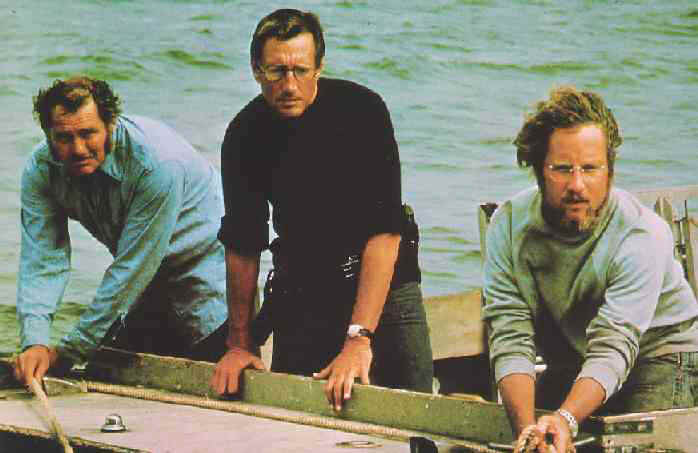
The shark's first real appearance in the film is one of pure shock. it is the moment in which the film completely changes gears and is no longer in a "transition" stage. With the unannounced sight of the shark to quickly and unexpectedly, this one shot signals that the rules are now different and that this is the beginning of a massive duel that will dominate the rest of the narrative. In this shot (as seen at the top of the page), Brody stares back over the camera (presumably at Hooper, who is directing the boat) and utters a line that, in my mind at least, has always been more memorable than the one that follows it. Of course, Brody's "You're gonna need a bigger boat" line is one of the classic movie lines in history, I find that his "Slow ahead..." comment is more memorable, mostly due to the context in which it is uttered. The shot consists of his face foregrounded and occupying much of the right half of the frame and his chum tossing and the ocean in the background. A cigarette dangles from his mouth as he speaks comfortably for the first (and only) time aboard the ship. Immediately after he makes the comment "Come on down and chum some of this shit," a gray mass bursts out of the water, encompassing the rest of the frame as it lunges towards the Orca. For me, this is one of the most memorable movie frames I can recall and its purely for the quick burst of energy that was waiting to be unleashed. Before the shark even arrives (note that he does so without his two note motif or three note theme for the first time), there is something uncomfortable about the shot, almost as if it's preparing us for the shock it will contain.

Note that this shot does not resemble that of a contemporary horror film, in which the camera slowly pans over from a character's face to create empty space for an inevitable scare by a killer/monster; those instances are predictable in every fashion. But here, we are given just enough of the ocean in the background to not expect it, yet the elements the composition somehow suggest the inevitable appearance of the shark, perhaps because the nature of the shot differs so much from more elongated takes of the movie. While the movie features plenty of close-ups of Chief Brody, this particular shot is unique because it involves him and the water. By the point, the film has thematically and visually established his fear of water and has kept a distance between Brody and the ocean, but here in this shot they are connected. Another note about the shot is that it scares the hell out of me each time I watch it. I know it's coming, but the details of the frame itself somehow make me uncomfortable in my anticipation of the shark's appearance. There may be a few reasons for this. First, the nature of suspense (as David Bordwell observes in this essential piece) is much more due to how the viewer processes the elements of composition, i.e. editing, staging, background/foreground, in a film rather than the pure shock of something unexpected happening. Following this idea, the shot's ability to create suspense for me nearly every time I see it may be due to how the shark briefly appears, in full view for the first time, in relation to the viewer's previous knowledge of him based on a lack of sight. Roger Ebert observes in his archived Great Movies review of Jaws:

"When the shark does appear for its closeups, it is quite satisfactorily terrifying... The shark has been so thoroughly established, through dialogue and quasi-documentary material, that its actual presence is enhanced in our imaginations by all we've seen and heard."

This effectively captures the experience of the entire movie. Its motions and moving parts interact so fluidly and so brilliantly, so as to operate on conscious and unconscious levels, that they form relationships with the spectator to the extent that the images remain in memory, despite constantly moving and changing. The spectator's memory of these moments then interact with the present shots, giving them a power and viscera that they might not ordinarily have if seen alone. that is the beauty of cinema, and part of the reason why this film is so brilliant. Whether calculated or accidental, every composition (and its elements) is beautifully presented, working together to create a sense of atmosphere and character. Notably, the film rarely provides single shots of characters that are saying one thing at one time or of one place for the purpose of establishing its presence or purpose in the narrative. Jaws works so effectively because it always has so much going on and it creates an environment and a strong sense of the major and minor characters in its more naturalistic approach to editing and compositional details. Yes, there are one-shots of characters (for the purposes of reaction) here and there, but they are always deliberately and sparing placed so as to compliment the more important shots, featuring many characters, conversations, and events. Furthermore, the score is very restrained and seems to enter at just the right time so as to not call attention to itself. The film is more interested in building the essence of its locations through long, wide shots, the level of activity in them, and the authenticity of real sounds. Iit seems that none of the sound was added in post-production but that the natural sounds of the locations and actual organic sounds are what we hear in the movie.

The complicated activity and busyness of the shots work are so authentic, real, and alive not just due to the framing, design, and details within them, but with the surprisingly subtle performances (given the nature of the genre) coupled with the perfectly written dialogue in the screenplay. The dialogue in Jaws is among the best written for a movie. Whether it is expository exchanges or arbitrary background conversation, every word of it is genuine and unique, true to the characters and the world they inhabit. In discussing the complex details of the film's compostions, one must not ignore the pitch-perfect screenplay, both in structure and dialogue.

Regarding my previous point about the complex compositional details of each frame of the movie and how they build together to form a sense of the Amity Island community, Quint's creaking Orca, or the calmness of the ocean surface, these perfect compositions (along with the said dialogue) play a great role in building revealing moments of character. Sometimes, no diaogue is necessary at all. And this is the wonder of the film: it's amazing structural balance between quiet moments and intense moments, dialogue driven conjecture and character revealing asides. It all gels so smoothly, creating fluid movements and actions that complement each other and form a visual narrative that is utterly unique in its lightfooted ability to balance so many various elements and make them work together.

A great example of one of these small, character revealing moments is a scene in the "land" half in which Brody sits at his dinner table, stressed by the increasing danger of the town's waters. What starts as a wide shot of the dimly lit room pulls back and becomes an intimate moment between Brody and his son; the two positioned in either side of the frame with the foregrounded table in between them and the lit kitchen in the background. This is the establishing shot to a beautiful moment that Spielberg captures simple with the shot decisions and honest performances. (Like all great movies, Jaws is about moments.) After Brody realizes that his son is mimicking him, the film cuts between two one-shots of their reactions to each other as they share a playful, loving exchage underscored by John Williams' delicate and unsentimental music. Somewhere in between the editing between these two shots, Spielberg cuts to Ellen Brody, watching on from the kitchen. The moment ends with a return to the establishing shot -- this time with Mrs. Brody between them in the background with her as Hooper knocks on the door (one shot of her being interrupted by the sound him knocking). It's a scene that almost any other movie might have cut or treated as arbitrary "character development" material, but Spielberg makes it a character revealing scene, one with unique, subtle details that not amount of backstory to a character can create in building a sense of that character.

Jaws is full of these kinds of moments, in both the "land" portion and the sea-based half. In the midst of all the fun chases and silent bits between the chases of the "water" section, the heart of that section (and of the film) is night scene in the cabin of the Orca, with Quint's haunting Indianapolis speech bookended by lighter moments of drunken lunacy. After the great "battle scars" comparison between Hooper and Qunit in one beautiful long shot (with the occasional cut to a reactionar one shot of Brody), Quint takes center stage in the movie's most compelling sequence, an eerie speech which showcases many of the film's high points: beautiful compositions, sublime performances, perfect writing, subtle character interaction, and thematic depth. All of that is in Quint's story, and it's the heart of not just the "water" section, but of the entire movie.

The sequence breaks down in a series of long shots of him, with Hooper in a blurred background, as he recounts his memory of the day the USS Indianapolis sunk. The first shot is more clear, with an overall focus on the entire composition (Quint on the left), and lasts about 40 seconds as he sets up the sinking and what the soldiers did to survive. After a very brief reactionary shot of Brody, the next shot of Quint is similar to the previous one but is more focused, with Hooper and other background details more blurry and Quint more clearly in the foreground. The composition rests entirely on Quint's eyes and their expression as he goes on to talk about the "lifeless, like a doll's" eyes of shark, and the "terrible high pitch screaming" of the victims he watched die, all the while maintaining his steady, hypnotic mumbled speech patterns. Lasting more than a minute (76 seconds), this shot maintains such intensity because of its total locking onto Quint. After another reactionary shot of Brody (and then Hooper), the next shot of Quint puts him more in the center of the frame, practically erasing everything else around him, including Hooper, as he explains why he will never put another life jacket on.

This speech is riveting in its shot design, writing, and performance and exemplifies the coming together of so many brilliant elements to form pure cinematic feeling, which encompasses not just one or two emotions or bodily states but many sensations of abstraction and ambiguity. The mystery and mastery of great cinema is right there to be experienced in that scene and it's something to behold. Yet, for as dark as it is, it is bookended by moments of drunken bonding, which are just as genuine and moving but in a more lighthearted manner. In these moments and the speech, the characters and atmosphere come to life here in a scene that functions as both a self-contained moment of cinematic greatness, but a reflection of the movie; all its themes, relationships, and nuances, taking place in its own unique space (within a rickety cabin aboard Quint's vessel) and time (as it is the only night scene in this portion of the movie).

The remainder of the film is a more focused duel between the the Orca and the shark. Not that the film has ever been operating under any principles of logic, the sea half practically shuts off the entire world the film worked so hard to built in the first half, operating according to its own rules. In this section, as the shark becomes more visible, its personality becomes more vivid rather than its mythological presence in the first half. It is intelligent and relentless in its engaging the Orca in a game of strategy in a battle for the sea. Of course, no shark would exhibit such intelligence and downright vigor, but as it progresses the movie leaves logic aside and hones in on the experience of the adventure and the inevitable conclusion of the duel.

Apart from the outstanding first chase sequence, which follows the Brody/shark shot I analyzed above, there are a number of chase scenes that delve into a real sense of pirate fun that contrast so harshly with the quiet subtlties of Quint's speech and the growing relationship among the trifecta of men. But somehow, these strange juxtapositions seem right. The adventure, the chase, the ripping through the ocean surface in pursuit of "the barrels"; none of it infantilizes the more quiet, dark material, but it instead compliments it. When the music isn't riffing on the two note stalking motif, it's bouncing around playful pirate melodies which are more driven by strings and and winds rather than pounding brass. It's the right sound for all those barrel chases and it complements the quick-moving visual sequences to a tee.

These all culminate in an action-based final 20 minutes, in which the average shot length quickens, the attacks by the shark become more relentless and frequent. In the final sequence in which all three men are together (when they are putting the cage together in an irresistible montage sequence), few words are said. But we know that the trifecta relationship is at a close, and that the narrative is nearly at its end as well. There is a sobering sense of seriousness to the rest of the proceedings as we realize for the first time that we truly care about the fates of these characters. This is the result of the sublime visual narrative that has built to the wacky action-packed finale and the moments before it. In these final moments of the film, Quint's fate within the shark's mouth is sealed as he we him stripped of his armor (his coat and his hat), disheveled, angered, and beaten. Long before he is taken by the shark, we know what's in store for him. Interestingly, this process of Quint's breakdown and humanity begins with his Indianopolis soliloquoy.

I should note that the movie intelligently ends before our heroes arrive back to shore. Something tells me it would have lost something had we been treated to an epilogue. The final shot—a long shot connecting the land and the ocean one a peaceful beachline—represents the perfect finale and culmination of the film's themes, interestingly suggesting the triumph of humanity and "land" over the instinct of the water. The shot is at a distance from the land and ocean it presents, each of which take up about half the shot, in essence bringing together to film's two sections. From there, we can imagine for ourselves where Hooper and Brody go, what they do when they get back, how Amity reacts to the news; but the movie necesarily ends with the destruction of the shark and the suggestion of a more happy union between the land of the humans and the sea of nature.

I could go on forever recalling the small details that account for the movie's mastery and status as an American movie classic, e.g. the fabulous night sequence involving the discovery of Ben Gardner's boat, the many chase sequences, the shark's lifeless body bellowing a roar as it plummits to the bottom of the sea, filling the frame with a red cloud to the perfect descending piano motif in the score. But all of these moments, some of which I've rigorously analyzed above, can only be experienced in the two-hour experience that is Jaws. During its duration, Jaws exemplifies why cinema is such an evocative artistic and narrative medium. Its structural perfection, subtle character-revealing moments, precise but naturalistic compositions, and commitment to visually and viscerally exploring a variety of themes all work together to a build a movie experience that is justified for being such a cultural staple. It is entertaining and thoughtful, subtle and overt, terrifying and fun. Capturing all of this with a nostalgia for the never-changing waves of the beaches' oceans, Jaws may be Steven Spielberg's ultimate cinematic experience.

Thursday, May 31, 2007

Pirates of the Caribbean: At World's End

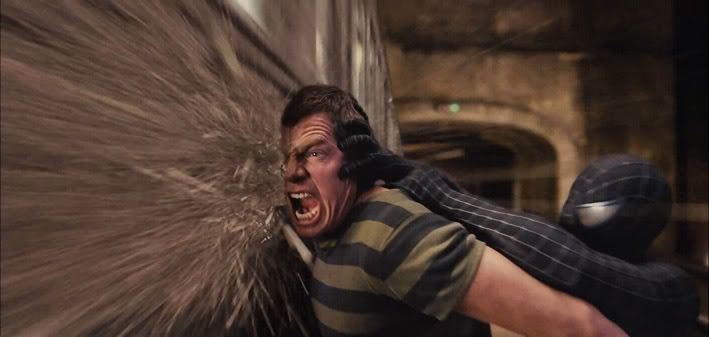
Just a few weeks ago, I complained that much of the critical body was off-base in deriding Spiderman 3 for its overstuffed plot and epic ambition. I argued that this content-based approach to reviewing movies is a fundamentally weak mode of criticism even by journalistic standards. I think it's fitting for plot-demanding audiences and opinion-driven commentaries that are so marketable today, but as criticism it flounders under its own bloated self-importance. Now comes threequel number three from the endless Hollywood summer arsenal, Pirates of the Caribbean: At World's End. (The second, Shrek the Third, isn't so much a movie but the cinematic equal of the fast food with which the film cross-promotes.)

Given the market-value of this film and its status as both "blockbuster" and "sequel," I suppose it would be easy to lambast its running time, convoluted plot, etc., which is precisely what many critics have done. They may as well have re-printed all of their reviews for Spiderman 3 and switched the names of the films, because the reviews are practically the same. The movies, however, are nothing alike. Yes, both are incredibly long (which is a critique only a consumer-friendly critic would bother mentioning), and both feature extensive plot trails that are borderline impossible to follow. However, while Spiderman 3 was content to lean on the viewer's recognition of the previous films' freshness and popularity, Pirates of the Caribbean: At World's End is only interested in moving ahead, digging deeper into its own mythology, and moving farther away from the easily defined limits of the Hollywood blockbuster. Sure, it speechifies, a la Braveheart and Lord of the Rings, it features cartoonish caricatures, e.g. the monkey, parrot, and two duos of quirky side characters, and it resorts to lots and lots of noise during its climactic duel; but it does all of this with a spirited sense of whimsy, off-setting the increasingly serious tone of the movies and the genuinely strange nature of its oceanic universe. These touches of movie convention, which take inspiration from Star Wars, Kurosawa, old-fashioned epics, and silent comedies of the silent era, lend the films a stable sense of familiarity as they plunge deeper (unexpectedly) into the stories of side characters, working against the more simply stated rules and atmospheres of the original film.

Before looking at the details of At World's End, it is first appropriate to lay the groundwork by looking at the underrated Dead Man's Chest, a film that assaulted the viewer with complex images that rather boldly proclaimed the filmmakers' lack of interest in recreating the naive innocence of The Curse of the Black Pearl, a film that was more of a direct homage to matinee serials, pirate adventures, and Errol Flynn swashblucklers. Dead Man's Chest instead builds elongated and somewhat disturbing sequences featuring an implaccable sea monster, The Kraken, feasting on helpless victims before enveloping the frail and creaking wood of various pirate vessels, including the Black Pearl, swallowing them whole underneath the sea. Dead Man's Chest is more about the dangers of the sea and the uncertainty of what lies beyond that horizon so romanticized in the first film.

Audiences detested Dead Man's Chest and critics ripped it, but its treasures were reaped by those unwilling to pen the movie as a hapless summer blockbuster who are more receptive to the nuances of all movies. Those who categorize movies in a simple manner disallow themselves from actually witnessing their images, seeing them, and processing them with a cynical bias they often impose upon the more expensive ones due to their "consumer" nature. To be fair, the film walked the line of comfortable familiarity a bit too much to really embrace the dark nature of its core; a case in point being how the dark scenes aboard the Flying Dutchman are countered by the more light-hearted nature of the land-based fight sequences late in the film which seemed to echo the first film's innocence. The film was nonetheless interesting cinema, if only for its strange deviations and basking in digital darkness.

On to At World's End...

In his excellent review of the film, Ryland Walker Knight explains:

"At a very basic level, like Irvin Kirshner's The Empire Strikes Back and James Cameron's Aliens, Gore Verbinski's two Pirates sequels disrupt everything (the worlds, the narratives, the structures) the first film (in each trilogy) rightly set up at the outset. The Caribbean world of Verbinski's trilogy is, after the first film, one of constant shuffling, of tangential narrative ruptures: the world of the film, like the world we audience members live in, is chaotic. Of course, this Caribbean world is not the world we live in. In our world, there are no giant mythological squids or sea goddesses, but there are, however, pirates — and daily acts of piracy. And there are social dictums, social pacts, that we appropriate and reconstitute on an individual basis, to live with ourselves, to live with the world. The main thrust of this trilogy is that reckoning: How will we live in the world when our autonomous freedom is continually challenged?"


Interestingly, where the pirates represented the villains in the first film's rose-colored vision of the world, the two sequels envision pirates as a dying breed of individuals willing to fight for freedom. Moreover, where much of the original film is spent on some kind of land with the sea essentially serving as the passage through which our land-based heroes must travel in order to reach destinations, At World's End is set primarily at sea. It is a game of cat-and-mouse, with constant betrayals and backstabbings before arriving at the waters of Shipwreck Cove, where the final stand is made. The three films seem to represent a progression from land to sea from first film to third, with the sea representing the horizon in The Curse of the Black Pearl, a more dangerous and lively world in the second film, with ships inhabiting the waters as well as its surfaces.

In At World's End, the sea is where most of the action occurs and the land is the distant place. The scenes of discomfort take place on land and aboard the stagnant quarters of the East India Trading Company vessels, each ship looking exactly the same, a direct reversal of the disorganized nature of the Black Pearl and Flying Dutchman. But the land-based drones of the East India Trading Company must take to the sea in the third film and can only rule with an iron fist with the heart of Davy Jones in their clutches. While Lord Beckett appears to be more self-assured in the film, attempting to embody the pirate image he so rigorously desires to destroy, he meets his end stradled by the Pearl and the Dutchman, which both unleash canon fire upon his ship. The perfectly constructed and stained wood shatters around him, blown to bits by the creaking lumber of the pirate vessels which now reclaim the seas.

Apart from the mythical archetypes throughout the film's storyline and freedom versus fascism plot, the film is focused on pure moments which seem to exist between the endless interludes of meetings and conversations. One example of this is the re-introduction of Davy Jones, a creature so hell-bent on destruction in the previous film, first seen wiping a tear away from his face with a tentacle in At World's End, fondly reminiscing on his memory of love as his ship wreaks havoc in the open waters. Jones takes no joy in the spectacle of destruction here and is more focused on regaining his own dignity as the would-be villain were it not for Beckett, who controls Jones and his ship. This allows us to see Jones more as the shadow of a pirate who at one time may have understood the joys of piracy, i.e. freedom but has since been taking that from others since his own was stripped of him. His tentacles slither and shake when he is emotional, the skin around his eyes, nose, and mouth tremble, and we see him for the defeated soul he is in these films. His only moment of regaining himself is his ruthless killing of Beckett's number one henchman before directing the Dutchman into the maelstrom to duel the Black Pearl. His tragic story demands that he die in the end, but he does so having embraced the pirate freedom that he had taken away from others for years. He collected their debts to the sea, but his own demanded that he plunge to the depths.

Other standout sequences come in the form of passing moments, in which not only the world of the film is established and built-upon, but that imbue the characters with feeling. It is true that they mostly remain type characters rather than full developed and dimensional individuals, but Verbinski's visuals and brief asides from the complications of the plot actually enable the characters to take some kind of form. Jack Sparrow interacting with his hallucinations of himself in Davy Jones' locker are among the film's finest moments, as well as the bitter rivalry between him and Barbossa, which remains playful throughout the film. In these seemingly arbitrary asides, the film takes life in the sumptious visuals. Another moment of visual beauty is an image of the Pearl cutting through the waters dark, speckled waters (looking very much like space) at the edge of Davy Jones' locker. Another such moment involves the pearl, quietly sailing through the icy wilderness before approaching the end of the world.

All quibbles over logic and plot details aside, At World's End is a movie about moments. It may be an empty embodiment of mythical archetypes on a superficial level of narrative details and plot developments, but it revels in its crazed nature and gets a wit of enjoyment out of portraying them. Through all the action and cartoonish moments of caricaturizing the side characters, the movie actually takes itself serious based on its focus on the strong performances on the part of the cast, of whom Bill Nighy's Davy Jones is the easy standout. Nighy is commanding in portraying Jones' fury and enslaved emotion, and the digital artists that brought him to life may well be the first to imbue a digital character with a performance of subtlty and sublimity, one not achieved (in an artificial "non-human" sense) since Frank Oz's puppetry of Yoda in The Empire Strikes Back.

It is certainly true that these "Pirates" sequels, both Dead Man's Chest and At World's End, are not cinematic masterpieces as defined by classical or contemporary standards, but that's nothing to aspire to. To achieve such a status, a film must meet a checklist of requisites. However, like all of art, cinema is not defined by its meeting of a certain standard of excellence. In the case movies, Narrative (as a broad idea) sets the rules for the familiarity, convention, and identification, and good movies work within them and beyond them to provide images of depth and feeling.

Unfortunately, emotional reactions to sights and sounds on a screen have been devalued in contemporary mainstream critical discourse and pop entertainment just the same, which is why the ambitions of these films are not rewarded, but instead blasted for their bloated nature of "being too long." This fuels a mentality that suppresses one's ability to experience moments and feelings as brought on by images and sounds. But that mentality is one all too common amongst critics and moviegoers, and the fact that these movies are routinely slammed is evidence of an overall inability to experience a moving narrative image.

Dead Man's Chest and At World's End are richer films than many critics are claiming. They celebrate the familiarity of movie conventions and mythical storytelling. While they do not master either end of that spectrum, they explore both sides through the complexity of their compositions and willingness to take enjoyment in their own strangeness and invention, risking a convoluted plot in the name of pure cinematic moments.

Tuesday, May 29, 2007

Oh The Memories

Girish Shambu has recently written about the difficulty of and desire for remembering films, their images and their sounds. His post wonderfully evokes the pain and beauty of cinema. An excerpt:

Over the years, I’ve steadily become aware of a film as being not something abstract or intangible but instead a collection of concrete, material details: shots and cuts; bodies, gestures and speech of the performers; movement; sound and music; color and light; décor; setting; compositions; duration; etc., not to mention absences such as offscreen space and events, and ellipses. A film contains hundreds (thousands) of such details, and in the aftermath of watching a good film, I have a great desire to savor, hang on to, remember those scores of details that struck me, affected me.

We are enraptured by its moving parts and how everything about a good film works together, but these moments are transient. To try to recall or "store" such moments of cinematic feeling in our minds is next to impossible. To me, this is cinema in a nutshell; forever cemented in our minds, yet always fleeting. Every element of a single moving image exists precisely to enable its existence, but is already out of existence by the time we process it in relation to the fluidity of the composition it creates. So, how we construct a memory of cinematic images and the elements contributing to them is central to both appreciating cinema and participating in its being.

Though I think Girish is spot-on regarding this ever-increasing desire of recalling cinematic moments and that how a film tells a story is the story itself, I think the elements (shots, cuts, gestures, bodies, etc.) making up these images, while concrete and material, actually become abstract and intangible. They do so in their embodiment of both oral and written language, somehow always fading away but becoming permanent this process. A maddening duality of opposites, for sure, but this is cinema, as well as the individual and cultural experience with memory.

Focusing on the conrete and material details of the image is the one and only starting point of a knowing criticism of cinema. Visuality has no doubt assimilated elements of orality, literacy, and textuality into its being, but it becomes abstract and intangible in how its various elements interact in such a way that they individually exist differently in relation to one another due to their constant pushing up against each other, challenging each other, juxtaposing with each other, and so on. While formalistic details are the entry point into a responsible criticism, they cannot by themselves account for a lasting memory of cinema. If one can react to and understand what feelings and memories these material details create, only then can she or he comprehend how they do so.

Girish's lament of the imperfection and inevitable failure of cinematic memory is a direct reflection of the abstraction and intangible nature of cinema as created through the complex relations among its concrete elements. These relations create that abstract connection to memory. Therefore, how we perceive and interpret these relationships (and likewise our ability to understand and analyze them) is essential to both experiencing and remembering the transient permanence of moving images.

Friday, May 25, 2007

Cinema 2006: Old Joy


One of the defining "problems" of cinema is representation. Rarely can an image merely exist. Documentary or fiction, all movies in some form or another adhere to a narrative structure, therefore any image of that movie is constructed and positioned in relation to that narrative framework. The nature of that structure may differ, but since cinema is itself a culmination and extension of various art forms, narrative media and technologies, it has been positioned in a narrative spectrum from which it cannot escape.

While Deleuze may have been overly simplistic in labeling Italian Neo-realism as the liberating movement in cinema, his summation generally holds up insofar that many films of the neo-realism variety were explicitly reflexive of classical styles and refused to adhere to a connect-the-dots mode of film language that the early days of cinema necessarily offered. While much of American cinema moved along that same plane of film language (keep in mind that I'm writing in generalities so as to avoid a dissertation here), neo-realism films created gaps in films language, turned the system of signification that the moving image had become upside down and explored narrative possibilities from a standpoint of subtlty and abstraction. It was still reliant upon those very classical traditions in order to deviate from them, but they opened up what Deleuze calls the time-image, an image free from representation despite being made possible through its properties. The time-image may or may not more stringently adhere to classical narrative structures, styles, and traditions, but the key is that it expands upon them and confounds the comfortable familiarity of their cliches. The time-image does not allow the spectator to see less than the image, but rather enables her to see the whole image, in so doing moving beyond mere representation. This notion best surmises Deleuze's claim that cinema is another world altogether, not a symbolic representation of one.

Kelly Reichardt's Old Joy seems to me an extension of the essence of neo-realism. From a narrative standpoint, it is straightforward, chronicling the overnight camping trip of two old friends. Structurally, Old Joy exhibits simplicity, starting with Mark (Daniel London) receiving a call from his friend, Kurt (William Oldham), inviting him to meet up and hike through the woods of Oregon. Although this short description encompasses the extent of the introduction from the standpoint of plot, the film announces itself as one of real images (despite their apparent lack of stylization) and subtly stated emotions from its opening shot (a bird sitting on the roof of Mark's house). The actors' faces envelope the frames; Mark and his pregnant wife share few words in the film's opening scenes, but in the camera's intimate observation of both of them, the spectator can explore the same ambiguity transpiring between the characters. Nothing is really stated. We don't uncover any plot points other than is made visible in the compositions. Instead, we have an emotionally complex visual design through what appears to be simplicity.

I am spending so much time on this opening sequence because it establishes an atmosphere that permeates the film, setting up the viewer's knowledge of Mark and his wife before incorporating Kurt into the narrative. From a representational standpoint, we can gather what we know about Mark and Kurt based on the images and the dialogue, but this film is not about easily compartmentalized feelings and actions. It's about the feelings underneath the memory.

When the two meet up and begin their trip, the film enables the viewer to immerse herself in the lives of these individuals through the sublimity of the "ordinary" images. The images in fact are far from ordinary and capture every small detail of Kurt and Mark's relationship - from joking at the gas station, uncomfortable pauses when they scramble for things to talk about, shooting cans with beebee guns, and conversing about their lives over the past 20 years in short sentences, carefully phrasing their thoughts do to their own uncertainties about themselves and each other. All the while, the emotions conjured by the images is both hard to pinpoint, yet overwhelming in their nostalgia. The spectator knows nothing about these people outside these few days it follows them. We only know the extent of their relationship based on their own insider accounts of old memories. But this coupled with the observant nature of the film's images - whether it's panning the tree tops or lingering on facial expressions - result in a joyously bittersweet experience of reminiscing and enjoying the transient beauty of an old friendship. The backdrop of the densely wooded forrest only further emphasizes the isolation of such feeling and memory, and the film's contrast of these men and the woods they walk in builds the perfect atmosphere in which to set this nostalgic journey.

In its gentle simplicity and seemingly straightforward observations of these characters on two days of their lives, Old Joy builds a relationship between spectator and image brimming with ambiguity and nuanced emotion, mirroring the relationship between Mark and Kurt. Tensions are abound, and as much as we would like to easily categorize the aspects of the relationship and the feelings emerging from it, such simplicity is not ever possible within the seemingly simple relationship. The main struggle within the spectator/image relationship is (in general terms) the confusion over obervation and identification. Both infer a greater idea of representation, as if the viewer's observation of these characters triggers one's own experiences, thus we have identification through observation. Are we the characters or are we watching and identifying them? Further, what does it mean to "identify" with a character at all? Questions such as these are immensely difficult to answer, even if one has unlimited time and space to do so. They concern the greater relations between individual and cultures and narrative/cinema. With regards to narrative, cinema does separate itself in its visual nature. The purpose of narrative is to form a representation, but the very idea of seeing and hearing an action existing in its own place and time seems to conflict with this notion.

Old Joy exemplifies this relationship between spectator and image. And this comes through in dynamic of the characters and the deeply intimate portrait presented by Reichardt that both lets us into their minds, yet keeps us at a firm distance, as if to remind that every moment and every aspect of lived experience is subject to perception and interpretation. That tension defines Kurt and Mark's relationship as it does the cinema/spectator duality. While it ultimately introduces so many questions in its presentation of this narrative and these characters, what underlies the images and narrative structure is an examination and reflection on the very idea of experience and nostalgia. The images then serve to reflect the ambiguities and abstraction shared between two people whose experiences cannot be surmised by the language between them, but intead by the memory and feeling of such experiences.

Old Joy's sublime images and simple presentation of narrative exhibit a beauty about cinema (as a medium) that no amount of critical rumination can capture. Mark and Kurt's relationship - all its struggles, misunderstandings, and beauties - is not suggested through (or represented by) the images, but rather exists in the images themselves and our perceptions and interpretations of them. That is cinema, and that is the human sociocultural experience.

Tuesday, May 22, 2007

A letter to Richard Schickel

Dear Mr. Schickel:

I know that you probably cannot hear me down here in the lowly blogosphere as you sit atop your pedestal at Time Magazine, and that you would not stoop to such a low as to read something on one of these unworthy blogs. But if you so allow me, I would like to bring a couple of points to your attention.

Your article in the Sunday edition of the Los Angeles Times correctly addresses some very important and serious issues currently plaguing film criticism, specifically regarding the favoring of opinion-voicing over "disciplined taste, historical and theoretical knowledge and a fairly deep sense of the author's (or filmmaker's or painter's) entire body of work." Interestingly, I should point out that I too have recently written about these very issues here on my own blog, not that you would know. I argued that certain areas of the film writing community perpetuate the consumer mentality to which they pander, and that real criticism is often much more difficult to find (in the journalistic circuit) amongst the many empty expressions of opinion that permeate a majority of mainstream film reviews. However, while you point to blogs as the corruptors of film criticism, your arrogant tone and uninformed claims regarding the film blogging community are evidence that the very problems you speak of invade the highest levels of journalistic criticism, especially your own.

Your stature as a published and respected critic, Mr. Schickel, does not entitle you to make broad claims about us "busy bloggers" that lack any validity or reasoning. However, since you have done precisely that, you have shown yourself to be among the very imposters of film criticism you label bloggers to be. It's a shame that you don't have one of these "less permanent" blogs, in which case go back and erase or edit out the hypocrisy of your argument. Because you are unable to do this, I can only advise that it would be in your best interest as a true critic to heed your own advice before voicing an opinion on something about which you seem to know very little.

Sure, any critic can express an opinion about blogs, but, to use your own words, true criticism is more than just an opinion.


Sincerely,

Ted Pigeon
Blogger


[For some of my thoughts on blogging and criticism, check out two entries I posted a few months back: Why Blogging Is Essential and A Blogger's Reflections. Both contain typos, for sure, as they were written at a time in which I was editing my posts less. But that sums up the flaws and the (potential) beauty of blogging.]

Saturday, May 19, 2007

Pop Reflexivity and Opinion-Based Reviewing

While I agree with the many critical assertions that the third "Shrek" film is a blatant cash-in to capitalize on the massive success of the previous two films, the journalistic critical community's overwhelming reliance on this is evidence of the many problems with film criticism. In short, this criticism (if it can be called that) is a cop-out. I'm not saying that one cannot take a political/media economy approach to film criticism. But relying on it to explain a film's flaws while neglecting to offer sound reasoning is precisely the reverse of what criticism is - or should be - about.

This is just one example of what is essentially an expression of opinion. Qualifications for film criticism in journalistic circuit require an individual who knows a little something about the movie industry, can conjure a few clever puns, and structure a short essay. This is how many readers perceive film criticism, and it's hard to blame them given the prominence of such "criticism." Anyone can express her or his opinion about a film - that's not difficult. But to articulate an argument and defend it elevates opinion into criticism. (Furthermore, this approach to criticism and its content fundamentally misunderstands the importance of the medium itself.)

Unfortunately, our news media culture tends to prize expression of opinion over intelligent criticism: keep it short, keep it sweet, and don't bother providing a reasoning for your argument - just throw your conclusions out there. This is the cultural attitude towards most issues involving politics, art, etc., and unfortunately many film critics perpetuate it. Rather than asking questions of a movie, observing details, engaging in thoughtful commentary, and piecing together an argument based on knowledge of the medium, they lay down the "answers," or opinions often based on nothing. A film is too much of one thing, not enough of another. [For those who haven't read this absolutely essential piece on criticism by David Bordwell, he outlines the problem with criticism far more efficiently than me. If you have read it before, read it again.]

Not all critics are guilty of this. In fact, there are many wonderful critics in the journalistic circuit. For example, on the topic of Shrek the Third, A.O. Scott's review, while brief (as most journalistic criticism demands), raises many thinking points about the nature of the film's underpinnings and, interestingly, a subtle commentary on these very issues of opinion and criticism as manifest in American popular cinema. An excerpt:

"Expressing a sometimes explicit animus against the Disney versions of well-known European folk tales, the franchise set out from the start to scramble the traditional polarities of good and evil, setting itself up as a more sophisticated, knowing brand of pop-culture magic. But those old stories — and those classic Disney movies — were almost more complicated than the parodies allowed. Their eerie subtexts and haunting ambiguities have always been more crucial to their power and appeal than the overt lessons they teach. “Shrek,” “Shrek 2” and “Shrek the Third,” by contrast, are flat and simple, hectic and amusing without being especially thrilling or complex. Their naughty insouciance makes their inevitable lapses into sentimental moralism all the more glaring."

Focusing on the supposedly witty references to previous narrative styles and elements, Scott exposes a facade permeating much of pop entertainment and pop criticism. This parodic approach to comedy and satire is typical of many digitally animated films and a surprising amount of television shows. Although these clever references appear to be satirical and sharp in their commentary, they exemplify the cultural trend of favoring quick-witted opinion over real critiques. And how fitting that one who understands criticism and its purpose - A.O. Scott - point this out. The "Shrek" films are most guilty of this; they appear to jab at fairy tales and Disney, yet they themselves very much follow the same pattern of moralism and syrupy endings. As Scott says, the referenced narratives are typically far more interesting than the film referencing them. But because contemporary films seem to be only what consumers are interested in, no real knowledge of these past stories exists outside these references.

Movies are not "texts" in the same way that a languaged argument is, and therefore cannot build arguments as an essay might. But they are capable of offering commentaries of a different variety - through narrative structure and visual style, juxtaposing different familiar elements and achieving new images through reflexivity, in a broad sense. This, I feel, is essential in storytelling, cinema, and communication; not empty referencing, but more subtle variations on styles and structural patterns. True reflexivity builds upon an idea and is more aware of the details of what it is reflexive upon, unlike the flat commentaries offered by the "Shrek" films and countless other pop-reflexive narratives. In these films and other pop narratives, real commentary or criticism is lost somewhere amidst the self-aware, endless referencing. These narratives may appear consciously rejecting the often shallowly interpreted and understood traditions of more traditional narrative, yet are unconsciously reliant on them to exist all. Pop-reflexive cinema is nothing more than an uninformed expression of opinion. (And opinion without reasoning or knowledge is not much of anything at all, as anyone who has ever seen or read Ann Coulter knows.) Unfortunately, this defines much of critical discourse in our media culture. With its championing of empty opinions and content over form, it is a criticism deserving of the pop-discourse it perpetuates.

Tuesday, May 15, 2007

Following the Ideal Sequel: Where Spiderman Went Wrong

Spiderman 3 (Sam Raimi, 2007)

All criticisms aside (and I have many), Spiderman had a colorful sense of exuberance in its images and characters. Sam Raimi's film was deliberately hokey, revelled in its own naivete, and felt oddly fresh in its familiarity. What it lacked in excitement, it made up for in playful charm. When Spiderman saves Mary Jane and swings with her between the skyscrapers of New York, the images breathe with life as Danny Elfman's choral music swells. That Spiderman looked cartoonish slinging himself through the streets of Manhattan didn't take away from the beauty of the moment. Though far from a truly memorable superhero film, it's no wonder that the film drew such strong box office, especially in the first summer after September 11th.

With Spiderman 2, the visual freshness was maintained and built-upon, with a far more real (though still noticeably animated) Spiderman swinging through town. While the story remains pop drama, there was something endearing to Peter Parker's undying desire to confess his love to Mary Jane, while saddled with the responsibility of keeping the people safe. Its villain, Doc Ock (brilliantly played by Alfred Molina), was much more memorable than Willem Dafoe's Green Goblin, and the film manage its action effectively - both in relation to the film's overall structure as well as from shot to shot of each individual sequence. Raimi seemed more comfortable directing large scale action, and the visual effects were employed to unify with the live action elements, rather than create distance between them (as in the original film).

With a touching story for the hero and villain and visual flair to the action scenes, Spiderman 2 capitalized on its seemingly effortless screenplay. Its personal drama was brilliantly complimented by a unique intensity to the villain and action sequences that the first film lacked. Despite its larger scale, Spiderman 2 felt personal, written and made by filmmakers who cared about the genre and characters, and it showed in its compositions and structure.

The rythyms, compositions, and structure of Spiderman 3, however, feel forced and inconsistent, not only in relation to the previous two films but within the film itself. This is of course the built-in problem that many sequels face. Especially on the heels of such a well-structured and thoroughly original sequel (let alone movie), the next film is typically self-consciously trying to replicate magic, e.g. Alien 3, The Godfather Part III, X-Men 3. But in the case of Spiderman, its not for lack of creativity. Raimi and company certainly try to accomplish new things with the story and character, but they often render themselves moot because the film wanders aimlessly exploring the film's possibilities as if they feel pressured to do so. The resulting film is an awkward mix between corporate studio wishes (appealing to every demographic and having "a little bit of everything") and true creative instinct. The film goes for big moments too consciously and it fails in delivering the emotion it seeks to conjure, whether that's exhiliration, envy, or rage.

Many have criticized Spiderman 3 for offering too many villains, too many plotlines, too many "big" moments. But my criticisms reside not in the film's ambitious disjointedness, which can actually be a good thing, but in how generically an instrusively the film's elements interact with one another. Individual sequences lack the drive they strived for, and what seemed fresh in, say, Spiderman (hokey plotlines, etc.) seemed incongruous with this film's ambition of embodying a more serious, darker drama. None of these elements worked well together because the film felt, by and large, manufactured. The film introduces its plotlines and felt obliged to develop them to logical conclusion. Not only does it feel calculated, but Spiderman 3 lacks vigor and feeling. as if it was comfortable enough to rest upon the spectator's familiarity with the wonder of the previous films and therefore feels no incentive to conjure some on its own.

Had the film been more focused in terms of its plot structuring and was less stuffed, I get the feeling it still would have suffered the same problems. That's why I find it difficult to accept criticisms that the film lacks cohesive structure. While perfectly structured piece of classical filmmaking can achieve great things, so too can a disjointedly structured one. Within the images themselves, the elements don't move with life as they did in the previous film. Interestingly, one of the major subplots involved Peter Parker dealing with an inflated ego and learning to find his true innocent self once more. But the film seems to suffer from the same problem, confident in its own creation despite not really offering a cinematic experience it so well acknowledges the previous entries were.

Nevertheless, the film exhibits a tension underneath its manufactured nature, and that is the creativity trying to break through. When I claim that the film feels more like a studio's film than a director's film, I don't mean that Sony all of the sudden stole the reigns from Sam Raimi, but rather that Raimi himself has suffered from studio laziness perhaps due to the massive success of the previous films. The film never feels as though it's not a Sam Raimi film, but that Raimi's images have been filtered through a watered down, lazy-inducing system prizing plot quantity and "big" moments over locating subtlety in dramatic scenes as well as the action-oriented ones. Like Peter Parker with his hair down in his face, sporting all black and swinging his pelvis at women on the sidewalks, Raimi seems too eager to impress out of recognition of his own acknoweldged talent. But, as mentioned, his filmmaker prowess isn't totally eradicated. There are moments of genuine inspiration - notably when Flint Marko (Thomas Hayden Church) becomes the Sandman and tried to form his own body out of a pile of speckled sand, as well as the scene in which Mary Jane breaks up with Peter in Central Park. Raimi's camera locks onto Tobey Maguire's emotive eyes so magnetically and finds true heartbreak in the moment.

To its credit, also, the final action sequence seems in the spirit of the comic books that inspired it, with Sandman and an underused Venom teaming up to battle Spiderman in, on, and around a construction site. The scene has the courage to be true to its somewhat pretentious roots, but Raimi has no problem with it and it is both goofy and enjoyable. The following scenes of closure to the character's individual subplots are as painfully artificial as Raimi has ever been, unfortunately. Spiderman 3 closes on a serious point that effectively sums up its assuming and egotistical nature about itself.

Unlike Spiderman, this film never quells its bloated assurance of its own worth, which is why it feels so comfortable experimenting to employ so many familiar and simple plot devices rather than really exploring this world and its characters. The filmmakers seem comfortable to rest upon their own accomplishments with the last two films. As Spiderman swings about the city's towering structures looking more real than ever in Spiderman 3, the naive sense of wonder created by his previous travels amongst the skies is all but drained away and Spiderman becomes all the more unreal.

Monday, May 14, 2007

"We Can't Be Too Careful When It Comes to our Children..."

In light of the recent smoking regulations imposed upon movies by the MPAA, I must point out a particularly memorable blog entry on the matter. Since the MPAA has added smoking to its ever-expanding list of "strong" and "intense" things earning films an R rating, MaryAnn Johanson over at the Flik Filosopher has posted a short list of other things that the MPAA should be watching out for. The more I think about her point about car chases, the more I realize that last year's Cars should have been rated R. It's only appropriate. A short excerpt:

"Are we seriously considering the impact the appearance of Jessica Biel and Scarlett Johansson on film is having on our ugly daughters? Must we force our precious young boys to constantly compare themselves to Ashton Kutcher and Orlando Bloom? And self-esteem is not just about physical appearance. Should we be surprised when our children size up their athletic ability next to, say, Will Smith as Muhammad Ali or The Rock as himself and find themselves lacking? Should we be surprised when our children look at their utter lack of brains and talent and feel belittled next to the prodigious gifts of a Meryl Streep or a Phillip Seymour Hoffman? I propose that from now on, films featuring anyone gorgeous, brainy, or artistic or athletically endowed receive an automatic NC-17.

We can’t be too careful when it comes to our children, after all."