Tuesday, September 25, 2007

Thoughts on Missing the Deadline (Part II)

For those who haven't seen it already, the list is now up over at Edward Copeland's site, and what a treat it is. As I've said countless times, I wish I had participated in this project. Seeing the titles and the various comments on them, I am both frustrated and relieved that I did not partake in the voting. Judging by the fact that I've only seen about 25 percent of the represented films, I've got a lot of catching up to do. Nevertheless, it's a great list; one that captures the pulse of contemporary film lovers and critics' sensibilities regarding international cinema, from which some interested trends emerge.

I'm not surprised to see The Rules of the Game sit atop the list, since the film is regarded in just about the same light as Citizen Kane. I just recently saw it and was riveted. While watching the analyses on the Criterion DVD, I concluded that to fully appreciate this film for all of its details, I must see it several times again. As is the case with most great movies, one is almost overwhelmed with feeling and thought on first viewing that to try to process it all in a comprehensive and intelligible way is both impossible and undesirable. I can often feel on first viewing, but cannot articulate, which is, oddly enough, how it should be.

Despite the Top 10 or 15 being fairly easy to predict (which is not necesarily a bad thing), there were some fairly significant surpises concerning what made the list as well as placement. Three films that appeared much higher than I anticipated are Spirited Away, Y Tu Mama Tambien, and City of God. I suppose their relative newness (all released in the last seven years) may account for it, but I am nonetheless pleasantly surprised to see them feature so prominently because I also hold them in such high esteem. I have seen each of them multiple times and discovered new things about them each time; yet I also have that wonderful feeling watching them that there is still so much to explore in these films, especially Y Tu Mama, Tambien, which I viewed back in January (for a second or third time) and felt like I was seeing it for the first time.

Another welcome surprise was that Run Lola Run appeared so low (or is it high) on the list. I just assumed it would appear at least in the Top 50 due to its strong following among film class 101 students; the same members who voted on The Usual Suspects and The Shawshank Redemption in the Online Film Community Top 100. Although I find the movie very entertaining, it's hardly good enough to appear on any such list. Occupying the 95 slot, I was pleased to see that it didn't get as many votes. It's also nice to see Raise the Red Lantern on the list; a film of such restrained sublimity. I saw it probably eight years ago, and moments of it (many of them, actually) stand out so perfectly in my mind. I keenly remember my fascination with the culture it depicted, my astonishment for the cool blues of the outside snow and the enveloping reds of the interiors, and the pain I felt inside for a character that speaks so little in a world I knew even littler about. For pure atmosphere and feeling (even of the ambiguous sort), very few films can match Zhang Yimou's film. It carves out its own place and time with its sustained sense of ambiance.

I could go on forever describing the various titles on the list, but I promised I would get to a few movies on own list. I must admit that my Top 25 selection includes many of the films on Edward's Top 100. So I don't have a whole lot to add to the list, I suppose. Many of these familiar titles that are frequently discussed in critics circles and film blogs require little more commentary from me. Nevertheless, they deserve mention as they are some of my very favorite films as well. These include (in no particular order):

- The Bicycle Thief directed by Vittorio de Sica
- 8 1/2 directed by Federico Fellini
- The 400 Blows directed by Francois Truffaut
- La Strada directed by Federico Fellini
- The Seven Samurai directed by Akira Kurosawa
- The Seventh Seal directed by Ingmar Bergman
- Aguirre, the Wrath of God directed by Werner Herzog
- The Rules of the Game directed by Jean Renoir
- Playtime directed by Jacques Tati

All are wonderful films that I've had the great opportunity to see throughout high school, college, and beyond. Some I've seen more than once, others in various classes only once, but they all represent important staples in my own narrative with cinema as well as for the medium's own narrative and shaping. Plain and simple, cinema would not be the same without these movies, and neither would I. The final word has not been made on any of these movies; if it were, than none of them would be as good as many claim they are. That there still await so many more perpsectives on these works to be voiced, on blogs and on book pages, is what makes cinema so special. The images are the same, but the world around them and the eyes seeing them continue to change.

Since many bloggers and critics have already sounded off on the above titles, I will here briefly discuss some other non-English language films that either didn't make the list (as well as the nomination list) or maybe that did make it, but are often glossed over in favor of the more established masterpieces.

L'Argent (Robert Bresson, 1983)

Although Robert Bresson's last film did not make the initial cut of Edward's list, it nonetheless remains a profound experience. Bresson's masterwork unfolds in what appears to be a very simple visual style, with a contrast of long shots and close-ups observing a variety of characters whose lives are altered by the most trivial of things. In its depiction of a young man who begins a chain of crime after the simple transaction of counterfeit money, Bresson evokes the existential agency of human beings, who, in their participation in (and deviation from) societal norms inevitably causes them to collide with devasting effects. With L'Argent, Bresson's visuals mirror the thematic convergence of the simplicities and complexities that comprise human behavior and communication.

Belle de Jour (Luis Bunuel, 1967)

When I worked at a video store in High School, I remember picking up this film because of the Roger Ebert quote on the cover box claiming the film was "an erotic masterpiece." Alas, the film was erotic, but in an entirely different way. Bunuel's masterpiece is one of the very first non-English language films I've seen, and it's probings of guilt, shame, and pleasure through the life of an upper class wife left an indelible imprint on my mind. What struck me most at the time was how I was unable to get inside this woman's mind and understand why she felt so compelled to rebel against her life of security and meaning. The film never provides an answer, but rather manages to pose many questions about gender roles norms, especially as they pertain to narrative. In particular this film manages to both call into question typical representation of sexless female while also observing that representations of "male" and "female" wield great influence in our own understanding and embodiment of gender, sexuality, and identity. The images of Catherine Deneuve's legs as she struggles to decide to go into the whore house is a perfect expression of the profundity of cinema.

Cinema Paradiso (Giuseppe Tornatore, 1988)

What happened to appreciating sentimental moviemaking? For some reason, Cinema Paradiso is scoffed at by more than a few bloggers and critics. I understand that each and every person is entitled to her opinion about a movie, but so much of the negative backlash over this film seems a bit too guarded to be genuine. I have never been afraid to express my enthusiasm for sentimentality in cinema. To me, Guiseppe Tornatore's film is like a gateway into my own nostalgia, of childhood and first love. Maybe I'm presumptious, but I have observed that those who love cinema often hold a lot of unrequited passion; the need to intensely feel, or emote. Part of being a lover of cinema requires the individual to in a sense never really let go of her/his childhood, happy memories, and strong affective states. Because in the cinema, feeling lives forever right there in the marriage of sight and sound. Cinema taps into how we all construct our own narrative narrative, which is rather bittersweet with the realization that much of our own selves is a romanticizing and framing of memory, feeling, pain, and passion. Cinema Paradiso evokes the perfection and the pain of loving cinema, the innocence of childhood, the magic of first love, and the transience of life. It may be sentimental, but much like other great sentimental movies (e.g., E.T.: The Extra Terrestrial), it's outward expressions of emotion are actually much deeper than their "bigness" lets on.

Nosferatu the Vampyre (Werner Herzog, 1979)

Remakes have it worse than sequels. In the eyes of many film goers and critics, the very idea of a remake is enough to cause nausea, especially for one of cinema's beloved masterpieces. But as a medium of spatial and temporal relations, sight and sound, and moving images, one must question whether a remake is actually possible on any terms other than plot. Nevertheless, the remake debate might have something to do with what seems to be an overwhelming absence of discussion about Werner Herzog's masterpiece, Nosferatu the Vampyre. While the film exhibits the same narrative elements as F.W. Murnau's historic film, which itself took its narrative cues from Bram Stoker's novel, Herzog's film is mesmerizing in its long, quiet interludes. Imbuing the story with a real sense of dread, Herzog's vampire is far more of a mystery than in many other dracula renditions, and the world around him is equally cold. While Aguirre, the Wrath of God remains Herzog's ultimate mood piece, the atmospheres he achieves in this film are vast, ambiguous, and sensuous.

Wages of Fear (Henri-Georges Clouzot, 1953)

Henri-Georges Clouzot was often refered to as the French Hitchcock. Although such a term is currently understood as a high praise, we must not forget that Hitchcock was not appreciated for his time, despite his amazing popularity. Moreover, Clouzot was reportedly insulted that he was reduced to the french version of an American filmmakers. (I'm sure Hitch would have equally loathed the reverse term, as well.) He was rightfully upset, because although his penchant for suspense was of the same level of Hitchcock, his films were altogether very different. While Diabolique (unseen by me) is often cited as the director's premiere work, it would be unwise to overlook the film that preceded it, Wages of Fear. The plot focuses on four men transporting nitroglycerine across the French countryside,. While it boasts a number of tense set pieces, the whole film is an exercise in rising tension, to the extent that by the end the suspense reaches almost unbearable heights. As the story unfolds and the tensions ratchets up, Clouzot refuses the viewer the ease of placing the characters and visual styles into familiar boxes, thus enabling easy judgment and passive enjoyment. In so doing, Clouzot teeses out a surprising amount of subtlty stemming from its simplicity. In simplicity, Clouzot finds nuance instead of easily exploited convention.

Suspiria (Dario Argento, 1977)

Any person who calls her/himself a lover of horror simply cannot afford to miss Dario Argento's film, which can best be described as an erotic fetishization of gore and death. I should note that I have not seen very many films by Dario Argento, but Suspiria is nonetheless one of my very favorite horror films. Although I hear Argento uses color to great extent in all of his films, his overt, sharp color palettes make the ballet school where the film is set become a labyrinth of flesh, blood, and death. As the film does on, Argento digs more and more into this vivid imagery, transforming the school into an inferno world from which the central character cannot escape. The first murder scene stands as one of the most gruesomely sexual sequences I've seen in a horror film, and one of the most memorable.

Saturday, September 22, 2007

Making Body Sense

"It's all about bodies. It's about the destruction of bodies. And I insist on that as the reality of this. And I want to see it all. This fight scene has to make physiological sense. It has to make mechanical sense. It has to make body sense." - David Cronenberg

The opening scenes of David Cronenberg's Eastern Promises (2007) depict a man awkwardly severing another's neck. They both quiver in fear; one for losing his life, the other for taking one. Cronenberg draws out this precise feeling to unbearable lengths, with the stable camera refusing to edit to another image as we see the struggle ensue. Where many filmmakers are content to represent brutality via images of slit necks and stabbings often containing just enough detail to keep the viewer at a pleasurable distance, Cronenberg refuses you that pleasure. In doing so, he locates a primal state of feeling blood flow through your vains and his images invites another form of pleasure. The scene consists of a very simple series of shots which (as Jim Emerson expertly notes) evoke the difficulty and the struggle of being on both the perpetrating and receiving ends of the killing of a person. It's almost a sexual encounter in a sense, one that's revealed to be nothing more than business once it's over. Of course, this isn't the last time we see violence of this nature in the film. But in that moment is the whole movie.

Eastern Promises is an equally sumptuous and repulsive exploration of family, bodies, and the social structures that govern the underbelly of society. The narrative focuses on two central characters, one a driver for the Russian mafia (Viggo Mortensen), the other a suburban London midwife (Naomi Watts). Both Nikolai and Anna deal with violence and its effects as part of their jobs, but must remain detached from it. Both also understand the trappings of family. And yet they could not be more different. When Anna uncovers the diary of a young Russian prostitute who died giving birth, she seeks out the Russian company with whom the girl was connected in an attempt to locate the baby's family. This, however, unwittingly involves her in what she soon discovers to be the Russian mafia.

While the exposition seems almost to be setting up a suspenseful thriller about an innocent woman trying to escape the the mafia, Cronenberg instead uses it as a means for exploring the interactions and perceptions of Nikolai and Anna with each other and in their respective environments. He reveals the innermost character of complex individuals who, being typical "villains" in many films, are easy to simplify to bad guys. Instead, Cronenberg observes the simplicity of their lives through the the day-to-day practices of their operation. The head of the family, Semyon (Armin Mueller-Stahl), is a softly spoken gentlemen who wears button down sweaters and moves gingerly about his restaurant, talking of food and wine with family. His son, Kirill (Vincent Cassell), is a lunatic who tries to be tougher than he really wants to be, has no idea how to express anything resembling an emotion in an intelligeble, respectful manner. Nikolai, the driver, maintains a detachment concerning his daily work that represents the face of Semyon's business. He does not emote, show worry or remorse for anything. Nor does he have to. When you look into his eyes, you don't question a thing he says or does. But he remains a mystery to everyone around him. Mortensen has a unique, sublime way of making emotionless behavior so expressive that when Anna is unafraid to approach him, one can relate to her doing so. Nikolai, while seemingly cold and detached, has much going on beneath his surface. Capable of the most brutal of murder and operating seemingly without conscience, however, his motivations and inner secrets cannot be discovered by anyone.

No matter the amount or level of violence, the best mafia/mob movies are never about violence. They instead probe the lives of violent people in honest and subtle detail. There are many long scenes of dialogue among the many characters in Eastern Promises. During them, there is a feeling that we are being let into the mundanities of mafia life, seeing their familial and economic tensions. This of course makes the outbursts of violence all the more intriguing, as we see how violence manifests within the characters' lives as an assertion of power, and a test of will. Even sex for these men is a raw expression of violent impulses, as if that's the only way they now how to interact with another individual meaningfully. In conversation, we see masks and repression. Therefore, it's in how their bodies interact that enable Nikolai, Kirill, and others to attempt to express their inner desires and repressed states.

Physical signifiers of the importance of the body are the tattoos that cover the bodies of the Russian family. Physical markings on one's body tells his story so that it need not be expressed in language, which is used primarly for business interaction. These mens' identities are lliterally cut onto their bodies; which tell stories of their family, country, and achievements. Their naked flesh reveals their innermost passions and memories.

Similar to A History of Violence (2005), Cronenberg's visual and stylistic approach in this film is subdued, with meanings sublimated into the environments and subtle relations among characters and images. During the day, London is shot in washed out colors and seems very gray and gritty. At night, Cronenberg heightens the color palette. He also opts for longer shots, lengthier scenes, and a real exploration of the characters through smaller details of their actions and business deals. Both films also contain outbursts of savage, almost inhuman violence that both feels real and unreal due to the somewhat believable surroundings of the characters and their tangibility in their respective worlds. Cronenberg does not shy away from images of violence, and he never has. His approach to committing violence to images is no different than how he stages conversations between characters: little editing, a mostly steady camera, and always enabling the viewer to see, as he understands that it is through seeing that cinema becomes alive. Unlike his previous efforts in horror and sci-fi, in which Cronenberg heavily stylizes his fetishizations of flesh, both A History of Violence and Eastern Promises are actively more reflexive about violence as its situated in a narrative as well as how it manifests in the lived experience of ordinary, relatable people. In these films, Cronenberg expresses a fascination in the very flimsy boundary separating "normal" people from violent ones. The violence in these two pictures is almost more shocking because it is surrounded by a subtle, yet sublime visual approach that captures both the shade and the color of the characters and the world they inhabit. During the day, London is shot in washed out colors and seems very gray and gritty. At night, Cronenberg heightens the color palette. Cronenberg always reminds that despite the sumptuous colors of Semyan's restaurant and the night rain through which his mafia characters move, these people live and interact in a very real, believable world.

But the glaring difference between his two most recent films is that A History of Violence fetishized mechanical weaponry and its effects on bodies; malforming and mutilated them. However, there is not a single gunshot to be seen or heard in Eastern Promises, and yet many people lose their lives. It does not contain so much as one composition of an automatic weapon of any sort. Here, Cronenberg more explicitly focuses on bodies mutilating bodies and colliding with one another other.

Rather than employing the advantages of mechanical weapons, the characters in this film are instead forced into close contact with each other with the use of knives in combat. Despite that knives starkly contrast with the brute force of a fist, they nonetheness function as extensions of bodies, enabling one body to penetrate fully into the surface of another. It is the convergence of sharply cold surfaces and warm flesh that Cronenberg evokes so sensuously in moments of bodies crashing into each other. He observes the icy precison with which a blade smoothly glides across the skin's warm surface to unleash spools of blood, as well as the sharp plunge of a knife's edge deep into the body. It is both beautiful and harsh, and Cronenberg finds both in individual moments, particularly in a scene late in the film in which Nikolai, naked, must defend himself from two attackers using only his body. In this scene, Cronenberg wants to to see and feel every detail of bodies in action, the vulnerability of it, and the primal behavior of survival. In these moments, in the coming together of bodies, Cronenberg elucidates the complex relationships that emerge from the seemingly simple aspects of lived experience. And his framing it all through the diary of a violated woman, a woman who never had a choice, and the physical marker of that --a baby-- is wrenchingly powerful.

Tuesday, September 18, 2007

Thoughts On Missing the Deadline (Part I)

After weeks of preparing for Edward Copeland's Top 100 Non-English Language Films List, Sunday came and went, and, alas, I failed to submit my list. I noted in different posts (here and here) last month that my place in the discussion of international cinema is small (at best) and that I still had a long way to go. With the deaths of Ingmar Bergman and Michelangelo Antonioni immediately following the online response to the updated list of American classics earlier in the summer and the subsequent announcement of the Non-English Language Films List, I decided to spend much of my movie time on films I should have seen years ago. I did this not just so I could enter the rich discourse sparked by Edward's project, but that I could also broaden my cinematic sensibilities. While I have seen a number of classic non-English language films over the last seven or eight, I made a point to introduce myself to the work of particular filmmakers about which I only knew from reading film books. These directors include Jacques Tati, Jean Renoir, Robert Bresson, and others.

In a sense, I knew that my own list would represent only the beginning of my journey through the works of countless artists of cinema. Nevertheless, I still wanted to try to submit a list of 25 films from the 123 that were nominated. I realized as I was watching one treasure after the next that there was no way I could embark on this endeavor responsibly. That is to say that when I received the movies in the mail, I would watch them, in most cases relish them, and then send them right back so that I could see more. It was a constant revolving door of movies I knew I had to see many more times, movies that had to dance around in my memory for some time before I really came to grips with them, no matter where I've only seen each one of them once or several times. It's almost too difficult to process so much great cinema at once, if you'll excuse my indulgence. It's not that I missed what seemed like the mediocrity of everything else, it's that I became aware that I was beginning to think that much of what I left behind was mediocre; you know, all those ordinary movies. Of course, this isn't true. Lucky for me, I came to that awareness.

Awakening somewhat hung over to the September morning sun after hosting many friends for a fiesta on August's last warm night, my friends and I decided to put on Reno 911!: Miami (2007). As we watched the movie over the next 90 minutes, crammed in my living room, we probably woke immediate neighbors of mine with all the laughing (as if we hadn't kept them up all night with the music and noise already). I was hesitant at first, but it turned out to somehow be the perfect movie to watch at that moment; certainly not the best one, but the right one. I had seen the show before and enjoyed it, but I didn't expect to enjoy the many hilarious stagings, framings, and visual gags that the movie boasted. It also contains one of the funniest shootings I've ever seen with an unexpecting victim begging for immunity. Is Reno 911!: Miami a great movie by the standards set by the movies I've seen previously that month? Of course not, and nor should it be. It's a totally different film, designed for a totally different response. And whether or not the context in which I saw the film had great influence on my enjoyment of it was rather beside the point. I may not have enjoyed the movie as much at any other time, and I likewise would not have enjoyed a film by Truffaut or Godard as much had I watched it then. Acknowledgment of this subjectivity of experience is both crucial and very difficult to grapple with on being a responsible critic.

When one is exposed to a great deal of anything -- whether in cinema or other art forms -- that is situated within canononical frameworks and acknowledged to be brilliant, innovative, and all those other superlatives, there is a great risk of becoming "too good" for the rest of it and becoming reactive as a critic. Context appears to be both essential to obtaining knowledge of something -- in this case cinema -- but it can also be dangerous, I learned. As a proponent of the notion that the discourse of social context determines the level at which we engage the world, each other, and our own thoughts and experience, observing the limitations and potential dangers of too much conscious emphasis on context is a harsh reality to face, but an important one. While we cannot escape various levels of social conventions within our discursive practices, too much outright awareness of these structures can negatively affect how one approaches a medium as a critic. We must remember to see films as films; to, on some level, strive for an openness to a film's images, sounds, and stylistic approaches, while never forgetting the context in which we see it and in which the film itself situates within the grander context of the medium. This is an immensely difficult task, one that may not be entirely achievable. But that flaw is what makes artistic expression so unique in the first place. Yes, we have to consciously appreciate film history and its many treasures; I want to soak them up for years to come. But it's so essential to maintain as open an attitude as possible about all types of cinema, of both of the past and of the now, international or domestic, animated and live-action.

That's the Great Lesson Ted Learned in reflecting on missing the deadline for submitting my list of non-English language films for the project. Upcoming, I'll discuss some of the recent films I saw because of my ill-fated intent to participate in the survey, as well as other non-English language films I've seen over the years. Some of the films I'll discuss are not on the list of nominated films for the project (I missed the nomination vote for that as well), so this list will be uniquely my own, reflecting both my connection to Edward's project and my disconnect to it. Be warned: my list will no doubt display my relative inexperience with international cinema, but that's alright. It will, however, represent a springboard from which I will launch into the movies of all languages that await me in coming days, months, and years.

Friday, September 14, 2007

"Because You're On Television, Dummy."

[Update, Monday, 9/17: The following article is now slightly longer and much more coherent than when I originally posted it on Friday.]

"You have meddled with the primal forces of nature, Mr. Beale, and I won't have it! You think you've merely stopped a business deal? That is not the case. The Arabs have taken billions of dollars out of this country, and now they must put it back. It is ebb and flow, tidal gravity. It is ecological balance. You are an old man who thinks in terms of nations and peoples. There are no nations; there are no peoples. There are no Russians. There are no Arabs. There are no third worlds. There is no West. There is only one holistic system of systems; one vast, interwoven, interacting, multivaried, multinational dominion of dollars. It is the international system of currency which determines the vitality of life on this planet. That is the natural order of things today. That is the atomic and subatomic and galactic structure of things today. And you have meddled with the primal forces of nature, and you will atone! Am I getting through to you, Mr. Beale? You get up on your little 21-inch screen and howl about America, and democracy. There is no America; there is no democracy. There is only IBM, and ITT, and AT&T, and DuPont, Dow, Union Carbide, and Exxon. Those are the nations of the world today."


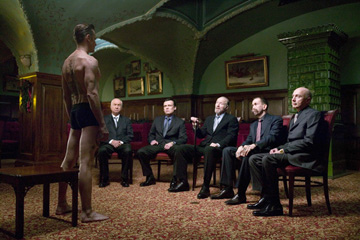
The above quote comes late in Sidney Lumet's Network (1976), long after Howard Beale's infamous "mad as hell" speech, and long after Beale was imprinted into the collective conscious of the American TV-watching public. Although Beale's early speeches are the locus of the film's ideas, I would argue that the real center of its themes is Arthur Jenson's speech to Beale from across the board room table (pictured above). Enveloped by the ordered surroundings of commerce, a brightly lit Jenson occupying a small portion of the frame informs Beale that there are no countries, no individual voices, and no real humanity beneath our surfaces. This inspires Beale to accuse his audience of having become "humanoids", in doing so Howard becomes just another blip on the screen. After single-handedly reviving a news division and a network, his ratings dip and executives discuss ways of getting him off the air. Audiences didn't want to hear they were humanoids -- they wanted to remain passive recipients of a message about revolution while complacently sitting in front of the television.

Sidney Lumet made Network more than 30 years ago. The film is remembered for Howard Beale's many famous speeches, in which the seemingly crazed news man preaches a revolution from the shackles of capitalism, war, and corporate power. Today, Howard Beale is considered a prophet. Critics and scholars cite the film's relevance in this time of hyper media attention and saturation. The cliche is that we are currently in the "here and now" age of digital reproduction. While I often despise the use of cliches and broad, familiar claims, there may be some amount of truth to this widely held belief. For example, popular magazines of the pre-digital age were known for long articles exhausting all angles of the given subject. Today, however, articles are becoming shorter. Online versions of popular news sources such as CNN or MSNBC routinely make errors in attempt to get something online or in print ahead of the competition. Networks now report "Breaking News" every 20 minutes on their websites without adequate information. Fearing that the consumer will choose another source, news Web sites and shows will do whatever it takes for those precious ratings so as to attract more advertisers. Moreover, our technological gadgets have further enabled us the convenience of shrinking the world into our own hands. Now we have more people to call or text message, more things to consume, and more pictures to take with our camera phones. And "news" -- both in presentation and content -- becomes a passing headline on the screen; faster, less trustworthy, and more controlling.

But it would be a great misunderstanding to assume that these digital media are displacing analogic media. Mechanical reproduction of electronic media enables the benefactors of capitalism to maintain dominion over the public, and digital technology only helps to sustain that. We are now experiencing a greater onslaught of the same systems of power, a greater reproduction of them in which the illusion of choice now becomes more believable to consumers. What appears to be pure democracy as represented by blogs, onDemand service and choice, YouTube, and digital downloads is just another veil of ignorance. Suddenly, Howard Beale's comments strike a resounding chord. Much like he says in his now famous speech, we have learned to isolate ourselves in our homes, cars, and in front of computer screens, surrounding ourselves with the comfort of brand names and products that we've been instructed to "need".

Perhaps, digital media are an intensification of our transformation into a culture of humanoids. Research, inquiry, and real living thought are argued to be devalued in our contemporary media culture in which the mainstream media will do everything in its reach to ensure that we choose between the Right and the Left. There we remain under the illusion that we "know a thing or two" about what's important in this world, totally oblivious that we think in product names and are conditioned to be good consumers. But now I'm starting to sounds like Howard Beale, aren't I?

Although it's tempting to reflect on the film and only think about Howard's illustrious speeches, perhaps our being so struck by them makes us just like the audiencing applauing his death at the end of the film, passive, acting and thinking that we're not going to take it anymore, but really taking all of it. The film poses this question by offering a narrative to which Howard Beale's plotline is the counterpoint. While Howard's speeches endure as some of the most memorable expressions of passion in cinema, the movie is so brilliant because it embraces the very real nature of its satire and the illusory nature of its drama. Lumet juxtaposed the biting satire of Beale's program with a subplot involving television executives Max Schumacker (William Holden) and Diana Christensen (Faye Dunnaway), the former a committed news man, father, and husband approaching the autumn of his life, and the latter a young, ambitious woman who thinks, lives, and breathes her job. Their work on popularizing the Howard Beale show brings them together. It isn't long before Max leaves his wife and home for a relationship with Diana. The film follows this subplot along with the behind-the-scenes subplots with Frank Hackett (Robert Duvall), who manipulates the business end of the Howard Beale show. Intercut with these subplots are new episodes of the Howard Beale show, as he continues to gain popularity by articulating "the rage of the people", as Diana puts it.

These seemingly disparate story threads of drama, comedy, and satire converge as the film reaches its end, and this convergence is Lumet's pedigree. The late scenes represent the movie's punishing blow. Otherwise, it would be just another smart satire about media and capitalism. In these moments, Network really becomes about Max and Diana's dwindling relationship, to which the Beale storyline becomes the counterpoint and mirrors its demise. Although Max's mistakes are many -- and he is by no means a protypical hero -- his leaving Diana represents the only bit of hope in the film; hope that some people will resist the commodification of life and fight for whatever humanity has left. But he too has fallen victim to the overwhelming power of the media that surround him and constitute his life at all. When he's telling Diana why he's leaving her as if he's pitching a script, he describes his own ending as a hopeful one in his desire to re-unite with his wife. If he wasn't so influenced by the illusory nature of his life's work, he'd realize that there is likely no happy ending for him and his wife. He has burned the bridge between them. But the film never shows us what happens to its characters. In fact, what happens to them is essentially besides the point.

The final tragic scene between Diana and Max encompasses the human side of the film's themes, where we see that the line between life and fantasy that Howard Beale speaks of no longer exists, between real people and flickering images on a screen. Those images inhabit our existence, which results in a disconnect from what's real and human, one from which we as a culture cannot return. Much like the heartbreaking exchange between Max and his wife earlier in the film (which won Beatrice Straight the Oscar), Lumet finds a dramatic pulse to the film that is both unexpected and bittersweet. Here we realize that Network is far more than just an intelligent satire. Lumet is not content to just let Howard Beale act as a symbol of his film's messages. Instead, he makes a film with a real story made with concern; it's about real people whose lives and personal relationships become the hollow network plots they discuss in meetings. By the end, these characters are speaking only in television terminology to convey their defeated emotions. Their artificial surfaces have enveloped them to the extent that artifice constitutes their very being.

This is made tragically clear when Howard Beale's popularity begins to slip and becomes just another passing trend. His message is the same, but he delivers it with a more defeated tone and disgust for humanity. Perhaps he finally acknowledges that he is himself another pawn of the corporate power that packages and markets him to consumers. Maybe he realizes that he spouts off messages which resonate only superficially with the massive audience he's amounted; for if it really did have the desired effect, no one would have to watch the show to begin with and Howard wouldn't be on the air ranting. But he is on the air, and his very presence reproduces the problems about which he preaches. His tirades against television fundamentally ignore the fact that he is the content of the medium he so detests. The irony of the film therefore is its McLuhan-inspired acknowledgment that the medium is the message. Control lies not in the message of the medium, but in the medium itself. Network therefore posits that television is an institution in which relatively few can control the interests of its viewers, where capitalism exploits even the smallest trace of humanity and knowledge, transforming it into a means of controlling consumers. This is perhaps best said by Beale himself:

"Right now, there is a whole, an entire generation that never knew anything that didn't come out of this tube. This tube is the gospel, the ultimate revelation; this tube can make or break presidents, popes, prime ministers; this tube is the most awesome goddamn propaganda force in the whole godless world, and woe is us if it ever falls into the hands of the wrong people, and that's why woe is us that Edward George Ruddy died. Because this company is now in the hands of CCA, the Communications Corporation of America; there's a new chairman of the board, a man called Frank Hackett, sitting in Mr. Ruddy's office on the twentieth floor. And when the 12th largest company in the world controls the most awesome goddamn propaganda force in the whole godless world, who knows what shit will be peddled for truth on this network?"

To talk about Network is to talk about issues of media, corporote control, and, of course, being mad as hell. But the film is far deeper than its satirical surface. It's a deep ponderance of humanity in the age of hyper-capitalism as manifest in the mechanical reproduction of media sources and corporate power. But, it also examines these notions within the dramatic spectrum of relationships and characters. Underneath its depictions of a news anchor turned media spectacle named Howard Beale is both a tragic narrative and a profound inquiry into media relations.

Howard Beale tapped into the fears and rage of the people so much that they kept tuning into his program, playing right into the very traps he was enraged about. Therefore, viewers remained in their passive states of inactivity and Beale was reduced to just another image on the screen, one that will vanish with the click of a button. And when Beale began broaching issues that no longer appealed to viewers' passive states of faux-rage, they did precisely that: they changed the channel. Then, a real, breathing individual preaching a message that wasn't condusive to the corporate interests that undergird the medium of "the tube" is shot down on his own show. The camera zooms in on his lifeless body, the lights come up, and the room fills with applause, signaling not just the end of the Howard Beale show and tragic media image that was once a man, but the death of individual voice, reason, and humanity. The finals image of the film consists of four television screens at the corners of the frame repeatedly displaying graphic images of his death intercut with various commercials and advertising. They show quick images at different times; a sensory overload accompanied by a mechanical voiceover narration.

The questions raised by the film's juxtaposition of Howard Beale and the personal struggles of the individuals who made him accessible to the public are startling and troubling: Can humanoids even recognize that they are no longer human if they have purged themselves of the means by which they once embodied humanity? Can one recognize the problem/s with a system (let lone try to solve them) if that very system has provided the tools with which one can determine the problem at all? Since we started speaking these words, writing them down, and reproducing our means of communicating, have we really been able to understand ourselves and that which is outside ourselves to even understand what it means to be human?

The scene I quoted at the start of this article evokes these questions and more when viewed in relation to the rest of the movie. Watch it real closely; the dialogue, the performance, the sound, the framing; it's all right there. Jenson is more right than he, Howard, or any of us really know. Maybe we're not as mad as we think. Maybe we're happy as hell and will continue to take it. After all, it's all we know, and it's all we are.

Monday, September 10, 2007

Cronenberg on Sex, Violence, and Cinema

In a perfect world, I wouldn't know very much about the movies I see before seeing them. So often, critics write about the importance of having as little exposure to a film as possible and seeing it with fresh eyes. Since I usually can't see them until well after their release, the reality is that I read quite a bit about movies long before finally watching them. Even in the case of movies I go to see on opening day, I find it utterly impossible not to read interviews and reviews, especially if it's something I'm really looking forward to. One such movie is David Cronenberg's Eastern Promises (2007), which is currently playing at the Toronto International Film Festival, where several critics have written rather enthusiastically about it already. In a recent post, I explain why it's not the worst thing in the world to read about a movie before you see it. But it's a fine line to walk, because it is a more pure experience when you know less.

When it comes to particularl filmmakers (e.g. Spielberg, Scorsese, Sofia Coppola, Guillermo Del Toro, Alfonso Cuaron, Woody Allen, etc.), once I know the littlest thing about their films I become intrigued enough to seek out more. Sometimes, it's almost uncontrollable and I have to consciously stop myself from reading too much; not so much for knowing too much about plot (as plot means very little to me) but instead about compositions, themes, ideas, etc. It's always a struggle, one that the everyday cinephile has to deal with, especially this time of year. And with Eastern Promises coming out this week, I'm on overload with enthusiasm. This morning, I came across this outstanding interview (via GreenCine Daily), in which Michael Guillen talks with Cronenberg and actor Viggo Mortensen about the film. Here is an excerpt from Cronenberg's comments that particularly struck me:

"The nudity in the scene is really about vulnerability; it's not sex. Most nudity in movies has a sexual aspect. Not that this doesn't maybe have some of that as well; but, it's much more sublimated. I've only recently been talking about it - because it just occurred to me - that it's like the shower scene in Psycho. You're naked, you're wet and there's some people with knives who don't like you. This is a very vulnerable kind of thing that people can relate to. Of course, it's all set up properly because of the tattoos that you meet there, so people can see the tattoos and see that it's all legitimate, and then it goes quite wrong.

I said to the stunt coordinator and the camera man, 'This is not Bourne-like impressionistic cutting away, where you don't see anything. Violence is physical. It's all about bodies. It's about the destruction of bodies. And I insist on that as the reality of this. And I want to see it all. This fight scene has to make physiological sense. It has to make mechanical sense. It has to make body sense.'

If an audience is seeing a movie to live another life - which I think is one of the attractions of seeing movies; you get to be out of your own life and live some other life that maybe you [wouldn't] ever really want to live but you're curious about - so, I'm saying, if you're a Nikolai in the movie, then you're going to experience this; I'm not going to throw it away, do it off camera, and do it frivolously. All the hard work and the difficulty of killing someone, if that's what this character has to do, I want you to feel it and see it."


Cronenberg can articulate sex, violence, and images like no other. And yet, despite his reflecting on the film's themes, he's somehow very ambiguous about it all, still inviting the reader/viewer to see the images for her/himself. The mere suggestion that Eastern Promises explores similar notions as A History of Violence (2005) is enough to send me through the roof. Although some yearn for the Cronenberg of old, i.e., the sci-fi Cronenberg, or the horror-Cronenberg, right now may be the most intriguing point in his career. I say this because he is now entering into a realm of reflexivity about narrative, sexuality, violence, memory, identity, and the body, further cementing my belief that he is our foremost scholar on the interconnectedness of these subjects.

Videodrome, 1983

Thursday, September 6, 2007

The Power (and Indifference) of Nature in Cinema

Werner Herzog's Aguirre, the Wrath of God (1972) represents cinema at its most evocative, elusive state. Last year, Jim Emerson added Aguirre to his massive Opening Shots Project, an entry that includes a reader's remarks as well as a few of Jim's own. They both commented on the total indifference of nature towards human beings as suggested by the stark images and sounds of the opening sequence, one of the most masterful of cinematic moments. The scene is almost hypnotic in its ambiance and atmosphere. It's underscored with the echoing, drawn out notes of the film's score as the ant-like soldiers descend down the mountain seeking to bring Western culture to a land they soon discover is incongruous with their ideas of God and society. The movie left an indelible imprint on my mind, and for some reason I kept thinking back to that opening sequence. It's amazing how those evocative moments stand out, not just on first viewing but seen in relation to the rest of the film. I remember being so enamored by the images and music when I first saw them that I felt somehow honed into the sensibilities of the film before it really unfolded. Only in retrospect can one appreciate the thematic depth of the images.

After seeing the whole film, I went back and watched the opening sequence again, which was both the same but also different because I had the knowledge of the film's events, characters, themes and images already fresh in my mind. The aura of feeling still remained, but I could detect more subtleties within the compositions, framings, and sounds, and I essentially experiencing them differently even though they have not changed. By the third time of watching the opening sequence, I realized that many of the central tensions and themes of the film itself are suggested in that descent that lasts only a few moments. It builds wonderful contrasts and relationships through its images and sounds, essentially planting them in the first-time viewer's mind, not allowing her/him to really understand them but rather to allow them to blossom and come into focus (however subconsciously) as the film plays out.

Throughout the film, we see the banality and insistence with which the conquistadors attempt to conquer the jungle and its natives. They seek to reach the city of El Dorado, but as their journey descends to madness they are slowly enveloped and eventually swallowed by their surroundings. All the customs, traditions, and social contructions that constitutes their Westernized lives are rendered totally insignificant. Herzog's observations of this with his stark compositions, gritty atmospheres of quietness, and long interludes of nature's own wrath (e.g. the mesmerizing slow pan of the rapids) effectively contrast but eventually coincide with Aguirre's own madness as the batallion of conquistadors slowly dwindles into oblivion.

I suppose the beauty of great opening moments in films such as this is the elusiveness of feeling created within sounds and images as they interact. It reminds how essential a film's opening moments are; they set the tone for how one sees the rest of a movie, as Jim explains in the introduction to his project. We see them differently as we would images later in a movie after we've become accustomed to its rhythms. But since the opening of a film establishes those rhythms, the experience of seeing those initial images is radically different. The viewer has no sense of the styles, rhythms, or temporal and spatial relationships. Without that knowledge, seeing an image is a wholly different experience. The moods, feelings, and thoughts provoked by the sights and sounds of a great film's opening moments both tells the story of a film, yet remains intangible to the viewer and digs deeper than the story. Those feelings and thoughts build, shift, and evolve as the movie plays out. In Aguirre, there's no dialogue or discernable character that we're following, but instead a line of people carrying their riches and armor through mud and water, shrouded and mist. Somehow, on a more abstract level, the whole movie is in those moments; not the story, but the movie.

Tuesday, September 4, 2007

Autumn in cinephilia: Or how I learned to stop envying those in Toronto and love my computer

This time of year always has a personal significance for me, as I'm sure it does many movie lovers. Now that August has ended, summer sequels and blockbusters are all but purged from the cineplex, barring the Labor Day stragglers like Rob Zombie's Halloween (which I would like to see). Although I tend to be more generous toward the big, glossy productions of summer (which I have seen noticeably less of this year), I am usually very eager to get to the Fall releases. And no matter how depressed I get in August about the state of cinema or Hollywood, it seems that every year I am re-invigorated and my appetite for great contemporary cinema really kicks into high gear. September is not usually the finest month on the cinematic calendar in terms of release dates, but it represents a crucial time during which the overall atmosphere changes. Film news coverage begins shifting toward studio prestige releases and international cinema with the onset of various film festivals. Also, the quality of the films in release tends to upsurge starting in September. After consistent years of seeing great films in the later end of the year, there's no reason to expect that this year will be any different in terms of the quality of films in release; though I should be careful not to emphasize sameness, because the reason why I love this time of year is that my choices of films become more varied. Although I can't see many of the movies I'm usually reading about in September, seeing my favorite critics and writers sound off about them while knowing that I will see a number of these films eventually is what makes this time in particular so special.

The catalyst of this shift in the cinematic world can be broadly summarized in one word: Toronto. Despite that I have never been to a film festival, the Toronto International Film Festival is my favorite for a number of reasons. Along with its perfect timing, the festival offers hundreds of movies and is open to the general patronage. From what I have read, the festival pretty much takes over the city for two weeks. Though I have never been, I envision thousands of cinephiles and critics walking the streets, wandering in and out of movie houses to see films they either may not have heard of or are directed by big-name directors such as Brian DePalma or Woody Allen.

Last year, I remember reading about The Host, The Fountain, Stranger Than Fiction, Shortbus, Rescue Dawn, and Pan's Labyrinth among others. I just thought of these films off-hand, but even now that I look back at them, I can once again observe the shear diversity of filmmaking talent and style. Many of the films that excited me most I have already seen, while others I have not yet gotten to. Still, some others haven't even been released. While each of the critics whose accounts of the festival I have read (including Jim Emerson and James Berardinelli) didn't see all of the films or even a representative sample, the beauty of it is that its impossible see all of the movies or even sum up all of the films with a handful that one person sees. From the studio award bait to the small-funded shorts, each movie is a discovery waiting to happen. It's all a matter of what compels one to see a given film at a given moment.

Here are some films playing at Toronto that I'm greatly anticipating:

The trailer for Julie Taymor's Across the Universe is evocative and visually inventive. While some reports indicate that Taymor lost creative control of the film when the studio stepped in, I'm still very interested to see how this Beatles story unfolds. Taymor is not often one to offer simple narratives (see Titus), which is why I'm curious for her perspective on not just a biopic, but one that centers on one of the most influential bands of the 20th Century. [Update: Anne Thompson reports that Julie Taymor will retain creative control of her film. Thanks to Peet Gelderblom for the news.]

David Cronenberg's latest, Eastern Promises looks to be in the vain of his last film A History of Violence (2005) insofar that he's taking on violence and sexuality once again seemingly reflexively. I obviously have not seen the film, so I could be wrong, but early word indicates that the movie embodies a reflexivity about its themes and narrative structure. That's not bad news considering that A History of Violence is one of the very best movies I've seen in years. Both Eastern Promises and Across the Universe will have wide releases with month, which greatly pleases me, but just about all of the other films screened at Toronto (from what I've seen) will either be released later this year or have no release date of yet. I've already got Eastern Promises marked on my calendar (I'll be seeing it Saturday, September 15th).

Keeping with contemporary American films, one movie that's not getting strong early buzz is Woody Allen's Cassandra's Dream, which just screened at Venice to rather lukewarm reviews. I've come to expect this from critics today. With the exception of the largely praised Match Point (2005), critics have had no interest in Allen for the last 10 or 15 years. I will write at greater length about Woody Allen, his stature in American cinema for the last 35 years, and the image of him perpetuated by critics who claim to know him. If I see one more article about how he "stopped making us laugh", I just might snap. Nevertheless, his films are as interesting to me as any other filmmaker today and I look forward to this film with great interest, even if he's not trendy anymore.

Another film I am eagerly anticipating is George A. Romero's Diary of the Dead, a continuation in his ever growing zombie universe, which he again recently explored in the underrated Land of the Dead (2004). In each of the Dead films, a new group of people and social environment is explored in the same world overrun with zombies. Although his recent Dead movies don't measure up to the brilliance of Night of the Living Dead (1968) and Dawn of the Dead (1978), they are fascinating entries in what's becoming one of the most intriguing film series in horror cinema.

Other films I greatly look forward to seeing include The Coens' No Country For Old Men, an apparent "return to form" for the once invincible filmmaker brothers; Michael Clayton (Tony Gilroy), I'm Not There (Todd Haynes), The Brave One (Neil Jordan), Reservation Road (Terry George), Redacted (Brian De Palma), Before the Devil Knows You're Dead (Sidney Lumet), Atonement (Joe Wright), The Assassination of Jesse James by the Coward Robert Ford (Andrew Dominik), The Mother of Tears (Dario Argento), Sleuth (Kenneth Branagh), Lust, Caution (Ang Lee), Into the Wild (Sean Penn). The list goes on and on and on... But take note of the variety of filmmakers on this list alone: Lumet, DePalma, Allen, Romero, Argento, Cronenberg, Jordan, Coen (and that's just the North American directors!); figures that have in different ways shaped contemporary cinema. They're still at it, and I can't wait to see what they have to offer now.

What I've learned about TIFF as an outsider is that the festival is sort of a microcosm for (or physical representation of) cinema. A critic or film lover can only see so many movies, and the list of movies that one person sees will differ from the next, despite probably sharing a few. What you have are a bunch of different people seeing different films, all with the potential to inform each other with their own unique experiences with them.

Reading about the many treasures has become something I look forward to every September. This year I'll be reading more reports because of my deeper involvement in the online film world, which I am in tune with than last year and therefore have greater exposure to quality online writing. Other than Emerson, Ebert, Berardinelli, etc., I will also frequently visit the blog, 1st Thursday, a site that's about the TIFF and nothing more. Darren Hughes has done such a great job with this site; it really represents the quintessential TIFF website; it is chock full of information about the festival, its films, as well as the city of Toronto, among other things. If you haven't done so already, I highly recommend visiting his site (click here for an introduction to the site and a description of its task), as I'm sure his updates will be many and informative. What 1st Thursday does best though is conveying an enthusiasm for this event that no other writing I've seen has done. Darren loves this festival; maybe for some of the reasons I've mentioned above, but probably for many others as well that I wouldn't understand since I've never been.

The only gateway I have into the festival is by reading blogs like 1st Thursday as well as the reports by Jim Emerson, Roger Ebert, Girish Shambu, and many, many others has lead me to promise myself that I will one day go to Toronto. But until then, I will read the reports and wet my appetite for what's in store over the next year. The air outside is still warm, but my inner-cinephile couldn't be happier (short of actually being in Toronto) to read about the many movies I will finally see when the air cools off and the leaves start falling.

Monday, September 3, 2007

The Great Divide

Dennis Cozzalio's recent reflections on the "31 Days of Spielberg" captures the dread that some of us feel right now the blogosphere. As he observes, the film blogging community (if it can be called that) has experienced something of a ripple that struck a chord with many of us, whether we have written about it or not. As for me and my place in online film writing, I will admit that I've been a little unsettled of late. Although I have remained relatively quiet until this point, I have kept up with its backlash over the weeks. Right now I still don't have much to contribute outside expressing my upset over the situation. Arguably more interesting than Damian's actions, however, is how others have responded and used these media to express their views. Some have lashed out on Damian and others have shown their support, but sparing you all a disertation-length analysis of the communicative proccesses of online writring, I think it's important at this time to maintain a certain amount of professionalism as us film bloggers grapple with this situation and its implications. In light of my recent SCMS research assignment of cinephila, film criticism and blogging, I will say that the events have given me much to think about regarding the implications of blogging and the free-wheel form of writing its participants have enacted. In many ways, this event has elucidated for all of us the major schism between blog writing and published writing, no matter what the style (which I touched on somewhat recently). This divide must be taken seriously, even as we try to break it down.

Monday, August 27, 2007

Roger Ebert and his Great Movies

As I do most Sundays, I was perusing Roger Ebert's website yesterday morning and saw that the Great Movies section appears to be up and running again. Of course, this is great news. The column has been a staple in my online film reading for as long as I can remember. Running once every two weeks (with the Answer Man column appearing on alternate Sundays), the column features some of Ebert's best writing and film criticism as he reflects on cinematic treasures. His insights on individual films are unique, even subtle and are sufused with an extensive knowledge of film history and cinematic style. Unlike the lengthy analyses appearing in film journals or books, these columns can usually be read in less than 15 minutes and are smoothly written. This coupled with the aforementioned insights make the column an essential read, 26 Sundays a year. Another great aspect of the column is the unexpected nature of the selections. At first glance, it would seem that he adheres to your typical movie critic canon, with expected choices like Casablanca, Citizen Kane, The Godfather, It's a Wonderful Life, and others. But a closer look reveals that Ebert's tastes and sensibilities are very ecclectic, even brashly contrarian. On what other list will you find Saturday Night Fever just below Santa Sangre or Yojimbo right after Yellow Submarine?

This week's selection, Pan's Labyrinth is in some ways expected, due to his absence from reviewing when the film was releases last Winter. It might seem that the Great Movies column is appropriate for it because it would give him a chance to review the film (as he clearly loved it). But as with most of Ebert's criticism, there is more to this selection than might initially appear. Over the last month or two, Ebert has revisited some of bigger releases over the last year that he was not able to review during their release. These reviews, which include four-star reviews of The Departed, Zodiac, and Casino Royale, were not published in the great movies column, but instead ran alongside reviews for current films in release. While I have no inside information on this, I would guess that the choice to run the aforementioned reviews on the main page of rogerebert.com was to call readers' attention to the fact that Ebert has now officially reviewed several prominent movies of the last several months. Why not then go back and review dozens of late 2006 and early 2007 releases? Because it appears that Ebert is selectively choosing a couple of films that seem as though they will be "around for a while"; by this I mean that films like Casino Royale and The Departed are going to be analyzed and discussed for a long time to come and represent memorable artificats in mainstream American cinema while Ebert was gone. Of course, he can't go back and review them all, or even get to all of the similar memorable staples during his absense. But his reviews of these respective films represents an effort to record his own contribution to the dialogues about them.

So what does it mean to survery the collective interests in determining what will be discussed or deemed cinematically important, if not for quality but perhaps for influence? Difficult to say. It's more a guessing game that it seems. His initial three choices are rather safe (among them one best picture winner and an origin story for one of cinema's most influential characters), and I would expect that his reviewing such films does not continue for a whole lot longer, since he must commit the majority of his time on reviewing new films. Notably, Roger thought highly of all of the older films that he has reviewed, which I believe only includes The Departed, Casino Royale, and Zodiac (but I could be wrong), which is why it would seem appropriate that he would include his review of Pan's Labyrinth among this effort to survey "important" movies of the last year. Instead, his review of Guillermo Del Toro's film appears in the Great Movies column, which is typically grounds for established classics that have cemented themselves in his mind and that he has seen a number of times over the years. A curious choice, for sure, but one that I may understand.

Time plays a big role in cinema; both within it and outside it. I should note that I don't take the word "great" lightly. Like "classic" or "masterpiece", it's a term that suggests another level for a movie, one that can't really be determined based on a single (or even mutiple) viewing/s of a film, however much it may grab you or announce itself as great. Yes, these terms are broad and flimsy, and are rather empty without sufficient analysis and examination, but they wield great influence for both critics and readers, as the continued popularity of Top 100 movies lists suggests. As Edward Copeland notes in the regulations for his Non English-Language Films List, assessing cinema essentially requires the critic to really wrestle with the text before placing it among the pantheon of films that s/he has seen in many contexts and places in one's own life; these films show new colors each time, while unveiling new dimensions to old perspectives each time they are viewed. In that sense, time is required for any movie to be considered great or classic.

But in our experiences as critics, scholars, or film lovers, some movies ingrain themselves in our minds and souls, where they continue to live. Although once is never enough for any great movie, there are rare instances (which I find often depend upon the individual and her/his experiences with life and cinema) when we latch onto a movie when we first experience it. During these experiences, we can both be invovled in the immediate moment of the film's sensibilities, compositions, sights and sounds, while simultaneously recognizing that this movie's treasures --a few of which may be breached in that first viewing-- lay in store to be discovered in more detail on further viewings. It's a strange intuition, to know that a movie will stay with you and affect you so deeply in so many different ways, but it's one that I would guess every movie lover experiences every so often. For me, and I would guess Roger Ebert, Pan's Labyrinth is such a movie. In recognizing this, perhaps Ebert felt it necessary to place the film immediately among the many great films over the past 100-plus years.

I'm sure others would disagree, but my two viewings of the films suggest to me that Pan's Labyrinth deserves to stand among the best. Although I hope to someday examine the film from a variety of perspectives (I shared my initial thoughts here), I can now only observe those those intangible intuitions and feelings of how the experience of seeing that film (or any great film) can affect me so profoundly. Most great movies are in some form (albeit in very different ways) ruminations on the elusive human condition as manifest in visual narrative. In that sense, all great movies are reflexivse of some element of narrative or cinema, as narrative is one of the very few defining elements of humanity throughout all civilizations, right down to every individual. Narrative is apart of all of our lives, and, in the case of Pan's Labyrinth, we have narrative that is equally ethereal and brutally realistic. Some how, some way, Del Toro captures the fleeting feeling of that enraptured state that any person may find her/himself in while experiencing a narrative. The film juxtaposes two different worlds, the endless spectrum of imagination and the harsh reality of organized warfare and governmental control. The beauty of the film is not in how it separates these two worlds, but in how it brings them together, demonstrating their indelible influence upon one another.

Here is a short excerpt from Ebert's review of the film (the first and last paragraph -- it's up to you to read the rest!):

"Pan's Labyrinth" is one of the greatest of all fantasy films, even though it is anchored so firmly in the reality of war. On first viewing, it is challenging to comprehend a movie that on the one hand provides fauns and fairies, and on the other hand creates an inhuman sadist in the uniform of Franco's fascists. The fauns and fantasies are seen only by the 11-year-old heroine, but that does not mean she's "only dreaming;" they are as real as the fascist captain who murders on the flimsiest excuse. The coexistence of these two worlds is one of the scariest elements of the film; they both impose sets of rules that can get an 11-year-old killed.

...

What makes Del Toro's "Pan's Labyrinth" so powerful, I think, is that it brings together two kinds of material, obviously not compatible, and insists on playing true to both, right to the end. Because there is no compromise there is no escape route, and the dangers in each world are always present in the other. Del Toro talks of the "rule of three" in fables (three doors, three rules, three fairies, three thrones). I am not sure three viewings of this film would be enough, however."


I'll just make a few more notes about Roger Ebert and the Great Movies column to wrap my thoughts on this...

I generally consider Roger Ebert the Steven Spielberg of film criticism inasmuch that he is often dismissed by his peers for being to "mainstream" but routinely offers subtle insights into filmmaking and film watching throughout his varied work. Yes, he plays by many of the rules (as one must do to thrive in the mainstream), but within those broadly familiar frameworks of informal, seemingly simple weekly reviews, he slides in subtleties that go unnoticed by those who only allows themselves to see the more conventional elements. Not all of his work is brilliant or cutting edge (but whose is?), which is tough considering that he reviews hundreds of films a year. Like the films themselves, his critical insights are not all poetic, incendiary, or great, but he maintains a level of consistent interest and quality in his work that is unparalleled by many, and very often offers sound, subtle, even sublime movie criticism.

Perhaps the most important lesson I've learned from Roger Ebert through his criticism is that any movie can be great, whether its about dueling spaceships or existential voids. Ebert's passionate writing about a diverse field of movies not only expresses his broad taste for storytelling, but also communicates his philosophy that cinema is a medium for all stories and that critics should never be above certain kinds of movies. Blockbusters or indies, new or old, greatness can be found in all corners of the medium, in all types of stories. No piece says this more than what is perhaps my favorite article by Ebert, which is a retrospective of the First 100. This article spoke to me 10 years ago, and (much like a great movie) continues to speak to me today, only in new ways. Here is an excerpt:

"I like to sit in the dark and enjoy movies. I think of old films as a resource of treasures. Movies have been made for 100 years, in color and black and white, in sound and silence, in wide-screen and the classic frame, in English and every other language. To limit yourself to popular hits and recent years is like being Ferris Bueller but staying home all day.

I believe we are born with our minds open to wonderful experiences, and only slowly learn to limit ourselves to narrow tastes. We are taught to lose our curiosity by the bludgeon-blows of mass marketing, which brainwash us to see "hits," and discourage exploration.

I know that many people dislike subtitled films, and that few people reading this article will have ever seen a film from Iran, for example. And yet a few weeks ago at my Overlooked Film Festival at the University of Illinois, the free kiddie matinee was "Children of Heaven," from Iran. It was a story about a boy who loses his sister's sneakers through no fault of his own, and is afraid to tell his parents. So he and his sister secretly share the same pair of shoes. Then he learns of a footrace where third prize is . . . a pair of sneakers.

"Anyone who can read at the third-grade level can read these subtitles," I told the audience of 1,000 kids and some parents. "If you can't, it's OK for your parents or older kids to read them aloud--just not too loudly."

The lights went down and the movie began. I expected a lot of reading aloud. There was none. Not all of the kids were old enough to read, but apparently they were picking up the story just by watching and using their intelligence. The audience was spellbound. No noise, restlessness, punching, kicking, running down the aisles. Just eyes lifted up to a fascinating story. Afterward, we asked kids up on the stage to ask questions or talk about the film. What they said indicated how involved they had become.

Kids. And yet most adults will not go to a movie from Iran, Japan, France or Brazil. They will, however, go to any movie that has been plugged with a $30 million ad campaign and sanctified as a "box-office winner." Yes, some of these big hits are good, and a few of them are great. But what happens between the time we are 8 and the time we are 20 that robs us of our curiosity? What turns movie lovers into consumers? What does it say about you if you only want to see what everybody else is seeing?"


Below is a short list of some of my favorite Great Movies reviews over the years.

Dark City
E.T. -- The Extra-Terrestrial
Groundhog Day
JFK
Manhattan
McCabe & Mrs. Miller
Network
Saturday Night Fever
Star Wars
Strangers On a Train
Vertigo

It's worth noting that I agree with Ebert that each one of these movies is indeed great, which would lead some to deduce that my love of Ebert's criticism is tied to the fact that I love his reviews I agree with. As I've noted before, sometimes I couldn't be in greater contrast with Roger regarding some movies (ahem, War of the Worlds!). But engaging criticism is not about agreeing with the critic. It's about learning and challenging one's own interpretation of a movie or understanding of movies. Why then do I highlight these movies? Because they represent a diverse collection of his writing that is personal, knowledgeable, poetic, sometimes even profoundly moving work about films I personally hold closely. That love or appreciation of these films was enhance, stretch, even challenge after reading his reflections. I believe that all of Ebert's best writing and critical qualities are contained in these reviews to varying degrees. For me, they highlight his flexibility and out-and-out quality as a film critic. His writing continually shows me that writing about cinema is both incredibly important and very personal. Nothing better sums up Ebert's place in film criticism than Jim Emerson's observation in May: "He's so very much more than the sum of this thumbs."

Now that I've showed you my list of favorite Great Movies, let's see yours.

Wednesday, August 22, 2007

The Non-English Language Films Project

[Update: Elusive Andy Horbal post found. See below.]

For the very few who haven't read about or contributed Edward Copeland's Non-English Language Films project, I suggest you do so over at at Edward Copeland On Film. Regrettably, I was unable to contribute to the first round of nominations but I will be contributing my Top 25 in just under a month (ballots are due September 16). I think this is a rich project for a number of reasons. First, as a follow-up to the inevitably flawed project that was the Online Film Community's Top 100, this list serves as something of a statement from online film writers concerned about their own image and place in film scholarship and eager to contribute to that larger dialogue, a dialogue which (as I wrote previously) is happening right now, partly because of the growing body of worthy criticism here on the web.

One especially notable aspect of this project is that it doesn't include just film bloggers, but instead a wide variety of critics, scholars, and online writers. On that list, we see established journalistic critics like Carrie Rickey and Jonathan Rosenbaum alongside several prominent film bloggers, not to mention a few academic critics. Putting together such a list is a progressive step in the interactional nature of blogging and its place in film criticism. When it's finished it will not represent an authoritative list as voted on by a group or committee falling under the same name such as the "Online Film Community" or "American Film Institute". This instead includes a variety of perspectives and exists primarily for the exposure of these voices in a participatory experience (almost like a seminar) during which readers and contributors can learn about films they've missed and what other film lovers and critics think about international films.

Of course the rigorous structure to this list --which bars silent films and all English language films-- is limiting, but such restrictions are necessary for this project to succeed. Besides, this experiment will not represent the be-all-end-all of non-English Language movies but instead will generate discussion and dialogue about films that deserve more discourse and criticism in the online writing circuit as well as in the published ones. As Edward has noted, this may only be the beginning of projects like this. That there are some restrictions will not hinder the experience for me at all; it only opens possibilities for more projects like this in the future. Personally, I'm glad to take part in it. Although my experience with many of these movies is not nearly as vast as most other contributors, I have been watching these films rigorously of late in hopes of broadening my sensibilities before I submit my list. Many of my picks may still be fresh in my memory and will have seen only once (I just saw Jacques Tati's wondrous Playtime for the first time last night and its still dancing in my head), but that probably adds a flavor to my contribution that others may not have. In time, I'll have seen many of these movies; some several times as others have. So though I feel somewhat inexperienced, this project like online film writing in general has opened innumerable possibilities for me as I continue my own experiences in online writing and criticism.

One last note, somewhat unrelated: Andy Horbal recently shared a brief thought (which, he explains, was posted, accidentally removed, and is now up again) comparing film blogging to filmmaking, which is kind of a profound insight in its simplicity. In light of the above discussion and the participation and collaboration I'm seeing in the online film writing world, Andy's words resonate strongly. It's actually kind of inspiring (If I can find the post, I'll provide a link). I have always been of the mindset that art requires criticism just as much as criticism requires art, but this specific comparrison of film blogging and filmmaking --and the various levels of them-- is a neat idea.

Monday, August 20, 2007

The Digital Embrace

"To read a narrative continuum is in fact to arrange it in a variety of structures, to strive for concepts or labels which more or less sum up the profuse sequence of observations." - Roland Barthes

Just recently, I watched Zack Snyder's 300 on DVD, which, like Sin City (2005) and Sky Captain and the World of Tomorrow (2004), superimposes "real" actors on a sythnetic canvas: lumbering beasts, endless armies, gallons of blood, severed limbs, and entire cities were added in post-production while production likely consisted of actors in front of a green screen. Like the aforementioned films, 300 is a sometimes harsh melding of digital and analogic properties of cinematic style and narrative. Audience reception of these green screen films varies, but their presence in the Hollywood mainstream is becoming more prominent.

While many would agree that neither Sky Captain nor Sin City were entirely successful as genre narratives, it's tough to say whether that's due to their digital properties. That the manner in which a story is visualized greatly impacts the effect of the story doesn't help when attempting to assess these two elements independent of each other. Nevertheless, both movies relied upon familiar temporal and causual relations as they experimented with cinematic space via their digital design: Sky Captain is a very enjoyable throwback to a number of golden age film styles --from film noir to John Huston adventures-- while Sin City combined a hyper-violent Tarantino-esque visual design with a graphic comic aesthetic. These films' experimentation with spatial and temporal relations were successful with the target audiences for the respective films because their intended viewers were familiar with the genres and visual structures, and could "fill in the gaps" while acknowledging the artifice of the content and the sometimes harsh juxtapositions of the analogic and the digital.

300 is very much in line with this pre-established logic of spectatorship, not deviating much from the editing and compostional styles of contemporary music videos and popular cinema. It features digitally enhanced slow-motion action shots, detailed vistas and digitally created monsters that wrestle with the human actors; but this all serves to sustain the very same purpose as Mel Gibson's Braveheart and George W. Bush's war propoganda about honor, valor, and vanguishing evil. Some hail the film's supposedly groundbreaking visual techniques and synthetic compositions, but in reality, the film's images are purely conventional. That's not to say they can't be effective; but audience response (as well as some critical response) to the film has been overwhelmingly positive in my observations, and that response is what really interests me. 300 wants to convince you that it's status as digital --which the filmmakers boldly pronounce-- elevates it beyond the structural design and trends of photographically based films. It features self-consciously "different" movements and framing techniques by the standards of most risk-free popular cinema, but as compared to sitcom style framing and editing, that's not saying much. If we're comparing the film to the real originality from the likes of Tati or Kubrick, then it becomes evident that 300 fits more with the subset of popular cinema that prides itself on being different and noncomformist by showcasing overtly digital composition, but which really fits the mold of intensified continuity to a tee and challenges nothing.

Nevertheless, the film is worth analyzing for its employment of effects and how we are cued to perceive them. The digital environments inhabited by the respective characters of these films are at once supposed to be real and unreal inasmuch that the spectator may perceive them and form a spatial knowledge of them as concrete despite the acknowledged reality that they are unreal. These films therefore exhibit qualities of real, photographed space (an already questionable term). But by acknowledging the artifice of these environments, the viewer may thus accept the incongruent relations of cinematic space and thereby accept the faker looking effects as part of the storytelling. Coincidentally, this cues the viewer to settle into a state of passive admiration for digital images. It seems that the more overt filmmakers are with digital effects in movies such as 300 or Sin City, the greater response they achieve from their intended audience, of which many journalistic critics are apart. Yet distinct relations between the makeup of the images and the perceiver's ability to interpret them is largely underdiscussed.

Though I have staunchly defended digital technology in cinema since this blog's inception, I have focused on movies that I personally consider innovative. I have praised many big-budget films for their employment of the digital, but few of them have seen such high praise from popular audiences or even critics. As evidenced by what I consider to be significant advancements of the medium in movies like Miami Vice (2006) (a hugely budgeted movie whose treasures are only reaped by cinephiles and a handful of critics since it flopped with popular audiences), my interests in these media clearly differ with a common moviegoer or critic. Nevertheless, attempting to grapple with popular manifestations of digital media in cinema is crucial to my own perspective of digital technology. Specifically, I like to look at popular texts in relation to the greater advancement of the technology, especially how it is viewed in the eyes of consumers and moviegoers. There is undoubtedly a major shift occuring in popular cinema, if not from the filmmaking angle but instead concerning the collective understanding and interpretation of digital cinema.

Looking back on some of the more successful movies extensively employing digital technology, reception of them has been rather inconsistent both with critics and audiences. It's as if we are in a collective state of uncertainty regarding digital technology. Ever since Terminator 2: Judgment Day (1991) and Jurassic Park (1993), two movies that are discussed more for their use of digital effects than their storytelling, it seemed like digital technology was ready to explode. Now, roughly 15 years and millions of effects shots later, I cannot distinguish any clear direction in terms of how audiences and critics receive the technology. Some will often complain that movies are too effects-heavy, while others seem to crave effects since they spell out more destruction in high-budgeted action movies.

The prevailing current attitude in the critical community is one of trepidation, as movies are commonly criticized for their increased use of digital technology. About movies like 300 and The Matrix, we read popular cinema is embodying more aspects of video games as they are increasingly pixelated, to which I respond: How is that a criticism, and what does that mean, anyway? I have seen little real research or deeper analytical inquiries into how digital cinema is actually received with critics, consumers, and cinephiles. There are many opinions about it, but they are often based on uninformed assumptions. Meanwhile, there is so little actual criticism of digital storytelling outside your typical appreciations of digital effects in DVD documentaries and TV specials. Teminator 2 is routinely cited as a digital effects revolution and is considered a great movie because of it, yet its status as such has clouded the real issue of how those effects influence storytelling. (Note: Its arguably superior predcessor, The Terminator, by comparison, doesn't even seem to exist at all sometimes. I guess nobody wants to see a movie with stop motion animation anymore.) It seems that effects are often cited for why certain films are successes and others failures, yet there is no correlation between increased effects use and either box office revenue or critically agreed upon quality, which suggests two things: 1) that the reception of digital cinema may not be in line with the greater use of it in visual narrative, and 2) that critics and audiences are in many ways just as apprehensive about the technology as they were 15 years ago.

George Lucas' Star Wars prequels --which pioneered many of these digital filmmaking techniques and post-production-leaning filmmaking methods-- have raked in millions of dollars at the box office. But much of that can be attributed to the already rabid fan base of the series, Lucasfilm's and 20th Century Fox's successful marketing campaigns, and previous trilogy's status as a familiar mythology in moviegoers' canon. Though each recent Star Wars film made more than $300 million, critical and audience conjecture has not been kind to the films, even now as they are cemented as a trilogy. Yet when we hear about the failures of the films, one of the most common reasons is their reliance on digital effects, which in turns effects performances and the liveliness of the movie. But does that make effects inherently bad?

Since there seems to be little consistency when it comes to how certain digitally-based films are received, perhaps we can speculate that perceivers' expectations have something to do with it. Sure, we can lean on narrative quality, but that is often influenced more by personal and cultural ideology than real objective standards of quality. That some stories are poorly told for their over-reliance on digital cinema says more about viewers' notions of good storytelling (which shift according to the emergence of new technologies) than about the effects themselves. The fact is, there are innumerable potential contributors to how a film's images are perceived and interpreted that to single out effects not only is invalid and reductive, it says a lot about how a viewer conceives of visual storytelling at all.

In the scope of digital cinema's success stories, 300 is distinct insofar that its booming success was a great surprise to many. Although Frank Miller has a strong following, that alone cannot account for more than $200 million in theatrical box office receipts, in March especially (a month not known for generating big box office). The movie could have followed a similar pattern to like-minded predcessors; it could have been a relative success, such as Sin City ($74 million), or it could have borderline flopped, like Sky Captain and the World of Tomorrow ($37 million). But it far surpassed all expectations and is one of Hollywood's biggest success stories of the year. Yet one should note that while each of these films demonstrate the overwhelming presence of the digital in contemporary cinematic narrative with varying degrees of success, they each fit comfortably within specific genre norms and styles, further supporting the hypothesis that their images rely more on spectatorial acknowledgment of narrative relations and genre bounds, which thus yields passive admiration for supposedly new images.

It's clear that digital filmmaking techniques have advanced in extraordinary ways over the last 15 years. However, although movies are becoming increasingly digital in design, it still seems that audiences nor critics can really make sense of this technology, even in spite of 300's success, which just shows me that audiences are becoming more comfortable with this particular use of the technology, which should be expected after 15-20 years of mainstream use. How these technologies alter our way of seeing images is moreoreless uncertain, though, which is evident over the nature of the discourse surrounding digital cinema. There are proponents and naysayers on both sides of the debate for digital cinema's validity, but even considering digital technology in a "good" or "bad" light assumes photographic means of visual narrative is the standard by which all future technology is measured.

I'm sure I could be proven wrong with a number of examples, and I anticipate these arguments. But when we really step back and try to look at the bigger picture of digital cinema, it looks increasingly muddled in terms of the discourse about it and how it is perceived. We can all frame our opinions about the technology --however informed or uninformed they are-- and piece together an argument about digital technology and its place in storytelling, cinema, and visuality. But for every argument one makes, several others can counter that argument and offer another. Now, more perspectives are emerging along with potential uses for digital technology, which is now being used as much more than a tool for special effects-laden movies, but itself is becoming an expression on its own terms. David Lynch's Inland Empire, while not being a huge hit by any stretch, represents a prominent filmmaker actively exploring the possibilities of digital cinema. On the maintream front, Robert Zemeckis' forthcoming Beowulf employs a rare form of digital cinema in which the movements of the actors are digitally captured and then animated into a completely photorealistic, yet synthetic movie. In the case of Beowulf, as well as other animated movies like it (namely Monster House and Zemeckis' own Polar Express), the end result is entirely digital, but is based on photographic properties.

The shear diversity of uses of digital media and the variety of perspectives about them speaks to the lack of definition that really pervades the cleanly defined analog/digital dichotomoy. Having just seen Lynch's Inland Empire, a true convergence of form and content in the digital realm, I was reminded of how much there is still yet to be explored with these media, specifically their relationship to narrative. That connection is rarely breached (at least that I've seen) in discourse concerning digital media.

Filmmaking has drastically changed due to the prominence of digital cinema, not just for filmmakers but for viewers of and participants in these media. Now more than ever, more emphasis is placed on pre-production and post-production, whereas in the analogic days of cinema the greater emphasis was on production itself. How this shift alters the effect of making and seeing a film is difficult to sum up by examining (however in-depth) a number of digitally influenced films. But we may still gain some insight by observing normative trends of popular cinema of today from two broad vantage points: 1) how it sustains and/or deviates from the stylistic and narrative norms established in last 20 years of digital cinema (which entails observation of how digital cinema has evolved in that time), and 2) how it stands in relation to pre-digital cinema, or photographic (analogic) cinema. The binding element of these two modes of analysis is that the digital exists with the analogic rather than displacing it. The medium itself is made up of many media, so to say that a given film is strictly analogic or strictly digital is foolish. How the digital exists in relation to the photographic properties should be the focal point of analysis, since digital cinema abides by stylistic, visual, and narrative norms established long before digital technology.

If we are to accept "digital" as separate from "analog", we would be suggesting that we are in a new age of cinema, free of the constraints of linear storytelling and photographic properties. (I'm not even sure this is possible since even the most abstract of films abide by some visual or stylistic narrative framework, even if that's not adhereing to one.) Nice as that sounds, it's an awfully big claim that just wouldn't hold up if applied in theory or practice. But it's a mentality fueled by the popular analog/digital model that so many of us use to understand these technologies. If anything, the wide use of digital technologies and the endless ways in which they enable narratives and images to be seen, constructed, and interpreted in entirely new ways suggests how flimsy terms like "analog" and "digital" really are. Perhaps as more ways of expressing visual narratives are increasingly exercised in filmmaking through the use of digital video, effects, and animation, the separation of analog and digital will no longer be relied on to understand these emerging media and the analog/digital model may finally be rightly seen as a false dichotomy.