Friday, July 13, 2012

Nostalgia for summer movies

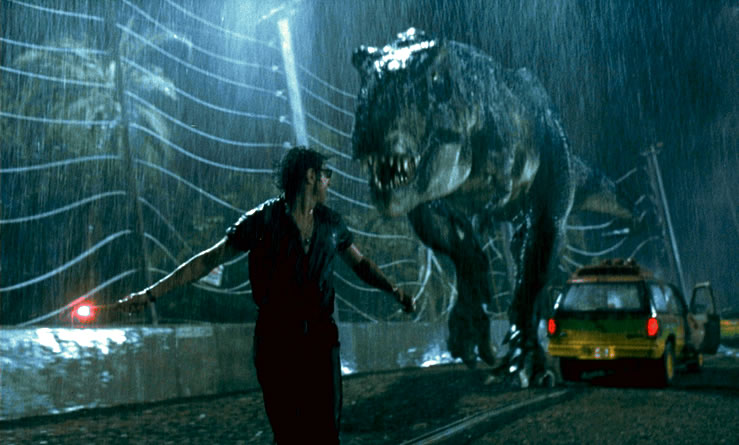
Something about the summer heat makes me crave the bigness of movies. A good blockbuster may be hard to come by these days, nevertheless I often become nostalgic for "summer movies" this time of year. It probably has something to do with all those memories of staggering out of the theater into warm, bright atmosphere of summer after a movie experience. For instance, I'll never forget those first few steps into the sun after seeing Jurassic Park in 1993. In the cocoon of darkness and air conditioning, I was so enraptured by the storytelling for two hours that I had quite nearly forgotten the outside world. As the credits rolled and we left the theater, I remember stepping out into the parking lot and being blasted by heat and light while struggling to regain a sense of time and space. Even as I adapted to the conditions on our trek back to the car, visions of severed human arms and goat legs danced around in my head. In the years following, I would have similar experiences (though admittedly not as memorable) with Independence Day, Twister, Star Wars: Episode I, and other escapist entertainments. As I got older, I broadened my tastes considerably. But I will always have an affinity for the fanciful gluttony of blockbuster films and the communal experience of moviegoing with which they have become synonymous. So even though I seemingly find less to enjoy about summer blockbusters with each year, I hope I never lose that desire to retreat from the summer heat and get lost in a movie.
In coming days and weeks, I will be celebrating summer movies in a number of capacities both here at The Cinematic Art and elsewhere. Here at this site, I will soon unveil a weekly review series chronicling the Indiana Jones films in similar fashion as I did the Star Wars films earlier this year. When it comes to summer movie fare, I can think of no bigger staple than Harrison Ford in his fedora and cracking his whip. That's why I am looking forward to taking retrospective look at each individual film and considering how they stack up against each other (stylistically, aesthetically, thematically, etc.).
Another retrospective series that I will be contributing to is The House Next Door's Summer of '87 series. For the last several years, the "Summer of..." series has been a staple in my summer reading. It has given writers such as Odie Henderson, Matt Zoller Seitz, Eric Henderson, and many others a chance to dive back into movies a quarter of a century after their release and offer fresh insights and delightful prose, to boot. I'm honored to be contributing several articles to this year's series and have enjoyed taking a look back at 1987's unique cinematic offerings.
Finally, my last significant summer project concerns a more current phenomenon of the summer movie cycle: The Dark Knight Rises. The final act in Christopher Nolan's Batman trilogy will be the subject of my next Critical Distance entry for The House Next Door. (Previous entries in the series covered The Avengers, Mission: Impossible—Ghost Protocol, and The Artist.) Per the underlying idea of "Critical Distance" my take will not be a traditional review like the kind we will see trickle out starting next week. This will instead be published a week or two after the film's release in the aftermath of what is bound to be a spirited discussion amongst critics, fans, and other filmgoers. My aim is to take a look at both the film and the dialogue it has inspired and situate it within the larger thematic and aesthetic arc of all three of Nolan's films. I recently re-watched Batman Begins and The Dark Knight, both of which I have complicated feelings towards. So once the arguments are aired and the dust settles from The Dark Knight Rises, be on the lookout for what I can only hope will be an epic consideration of Nolan's Bat-films and their significance in the critical dialogue and in the annals of summer movie fare.
When I have completed these projects (and whenever I have time between them), I will be primed to switch gears and review older auteur films that have slipped through my fingers in the time I have devoted to Hollywood cinema. Because when the air cools down and the leaves begin to fall, a very different cinematic nostalgia kicks in. You'll see the results of that in the Fall as I begin turning my focus toward Kurosawa, Dreyer, Renoir, Truffaut, Bergman, and others. The summer is nice while it lasts, after all, but in the seasons of my mind, nothing trumps the Fall.

Monday, July 9, 2012

A brief (belated) reflection on Andrew Sarris

Film has lost too many legends of late. In the last several weeks, we have seen the deaths of Nora Ephron, Andy Griffith, and Ernest Borgnine, all of whose work had a lasting effect on the Movies (or TV, in Griffith's case). But for film writers and critics, a more personal loss was felt with the death of Andrew Sarris, champion of auteur theory and all-around titan of American film criticism for the last 50 years. At the time the news broke, I was so moved by the bevy of remembrances and beautifully-written tributes that I could hardly find the words myself. Having digested it all, I still feel at a loss for words, suffice to say that although he will best be remembered for his involvement in Cahiers du Cinema and his brief riff with Pauline Kael (which was barely that, as Jim Emerson documents), Sarris's work will remain important to me for a very different reason.
Sarris eschewed the journalistic/academic binary that began to emerge in the 1960's and 1970's, when film studies became more accepted at colleges and universities and journalistic criticism more resembled a buyer's guide. Overly simplistic, perhaps, but this schism was and continues to affect how criticism is approached and practiced. Sarris, though, was never quite comfortable in either mold. That is to say, he was very comfortable in both venues but rejected the ideological simplicity of their respective purposes. This was a staple of his compact writing about films and directors. He recognized the different ways to see movies—as art, as commercial property, etc.—and came at them with insights that blended various sensibilities. Many writers have also noted that Sarris also famously changed his mind about movies and was willing to re-evaluate them. That he fluidly and cogently addressed this in his writing gave it an evenly personal and knowledgeable aura. He made me want to know about movies, but he also made me want to experience them and feel them.
No matter the circuit, the best criticism should be penetrating, informed, and personal. To engage in a bit of playful wordplay, criticism should rest somewhere be analysis and poetry. It's not an easy balance to strike, but Sarris straddled this line so convincingly and, consequently, inspired so much great criticism. His death is a matter of great sadness for those who love and practice criticism. And it is a reminder that in an age of ubiquitous digital exchange—in which opinion seems to trump knowledge, and in which serious media reporters interrogate film critics as if the occupation is without meaning or merit—perceptive criticism is needed now more than ever. And all those who (thankfully) practice it have Sarris to thank.

Tuesday, July 3, 2012

21 Jump Street


“High school’s never over.” So Emily Blunt’s character achingly blurts out in the charmer from a few years ago, The Jane Austen Book Club. I recalled this line over and over again as I watched 21 Jump Street, a different kind of charmer. In it, Jonah Hill and Canning Tatum play inexperienced cops—one smart, the other dumb. One fit, the other…yeah, yeah, yeah. Per the show that inspired it, the two go undercover as students at a local high school where a new drug is sweeping the hallways. Now, I know what you’re thinking, and so do the film’s writers (who in the opening moments make this very clear): Here is yet another Hollywood ploy to snatch up an old property and spin some more dollars from it. And by all accounts, 21 Jump Street is just that. But for a self-consciously outlandish action-comedy it also has a lot of heart. In fact, its airy brashness coupled with that heart makes 21 Jump Street intriguing, even fresh.
In school, both the Hill and the Tatum characters try to slip back into the roles they filled with such ease the first time: Tatum, the dumb jock; Hill, the brainy nerd. But they soon learn that kids nowadays don’t fit as snugly into the simpler framework of social identities that dictated their adolescent years. The nerds are not outcasts and it’s cool to be informed. This is a wired generation that has reflexively internalized the values and commercial fads of the 80s and 90s. (Maybe Juno wasn’t so far off, after all?) If I’m making this all sound like an overt generational commentary, the film itself is more subtle. It knowingly navigates the trappings of high school life via its proxies of the two protagonists, each of whom essentially has a do-over at a most defining point in anyone’s development. Yes, the movie offers extravagant set pieces of action and comedy, some more effective than others. (Rob Riggle’s desperate attempts at comedy are ever more desperate, if you’re wondering.) And the frenetic action towards the end threatens to compromise the film’s smooth balance up until. But the quieter moments between are when 21 Jump Street really digs in and rather touchingly addresses how easy it is to shun even those who we care most about on our quests to gain acceptance. More pointedly, the movie captures how much it hurts to be on the other side. And isn’t that what we really learn in High School, anyway? (Phil Lord, Chris Miller) ***

Tuesday, June 26, 2012

John Carter

It’s hard to see John Carter in any other light than that of its current status as one of the greatest debacles in recent box office history. When financial disasters like this happen, a number of reasons both internal and external to the movie usually have a hand in the mess. Pundits are more prone to scrutinize the movie itself, which in the case of some titles—Battlefield Earth, The Adventures of Pluto Nash—can be a perfect storm of awfulness. John Carter is different, but first let’s have a look at the context to make sense of Disney’s rare box office meltdown. Aside from the marketing and release date never seeming in sync, there might also be some element story fatigue at play. Whether or not you’re familiar with the Edgar Rice Burroughs source material, considered a precursor to Star Wars and Avatar (as the advertisements reminded), you know this story well. A flawed, but good-hearted hero is transported to a foreign world and immersed in an epic struggle. In this case, civil war veteran John Carter (Taylor Kitsch) finds himself on Mars, where he quickly becomes steeped in the politics of warring nations. Naturally, Carter picks the right side (because of a babe, primarily) and fights the noble fight, for love, honor, and redemption. Oh, and he can jump really far. Like, really far.
As the title character, Kitsch is serviceable but lacks personality. This is a problem for the whole affair, however. Excepting perhaps the Martian dog whose loyalty to Carter never wavers, John Carter oozes mediocrity. It is epic by-numbers, evoking little in the way of wonderment even as it serves up all the latest tricks in special effects. The movie fashions an expansive world, complete with numerous alien species, sprawling cities, and sleek aircraft, all rendered with detail and precision. But as I watched and thought about the countless dollars that went into each busy shot, I lamented the film’s impotence in the face of it all. The problem isn’t that we’ve seen this before, but that there is nothing to latch on to, no pop to the images and no zest to the story. That there is so much activity on screen amplifies the movie's blandness. Part of the problem is that Pixar alumnus director Andrew Stanton ostensibly took the material very seriously and wanted to make something decent out of it. If nothing else, John Carter is earnest. But because it sets its ambitions so high, the film cannot even fall under the category of a good guilty pleasure. It's stuck somewhere in between without the gusto to be either a good "bad" movie or bad "good" movie. While not actively inept enough to elicit the cheerful battering that so many other movie busts have endured over the years, John Carter in a way is worse: It is relentlessly mediocre. (Andrew Stanton, 2012) *½

Friday, June 22, 2012

Minority Report at 10


Some of cinema's most awesome sights are those that envision our future. Movies have routinely taken a look at where we'll be decades, sometimes centuries, from now. And while these visions have captured our imaginations (from Metropolis's towering skyscrapers and lumbering archways suspended thousands of feet over ground to Blade Runner's perpetual rainfall over neon-lit urban decay), their accuracy has been sketchy. To be fair, not all of these movies necessarily tried to foster authentic versions of the future. Nevertheless, the near-deficiency of believable futuristic settings in the cinema speaks to the slippery slope of anticipating cultural, technological, and architectural components that are in constant flux. It's with some bit of irony, then, that a movie about visualizing the future has produced a vision of society decades from now that continues to gain legitimacy, even as the work itself slips further into the past. 
This week marks the 10-year anniversary of the release of Steven Spielberg's Minority Report. And though it grossed only $132 million in 2002 (a low number considering the actor-director pedigree of Spielberg and pre-meltdown Tom Cruise), it's left a legacy few contemporary blockbusters can touch. No doubt, the film's increasingly relevant depiction of mid-21st-century society plays a significant role in its growing presence in the cultural movie lexicon. But the film is more so a staggering achievement for precisely how it places the future it conjures in motion with storytelling's past. Minority Report straddles the divide of classicism and futurism, serving up a decidedly old-fashioned noir detective story in a modern sheer. And the combination proves virtuoso, as the film is every bit as much about a future world in decay as it is our own world now; except, unlike other films that exaggerate their vision of the future and rely more stringently on allegory, Minority Report brandishes in its own kind of surrealistic realism and offers a layered narrative surface, to boot.


Click here to read the full article at Slant Magazine's blog The House Next Door.

Monday, June 18, 2012

Louie—Season 1


On stage, he is in cool command. He knows his audience, makes all the right pauses, and is self-deprecating, to boot. Off-stage, he is socially awkward and insecure. This is the warring screen persona of comedian Louis C.K. and one of the defining attributes that sets the first season of the FX show Louie (2010) apart from its obvious forebear Seinfeld. But where Seinfeld carefully preserved its sitcom configuration, Louie pares it down to something more human—and also more cynical. The show bounds between the comedian's sardonic stage musings and tragicomic real-life encounters, threaded together with a quasi-documentary aesthetic (which C.K. himself aptly describes as vérité) that joins well with a no-frills dissemination of world-weary humor. So committed to this approach is C.K.—who not only writes and stars, but also edits and directs each episode—that much of the content has an autobiographical slant. Even some of C.K.’s fellow comics turn up to play themselves (or rather versions of themselves), lending to the “day-in-the-life” feeling of the show.
But there is more to the comedy and visual stylings than disenchantment. C.K. occasionally offers up wry surrealism, which has earned the show comparison to some of Woody Allen’s films. Take the set piece from the pilot episode, for example, when a woman makes a helicopter getaway after her date with C.K. goes terribly wrong. Louie weaves bits like this into its deadpan, naturalist style rather seamlessly. It leaps from fantasy to realism as frequently C.K. does topics, often without direction or abandon, but always maintains a pessimistic comedic edge. Within his established stage/vignette structure, C.K. proves willing to go anywhere, explore anything, and speak his mind, especially concerning his own misery, which is fueled more by indifference than depression. His observations about the most basic challenges of living and functioning often have a stinging truth and irony about them. He channels the base impulses many of us experience (but quickly suppress) when it comes to meeting responsibilities and coats them in irreverence. Whether talking about sex or parenting, he is always frank and upfront. 
Working within a rigorous narrative structure, C.K. explores various ways of blending his authenticity with surrealistic overtones. Even still, the flair of the first couple of episodes starts to wear around mid-season. This is likely due to the show’s rawness and the close proximity it puts you to the comedian. His generally negative disposition and candid remarks are frequently distasteful. In particular, his comments to and general treatment of women are mean-spirited and border on misogyny. But it’s worth noting that the show’s experimental platform would likely fail if it didn't include these elements.
I suspect what C.K. is after more than comedy (although the show is spectacularly funny at points). Unlike a good deal of other television shows that exploit faux-documentary elements, Louie doesn’t ride by on its high concept but on precise execution. It is an ambitious attempt to appropriate the stage-as-confessional concept to the television format. Whether it always works or goes down easy is up for debate, nevertheless Louie exhibits a distinct brand of self-inquiry that emboldens its profiling of the life of a performer. The material at times is exhausting—even frustrating—but it is also uncommonly vibrant for following the 22-minute format so closely.

Monday, June 11, 2012

Shame

These days, few movies are intrepid enough to don the NC-17 badge. The MPAA’s most notorious rating is reserved for movies crammed with sex. Movie sex is usually ok; you know, the kind that’s limited to women’s breasts, men’s buttocks, and some implied thrusting. But when you start showing babymaking parts (even in a non-sexual context), you’re in trouble. Steve McQueen’s Shame is the latest entry on the short list of NC-17 rated films, and it likely has the distinction of being the only one to earn the rating with its opening shot. It peers from above at Brandon (Michael Fassbender) lying in bed, his body motionless and half exposed. After a prolonged stillness he gets up, opens the blinds, and walks around bare in his empty apartment, listening to voicemails from someone beckoning his attention.
Shame is not about sex, but a man imprisoned by it. The opening scenes establish all this with little visualization of Brandon’s sexual encounters. McQueen is more interested in what happens after the impulse and release, which in this case is profound indignity. From here, Shame delves into Brandon’s life, which despite his giving the appearance of control is, in fact, teetering. We are introduced to a number of supporting characters—from Brandon’s chauvinist of a boss to his unstable sister. But, the more the film shows us of Brandon’s life, the less compelling it is. Part of the reason for this is that the screenplay sells the premise short. Its symmetrical bookends (an encounter on the subway) and too-neat character arcs are not especially genuine or interesting, nor do they pair well with McQueen’s minimalist aesthetic (which perhaps requires less rigorous structure from the screenplay).
Michael Fassbender’s portrayal of the numbness into which his character’s relentless pursuit of pleasure inevitably transforms is wrenching. His ability to express profound suffering with so little speech and movement borders on poetic. Needless to say, Fassbender is Shame’s greatest asset. Paradoxically, the pain he movingly exudes is most potent and fully realized at the outset of the film, when we have less of a sense of Brandon’s life. That’s because despite eschewing a concrete resolution, Shame remains tightly sealed and with curiously little to do. I admire McQueen’s frank approach to addiction—which netted the film an NC-17 rating—and I wish more directors were as brave purely on a conceptual level. However, McQueen fails to leverage both his broader mission and Fassbender’s withering vision of dependency into something substantive. (Steve McQueen, 2011) **

Tuesday, June 5, 2012

Tinker Tailor Soldier Spy


Having not read John le Carré’s renowned spy novel Tinker Tailor Soldier Spy, I cannot say whether Tomas Alfredson’s 2011 adaptation is a faithful work. It nonetheless has the taste of a good novel. Dense with information and characters (some say to a fault), the plot generates even amounts of intrigue and disorientation. Yet for as difficult to follow Tinker Tailor Soldier Spy often is, its impeccably crafted atmosphere lends a level of narrative and thematic depth within which it becomes easy to lose oneself. Set during the height of the Cold War, the film stars Gary Oldman as George Smiley, a retired British Intelligence agent who is recalled to hunt down a Russian mole in his unit. Oldman is terrific as Smiley, a soft-spoken, slow-speaking man who maneuvers every conversation with scary precision. Alfredson surrounds Oldman with the likes of John Hurt, Ciarán Hinds, Toby Jones, Colin Firth, Mark Strong, Benedict Cumberbatch, and Tom Hardy, all of whom bring a distinct flavor to the proceedings.
Integral to Tinker Tailor Soldier Spy’s navigation of a labyrinth of character relationships and narrative cogs is its deft manipulation of time. Essentially, the film is a series of conversations, but they are presented in such a way that makes connecting them to a tangible timeline a challenge. Perhaps the scattered staging of the various dialogues reflects Smiley’s own recalling of their occurrence and relative importance to the puzzle. No doubt, as his investigation peels away more layers, the temporal fluxes add to a growing sense of paranoia in each successive exchange. But Tinker Tailor Soldier Spy does more than ramp up suspicion and tension (which, by the way, it does exceptionally well). It also does something that many a spy story does not, which is to impart the emotional burden of the life of a spy. Moreover, Tomas Alfredson's film does so with uncommon nuance, culminating in a finale that overlays past and present in beautifully lyrical ways. The scene—a recurrent image throughout the film—is celebration attended by nearly all of the concerned parties, where wordless exchanges punctuate the fleeting sense of happiness. The reason for the party is not quite clear; nor is its placement in the story. But as the film hurdles toward its inevitable resolution, the purpose of the respite sharply emerges in focus. And what begins as a simple exchange of smiles (set to the tune of Julio Iglesias’ performance of La Mer) becomes a singularly devastating moment towards which Tinker Tailor Soldier Spy has been building all along. (Tomas Alfredson, 2011) ***½ 

Thursday, May 31, 2012

A Dangerous Method


Since shifting away from creatures and techno-fetishes in recent years, David Cronenberg’s macabre sensibilities have manifested in new ways. He expounded on the intersection of violence and identity in both A History of Violence and Eastern Promises, whilst stretching each of their narratives to reflexively visceral extremes. His latest film, A Dangerous Method, continues this trend and ventures onto new ground for the noted auteur. It deals with the beginnings of psychoanalysis. Specifically, A Dangerous Method tells the story of the relationship of two of the most influential practitioners of psychoanalysis: Sigmund Freud and Carl Jung. If the thought of a turn-of-the-century drama about the birth of one of the most influential movements in human thought doesn’t excite you, don’t let the plot fool you. For beneath its fiercely theoretical overtones, A Dangerous Method arouses the senses and provokes thought in typically strong Cronenbergian fashion. In fact, the glossy period trappings and meticulous language play an important part in the film’s rich evocation of the underlying ambiguities of thought and sexuality at its core.
A Dangerous Method opens with a virtuoso sequence involving Keira Knightley’s contorting body. Its rawness forms a stark contrast to the composed characters introduced thereafter. Knightley has been criticized for the unhinged nature of her physical performance, but she handles the role with assuredness and merges a range of sexual foibles rather convincingly. Knightly provides the source of the film’s manic energy, while Michael Fassbender, as Carl Jung, gradually sheds his mannered veneer and slips deeper into imprudence in order to satisfy his sexual desires. Finally, Viggo Mortensen balances the film’s hyper-sexuality by imbuing his portrayal of Sigmund Freud with a cool intellectualism and serene arrogance. His ongoing dialogue with Fassbender’s Jung (both in person and more compellingly through letters) makes for some of the movie’s most tantalizing moments as the animosity between the two grows deeper.
While A Dangerous Method parts ways with Cronenberg’s usual preoccupation with violence, the ease with which it fashions a vividly sensual aesthetic in such an understated manner remains consistent with the director’s past work and shines in fresh ways here. But don’t buy the hype that A Dangerous Method is somehow incongruent with Cronenberg’s style because it is not concerned with violence. The director’s usual savagery is very much intact (especially considering that each of the trio of characters inflicts harm upon the others that is equally devastating as any physical pain), along with his keen fixation on bodies. The difference with this film is that it more explicitly hones in on and explodes the Cartesian notion of the separation of mind and body that has afflicted psychoanalysis and invaded broader cultural notions of the two. Instead of highlighting the contrast between humanity’s base sensibilities—intellect and sex—A Dangerous Method removes the seams between them and dares to suggest that, in actuality, each intensifies the other. (David Cronenberg, 2011) ****

Thursday, May 24, 2012

A bit of permanence

In 2008, Scott Balcerzak and Jason Sperb, co-editors of the book, Cinephilia in the Age of Digital Reproduction, Vol. 1, invited me to join their panel at the Society of Cinema and Media Studies annual meeting. It was a moment of true happenstance, given that the meeting was held in my home city of Philadelphia. I graciously accepted the offer and focused my presentation on the contributions of internet writing to film criticism and cinephilia, particularly how it might redefine and collapse the space between the two. (Back then, my writing approach was more polemical, reflected by the longer posts.) The presentation went about as well as it could have, when you take into account that I'm a nervous wreck of a public speaker. I was more impressed by the uniquely focused presentations by the other panelists. Afterwards, Jason and Scott asked if I would be interested in contributing something for their planned second volume of the Cinephilia book series. Again, I accepted with equal feelings of excitement and trepidation.
Four years later, I am pleased to report that the outcome of that conversation has taken shape in the form of Cinephilia in the Age of Digital Reproduction, Vol. 2. The book aims to illuminate the larger historical and global contexts of the changes in technology and film spectatorship in recent years. My contribution is a chapter entitled "Revisioning Critical Space in the Digital Age." It represents an attempt to synthesize elements of my 2008 SCMS presentation with some writings that I've done here at The Cinematic Art. In retrospect, I wish I had given more time and energy to the product. But, having said that, I am generally pleased with the piece. It is not the definitive argument for my platform but its very publication may represent an important step in realizing the broader perspective of a kind of "critical cinephilia" that it outlines. It's also worth noting that it is an incredibly dated essay. I suppose that's the nature of the beast when it comes to academic publishing, but I cannot help but note the irony of an essay about the shifting state of media relations and film viewership that in some ways is already obsolete.
Limitations notwithstanding, the article is a standing reminder of what is possible in the digital age. On a personal level, I feel a deep sense of satisfaction that my small contribution to the still-growing network of film writing in the digital sphere has secured a bit of analogic permanence in print. When I started this blog five years ago, I had no inclination that it would result in a presentation at an academic conference and a chapter in a prominent book series in film studies. I am profoundly grateful to Jason and Scott for taking notice of The Cinematic Art—flaws and all (and there are many)—and seeing its potential. Moreover, I am thankful to them for providing me the opportunity to stand amongst scholars and argue the value of this format as an intermediary to criticism and cinephilia.

Cinephilia in the Age of Digital Reproduction: Film, Pleasure and Digital Culture, Vol. 2 is available now through Columbia University Press and can also be purchased via Amazon.

Monday, May 21, 2012

Tiny Furniture


To know where you are and where you are going is a something many of us only occasionally grasp. Nearly everyone seeks to achieve some version of this scenario, in which the world makes sense and we have a clear role in it, but the means are not always clear. This is the premise of Tiny Furniture, Lena Dunham’s second feature-length film in which she plays a recent college graduate who returns home without a strong sense of her next step, much less who she is. Her mother and sister are befuddled by her presence and her friends seem as confused as she is, although many of them wear the sheen of assuredness. The film follows her exploits as a privileged 20-something named Aura living in Manhattan and it oscillates between sympathy and laceration without ever wading too deeply into one. Aura is not neurotic or unconfident, but simply lacks a strong of vision of role as a daughter, sister, friend, and professional. This is apparent in Dunham’s lively aesthetic, visually reflecting her confused state with wide-open interior compositions and disproportionately framed conversations.
As a series of social encounters edging between awkward and playful, Tiny Furniture articulates and re-enforces the challenge of becoming an idea of yourself and settling for the aftermath of those choices. Whether at home, at work, or in sex, Aura cannot separate the decisions she makes out of convenience from those she makes out of genuine desire. Dunham focuses on how this manifests through the daily habits and ordinary bits of life. Her portrait of Aura can therefore neither be described as loving or scathing, which is perhaps why it is so genuine.
After Tiny Furniture, Lena Dunham created the much-buzzed HBO show airing currently called Girls. It reportedly delves into many of the same thematic and aesthetic angles and has gone on to win much acclaim. But this should not be a surprise to anyone familiar with Tiny Furniture. Its “fish out of water” scenario somewhat undervalues Dunham’s apparent ambition to re-envision feminine space (both visually and narratively), but the film nonetheless holds up and is a notable early achievement in what will likely be a long, fruitful career. Moreover, Tiny Furniture reveals a filmmaker with attuned senses and a unique and badly needed voice in today’s mediascape. (Lena Dunham, 2010) ***