As I said in the first account of my experiences at the Society of Cinema and Media Studies annual conference, my day at the meeting was was so overwhelming that it was almost too much to process all at once. I wish I had been there for a couple of days, if only to digest all the lectures, workshops and encounters. But I had just one day. And at the end of that day (4:00 PM), I was to present first in a workshop called The Presence of Pleasure: The Work of Cinephilia in the Age of Digital Reproduction. I was asked on to the panel by co-chairs Scott Balcerzak and Jason Sperb, who were seeking the input of a "prominent, academic blogger," even though I may boldly disagree that I am academic or prominent. Nevertheless, I was more than honored to receive the invitation, if a bit nervous. Panel members included myself, Jason and Scott, as well as Catherine Russell and Robert Burgoyne, both respected figures in film scholarship.
As both a student and as a blogger, I felt out of my league. But my presence alone at this workshop may be a reflection of some of the issues I've decided to talk about. Unlike most other presentations on the workshop, each of whom took on the notion of cinephilia in a uniquely focused manner, I elected to speak more broadly about the institutional frameworks that influence the variety of outlets for film criticism. Connecting this discussion with distinct proposal for a kind of digital criticism, i.e. blogging, I tried to examine specific film criticism both as a practice and as a concept, specifically addressing the question of what defines film criticism at all. What interested me most in this discussion was the odd prominence of binary structures in influencing forms of content and expression of film criticism. Working from the idea that film criticism splits into two kinds --academic and journalistic-- I examined the rhetorical and critical styles of both, as well as their respective interfaces and formats.
Given that this was a workshop, presentations were expected to be shorter and so I spoke for about 15 minutes roughly on these topics. While I tried to cover as much as possible in outlining the odd place within which blogging is situated as a medium for communication and a possible model for film criticism, ultimately, I could only introduce a lot of these concepts. My development of them will probably take place over time, perhaps in my thesis preparation and proposal next semester. But for the moment, at least, I had to keep it broad and simple. Which was extremely difficult to do because I was appealing to a particular audience with my presentation. I didn't adopt a distinctly academic or journalistic rhetorical style, and many of my observations I was able to make because of my unique involvement in many facets of film journalism and criticism, as both a reader and performer. I was more interested in the inter-relations among the variety of film criticism modalities, which is not a discussion in which many film enthusiasts seem interested. Depending on our training and expertise, many of us can address conflicts and issues within a particular body of criticism, which is useful and important, but to understand the larger social policies of film criticism, one must extend that discussion to external factors.
As it turns out, varying levels of professional criticism are not just at war with themselves --i.e.. journalistic criticism becoming ever-cutthroat, and academic criticism factioned off into so many theoretical viewpoints-- but also with each other. Academic critics rip into journalistic critics routinely, critiquing their critical values and structures. The same is true vice versa. So what we have are a number of "pockets" of film criticism, each with its own language and rhetoric, engaging views that are designed to fit that scheme (positively or negatively). These are concepts I mentioned in a blog post last October, in which I made many sweeping, mostly unfounded claims, but may have found the beginnings of a larger, more signicant argument:
"[T]he end result is a spectrum of sectioned off critics, scholars, and writers, all subscribing to different norms and practices within that larger spectrum, engaged in masturbatory dialogue wherein those who subscribe to the same theories, views, and opinions love the sound of their own voice, and those who disagree simply do not associate. And never once is the makeup of that larger spectrum that keeps them so divided ever challenged."
These systems have been in interaction for quite some time, as each has evolved over many decades and developed their own styles and sub-styles of critical commentary and theorizing. So how does blogging situate in this discussion? Rather intriguingly, it seems. The following paragraphs strike more to the core of my argument, or at least my articulation of the problem:
"These pockets of film writing culture rarely breach other, but they have nearly unanimously made certain to frame the debate over web discourse and critical validity as if it must "earn" some respect via the same means that enables published writers to lay come claim to validity or qualitification. The blogging debate is continually engaged on the level of asking the question as to digital democracy, which is indicative of publishing trends that too many writers and readers have bought into. Proponents of digital media and blogging are forced to enter the dialogue by defending this supposed wasteland that is the internet. In doing so, they are immediately handicapping themselves to the dominant underlying assumptions as set forth by published writing. The only way of seemingly entering this dialogue is to accept the pre-established position of skepticism regarding digital media and web interaction.
That's not to say that blogging is a "whole new realm", since this too is a rhetorical device emerging as the fierce alternative to the "internet is inherently bad" mindset that permeates the debate. Those who blindly sing the praises of the internet, hailing it as a bold new medium of communication, are essentially playing right into a dominant deology to which they are positioning themselves in direct contrast, thus sustaining a binary level of discourse that is required to preserve that ideology."
I expanded on this notion, in particular, observing that blogging as a form of criticism subject to many of the same problems and conflicts of the existing models of criticism, plus a whole other series of questions with regards to its status as a discursive medium. Speaking more to the connection of blogging and professional criticism, I noted that the model of journalistic/academic has undeniable set the course of criticism, and that won’t change. Digital criticism doesn’t displace other forms of criticism. It should, however, changes how they function and facilitates growth via reflexivity and re-calibrates our modes of vision and analysis for the ever-changing medium of cinema.
For instance, it is possible that the blog embodies a more immediate, flawed, and urgent criticism, one that is arguably more in-demand given the shear amount of cinema that is now available to critics and consumers. Of course, we need to take care not to resort to the "brand new frontier" approach and claim the blog as the site where true critical democracy lives. This is dangerous rhetoric, because, after all, the majority of blogs offer no insights or perspectives than that of mainstream journalistic criticism. Some do, definitely, but the majority of them do not. Furthermore, as Matt Zoller Seitz recently pointed out in a discussion over at the House Next Door about the fragile state of journalistic criticism, the only blogs with high readership and prominence are ones that are commercialized, displaying the same homogenized styles of the media to which they should be an alternative. On my best day here on this blog, I may get 300 hits, most of which come from image searches.
But getting back to this notion of the immediate, flawed, and urgent criticism I mentioned at the beginning of the last paragraph, there seems to be something developing on the non-commercial blogging front that's particularly interesting. For bloggers with or without professional experience, the blog in many ways represents the sort of bare bones criticism that is sorely needed. It's criticism without the gloss and glean of the finished product. it's more about the process of engaging ideas and challenging concepts, wherein we all the flaws of the perspectives are on display. But if we don't engage perspectives at this stage, we would become too attached with the conventional theories and styles of criticism that have become so internalized amongst professional critics of all types; which may partly account for the degree of fierce division I mentioned earlier. With the blog, we are seeing an erasure of line of professionalism between so-called "critics" and "cinephiles." With digital criticism, the meaning of those terms is not all that far off, and depending on your position as a critic and/or cinephile, your comfort with this notion will vary.
------------------------------------------
These were a few of my talking points during my presentation. In retrospect, I wish I had provided a more focused argument about the state of film criticism, because it felt like I was rushing through a lot of it. But when you're dealing with a subject matter such as this, there's no easy way to streamline it. Regarding the discussion afterwards, I should first note that it was a pleasure meeting some fellow bloggers: Jason and Scott, obviously, but I also met Zach Campbell and Chuck Tyron, with whom I talked further about blogging and criticism. I was also struck with the amount of attendees who were almost completely oblivious to the goings on of the film blogging community, let alone journalistic crticism. The disparity of reactions --from those who have not read a blog to those who do so adamantly-- is fascinating, as some of perspectives from those who have "dabbled" on blogs seemed to embody that academic elitisim of which I was so critical. The responses from people who do not associate with journalistic criticism, or the internet for that matter were equally interesting as firsthand evidence of a popular critique of blogs as a self-enclosed community lacking relevance to the overall discussion of film criticism. Although I did discuss the question of relevance earlier in my talk, I wish I was able to articulate my concerns about it; because it's a question not only facing bloggers, but film writers of all kinds.
Despite my own shortcomings and feeling like we only scractched the surface, I was pleased with the presentation and discussions. As I said, the goal was to illuminate central questions and concerns facing critics and cinephiles of all professional backgrounds as we move into the digital age of cinema and criticism. I've tried to explain why it’s become essential that we evaluate different modes of criticism and cinema, as well as the implications for the ever-changing relationship of cinema and criticism. Catherine Russell's comment regarding who specifically is writing for blogs is one we will always have to deal with, but as myself and others pointed out, the more serious (i.e. smaller) circles of film critic blogs are not as male-, white- dominated as one would think. Again, though, these are concerns for all of criticism, not just blogs. The willingness to raise skeptical questions about blogging demonstrates, in my mind, the "otherization" of new forms of discourse, wherein blogs and other new media must rise to the standards of established modes of communication. These concerns are absolutely essential to any discussion of the blog's validity as criticism.
One of central concepts in Gilles Deleuze's writing that informed his increasingly relevant and indispensible logic of cinema is the notion that people should become foriegners to their own language, as well as multilingual with their use of language. Deleuze routinely spoke of making language "stutter," of forming new relations within our systems of signification. That includes not just language, but all media. In doing so, we may thus understand movement in the more nuanced way it demands. This idea applies to cinema, but also to discourse and criticism. We shouldn't be looking outside the binary of academic / journlistic model of criticism, but within it. We need to find the "lines in between," as Deleuze might say. For that is the essence of digital cinema, criticism, and culture.
Moving ahead and advancing these Deleuzian notions of digital criticism will not be easy, since that would requires a fair amount of reflexivity about what we do as film spectators and critics. But if we expect to enact a digital criticism that transcends discursive formats and technological capacities of media, that reflexivity is necessary.
I’ve always thought of criticism as a discovery of thought and ideas, not a vehicle for conveying them. Good criticism, like good art, is always in the process of constructing itself. Like the cinematic image, criticism should be in the perpetual state of becoming. Sometimes all that separates critics and cinephiles is the rhetoric associated with them. And as digital culture and media become more constitutive of our critical, analytical, and professional capacities, we must constantly challenge ourselves to widen our perspective and understanding of the media with which we actively construct these models of criticism.
We are all students of cinema, and our own perspectives will grow only when we are open not just to new perspectives in criticism, but also new modes of it.
Monday, April 7, 2008


Tuesday, April 1, 2008
Laura Mulvey and other film events in Philly
As those who follow the academic side of film criticism know, Laura Mulvey is a distinguished figure in film theory. Her development of psychoanalytic film theory greatly influenced a whole body of thought and research in the areas of gender, representation, and cinema, starting with the seminal essay, Visual Pleasure and Narrative Cinema (1975). Although my most recent project critiques her theories as functioning among the very modes of representation and analytical frameworks that she seeks to bring down, Mulvey's importance as a feminist and a film scholar has left an indelible mark on cinema studies and enabled the development of a variety of feminist film theories over the past three decades.
She is currently in Philadelphia, participating in a lecture series at the University of Pennsylvania.
Here is the information from Penn's Cinema Series web page:
Tuesday, April 1, 3:00 pm
Penn Cinema Distinguished international Scholar Series Presents
LAURA MULVEY
Lecture on Kiarostami's transition to the digital
401 Fisher Bennett-Hall
3440 Walnut Street
University of Pennsylvania
Tuesday, April 1, 7:00 pm
Penn Cinema Distinguished international Scholar Series Presents
LAURA MULVEY
Public screening of Riddles of the Sphinx,
Frida Kahlo & Tina Modotti, and Amy!
International House
3701 Chestnut Street
Philadelphia, PA 19104
Tuesday, April 1, 8:00 pm
PENN CINEMA PRESENTS
You Talking To Me? America Remakes Movies... a film series
Wings of Desire
Wim Wenders, Germany, 1987
Sky Lounge Harrison College House
3910 Irving Street
University of Pennsylvania
Wednesday, April 2, 5:00 pm
Fourth Annual Film and Pedagogy Colloquium
Laura Mulvey on Teaching Formal Film Analysis
William Boddy on Teaching Television Studies
401 Fisher Bennett-Hall
3440 Walnut Street
University of Pennsylvania Thursday, April 3, 5:00 pm
Penn Cinema Distinguished international Scholar Series Presents
LAURA MULVEY
Lecture on Under the Skin of the City
111 Annenberg School for Communication
3620 Walnut Street
University of Pennsylvania
This marks the second impressive catch for this quickly up-and-coming program, which also featured a series on Werner Herzog for several nights last Fall. (Although I regrettably missed out on seeing Herzog talk, I did catch a screening of his latest movie, Encounters at the End of the World.)
Unfortunately, I won't make it to this lecture series. But for those in the Philadelphia area with an interest in film studies, I strongly encourage attending. Besides, it's free! Distinguished Scholar Lectures just don't get much better than that. It's sort of like a pre-Festival treat for film lovers in Philly.
Which reminds me: I will be attending the Philadelphia Film Festival this coming Saturday. Anyone interested in meeting downtown, let me know.
She is currently in Philadelphia, participating in a lecture series at the University of Pennsylvania.
Here is the information from Penn's Cinema Series web page:
Tuesday, April 1, 3:00 pm
Penn Cinema Distinguished international Scholar Series Presents
LAURA MULVEY
Lecture on Kiarostami's transition to the digital
401 Fisher Bennett-Hall
3440 Walnut Street
University of Pennsylvania
Tuesday, April 1, 7:00 pm
Penn Cinema Distinguished international Scholar Series Presents
LAURA MULVEY
Public screening of Riddles of the Sphinx,
Frida Kahlo & Tina Modotti, and Amy!
International House
3701 Chestnut Street
Philadelphia, PA 19104
Tuesday, April 1, 8:00 pm
PENN CINEMA PRESENTS
You Talking To Me? America Remakes Movies... a film series
Wings of Desire
Wim Wenders, Germany, 1987
Sky Lounge Harrison College House
3910 Irving Street
University of Pennsylvania
Wednesday, April 2, 5:00 pm
Fourth Annual Film and Pedagogy Colloquium
Laura Mulvey on Teaching Formal Film Analysis
William Boddy on Teaching Television Studies
401 Fisher Bennett-Hall
3440 Walnut Street
University of Pennsylvania Thursday, April 3, 5:00 pm
Penn Cinema Distinguished international Scholar Series Presents
LAURA MULVEY
Lecture on Under the Skin of the City
111 Annenberg School for Communication
3620 Walnut Street
University of Pennsylvania
This marks the second impressive catch for this quickly up-and-coming program, which also featured a series on Werner Herzog for several nights last Fall. (Although I regrettably missed out on seeing Herzog talk, I did catch a screening of his latest movie, Encounters at the End of the World.)
Unfortunately, I won't make it to this lecture series. But for those in the Philadelphia area with an interest in film studies, I strongly encourage attending. Besides, it's free! Distinguished Scholar Lectures just don't get much better than that. It's sort of like a pre-Festival treat for film lovers in Philly.
Which reminds me: I will be attending the Philadelphia Film Festival this coming Saturday. Anyone interested in meeting downtown, let me know.
Losing my SCMS virginity (Part I)
I have been in graduate school for two and a half years, and I regret to admit that (until recently) I have not attended an academic conference in media or communication studies. I've read abstracts, paged through programs, and read reports, but I've never actually been to one. Had I not been asked by bloggers and PhD students Scott Balcerzak and Jason Sperb of Dr. Mabuse's Kaleidoscope, I still would not have been to one. Being only a part-time student with a full time job makes traveling and preparing a presentation unrealistic in most cases. But with Society of Cinema and Media Studies annual conference taking place in my hometown of Philadelphia this year, and having the unique opportunity of being asked onto a workshop panel (which I will discuss in my second of two posts on SCMS), the situation was ideal for my first conference attendance and presentation.
The workshop in which I participated was slated to begin at 4:00 pm on Saturday, March 8th, but I arrived at the conference around 10:30 in the morning so as to gain familiarity with the atmosphere of the participants, attendees, and the minglings in the hallways. I made sure to attend a variety of panel presentations to get a sense of the overall flavor of the conference -- its academic and social policies. Although I initially paged through the program with the intention of attending as many panels as possible with presenters whose work I've read, I stuck to my guns and wandered in and out of different presentations.
I brief poked in to a panel on documentary filmmaking, entitled "Claiming the Real: Documentary as Practice." Chaired by Shilyh Warren of Duke University, this panel examined the ways in which documentary filmmaking not only provides voice, but enables a kind of agency that is elsewhere non-existent, such as in mainstream news media. I didn't stay long, but found the presentations provocative, especially in light of my increased viewings of documentaries, which are desperately in need of greater study, not so much as a separate kind of cinema, i.e. Cinema B to narrative cinema's Cinema A. Documentaries are wide-ranging, and very accessible now. As more films become available and more people become aware of them, it's nice to know there is a devoted body of scholarship out there. It's not my focus of study, but it's one that interests me greatly, as it should any student of cinema.
I then attended a textbook writing workshop, where Louise Spence, Jeremy Butler, Kristin Thompson and others gleaned social and economic issues of text book writing. I felt I was in the company of other text book writers, mostly, which is a shame because I found their dialogue especially enlightening. The central question that kept coming up was, "How can text book writing remain relevant?" and it's an important one for non-text book writers because text books are the vehicles through which professors teach. They are physical manifestations of canonized film criticism. Writing one requires great care and knowledge, even though none of the topics discussed in these books do not provide the in-depth commentary to which most text book writers and other film professors are accustomed. Their design is such that real, analytical film criticism is not possible. And yet they are utterly essential as tools for guiding and reflecting the pulse of film scholarship.
One of my very favorite lectures from the conference was the panel entitled "More Notes on Soundtracks," chaired by Carol Vernalis, who, despite proudly "taking on Bordwell" (in her own words), was arguably the least interesting of the four presentations. Her central premise --that "music video aesthetics" represent a new kind of cinematic aesthetic, one that is less based on intensified variations of continuity established by classical cinema-- is intriguing, but ultimately works better as a conceptual model than the proposal for a new direction in sound and image studies. What she fails to consider, in my judgment, is that there may be an inherent rhythm to cinematic images made in the classical tradition, with or without music. I'm sure she didn't present her whole thesis, and that time did not allow her to really articulate this music video aesthetics model. But, however interesting it was, it seems that she, like many contemporary scholars, is too quick to draw a line between contemporary aesthetics and classical aesthetics.
Also on that panel, Jeff Smith examined the significance of music in cinema, specifically detailing the function of music and the manners in which film scores are situated in a film depending on the genre, time period, and setting. His exploration of the deviation from the classic tradition of symphonic film scoring was very noteworthy, especially in an age of pop cinema in which the film score is but a distant memory.
Finally, I attended Malcom Turvey's panel on Noel Carrol's influential work in cognitivism, Mystifying Movies, which featured two wonderfully articulate presentations (neither by Carroll himself, who spoke after them) on contemporary film theory. Turvey's analysis of cognitivism and critique of criticism aimed at it was challenging and provocative. In particular, his musings on the spatiotemporality of cinema I found most interesting. He noted that most scholarship seeking to overturn the common bias of space over time to favor time over space ultimately fails because it presupposed a spatial order within which any conception of time is brought forth.
The last panel, on Carroll's Mystifying Movies was one of the few panels providing an in-depth look into film form. I'm not referring to neoformalism or cognitivism, specifically, when I invoke the term "film form." I use the term as a broader notion for the audiovisual relations of cinema. Where a great deal of scholarship seems to look at form of content, there seems to be little of it (at least at this conference) focused on forms of expression, and the relationship between forms of expression and forms of content. Too often that binary is honored in film scholarship, as if form and content can be isolated from one another.
Despite this qualm, I was overall mostly impressed with the diversity of the presentations, even though I didn't see 90 percent of them. Paging through the program gave me a sense of the overall conference, especially when situated against the panels I did attend. One of the panels on Sunday I would have loved to attend was the panel entitled, Untimely Bodies: Towards a Comparative Film Theory of Human Figures, Temporalities, and Visibilities.” Steven Shaviro, a respondent on the panel, recently posted his three-page piece from the panel on his blog. Having read it, I only wish more that I had attended this panel on Sunday. Here is an excerpt from his presentation:
"The speakers on this panel all point, in one way or another, to the hauntological dimension of the movies. They testify to the ways that -- as Gilles Deleuze puts it in a different context -- the cinematic image is never simply in the present: for it contains, rolled up within it, virtual dimensions of pastness and futurity. But beyond this, they suggest that film is itself the hauntological art par excellence. It is not just that a certain practice of cinema might be described as hauntological; but more importantly that hauntology itself, in its evanescent yet more-than-real spectrality, is inherently cinematic. Film does not capture and reproduce the real, so much as it always already haunts reality, sapping its apparent solidity from within. Film is implicitly an art of specters: of what Brian Wall calls “spirit,” and what Chika Kinoshita designates as “the passive regime of the image.” The presence of the movie star involves an uncanny doubling of physical presence and ghostly evanescence, of fiction and lived experience, as Prakash Younger shows in his discussion of the career of Meena Kumari. In the most general sense, and from its nineteenth-century origins to its twenty-first century actuality, cinema is most essentially what Tom Gunning describes as a phantasmagoria of “invisible bodies” and “intangible images.”
...
I discuss Tom Gunning's talk last, because it engages in a more general consideration of the issues that the other three panelists raised in relation to specific films. Gunning traces the ways that spectrality has been crucial to film from its very beginnings. The familiar concern with vision and the gaze, with the powers of surveillance and visual control, has always been doubled and undermined, within the cinematic apparatus itself, by the play and display of a resistant opacity. The very thickness of material reality disrupts the perspectival organization of the world by the gaze. Material density and embodied vision find their correlates in “a rhetoric of invisibility and a very complex form of disembodiment.” This is less paradoxical than it might seem at first. For the depth of bodies – and one might also say the sheer givenness of matter, or of what we characterize as “objects” – exceeds and exhausts the capacity of even the most phallic and penetrating gaze. Or to make the same point in an entirely different register, the temporality of the body-as-image is irreducible to the spatializing logic of “the model of vision as total transparency and surveillance.” which Gunning rightly dismisses as an “ultimate fantasy of totalitarianism,” but never an actuality.
What's crucial to Gunning's account, as to those of all the speakers on this panel, is the way that invisibility, impalpability, disappearance, and disembodiment are by no means opposed to an insistence, not just upon the materiality of the film itself, and of the cinematic apparatus, but also upon the embodiment of the spectator, and the materiality of the images or bodies or things that appear onscreen. That is to say, spectrality is not an effect of “lack,” or of the supposed gap between representation and its referent. Rather, we encounter the specter at the very heart of materiality and presence. Or – if a phenomenological manner of speaking be preferred – spectrality is a supplemental dimension of manifestation and appearance themselves. Cinema is not a Platonic cave of illusions, as the old-style film theory would have it, but a hauntological apparatus, a machine for raising ghosts."
One could only hope that Shaviro more explicitly focuses his future writing on some of the issue he talked about on the panel. Although I have not personally read or seen any of the individuals' work he cites, Shaviro is after a new way of thinking about cinema. Whether he was aware of it or not, his piece broadly functions in some way other another of the beginnings of a model for a new kind of film criticism: one not focused on "form" or "content," but of figures, temporalities, and visibilities.
----------------------------------------
In wrapping my thoughts on my experience at SCMS as an observer, I'd say the overall experience was overwhelming. It took place more than three weeks ago, and there are still ideas bouncing around in my mind; some totally random asides I picked up from conversations, others are gestating critiques and/or expansions on theoretical inquiries put forth by the variety of presenters whom I saw give their presentations.
If there's one thing I learned --or at least was reminded of-- from my wanderings, it's that there is no end to the amount of ways for thinking about (and with) media, specifically cinema. Some of these theoretical frameworks were built and maintained over decades, such as Lacanian psychoanalysis, Marxism. These are the old reliables of media theorizing; but for as lucrative as each of these established bodies may be, they are perhaps employed too often and stringently to reveal anything about media and cinema. Other theoretical bodies are relatively recent, such as cognitivism, post-modernism, and post-structuralism, all of which lend significant insights into film scholarship. The problem with these schools of thought is in how proponents of them position themselves as the extreme reverse of established theories like psychoanalysis. In other words, many of these more trendy contemporary theoretical inquiries tend to be substituting one Grand Theory for another. This idea is the central argument of my own presentation, and is currently the topic of the project I'm working on right now in my independent study of Deleuze and media. (More on this in the next post...)
Although film and media scholarship has fractured into countless factions and schools of thought, there was a distinct flavor to most of the proceedings I witness at SCMS. Based on the the sessions I attended and reading through the program, I gathered that the conference errs on the conservative side (for the most part) with regards to modes of theoretical inquiry. I can't say that for certain, since I'm basing this observation on one day of attendance at one conference, but I get that feeling.
What this year's offerings lacked in terms of media content, however, it somewhat made up for in media content. This may not so much be to the credit of the Society itself, but to media scholarship as a whole in the last 15 to 20 years. Nevertheless, I attended a few panels and workshops representing diverse interests and inquiries into world cinema, documentary filmmaking, many of which were well versed in cultural studies. One hopes that this is not a short-lived trend, but instead the beginning of a larger movement within scholarly cinema and media research that will blossom into a greater understanding of various forms of content and expression reflected in and enacted by new and old media.
I acknowledge my overtly optimistic attitude toward cinema, concerning its limitless aesthetic and communicative possibilities, but the shear diversity of the kinds of films, social policies, and and modes of cultural agency that is currently being explored by students and scholars is wide-ranging, and inspiring to say the least. I do not envision this "cinema of tomorrow" as a much-needed cultural convergence through the various forms of analogic and digital media now available. Rather, electronic and digital media that have re-calibrated individual and collective means for participating in social policies and institutions. And since these forms of media are increasingly constitutive of our cultural agencies, cinema's relevance as an aesthetic means of communicating, sharing and experiencing narrative, and a form of discourse. This last notion is perhaps most intriguing, but the extent to which it is realized and developed hinges on necessary paradigm shifts which have yet to play out.
The workshop in which I participated was slated to begin at 4:00 pm on Saturday, March 8th, but I arrived at the conference around 10:30 in the morning so as to gain familiarity with the atmosphere of the participants, attendees, and the minglings in the hallways. I made sure to attend a variety of panel presentations to get a sense of the overall flavor of the conference -- its academic and social policies. Although I initially paged through the program with the intention of attending as many panels as possible with presenters whose work I've read, I stuck to my guns and wandered in and out of different presentations.
I brief poked in to a panel on documentary filmmaking, entitled "Claiming the Real: Documentary as Practice." Chaired by Shilyh Warren of Duke University, this panel examined the ways in which documentary filmmaking not only provides voice, but enables a kind of agency that is elsewhere non-existent, such as in mainstream news media. I didn't stay long, but found the presentations provocative, especially in light of my increased viewings of documentaries, which are desperately in need of greater study, not so much as a separate kind of cinema, i.e. Cinema B to narrative cinema's Cinema A. Documentaries are wide-ranging, and very accessible now. As more films become available and more people become aware of them, it's nice to know there is a devoted body of scholarship out there. It's not my focus of study, but it's one that interests me greatly, as it should any student of cinema.
I then attended a textbook writing workshop, where Louise Spence, Jeremy Butler, Kristin Thompson and others gleaned social and economic issues of text book writing. I felt I was in the company of other text book writers, mostly, which is a shame because I found their dialogue especially enlightening. The central question that kept coming up was, "How can text book writing remain relevant?" and it's an important one for non-text book writers because text books are the vehicles through which professors teach. They are physical manifestations of canonized film criticism. Writing one requires great care and knowledge, even though none of the topics discussed in these books do not provide the in-depth commentary to which most text book writers and other film professors are accustomed. Their design is such that real, analytical film criticism is not possible. And yet they are utterly essential as tools for guiding and reflecting the pulse of film scholarship.
One of my very favorite lectures from the conference was the panel entitled "More Notes on Soundtracks," chaired by Carol Vernalis, who, despite proudly "taking on Bordwell" (in her own words), was arguably the least interesting of the four presentations. Her central premise --that "music video aesthetics" represent a new kind of cinematic aesthetic, one that is less based on intensified variations of continuity established by classical cinema-- is intriguing, but ultimately works better as a conceptual model than the proposal for a new direction in sound and image studies. What she fails to consider, in my judgment, is that there may be an inherent rhythm to cinematic images made in the classical tradition, with or without music. I'm sure she didn't present her whole thesis, and that time did not allow her to really articulate this music video aesthetics model. But, however interesting it was, it seems that she, like many contemporary scholars, is too quick to draw a line between contemporary aesthetics and classical aesthetics.
Also on that panel, Jeff Smith examined the significance of music in cinema, specifically detailing the function of music and the manners in which film scores are situated in a film depending on the genre, time period, and setting. His exploration of the deviation from the classic tradition of symphonic film scoring was very noteworthy, especially in an age of pop cinema in which the film score is but a distant memory.
Finally, I attended Malcom Turvey's panel on Noel Carrol's influential work in cognitivism, Mystifying Movies, which featured two wonderfully articulate presentations (neither by Carroll himself, who spoke after them) on contemporary film theory. Turvey's analysis of cognitivism and critique of criticism aimed at it was challenging and provocative. In particular, his musings on the spatiotemporality of cinema I found most interesting. He noted that most scholarship seeking to overturn the common bias of space over time to favor time over space ultimately fails because it presupposed a spatial order within which any conception of time is brought forth.
The last panel, on Carroll's Mystifying Movies was one of the few panels providing an in-depth look into film form. I'm not referring to neoformalism or cognitivism, specifically, when I invoke the term "film form." I use the term as a broader notion for the audiovisual relations of cinema. Where a great deal of scholarship seems to look at form of content, there seems to be little of it (at least at this conference) focused on forms of expression, and the relationship between forms of expression and forms of content. Too often that binary is honored in film scholarship, as if form and content can be isolated from one another.
Despite this qualm, I was overall mostly impressed with the diversity of the presentations, even though I didn't see 90 percent of them. Paging through the program gave me a sense of the overall conference, especially when situated against the panels I did attend. One of the panels on Sunday I would have loved to attend was the panel entitled, Untimely Bodies: Towards a Comparative Film Theory of Human Figures, Temporalities, and Visibilities.” Steven Shaviro, a respondent on the panel, recently posted his three-page piece from the panel on his blog. Having read it, I only wish more that I had attended this panel on Sunday. Here is an excerpt from his presentation:
"The speakers on this panel all point, in one way or another, to the hauntological dimension of the movies. They testify to the ways that -- as Gilles Deleuze puts it in a different context -- the cinematic image is never simply in the present: for it contains, rolled up within it, virtual dimensions of pastness and futurity. But beyond this, they suggest that film is itself the hauntological art par excellence. It is not just that a certain practice of cinema might be described as hauntological; but more importantly that hauntology itself, in its evanescent yet more-than-real spectrality, is inherently cinematic. Film does not capture and reproduce the real, so much as it always already haunts reality, sapping its apparent solidity from within. Film is implicitly an art of specters: of what Brian Wall calls “spirit,” and what Chika Kinoshita designates as “the passive regime of the image.” The presence of the movie star involves an uncanny doubling of physical presence and ghostly evanescence, of fiction and lived experience, as Prakash Younger shows in his discussion of the career of Meena Kumari. In the most general sense, and from its nineteenth-century origins to its twenty-first century actuality, cinema is most essentially what Tom Gunning describes as a phantasmagoria of “invisible bodies” and “intangible images.”
...
I discuss Tom Gunning's talk last, because it engages in a more general consideration of the issues that the other three panelists raised in relation to specific films. Gunning traces the ways that spectrality has been crucial to film from its very beginnings. The familiar concern with vision and the gaze, with the powers of surveillance and visual control, has always been doubled and undermined, within the cinematic apparatus itself, by the play and display of a resistant opacity. The very thickness of material reality disrupts the perspectival organization of the world by the gaze. Material density and embodied vision find their correlates in “a rhetoric of invisibility and a very complex form of disembodiment.” This is less paradoxical than it might seem at first. For the depth of bodies – and one might also say the sheer givenness of matter, or of what we characterize as “objects” – exceeds and exhausts the capacity of even the most phallic and penetrating gaze. Or to make the same point in an entirely different register, the temporality of the body-as-image is irreducible to the spatializing logic of “the model of vision as total transparency and surveillance.” which Gunning rightly dismisses as an “ultimate fantasy of totalitarianism,” but never an actuality.
What's crucial to Gunning's account, as to those of all the speakers on this panel, is the way that invisibility, impalpability, disappearance, and disembodiment are by no means opposed to an insistence, not just upon the materiality of the film itself, and of the cinematic apparatus, but also upon the embodiment of the spectator, and the materiality of the images or bodies or things that appear onscreen. That is to say, spectrality is not an effect of “lack,” or of the supposed gap between representation and its referent. Rather, we encounter the specter at the very heart of materiality and presence. Or – if a phenomenological manner of speaking be preferred – spectrality is a supplemental dimension of manifestation and appearance themselves. Cinema is not a Platonic cave of illusions, as the old-style film theory would have it, but a hauntological apparatus, a machine for raising ghosts."
One could only hope that Shaviro more explicitly focuses his future writing on some of the issue he talked about on the panel. Although I have not personally read or seen any of the individuals' work he cites, Shaviro is after a new way of thinking about cinema. Whether he was aware of it or not, his piece broadly functions in some way other another of the beginnings of a model for a new kind of film criticism: one not focused on "form" or "content," but of figures, temporalities, and visibilities.
----------------------------------------
In wrapping my thoughts on my experience at SCMS as an observer, I'd say the overall experience was overwhelming. It took place more than three weeks ago, and there are still ideas bouncing around in my mind; some totally random asides I picked up from conversations, others are gestating critiques and/or expansions on theoretical inquiries put forth by the variety of presenters whom I saw give their presentations.
If there's one thing I learned --or at least was reminded of-- from my wanderings, it's that there is no end to the amount of ways for thinking about (and with) media, specifically cinema. Some of these theoretical frameworks were built and maintained over decades, such as Lacanian psychoanalysis, Marxism. These are the old reliables of media theorizing; but for as lucrative as each of these established bodies may be, they are perhaps employed too often and stringently to reveal anything about media and cinema. Other theoretical bodies are relatively recent, such as cognitivism, post-modernism, and post-structuralism, all of which lend significant insights into film scholarship. The problem with these schools of thought is in how proponents of them position themselves as the extreme reverse of established theories like psychoanalysis. In other words, many of these more trendy contemporary theoretical inquiries tend to be substituting one Grand Theory for another. This idea is the central argument of my own presentation, and is currently the topic of the project I'm working on right now in my independent study of Deleuze and media. (More on this in the next post...)
Although film and media scholarship has fractured into countless factions and schools of thought, there was a distinct flavor to most of the proceedings I witness at SCMS. Based on the the sessions I attended and reading through the program, I gathered that the conference errs on the conservative side (for the most part) with regards to modes of theoretical inquiry. I can't say that for certain, since I'm basing this observation on one day of attendance at one conference, but I get that feeling.
What this year's offerings lacked in terms of media content, however, it somewhat made up for in media content. This may not so much be to the credit of the Society itself, but to media scholarship as a whole in the last 15 to 20 years. Nevertheless, I attended a few panels and workshops representing diverse interests and inquiries into world cinema, documentary filmmaking, many of which were well versed in cultural studies. One hopes that this is not a short-lived trend, but instead the beginning of a larger movement within scholarly cinema and media research that will blossom into a greater understanding of various forms of content and expression reflected in and enacted by new and old media.
I acknowledge my overtly optimistic attitude toward cinema, concerning its limitless aesthetic and communicative possibilities, but the shear diversity of the kinds of films, social policies, and and modes of cultural agency that is currently being explored by students and scholars is wide-ranging, and inspiring to say the least. I do not envision this "cinema of tomorrow" as a much-needed cultural convergence through the various forms of analogic and digital media now available. Rather, electronic and digital media that have re-calibrated individual and collective means for participating in social policies and institutions. And since these forms of media are increasingly constitutive of our cultural agencies, cinema's relevance as an aesthetic means of communicating, sharing and experiencing narrative, and a form of discourse. This last notion is perhaps most intriguing, but the extent to which it is realized and developed hinges on necessary paradigm shifts which have yet to play out.
Thursday, March 27, 2008
The state of the (Cinematic) Art and other updates
 The last six or seven weeks have been extremely busy for me, with business travel, social engagements, college basketball, and other activities filling up my calendar. Added up, these events have left me just barely enough time to upkeep a regular schedule of film viewing. And although I've maintained my screening schedule of about 12 to 15 movies per month, only a few of these films have I seen completely through on one viewing. I find myself starting a movie after 9:00 or 10:00 PM more often now, which I used to do quite frequently a couple of years ago. The difference between now and then is that I would last through a whole movie back then. Now I find myself watching a movie in halves or thirds much more, which is acceptable --even useful-- on second or third viewing, but not ideal for a first viewing.
 With that said, I have seen several late 2007 movies on DVD; some wonderful (The Assassination of Jesse James by the Coward Robert Ford, Helvetica, Syndromes and a Century), some good (The Darjeeling Limited), and some mediocre (I Am Legend, Lust, Caution). But it's been nice to catch up on some of the 2007 releases I've missed in theaters, especially as I begin thinking about my upcoming Cinema 2007 post.
Fortunately, I've also had a few moments to counter all of these current films with a few older treasures (by comparison), which I've seen for the first time. One of these gems is Peter Jackson's famous low-budget horror film, Dead-Alive, one of the most delightfully twisted movies I've seen in some time, and a perfect movie to watch after 10:00 PM on a weeknight. It's is a pure joy from both a comedy and a horror standpoint, and its self-conscious nods to genre favorites are great for fans of the genre. And it's worth noting that the third act may boast the grandest orgy of violence these eyes have seen. So much I enjoyed the film that I couldn't resist posting the picture above (from the end of the film), featuring a lawnmower-wielding lovelorn hero ready to mow his way through legions of zombies. After the recent crop of serious zombie flicks, it's nice to look back on one with a bit more of a comedic approach to the irresistible sub-genre.
-----------------------------------
These excursions into cinephile indulgence that have given me reprieve from the busyness of other time-consuming activities. Apart from these film viewing experiences and other events, I've experienced a number of computer problems, which has severely handicapped my ability to write or post a new entry. So even though I've been able to somewhat maintain my film watching, my reading and writing has taken a hit.
Alas, my frustrations have finally paid off, and I'm coming to you now from a brand new computer with all kinds of new features. (Who knew that new versions of Microsoft Word would include a feature for writing blog posts!) I'm still trying to work out the kinks with adapting to the new system and to Vista, but now that I am up and running I can at least plunge head first into all the blogs I've only been glancing at here and there in recent weeks. As my familiarity with the computer grows, and the rest of my schedule begins to settle down (hopefully), I expect to be more active on the blogging front. But before I dive into some more elaborate and focused posts, I'd like to share just a few thoughts on blogging, from both inside and out.
In the past few weeks, I've only managed to visit web sites and blogs on a sporadic and limited basis. But since I've set myself up with the new computer, it's been refreshing to jump right back in to all the fun. One thing I've learned from being away from the film for a short time is that it moves very quickly. There is so much to catch up on. Perhaps Peter Bart wasn't too far off when we referred to bloggers as "busy bodies," because there is so much activity among film blogs that it's hard to streamline any of it. So much of our own material is rigorously controlled and always changing. We are the gods of our own universe, changing posts content and visual interfaces at will, shifting the entries on the all important blogrolls, and moderating the comments following our posts. Millions of threads of discussion are sprouting in new and old places that to try to jump in is like awkwardly trying to join a race already in progress. One just feels out of place. But when Big Events happen, the explosion of discourse is almost overwhelming (in a good way).
A great example of this would be the recent news that Nathan Lee was laid off by the Village Voice. Some of the discussion that's come about on various blogs has been incredible, reminding me of why I love this medium to begin with. But as Matt Zoller Seitz bittersweetly reminds in a comment over at his blog, The House Next Door, blogging as criticism will likely not be defined as the next step.
"What we're seeing here is the passing of a notable and vibrant phase of movie writing. It'll be replaced by something else, yes, but something very different.
I think we're fast approaching the point where criticism will become, for the most part, a devotion rather than a job.
I'm not quite sure what to make of that. There are definitely a lot of hack-y film critics (and there always have been). But some of the great ones that came along during the era of newspapers and magazines could not have reached a national or international audience without the support of a paycheck, editors, and the rest of the superstructure that professional publications have in place. And that's still true. The best film blogs are influential within the context of the film buff community, but the fact is, on their best days, even the biggest independent, halfway serious film blogs don't have a fraction of the readership of blogs that are attached to advertiser-supported big media outlets.
Will that change as the print medium dies out and becomes mulch for the next phase of journalism?
I wish I knew the answer to that."
While the explosion of online film discourse likely signal the dawn of a new movement in film criticism, as Matt remarks, its lack of structure and tangible direction demonstrates its somewhat perishable nature as well. Ultimately, all this blogging from the variety of professional and non-professional writers alike may not amount to much (in the professional sense), but I'm glad to be apart of it as a reader and a contributor. And as many have already said, hardly any of us have a clue where this little experiment is headed. But maybe that is what keeps us compelled to do it.
------------------------------------
On to some matters regarding TCA:
As I noted above, I will be posting more regularly in the near future. Many of these posts, at least for the next two months, may coincide with a project I'll be working on, which, ironically enough, will look at film criticism and new media in the digital age, specifically exploring the problematic binary of analog / digital and its constraining approach to engaging and understanding the role of new media in cultural and critical discourse.
This project will dominate the bulk of my free time until the end of the semester, but I will also reflect on some other topics in film criticism and on the blogging circuit. I may even post the occasional movie review. But I'm still struggling over how much I should indulge in my own cinematic tastes and experiences, as opposed to providing more currently relevant commentaries. Ideally, I don't want to be reactionary or inconsequential, which is a struggle for all of us "non-professional" bloggers, but it's something worth pondering reflexively as I attempt to gain a kind of critical relevance as a blogger. But if I want to build a solid critical relevance, that means engaging other media and critical outlets outside this blog, both online and in print. Coming months will determine what these endeavors may bring.
For now, however, I have some pieces in the pipeline that should give this site the boost it needs. I'll be presenting a piece on my favorite movies of last year, and will also be offering long-delayed thoughts on my presentation at SCMS.
As always, thanks for reading (and feel free to comment!), to those who take the time.
Wednesday, March 19, 2008
On the cinema of music

"One thing you don't want is for the music to become self-conscious, for the music to draw attention to itself. It really needs to be in the film, not sitting on top of the film."
"It really takes the right notes, the right gesture, the right amount of activity at the right time..."
- James Newton Howard
Musicians and filmmakers who intuitively grasp their art form have a way of tapping into the mysteries of perception, movement, and memory, and how they relate to each other. There are striking remblances between music and cinema. One can even say that cinema is a kind of musical expression, or that music has a cinematic-like motion.
These were thoughts I had while watching Tony Gilroy's Michael Clayton, a movie about law, corporate corruption, and social responsibility. Involving from start to finish, the film has a consistent line of quality regarding formal details, such as writing, acting, lighting, etc. I was surprised with the amount of very distinct moments in Michael Clayton that were like little cinematic universes to themselves. By that I mean the kind of moments that breach that elusive momentary sublimity that the best cinema constructs. These moments creep in, out, and around the movie, despite never really defining it. Sometimes it's a simple composition of a darkly lit street or office building corridor, or a well-acted and crisply-written exchange between two actors. Other times it is an intangible abstraction within seemingly simple movements. These moments often occur when the movement of sound and image interact together.
One of these moment occurs at end of the film, as Clayton (George Clooney) walks away from Karen Crowder (Tilda Swinton) as authorities swarm the premises. He walks directly toward the camera in a simple, evocative shot of hotel lobby area. As Clayton walks from the lobby to the escalator, the musical score enters into the image with just the right sound, speed, and rhythms to imbue the images with nobility and finality. A subtle piano chord accompanies these long shots of Clooney exiting the hotel and getting into a cab. It's a simple theme, consisting of only a few notes, but it compliments the images and the catharsis of the movie's climax to an extent that they breathe outside the typical Cathartic Climax you so commonly see at the end of a film. Until that point in the movie, the score is hardly noticeable. It features eletronics and ambient sounds, and builds subtle motifs for various moments and characters. But at the end, despite it still remaining quiet, it enables the climax a kind of fresh catharsis, one that hits the right note without overstating it. The sustained string chords and the extended shot of Clooney's face in the back of the taxi cab make for one of the more memorable film endings of 2007. Both the image and the music to "fit" each other. Neither would be right without the other.
The music was written by James Newton Howard, one of the more prominent composer of American film scores today. Howard seems to grasp not just musical theory and composition, with a strong knowledge of classical tradition of both the western orchestra and film scores as well as a keen ear for contemporary arrangements and electronic ambiance. Yet unlike many prominent film composers who write for Hollywood studio films, Howard understands the role of music in cinema. Music itself is a kind of cinema. In a recent video interview, Howard discussed the frequencies of music, noting that certain notes have particular textural and sensual properties. Many musicians have noted this in the past, but Howard's explanation of this notion of particularly interesting. He says:
"I've always felt that all music comes from the same source. I visualize a gigantic shpere --maybe it's a universe itself-- and from that sphere is basically everything that already exists. Because let's face it: everything in music already exists. It's just a matter of unravelling certain things and uncovering certain numbers of layers and finding things that were there. We're not inventing any frequencies. The frequencies exist in physics. They have always existed; they're there. The patterns of frequencies, the relationship of frequencies to each other, the timbres involved -- they're all pieces of some wonderful puzzle that a composer takes and puts together in whatever way [she or he] is able to to form a musical idea. But the salient idea for me is that its already there; it's there floating all around us. it's just a question of getting out of one's own way and letting it kind of come to you. That's really all I do. I spend most of my time trying to get out of my own way."
James Newton Howard would make a very good film critic. His understanding of music stretches beyond music, and seems to have more to do with the plane of sensory perception, i.e. experience. When we evaluate movies or pieces of music as cohesive wholes, all we have to go on is our memory if the chain of moments. These moments don't have specific starting or end points, but are instead multi-varied, ambiguous, and constantly bouncing off of each other. Our experience of perceptual stimulii of any kind seems to come down to how we arrange those moments, how we pluck them from the plane of experience and structure them to make sense, to mean. They cannot be reduced to mere linearities, boxed into symptoms or descriptions, but instead function assemblages of sound, memory, and emotion. The specific sensation of one single note or image is difficult to isolate from the rest of the experience and examined; it is changing along with the image and/or music.
In art, or narrative in general, we arranged images and sounds in recognizable patterns according to visual or musical vocabulary so that the viewer/listener may perceive them and situate them according to the pre-established clusters of visual and musical information. But the essence of cinema, and music as well, is in the experience of those sensations. It's not about understanding or interpreting, but seeing, hearing, feeling. The most effective cinematic and musical compositions are about moments that we experience in unison with various other moments, which we then reconstruct in our memories to form a greater sense of a shot, a scene, or a film, or a note, a bridge, and melody. The only difference is that we see images and hear music. But do we not also hear images and see music?
Although we have been socialized to experience and understand perceptual stimuli in a heavy categorical manner—i.e. sight, touch, taste, etc.—one could argue that sensual perception is a far more fluid process, and that we only condition ourselves to separate and distinguish between them. Artistic expressions like cinema or music employ all of the senses to construct and consume. Some would argue they even incorporate different ones. To "see" a film is to hear it, to touch it, to smell it, to taste it.
This idea is the greater basis for a more Deleuzian definition of cinematic movement, in which the movement-image is not exlusively a visual phenomenon, but also an auditory one, a musical one. Images—even those without sounds—are rhythmic, auditory, even musical. By the same token, cinematic sound deeply embodies the aesthetics of fluid motion and movements in an image. Movement and sound are entwined together. And that's the beauty of each. Cinema and music are the same expression insofar that they each dive into the senses and innate processes of sensation, thought, and lived experience.
We can analyze cinema from a particular theoretical perspective, e.g. Lacanian psycoanalysis or Bordwellian cognitivism, but as useful as it is learn about a film's thematic meaning or systematic relations, perhaps cinema creates a new kind of sensual experience that goes beyond the universalization of experience, which many of said bodies of concepts purport. Maybe it's difficult to recognize how perfect cinema really is because we've broken it down via theoretical or empirical means. But the Deleuzian cinema is right there in front of us. Maybe we just need to know how to see it.
What are some other movies or movie moments that capture this fleeting wonderment of sound and motion?
Wednesday, March 5, 2008
Canonized auteurs and contrarianism
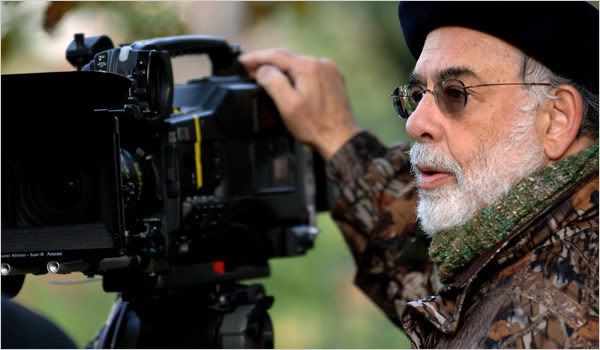 One of the running themes on Jim Emerson's scanners blog over the last year (roughly) is contrarianism as it relates to film criticism. Starting with a string of posts about Martin Scorsese's pedantic and shallow Oscar winner, The Departed, and various other things, Jim wrote piece after piece examining the idea of contrarianism. The discussions that resulted were enormous and rich, which is (I would guess) partly why he felt so inspired to continue writing about it. Eventually, he organized a contrarian blog-a-thon, which turned out to be quite a large event in the film blogging circuit, bringing in a number of contrarian perspectives on film, culture, and contrarianism. Although I would have loved to have delved more into my own contrarian passions, of which I have many, I opted to write more broadly about guilty pleasures. (My long gestating contrarian perspective of Frank Marshall's brilliant 1995 film Congo is still in development, and will see the light of day on this blog sometime in the hopefully near future. I promise.) But I love to relish in contrarian viewpoints, especially on taboo subjects like critically panned movies.
One recent example of how the critics turn against their once-darling filmmakers is Youth Without Youth, Francis Ford Coppola's long-awaited return to directing. I remember eagerly anticipating this film when I read about it last year. I was disheartened, however, to learn that most critics ripped the film -- it scored a poor 28 percent on the Tomatometer -- and its maker for being overly pretentious, heavy-handed, and condescending. Francis Ford Coppola, it seems, has fallen out of graces with the critics who championed him as the wonderboy of cinema 35 years ago. Amazingly, much of the criticism of the film echoed the same rhetoric about other supposedly "once great" auteurs, namely Woody Allen, whose recent films are unfairly simplified and situated within the "What Happend to Woody?" narrative to a sickening degree. Although Youth Without Youth is the first movie to be subject to such negative judgment, I fear that Coppola may be doomed to the same fate with critics, many of whom are so baffled that a filmmaker dares to offer something different from her/his previous work that they choose to deride the art. In trying to be contrarian and cutting edge -- like most critics are painted -- critics actually draw themselves as the boring community of homogenized writing styles they so adamantly reject.
 Based on the skewering criticism, it came as no surprise in its very limited release that was quickly "shown the door" at the cinema arthouses last December, when films like There Will Be Blood, Persepolis, and various others were competing for cinema goers' attention. In the blink of an eye, it seems, Youth Without Youth was gone, never to be heard from again like so many interesting looking films as awards season reared its head and started cutting down films to the small number that will be admitted into contemporary critical canon. It should be noted that films admitted to canon now often fail to resonate as much as films that were ignored in-the-moment, but over time were more memorable.
I discussed the danger of awards season discourse in a recent entry, in which I highlighted the importance of critics who were willing to swim against the current and talk about films no one else was talking about during awards season, such as David Cronenberg's mesmerizing, every-bit-as-good-as-No Country For Old Men film, Eastern Promises. But I admire just as much the critic who admirably discusses, and demands that we pay attention films that not only get forgotten, but which are disparaged and then forgotten, like Youth Without Youth.
Larry Aydlette is one of these critics. His seemingly bold take on the film, whether you agree or not, is utterly necessary at a time when so much criticism appears the same, not just in tone and structure, but in viewpoint too. His review of Youth Without Youth is inspiring, and should make and cinephile or critic want to see the film. Given that it would be impossible for any critic defending this film not to position her or himself as a "defender" of it, Aydlette takes on these criticisms head-on, and is baffled with the strangely uniform and predictable critical response to the film.
"I was completely mesmerized by Francis Ford Coppola's “Youth Without Youth.” If I had seen it last year, it would easily have made my Top 5 films of 2007. Where are all the cinephiles on this one? Why aren’t they supporting this legendary filmmaker? Isn't this what bloggers say they want more of: Independent movies with intelligence and storytelling and heart? I think that the failure here is not Coppola’s, but ours.
"Youth Without Youth” is told with passion and a love of a cinema that no longer exists. It’s the best movie Francis Ford Coppola has made since “Apocalypse Now.” Coppola has long promised to return to smaller, artier, more experimental films. This isn’t exactly experimental; it’s very soulful and old-fashioned. But in today’s film language, that’s downright radical. “Youth Without Youth” is one from the heart. Go see it."
 Simple, direct, and somewhat fiery. It's perfect. I should probably disclose that I haven't seen Youth Without Youth, but whether I've seen it or not is really the point. The reason this is important is because it reminds of how much critics actually become figures predictable sameness in their attempts to be cultural contrarians. It's firstly interesting that so many directors in their later years tend to be unfairly judged in a negative manner, as if critics recognize that they perhaps gave a filmmaker too much credit for her/his classics or masterpieces and are now making up for it. It is quite fascinating, though, to examine critical trends, specifically how certain filmmaking styles and aesthetic conventions suddenly become taboo, such as mise-en-scene and classically-influenced cinematography.
 But in a broader sense, I wonder if critics are losing touch with what it means to see films and write about them, and whether their sense of history contorts their understanding of contemporary cinema. Do we need a proverbial slap in the face to pull ourselves away of the same-old, boring conventions of predictable contrarianism? And at what point does being contrarian actually become the very act of sameness that contrarianism sought to reject in the first place? But I suppose the bigger question to come out of this is whether there is any way of shifting the critical dialogue away from the dominant binary approach of majority/minority and injecting it with the same amount of nuance that complex films demand?
Thursday, February 28, 2008
Cops: Special Iraq Edition
 Brian DePalma's underlying concept for his lraq war film, Redacted is noteworthy, along with his conviction and outrage regarding the subject matter. But those qualities are often hindered by sloppy execution, at least when it comes to formal film appreciation. Where DePalma is concerned mostly with stylistic details, his empassioned presentation of a soldier's experience in (and perspective of) Iraq is marred by poor acting and connect-the-dots screenwriting. Yet Redacted still manages to fulfill its purpose -- i.e. to disturb and provoke -- despite its failure to engage on the cerebral levels its makers clearly want to. The feelings/reactions that DePalma attempts to evoke are complicated, no doubt, but his film may work best as a piece of sensationalist propaganda, a la "Cops" or its news equivalent, "The O'Reilly Factor." Only instead of the dangerous streets of urban America, this film turns the tables on dominant representations of Iraqis and looks at the atrocities committed by American soldiers in Iraq; not safe territory. But the film isn't so much about heinous acts of bigotry and racism as it is about the dangers of representation in media economy, and how theses representations foster unhealthy and overly simplistic perspectives of people and cultures.
Redacted both critiques and embodies the kind of trash journalism that is pervasive in today's media environment, one that feeds on spectators' fears and nationalistic desires. Despite the formal failings in fundamental areas of filmmaking --acting and writing-- DePalma seems content to explore the nature of perspective in an age of ever-multiplying information sources and commercial interests. Redacted is a literally a visual assault of information, and although it sacrifices sound, formal filmmaking and occupies a particular political position, it is an important film because it is assaultive. It's an active reflection on the crisis of representation that has mounted for some time and is now boiling over in digital culture.
The film follows a squad of American soldiers stationed in Iraq, who, when they're not playing cards and bonding in male comradery (as only the movies can deliver), patrolthe dilapidated streets of an Iraqi city. Children run and play like any kids in a schoolyard might; kicking soccer balls and playing tag. Men and women walk about the rubble of destroyed buildings, going about their days in a more seemingly haphazard manner than would be Manhattan business people, patiently waiting in masses for a "Walk" sign to instruct them. City dwellers regard the soldiers with trepidation, despite having grown accustomed to their presence. Interestingly, the film keeps a strong focus on the soldiers themselves, concerning how hot, uncomfortable, and disoriented they are rather than anyone else. The soldiers loathe being there, and justifiably so. But the film keys in on the soldiers with regards to their view of everything around them, implicitly or explicitly wondering why or how a culture could be so different, violent, and barbaric. Every civilian is a potential suspect in the eyes of the soldiers, and after surprise assaults and bombings, they have gotten used to that.
 The movie is especially interesting in these moments, which are mostly captured on a small hand-held camera operated by on of the soliders who is resigned to capture the realism and immediacy of what they're enduring. This narrative and stylistic tactic is brilliantly used to form a soldier's sense of the surroundings and provide a feeling of the underlying tensions between two very different cultures and ideologies in such close prximity, each physically and symbolically occupying the same space. And yet on that ground, there tragically exists no plane of understanding, of sympathy, and of acceptance. Whether each culture's -- i.e. persons on the street (soldiers or citizens) -- perspective of the other is accurate or inaccurate, those perspectives are sealed in the cultural and ideological assumptions underlined in their respective practices. It's a cynical interpretation of everyday encounters between American soliders and Iraqi citizens, but one that's hard to deny.
Redacted doesn't remain grounded in these observations in the first portion of the film, arguably its most provocative. DePalma instead shifts attention to the rape of an innocent girl by two U.S. soldiers, an event depicted in graphic detail via the hand-held camera's night vision. The idealistic soldier operating the camera in no way condones the actions of the two soldiers who raped and killed the girl and her family, but his choice to record it becomes the central thematic groundwork on which the film bases its ehical, social, and philosophical claims. To play witness to an event is to submit to some kind mediating structure which enables one to interpret that image or event in a particular way. In other words, the spectator plays just an integral a role in the construction of a representation as those who construct it to be seen.
Apart from these consideration, the images are difficult to watch. There is a reality to it, one that is all the more sickening knowing that something similar to this actually happened. But if there was no desire to see the event, then it would not have been captured, and only would have existed in the memories of those who experienced it. Nevertheless, the man watches through the lens of the camera before leaving the building in sickness and disgust. The remainder of the film presents a variety if disparate images, some involving soldier's tributes to fallen heroes, others taking on security-cam vision of the soldiers interrogated over the events of rape. And perhaps most interestingly, several scenes offer up internet images of YouTube-like sites, where videos are posted by soldier's wives, anti-war activists, and masked soldiers admitting to having seen the event of the rape.
These moments are provocative in the greater consideration of media economy that the film actively constructs. Where the drama of the characters and soldiers' encounters tends to fizzle out in several scenes of poor acting and literalist writing, these different mediated images imbue the film's final proceedings with a level of interest that was only subtly suggested in first two acts. Whether DePalma knows it, the film eventually becomes the schlock pastiche of violent images and mediated information it seeks to question. The final montage of real images of carnage, death, and destruction suffered by the people of Iraq illustrates the polarizing differences between two cultures that ideologically and now physically clash. The problem is that those physical clashings are captured and portrayed in very particular manners, so as perhaps to facilitate further ideological clashings between what Slavoj Zizek deems the war between the "civilized" West and the "barbaric" culture of Islam it seeks to cleanse. Therefore, when we see these alternative, painful representations of those physical clashings, the need for a stronger and altogether different way of engaging issues of war/violence, media economy, and international relations becomes quite evident in the visceral, emotional reaction of witnessing such tragic occurrences.
In spite of its failings, Redacted strikes a resounding chord in an age in which cable news shows assault viewers with a plurality of violent images designed to evoke a specific emotional response: Fear; of terror, extremism, both which are too often foolishly associated with Islam. DePalma's central premise --that fear is harnessed by media powers as the central tool in the production of misguided nationalism-- is potent and relevant, and is one that mainstream (and so-called "liberal") media wouldn't dare consider.
The real question is to what extent his assertions against mainstream representations of violence and destruction may actually reproduce the very same kind of fears, thus failing to offer the beginnings of an alternative method of thinking the situation. And so we arrive once again to the crisis of representation: by refusing to offer dominant, i.e. patriotic representations of American soldiers and instead constructing a wholly different portrait of Iraq -- one that is readily accessible to those who decide to educate themselves about the American occupation in Iraq -- is DePalma degrading all troops and America? That's tough to say, but I would venture to guess based on the methods of his film's inquiry that he is more likely examining the notion that this "conflict" is more intricate than our narrow interpretations and representations will allow.
Friday, February 22, 2008
The films (and reviewing) that got away
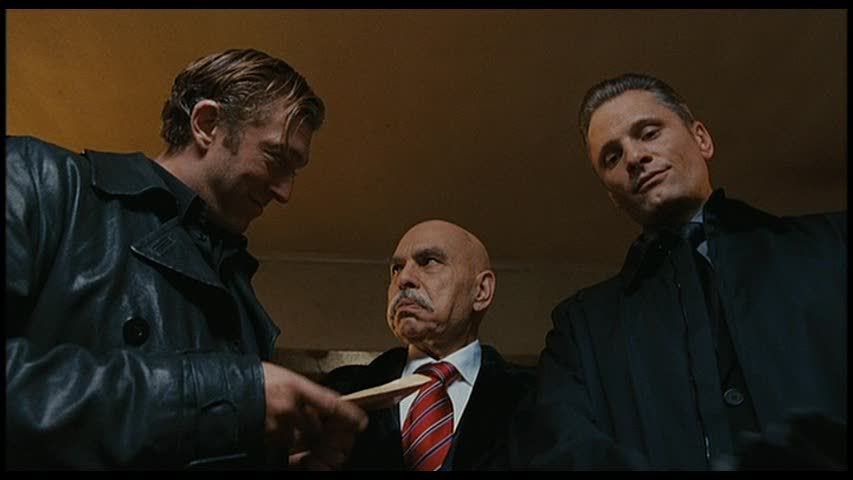 Year-end dialogues regarding the finest films of the year have gradually whittled down the number of films discussed from about 15/20 films to about five or 10 over the past few months. Then the Oscar nominations were released last month, and it was down to five films. Bloggers, pundits, and critics have since argued about the five movies -- whether one of them didn't deserve to be there, which should win the prize, etc. After Sunday, it will only be one. And then we will all move on.
 Seeing the plurality of great cinema released last year be reduced to bland discussion of "bests" is no doubt a tragedy. To see only five films, which is really only three -- Juno, There Will Be Blood, No Country For Old Men -- being discussed in spite of the many great films that didn't "peak at the right time" in the politics of awards season can be depressing. That's not to say that the Oscars are the be-all, end-all of critical discussion, but they represent the public's small investment in good, quality cinema. So the fact that only a few films, some of which are considered questionable by many, are being examined by the public eye is somewhat discouraging, especially when thinking back on the many great movies last year that slipped under the radar. Although I at least liked all of the Best Picture contenders this year (including Juno, minus the first 15 minutes), even the one I loved, i.e. No Country For Old Men, which has been written about and discussed in such great detail, is perhaps receiving an excess of attention, especially considering that so many other movies that are equally good, interesting, and worthy of discussion in the public domain.*
That's why it's refreshing to see other movies being talked about this time of year, and not because they were released in theaters or DVD. One of my very favorite movies from last year, David Cronenberg's Eastern Promises, had initial surge of discussion back in September during its theatrical run. (Here's my review of the film, written in September.) But this dialogue was quickly suppressed when the Toronto Film Festival started, and a variety of other films shared the attention. Nevertheless, Eastern Promises is a great achievement; that it's not currently held in the same high esteem as No Country For Old Men is a cinematic/critical crime.
It's easy to forget about wonderful films like Eastern Promises when Oscar talk has smothered all discussion about any other movie. Although Viggo Mortensen was nominated for Best Actor, his presence in the race is an afterthought; further validating the notion that the Oscars are nothing more than a political race. Eastern Promises, for whatever reason, lacks the financial backing and social presence and has lost a lot of steam since its release. It was fortunate enough that Mortensen was even nominated. That said, he doesn't stand a chance against a film that's gaining more momentum, i.e. There Will Be Blood, especially in the Best Actor category. Again, it's all a matter of politics. People are talking about There Will Be Blood and not Eastern Promises; whether the former is more worthy is more than questionable, stripped of the politics. Looking at the films and performances though, Mortensen's performance still stands out to me as the finest by any actor this year.
Which brings me to why it's so refreshing to read insightful articles about another movie, such as Ed Howard's intelligent review of Eastern Promises. Ed's writing demonstrates that this film (or any film) can be discussed, analyzed, and enjoyed from several perspectives; not just can be, but it should be. And he does this with so few words. His writing on Eastern Promises --like much of his work-- serves as an introduction to the film's key themes, and suggests a variety of levels on which Cronenberg's film resonates. Here's an excerpt:
"The story of Cronenberg's film — the real, underlying story lightly disguised by its genre trappings — can be read from the abundant symbols he employs. It's a story of the traditional family undermined by both homosexual desire and explosive violence — a brief that sounds surprisingly conservative on paper, except that Cronenberg clearly takes such gleeful pleasure in disrupting the placid surfaces of Hollywood conventionality that it's hard to take the film as anything but a radical critique of the normative structures it sometimes apes. Unlike A History of Violence, where Cronenberg seemed to disappear too readily into the conventional surfaces of the genre narrative, Eastern Promises is a prickly, genuinely disturbing and potent film that may indicate a fresh new development in Cronenberg's oeuvre. Certainly, it's his most perverse and exciting film since the delirious high point of 1997's Crash, and that alone is reason enough to celebrate this return to form."
I recommend heading over to his site and reading the whole review over at his place, Only the Cinema; a site that, by the way, features some of the most consistently thoughtful and provocative film reviews on the film blogging circuit. This review, in particular, is a model example of strong journalistic criticism, which is so sorely needed in the published and blogging venues. And in the midst of pervasive Oscar previewing and discussion, it reads even better.
I have always strongly felt that journalistic film reviewing can serve a good purpose in film journalism. The best of it can even bridge the gap between analytic examination and reflecting on the immediacy of cinematic sensation in tantalizingly few words. When that happens, it's a special thing.
Your thoughts?
-------------------------------------------
* Note: I'm not proposing that critics stop or greatly reduce discussion of films like No Country For Old Men. Engaging articles like this remind that too much can't be said about films like the Coens' eventual Best Picture winner. I'm instead suggesting that critics and bloggers --the latter of whom can mostly control the content of their output-- broaden their critical horizons and dare to discuss movies that aren't being discussed currently.
Wednesday, February 20, 2008
Indiana Jones and the Trailer of Digital Nostalgia
 With last week's debuting of the long-awaited Indiana Jones and the Kingdom of the Crystal Skull trailer, cinephiles, Indy fans, and casual movie watchers are now officially engaged in a three-month period of hype for the Man with the Hat's return to the big screen. For fans of the beloved 80's action series, the trailer serves up a heavy dose of nostalgia in painting Jones as a conqueror of worlds. The first minute (roughly) is a travelogue over the three films as a long build-up to the sight of Indy, 20 years later and fiesty as ever. After Indy and his hat are appropriately introduced via silhouette, all set to the instantly recognizable horn notes of the Raiders March, the trailer then presents a rapid-fire series of images from the new film, showing various explosions, wide-shots of exotic locations, character close-ups, and tons of "punchings." And within two minutes, the trailer has succeeded in reminding you why the world simply can't live without this character.
Although I don't usually keep up with the latest movie trailers (outside the occassional on-Demand trailer search), I should admit to having anticipated this one for some time. This is just one of those films that will escape all logical criticism for me. The series is too closely tied to my childhood for me to even pretend like this is any other movie. But now that I've seen it, digested it, and listened to various interpretations of its quality (or lack thereof), I've been thinking a lot about movie trailers in general; that is, how trailers and their condensed images work on viewers in the variety of ways they do. Obviously, a trailer for an "Indiana Jones" movie is different than your average trailer, especially with regards to how it's staged as "an event" (like the movie itself), and because it's function is not so much to advertise the movie as it is to envelop the viewer in a kind of cultural nostalgia. Specifically, the image-sound relations of this trailer are constructed in such a way so as to sell you on the idea that there has been a great void in "the movies" since Indy left the screen in 1989.
And indeed much has changed, both in the world and in mainstream filmmaking styles. While the cultural significance of "Indiana Jones" as a brand name for old-fashioned adventure, and/or the aesthetics of American action films are certainly interesting topics to think about and discuss, I'm more interested here in how these concepts are envisioned, drawn on, and constructed through a two minute advertisement. The notion that a movie trailer can create a kind of cinematic nostalgia as a device to sell a movie is really quite interesting, particularly when it comes to the warring aesthetics of the trailer. Also, how this discussion can be framed fromt the concept of "movie trailer as event" is .
In today's market for action films --as opposed to 20 years ago-- the trailer is everything. The task of the preview is essentially to play out the film in two to three minutes, or at least provide a sense of the film's visual styles. When it comes to plot, viewers don't want to know too much. But you can never have too many quick action shots of guns, explosions, and chases. Interestingly, action films themselves have disappointed in recent years. Even long-awaited sequels to Die Hard and Rambo, two of the more successful franchises in the heyday of action franchises, are failing to garner the same interest they once did. A large number of current action films fail both at the box office and in terms of overall cultural significance. The films (for the most part) are so dependent on the level of destruction rather than a sense of space, tension, and character; elements that must work for a strong action film. After all, there is an art to these movies -- the serious ones and even the throwaway B-movies -- that has largely been forgotten with regards to large-scale filmmaking.
 Although the movies themselves may fail to resonate, their respective trailers are so hyped, so pumped-up with action, that they have become the event, or the movies themselves. Thinking about trailers for Bad Boys II, Pearl Harbor, Terminator 3: Rise of the Machines, and others, there is an epic cinematic quality to them, something that wasn't present in the action/fantasy/adventure/sci-fi films of the 80's, and even the 90's. The aesthetics of movie trailers have changed so much in recent years to reflect changes in mainstream contemporary action filmmaking, which now prizes not seeing rather than seeing. With more close-ups, shaky camera work, and rapid editing, action films are intensifying established styles to such an extent that they are embodying a new aesthetic: a trailer aesthetic of sorts. (Of course, many filmmakers are fiercely contesting this popular trend; namely David Cronenberg. But I'm mostly talking about mainstream cinematic conventions.) This movement is so firmly established that when one looks back on old action flicks, it's easy to recognize the massive gap between the then and the now. It also may account for why trailers for mega-budgeted productions are more memorable than the movies themselves. These extremely popular hyper-styles of camerawork and editing work excellently in short stints, as for trailers. It's almost designed for trailers. But in many cases, this aesthetic doesn't sustain itself in two hour-long films. When it works though, e.g. The Bourne films, Cloverfield, etc., you've got a hit. Interestingly, the trailers for the Bourne films as well as Cloverfield were very different than the epic trailers for other established franchises that floundered.
 Trailers aesthetics is one small part of the picture when it comes to analyzing the box office success and cultural impact of action films in the digital age. There are so many more elements at play, but before I blow this discussion up to something epic in itself, I'd like to regain a little bit of focus and get back to the trailer for "Indiana Jones," and tackle the issue of why it seems so... off. Broadly speaking, it's caught between two worlds: one that's firmly built around contemporary demographics and current mainstream action film appeal, and one that's built on nostalgia for an age of filmmaking that couldn't be further removed from now. The first half of the trailer employs synthesized orchestral music to accompany the digitally mastered images from the first three films, which is a clear nod to new/old appeal it's trying to bridge. But in the second portion, everything goes haywire. The famous Indy theme seems misplaced with the rapid-fire and somewhat artificial-looking computer-generated images.
Looking at the trailers for the previous films, John Williams' music was far more conducive to the rhythms of the longer shots, which, captured the more old-fashioned style in which the films are made. Even if the images were cut together more quickly, the sense of hyper-motion doesn't pervade the old trailers. Which is why they aren't nearly as exciting. Nevertheless, it worked for its time because trailers were not nearly as significant a force in selling a movie as they are now. For the new preview, this old-fashioned musical approach simply doesn't work, and comes off as quite awkward. From a visual standpoint, the trailer is thoroughly contemporary, making the melodic beats of the Raiders March seem almost cartoonish as accompaniment to the images, resulting in a disorienting experience. And yet, looking at the films themselves, one should note that the Raiders March fits like a glove in some of the more memorable action set-pieces, notably in the quintessential chase scene, the desert truck chase from Raiders of the Lost Ark. The average shot length in that eight or nine minute sequence is probably not too different from, say, the trailer to The Kingdom of the Crystal Skull, and yet the music is rhythmically sound with the images.
 One the best criticisms of the Kingdom of the Crystal Skull trailer comes in the form of another trailer --fan-made, presumably-- using the same images from the recent trailer. This trailer, now on YouTube, is arguably more effective than the trailer we've got. What it does is break up the images of the trailer, re-assembles them, and present them according to the traditional model and aesthetic design for action films of the 80's. It uses audio and visual cues from previous "Indiana Jones" previews, displaying the disparate styles of trailers from 20 years ago and trailers from now. Despite the deliberate datedness and strange constrasts (especially after seeing the official trailer), this "old school" trailer actually works more effectively than the new trailer. It's still cut too quickly, which is perhaps inevitable since the source of most of images is the overcut preview. But it works still in spite of this. The images and the music together feel more appropriate for each other, and there is a consistent aesthetic structure throughout. The "old school" trailer is a strong reminder that a single image or shot is dependent on context. Its effect of an individual image depends on how it exists in relation not just to other images and shots, but to sounds as well. Which is why this fan-made trailer is more consistent and overall more satisfying than the colliding stylistic sensibilities of the official trailer.
 Another fascinating venue of discussion is the 2008 representing a digital age, not so much in terms of specific technologies, but as a social environment. The conditions under which images are made and seen are overall much less linear than it was before the introduction of the digital. Information is not conveyed the same way or even defined in a similar manner. Which is perhaps why a sequel to a popular action series of the 1980's, made by a director who has long since changed his own aesthetics, is especially interesting in today's market. Twenty years ago this trailer analysis would not have even occurred, let alone have been possible. There would no old school trailers or discussions about the contrasts between aesthetic styles of different times. The "old school" trailer is reflective of the current sensibility of reflexivity with regards to how contemporary viewers understand older stylistic tendencies and conventions; it's self-awareness is oddly reminiscent of Tarantino-style pastiche, in which digital viewers come to udnerstand older styles through reflexive visual cues.
Ultimately, this discussion of digital reflections and nostaglia may breach on larger issues of why Indiana Jones and the Kingdom of the Crystal Skull was made at all, and what kind of movie it will be... if it's even a movie at all, that is, rather than an experience in cultural nostalgia and digital reflexivity. But in keeping this discussion closely linked to the trailer itself, I would like to know your thoughts and reactions, no matter what angle you're coming from. Thus far, most reactions I've read/heard have been either extremely positive, mostly people who have bought right into the nostalgia, or extremely negative, i.e. those complaining about the use of CGI and the rapid-fire editing, and such. I feel both positively and negatively about it. I was swept into old reliable state of watching an Indiana Jones film. But the aesthetics of the preview are a constant reminder that no matter how true to style this film may be with regards to the previous films, it simply cannot recreate something that it's trying so hard to recreate. That's not to say that the movie will be made in this style -- just that the trailer is disjointed because of it. The movie may be an entirely different matter. It will be quite an interesting movie to watch indeed. Although it will be set in the 1950's, we will undoubtedly be seeing Indiana Jones in the digital age.
--------------------------------------------------------
Update - 2/20 - 4:25 PM: Some post-thoughts after reading one comment and writing one myself... If the trailer is any indication, this movie will be try to show that Indiana Jones is a timeless, mythic hero. After all, this trailer is not selling the movie at all. It's selling the significance and recognizability of the brand name of Indiana Jones. Just pay attention to how Indy is re-introduced without showing the face of Harrison Ford. The two most key points to Indy's re-introduction is the hat --seen first on the ground (when the music starts up), then in silhouette-- and the shot of Indy dodging bullets to the tune of "dah--dah-dah-DAHHH," which is the clear money-shot of the trailer. This trailer clearly demonstrates that it's not about proving anything in terms of Harrison's Ford age. If anything, they're using the impossibilty of his age --he is currently 65 years-old-- as an asset to Indy's timelessness and cementing as the modern heroic archetype.
Let's keep this discussion up!
---------------------------------------------------------
In the next (and final) episode of The Cinematic Art's "Indiana Jones" discussion series, we will take a look at the evils of the Motion Picture Association of America, who have once again wreaked havoc on the American moviegoing public, using censorship to impose certain values and ideas on us in their phantom removal of guns. The real question is: whose values/ideas are they representing? All that and more in the next chapter in this blogging saga... "Indiana Jones and the MPAA's Crusade."

Monday, February 18, 2008
Deleuze on mediators
Structuralisms/Deleuzean/Deleuze/Deleuze2.gif) The work of Gilles Deleuze is incendiary, even inspiring. His concepts draw no distinctions between scholars, artists, and scientists. He doesn't play to a particular discipline or crowd, especially not an intellectual one. If he is seen as inaccessible, it's likely because he harnesses language and theory in manners that are seen as incongruous to their predetermined function. One of his most profound statements is that we should all become multilingual with our own language, and even foreigners to our own language. For Deleuze, the plane of experience is about motion, movement, and images. There is no subject, and no ideology. There are no "correct" ideas or images, just ideas and images.
The work of Gilles Deleuze is incendiary, even inspiring. His concepts draw no distinctions between scholars, artists, and scientists. He doesn't play to a particular discipline or crowd, especially not an intellectual one. If he is seen as inaccessible, it's likely because he harnesses language and theory in manners that are seen as incongruous to their predetermined function. One of his most profound statements is that we should all become multilingual with our own language, and even foreigners to our own language. For Deleuze, the plane of experience is about motion, movement, and images. There is no subject, and no ideology. There are no "correct" ideas or images, just ideas and images. Although he has written just two books on cinema, a great focus of his writing is on the cinema. And his unique perspective about it is unlike any other I've seen or encountered. Both an empiricist and a poet, Deleuze locates the lines and spaces in between the binary machines and hetergeneous assemblages which call for experiences to be interpreted. For Deleuze, the pouring out of experience and the dually transient yet eternal plane of perception and experience is what we ought to be examining, and what he thinks writers like Kafka, Kerouac, and Fitzgerald tap into in an almost empirical way. Within these relations, the production of meaning, desire, and multiplicities developed – in the lines and particles of images and movements.
I've been reading quite a bit more about Deleuze's concepts over the last month, and the experience is both daunting and illuminating. I'm convinced that he may be our most relevant and significant thinker (although he died in 1995) with respect to art, science, and philosophy, three schools one would ordinarily think are so different from each other. For Deleuze, however, this is not the case. One book I've recently read of his, "Negotiations" contains his theoretical positions in a nutshell and is indispensable concerning how see media, how to analyze information, and how to critique art. Ahead I will highlight excerpts:
On Truth: "This idea that truth isn't something already out there we have to discover, but has to be created in every domain, is obvious in the sciences, for instance. Even in physics, there's no truth that doesn't pre-suppose a system of symbols, be they only coordinates. There's no truth that doesn't "falsify" established ideas. To say that "truth is created" implies that the production of truth involves a series of operative that amount to working on a material -- stricktly speaking, a series of falsifications."
"Truth, in other words, doesn't imply some method for discovering it but procedures, proceedings, and processes for willing it. We always get the truths we deserve, depending on the procedures of knowledge (linguistic procedures in particular), the proceedings of power, and the processes of subjectification or individuation available to us."
On the death of literature: "People who haven't properly read or understood McLuhan may think it's only natural for audiovisual media to replace books, since they actually contain all the creative possibilities of the literature or other modes of expression they supersede. It's not true. For if audiovisual media ever replace literature, it won't be as competing means of expression, but as a monopoloy of structures that also stifle creative possibilities in those media themselves. If literature dies, it will be a violent death, a political assassination. It's not a matter of comparing different sorts of medium. The choice isn't between written literature and audiovisual media. It's between creative forces and domesticating forces. It's highly unlikely that audiovisual mediawill find the conditions for creation once they've been lost in literature. Different modes of expression may have different creative possibilities, but they're all related insofar as they must counter the introduction of a cultural space of markets and conformity -- that is, a space of "producing a market" -- together."
On Creating Concepts/Images: "Philosophy, art, and science come into relation of mutual resonance and exchange, but always for internal reasons. The way they improge on one another depends on their own evolution. So in this sense we really have to see philosophy, art, and science as sorts of separate melodic lines in constant interplay with one another. With philosophy having in this no reflective pseudoprimacy nor, equally, any creative inferiority. Creating concepts is no less difficult than creating new visual or aural combinations, or creating scientific functions. What we have to recognize is that the inreplay between the different lines isn't a matter of one monitoring or reflecting another. A discipline that set out to follow a creative movement coming from outside would itself relinquish any creative role. You'll get nowhere by latching onto some parallel movement, you have to make a move yourself. If nobody make a move, nobody gets anywhere. Nor is interplany an exchange: it all turns on giving or taking."
Monday, February 11, 2008
Roy Scheider: In Memory
 Roy Scheider is the acting equivalent of Sidney Lumet. His filmography is staggering, and not because he was in so many hits or because of the awards he won. Over his long career, Scheider has quietly assembled one of the most impressive careers an actor can have in Hollywood. And quite simply, it's because he was good. He committed to each role he played, which is evident in his variety of strong performances, from The French Connection to All The Jazz. His face expressed so much but with so little. There was a passion in his eyes that was at once confident and vulnerable. Revealing character in the most subtle, even mysterious ways, the beauty of Scheider's work is that he did it in his own way. He carved his own niche. His best performances will be remembered as some of the most important and significant in all of cinema.
His most famous utterance on screen is the immortal "We're gonna need a bigger boat" line from Jaws. The cigarette dangles from his mouth like he doesn't even know it's there, his body is frozen in shock, and in that one moment of immobility he communicates exactly what every viewer watching the film feels. It's one of the most memorable moments in all of the movies, and it comes across because of Scheider's ability to evoke the intangibility about acting. This moment alone will cement Scheider into the minds of millions. It will be forever branded on the silver screens of our minds.
But for me, his finest moment comes in the very same movie, but in a much more tender scene at a dinner table. The scene contains almost no dialogue, and consists of Chief Brody (Scheider) and his son, who is maybe four-years-old, sitting at the table after dinner. Brody is tired and stressed, more so than he would ever expected to have dealth with. He's also beginning to feel a bit like the lone figure of authority left on Amity island with a shred of ethical responsiblity. His son sits across from him, watching him and mimicking his actions. At first, Brody doesn't realize he is even there, let alone replicating his actions. When he finally glances over and sees his son gazing admirably at him, he doesn't smile or well up in tears but instead looks right back at him. His facial muscles begin to relax, but for a moment he looks searchingly back into his son's eyes, as if he is recalling his own childhood wonderment with his father while realizing what a figure of importance he is to his child.
Brody then decides to have a little bit of fun, almost to reassure him that everything is going to be alright. The playful candor between the two is so naive, so benevolent, and yet profoundly simple, that it locates a childish wonderment that lives buried underneath the stress and burdens of everyday life. In that moment Scheider and his young acting counterpart create real magic. The scene continues with Brody leading his son in a series of strange hand motions and facial contortions, before his son finally smiles at him like he knew that was the one thing Brody needed to get through the rest of his day. Brody then leans down close to the boy's face and softly says, "Give us a kiss." The boy asks why, and Brody responds simply, directly, even painfully, as if caught between the reality of being chief of police in shark city and the transient moment of connecting with his son: "Because I need it."

Subscribe to:
Posts (Atom)