Thursday, March 27, 2008

The state of the (Cinematic) Art and other updates

The last six or seven weeks have been extremely busy for me, with business travel, social engagements, college basketball, and other activities filling up my calendar. Added up, these events have left me just barely enough time to upkeep a regular schedule of film viewing. And although I've maintained my screening schedule of about 12 to 15 movies per month, only a few of these films have I seen completely through on one viewing. I find myself starting a movie after 9:00 or 10:00 PM more often now, which I used to do quite frequently a couple of years ago. The difference between now and then is that I would last through a whole movie back then. Now I find myself watching a movie in halves or thirds much more, which is acceptable --even useful-- on second or third viewing, but not ideal for a first viewing.

With that said, I have seen several late 2007 movies on DVD; some wonderful (The Assassination of Jesse James by the Coward Robert Ford, Helvetica, Syndromes and a Century), some good (The Darjeeling Limited), and some mediocre (I Am Legend, Lust, Caution). But it's been nice to catch up on some of the 2007 releases I've missed in theaters, especially as I begin thinking about my upcoming Cinema 2007 post.

Fortunately, I've also had a few moments to counter all of these current films with a few older treasures (by comparison), which I've seen for the first time. One of these gems is Peter Jackson's famous low-budget horror film, Dead-Alive, one of the most delightfully twisted movies I've seen in some time, and a perfect movie to watch after 10:00 PM on a weeknight. It's is a pure joy from both a comedy and a horror standpoint, and its self-conscious nods to genre favorites are great for fans of the genre. And it's worth noting that the third act may boast the grandest orgy of violence these eyes have seen. So much I enjoyed the film that I couldn't resist posting the picture above (from the end of the film), featuring a lawnmower-wielding lovelorn hero ready to mow his way through legions of zombies. After the recent crop of serious zombie flicks, it's nice to look back on one with a bit more of a comedic approach to the irresistible sub-genre.

-----------------------------------

These excursions into cinephile indulgence that have given me reprieve from the busyness of other time-consuming activities. Apart from these film viewing experiences and other events, I've experienced a number of computer problems, which has severely handicapped my ability to write or post a new entry. So even though I've been able to somewhat maintain my film watching, my reading and writing has taken a hit.

Alas, my frustrations have finally paid off, and I'm coming to you now from a brand new computer with all kinds of new features. (Who knew that new versions of Microsoft Word would include a feature for writing blog posts!) I'm still trying to work out the kinks with adapting to the new system and to Vista, but now that I am up and running I can at least plunge head first into all the blogs I've only been glancing at here and there in recent weeks. As my familiarity with the computer grows, and the rest of my schedule begins to settle down (hopefully), I expect to be more active on the blogging front. But before I dive into some more elaborate and focused posts, I'd like to share just a few thoughts on blogging, from both inside and out.

In the past few weeks, I've only managed to visit web sites and blogs on a sporadic and limited basis. But since I've set myself up with the new computer, it's been refreshing to jump right back in to all the fun. One thing I've learned from being away from the film for a short time is that it moves very quickly. There is so much to catch up on. Perhaps Peter Bart wasn't too far off when we referred to bloggers as "busy bodies," because there is so much activity among film blogs that it's hard to streamline any of it. So much of our own material is rigorously controlled and always changing. We are the gods of our own universe, changing posts content and visual interfaces at will, shifting the entries on the all important blogrolls, and moderating the comments following our posts. Millions of threads of discussion are sprouting in new and old places that to try to jump in is like awkwardly trying to join a race already in progress. One just feels out of place. But when Big Events happen, the explosion of discourse is almost overwhelming (in a good way).

A great example of this would be the recent news that Nathan Lee was laid off by the Village Voice. Some of the discussion that's come about on various blogs has been incredible, reminding me of why I love this medium to begin with. But as Matt Zoller Seitz bittersweetly reminds in a comment over at his blog, The House Next Door, blogging as criticism will likely not be defined as the next step.

"What we're seeing here is the passing of a notable and vibrant phase of movie writing. It'll be replaced by something else, yes, but something very different.

I think we're fast approaching the point where criticism will become, for the most part, a devotion rather than a job.

I'm not quite sure what to make of that. There are definitely a lot of hack-y film critics (and there always have been). But some of the great ones that came along during the era of newspapers and magazines could not have reached a national or international audience without the support of a paycheck, editors, and the rest of the superstructure that professional publications have in place. And that's still true. The best film blogs are influential within the context of the film buff community, but the fact is, on their best days, even the biggest independent, halfway serious film blogs don't have a fraction of the readership of blogs that are attached to advertiser-supported big media outlets.

Will that change as the print medium dies out and becomes mulch for the next phase of journalism?

I wish I knew the answer to that."


While the explosion of online film discourse likely signal the dawn of a new movement in film criticism, as Matt remarks, its lack of structure and tangible direction demonstrates its somewhat perishable nature as well. Ultimately, all this blogging from the variety of professional and non-professional writers alike may not amount to much (in the professional sense), but I'm glad to be apart of it as a reader and a contributor. And as many have already said, hardly any of us have a clue where this little experiment is headed. But maybe that is what keeps us compelled to do it.

------------------------------------

On to some matters regarding TCA:

As I noted above, I will be posting more regularly in the near future. Many of these posts, at least for the next two months, may coincide with a project I'll be working on, which, ironically enough, will look at film criticism and new media in the digital age, specifically exploring the problematic binary of analog / digital and its constraining approach to engaging and understanding the role of new media in cultural and critical discourse.

This project will dominate the bulk of my free time until the end of the semester, but I will also reflect on some other topics in film criticism and on the blogging circuit. I may even post the occasional movie review. But I'm still struggling over how much I should indulge in my own cinematic tastes and experiences, as opposed to providing more currently relevant commentaries. Ideally, I don't want to be reactionary or inconsequential, which is a struggle for all of us "non-professional" bloggers, but it's something worth pondering reflexively as I attempt to gain a kind of critical relevance as a blogger. But if I want to build a solid critical relevance, that means engaging other media and critical outlets outside this blog, both online and in print. Coming months will determine what these endeavors may bring.

For now, however, I have some pieces in the pipeline that should give this site the boost it needs. I'll be presenting a piece on my favorite movies of last year, and will also be offering long-delayed thoughts on my presentation at SCMS.

As always, thanks for reading (and feel free to comment!), to those who take the time.

Wednesday, March 19, 2008

On the cinema of music

"There's a role that music plays in just filling up the screen. You don't necessarily hear every detail, but it's behind all the action, it's around all the action -- in the front of it, on the sides."

"One thing you don't want is for the music to become self-conscious, for the music to draw attention to itself. It really needs to be in the film, not sitting on top of the film."

"It really takes the right notes, the right gesture, the right amount of activity at the right time..."

- James Newton Howard

Musicians and filmmakers who intuitively grasp their art form have a way of tapping into the mysteries of perception, movement, and memory, and how they relate to each other. There are striking remblances between music and cinema. One can even say that cinema is a kind of musical expression, or that music has a cinematic-like motion.

These were thoughts I had while watching Tony Gilroy's Michael Clayton, a movie about law, corporate corruption, and social responsibility. Involving from start to finish, the film has a consistent line of quality regarding formal details, such as writing, acting, lighting, etc. I was surprised with the amount of very distinct moments in Michael Clayton that were like little cinematic universes to themselves. By that I mean the kind of moments that breach that elusive momentary sublimity that the best cinema constructs. These moments creep in, out, and around the movie, despite never really defining it. Sometimes it's a simple composition of a darkly lit street or office building corridor, or a well-acted and crisply-written exchange between two actors. Other times it is an intangible abstraction within seemingly simple movements. These moments often occur when the movement of sound and image interact together.

One of these moment occurs at end of the film, as Clayton (George Clooney) walks away from Karen Crowder (Tilda Swinton) as authorities swarm the premises. He walks directly toward the camera in a simple, evocative shot of hotel lobby area. As Clayton walks from the lobby to the escalator, the musical score enters into the image with just the right sound, speed, and rhythms to imbue the images with nobility and finality. A subtle piano chord accompanies these long shots of Clooney exiting the hotel and getting into a cab. It's a simple theme, consisting of only a few notes, but it compliments the images and the catharsis of the movie's climax to an extent that they breathe outside the typical Cathartic Climax you so commonly see at the end of a film. Until that point in the movie, the score is hardly noticeable. It features eletronics and ambient sounds, and builds subtle motifs for various moments and characters. But at the end, despite it still remaining quiet, it enables the climax a kind of fresh catharsis, one that hits the right note without overstating it. The sustained string chords and the extended shot of Clooney's face in the back of the taxi cab make for one of the more memorable film endings of 2007. Both the image and the music to "fit" each other. Neither would be right without the other.

The music was written by James Newton Howard, one of the more prominent composer of American film scores today. Howard seems to grasp not just musical theory and composition, with a strong knowledge of classical tradition of both the western orchestra and film scores as well as a keen ear for contemporary arrangements and electronic ambiance. Yet unlike many prominent film composers who write for Hollywood studio films, Howard understands the role of music in cinema. Music itself is a kind of cinema. In a recent video interview, Howard discussed the frequencies of music, noting that certain notes have particular textural and sensual properties. Many musicians have noted this in the past, but Howard's explanation of this notion of particularly interesting. He says:

"I've always felt that all music comes from the same source. I visualize a gigantic shpere --maybe it's a universe itself-- and from that sphere is basically everything that already exists. Because let's face it: everything in music already exists. It's just a matter of unravelling certain things and uncovering certain numbers of layers and finding things that were there. We're not inventing any frequencies. The frequencies exist in physics. They have always existed; they're there. The patterns of frequencies, the relationship of frequencies to each other, the timbres involved -- they're all pieces of some wonderful puzzle that a composer takes and puts together in whatever way [she or he] is able to to form a musical idea. But the salient idea for me is that its already there; it's there floating all around us. it's just a question of getting out of one's own way and letting it kind of come to you. That's really all I do. I spend most of my time trying to get out of my own way."

James Newton Howard would make a very good film critic. His understanding of music stretches beyond music, and seems to have more to do with the plane of sensory perception, i.e. experience. When we evaluate movies or pieces of music as cohesive wholes, all we have to go on is our memory if the chain of moments. These moments don't have specific starting or end points, but are instead multi-varied, ambiguous, and constantly bouncing off of each other. Our experience of perceptual stimulii of any kind seems to come down to how we arrange those moments, how we pluck them from the plane of experience and structure them to make sense, to mean. They cannot be reduced to mere linearities, boxed into symptoms or descriptions, but instead function assemblages of sound, memory, and emotion. The specific sensation of one single note or image is difficult to isolate from the rest of the experience and examined; it is changing along with the image and/or music.

In art, or narrative in general, we arranged images and sounds in recognizable patterns according to visual or musical vocabulary so that the viewer/listener may perceive them and situate them according to the pre-established clusters of visual and musical information. But the essence of cinema, and music as well, is in the experience of those sensations. It's not about understanding or interpreting, but seeing, hearing, feeling. The most effective cinematic and musical compositions are about moments that we experience in unison with various other moments, which we then reconstruct in our memories to form a greater sense of a shot, a scene, or a film, or a note, a bridge, and melody. The only difference is that we see images and hear music. But do we not also hear images and see music?

Although we have been socialized to experience and understand perceptual stimuli in a heavy categorical manner—i.e. sight, touch, taste, etc.—one could argue that sensual perception is a far more fluid process, and that we only condition ourselves to separate and distinguish between them. Artistic expressions like cinema or music employ all of the senses to construct and consume. Some would argue they even incorporate different ones. To "see" a film is to hear it, to touch it, to smell it, to taste it.

This idea is the greater basis for a more Deleuzian definition of cinematic movement, in which the movement-image is not exlusively a visual phenomenon, but also an auditory one, a musical one. Images—even those without sounds—are rhythmic, auditory, even musical. By the same token, cinematic sound deeply embodies the aesthetics of fluid motion and movements in an image. Movement and sound are entwined together. And that's the beauty of each. Cinema and music are the same expression insofar that they each dive into the senses and innate processes of sensation, thought, and lived experience.

We can analyze cinema from a particular theoretical perspective, e.g. Lacanian psycoanalysis or Bordwellian cognitivism, but as useful as it is learn about a film's thematic meaning or systematic relations, perhaps cinema creates a new kind of sensual experience that goes beyond the universalization of experience, which many of said bodies of concepts purport. Maybe it's difficult to recognize how perfect cinema really is because we've broken it down via theoretical or empirical means. But the Deleuzian cinema is right there in front of us. Maybe we just need to know how to see it.

What are some other movies or movie moments that capture this fleeting wonderment of sound and motion?

Wednesday, March 5, 2008

Canonized auteurs and contrarianism

One of the running themes on Jim Emerson's scanners blog over the last year (roughly) is contrarianism as it relates to film criticism. Starting with a string of posts about Martin Scorsese's pedantic and shallow Oscar winner, The Departed, and various other things, Jim wrote piece after piece examining the idea of contrarianism. The discussions that resulted were enormous and rich, which is (I would guess) partly why he felt so inspired to continue writing about it. Eventually, he organized a contrarian blog-a-thon, which turned out to be quite a large event in the film blogging circuit, bringing in a number of contrarian perspectives on film, culture, and contrarianism. Although I would have loved to have delved more into my own contrarian passions, of which I have many, I opted to write more broadly about guilty pleasures. (My long gestating contrarian perspective of Frank Marshall's brilliant 1995 film Congo is still in development, and will see the light of day on this blog sometime in the hopefully near future. I promise.) But I love to relish in contrarian viewpoints, especially on taboo subjects like critically panned movies.

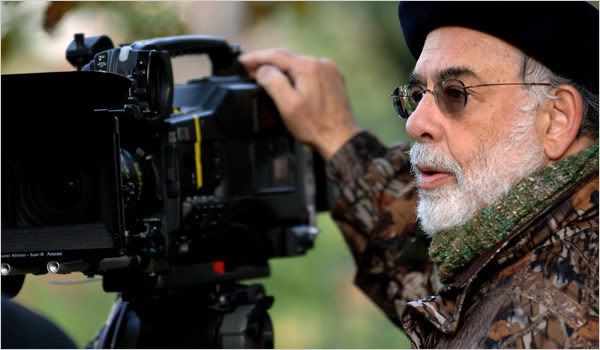
One recent example of how the critics turn against their once-darling filmmakers is Youth Without Youth, Francis Ford Coppola's long-awaited return to directing. I remember eagerly anticipating this film when I read about it last year. I was disheartened, however, to learn that most critics ripped the film -- it scored a poor 28 percent on the Tomatometer -- and its maker for being overly pretentious, heavy-handed, and condescending. Francis Ford Coppola, it seems, has fallen out of graces with the critics who championed him as the wonderboy of cinema 35 years ago. Amazingly, much of the criticism of the film echoed the same rhetoric about other supposedly "once great" auteurs, namely Woody Allen, whose recent films are unfairly simplified and situated within the "What Happend to Woody?" narrative to a sickening degree. Although Youth Without Youth is the first movie to be subject to such negative judgment, I fear that Coppola may be doomed to the same fate with critics, many of whom are so baffled that a filmmaker dares to offer something different from her/his previous work that they choose to deride the art. In trying to be contrarian and cutting edge -- like most critics are painted -- critics actually draw themselves as the boring community of homogenized writing styles they so adamantly reject.

Based on the skewering criticism, it came as no surprise in its very limited release that was quickly "shown the door" at the cinema arthouses last December, when films like There Will Be Blood, Persepolis, and various others were competing for cinema goers' attention. In the blink of an eye, it seems, Youth Without Youth was gone, never to be heard from again like so many interesting looking films as awards season reared its head and started cutting down films to the small number that will be admitted into contemporary critical canon. It should be noted that films admitted to canon now often fail to resonate as much as films that were ignored in-the-moment, but over time were more memorable.

I discussed the danger of awards season discourse in a recent entry, in which I highlighted the importance of critics who were willing to swim against the current and talk about films no one else was talking about during awards season, such as David Cronenberg's mesmerizing, every-bit-as-good-as-No Country For Old Men film, Eastern Promises. But I admire just as much the critic who admirably discusses, and demands that we pay attention films that not only get forgotten, but which are disparaged and then forgotten, like Youth Without Youth.

Larry Aydlette is one of these critics. His seemingly bold take on the film, whether you agree or not, is utterly necessary at a time when so much criticism appears the same, not just in tone and structure, but in viewpoint too. His review of Youth Without Youth is inspiring, and should make and cinephile or critic want to see the film. Given that it would be impossible for any critic defending this film not to position her or himself as a "defender" of it, Aydlette takes on these criticisms head-on, and is baffled with the strangely uniform and predictable critical response to the film.

"I was completely mesmerized by Francis Ford Coppola's “Youth Without Youth.” If I had seen it last year, it would easily have made my Top 5 films of 2007. Where are all the cinephiles on this one? Why aren’t they supporting this legendary filmmaker? Isn't this what bloggers say they want more of: Independent movies with intelligence and storytelling and heart? I think that the failure here is not Coppola’s, but ours.

"Youth Without Youth” is told with passion and a love of a cinema that no longer exists. It’s the best movie Francis Ford Coppola has made since “Apocalypse Now.” Coppola has long promised to return to smaller, artier, more experimental films. This isn’t exactly experimental; it’s very soulful and old-fashioned. But in today’s film language, that’s downright radical. “Youth Without Youth” is one from the heart. Go see it."


Simple, direct, and somewhat fiery. It's perfect. I should probably disclose that I haven't seen Youth Without Youth, but whether I've seen it or not is really the point. The reason this is important is because it reminds of how much critics actually become figures predictable sameness in their attempts to be cultural contrarians. It's firstly interesting that so many directors in their later years tend to be unfairly judged in a negative manner, as if critics recognize that they perhaps gave a filmmaker too much credit for her/his classics or masterpieces and are now making up for it. It is quite fascinating, though, to examine critical trends, specifically how certain filmmaking styles and aesthetic conventions suddenly become taboo, such as mise-en-scene and classically-influenced cinematography.

But in a broader sense, I wonder if critics are losing touch with what it means to see films and write about them, and whether their sense of history contorts their understanding of contemporary cinema. Do we need a proverbial slap in the face to pull ourselves away of the same-old, boring conventions of predictable contrarianism? And at what point does being contrarian actually become the very act of sameness that contrarianism sought to reject in the first place? But I suppose the bigger question to come out of this is whether there is any way of shifting the critical dialogue away from the dominant binary approach of majority/minority and injecting it with the same amount of nuance that complex films demand?

Thursday, February 28, 2008

Cops: Special Iraq Edition

Brian DePalma's underlying concept for his lraq war film, Redacted is noteworthy, along with his conviction and outrage regarding the subject matter. But those qualities are often hindered by sloppy execution, at least when it comes to formal film appreciation. Where DePalma is concerned mostly with stylistic details, his empassioned presentation of a soldier's experience in (and perspective of) Iraq is marred by poor acting and connect-the-dots screenwriting. Yet Redacted still manages to fulfill its purpose -- i.e. to disturb and provoke -- despite its failure to engage on the cerebral levels its makers clearly want to. The feelings/reactions that DePalma attempts to evoke are complicated, no doubt, but his film may work best as a piece of sensationalist propaganda, a la "Cops" or its news equivalent, "The O'Reilly Factor." Only instead of the dangerous streets of urban America, this film turns the tables on dominant representations of Iraqis and looks at the atrocities committed by American soldiers in Iraq; not safe territory. But the film isn't so much about heinous acts of bigotry and racism as it is about the dangers of representation in media economy, and how theses representations foster unhealthy and overly simplistic perspectives of people and cultures.

Redacted both critiques and embodies the kind of trash journalism that is pervasive in today's media environment, one that feeds on spectators' fears and nationalistic desires. Despite the formal failings in fundamental areas of filmmaking --acting and writing-- DePalma seems content to explore the nature of perspective in an age of ever-multiplying information sources and commercial interests. Redacted is a literally a visual assault of information, and although it sacrifices sound, formal filmmaking and occupies a particular political position, it is an important film because it is assaultive. It's an active reflection on the crisis of representation that has mounted for some time and is now boiling over in digital culture.

The film follows a squad of American soldiers stationed in Iraq, who, when they're not playing cards and bonding in male comradery (as only the movies can deliver), patrolthe dilapidated streets of an Iraqi city. Children run and play like any kids in a schoolyard might; kicking soccer balls and playing tag. Men and women walk about the rubble of destroyed buildings, going about their days in a more seemingly haphazard manner than would be Manhattan business people, patiently waiting in masses for a "Walk" sign to instruct them. City dwellers regard the soldiers with trepidation, despite having grown accustomed to their presence. Interestingly, the film keeps a strong focus on the soldiers themselves, concerning how hot, uncomfortable, and disoriented they are rather than anyone else. The soldiers loathe being there, and justifiably so. But the film keys in on the soldiers with regards to their view of everything around them, implicitly or explicitly wondering why or how a culture could be so different, violent, and barbaric. Every civilian is a potential suspect in the eyes of the soldiers, and after surprise assaults and bombings, they have gotten used to that.

The movie is especially interesting in these moments, which are mostly captured on a small hand-held camera operated by on of the soliders who is resigned to capture the realism and immediacy of what they're enduring. This narrative and stylistic tactic is brilliantly used to form a soldier's sense of the surroundings and provide a feeling of the underlying tensions between two very different cultures and ideologies in such close prximity, each physically and symbolically occupying the same space. And yet on that ground, there tragically exists no plane of understanding, of sympathy, and of acceptance. Whether each culture's -- i.e. persons on the street (soldiers or citizens) -- perspective of the other is accurate or inaccurate, those perspectives are sealed in the cultural and ideological assumptions underlined in their respective practices. It's a cynical interpretation of everyday encounters between American soliders and Iraqi citizens, but one that's hard to deny.

Redacted doesn't remain grounded in these observations in the first portion of the film, arguably its most provocative. DePalma instead shifts attention to the rape of an innocent girl by two U.S. soldiers, an event depicted in graphic detail via the hand-held camera's night vision. The idealistic soldier operating the camera in no way condones the actions of the two soldiers who raped and killed the girl and her family, but his choice to record it becomes the central thematic groundwork on which the film bases its ehical, social, and philosophical claims. To play witness to an event is to submit to some kind mediating structure which enables one to interpret that image or event in a particular way. In other words, the spectator plays just an integral a role in the construction of a representation as those who construct it to be seen.

Apart from these consideration, the images are difficult to watch. There is a reality to it, one that is all the more sickening knowing that something similar to this actually happened. But if there was no desire to see the event, then it would not have been captured, and only would have existed in the memories of those who experienced it. Nevertheless, the man watches through the lens of the camera before leaving the building in sickness and disgust. The remainder of the film presents a variety if disparate images, some involving soldier's tributes to fallen heroes, others taking on security-cam vision of the soldiers interrogated over the events of rape. And perhaps most interestingly, several scenes offer up internet images of YouTube-like sites, where videos are posted by soldier's wives, anti-war activists, and masked soldiers admitting to having seen the event of the rape.

These moments are provocative in the greater consideration of media economy that the film actively constructs. Where the drama of the characters and soldiers' encounters tends to fizzle out in several scenes of poor acting and literalist writing, these different mediated images imbue the film's final proceedings with a level of interest that was only subtly suggested in first two acts. Whether DePalma knows it, the film eventually becomes the schlock pastiche of violent images and mediated information it seeks to question. The final montage of real images of carnage, death, and destruction suffered by the people of Iraq illustrates the polarizing differences between two cultures that ideologically and now physically clash. The problem is that those physical clashings are captured and portrayed in very particular manners, so as perhaps to facilitate further ideological clashings between what Slavoj Zizek deems the war between the "civilized" West and the "barbaric" culture of Islam it seeks to cleanse. Therefore, when we see these alternative, painful representations of those physical clashings, the need for a stronger and altogether different way of engaging issues of war/violence, media economy, and international relations becomes quite evident in the visceral, emotional reaction of witnessing such tragic occurrences.

In spite of its failings, Redacted strikes a resounding chord in an age in which cable news shows assault viewers with a plurality of violent images designed to evoke a specific emotional response: Fear; of terror, extremism, both which are too often foolishly associated with Islam. DePalma's central premise --that fear is harnessed by media powers as the central tool in the production of misguided nationalism-- is potent and relevant, and is one that mainstream (and so-called "liberal") media wouldn't dare consider.

The real question is to what extent his assertions against mainstream representations of violence and destruction may actually reproduce the very same kind of fears, thus failing to offer the beginnings of an alternative method of thinking the situation. And so we arrive once again to the crisis of representation: by refusing to offer dominant, i.e. patriotic representations of American soldiers and instead constructing a wholly different portrait of Iraq -- one that is readily accessible to those who decide to educate themselves about the American occupation in Iraq -- is DePalma degrading all troops and America? That's tough to say, but I would venture to guess based on the methods of his film's inquiry that he is more likely examining the notion that this "conflict" is more intricate than our narrow interpretations and representations will allow.

Friday, February 22, 2008

The films (and reviewing) that got away

Year-end dialogues regarding the finest films of the year have gradually whittled down the number of films discussed from about 15/20 films to about five or 10 over the past few months. Then the Oscar nominations were released last month, and it was down to five films. Bloggers, pundits, and critics have since argued about the five movies -- whether one of them didn't deserve to be there, which should win the prize, etc. After Sunday, it will only be one. And then we will all move on.

Seeing the plurality of great cinema released last year be reduced to bland discussion of "bests" is no doubt a tragedy. To see only five films, which is really only three -- Juno, There Will Be Blood, No Country For Old Men -- being discussed in spite of the many great films that didn't "peak at the right time" in the politics of awards season can be depressing. That's not to say that the Oscars are the be-all, end-all of critical discussion, but they represent the public's small investment in good, quality cinema. So the fact that only a few films, some of which are considered questionable by many, are being examined by the public eye is somewhat discouraging, especially when thinking back on the many great movies last year that slipped under the radar. Although I at least liked all of the Best Picture contenders this year (including Juno, minus the first 15 minutes), even the one I loved, i.e. No Country For Old Men, which has been written about and discussed in such great detail, is perhaps receiving an excess of attention, especially considering that so many other movies that are equally good, interesting, and worthy of discussion in the public domain.*

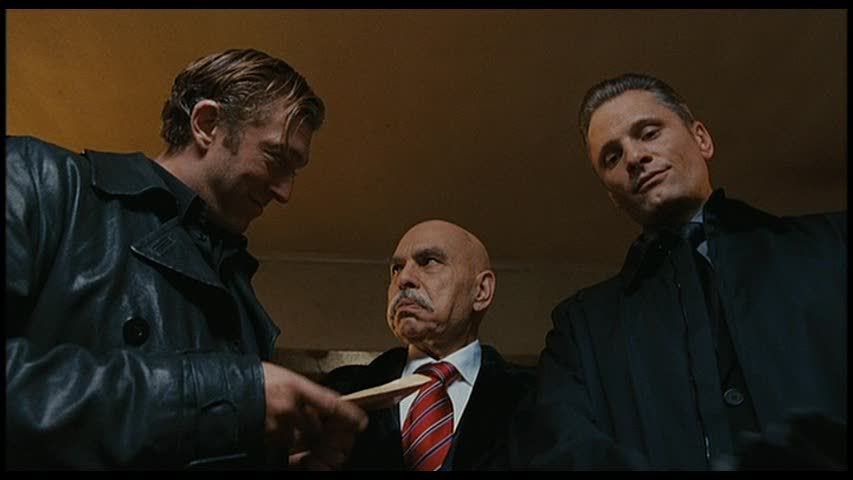
That's why it's refreshing to see other movies being talked about this time of year, and not because they were released in theaters or DVD. One of my very favorite movies from last year, David Cronenberg's Eastern Promises, had initial surge of discussion back in September during its theatrical run. (Here's my review of the film, written in September.) But this dialogue was quickly suppressed when the Toronto Film Festival started, and a variety of other films shared the attention. Nevertheless, Eastern Promises is a great achievement; that it's not currently held in the same high esteem as No Country For Old Men is a cinematic/critical crime.

It's easy to forget about wonderful films like Eastern Promises when Oscar talk has smothered all discussion about any other movie. Although Viggo Mortensen was nominated for Best Actor, his presence in the race is an afterthought; further validating the notion that the Oscars are nothing more than a political race. Eastern Promises, for whatever reason, lacks the financial backing and social presence and has lost a lot of steam since its release. It was fortunate enough that Mortensen was even nominated. That said, he doesn't stand a chance against a film that's gaining more momentum, i.e. There Will Be Blood, especially in the Best Actor category. Again, it's all a matter of politics. People are talking about There Will Be Blood and not Eastern Promises; whether the former is more worthy is more than questionable, stripped of the politics. Looking at the films and performances though, Mortensen's performance still stands out to me as the finest by any actor this year.

Which brings me to why it's so refreshing to read insightful articles about another movie, such as Ed Howard's intelligent review of Eastern Promises. Ed's writing demonstrates that this film (or any film) can be discussed, analyzed, and enjoyed from several perspectives; not just can be, but it should be. And he does this with so few words. His writing on Eastern Promises --like much of his work-- serves as an introduction to the film's key themes, and suggests a variety of levels on which Cronenberg's film resonates. Here's an excerpt:

"The story of Cronenberg's film — the real, underlying story lightly disguised by its genre trappings — can be read from the abundant symbols he employs. It's a story of the traditional family undermined by both homosexual desire and explosive violence — a brief that sounds surprisingly conservative on paper, except that Cronenberg clearly takes such gleeful pleasure in disrupting the placid surfaces of Hollywood conventionality that it's hard to take the film as anything but a radical critique of the normative structures it sometimes apes. Unlike A History of Violence, where Cronenberg seemed to disappear too readily into the conventional surfaces of the genre narrative, Eastern Promises is a prickly, genuinely disturbing and potent film that may indicate a fresh new development in Cronenberg's oeuvre. Certainly, it's his most perverse and exciting film since the delirious high point of 1997's Crash, and that alone is reason enough to celebrate this return to form."

I recommend heading over to his site and reading the whole review over at his place, Only the Cinema; a site that, by the way, features some of the most consistently thoughtful and provocative film reviews on the film blogging circuit. This review, in particular, is a model example of strong journalistic criticism, which is so sorely needed in the published and blogging venues. And in the midst of pervasive Oscar previewing and discussion, it reads even better.

I have always strongly felt that journalistic film reviewing can serve a good purpose in film journalism. The best of it can even bridge the gap between analytic examination and reflecting on the immediacy of cinematic sensation in tantalizingly few words. When that happens, it's a special thing.

Your thoughts?

-------------------------------------------

* Note: I'm not proposing that critics stop or greatly reduce discussion of films like No Country For Old Men. Engaging articles like this remind that too much can't be said about films like the Coens' eventual Best Picture winner. I'm instead suggesting that critics and bloggers --the latter of whom can mostly control the content of their output-- broaden their critical horizons and dare to discuss movies that aren't being discussed currently.

Wednesday, February 20, 2008

Indiana Jones and the Trailer of Digital Nostalgia

With last week's debuting of the long-awaited Indiana Jones and the Kingdom of the Crystal Skull trailer, cinephiles, Indy fans, and casual movie watchers are now officially engaged in a three-month period of hype for the Man with the Hat's return to the big screen. For fans of the beloved 80's action series, the trailer serves up a heavy dose of nostalgia in painting Jones as a conqueror of worlds. The first minute (roughly) is a travelogue over the three films as a long build-up to the sight of Indy, 20 years later and fiesty as ever. After Indy and his hat are appropriately introduced via silhouette, all set to the instantly recognizable horn notes of the Raiders March, the trailer then presents a rapid-fire series of images from the new film, showing various explosions, wide-shots of exotic locations, character close-ups, and tons of "punchings." And within two minutes, the trailer has succeeded in reminding you why the world simply can't live without this character.

Although I don't usually keep up with the latest movie trailers (outside the occassional on-Demand trailer search), I should admit to having anticipated this one for some time. This is just one of those films that will escape all logical criticism for me. The series is too closely tied to my childhood for me to even pretend like this is any other movie. But now that I've seen it, digested it, and listened to various interpretations of its quality (or lack thereof), I've been thinking a lot about movie trailers in general; that is, how trailers and their condensed images work on viewers in the variety of ways they do. Obviously, a trailer for an "Indiana Jones" movie is different than your average trailer, especially with regards to how it's staged as "an event" (like the movie itself), and because it's function is not so much to advertise the movie as it is to envelop the viewer in a kind of cultural nostalgia. Specifically, the image-sound relations of this trailer are constructed in such a way so as to sell you on the idea that there has been a great void in "the movies" since Indy left the screen in 1989.

And indeed much has changed, both in the world and in mainstream filmmaking styles. While the cultural significance of "Indiana Jones" as a brand name for old-fashioned adventure, and/or the aesthetics of American action films are certainly interesting topics to think about and discuss, I'm more interested here in how these concepts are envisioned, drawn on, and constructed through a two minute advertisement. The notion that a movie trailer can create a kind of cinematic nostalgia as a device to sell a movie is really quite interesting, particularly when it comes to the warring aesthetics of the trailer. Also, how this discussion can be framed fromt the concept of "movie trailer as event" is .

In today's market for action films --as opposed to 20 years ago-- the trailer is everything. The task of the preview is essentially to play out the film in two to three minutes, or at least provide a sense of the film's visual styles. When it comes to plot, viewers don't want to know too much. But you can never have too many quick action shots of guns, explosions, and chases. Interestingly, action films themselves have disappointed in recent years. Even long-awaited sequels to Die Hard and Rambo, two of the more successful franchises in the heyday of action franchises, are failing to garner the same interest they once did. A large number of current action films fail both at the box office and in terms of overall cultural significance. The films (for the most part) are so dependent on the level of destruction rather than a sense of space, tension, and character; elements that must work for a strong action film. After all, there is an art to these movies -- the serious ones and even the throwaway B-movies -- that has largely been forgotten with regards to large-scale filmmaking.

Although the movies themselves may fail to resonate, their respective trailers are so hyped, so pumped-up with action, that they have become the event, or the movies themselves. Thinking about trailers for Bad Boys II, Pearl Harbor, Terminator 3: Rise of the Machines, and others, there is an epic cinematic quality to them, something that wasn't present in the action/fantasy/adventure/sci-fi films of the 80's, and even the 90's. The aesthetics of movie trailers have changed so much in recent years to reflect changes in mainstream contemporary action filmmaking, which now prizes not seeing rather than seeing. With more close-ups, shaky camera work, and rapid editing, action films are intensifying established styles to such an extent that they are embodying a new aesthetic: a trailer aesthetic of sorts. (Of course, many filmmakers are fiercely contesting this popular trend; namely David Cronenberg. But I'm mostly talking about mainstream cinematic conventions.) This movement is so firmly established that when one looks back on old action flicks, it's easy to recognize the massive gap between the then and the now. It also may account for why trailers for mega-budgeted productions are more memorable than the movies themselves. These extremely popular hyper-styles of camerawork and editing work excellently in short stints, as for trailers. It's almost designed for trailers. But in many cases, this aesthetic doesn't sustain itself in two hour-long films. When it works though, e.g. The Bourne films, Cloverfield, etc., you've got a hit. Interestingly, the trailers for the Bourne films as well as Cloverfield were very different than the epic trailers for other established franchises that floundered.

Trailers aesthetics is one small part of the picture when it comes to analyzing the box office success and cultural impact of action films in the digital age. There are so many more elements at play, but before I blow this discussion up to something epic in itself, I'd like to regain a little bit of focus and get back to the trailer for "Indiana Jones," and tackle the issue of why it seems so... off. Broadly speaking, it's caught between two worlds: one that's firmly built around contemporary demographics and current mainstream action film appeal, and one that's built on nostalgia for an age of filmmaking that couldn't be further removed from now. The first half of the trailer employs synthesized orchestral music to accompany the digitally mastered images from the first three films, which is a clear nod to new/old appeal it's trying to bridge. But in the second portion, everything goes haywire. The famous Indy theme seems misplaced with the rapid-fire and somewhat artificial-looking computer-generated images.

Looking at the trailers for the previous films, John Williams' music was far more conducive to the rhythms of the longer shots, which, captured the more old-fashioned style in which the films are made. Even if the images were cut together more quickly, the sense of hyper-motion doesn't pervade the old trailers. Which is why they aren't nearly as exciting. Nevertheless, it worked for its time because trailers were not nearly as significant a force in selling a movie as they are now. For the new preview, this old-fashioned musical approach simply doesn't work, and comes off as quite awkward. From a visual standpoint, the trailer is thoroughly contemporary, making the melodic beats of the Raiders March seem almost cartoonish as accompaniment to the images, resulting in a disorienting experience. And yet, looking at the films themselves, one should note that the Raiders March fits like a glove in some of the more memorable action set-pieces, notably in the quintessential chase scene, the desert truck chase from Raiders of the Lost Ark. The average shot length in that eight or nine minute sequence is probably not too different from, say, the trailer to The Kingdom of the Crystal Skull, and yet the music is rhythmically sound with the images.

One the best criticisms of the Kingdom of the Crystal Skull trailer comes in the form of another trailer --fan-made, presumably-- using the same images from the recent trailer. This trailer, now on YouTube, is arguably more effective than the trailer we've got. What it does is break up the images of the trailer, re-assembles them, and present them according to the traditional model and aesthetic design for action films of the 80's. It uses audio and visual cues from previous "Indiana Jones" previews, displaying the disparate styles of trailers from 20 years ago and trailers from now. Despite the deliberate datedness and strange constrasts (especially after seeing the official trailer), this "old school" trailer actually works more effectively than the new trailer. It's still cut too quickly, which is perhaps inevitable since the source of most of images is the overcut preview. But it works still in spite of this. The images and the music together feel more appropriate for each other, and there is a consistent aesthetic structure throughout. The "old school" trailer is a strong reminder that a single image or shot is dependent on context. Its effect of an individual image depends on how it exists in relation not just to other images and shots, but to sounds as well. Which is why this fan-made trailer is more consistent and overall more satisfying than the colliding stylistic sensibilities of the official trailer.

Another fascinating venue of discussion is the 2008 representing a digital age, not so much in terms of specific technologies, but as a social environment. The conditions under which images are made and seen are overall much less linear than it was before the introduction of the digital. Information is not conveyed the same way or even defined in a similar manner. Which is perhaps why a sequel to a popular action series of the 1980's, made by a director who has long since changed his own aesthetics, is especially interesting in today's market. Twenty years ago this trailer analysis would not have even occurred, let alone have been possible. There would no old school trailers or discussions about the contrasts between aesthetic styles of different times. The "old school" trailer is reflective of the current sensibility of reflexivity with regards to how contemporary viewers understand older stylistic tendencies and conventions; it's self-awareness is oddly reminiscent of Tarantino-style pastiche, in which digital viewers come to udnerstand older styles through reflexive visual cues.

Ultimately, this discussion of digital reflections and nostaglia may breach on larger issues of why Indiana Jones and the Kingdom of the Crystal Skull was made at all, and what kind of movie it will be... if it's even a movie at all, that is, rather than an experience in cultural nostalgia and digital reflexivity. But in keeping this discussion closely linked to the trailer itself, I would like to know your thoughts and reactions, no matter what angle you're coming from. Thus far, most reactions I've read/heard have been either extremely positive, mostly people who have bought right into the nostalgia, or extremely negative, i.e. those complaining about the use of CGI and the rapid-fire editing, and such. I feel both positively and negatively about it. I was swept into old reliable state of watching an Indiana Jones film. But the aesthetics of the preview are a constant reminder that no matter how true to style this film may be with regards to the previous films, it simply cannot recreate something that it's trying so hard to recreate. That's not to say that the movie will be made in this style -- just that the trailer is disjointed because of it. The movie may be an entirely different matter. It will be quite an interesting movie to watch indeed. Although it will be set in the 1950's, we will undoubtedly be seeing Indiana Jones in the digital age.

--------------------------------------------------------

Update - 2/20 - 4:25 PM: Some post-thoughts after reading one comment and writing one myself... If the trailer is any indication, this movie will be try to show that Indiana Jones is a timeless, mythic hero. After all, this trailer is not selling the movie at all. It's selling the significance and recognizability of the brand name of Indiana Jones. Just pay attention to how Indy is re-introduced without showing the face of Harrison Ford. The two most key points to Indy's re-introduction is the hat --seen first on the ground (when the music starts up), then in silhouette-- and the shot of Indy dodging bullets to the tune of "dah--dah-dah-DAHHH," which is the clear money-shot of the trailer. This trailer clearly demonstrates that it's not about proving anything in terms of Harrison's Ford age. If anything, they're using the impossibilty of his age --he is currently 65 years-old-- as an asset to Indy's timelessness and cementing as the modern heroic archetype.

Let's keep this discussion up!

---------------------------------------------------------

In the next (and final) episode of The Cinematic Art's "Indiana Jones" discussion series, we will take a look at the evils of the Motion Picture Association of America, who have once again wreaked havoc on the American moviegoing public, using censorship to impose certain values and ideas on us in their phantom removal of guns. The real question is: whose values/ideas are they representing? All that and more in the next chapter in this blogging saga... "Indiana Jones and the MPAA's Crusade."

Monday, February 18, 2008

Deleuze on mediators

The work of Gilles Deleuze is incendiary, even inspiring. His concepts draw no distinctions between scholars, artists, and scientists. He doesn't play to a particular discipline or crowd, especially not an intellectual one. If he is seen as inaccessible, it's likely because he harnesses language and theory in manners that are seen as incongruous to their predetermined function. One of his most profound statements is that we should all become multilingual with our own language, and even foreigners to our own language. For Deleuze, the plane of experience is about motion, movement, and images. There is no subject, and no ideology. There are no "correct" ideas or images, just ideas and images.

Although he has written just two books on cinema, a great focus of his writing is on the cinema. And his unique perspective about it is unlike any other I've seen or encountered. Both an empiricist and a poet, Deleuze locates the lines and spaces in between the binary machines and hetergeneous assemblages which call for experiences to be interpreted. For Deleuze, the pouring out of experience and the dually transient yet eternal plane of perception and experience is what we ought to be examining, and what he thinks writers like Kafka, Kerouac, and Fitzgerald tap into in an almost empirical way. Within these relations, the production of meaning, desire, and multiplicities developed – in the lines and particles of images and movements.

I've been reading quite a bit more about Deleuze's concepts over the last month, and the experience is both daunting and illuminating. I'm convinced that he may be our most relevant and significant thinker (although he died in 1995) with respect to art, science, and philosophy, three schools one would ordinarily think are so different from each other. For Deleuze, however, this is not the case. One book I've recently read of his, "Negotiations" contains his theoretical positions in a nutshell and is indispensable concerning how see media, how to analyze information, and how to critique art. Ahead I will highlight excerpts:

On Truth: "This idea that truth isn't something already out there we have to discover, but has to be created in every domain, is obvious in the sciences, for instance. Even in physics, there's no truth that doesn't pre-suppose a system of symbols, be they only coordinates. There's no truth that doesn't "falsify" established ideas. To say that "truth is created" implies that the production of truth involves a series of operative that amount to working on a material -- stricktly speaking, a series of falsifications."

"Truth, in other words, doesn't imply some method for discovering it but procedures, proceedings, and processes for willing it. We always get the truths we deserve, depending on the procedures of knowledge (linguistic procedures in particular), the proceedings of power, and the processes of subjectification or individuation available to us."


On the death of literature: "People who haven't properly read or understood McLuhan may think it's only natural for audiovisual media to replace books, since they actually contain all the creative possibilities of the literature or other modes of expression they supersede. It's not true. For if audiovisual media ever replace literature, it won't be as competing means of expression, but as a monopoloy of structures that also stifle creative possibilities in those media themselves. If literature dies, it will be a violent death, a political assassination. It's not a matter of comparing different sorts of medium. The choice isn't between written literature and audiovisual media. It's between creative forces and domesticating forces. It's highly unlikely that audiovisual mediawill find the conditions for creation once they've been lost in literature. Different modes of expression may have different creative possibilities, but they're all related insofar as they must counter the introduction of a cultural space of markets and conformity -- that is, a space of "producing a market" -- together."

On Creating Concepts/Images: "Philosophy, art, and science come into relation of mutual resonance and exchange, but always for internal reasons. The way they improge on one another depends on their own evolution. So in this sense we really have to see philosophy, art, and science as sorts of separate melodic lines in constant interplay with one another. With philosophy having in this no reflective pseudoprimacy nor, equally, any creative inferiority. Creating concepts is no less difficult than creating new visual or aural combinations, or creating scientific functions. What we have to recognize is that the inreplay between the different lines isn't a matter of one monitoring or reflecting another. A discipline that set out to follow a creative movement coming from outside would itself relinquish any creative role. You'll get nowhere by latching onto some parallel movement, you have to make a move yourself. If nobody make a move, nobody gets anywhere. Nor is interplany an exchange: it all turns on giving or taking."

Monday, February 11, 2008

Roy Scheider: In Memory

Roy Scheider is the acting equivalent of Sidney Lumet. His filmography is staggering, and not because he was in so many hits or because of the awards he won. Over his long career, Scheider has quietly assembled one of the most impressive careers an actor can have in Hollywood. And quite simply, it's because he was good. He committed to each role he played, which is evident in his variety of strong performances, from The French Connection to All The Jazz. His face expressed so much but with so little. There was a passion in his eyes that was at once confident and vulnerable. Revealing character in the most subtle, even mysterious ways, the beauty of Scheider's work is that he did it in his own way. He carved his own niche. His best performances will be remembered as some of the most important and significant in all of cinema.

His most famous utterance on screen is the immortal "We're gonna need a bigger boat" line from Jaws. The cigarette dangles from his mouth like he doesn't even know it's there, his body is frozen in shock, and in that one moment of immobility he communicates exactly what every viewer watching the film feels. It's one of the most memorable moments in all of the movies, and it comes across because of Scheider's ability to evoke the intangibility about acting. This moment alone will cement Scheider into the minds of millions. It will be forever branded on the silver screens of our minds.

But for me, his finest moment comes in the very same movie, but in a much more tender scene at a dinner table. The scene contains almost no dialogue, and consists of Chief Brody (Scheider) and his son, who is maybe four-years-old, sitting at the table after dinner. Brody is tired and stressed, more so than he would ever expected to have dealth with. He's also beginning to feel a bit like the lone figure of authority left on Amity island with a shred of ethical responsiblity. His son sits across from him, watching him and mimicking his actions. At first, Brody doesn't realize he is even there, let alone replicating his actions. When he finally glances over and sees his son gazing admirably at him, he doesn't smile or well up in tears but instead looks right back at him. His facial muscles begin to relax, but for a moment he looks searchingly back into his son's eyes, as if he is recalling his own childhood wonderment with his father while realizing what a figure of importance he is to his child.

Brody then decides to have a little bit of fun, almost to reassure him that everything is going to be alright. The playful candor between the two is so naive, so benevolent, and yet profoundly simple, that it locates a childish wonderment that lives buried underneath the stress and burdens of everyday life. In that moment Scheider and his young acting counterpart create real magic. The scene continues with Brody leading his son in a series of strange hand motions and facial contortions, before his son finally smiles at him like he knew that was the one thing Brody needed to get through the rest of his day. Brody then leans down close to the boy's face and softly says, "Give us a kiss." The boy asks why, and Brody responds simply, directly, even painfully, as if caught between the reality of being chief of police in shark city and the transient moment of connecting with his son: "Because I need it."


Friday, February 8, 2008

The Altman / Williams connection

Director-composer collaborations gave always been a great interest of mine. Rich in the old Hollywood filmmaking tradition, some of the best creative partnerships have been between directors and composers. Some of these relationships are so strong and long-lasting that it would be nearly impossible to imagine a director's images without his collaborating composer's music: case in point Tim Burton / Danny Elfman, and Steven Spielberg / John Williams. But in reality, many of these collaborations don't ensure, and the ones that do last tend to fade before too long. Perhaps the most famous director-composer relationship fitting this description is that of Alfred Hitchcock and Bernard Herrmann, who worked together to create some of the most beautiful and exhilirating marriages of image and sound the movies as ever known: The Man Who Knew Too Much (1954), Vertigo (1958), North By Northwest (1959), Psycho (1960), Marnie (1964), etc. And even though there is little consensus to this day regarding why they split -- the most reliable story to date being a feud over Torn Curtain (1966) -- it was no secret that they had a severe falling out. Still, I can't help but wonder what it would have been like had they settled their creative differences and continued their collaboration. Maybe the twilight in Hitchcock's career, from 1966 to 1976 would have been better remembered. But we will never know.

Although long-lasting collaborations between filmmakers and musicians are interesting, more intriguing are the relationships that never realized themselves after a spark of fire between two minds, one thinking in images, the other in notes. One of these mini-collaborations that is rarely spoken of is that of Robert Altman and John Williams, who worked together on two films early in both of their careers: Images (1972) and The Long Goodbye (1973). I'm sure there are numerous instances in the history of Hollywood in which a composer and director have worked together that many wouldn't consider to be a mini-collaboration; it's kind of like calling two consecutive wins a "winning streak." But I am more interested here in the kind of filmmaking minds these two individuals possessed, and how they uniquely came together resulting in two wonderful films and scores. After all, I would venture to guess that Robert Altman and John Williams aren't typically mentioned in the same sentence together, not just in terms of director-composer collaborations, but also when it comes to artistic sensibilities.

Images is one of Robert Altman's strangest films, especially considering how early in his career it was. Echoing Bergman and other abstract European filmmaking, it told a story through a series of disparate images and even more dissonant music. After listening to Williams' melodic work on Star Wars, Indiana Jones, and Harry Potter, it's hard to imagine that his name was attached to the film. But as devoted followers of his know, Williams is more than capable of writing strong abstract music. The score contrasts a haunting central theme with unconventional percussion which may first sound like noise but slowly reveals itself to be very complex.

For Altman, Images came one year after his critical success (and masterpiece, in this writer's perspective) McCabe & Mrs. Miller (1971), a film that stands today as the quintessential Altman film, whose only score was the gentle voice and guitar of Leonard Cohen. But Altman finds such beautiful music in the silence of his images, and in the neorealist-inspired narrative and compositional style. It would come as a surprise, then, that Altman would choose (or maybe he didn't choose) John Williams to compose the other-worldy score for Images. At the time, Williams was mostly known for throwaway comedy scores, for which he was being typecast as a composer. However, he had also been dabbling in action scoring for the disaster flicks of the pre-Star Wars era of action filmmaking. Either way, he wasn't known for writing the kind of music that Images called for. Whether the studio arbitrarily selected Williams or whether Altman picked up on Williams keen sensiblity for evoking beauties in "simple" cinematic images (e.g,, his beautiful take on Americana in The Reivers), it proved to be a wise decision, since the music injects the movement and non-movement of Altman's film.

Images was something of a departure for both Altman and Williams, but its effect is dizzying and at particular moments mesmerizing. Not a major hit at the time, Images still does not stand out as a significant entry in either Altman or Williams' filmography. After watching it though, it may provide new perspective on their work to follow.

Their second, and final collaborative effort came the following year, with a film that was about as far away from Images as one could imagine. The film, The Long Goodbye, was both a homage to and parody of the film noir genre, which, at the time, was thought to have run it's course. Although Chinatown, released the following year in 1974, was deemed the revisionist film noir of the 1970's (and rightly so), some credit should also be given to Altman's film, which is arguably just as impressive, if not as subtle. But then again, film noir was never known for its absence of identifiable style, but rather its extreme incorporation of shadow, smoke, and cold emotion. For Altman, The Long Goodbye was his third impressive showing in a row. Despite the film fitting a different tone than the previous two, with a somewhat comedic and outwardly self-aware detective story played in a dead-straight manner, Altman managed to create an evocative atmosphere through long takes and wide-angle lenses that permeates a mood both light and dark.

For Williams, the film presented a unique scenario wherein he could play off the pre-established norms of music for film noirs as well as ample opportunity for building comedy around musical ideas. Employing a leitmotif approach, Williams built the whole score around a single theme, a theme that is played and repeated several times over and in various orchestrations. It's so overtly repetitive that takes on farcical dimensions, which at times contrasts with the level of serious detail in the images -- far more than your typical parody. The combination of the images and the music make for an oddly intoxicating, yet comedic film that is one of Altman's more unique efforts behind the camera. One can almost see traces of style that would come to full light in later films like Short Cuits or The Player. Williams never again composed a score for Robert Altman, who in many ways moved away from traditional musical scores towards the late 70's and all through the 80's. Yet their brief collaboration, now a third of a century ago, can be viewed as a precursor to various movements and themes they would draw on and evoke in each of their respective careers, even though neither of them would return to this specific style of filmmaking/composing.

John Williams' and Robert Altman's short-lived time working together came at just the right crossroads in their respective careers, when they were each relatively new but had some credit to their respectives names. After The Long Goodbye their careers took off in directions, with Altman gaining more artistic freedom to pursue various personal projects before settling down and embracing his indie maverick status, and Williams hitting the double-jackpot with Jaws (1975)and Star Wars (1977) shortly therafter. Despite each showing tendencies and subtle returns to that style (Altman to the epic auteur image and Williams to the quieter simplicity that defines much of his best work), their paths would cross no more leaving movie and score lovers only to wonder what could have come of the seemingly endless plane of possibility evident in these two lesser known films in the early 1970's. And although their directions after The Long Goodbye and Images took very different shapes, there are traces of that crossing throughout each of their respective work.

This is one of my favorite Never-Fully-Realized director/composer relationships. Are there any other memorable (however short or long) filmmaker/musician collaborations worth discussing? If so, please share.

Thursday, January 31, 2008

Gems of a genre: Sunshine and Paprika

Much has been made about the supposed revitalization of the western in 2007, with revisionist films like The Assinationation of Jesses James and 3:10 to Yuma garnering a fair amount of critical attention. But the notion that the genre is can be revived is somewhat belittling. It reflects a very particular attitude that certain cinematic styles or genres can "die" when they fall out of current popular trends. This perspective isn't too embracing of innovation of qualitative or quantitative varieties. According to this ideology, cinema is a field of neat, quantifiable categories into which movies may be placed. The viewer/critic watched a movie with the knowledge of these pre-existing categories and the criteria for meeting those categories and then interprets movies accordingly in order to place them neatly into the boxes labeled "Western," "Film Noir," "Classical Hollywood," etc. This is an unfortunate and restricting way to see this a means of artistic expression, if only because cinema is always growing, along with our knowledge of it. The aforementioned categories are very real and necessary, but to perceive films through the lense of this strict perspective is to miss what movies are really about: moving images, sounds, and narrative, specifically the unique interplay between them. Cinema was not meant to be labeled with symptoms or terms, but should instead be seen (and examined) head-on. In other words, the how is more important than the why.

While last year was certainly an integral time for westerns, particularly for revisioning the genre itself for the digital age (not just the age of digital cinema), there have also been a number of other films that expand and/or subvert the genres and cinematic styles from which they took inspiration, despite not embodying the predetermined standard of a particular genre. Much of the "genre talk" in recent months has been about the Western, but other forms and styles have seen additions/expansions as well, such as animation (Persepolis, Ratatouille), film noir (Brick, although this is as 2006 feature), documentary (Helvetica, Manufactured Landscapes), horror (The Orphanage), etc.

The science fiction genre is an ever-elusive one in cinematic terms, because it takes cues from and morphs with so many other narrative and cinematic styles. Like other establishes narrative and stylistic molds, science fiction also grew last year due to several wonderful entries, some of which may not classify as classic science fiction, but in their subversions and differences contribute quite a bit to the development of it. Two films really stand out as great additions to the genre, neither of which has been mentioned much in the whirlwinds of masturbatory dialoguing (lists and awards) about the same films now being ushered into critical canon. But these two films are among the more interesting, even transcendent movies of last year: Paprika and Sunshine.

Satoshi Kon's Paprika is a film of many things, but above all, it is about dreams. It shatters all distinctions between actual and virtual, analog and digital, in its exploration of cyberlife, avatars, and digital space via the realm of the unconscious, of elusive lucidity. Kon masterfully constructs two distinct worlds: one involving cops, scientists, and cityscapes, i.e. reality, and the other about circusses, carnivals, and the gateways between genres. In each respective world, he constructs a story that so effortlessly blends conventional narrative motifs of chases, mysteries, technologies gone haywire, and various other distantly recognizable elements, and somehow he streamlines it in a way that makes sense in the way that a dream makes sense: not linearly, but abstractly. And as the plot develops and the conflict intensifies, the two worlds collide, which results in a frenetic but sublime cinematic experience.

Paprika is the kind of movie that's thoroughly conventional in its narrative cues and dramatic beats, even in its thematic trappings of the subservsion of the actual/virtual binary. But the manner in which it weaves these threads around one another, through each other, and together is incredibly inventive, and its marriage of movement and sounds is like being in a dream through the swirling colors and motions of its animation. It's an intoxicating experience that will linger in the conscious and unconscious mind. On several levels it could be seen as an allegory for cinema; not just cinematic technology (as the plot deals with scientific advances which enables individuals to explore dreams), but about the state of movement and time that cinema can construct, a way of seeing and hearing that manifests in all of us.

Danny Boyle's Sunshine, despite being a different kind of film experience and concerned with different ideas, can be thought of as a kind of companion piece to Paprika because it is a pure visual and auditory experience. It's been called a "great half of a film" by many critics and sci-fi lovers, mainly because after a quietly compelling and cerebral first act, the films veers into more visceral territory. It's perfectly understandable why some would be jarred by the film seemingly changing gears, but the film's change of direction should not be credited to laziness, but rather an attempt at transcendence, one that it nearly achieves.

The driving narrative force behind the film is that the sun is dying, which is why a group of scientists are sent to detonate some kind of advanced bomb on the sun's surface that would re-ignite it. It's a far-fetched notion, but one that's dealth with convincing sincerity by Boyle and his writers. The first half of movie builds a strong sense of the crew and atmosphere, and is refresing on the grounds that it embodies that distant notion of sci-fi being both intelligent and entertaining. It definitely owes a lot to greats like Alien and 2001, but the film seems to be after something different than those movies. It captures a strong sense of an existential void in its quiet tones and long-enduring images of the sun's surface. The characters aren't developed throughout the narrative in the classical sense, but they are very real in terms of how they interact with each other. Besides, good drama is not about building character but revealing it. As the films moves towards its conclusion and the stakes are increasingly raised, it achieves a sublimity in its sights and sounds that few films would dare to attempt. Somehow, it melds its the cold, disslocation of humanity's insignificance with a deeply humanistic spirit that is all the more moving because of the existential backdrop of the film's moods, themes, and images.

As an experience, Sunshine is so many things at once. Like Paprika it assembles various elements of familiar narrative techniques and science fiction staples in a way that serves to honor the genre. But it also forms incongruities by contrasting different ideas and images, and it seeks to disrupt common manifestations of the "man vs. technology" and "the triumph of man" themes. But in doing so, it reveals more nuances to already-established narrative flows and concepts and even broaches new ones, as it reaches a purely visceral climax that can really, truly be called a trumph of the human spirit. It makes the sight of that burning star utterly sublime, whether one is close enough to touch it or millions of miles away on this rock called Earth. It's visual poetry.

Films like Sunshine and Paprika are reminders that branding something with a genre "label" at all is utter nonsense. These movies are more than just great science fiction movies. At the same time, they are also each great works of science fiction, and they should wear that badge with honor. Because science fiction, like any genre, is not a label or a list of symptomological criteria. Not something tangible or concrete, genre is instead a shifting, growing plane of visual and auditory experience, with some of its elements recurring out of necessity of familiarity, and others emerging totally fresh from envisioning those familiar components in new ways. Genres are born out of our individual and cultural experiences and manifest in our memories and images, where they are embedded forever.

Tuesday, January 29, 2008

Imageless, quoteless blogging

Someone recently asked me why I tend to quote other bloggers, critics, or writers rather than using this medium to put forth my own thoughts. Although I fumbled around a lot of potential reasons in my attempt to defend the high amount of citing I do in my posts, I couldn't articulate a sound argument that satisfactorily surmised my extensive use of quotations as a sort of springboard for my own thoughts. This question has been stayed with me for several weeks now and affected my perspective of my writing, as well as how I read other blogs.

Part of the intrigue of blogging is that the writer is not restricted to a particular mode or style of writing. One can approach writing about cinema in a variety of ways. Some choose to follow a direct format of either formal journalistic review writing, others offer news or links on different areas of the filmmaking industry. Still others prefer to offer commentaries on immediate issues in film criticism and trends in contemporary cinema, while others frame their writing through a certain general time or style in film history. Of course these are only a few examples. There are many more kinds of blogs that defy this sort of label. In fact, many of the best blogs converge pre-established forms of writing about cinema, often resulting in fresh perspectives.

Aside from the "all styles, but no styles" approach to writing on many of these blogs, the multiplicity of these varied perspectives is staggering. When I look at my sidebar of links for blogs that recommend and read regularly, I will usually find links on those blogs to other sites I may not of heard of. When I read these sites, I encounter more perspectives, and then have access to even more unknown venues of film and culture writing via their sidebars. That's what I mean by multiplicity. There is so much out there that I wouldn't even know where to begin to recognize it all. Every sidebar of links on a blog is just a gateway to a corridor of so many other windows and entry ways into other blogs.

When thinking about my own writing, I recognize my position as a small cog in a greater machine of online film discourse. Which may account for why I make it a point to reference so many other sites and writers. My thoughts and perspectives are greatly influenced not just by what films I see, but what books, articles, and blog entries I read. I am constantly exposed to so many kinds of writing that it has a sort of decentering affect on me. My efforts to converge the stream-of-conscious diary-esque forms of writing that blogs with a professional mode of publishing, which itself represents an effort to bridge scholarly and journalistic argumentative and stylistic writing forms, results in posts that are the result of both my own thoughts and words as well as thoughts and words that are not mine. It important not only to acknowledge who or what is influencing my perspectives, but also to draw on different perspectives to assist in structuring my own writing and concepts. No ideas exist in a vacuum. Everything about this blog represents something I'm using that's already in existence, calling for me to use it; whether it's the aesthetic layout, which I can select from a controlled number of options, or the way in which I present links, lists, or other visual features, including images themselves. It all has to appear in a certain way. Therefore it would only seem appropriate that the words, i.e. signifying units, I use come from others sources; sources that lack an author.

My thoughts are sometimes free-flowing, providing me with endless topics and movies to write about. Other times (like now) my ideas are more intangible, messy, unorganized, to the extent that my writing reflects this level of thought rather than structuring it. Lately I've found it difficult to commit my thoughts to one post and follow through with it in spite of my desire to imbue this site with a consistent output of material. Only seldomly have I bothered to provide a structure to my thoughts because in doing so I lose what made those concepts unique: their totally unprocessed nature. It's so difficult to construct pieces of writing that are caught halfway between raw, actual moments and the structured precision of crisp journalistic or scholarly reflections.

Blogging seems to me like a free flowing consciousness serving as a conduit to the disjointed thoughts and ideas of those who write on them. This has its advantages and disadvantages, but often times those pros and cons are the same thing. As a result, the writer can be driven into frustration by a strong desire to honor a sense of order while at the same time shattering it and engaging in a new form of writing and critical exercise. David Edelstein once called blogging (and I'm paraphrasing here) a writing of the id, which he described as both flawed and necessary. I'm no fan of Freudian symbology, but his allusion is relevant inasmuch that it acknowledges the need for a new form, or new system of writing wherein new modulations of comprehension and analysis can be constructed, and those enact them can conceive of information or knowledge(s) in a new way.